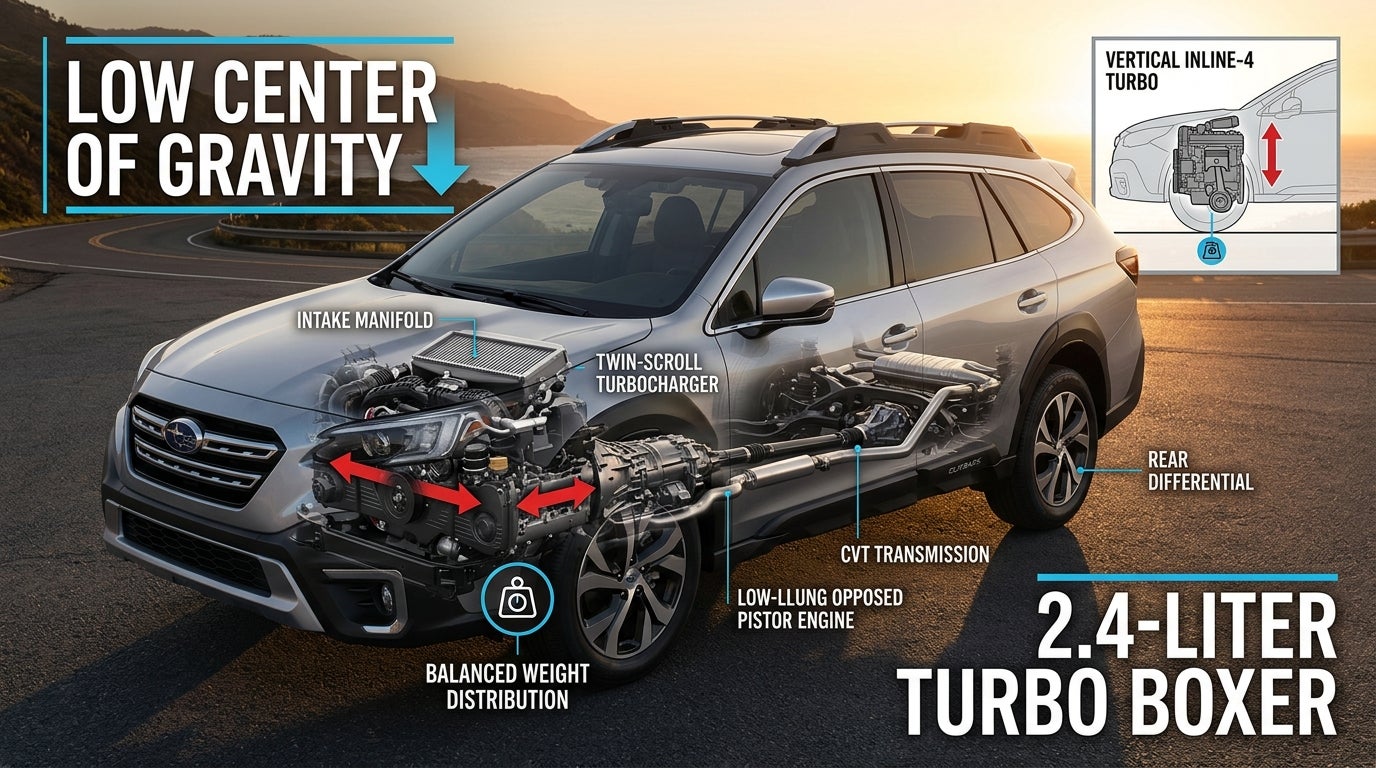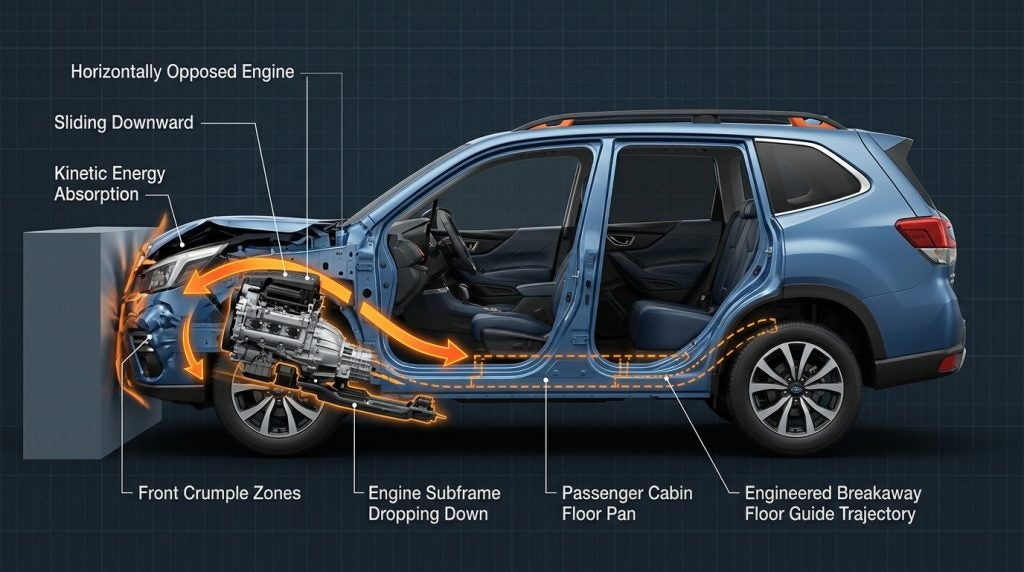
Blog

All Sunset Hills Subaru Dealer Sunset Hills New Subaru New Vehicle Reviews Model Comparisons Buying Guides Maintenance & Service Sunset Hills Subaru Service Technology & Innovation Subaru Repair Safety Subaru Road Safety Sunset Hills Subaru EV Dealership Auto Financing 2025 Subaru Crosstrek 2025 Subaru Outback Dealership Financing Hybrid Community Engagement Performance and Engineering Fuel Efficiency Leasing guides Sunset Hills Used Cars Subaru Financing Sunset Hills Subaru Loves Pets 2025 Forester Hybrid Fun Things to Do Near Sunset Hills MO Infotainment Ownership Experience Subaru Motorsports Subaru Share The Love 2024 Outback Automotive History & Evolution Automotive News Automotive Repair Tips Automotive Rumors & Insights Buying & Trade-In Process Guidance Certified Pre-Owned Charging Solutions & Infrastructure Outdoor Adventure & Camping Reliability and Quality Insights Sales Event Subaru Loyalty Program Things to do in Sunset Hills, MO Tire Care & Replacement Trade Up Advantage Vehicle Design & Innovation
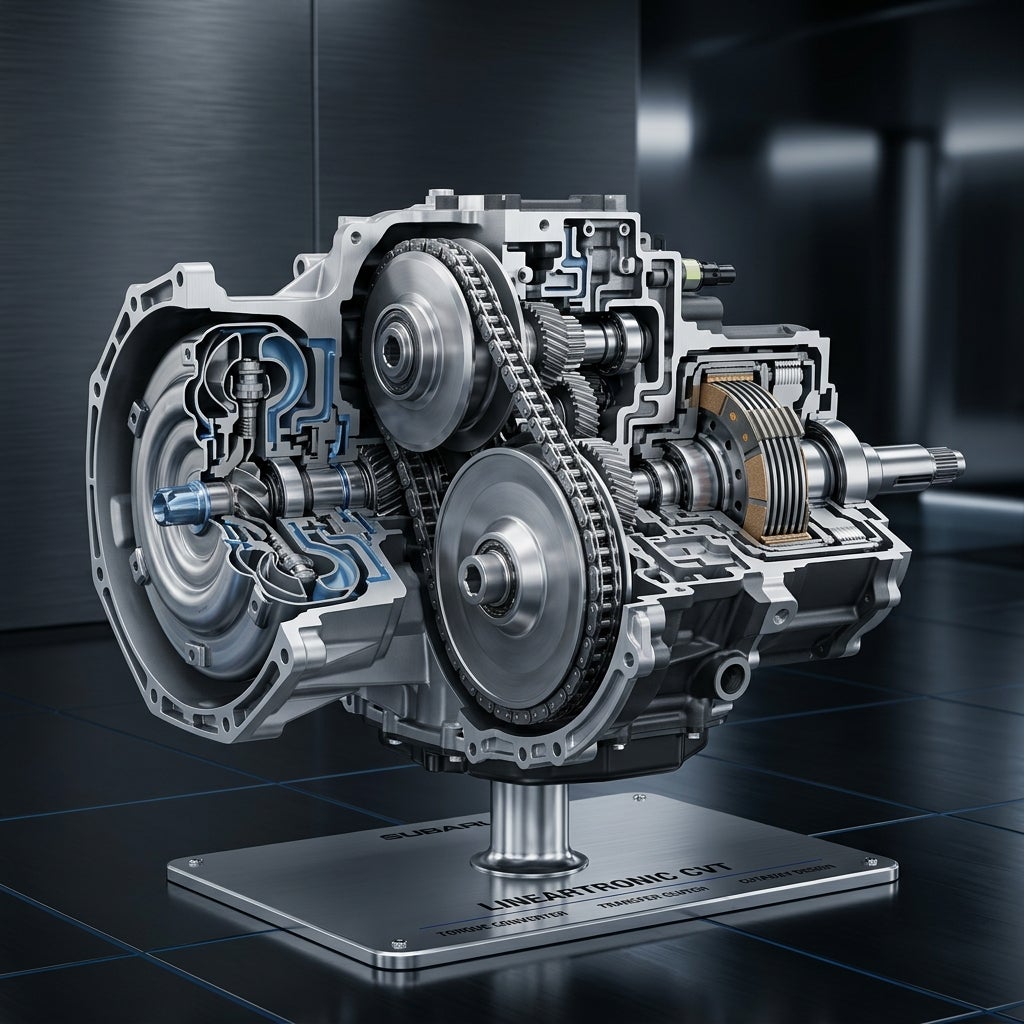
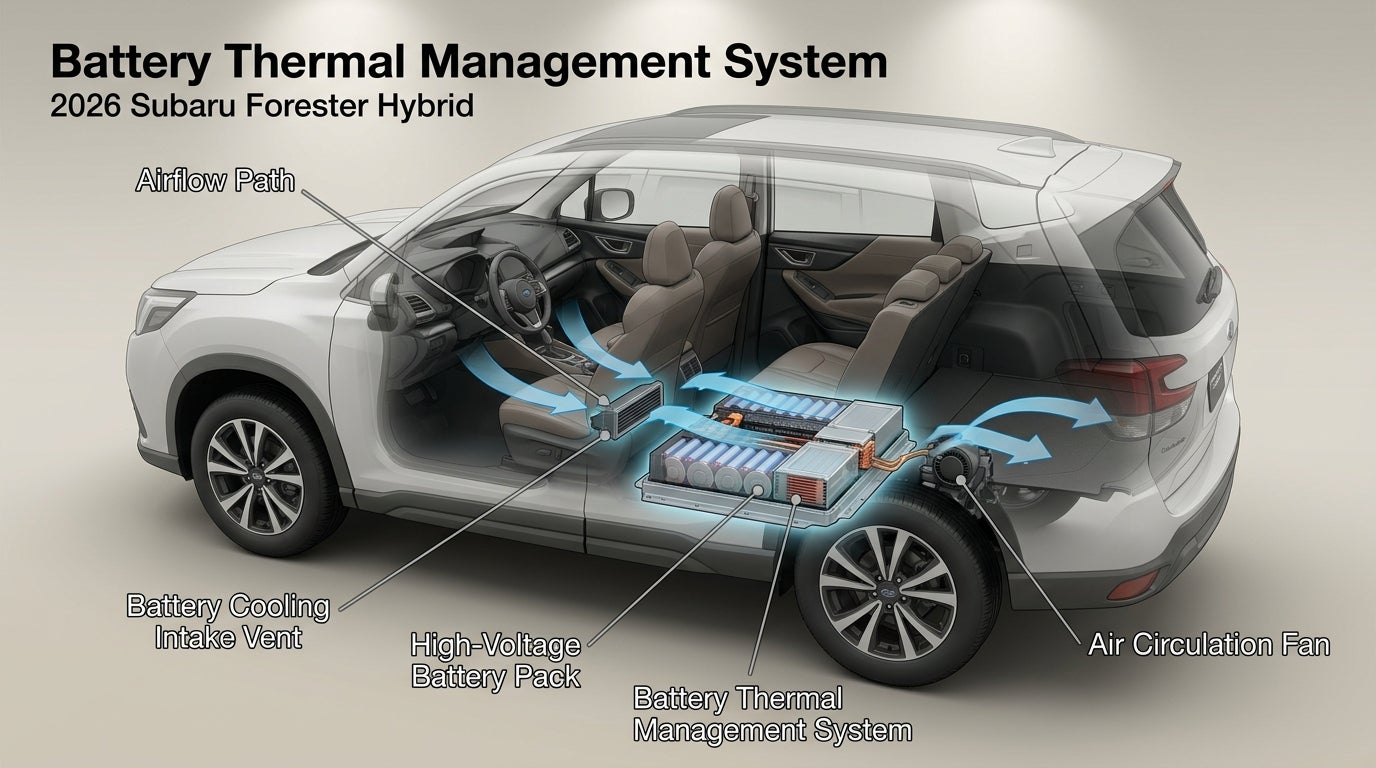
Cutaway diagram of a 2026 Subaru Forester Hybrid showing the battery thermal management system and airflow path. (Representative image for illustration purposes only. Actual vehicle may vary based on trim and configuration.)

Does the 2026 Subaru Forester Hybrid Require Special Battery Cooling Maintenance?

The bottom line for current and prospective owners is clear and reassuring: the 2026 Subaru Forester Hybrid does not require burdensome, frequent, or costly battery cooling fluid flushes under standard driving conditions. Unlike some early-generation hybrid vehicles or complex liquid-cooled high-voltage setups that demand frequent fluid replacement, Subaru’s hybrid battery thermal management system is designed for maximum long-term reliability and minimal driver friction. However, 'low maintenance' does not mean 'zero maintenance.' The health and longevity of your hybrid battery pack rely heavily on maintaining uninterrupted airflow across the high-voltage battery cooling intake vents and ensuring that routine multi-point inspections are conducted by certified technicians. Dust, pet hair, autumn leaves, and suburban St. Louis road grime can accumulate around the intake ducts located in the rear cabin, restricting airflow and forcing the battery cooling fan to work significantly harder. Over time, heat accumulation is the single greatest enemy of hybrid battery efficiency and cell lifespan. By simply keeping the cabin intake clear of obstructions and having the thermal management system evaluated during scheduled oil changes and tire rotations at Sunset Hills Subaru, you safeguard your battery's thermal state, preserve optimal fuel economy, and protect your vehicle's long-term resale value across every local commute. Expert Perspective: Service Director Ivan Krnjic Meet Ivan Krnjic — Service Director at Sunset Hills Subaru With over 4 years of hands-on experience leading technical operations and master diagnostics at Sunset Hills Subaru, Ivan Krnjic has diagnosed and serviced virtually every iteration of Subaru Symmetrical All-Wheel Drive and advanced hybrid powertrains. His team works daily on the front lines, helping St. Louis area drivers navigate seasonal weather demands, suburban wear-and-tear, and preventative maintenance strategies. 'When customers ask me if hybrid battery systems require special, expensive maintenance every few months, I give them a straightforward answer: No, but they do require smart care. In our Missouri climate, extreme summer heat combined with cabin debris like dog hair or dirt can act like a thermal blanket on your hybrid battery. Simple intake checks during standard service prevent high-voltage overheating before it ever starts.' — Ivan Krnjic Inside the 2026 Forester Hybrid Battery Thermal Management System To understand why maintenance for the 2026 Subaru Forester Hybrid is streamlined yet critical, it helps to examine how the battery thermal management system is engineered. The high-voltage lithium-ion pack operates within a strict temperature window to deliver optimal power assist to the BOXER engine while maximizing energy recovery during regenerative braking. Subaru utilizes a smart forced-air thermal management architecture. High-efficiency brushless cooling fans draw climate-controlled air from the passenger cabin, channel it across internal battery module heat sinks, and vent thermal energy out through dedicated exhaust paths. Because cabin air is conditioned by your HVAC system (warmed in winter, cooled in summer), the battery naturally benefits from comfortable ambient temperatures whenever you drive. Sensor-Driven Protection & Integrated Filters The system features continuous multi-point thermistor sensor monitoring. If thermal sensors detect elevated cell temperatures during steep climbs or heavy stop-and-go traffic in St. Louis summers, the electronic control module adjusts fan speeds dynamically. An integrated intake mesh filter catches coarse lint and particulate matter before air touches internal electrical components. Periodic filter inspection ensures maximum airflow without restriction. Subaru Forester Hybrid vs. Solterra: Battery Cooling Maintenance Compared Body text 2026 Forester Hybrid • System: Forced Cabin Air Cooling • Liquid Flush Needed: None for battery pack • Primary Care: Air intake vent filter checks & cabin air filter replacement • Inspection Interval: Every 6,000 to 12,000 miles • Engine Coolant: Standard Subaru Super Coolant for gas engine Subaru Solterra (Full EV) • System: High-Capacity Liquid Thermal Loop • Liquid Flush Needed: Specialized low-conductivity EV coolant at long intervals • Primary Care: Coolant level checks, radiator debris clearing • Inspection Interval: Every 7,500 miles • Engine Oil: None required Maintenance Takeaway Do electric Subaru vehicles require fewer fluid changes than combustion models? Yes, EVs like the Solterra eliminate engine oil flushes entirely. However, the Forester Hybrid combines the best of both worlds with simple air-cooled battery maintenance while retaining traditional BOXER engine fluid intervals. Schedule Hybrid & EV Maintenance Ivan Krnjic’s Take: Why Battery Air Vent Hygiene Matters in Missouri Living in the greater St. Louis metro area presents specific environmental conditions that directly impact vehicle maintenance. Between heavy spring pollen, humid summer dust, autumn leaves, and winter road salt, air filters across your vehicle work under heavy load. When it comes to the 2026 Forester Hybrid, Service Director Ivan Krnjic points out real-world shop findings that every owner should know. 'In our service bay at Sunset Hills Subaru, the single most common issue we see on air-cooled hybrid batteries isn't mechanical failure — it's airflow restriction,' explains Ivan. 'Owners who travel with pets, transport camping gear, or regularly carry rear passengers often block the battery intake vent without knowing it. Jackets thrown on the rear seats or pet hair pulled into the intake screen reduce airflow. When summer heat hits 95 degrees with 80% humidity in St. Louis, a restricted vent forces the battery pack to heat up quickly, causing the vehicle's computer to reduce hybrid electric assist to protect the system. Keeping that vent clean ensures you get 100% of your hybrid performance and fuel efficiency every time you drive.' 2026 Subaru Forester Hybrid & Outback Scheduled Maintenance Checklist Body text Service Interval 2026 Forester Hybrid Items Subaru Outback (Gas) Items Service Focus 30,000 Miles Synthetic Oil, Filter, Brake Fluid, Battery Vent Screen Clean, Cabin Filter Synthetic Oil, Filter, Brake Fluid, Engine Air Filter, Cabin Filter Comprehensive inspection & fluid updates 60,000 Miles Oil/Filter, Spark Plugs, CVT Fluid Check, High-Voltage Thermal System Diagnostic Oil/Filter, Spark Plugs, CVT Fluid Check, Front/Rear Differential Fluids Major ignition & drivetrain check 90,000 Miles Oil/Filter, Brake Fluid Flush, Hybrid Cooling Fan Inspection, Belt Check Oil/Filter, Brake Fluid Flush, Engine Air Filter, Belt Inspection Long-term wear & thermal protection Which Subaru Maintenance Tasks are Realistic for DIY Owners to Handle? Safe DIY Tasks for Home Mechanics • Cabin Air Filter Replacement: Quick 10-minute swap behind the glovebox to maintain clean airflow inside the vehicle. • Exterior Battery Vent Vacuuming: Gently cleaning dust or pet hair off the outer intake mesh using a soft brush vacuum attachment. • Windshield Wiper Blades & Washer Fluid: Easy seasonal maintenance for clear visibility. • Tire Pressure Monitoring: Checking cold tire pressures monthly to ensure even tire wear across all four wheels. Tasks Requiring Certified Subaru Technicians • High-Voltage Fan Diagnostics: Testing electric fan relay actuation and motor voltage using SSM4 factory diagnostic software. • Hybrid Battery Filter Internal Replacement: Disassembling high-voltage safety covers requires certified safety gear and training. • CVT Fluid Service & Differential Flushes: Sealed electronic transmission units require specific temperature monitoring during refilling. • Brake System Flush on Hybrid Models: Electronic brake pressure blending systems require diagnostic tool cycling. Subaru Cost of Maintenance Compared: Forester Hybrid vs. Toyota and Audi Body text Brand / Model Category Average Annual Maintenance Estimated 5-Year Total 10-Year Ownership Cost Outlook 2026 Subaru Forester Hybrid $450 - $620 $2,450 - $3,100 Highly predictable, low hybrid system wear Toyota RAV4 Hybrid $430 - $590 $2,300 - $2,950 Extremely competitive mainstream benchmark Audi Q5 Quattro (Luxury AWD) $1,150 - $1,650 $6,200 - $8,500 High labor rates, expensive proprietary parts Why does Audi cost significantly more to maintain than Subaru despite similar all-wheel drive capabilities? Luxury European crossovers utilize specialized complex turbocharger plumbing, adaptive suspension components, and higher dealership labor rates. Subaru delivers Symmetrical AWD performance engineered for practical maintenance using accessible components. View Current Service & Parts Information Brake Pad Replacement Intervals on Hybrid vs. Gasoline Subaru Crossovers Regenerative Braking Advantage When you press the brake pedal in the 2026 Forester Hybrid, the electric motor acts as a generator to slow the vehicle down first, capturing kinetic energy. Mechanical brake pads only engage during hard stops or coming to a complete final halt. Extended Replacement Lifespan Gasoline Crossovers (Forester/Outback): Brake pads typically require replacement every 30,000 to 50,000 miles. Forester Hybrid: Regenerative braking extends pad lifespan up to 70,000 to 90,000 miles under normal driving conditions. Lower Long-Term Cost Fewer pad and rotor replacements directly reduce long-term maintenance costs. Combined with reduced starter motor wear, the hybrid powertrain pays dividend savings beyond gasoline fuel economy alone. Estimating Long-Term Maintenance Costs for Ladue and Sunset Hills Drivers Driving habits across suburban St. Louis — from stop-and-go commuting along I-270 to navigating rolling terrain around Ladue and Sunset Hills — play a meaningful role in vehicle maintenance planning. To calculate a realistic 10-year ownership budget, drivers should account for basic annual maintenance ($450–$650/year for years 1–5; $700–$900/year for years 6–10) alongside strong residual trade-in values. Subaru vehicles consistently hold top industry resale awards, offsetting long-term maintenance costs when you trade in or upgrade. You can check your current vehicle value anytime with our online tool to Get your value trade. Preventative Care Checklist for Suburban St. Louis Driving Conditions Spring & Summer Prep • Inspect battery intake vents after pollen season. • Test cabin A/C efficiency before summer heat waves hit 90°F+. • Check coolant levels and engine air filter for dust buildup. Autumn & Winter Readiness • Verify 12V auxiliary battery state of charge. • Check wiper blades and washer fluid freeze protection. • Ensure tire tread depth is ready for winter ice and snow. Year-Round Best Practices • Keep rear floor and intake vent clear of gear or blankets. • Schedule routine oil changes every 6,000 miles. • Use original OEM filters to protect internal airflow. Professional Service and Maintenance Resources at Sunset Hills Subaru At Sunset Hills Subaru, we are committed to providing an exceptional service experience for every driver. Located convenient to St. Louis, Kirkwood, and Webster Groves, our state-of-the-art facility features factory-certified technicians equipped with specialized diagnostic tools for all Subaru gas, hybrid, and electric models. Whether you need to Find Subaru Parts like genuine air filters, explore New Subaru Forester Inventory, or Get approved for financing for a new vehicle, our dedicated team is here to support you. You can also explore our full lineup including New Subaru Inventory, Used Vehicle Inventory, or specialty models like New Subaru Outback Inventory and New Subaru Solterra Inventory. Schedule Service and Diagnostics Schedule Your Forester Hybrid Service Inspection at Sunset Hills Subaru Today Keep your 2026 Subaru Forester Hybrid performing at its peak efficiency. Contact Service Director Ivan Krnjic and our certified technical team at Sunset Hills Subaru for expert battery cooling inspections, routine scheduled care, or genuine OEM accessories. Call us at (314) 476-9638 today or visit us at 10100 Watson Rd, Sunset Hills, MO 63127. Schedule Service Online 2026 Subaru Forester Hybrid Maintenance in Sunset Hills, MO | Sunset Hills Subaru
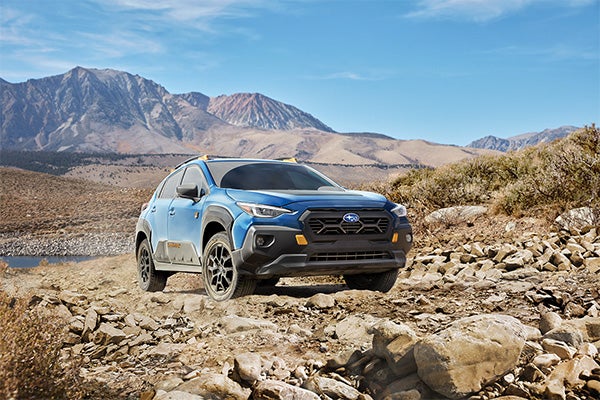
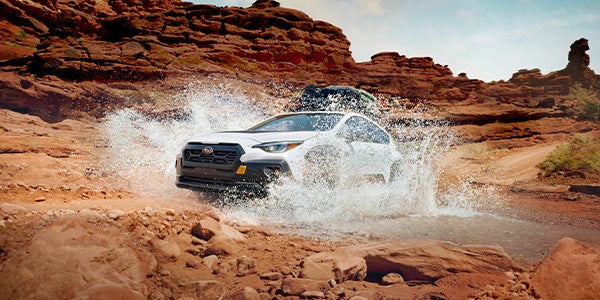
Blue Subaru Crosstrek Wilderness driving along a rocky trail with mountains in the background under a clear sky.

2026 Subaru Crosstrek Wilderness vs 2026 Honda CR-V TrailSport Comparison

2026 Subaru Crosstrek Wilderness vs 2026 Honda CR-V TrailSport Comparison The 2026 Subaru Crosstrek Wilderness CVT is the recommended choice for active buyers who demand genuine off-road capability, robust towing performance, and exceptional value. Priced at $33,795 MSRP, the Crosstrek Wilderness CVT delivers a massive 3,500-lb towing capacity, 9.3 inches of unladen ground clearance, and standard Symmetrical All-Wheel Drive. By comparison, the $38,800 MSRP 2026 Honda CR-V TrailSport AWD costs $5,005 more while offering only 1,000 lbs of towing capacity and 8.2 inches of ground clearance. Which 2026 Subaru Crosstrek Wilderness CVT or 2026 Honda CR-V TrailSport AWD Is the Best Fit for Ladue and Sunset Hills Families? The 2026 Subaru Crosstrek Wilderness CVT is the superior crossover for local families who prioritize authentic off-pavement capability, heavy-duty towing, and incredible overall value over sheer exterior footprint. Engineered specifically for outdoor adventures, the Crosstrek Wilderness CVT combines hatchback-like maneuverability with rugged utility. Standard Symmetrical All-Wheel Drive and an elevated suspension give drivers complete confidence during severe winter weather or weekend excursions. Furthermore, a starting MSRP of $33,795 makes the Crosstrek Wilderness CVT a highly attractive investment compared to the $38,800 starting MSRP of the 2026 Honda CR-V TrailSport AWD. While the Honda CR-V TrailSport AWD offers a larger exterior build and hybrid fuel efficiency, its higher purchase price and limited 1,000-lb towing capacity restrict its versatility for active utility. Families in Sunset Hills who frequently haul light boats, recreational equipment, or utility trailers to the Meramec River will quickly find the CR-V's towing limits restrictive. The Crosstrek Wilderness CVT boasts a 3,500-lb towing capacity, allowing you to pull camper trailers or leisure gear with ease. Shoppers researching their options across our showroom lineup can evaluate our new Subaru Crosstrek selection alongside stablemates like new Subaru Outback models and the new Subaru Forester lineup. For larger households needing three-row seating, our new Subaru Ascent inventory provides expanded passenger volume. Practical commuters can explore new Subaru Impreza models or new Subaru Legacy inventory, while enthusiasts might look to new Subaru WRX inventory or new Subaru BRZ models. Those seeking zero-emissions driving can inspect our new Subaru Solterra EV models. Across the entire lineup, Subaru prioritizes practical utility, safety, and long-term durability. Pricing Manufacturer-listed pricing per trim, across compared vehicles. 2026 Subaru Crosstrek Wilderness CVT Trim MSRP 2026 Honda CR-V TrailSport AWD Trim MSRP Wilderness CVT $33,795 TrailSport AWD $38,800 Engine & Performance Powertrain specs by trim Specification 2026 Subaru Crosstrek Wilderness CVT 2026 Honda CR-V TrailSport AWD Engine 2.5L 2L Horsepower 180 hp 204 hp Torque 178 lb-ft 247 lb-ft Transmission Lineartronic CVT CVT Drivetrain All-wheel drive All-wheel drive Explore New Subaru Crosstrek Inventory How Pricing and Trim Features Compare for the 2026 Subaru Crosstrek Wilderness CVT and Honda CR-V TrailSport AWD The 2026 Subaru Crosstrek Wilderness CVT delivers a far better value proposition, offering a lower starting MSRP than the 2026 Honda CR-V TrailSport AWD while supplying standard features geared for rugged utility. The Crosstrek Wilderness CVT starts at an MSRP of $33,795 with a $1,420 destination charge. In contrast, the Honda CR-V TrailSport AWD carries an MSRP of $38,800 plus a $1,395 destination charge. That price distinction becomes even clearer when examining standard off-road and utility hardware. The Crosstrek Wilderness CVT includes a factory-lifted suspension providing 9.3 inches of unladen ground clearance, water-repellent StarTex® synthetic leather upholstery, front underbody engine protection, and 17-inch alloy wheels wrapped in all-terrain tires. To equip similar protective items on the CR-V TrailSport AWD—which comes standard with cloth upholstery with orange stitching and 18-inch alloy wheels with 8.2 inches of ground clearance—buyers must purchase add-on dealer packages. Subaru also offers targeted optional equipment upgrades to tailor the vehicle to your exact needs. The available Option Package 23 adds a 10-speaker Harman Kardon® premium audio system with a subwoofer, a power glass moonroof, and a 10-way power-adjustable driver seat with 2-way electric lumbar support. For maintenance and personalization, genuine accessories are readily available through our Subaru parts center. In terms of physical capacity, the Crosstrek Wilderness CVT has a published curb weight of 3,369 lbs and supports a maximum braked towing weight of 3,500 lbs. The heavier CR-V TrailSport AWD registers a curb weight of 3,900 lbs but is rated to tow just 1,000 lbs. Dimensions & Capacity Capacity and dimensions by trim Specification 2026 Subaru Crosstrek Wilderness CVT 2026 Honda CR-V TrailSport AWD Seating 5 5 Cargo 20.0 cu ft 36.3 cu ft Curb weight 3,369 lbs 3,900 lbs Towing 3,500 lbs 1,000 lbs Cargo and Passenger Space for Golf, School Gear, and Weekend Adventures in the 2026 Subaru Crosstrek Wilderness CVT vs Honda CR-V TrailSport AWD The 2026 Honda CR-V TrailSport AWD provides greater raw cargo volume, but the 2026 Subaru Crosstrek Wilderness CVT offers a more versatile, easy-to-clean cabin layout with superior front passenger legroom and flexible storage solutions. The CR-V TrailSport AWD features about 36 cu ft of cargo space behind the second row and about 76.5 cu ft with the rear seats folded down. The Crosstrek Wilderness CVT provides about 20 cu ft of cargo capacity behind the 60/40-split rear seatbacks and about 55 cu ft when folded flat. For daily family duties like loading golf bags, backpacks, or camping gear, the Crosstrek Wilderness CVT maximizes usable room with a low loading floor height of 31.3 inches and a rear cargo area height of 29.4 inches. Standard load restraint hooks and an available flexible cargo area cover keep gear secure. Additionally, standard StarTex® water-repellent seat upholstery and available rear seatback protectors allow you to load muddy boots, wet sports equipment, or pets without worrying about staining the interior. Passenger comfort remains balanced between both crossovers. Front occupants in the Crosstrek Wilderness CVT enjoy a class-leading 42.9 inches of legroom and 39.8 inches of headroom, outpacing the CR-V TrailSport AWD's 41.3 inches of front legroom and 38.2 inches of front headroom. In the second row, the CR-V offers 41.0 inches of legroom compared to the Crosstrek's 36.5 inches, though both accommodate three rear passengers comfortably with standard 3-point center seat belts and height-adjustable head restraints. Shoppers interested in current inventory or pricing information can explore our current inventory. Fuel Economy Fuel economy and range by trim Specification 2026 Subaru Crosstrek Wilderness CVT 2026 Honda CR-V TrailSport AWD MPG 24 city / 29 hwy / 26 combined 38 city / 33 hwy / 35 combined View Current New Car Specials Performance and Driving Experience Tailored to Rolling Terrain: 2026 Subaru Crosstrek Wilderness CVT vs Honda CR-V TrailSport AWD The 2026 Subaru Crosstrek Wilderness CVT delivers a superior, confidence-inspiring driving dynamic on rough trails and slick roads thanks to its revised axle gearing and 9.3 inches of unladen ground clearance. Powered by a 2.5L 4-cylinder Subaru Boxer engine, the Crosstrek Wilderness CVT produces 180 hp at 5,800 rpm and 178 lb-ft of torque at 3,700 rpm. Power is managed through a Lineartronic CVT featuring a manual mode with steering wheel gearchange paddles and a descent control system for steep declines. The Honda CR-V TrailSport AWD utilizes a 2.0L 4-cylinder hybrid powertrain (Earth Dreams Technology™) combined with an electric motor to generate a combined 204 hp and 247 lb-ft of torque, managed by an electronic CVT. While the CR-V provides punchy acceleration around town, its Real Time AWD with Intelligent Control System™ is primarily tuned for paved roads. Its 8.2 inches of ground clearance, 16.1-degree approach angle, and 21.3-degree departure angle lag behind the Crosstrek's trail geometry. Off-pavement, the Crosstrek Wilderness CVT excels with a 20-degree approach angle and a steep 33-degree departure angle, allowing it to clear rutted paths and obstacles without scraping bumper covers. Standard Symmetrical All-Wheel Drive operates continuously to distribute power to all four wheels, ensuring surefooted traction on mud, gravel, or winter slush. Furthermore, the Crosstrek's revised CVT gear ratio and added engine oil cooler enable its robust 3,500-lb towing capability, far surpassing the CR-V TrailSport AWD's 1,000-lb limit. Fuel Efficiency and Range for Commuting and Recreation in the 2026 Subaru Crosstrek Wilderness CVT and Honda CR-V TrailSport AWD The 2026 Honda CR-V TrailSport AWD achieves higher EPA fuel economy numbers due to its hybrid powertrain, but the 2026 Subaru Crosstrek Wilderness CVT counters with a larger fuel tank that delivers substantial total driving range for daily commuting and weekend travel. The CR-V TrailSport AWD earns EPA estimates of 38 city / 33 hwy / 35 combined MPG. Equipped with a 14.0-gallon fuel tank, it provides a calculated total vehicle range of 490 miles. The Crosstrek Wilderness CVT achieves EPA ratings of 24 city / 29 hwy / 26 combined MPG on regular 87 octane unleaded gasoline. To offset its rugged lower final-drive gearing and all-terrain tires, Subaru equips the Crosstrek with a generous 16.6-gallon fuel tank. This gives the Crosstrek Wilderness CVT a calculated EPA total driving range of 432 miles—allowing drivers to travel long distances between fill-ups. For professionals commuting along I-64 from Ladue into downtown offices, both vehicles run on regular unleaded fuel to keep operating costs predictable. While the hybrid CR-V consumes less fuel in stop-and-go city traffic, the Crosstrek Wilderness CVT balances respectable highway efficiency with standard mechanical capability that no conventional hybrid crossover in its price class can match. Technology Features That Enhance Remote Work and Family Connectivity in the 2026 Subaru Crosstrek Wilderness CVT and Honda CR-V TrailSport AWD The 2026 Subaru Crosstrek Wilderness CVT leads in touchscreen real estate and integrated connectivity, featuring a standard 11.6-inch high-resolution center dashboard display compared to the 9.0-inch touchscreen in the 2026 Honda CR-V TrailSport AWD. Subaru's multimedia interface features intuitive touch controls for audio, climate, and vehicle settings, complemented by physical volume and tuning knobs for easy operation while driving. Both vehicles feature wireless Apple CarPlay and Android Auto integration, Bluetooth® hands-free phone pairing, and voice-activating controls. Device charging is well-supported in both cabins; the Crosstrek Wilderness CVT provides one USB front charging port, two rear USB charging ports, and a front 12v power outlet, with a wireless charging pad available. The CR-V TrailSport AWD includes two front USB ports, two rear USB ports, a front 12v outlet, and a cargo area 12v power outlet. Telematics and remote services are another area where Subaru offers added long-term value. The Crosstrek Wilderness CVT comes standard with Subaru STARLINK™ telematics, including a 36-month complimentary subscription for safety and security features, as well as a 6-month trial of remote services such as remote door lock/unlock, vehicle start, and remote HVAC control with heating and cooling settings. The Honda CR-V TrailSport AWD features HondaLink™ Assist telematics and a 3-month trial of remote services. For audiophiles, the Crosstrek's optional Option Package 23 upgrades the standard 6-speaker sound system to a 10-speaker Harman Kardon® system with surround sound and a subwoofer. Get Approved for Financing Online Safety and Driver Assistance Systems Designed for Family Neighborhoods in the 2026 Subaru Crosstrek Wilderness CVT and Honda CR-V TrailSport AWD Safety engineering is a foundational priority for both brands, with the 2026 Subaru Crosstrek Wilderness CVT and 2026 Honda CR-V TrailSport AWD both earning 5-Star Overall Crash Test Ratings from the National Highway Traffic Safety Administration (NHTSA). Both crossovers feature 10 standard airbags, including dual front airbags, front and rear side airbags, side curtain airbags, and driver knee airbags (the CR-V also includes a passenger knee airbag). Standard ISOFIX / LATCH child seat anchors are featured in both row two seatings. Active safety technology is standard across both models. The Crosstrek Wilderness CVT equips Subaru's EyeSight® Driver Assist technology, utilizing high-resolution stereo cameras to monitor road conditions. EyeSight® includes Advanced Adaptive Cruise Control with stop-and-go capability, Automatic Pre-Collision Braking, Pre-Collision Throttle Management, and Emergency Lane Keep Assist. Blind Spot Detection (BSD) and Rear Cross-Traffic Alert are also standard equipment. Honda equips the CR-V TrailSport AWD with its Collision Mitigation Braking System (CMBS), Lane Keeping Assist System (LKAS), Adaptive Cruise Control, and Blind Spot Information (BSI) system with Cross Traffic Monitor. In IIHS crash testing, both models earned "Good" scores in small overlap front driver-side and roof strength tests. Subaru's EyeSight® system operates at speeds as low as 7 mph to prevent low-speed parking lot collisions and protect pedestrians or cyclists. Warranty, Maintenance, and Local Service Options for the 2026 Subaru Crosstrek Wilderness CVT and Honda CR-V TrailSport AWD Both manufacturers back their vehicles with competitive factory warranty packages. The 2026 Subaru Crosstrek Wilderness CVT and 2026 Honda CR-V TrailSport AWD both feature a 3-year / 36,000-mile limited whole-vehicle warranty and a 5-year / 60,000-mile powertrain warranty. Both brands also provide 5 years of corrosion perforation coverage and 3 years / 36,000 miles of roadside assistance coverage. Honda includes a 12-month / 12,000-mile complimentary maintenance plan, while the CR-V's hybrid battery is covered for 8 years / 100,000 miles. Subaru owners benefit from manufacturer-backed emergency protection that provides brand-specific expertise and genuine OEM parts. Should an emergency arise on the road, drivers can call Subaru Roadside Assistance at 1-800-261-2155 for 24/7 towing to the nearest authorized service facility, flat tire changes, jump-starts, or lockout services. To keep your crossover running at peak performance, you can schedule a service appointment online with our factory-trained technicians. Our department uses specialized diagnostic equipment designed specifically for Symmetrical All-Wheel Drive and Boxer engines. Be sure to browse our current maintenance and parts offers before your next routine oil change or tire rotation. Schedule Service and Diagnostics Which Vehicle Should Buyers Choose? Frequently Asked Questions About the 2026 Subaru Crosstrek Wilderness CVT and Honda CR-V TrailSport AWD Q: Is the Honda CR-V TrailSport AWD worth the price premium over the Subaru Crosstrek Wilderness CVT? A: For most buyers prioritizing all-terrain capability and value, the CR-V TrailSport AWD is not worth the $5,005 higher MSRP. The Crosstrek Wilderness CVT starts at $33,795 MSRP, offering 3,500 lbs of towing capacity, 9.3 inches of ground clearance, StarTex® water-repellent seats, and an 11.6-inch touchscreen. The $38,800 CR-V TrailSport AWD offers better city fuel economy, but limits towing to 1,000 lbs and ground clearance to 8.2 inches. Q: Which crossover offers better real-world capability off pavement? A: The Subaru Crosstrek Wilderness CVT is significantly more capable off-pavement. It provides 9.3 inches of unladen ground clearance, a 20-degree approach angle, a 33-degree departure angle, front engine skid protection, and full-time Symmetrical All-Wheel Drive. The Honda CR-V TrailSport AWD features 8.2 inches of ground clearance, a 16.1-degree approach angle, and a 21.3-degree departure angle, making it better suited for light dirt roads rather than rugged trails. Q: How do the towing capabilities compare between these two models? A: The Crosstrek Wilderness CVT wins decisively with a 3,500-lb towing capacity, thanks to its revised transmission gear ratios and added drivetrain cooling. The CR-V TrailSport AWD is rated to tow only 1,000 lbs. If you plan to tow a small boat, pop-up camper, or utility trailer, the Crosstrek Wilderness is the clear choice. Q: How do I schedule a test drive or start the buying process at Sunset Hills Subaru? A: You can visit our showroom address at 10100 Watson Rd or give our sales team a quick call at (314) 476-9638. You can also browse our new Subaru inventory online, use our digital tools to value your trade-in, and get pre-approved for financing online from the comfort of home. Final Verdict: Why the 2026 Subaru Crosstrek Wilderness CVT Is the Recommended Choice The 2026 Subaru Crosstrek Wilderness CVT emerges as the clear winner in this head-to-head comparison, offering an unbeatable combination of off-road hardware, heavy-duty utility, modern cabin technology, and exceptional price value. While the 2026 Honda CR-V TrailSport AWD provides an appealing hybrid powertrain and a larger rear cargo hold, its $38,800 starting MSRP puts it in a significantly higher price bracket. Despite that cost premium, the CR-V falls short in essential adventure metrics, offering 2,500 lbs less towing capacity and over an inch less ground clearance than the Subaru. For an MSRP of $33,795, the Crosstrek Wilderness CVT provides standard features designed for active lifestyles: 3,500-lb Towing Capacity vs. 1,000-lb capacity in the CR-V TrailSport AWD. 9.3 Inches of Ground Clearance with a 20-degree approach and 33-degree departure angle. Standard Symmetrical All-Wheel Drive for confidence in all-weather conditions. Durable StarTex® Water-Repellent Seats built for gear, mud, and active families. Large 11.6-Inch Touchscreen with standard STARLINK™ telematics and wireless smartphone integration. A lower starting MSRP compared to the CR-V TrailSport AWD. Whether you are navigating weekly carpools or heading out for a weekend camping trip, the Crosstrek Wilderness CVT delivers turn-key adventure capability without compromising daily comfort. Our team at Sunset Hills Subaru is ready to assist you through every step of your vehicle search. Explore our online inventory, evaluate your current vehicle's trade value, or stop by our showroom for a no-pressure test drive. Schedule your test drive today and experience the Subaru difference firsthand. New Subaru Crosstrek Inventory Get Your Trade Value View New Subaru Inventory © 2026 Sunset Hills Subaru. All rights reserved. Vehicle specification data © JATO Dynamics Limited. 2026 Subaru Crosstrek Wilderness in Sunset Hills MO | Sunset Hills Subaru

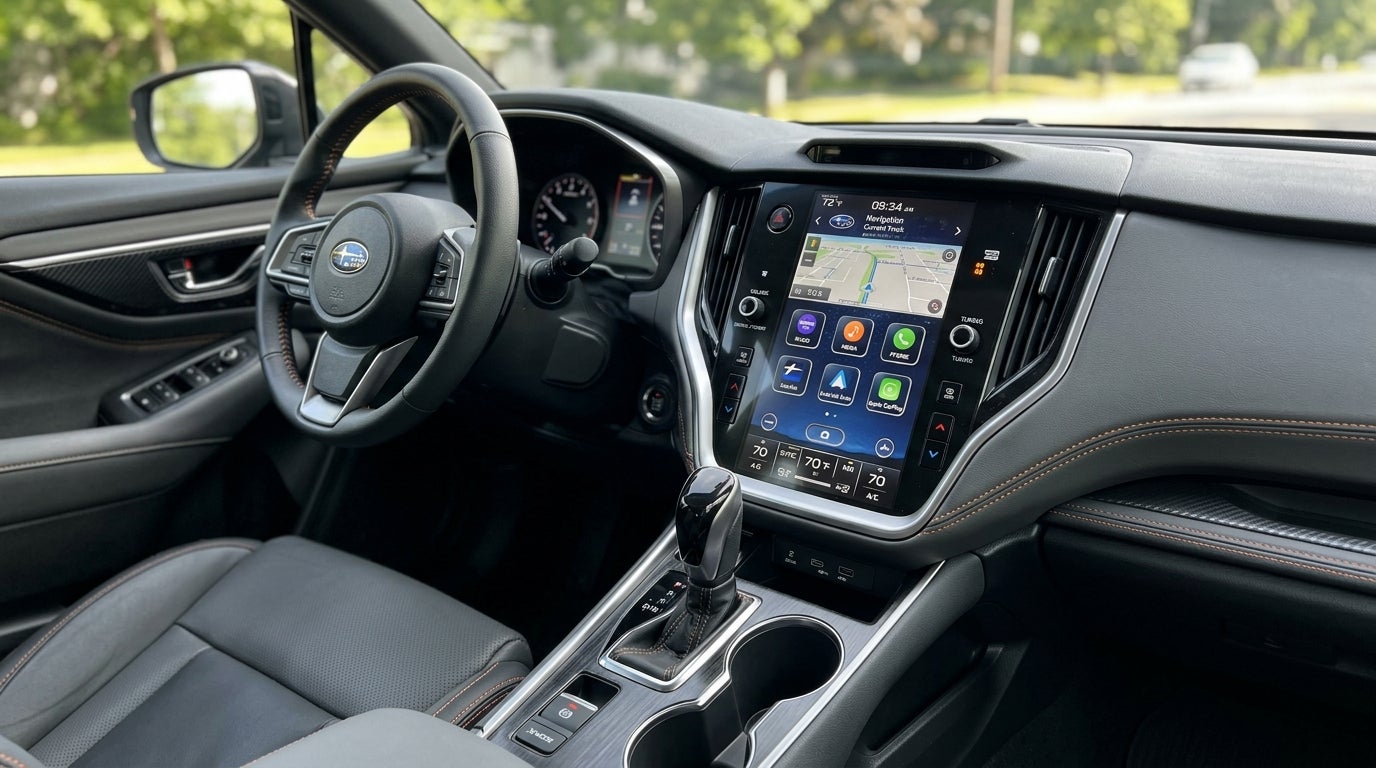
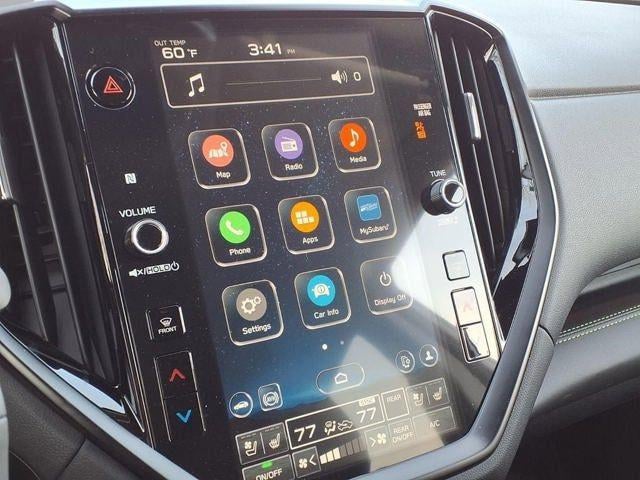
Interior view of a Subaru dashboard featuring a leather steering wheel, large touchscreen display, and center console. (Representative image for illustration purposes only. Actual vehicle may vary based on trim and configuration.)

Subaru STARLINK Package Comparison: What Is Included in Basic vs. Premium?

When purchasing or leasing a vehicle at Sunset Hills Subaru, one of the most common questions our tech specialists answer centers on automotive connectivity. Modern drivers expect seamless integration between their smartphones and their vehicles, but they also want clarity on safety systems, remote accessibility, and emergency response capabilities. The Subaru STARLINK system provides a suite of connected services, divided primary into two tiers: STARLINK Safety Plus (basic) and STARLINK Safety & Security Plus (premium). Key Takeaway Breakdown: • No-Subscription Features: Standard multimedia capabilities like Bluetooth pairing, Apple CarPlay, and Android Auto work automatically on touchscreen displays without requiring an active STARLINK paid subscription. • STARLINK Safety Plus (Basic): Focuses on critical vehicle health and emergency response, including Automatic Collision Notification, SOS Emergency Assistance, Enhanced Roadside Assistance, Vehicle Health Reports, and Diagnostic Alerts. • STARLINK Safety & Security Plus (Premium): Builds upon the basic package by introducing powerful remote convenience features via the MySubaru app, including Remote Engine Start with Climate Control, Remote Door Lock/Unlock, Remote Horn & Lights, Vehicle Locator, Stolen Vehicle Recovery, and customizable boundary, speed, and curfew alerts. Feature / Capability Standard (No Plan Required) STARLINK Safety Plus (Basic) STARLINK Safety & Security (Premium) Apple CarPlay & Android Auto Included Included Included Automatic Collision Notification Not Available Included Included SOS Emergency Assistance Not Available Included Included Monthly Vehicle Health Report Not Available Included Included Remote Engine Start with Climate Control Not Available Not Available Included Remote Door Lock / Unlock Not Available Not Available Included Stolen Vehicle Recovery & Immobilizer Not Available Not Available Included Geofence, Speed & Curfew Alerts Not Available Not Available Included Explore New Subaru Inventory Expert Insights on Subaru STARLINK: An Interview with Ryan Blankenship To help St. Louis area drivers navigate the technology options available on modern vehicles, we sat down with Ryan Blankenship, General Manager at Sunset Hills Subaru. With over 8 years of experience guiding drivers across Sunset Hills, Ladue, Kirkwood, and Webster Groves, Ryan has seen firsthand how connected vehicle technology has evolved from a luxury add-on into an essential everyday safety and convenience tool. "When customers step into our showroom on Watson Road, they often hear the term 'STARLINK' used for everything from touchscreen navigation to emergency roadside calls," Ryan explains. "My goal in this interview is to demystify what the technology does, clearly separate standard infotainment from active subscription features, and help buyers choose the exact package that fits their lifestyle." Whether you are considering a compact crossover like the New Subaru Crosstrek Inventory or a spacious three-row family SUV like the New Subaru Ascent Inventory, understanding how STARLINK works ensures you get maximum value out of your vehicle. Ryan Blankenship brings 8 years of automotive management experience to Sunset Hills Subaru, assisting customers throughout the greater St. Louis metropolitan area. Q: What features are included in a basic versus premium Subaru STARLINK package? Interviewer: Ryan, let's start with the direct feature breakdown. How does Subaru divide the basic package from the premium package? Ryan Blankenship: "Great starting point. Subaru structures its connected services in two distinct layers above the standard infotainment system. The basic layer is called STARLINK Safety Plus. It comes as a multi-year complimentary trial on almost every new Subaru model equipped with connected services. Safety Plus is built around vehicle protection and emergency readiness. It includes: • Automatic Collision Notification: If an airbag deploys, the vehicle automatically contacts a STARLINK Customer Care Advisor to dispatch emergency responders. • SOS Emergency Assistance: A red SOS button on the overhead console gives you 24/7 access to live assistance. • Enhanced Roadside Assistance: Pressing the blue wrench button connects you to roadside dispatchers who know your exact GPS location. • Maintenance Notifications & Diagnostic Alerts: Sends automated vehicle health checks and alerts if a check engine light illuminates. Ryan Blankenship (continued): "When you upgrade to the premium package—known as STARLINK Safety & Security Plus —you retain every feature of Safety Plus and add a suite of active remote control and theft-prevention features accessed primarily through the MySubaru app. Premium package additions include: • Remote Engine Start with Climate Control: Start your Subaru remotely and pre-condition the interior temperature. • Remote Door Lock / Unlock & Horn / Lights: Lock your vehicle from anywhere or flash the lights in a crowded lot. • Remote Vehicle Locator: Pinpoint your car's location on a digital map. • Stolen Vehicle Recovery & Immobilizer: Coordinates with police to track stolen vehicles and prevent engine restarting. • Boundary, Speed & Curfew Alerts: Perfect for suburban families with teenage drivers in Ladue or Sunset Hills. You receive immediate push notifications if the vehicle crosses a geofenced area or exceeds set speed limits. Q: Can Subaru STARLINK remotely start the engine and control climate settings? Prerequisites & Hardware Ryan Blankenship: "Yes! Remote Engine Start with Climate Control is single-handedly the most popular feature in the premium Safety & Security package. However, it requires two things: an active Safety & Security subscription and a vehicle equipped with Push-Button Start and Keyless Access. Vehicles with key-turn ignition cannot support cellular engine start, though they can still use standard key-fob starters. Seasonal Climate Presets Ryan Blankenship: "In St. Louis, we experience extreme summer heat and frosty winter mornings. With the MySubaru app, you can create custom presets. On a humid 95°F August afternoon in Sunset Hills, you can launch the app from your desk, set the cabin temperature to 68°F, enable max A/C, and activate ventilated seats. In winter, turn on defrost and heated seats before stepping outside. The MySubaru mobile application gives you instant control over cabin temperature, door locks, and engine start from anywhere with cellular coverage. Q: What features are included in Subaru STARLINK Safety and Security? 24/7 Safety Infrastructure Interviewer: Ryan, let's talk about the peace-of-mind aspect. How do these emergency systems function when a driver actually needs them on the road? Ryan Blankenship: "That's where Subaru's commitment to safety really shines. If you are driving on I-270 or highway 66 during heavy weather and get into a severe collision, sensors trigger Automatic Collision Notification instantly. An advisor speaks into the cabin over the hands-free speaker system. Even if you are unresponsive, the advisor uses onboard GPS coordinates to dispatch first responders directly to your location. Similarly, if you hit a pothole or experience a flat tire, pressing the blue Roadside Assistance button routes your location straight to tow services. You don't have to try to explain what landmark or highway mile marker you are near." If you ever need technical help or maintenance checkups, you can easily Schedule Service and Diagnostics with our factory-trained team at Sunset Hills Subaru. Anti-Theft & Stolen Vehicle Recovery Ryan Blankenship: "On the security side, the premium package acts as a constant guard. If your car alarm is triggered while parked at a shopping center, you receive an immediate alert on your smartphone. In the unfortunate event that your vehicle is stolen, STARLINK works in tandem with law enforcement. Once a police report is filed, STARLINK customer service can activate Stolen Vehicle Recovery, sharing real-time GPS tracking with officers. They can also issue a Stolen Vehicle Immobilizer command, preventing the engine from restarting once it is turned off. It makes recovering a stolen Subaru significantly faster and safer. Schedule Service and Parts Q: What multimedia features does Subaru STARLINK include on recent Subaru models? Interviewer: Some car buyers worry that if they don't subscribe to a monthly safety package, their dashboard touchscreen becomes useless. Can you clear up how STARLINK Multimedia works? Ryan Blankenship: "I'm really glad you asked that because there is a common misconception that touchscreen features are tied to subscription fees. That is completely untrue. Will you lose basic infotainment features if you do not pay for a Subaru STARLINK subscription? Absolutely not. STARLINK Multimedia is the physical and digital infotainment center built into the dashboard. On modern models like the New Subaru Outback Inventory or New Subaru Forester Inventory, you'll find either high-resolution 11.6-inch vertical touchscreens or dual 7.0-inch displays. Standard multimedia capabilities that work 100% free without any subscription include: • Wireless or wired Apple CarPlay and Android Auto integration. • Bluetooth audio streaming and hands-free phone calling. • AM/FM radio, HD Radio, and SiriusXM capability. • Steering wheel audio and voice controls. • USB input ports and smartphone charging capabilities. Ryan Blankenship: " Can I still use Apple CarPlay or Android Auto in a modern Subaru if wireless connectivity is not available? Yes, simply connect your phone using a certified USB cable to mirror Google Maps, Waze, Spotify, and Apple Music directly onto the display screen." Check out our New Subaru Legacy Inventory to explore models equipped with the 11.6-inch display. Q: Can I personalize the Subaru STARLINK interface for quicker access to my favorite features? Drag-and-Drop Icons Ryan Blankenship: "Just like customizing your smartphone home screen, STARLINK allows you to press and hold app icons on the touchscreen display to reorder them. You can move your top tools—such as Navigation, Apple CarPlay, Radio Presets, or Climate Controls—right to the primary row for one-touch access while driving. Driver Profile Syncing Ryan Blankenship: "If multiple family members drive the same car, you can set up distinct Driver Profiles. The vehicle recognizes paired Bluetooth phones or driver profiles, automatically recalling your favorite radio station presets, audio equalizer preferences, and climate shortcuts as soon as you enter. MySubaru App Registration How do you register an account on the MySubaru mobile app? During vehicle delivery at Sunset Hills Subaru, our Delivery Specialist pairs your phone, assists you in downloading the MySubaru app, inputs your Vehicle Identification Number (VIN), and establishes your secure PIN code so you walk away with a fully customized setup. Q: Which drivers benefit more from choosing Subaru STARLINK instead of HondaLink? Interviewer: Cross-shoppers frequently evaluate Subaru vehicles against Honda models such as the CR-V or Pilot. How does Subaru STARLINK stack up against HondaLink in terms of remote access and safety services? Ryan Blankenship: "Both systems offer quality telemetry, but Subaru STARLINK offers features that may appeal to suburban drivers and families: 1. Response Time & Cellular Network Integration: STARLINK utilizes built-in 4G LTE cellular connectivity designed for rapid execution of remote start and emergency signals, even in underground parking or semi-rural areas surrounding St. Louis County. 2. Integration with EyeSight® and Symmetrical AWD: STARLINK diagnostic systems monitor Subaru's active safety hardware—like EyeSight Driver Assist cameras and Symmetrical All-Wheel Drive sensors—providing alerts specifically tailored to AWD vehicle health. 3. Package Value & Extended Trials: Subaru consistently provides generous complimentary trial periods on Safety Plus with new vehicle purchases, whereas competitive systems often tier basic emergency notifications behind earlier subscription renewals. Suburban commuters benefit from STARLINK's seamless integration with Symmetrical All-Wheel Drive safety diagnostics and EyeSight camera monitoring systems. Q: How are Subaru STARLINK software updates installed to fix bugs or add features? Over-The-Air (OTA) Updates Ryan Blankenship: "Subaru keeps system software current via Over-The-Air (OTA) updates. You can connect your Subaru to your home Wi-Fi network while parked in your driveway. The system checks for available software patches, downloads them, and prompts you on the touchscreen to accept the installation. This improves bluetooth compatibility, optimizes screen response, and delivers new system refinements without a trip to the dealership. Troubleshooting & System Reset How do I reset a Subaru STARLINK radio if the touchscreen or audio stops responding? Ryan Blankenship: "If your screen occasionally freezes or phone connectivity drops, performing a quick soft reset usually resolves it immediately: 1. Turn the ignition switch to ON/ACC mode. 2. Press and hold down the physical Power / Volume knob for approximately 10 to 15 seconds. 3. Hold until the display screen goes completely dark and restarts with the Subaru emblem. If frozen screens persist, bring your car to Sunset Hills Subaru where our technicians can perform a full firmware re-flash under warranty. Schedule Service and Diagnostics Q: Is Subaru STARLINK worth the subscription cost compared to standard smartphone features? Cost vs. Benefit Ryan Blankenship: "Standard phone features mirror maps and music, but smartphones cannot start your engine, heat your seats, or automatically alert crash responders when you are unconscious. After the initial complimentary period expires, renewing Safety & Security Plus works out to contact the dealership for current subscription details. Transferring Ownership What documentation is required to transfer STARLINK account ownership at a dealership? If you purchase a pre-owned vehicle or trade in your car, simply present your vehicle registration and photo ID to our finance department. We clear the previous owner's account and activate your profile. Explore our quality Used Vehicle Inventory or trade in your car today with Get your value trade. Q: Can I get an in-person demo of Subaru STARLINK at a local Subaru dealer? Interviewer: For drivers who are still unsure which STARLINK package suits their driving habits, what is the best next step? Ryan Blankenship: "We invite you to visit our showroom at Sunset Hills Subaru for a hands-on live demonstration! Reading about remote start or collision notifications is one thing, but testing the MySubaru app on your phone while standing next to a vehicle makes the benefits crystal clear. Our Technology Specialists can walk you through screen navigation, pair your smartphone via Bluetooth, demonstrates wireless Apple CarPlay, and show you how to configure custom temperature presets on a test drive. Whether you want to test drive an electric model like the New Subaru Solterra Inventory, a sports vehicle like the New Subaru WRX Inventory or New Subaru BRZ Inventory, or a versatile hatchback like the New Subaru Impreza Inventory, our team is ready to guide you. You can also start your purchase online and Get approved for financing before visiting our dealership. Explore Subaru STARLINK Technology at Sunset Hills Subaru Choosing between STARLINK Safety Plus and STARLINK Safety & Security Plus comes down to your daily comfort and convenience requirements. If you desire remote start, temperature pre-conditioning for Missouri weather extremes, and advanced anti-theft security, upgrading to the premium tier is a clear choice. If you simply want peace of mind through automatic collision assistance and roadside emergency dispatch, the basic Safety Plus package provides outstanding foundation coverage. Visit Ryan Blankenship and the dedicated technology specialists at Sunset Hills Subaru to find your perfect connected vehicle today. Contact Sunset Hills Subaru: Get Directions to Sunset Hills Subaru | Call us at (314) 476-9638 10100 Watson Rd, Sunset Hills, MO 63127 Explore New Inventory Find Subaru Parts Subaru STARLINK Features in Sunset Hills MO | Sunset Hills Subaru

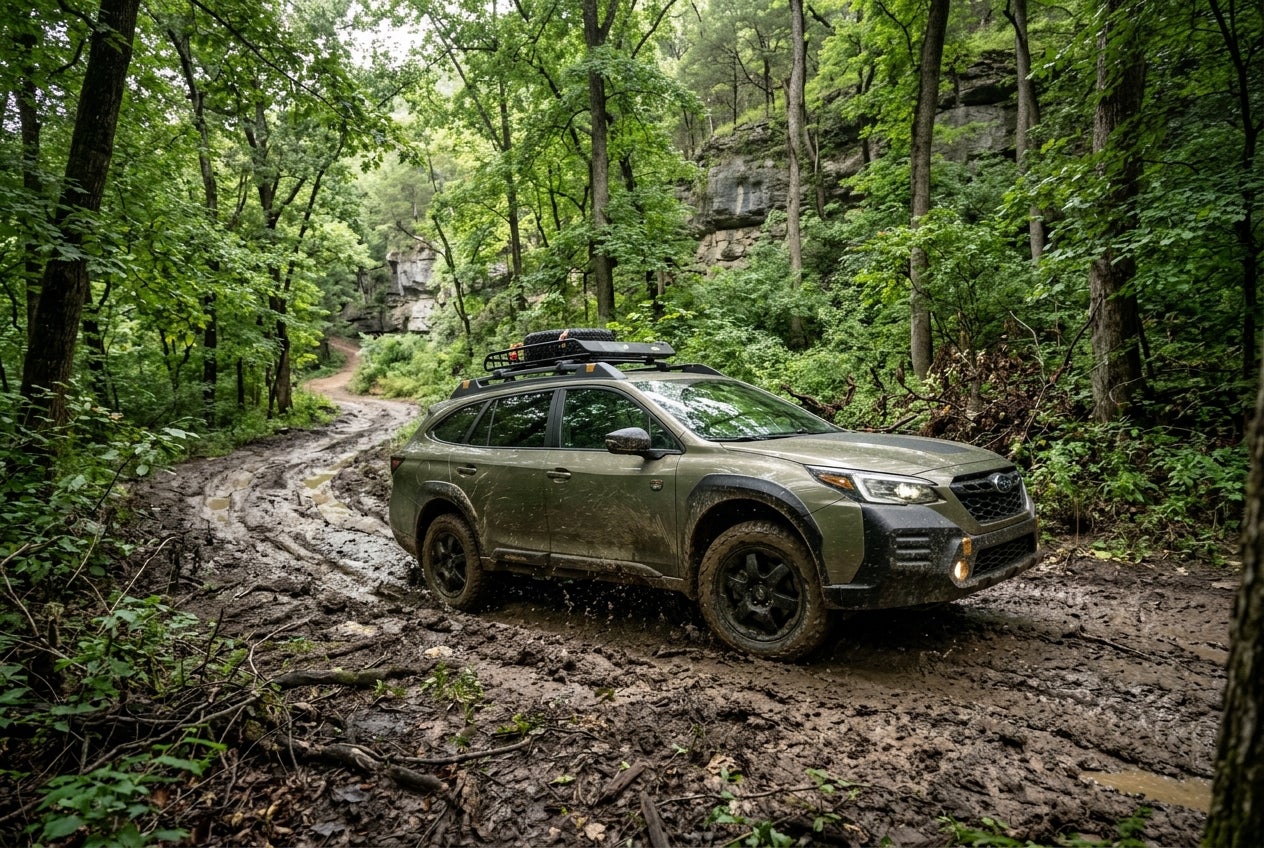
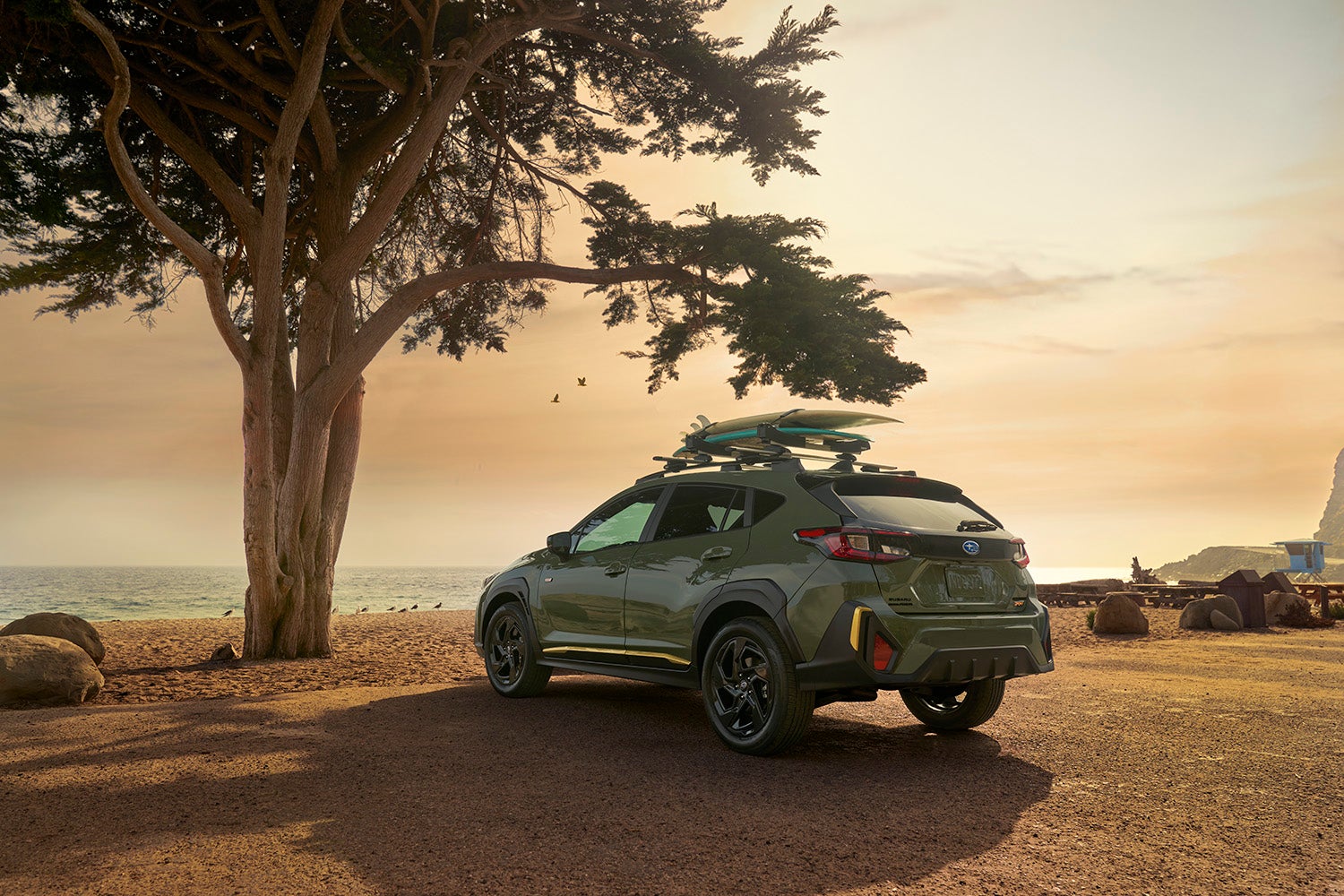
Olive green Subaru Outback Wilderness driving through a deep, muddy dirt road surrounded by dense green forest. (Representative image for illustration purposes only. Actual vehicle may vary based on trim and configuration.)

How Dual-Function X-MODE Optimizes Traction on Rocky and Muddy Park Trails

Navigating Missouri's unpaved backcountry—from the limestone bluffs of Castlewood State Park to the muddy floodplain trails along the Meramec River—demands far more from an all-wheel-drive system than standard wet-asphalt commuting. Subaru's Dual-Function X-MODE is an advanced, software-integrated traction management system engineered specifically to overcome the physical limits of traditional all-wheel drive when pavement turns into loose rock, rutted dirt, and deep river mud. At the core of Dual-Function X-MODE is a total remapping of four key vehicle systems: engine throttle responsiveness, the Symmetrical All-Wheel Drive electronically controlled transfer clutch, transmission gear reduction logic within the Lineartronic CVT, and Vehicle Dynamics Control (VDC) wheel-slip management. In standard driving, Subaru AWD continuously balances torque split for fuel efficiency and smooth cornering. However, when a tire loses grip on a slippery rock ledge or sinks into river silt, standard traction control typically cuts engine power to prevent wheel spin—a response that can completely stall forward momentum precisely when you need momentum most. When engaged via the center console control knob or touchscreen interface, Dual-Function X-MODE alters these parameters instantly. Engine throttle sensitivity is calibrated to deliver ultra-precise low-rpm torque output, preventing accidental power spikes that cause tires to dig deeper into soft ground. Simultaneously, the hydraulic multi-plate transfer clutch increases locking pressure by up to 25%, locking the front and rear axles into a firm 50/50 torque split. By combining this proactive axle locking with targeted individual wheel braking via the VDC system, Dual-Function X-MODE acts as an electronic differential lock, redirecting engine power away from airborne or slipping wheels directly to the tires with firm traction. Understanding 'Snow/Dirt' vs. 'Deep Snow/Mud' Modes on Unpaved Terrain Snow/Dirt Mode: Maximum Grip & Control The 'Snow/Dirt' setting is calibrated for semi-firm surfaces where tire tread can easily bite into the ground if wheel spin is kept to a minimum. Ideal for packed dirt trails, dry riverbed gravel, embedded limestone rock staircases, and hard-packed forest roads, this mode maintains active VDC intervention. If a tire begins to slip while climbing a rocky ledge, the system immediately applies brake force to that specific wheel while maintaining smooth throttle delivery to the resting tires. This prevents rock throw, protects delicate trail surfaces, and provides predictable control. Key Characteristics of Snow/Dirt Mode: • Active VDC traction control prevents wheel spin • Smooth, linear throttle response for low-speed crawling • Early Hill Descent Control engagement under 12 mph • Ideal for gravel access roads and rocky inclines Deep Snow/Mud Mode: Unrestricted Momentum In stark contrast, 'Deep Snow/Mud' mode is designed for soft, fluid surfaces where maintaining momentum requires tire tread self-cleaning. When driving through thick riverbank silt or waterlogged clay along the Meramec, mud quickly fills the tread grooves of standard tires, turning them into slick racing slicks. Deep Snow/Mud mode intentionally disables VDC wheel-slip torque suppression and allows controlled wheel spin. As the wheels spin at higher RPMs, centrifugal force flings packed mud out of the tire tread, allowing the rubber edges to dig deep for fresh traction beneath the slurry. Key Characteristics of Deep Snow/Mud Mode: • Deactivates engine torque cuts from traction control • Permits high-RPM wheel spin to clean mud from tire treads • Holds lower CVT gear ratios for high torque availability • Essential for deep mud ruts, wet riverbanks, and loose sand Navigating Castlewood State Park and Meramec River Trails in Variable Weather Castlewood Bluffs The steep access routes and gravel staging areas around Castlewood State Park present sharp elevation changes over exposed limestone shelf rock. High-torque low-gear management prevents rollback and keeps vehicle balance centered. Meramec River Basins Low-lying trailheads along the Meramec River quickly accumulate saturated silt and clay after late-summer thunderstorms. Deep Snow/Mud mode ensures continuous wheel rotation to cut through topsoil sludge down to stable ground. Hill Descent Control Integrated automatically into X-MODE, Hill Descent Control manages ABS braking on steep downhill trail drops. Drivers can focus entirely on steering without lockup risks on wet gravel or exposed tree roots. Local outdoor enthusiasts in St. Louis County know that weather conditions near the Meramec River basin can transform a dry dirt trail into a treacherous mud passage in under twenty minutes. When descending steep 15-degree grades near the bluffs, human brake modulation often causes wheel lockup, turning tires into sled runners across slick wet clay. Hill Descent Control reads wheel speed sensors continuously, applying hydraulic brake pressure to individual wheels at speeds under 12 mph. This allows you to steer around obstacle hazards and exposed tree roots with total confidence. What the Wilderness Package on the 2024 Subaru Forester Adds for Rugged Trailheads For outdoor adventurers seeking to venture beyond standard park boundaries, the 2024 Subaru Forester Wilderness elevates trail capability with factory-engineered hardware upgrades. Ground clearance jumps from the standard 8.7 inches to an impressive 9.2 inches thanks to longer coil springs and re-tuned dampers. This extra half-inch provides critical clearance over jutting limestone shelf rock and deep trail ruts along riverbank access routes. Mechanically, the Forester Wilderness features revised final drive gearing (4.11:1 ratio vs 3.70:1 standard), delivering improved low-end torque climbing power for crawling up steep grades. Underbody protection includes a standard front aluminum skid plate, protecting critical engine components from boulder impacts. Inside, water-resistant StarTex® synthetic leather seating makes clearing away wet mud and dog hair effortless after an afternoon on the trail. Forester Wilderness Trail Specs: • Ground Clearance: 9.2 inches • Approach Angle: 23.5 degrees (vs 20.0 standard) • Departure Angle: 25.4 degrees (vs 24.6 standard) • Breakover Angle: 21.0 degrees (vs 19.6 standard) • Towing Capacity: 3,000 lbs (with engine oil cooler) • Roof Rack Load: 800 lbs static / 220 lbs dynamic Interested in exploring rugged capability for your local excursions? You can browse our New Subaru Forester Inventory online today. Explore New Subaru Forester Models 2024 Subaru Outback Exterior Dimensions for Tight Trailhead Parking Areas Trailhead staging areas near popular St. Louis County parks—such as Castlewood's lower river parking lots or Chubb Trail access points—are notoriously cramped, featuring narrow entry turnarounds, tight tree lines, and low-hanging branches. Knowing your vehicle's physical footprint ensures stress-free parking and maneuvering in tight quarters. Dimension Specification 2024 Subaru Outback Standard/Onyx 2024 Subaru Outback Wilderness Overall Length 191.1 inches 191.1 inches Overall Width (with mirrors) 74.2 inches (82.0 with mirrors) 74.2 inches (82.0 with mirrors) Overall Height (with roof rails) 66.1 inches 66.9 inches Wheelbase 108.1 inches 108.1 inches Turning Circle Diameter 38.0 feet (19.0 ft radius) 38.0 feet (19.0 ft radius) Ground Clearance 8.7 inches 9.5 inches Despite its expansive interior cargo volume of up to 76 cubic feet, the Outback maintains a tight 38-foot turning circle. This agility allows drivers to perform swift u-turns on narrow dead-end park roads without running off into hidden shoulder ditches. Furthermore, the integrated swing-out crossbars on standard Outback roof rails stow flat when not carrying kayaks or cargo boxes, keeping overhead roof clearance low under low tree canopy. Preparing Your Subaru Brakes and Engine Coolant for Late Summer St. Louis Heat Brake System Heat Management Late August in St. Louis frequently brings temperatures topping 90°F with intense humidity. When descending steep gravel roads near Castlewood, continuous light brake application transfers intense thermal energy to brake rotors and friction pads. If brake pads are worn below 4mm or brake fluid has absorbed atmospheric moisture over time, thermal fade can significantly increase stopping distances. Prior to any late-summer outdoor trip, inspect pad thickness, rotor surface glaze, and fluid boiling point. Replacing aging brake fluid prevents pedal spottiness under heavy descent loads. Cooling System Health Under Load Low-speed trail crawling with Dual-Function X-MODE active generates high heat in both the engine and CVT transmission because airflow through the front radiator grille is drastically reduced compared to highway speeds. Standard cooling systems must rely heavily on electric radiator fans and coolant fluid integrity to dissipate heat. Ensure your coolant reservoir is filled to the full mark with genuine Subaru Super Coolant, which offers extended protection against boiling up to 265°F under pressure. Inspect upper and lower radiator hoses for softness or cracking. Managing Summer Tire Pressure and Wheel Alignments Before Highway and Trail Driving Thermal Expansion Ambient summer heat causes tire air pressure to expand by roughly 1 PSI for every 10°F rise in temperature. Setting cold PSI correctly before heading out prevents highway over-inflation. X-MODE Calibration Subaru's Symmetrical AWD and X-MODE require matching tire rolling circumferences. Uneven tire pressure tricks wheel-speed sensors, leading to premature AWD clutch wear. Laser Alignment Impacts with rocky ledges or deep trail potholes throw off suspension camber and toe angles. Precision four-wheel laser alignments eliminate highway vibration and tire cupping. Check Current Service and Parts Information Complete Pre-Trip Subaru Maintenance Checklist: Air Filters, Fluids, and Inspections Executing a structured pre-trip inspection ensures your vehicle performs flawlessly whether cruising down I-44 or traversing dirt trailheads. Airborne dust on dry summer park access roads quickly clogs engine air filters, reducing fuel economy and throttle response. Similarly, cabin HEPA filters trap ragweed and pollen, keeping interior air clean during dusty group drives. Essential Filter & Fluid Checklist: 1. Engine Air Filter: Replace every 12,000–15,000 miles (or sooner if frequently driving dusty gravel). 2. Cabin Air Filter: Replace annually to maintain HVAC air volume and clear summer allergens. 3. Engine Oil & Filter: Verify full capacity with 0W-20 or 0W-16 synthetic oil for heat dissipation. 4. Differential Gear Oil: Inspect front and rear differential oil for contamination after deep water crossings. Beyond fluids and filters, a comprehensive multipoint safety inspection evaluates suspension ball joints, tie rod ends, CV axle boots, and battery health. Off-road flexing puts added strain on rubber suspension bushings; catching a cracked CV boot early prevents dirt contamination and expensive axle shaft replacements later. Looking for genuine replacement filters or OEM gear oils before your trip? You can readily Find Subaru Parts through our factory-direct online portal. Essential Recovery Gear and Safety Items to Pack in Your Subaru Trunk Even with Subaru's formidable Symmetrical AWD and Dual-Function X-MODE, unexpected trail hazards like fallen tree limbs, sudden washouts, or flash mud pools can turn an enjoyable afternoon into a recovery scenario. Responsible off-pavement driving requires carrying dedicated recovery gear suited for Missouri's terrain. Recommended Backcountry Safety Equipment: • Heavy-Duty Tow Strap & Soft Shackles: Rated for at least 15,000 lbs minimum breaking strength (never use metal hooks on kinetic recovery ropes). • High-Traction Recovery Boards: Essential for bridging deep mud ruts along Meramec riverbanks or providing grip under high-centered tires. • Portable 12V Air Compressor & Tire Deflator: Allows you to lower tire pressure for soft sand/mud traction and re-inflate back to street pressure before highway driving. • Tire Plug Kit & Folding Shovel: Quickly repair tread punctures from sharp limestone rocks and clear mud from around tire contact points. • Rechargeable LED Headlamps & First Aid Kit: Essential for unforeseen trail delays past sunset near Ladue and Sunset Hills parks. Planning for Regional Outdoor Trips: Ownership Costs and Factory Warranty Coverage Factory Warranty Boundaries Every new 2024 Subaru includes a 3-Year/36,000-Mile New Vehicle Limited Warranty alongside a 5-Year/60,000-Mile Powertrain Limited Warranty. These warranties protect against manufacturing defects in key mechanical components including the BOXER engine, Lineartronic CVT transmission, and Symmetrical AWD transfer system. Understanding what is covered versus routine maintenance allows you to accurately budget for frequent weekend outdoor excursions across St. Louis County. Wear & Tear Budgeting Frequent trail driving increases wear on consumable maintenance items. Budgeting for regular tire rotations (every 6,000 miles), wheel alignments after rough trail excursions, brake pad replacements, and air filter changes keeps long-term cost of ownership predictable. Planning your next adventure vehicle purchase? You can easily Apply for financing online before visiting our dealership. Get Approved for Financing How Sunset Hills Buyers Can Reserve Trims and Schedule Same-Day Pre-Trip Service 1. Online Reserve Browse live inbound inventory for highly sought-after Wilderness and Onyx Edition models. Lock in your exact exterior color and option package online before delivery. 2. Express Service Take advantage of Express Service lanes for rapid pre-trip oil changes, tire rotations, and multi-point inspections with no appointment necessary for routine items. 3. Trade Valuations Upgrading to an outdoor-ready SUV? Utilize our quick online tool to Get your value trade appraisal towards a new Crosstrek or Outback. Residents across Sunset Hills, Ladue, and surrounding St. Louis communities can check real-time availability for New Subaru Inventory or inspect top-tier pre-owned options in our Used Vehicle Inventory directly from our website. Schedule Your Pre-Trip Inspection or Test Drive at Sunset Hills Subaru Today Whether you are preparing your trusty Outback for a weekend excursion along the Meramec River, or looking to experience Dual-Function X-MODE firsthand on a new Forester Wilderness, the dedicated team at Sunset Hills Subaru is ready to assist. Conveniently located on Watson Road, our factory-trained technicians and sales specialists are proud to serve outdoor enthusiasts throughout St. Louis County. Visit us at 10100 Watson Rd, Sunset Hills, MO 63127 or call us directly. Get Directions to Sunset Hills Subaru or Call us at (314) 476-9638 to schedule your service or test drive appointment today. Schedule Service and Diagnostics

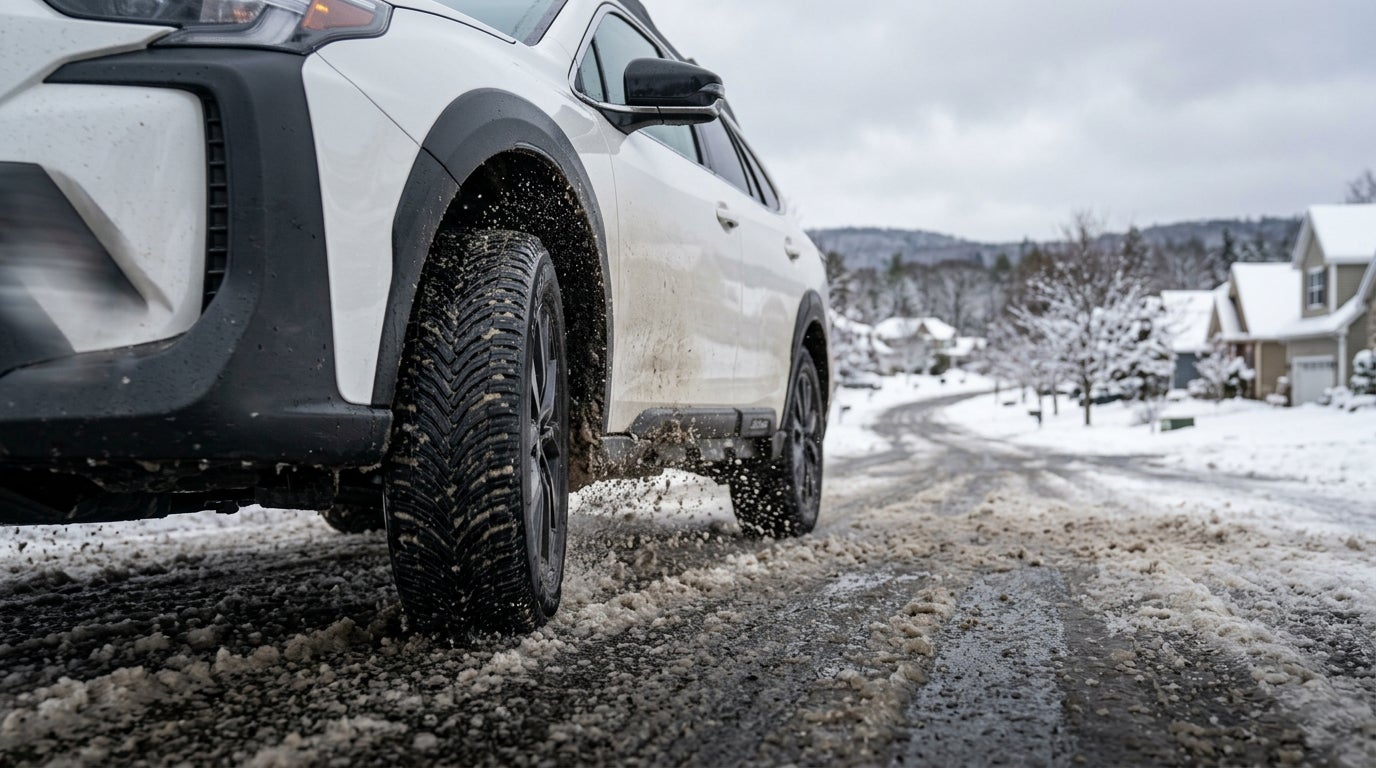
Low-angle shot of a white SUV driving through slushy snow on a residential street in winter. (Representative image for illustration purposes only. Actual vehicle may vary based on trim and configuration.)

What Tires Are Best for a 2025 Subaru Outback for All-Season and Snow Performance?

The best replacement tires for a 2025 Subaru Outback delivering all-season traction and severe snow performance are all-weather tires like the Michelin CrossClimate 2 and Continental ControlContact Tour A/S Plus. These tires earn the 3PMSF (Three-Peak Mountain Snowflake) symbol, providing robust grip on slush, ice, and heavy rain without requiring drivers to swap out tires when winter arrives. Selecting replacement tires for a crossover requires understanding how rubber compounds interact with road conditions and mechanical drive systems. Standard all-season tires use rubber compounds that harden when ambient temperatures drop below 45 degrees Fahrenheit, leading to longer stopping distances on cold pavement. True all-weather tires utilize thermal-reactive silica compounds that stay pliable in sub-freezing temperatures while maintaining structural integrity during hot summer highway driving. Pairing a 3PMSF certified tire with Subaru's standard Symmetrical All-Wheel Drive creates exceptional stability across changing road surfaces. While the AWD transfer clutch manages mechanical torque distribution between front and rear axles, tread design dictates actual surface adhesion. Deep directional tread blocks and high-density 3D sipes actively pump water away from the contact patch and bite into packed snow, allowing driver-assist features like X-MODE® to function at maximum efficiency. For residents navigating the gently rolling residential hills of Ladue during freezing rain and winter snowstorms, having tires engineered for cold-weather adhesion ensures predictable stopping power and steering response. If you have questions about choosing the right tire specification for your routine routes, give our team at our Sunset Hills service center a quick call at (314) 476-9638 for personalized tire recommendations. Table of Contents What Are the Original Factory Tire Sizes and Specs for the Subaru Outback? Why Must All Four Tires on a Subaru Outback Have Equal Tread Depth? How Do Michelin CrossClimate 2, All-Terrain, and Winter Tires Compare for the Outback? What Are the Best Budget-Friendly Replacement Tires for the Subaru Outback? Which Subaru Outback Model Years and Engines Show the Highest Reliability? Common Questions About Subaru Outback Maintenance and Tires What Are the Original Factory Tire Sizes and Specs for the Subaru Outback? Original factory tire sizes for the Subaru Outback vary by trim level, utilizing 225/65R17, 225/60R18, or 225/55R19 specifications. Maintaining exact factory load indexes and speed ratings during tire replacement ensures proper cornering balance, speedometer calibration, and sensor operation for advanced safety systems. Subaru matches wheel dimensions and tire profiles to the distinct suspension tuning of each model grade: 17-inch Fitments: Base trims and rugged models use 225/65R17 tires with a 102T load and speed rating on 17x7.0-inch wheels. The Outback Wilderness features specialized Yokohama GEOLANDAR A/T tires engineered for increased off-road puncture resistance and rim protection. 18-inch Fitments: Core trims such as the Premium, Limited, and Touring feature 225/60R18 tires rated at 100H mounted on 18x7.0-inch aluminum-alloy wheels, striking a balance between absorption comfort and responsive road feel. 19-inch Fitments: Upper grades including the Limited XT and Touring XT carry 225/55R19 tires rated at 99H on 19x7.0-inch wheels, offering a firmer sidewall profile for enhanced high-speed tracking. Maintaining the factory outer tire diameter is essential for vehicle electronic calibration. Subaru's EyeSight® Driver Assist technology relies on precise vehicle height, tilt angles, and wheel speed inputs to operate adaptive cruise control and pre-collision braking accurately. Reviewing your vehicle's door-jamb tire placard or checking Subaru Outback factory specifications ensures you select a replacement tire size that preserves original engineering parameters. Why Must All Four Tires on a Subaru Outback Have Equal Tread Depth? All four tires on a Subaru Outback must maintain equal tread depth within a strict 2/32-inch variance to protect the Symmetrical All-Wheel Drive transfer clutch and center differential from severe friction damage. Because power continuously feeds to both front and rear axles, unequal tire circumferences force individual wheels to spin at different speeds, creating constant mechanical stress inside the drivetrain. When one tire has significantly more tread than another, its effective rolling circumference is larger. A brand-new tire with 10/32-inch tread completes fewer revolutions per mile than a worn tire with 4/32-inch tread. On a standard two-wheel-drive vehicle, this variance is unnoticeable. On an all-wheel-drive vehicle, however, the center transfer clutch interprets this rotational difference as wheel slip. The system continuously attempts to lock and adjust power distribution, generating internal heat that rapidly degrades transfer fluid, wears clutch packs, and can eventually lead to complete AWD failure. When drivers bring an Outback in for service with a single unrepairable tire, the question our service team hears most often is whether replacing just one tire will harm the drive system. If the remaining three tires have worn down by more than 2/32-inch, replacing all four tires—or having a single new replacement tire mechanically shaved to match the exact tread depth of the existing set—is required to safeguard the transmission. Similar mechanical tolerances apply across the lineup, including larger crossover options like the Subaru Ascent. How Do Michelin CrossClimate 2, All-Terrain, and Winter Tires Compare for the Outback? Selecting between Michelin CrossClimate 2 all-weather tires, crossover all-terrain tires, and dedicated winter tires comes down to whether your driving demands year-round versatility, off-road durability, or sub-zero ice traction. For the majority of crossover owners who want strong cold-weather traction without seasonal tire swaps, all-weather options represent the most practical solution. Comparing the primary tire categories highlights key performance differences: All-Weather Tires (Michelin CrossClimate 2): Feature a thermal-adaptive tread compound and directional V-shaped grooves that excel in wet braking and snow traction. Earning the 3PMSF rating, they deliver dependable winter performance while maintaining a smooth, quiet ride on dry pavement backed by a 60,000-mile treadwear warranty. All-Terrain Tires (Falken Wildpeak A/T Trail): Engineered specifically for unpaved roads, these tires feature reinforced sidewalls, chip-resistant rubber compounds, and deeper tread blocks. While they excel on gravel trails and mud, they produce slightly more cabin noise and can reduce fuel economy by roughly 1 to 2 MPG compared to touring tires. Dedicated Winter Tires (Bridgestone Blizzak WS90): Feature soft hydrophilic rubber compounds and intense siping designed strictly for packed snow and glare ice. They deliver ultimate winter stopping power, but the soft tread wears rapidly when driven on dry pavement in temperatures above 45 degrees Fahrenheit, requiring a dedicated secondary set of wheels and seasonal storage. For drivers who spend most of their time on highway pavement but want confidence during winter weather, all-weather tires eliminate the expense and storage hassle of maintaining separate seasonal tire sets. What Are the Best Budget-Friendly Replacement Tires for the Subaru Outback? Top budget-friendly replacement tires for the Subaru Outback include the General AltiMAX RT45, Kumho Crugen HP71, and Hankook Kinergy PT, which deliver dependable wet traction and high treadwear ratings at an accessible price point. These value-focused tires meet factory load and speed specifications while providing a comfortable highway ride. Key characteristics of top budget replacement options include: General AltiMAX RT45: Features visual alignment indicators built into the tread to alert drivers to early wear issues, alongside stiff tread blocks that enhance steering response on rain-slicked asphalt. Kumho Crugen HP71: Designed specifically for CUV and SUV applications, utilizing noise-canceling tread pitches to keep the cabin quiet during long highway commutes. Hankook Kinergy PT: Utilizes a high-grip silica compound and extra-wide circumferential grooves to resist hydroplaning while offering high mileage durability. Maintaining value-tier tires requires rigorous service habits. Performing tire rotations every 6,000 miles and maintaining precise inflation pressures prevents premature shoulder wear. When replacing tires or sourcing maintenance components, turning to verified channels for ordering genuine OEM parts and tire accessories ensures your replacement components fit correctly every time. Which Subaru Outback Model Years and Engines Show the Highest Reliability? Recent Subaru Outback generations, particularly fifth-generation (2015–2019) and sixth-generation (2020–2025) models, demonstrate excellent long-term reliability ratings in automotive testing. Independent evaluations from Consumer Reports consistently highlight recent Outback models for strong overall dependability, while J.D. Power places the Outback above average for long-term mechanical quality in the midsize crossover segment. Older model years from 2010 through 2014 show higher rates of owner feedback regarding early Lineartronic® CVT torque converter shudder and oil consumption on early FB25 engines. Modern Outback powertrains are built around two distinct engine designs: 2.5L Subaru BOXER® Engine: Naturally aspirated and producing 182 horsepower and 176 lb-ft of torque, this engine pairs with a Lineartronic® CVT to achieve up to 26 city / 32 hwy MPG. Updated internal coatings and refined thermal control valves have addressed early-generation oil consumption concerns. 2.4L Turbocharged Subaru BOXER® Engine: Available on Limited XT and Touring XT grades, this direct-injection engine generates 260 horsepower and 277 lb-ft of torque. It increases towing capacity to 3,500 pounds and delivers effortless mountain climbing ability while maintaining strong mechanical durability when engine oil service intervals are strictly followed. Maintaining powertrain health on elevated terrain and highway commutes around Sunset Hills requires keeping engine cooling systems, battery connections, and CVT fluids serviced on schedule. Horizontal engine architecture, shared across performance models like the Subaru BRZ, relies on clean oil to protect lower cylinder walls and valve trains over long mileage intervals. Common Questions About Subaru Outback Maintenance and Tires Keeping a Subaru Outback operating smoothly requires consistent tire maintenance, steady electrical system voltage, and timely fluid inspections. Following factory service guidelines protects the vehicle's long-term reliability while preserving all-wheel-drive capability across every season. Q: How often should I rotate the tires on my Subaru Outback? Tires should be rotated every 6,000 miles or at every synthetic oil change interval. Regular rotation moves tires between front steering positions and rear load-bearing positions, ensuring even tread wear across all four positions. Because uneven front-to-rear wear stress the all-wheel-drive transfer clutch, staying consistent with rotations protects your vehicle's mechanical components while extending overall tire lifespan. Q: Can I install all-terrain tires on an Outback without a suspension lift? Crossover-specific all-terrain tires like the Falken Wildpeak A/T Trail can be installed in original factory sizes ( 225/65R17 or 225/60R18) on stock suspension without tire rubbing. These tires feature outer dimensions that fit within factory wheel wells while providing reinforced sidewall protection for gravel roads and light trail driving. Q: What happens if I drive on tires with different tread depths? Driving on tires with tread depth variances exceeding 2/32-inch forces the all-wheel-drive system to continuously compensate for differing wheel speeds. This constant engagement generates extreme heat and friction in the transfer clutch assembly, accelerating fluid breakdown and increasing the risk of expensive internal transmission damage. Q: Why is my Outback battery losing charge quickly? Modern Outbacks feature sophisticated onboard electronics, including EyeSight® Driver Assist camera modules, security telematics, and touchscreen displays that place continuous demands on the electrical system. Short driving trips do not allow the alternator enough time to recharge the battery fully, which can lead to low voltage conditions. Having your battery tested during routine service visits ensures stable system performance. Q: Do all-weather tires affect fuel economy on the Subaru Outback? High-quality all-weather tires like the Michelin CrossClimate 2 have a minimal impact on fuel economy, typically reducing efficiency by less than 1 MPG compared to standard summer touring tires. The enhanced cold-weather traction and wet braking safety provided by 3PMSF certified tires far outweigh any minor change in fuel consumption. If your Outback requires a tire inspection, tread depth evaluation, or routine maintenance service, our factory-trained service technicians are ready to assist. Contact our team by calling (314) 476-9638, stop by our Sunset Hills service location at 10100 Watson Rd, Sunset Hills, MO 63127, or save time by scheduling your next service appointment online today. © 2026 Sunset Hills Subaru. All rights reserved. Vehicle specification data © JATO Dynamics Limited. 2025 Subaru Outback Tire Guide in Sunset Hills MO | Sunset Hills Subaru

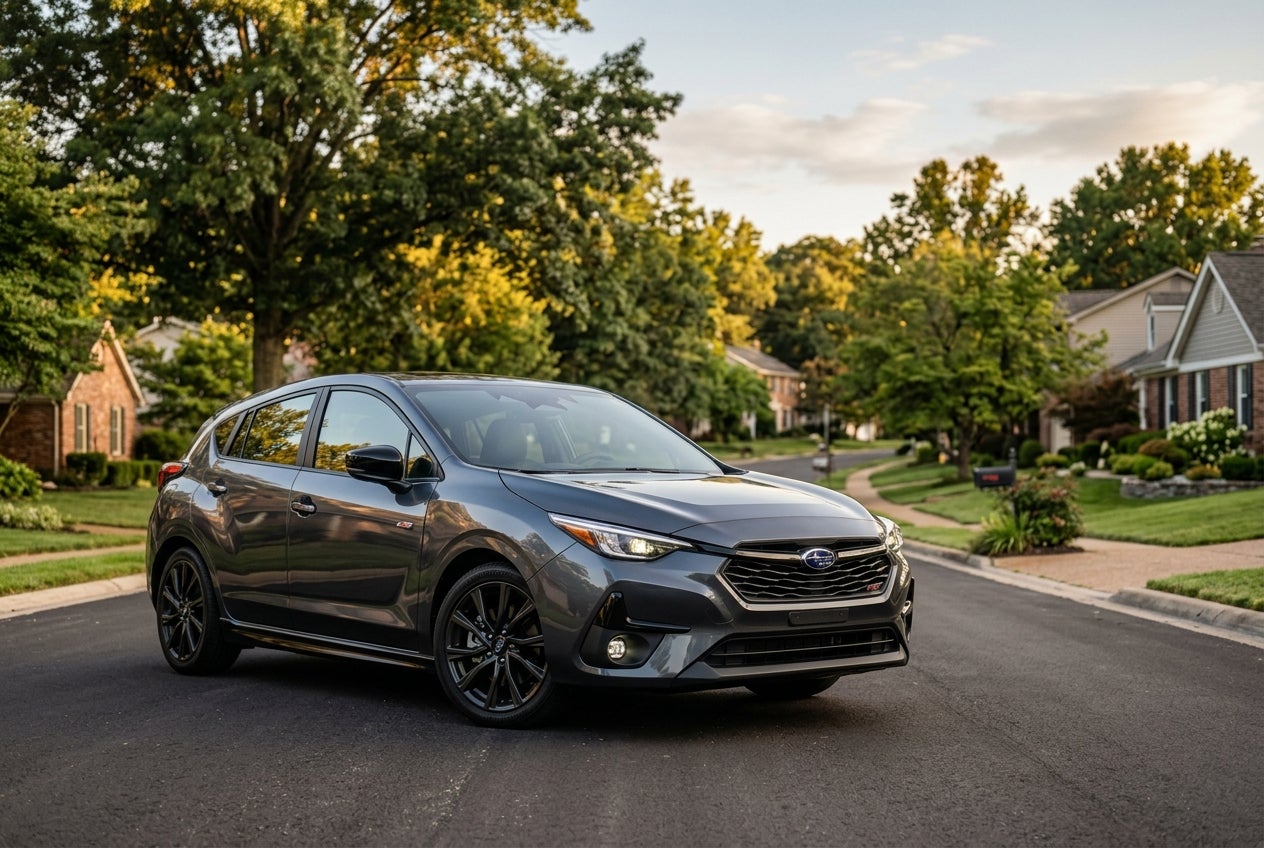
Dark grey Subaru Impreza RS hatchback parked on a quiet residential street at golden hour. (Representative image for illustration purposes only. Actual vehicle may vary based on trim and configuration.)

2026 Subaru Impreza 2.5 RS vs Honda Civic Type-R

2026 Subaru Impreza 2.5 RS vs Honda Civic Type-R The 2026 Subaru Impreza 2.5 RS CVT is the recommended choice for daily versatility, delivering standard Symmetrical All-Wheel Drive, 5-passenger seating capacity, and efficient 29 MPG combined fuel economy at a starting MSRP of $29,495. While the 2026 Honda Civic Hatchback Type-R provides 315 hp for track driving, its $46,895 starting MSRP, 4-passenger limit, front-wheel-drive layout, and stiffer suspension make it less focused on everyday commuting. New Subaru Impreza Inventory Which Is the Better Overall Choice for Ladue and Sunset Hills Drivers: 2026 Subaru Impreza 2.5 RS CVT or 2026 Honda Civic Hatchback Type-R? The 2026 Subaru Impreza 2.5 RS CVT is the practical choice for daily commuting and suburban usability, delivering standard Symmetrical All-Wheel Drive and 5-passenger seating at a starting MSRP of $29,495 compared to the front-wheel-drive 2026 Honda Civic Hatchback Type-R at $46,895. When evaluating these two compact five-door hatchbacks for everyday living, their core purposes quickly diverge. The Impreza 2.5 RS is engineered specifically for practical, all-weather versatility. Powered by a 2.5L 4-cylinder engine producing 180 hp and 178 lb-ft of torque through a Lineartronic CVT, the Impreza provides smooth, confident acceleration across rolling terrain and slick winter pavement. Its 5-passenger seating capacity ensures your entire household rides comfortably, while a manageable 3,275 lbs curb weight maintains composed agility. Conversely, the Civic Hatchback Type-R is built as a track-focused hot hatch. Its turbocharged 2L 4-cylinder engine generates 315 hp and 310 lb-ft of torque mated exclusively to a manual 6-speed transmission. While those output figures shine on open raceways, the Type-R sacrifices daily practicality. It limits interior capacity to just 4 passengers, lacks all-wheel traction, and features an aggressive track-tuned suspension that transmits every road imperfection directly into the cabin. For drivers navigating the tree-lined streets of Ladue during unexpected rain or snowfall, Subaru's full-time all-wheel traction provides peace of mind that a front-wheel-drive sports car simply cannot match. Shoppers exploring our broader lineup can also check out our new Subaru Impreza inventory, compare options within our new Subaru Legacy inventory, or review dynamic alternatives in our new Subaru WRX inventory and new Subaru BRZ selection. Families needing expanded cabin dimensions can also explore our new Subaru Crosstrek options, new Subaru Forester SUV models, new Subaru Outback crossovers, new Subaru Ascent models, or the zero-emissions new Subaru Solterra EV. Pricing Manufacturer-listed pricing per trim, across compared vehicles. 2026 Subaru Impreza 2.5 RS CVT Trim MSRP 2026 Honda Civic Hatchback Type-R Trim MSRP 2.5 RS CVT $29,495 Type-R $46,895 How Do the 2026 Subaru Impreza 2.5 RS CVT and Honda Civic Hatchback Type-R Compare in Price and Value? The 2026 Subaru Impreza 2.5 RS CVT delivers strong ownership value with a starting MSRP of $29,495, saving buyers $17,400 upfront over the 2026 Honda Civic Hatchback Type-R's starting MSRP of $46,895. Analyzing financial positioning reveals two fundamentally different value propositions. The Impreza 2.5 RS includes an impressive roster of standard equipment—such as 18-inch alloy wheels, dual-zone automatic climate control, wireless device integration, and full driver-assist technology—without requiring expensive add-on packages. Both vehicles carry a matching $1,195 destination charge, but the Impreza's accessible entry price allows buyers to enjoy sport-inspired styling and top-tier safety features without stretching their household budget. The Honda Civic Type-R's high price tag reflects its specialized racing hardware, including Brembo front brakes, forged aluminum components, and high-strung turbocharging. However, for drivers who do not intend to spend weekends on a closed circuit, that $17,400 price premium yields very little practical benefit during routine grocery runs or daily work trips. Furthermore, the Impreza runs on affordable 87-octane regular unleaded fuel, whereas the Type-R demands high-octane 91 premium unleaded gas, adding ongoing fuel expenses over every mile driven. To make upgrading even more accessible, our team can help you easily value your trade-in online before visiting our showroom. Long-term maintenance costs remain lower on the Impreza as well, supported by readily available genuine Subaru parts designed for lasting durability. Dimensions & Capacity Capacity and dimensions by trim Specification 2026 Subaru Impreza 2.5 RS CVT 2026 Honda Civic Hatchback Type-R Seating 5 4 Cargo 20.4 cu ft 24.5 cu ft Curb weight 3,275 lbs 3,118 lbs Value your trade-in Which Hatchback Offers More Cabin Comfort and Cargo Space for Family Outings? The 2026 Subaru Impreza 2.5 RS CVT offers superior passenger space and flexibility for family outings, providing full 5-passenger seating and up to about 56 cu ft of maximum cargo volume with the rear seats folded. Interior layout is one of the most critical differentiators between these two hatchbacks. The Impreza 2.5 RS prioritizes functional passenger comfort with a spacious 2+3 seating configuration. Front occupants enjoy 39.8 in of headroom and 42.9 in of legroom, while rear passengers benefit from 38.0 in of headroom and 36.5 in of legroom. With all seats in place, the rear cargo area holds about 20 cu ft of gear, expanding to a expansive about 56 cu ft when folding the 60/40 split rear seatbacks flat. The Civic Hatchback Type-R is restricted by its aggressive rear seat design, which eliminates the center position entirely to leave seating for only 4 occupants. While the Type-R provides about 24.5 cu ft of cargo room behind its rear seats, its lower rear headroom measurement of 37.1 in and fixed rear seat bolsters make loading bulky items or taking full family trips far more restrictive. The Impreza's extra seat and adaptable floor layout mean you never have to leave a family member or friend behind. Whether packing golf bags, picnic coolers, or sports equipment for a Saturday afternoon at Sunset Hills Park, the Impreza's wider rear gate opening and supportive cloth seats ensure effortless loading and comfortable travel. Shoppers looking for current offers on our complete lineup can view our current new car specials online. Fuel Economy Fuel economy and range by trim Specification 2026 Subaru Impreza 2.5 RS CVT 2026 Honda Civic Hatchback Type-R MPG 26 city / 33 hwy / 29 combined 22 city / 28 hwy / 24 combined How Do the 2026 Subaru Impreza 2.5 RS CVT and Honda Civic Hatchback Type-R Perform on Rolling Terrain and All-Season Roads? The 2026 Subaru Impreza 2.5 RS CVT provides superior all-weather capability and everyday fuel efficiency, achieving an EPA-estimated 26 city / 33 hwy / 29 combined MPG alongside standard full-time all-wheel drive. Under the hood, the Impreza 2.5 RS features a naturally aspirated 2.5L Subaru BOXER® engine producing 180 hp at 5,800 rpm and 178 lb-ft of torque at 3,700 rpm. Combined with the Lineartronic CVT featuring 8-speed manual shift modes and steering wheel paddle shifters, power delivery is smooth, predictable, and linear. The defining performance advantage is Subaru's standard Symmetrical All-Wheel Drive with active torque vectoring, which continuously routes power to the wheels with the most grip to maintain sure-footed handling through rain, mud, or winter slush. The Civic Type-R focuses purely on dry-pavement speed with its 2L turbocharged engine making 315 hp at 6,500 rpm and 310 lb-ft of torque at 2,600 rpm. While its mechanical limited-slip differential helps manage front-wheel traction, sending 315 horsepower exclusively through the front wheels can lead to torque steer and wheel spin on wet or gravel-covered suburban inclines. Furthermore, the Type-R's ultra-low-profile 30-series summer performance tires are ill-suited for cold weather or rough roads. Fuel efficiency also heavily favors the Impreza. Its 29 MPG combined rating and 16.6-gallon fuel tank deliver an estimated cruising range of 481 miles on a single tank. In comparison, the Civic Type-R manages just 22 city / 28 hwy / 24 combined MPG and holds only about 12 gallons of fuel, capping its estimated driving range at just 298 miles. Engine & Performance Powertrain specs by trim Specification 2026 Subaru Impreza 2.5 RS CVT 2026 Honda Civic Hatchback Type-R Engine 2.5L 2L Horsepower 180 hp 315 hp Torque 178 lb-ft 310 lb-ft Transmission Lineartronic CVT manual 6-speed Drivetrain All-wheel drive Front-wheel drive What Technology Features Keep You Connected and Safe During Commutes? The 2026 Subaru Impreza 2.5 RS CVT delivers a superior digital cabin experience centered around a massive 11.6-inch Subaru STARLINK® touchscreen display, significantly out-sizing the 9-inch screen found in the Civic Type-R. Subaru designed the Impreza's cockpit to combine intuitive high-tech features with easy-to-reach controls. The high-resolution 11.6-inch vertical touchscreen serves as the central hub for audio, vehicle settings, and climate controls, featuring standard wireless Apple CarPlay® and Android Auto™ integration. Driver information is clearly displayed on a 4.2-inch color LCD screen within the instrument cluster. Front passengers have access to two USB charging ports and a 12V power outlet, while rear passengers enjoy two dedicated USB charging ports to keep devices powered during longer drives. Audio is delivered crisp and clear through a standard 6-speaker system, with an available 10-speaker Harman Kardon® premium system offered for audiophiles. The Honda Civic Hatchback Type-R utilizes a smaller 9-inch horizontal center display. While it includes a 10.2-inch digital gauge cluster and a 12-speaker audio system, its interface offers less screen real estate for split-screen navigation and media management. The Type-R also lacks dedicated rear USB ports, forcing rear passengers to rely on front cabin connections. In addition, the Impreza includes 60 months of standard MySubaru companion telematics service, enabling convenient remote functions such as vehicle status checks, remote door locking, and automated maintenance notifications directly from your smartphone. How Do Safety Systems in the 2026 Subaru Impreza 2.5 RS CVT and Honda Civic Hatchback Type-R Support School Runs and Suburban Streets? The 2026 Subaru Impreza 2.5 RS CVT leads in active driver assistance usability with its standard EyeSight® Driver Assist technology, which operates at low speeds down to 7 mph for enhanced suburban collision protection. Safety is engineered into every structural layer of the Impreza. Built on the Subaru Global Platform, the chassis incorporates 8 standard airbags—including front, side curtain, driver's knee, and front seat cushion airbags—to protect all occupants. The award-winning EyeSight® system utilizes dual color cameras mounted near the rearview mirror to monitor surrounding traffic. Standard driver-assist features include Advanced Adaptive Cruise Control with lane centering, Pre-Collision Braking, Lane Keep Assist, and Blind Spot Detection with Rear Cross-Traffic Alert. The system continuously evaluates pedestrian and cyclist proximity, automatically applying full braking force if an impending hazard is detected. The Civic Hatchback Type-R includes Honda's Collision Mitigation Brake System (CMBS) and 10 airbags. However, its manual transmission limits the full functionality of certain driver-assist features; for instance, its adaptive cruise control cannot bring the vehicle to a complete stop and hold it automatically in stop-and-go traffic without driver intervention on the clutch. The Impreza's impressive safety credentials are reinforced by top crash-test marks, including an IIHS Top Safety Pick rating and a 5-Star Overall Vehicle Score from the NHTSA, confirming its role as a dependable protector for busy family schedules. What Warranty and Maintenance Options Should Owners Expect for These 2026 Hatchbacks? Both the 2026 Subaru Impreza 2.5 RS CVT and 2026 Honda Civic Hatchback Type-R include standard 3-year/36,000-mile basic warranty coverage and 5-year/60,000-mile powertrain warranty protection. Subaru backs every new Impreza with a comprehensive factory warranty package designed to ensure long-term peace of mind. Coverage includes a 36-month/36,000-mile new vehicle limited warranty, a 60-month/60,000-mile powertrain limited warranty, a 60-month/unlimited-mile rust perforation warranty, and 36 months or 36,000 miles of 24/7 Subaru Roadside Assistance. In the event of a flat tire, emergency breakdown, or unexpected battery failure, official Subaru Roadside Assistance connects you with factory-trained professionals using genuine OEM parts. Warranty / Maintenance Specification 2026 Subaru Impreza 2.5 RS CVT 2026 Honda Civic Hatchback Type-R Basic Warranty Coverage 36 months / 36,000 miles 36 months / 36,000 miles Powertrain Warranty Coverage 60 months / 60,000 miles 60 months / 60,000 miles Corrosion / Rust Perforation 60 months / Unlimited miles 60 months / Unlimited miles Roadside Assistance Package 36 months / 36,000 miles 36 months / 36,000 miles Primary Recommended Fuel 87 Octane Regular Unleaded 91 Octane Premium Unleaded Maintaining your Impreza is convenient and straightforward. When routine oil changes, tire rotations, or brake inspections are due, owners can easily schedule a service appointment online with our certified technicians who specialize in Symmetrical All-Wheel Drive and BOXER® engine mechanics. Schedule Service and Diagnostics Buyer FAQs: Which Hatchback Fits Your Active Suburban Lifestyle Best? Q: Is the 2026 Subaru Impreza 2.5 RS CVT worth choosing over the Honda Civic Type-R for daily commuting? Yes. The Impreza 2.5 RS CVT is vastly better suited for daily driving because it costs $17,400 less, achieves an efficient 29 MPG combined on regular gas, seats 5 passengers, and features standard Symmetrical All-Wheel Drive. The Civic Type-R is an expensive, 4-passenger track car with a stiff ride and manual transmission that can feel tedious during routine traffic stops. Q: Which hatchback offers better fuel economy and total driving range? The 2026 Subaru Impreza 2.5 RS CVT wins significantly on efficiency and range. It delivers an EPA-estimated 26 city / 33 hwy / 29 combined MPG and a 481-mile total cruising range on regular 87-octane fuel. The Civic Type-R manages only 22 city / 28 hwy / 24 combined MPG on expensive 91-octane premium fuel, limiting its range to 298 miles. Q: How does all-wheel drive benefit drivers during Missouri winters? Subaru's Symmetrical All-Wheel Drive continuously delivers power to all four wheels simultaneously, actively transferring torque to the tires with the best grip. This provides superior acceleration, cornering stability, and braking control on rain-slicked, icy, or snow-covered suburban roads where front-wheel-drive vehicles like the Civic Type-R struggle for traction. Q: Which vehicle provides more practical space for family cargo and passenger needs? The Impreza 2.5 RS CVT offers better overall passenger utility with 5 comfortable seats and about 56 cu ft of maximum cargo space with the rear seats folded. The Civic Type-R restricts rear seating to just 2 passengers (4 total in the vehicle) and features fixed performance head restraints that reduce rear visibility and cargo loading flexibility. Q: Where can I test drive the 2026 Subaru Impreza 2.5 RS CVT? You can explore and test drive the 2026 Impreza 2.5 RS CVT at Sunset Hills Subaru. Visit our Sunset Hills showroom located at 10100 Watson Rd, Sunset Hills, MO 63127. You can browse our new Subaru inventory online, easily contact us about financing from home, or give our sales team (314) 476-9638 a quick call today to schedule your test drive test drive. Ready to Experience the 2026 Subaru Impreza 2.5 RS? New Subaru Inventory Get approved for financing New Subaru Inventory © 2026 Sunset Hills Subaru. All rights reserved. Vehicle specification data © JATO Dynamics Limited.

2026 Subaru Crosstrek CVT vs Limited CVT Comparison

The 2026 Subaru Crosstrek Limited CVT is a strong choice for crossover buyers seeking refined daily comfort, featuring standard leather upholstery, an 11.6-inch touchscreen, and Blind Spot Detection for a base MSRP of $32,995. While the entry-level 2026 Subaru Crosstrek CVT offers exceptional all-wheel-drive value at $26,995, the Limited trim justifies its price premium by adding heated front seats, 18-inch alloy wheels, and Rear Cross-Traffic Alert that elevate everyday versatility. New Subaru Crosstrek Inventory Which 2026 Subaru Crosstrek Trim Offers the Best Value for Ladue and Sunset Hills Families? The 2026 Subaru Crosstrek Limited CVT offers strong long-term value for active suburban drivers by bundling premium interior appointments and advanced active safety features at a base MSRP of $32,995, whereas the entry-level 2026 Subaru Crosstrek CVT serves as a streamlined option starting at $26,995. Both models share core mechanical foundations—including a 2.5L Subaru BOXER® engine and standard Symmetrical All-Wheel Drive—yet they cater to distinctly different daily driving priorities. For families navigating school runs past Ladue Horton Watkins High School or commuting along local highways, the Limited trim's elevated feature set transforms the cabin into a serene haven. Upgrading to the Limited provides leather-trimmed seating with orange accent stitching, a 10-way power-adjustable driver's seat with lumbar support, heated front seats, and a windshield wiper de-icer that proves invaluable during icy Midwestern mornings. The base Crosstrek CVT, equipped with gray cloth upholstery and manual seat adjustments, appeals directly to value-focused commuters who prioritize mechanical capability and durability over luxury amenities. Shoppers evaluating their purchase options at Sunset Hills Subaru can easily explore our new Subaru Crosstrek inventory to compare both configurations in person. If you are considering upgrading from your current vehicle, our team can help you value your trade-in online in just a few clicks. For drivers whose seating or cargo requirements extend beyond the subcompact segment, browsing our new Subaru Outback inventory, evaluating our new Subaru Forester inventory, or checking our new Subaru Ascent inventory provides broader perspective on Subaru's adventure-ready lineup. Additionally, active lifestyle drivers can review our new Subaru Impreza inventory, examine our new Subaru Solterra inventory, check our new Subaru Legacy inventory, inspect our new Subaru WRX inventory, or explore our new Subaru BRZ inventory to see how Subaru engineering spans every driving preference. Pricing Manufacturer-listed pricing per trim, across compared vehicles. 2026 Subaru Crosstrek Limited CVT Trim MSRP 2026 Subaru Crosstrek CVT Trim MSRP Limited CVT $32,995 CVT $26,995 Contact us for financing information Pricing and Features: Comparing the 2026 Subaru Crosstrek CVT and Limited CVT A price difference of $6,000 separates the base 2026 Subaru Crosstrek CVT at $26,995 from the flagship 2026 Subaru Crosstrek Limited CVT at $32,995, with both trims requiring a $1,420 destination charge. This financial step represents a significant jump in standard equipment, transforming the Crosstrek from a rugged, functional daily driver into a near-luxury crossover. Under the hood, both trims share identical propulsion hardware: a 2.5L 4-cylinder engine producing 180 hp at 5,800 rpm and 178 lb-ft of torque at 3,700 rpm paired with a Lineartronic CVT. However, the extra $6,000 invested in the Limited trim yields immediate tangible upgrades across aesthetics, interior materials, and daily convenience: Wheels & Exterior Styling: The base Crosstrek CVT rides on 17-inch alloy wheels with 225/60R17 all-season tires, whereas the Limited trim steps up to 18-inch two-tone alloy wheels wrapped in 225/55R18 all-season tires. The Limited also adds LED front fog lights, body-color exterior door mirrors with integrated LED turn signals, and black roof rails. Seating & Interior Trim: While the base CVT features gray cloth upholstery and manual 6-way driver seat adjustments, the Limited trim comes dressed in black or gray leather upholstery with distinctive orange contrast stitching, a leather-wrapped steering wheel, a leather-wrapped shift knob, and high-gloss instrument panel accents. Driver Comfort & Climate Controls: The Limited includes heated front seats, a 10-way power driver's seat with power lumbar support, an auto-dimming rearview mirror with HomeLink®, illuminated driver and passenger vanity mirrors, and a windscreen wiper de-icer. Infotainment Hardware: The base CVT relies on dual 7-inch center display screens, while the Limited upgrades to a massive 11.6-inch STARLINK® multimedia display screen. For long-term owner maintenance or customizing exterior protection with genuine bumper covers, splash guards, or roof rail crossbars, visiting our genuine Subaru parts department ensures every accessory fits factory specifications flawlessly. Engine & Performance Powertrain specs by trim Specification 2026 Subaru Crosstrek Limited CVT 2026 Subaru Crosstrek CVT Engine 2.5L 2.5L Horsepower 180 hp 180 hp Torque 178 lb-ft 178 lb-ft Transmission Lineartronic CVT Lineartronic CVT Drivetrain All-wheel drive All-wheel drive Find Subaru Parts Space and Comfort for Active Families: Cargo and Passenger Room in the 2026 Subaru Crosstrek Trims Stepping inside reveals that both the 2026 Subaru Crosstrek CVT and 2026 Subaru Crosstrek Limited CVT share an identical, highly efficient body architecture yielding about 20 cu ft of cargo space behind the second row and about 55 cu ft with the rear seats folded down. Total interior volume measures 2,845.8 liters (approximately 100.5 cu ft), giving both trims class-leading roominess for human passengers and outdoor gear alike. Front occupants enjoy 42.9 in of legroom, 39.8 in of headroom, and 56.8 in of shoulder room, providing ample stretch-out space for long drives. Rear passengers benefit from 36.5 in of legroom, 38.0 in of headroom, and 55.3 in of shoulder room, allowing two adults or three children to sit comfortably across the rear 60/40-split folding bench. Where the two trims diverge dramatically is in passenger tactile comfort. The Limited trim enhances rear-seat convenience by adding a fold-down rear-seat center armrest with dual cup holders, dual rear USB charging ports (one USB-A and one USB-C), and leather seating surfaces that resist spills and clean up effortlessly after weekend outings to Sunset Hills Park. The base CVT utilizes high-durability cloth seating and relies on front-seat storage consoles without rear USB ports or a rear center armrest. Before visiting our showroom, checking our current offers allows buyers to view available promotional offers across our entire crossover lineup. Dimensions & Capacity Capacity and dimensions by trim Specification 2026 Subaru Crosstrek Limited CVT 2026 Subaru Crosstrek CVT Seating 5 5 Cargo 19.9 cu ft 19.9 cu ft Curb weight 3,349 lbs 3,296 lbs Towing 1,500 lbs 1,500 lbs Performance and Fuel Efficiency on Missouri's Rolling Terrain: 2026 Subaru Crosstrek CVT vs Limited CVT When driving across rolling suburban hills or handling wet asphalt, both 2026 Subaru Crosstrek trims deliver identical EPA fuel economy ratings of 26 city / 33 hwy / 29 combined MPG using regular 87-octane unleaded fuel. Equipped with a 16.6 gal fuel tank, both models provide an estimated calculated cruising range of 481 mi on a single fill-up, making long-distance road trips exceptionally efficient. Performance is identical thanks to the standard 2.5L Subaru BOXER® engine generating 180 hp and 178 lb-ft of torque. Power is routed through a Lineartronic CVT featuring steering-wheel-mounted paddle shifters with a selectable manual shift mode. Subaru’s full-time Symmetrical All-Wheel Drive system comes standard on both trims, continuously balancing power distribution between the front and rear axles to maintain surefooted traction on gravel access roads or slick winter pavement. Both trims feature an impressive unladen ground clearance of 8.7 in, an 18.0 deg approach angle, and a 30.1 deg departure angle, enabling drivers to clear high snow curbs and rutted trails without scraping the underbody. Curb weight differs slightly due to the Limited trim's added luxury features—weighing 3,349 lbs compared to the base trim's 3,296 lbs —though both maintain a maximum braked towing capacity of 1,500 lbs for hauling light utility trailers or small recreational equipment. Fuel Economy Fuel economy and range by trim Specification 2026 Subaru Crosstrek Limited CVT 2026 Subaru Crosstrek CVT MPG 26 city / 33 hwy / 29 combined 26 city / 33 hwy / 29 combined Get your value trade Tech That Enhances Your Commute: Infotainment and Connectivity in the 2026 Subaru Crosstrek Trims Technological interface is one of the most prominent differentiators between these two trim levels. The 2026 Subaru Crosstrek Limited CVT takes a decisive victory in user convenience with its standard 11.6-inch STARLINK® multimedia touchscreen display, whereas the entry-level 2026 Subaru Crosstrek CVT uses a dual 7-inch screen arrangement. The Limited trim's 11.6-inch vertical display integrates wireless Apple CarPlay® and Android Auto™ smartphone connectivity, allowing drivers to project navigation, playlists, and hands-free messaging without plugging in a cable. Furthermore, the Limited trim comes standard with a Qi-compatible wireless phone charging pad, a 6-speaker audio system, embedded SIM card Wi-Fi hotspot capability ( 1 GB / 1-month trial included), and 36 months of included STARLINK® Safety and Security telematics. In contrast, the base Crosstrek CVT's dual 7-inch screens divide functionality, with the top screen handling audio and mobile integration while the lower screen controls climate and vehicle settings. Smartphone integration requires a physical USB cable connection, and audio output is delivered via a 4-speaker system. Both trims include steering-wheel-mounted remote audio controls, Bluetooth® hands-free phone integration, and a 4.2-inch TFT color display set within the analog instrument cluster. Safety Features Tailored for Missouri Roads: Comparing Driver Assistance in the 2026 Subaru Crosstrek CVT and Limited CVT Subaru's commitment to vehicle safety is evident in both configurations, as both the Crosstrek CVT and Limited CVT earn a 5-Star Overall Vehicle Score from the National Highway Traffic Safety Administration (NHTSA) and feature 10 standard airbags, including dual front, front-seat side, rear-seat side, side-curtain, and driver's knee airbags. Furthermore, J.D. Power recognized the Crosstrek as the Most Dependable Small SUV in America for 2026. Both models come equipped with Subaru's EyeSight® Driver Assist technology, operating at speeds above 7 mph to provide Advanced Adaptive Cruise Control with stop-and-go capability, Pre-Collision Braking, Pre-Collision Throttle Management, and Lane Keep Assist with Lane Departure Warning. However, the 2026 Subaru Crosstrek Limited CVT adds critical active radar-based safety technologies as standard equipment: Blind Spot Detection (BSD): Radar sensors monitor rear blind zones and illuminate warning indicators in the side mirrors when vehicles approach. Rear Cross-Traffic Alert (RCTA): Warns the driver with visual and audible alerts when vehicles approach from either side while reversing out of driveways or parking spaces. Reverse Automatic Braking (RAB): Detects stationary objects behind the vehicle while backing up and can automatically apply the brakes at low speeds to prevent a collision. Keyless Access with Push-Button Start: Allows drivers to unlock and start the crossover without removing the key fob from a pocket or bag. New Subaru Inventory Warranty, Maintenance, and Local Service Options for 2026 Subaru Crosstrek Owners Every 2026 Subaru Crosstrek sold at Sunset Hills Subaru includes a comprehensive factory warranty package designed to protect your investment over years of daily driving: New Vehicle Limited Warranty: 3 years or 36,000 miles (whichever comes first), covering all major vehicle components against defects in materials or workmanship. Powertrain Limited Warranty: 5 years or 60,000 miles, protecting the 2.5L BOXER® engine, Lineartronic CVT, and Symmetrical All-Wheel Drive system. Anti-Corrosion Perforation Limited Warranty: 5 years / unlimited miles rust-through protection. Subaru Roadside Assistance: 3 years or 36,000 miles of 24/7 emergency roadside support across the United States. In the event of a flat tire, dead battery, or emergency breakdown, drivers can contact Subaru Roadside Assistance: 1-800-261-2155 for immediate, factory-backed towing to an authorized Subaru retailer. To keep your crossover running at peak efficiency, owners can easily schedule a service appointment through our online portal. Our factory-trained technicians use specialized diagnostic tools and genuine OEM parts designed specifically for your vehicle's Boxer engine and AWD drivetrain. Be sure to browse our service and parts specials prior to your visit for seasonal maintenance offers on oil changes, tire rotations, and brake inspections. Schedule Service and Diagnostics Which 2026 Subaru Crosstrek Trim Should Buyers Choose? Frequently Asked Questions Q: Is the 2026 Subaru Crosstrek Limited CVT worth the price premium over the base Crosstrek CVT? A: Yes, for drivers seeking daily comfort, elevated tech, and maximum safety, the $6,000 price difference is fully justified. Upgrading from the base $26,995 MSRP to the $32,995 Limited trim adds leather upholstery, an 11.6-inch touchscreen, wireless Apple CarPlay®/Android Auto™, a 10-way power driver's seat, heated front seats, 18-inch wheels, Blind Spot Detection, Rear Cross-Traffic Alert, and Reverse Automatic Braking. Q: Do both Crosstrek trims have the same engine performance and fuel economy? A: Yes, both trims are powered by the exact same 2.5L 4-cylinder Subaru BOXER® engine generating 180 hp and 178 lb-ft of torque, paired with a Lineartronic CVT and standard Symmetrical All-Wheel Drive. Both achieve identical EPA fuel economy ratings of 26 city / 33 hwy / 29 combined MPG on regular 87-octane unleaded fuel. Q: How does cargo space compare between the Crosstrek CVT and Limited CVT? A: Cargo capacity is identical across both trims. Both models provide about 20 cu ft of cargo storage behind the second row of seats and about 55 cu ft when the 60/40-split rear seatbacks are folded flat. Both trims also offer a maximum towing capacity of 1,500 lbs. Q: Which Crosstrek trim has better safety equipment for family driving? A: While both models include EyeSight® Driver Assist and 10 standard airbags, the 2026 Subaru Crosstrek Limited CVT offers significantly superior safety protection. The Limited adds standard Blind Spot Detection, Rear Cross-Traffic Alert, Emergency Lane Keep Assist, and Reverse Automatic Braking, which are not available on the base CVT. When you are ready to experience the comfort and surefooted handling of the 2026 Subaru Crosstrek lineup, visit our Sunset Hills showroom located at 10100 Watson Rd, Sunset Hills, MO 63127. Give our friendly sales team (314) 476-9638 a call to set up a no-pressure test drive. You can also explore our new Subaru inventory online or start the purchasing process from home by completing our secure online credit application today. New Subaru Crosstrek Inventory Get approved for financing © 2026 Sunset Hills Subaru. All rights reserved. Vehicle specification data © JATO Dynamics Limited.

2026 Subaru Ascent Onyx Edition Touring 7-Passenger

What Is the MySubaru App and How Does It Work with STARLINK?

Modern driving is defined by continuous connectivity, intuitive control, and effortless safety. At the center of the modern Subaru driving experience is the powerful synergy between the MySubaru app and Subaru STARLINK® in-vehicle technology. Designed to turn your smartphone into a virtual command post, this paired ecosystem allows you to interact with your vehicle from virtually anywhere—whether you are sitting at your desk in downtown St. Louis, relaxing at home in Ladue, or preparing for a weekend road trip through the Ozarks. So, how exactly do the two systems interface? Subaru STARLINK represents the hardware and embedded software built into your vehicle, including cellular transmitters, GPS modules, emergency buttons, and the high-resolution touchscreen display. The MySubaru mobile app serves as your personal remote control interface. By transmitting encrypted data over secure 4G LTE cellular networks, the MySubaru app sends commands directly to STARLINK in your car, enabling instant actions such as remote engine start, climate control pre-conditioning, remote door locking and unlocking, vehicle location tracking, real-time health diagnostic monitoring, and automated emergency responses. Whether you are looking at our latest New Subaru Inventory at Sunset Hills Subaru or seeking to unlock the full potential of your current vehicle, understanding how MySubaru and STARLINK work together ensures you maximize comfort, safety, and operational convenience every single day. Let us explore the complete feature suite, setup procedures, and real-world advantages of this industry-leading telematics system. What Safety and Remote Features Does Subaru STARLINK Include? STARLINK Safety Plus Services STARLINK Safety Plus establishes a comprehensive safety net designed to protect you and your passengers during critical moments on the road: • Automatic Collision Notification: In the event of an airbag deployment, the vehicle immediately alerts an emergency response specialist who attempts to communicate with occupants and dispatches first responders directly to your GPS coordinates. • SOS Emergency Assistance: A simple push of the red SOS button on your overhead console connects you directly with a STARLINK representative during medical or roadside crises. • Enhanced Roadside Assistance: Mechanical trouble or flat tires trigger location-based assistance at the push of a button. • Maintenance & Health Reports: Monthly automated vehicle health summaries and instant diagnostic alert notifications keep you informed of crucial servicing needs. STARLINK Security Plus Upgrades Upgrading to Security Plus adds advanced remote access controls and anti-theft safeguards directly accessible via the MySubaru mobile app: • Stolen Vehicle Recovery & Immobilizer: Coordinates directly with local law enforcement to pinpoint your stolen vehicle's position and prevent the engine from restarting. • Remote Horn & Lights / Door Lock: Flash lights or lock/unlock your vehicle remotely anywhere in the country. • Remote Engine Start with Climate Control: Start the engine and pre-condition cabin temperatures remotely. • Boundary, Speed & Curfew Alerts: Set digital geofences and alerts when non-primary drivers exceed predefined parameters. Explore models equipped with these safeguards in our New Subaru Outback Inventory. Can Subaru STARLINK Start Your Car Remotely and Preheat the Cabin? Winter Frost Pre-Heating Missouri winters bring freezing mornings to Ladue and Sunset Hills. Through the MySubaru app, drivers can initiate Remote Engine Start with Climate Control, set cabin temperatures to 72°F, activate heated seats, defrost windshields, and warm side mirrors before ever stepping out the front door. Summer Air Conditioning During humid August afternoons, step into a perfectly refreshed interior. Set climate parameters to Max A/C, adjust ventilation recirculate settings, and cool down leather seating across models found in our New Subaru Forester Inventory prior to your afternoon commute. Custom Preset Profiles Save up to four custom climate presets in the MySubaru app. Create standard profiles for 'Winter Warming', 'Summer Cool Down', 'Defrost Mode', or 'Eco Mode' to quickly trigger complex cabin settings with a single tap on your smartphone. What Features Are Available on the 11.6-Inch Subaru STARLINK Touchscreen? The centerpiece of modern Subaru cabin technology is the available high-resolution 11.6-inch STARLINK Multimedia touchscreen. Designed with tablet-style intuitive touch response, this vertical display centralizes navigation, entertainment, climate, and driver settings into a seamless interface. • Split-Screen Display Capabilities: Simultaneously monitor navigation route directions on the upper display tile while managing audio playlists or climate controls on the lower screen. • Customizable Widget Layouts: Drag and drop your favorite controls—such as X-MODE® traction settings, favorite contacts, tire pressure displays, or weather apps—directly onto the home screen. • Physical Rotary Controls: Subaru retains physical rotary knobs for quick volume and tuning adjustments, along with tactile buttons for instant driver/passenger temperature control. • Integrated Vehicle Systems: Monitor driver assistance settings, vehicle tilt angles, and EyeSight® system metrics directly through high-definition graphics available across our New Subaru Ascent Inventory. Explore New Subaru Models Should You Get Built-In Navigation or Just Use Phone Mirroring? One of the most frequent questions from buyers exploring our New Subaru Crosstrek Inventory is whether to select built-in STARLINK Navigation powered by TomTom® or rely exclusively on wireless Apple CarPlay® and Android Auto™ smartphone mirroring. Embedded TomTom® Navigation Benefits: • Offline Signal Reliability: Operates via direct satellite GPS signals, guaranteeing continuous guidance even when driving through zero-cellular coverage areas in remote state parks. • Integrated Gauge Cluster Prompts: Turn-by-turn direction arrows and distance meters display directly within the instrument cluster behind the steering wheel. • Voice-Command Integration: Supports natural voice prompts for addressing destinations without draining phone battery power or cellular data. Phone Mirroring (Apple CarPlay / Android Auto): • Provides real-time crowd-sourced traffic updates via Google Maps, Apple Maps, or Waze. • Syncs seamlessly with personal calendar events, messaging apps, and custom streaming playlists. Combining both gives you maximum versatility for both suburban St. Louis commutes and off-grid adventures. How Do You Set Up and Activate the STARLINK Wi-Fi Hotspot? Step 1: Access System Menu Turn on your Subaru ignition. On the 11.6-inch STARLINK touchscreen, select Settings, navigate to the Wi-Fi Hotspot tab, and toggle the Wi-Fi Hotspot switch to the ON position. Step 2: Connect Devices Select 'Wi-Fi Settings' to view your network SSID name and auto-generated security password. Up to eight devices—including tablets, laptops, and smartphones—can connect simultaneously over high-speed 4G LTE powered by AT&T. Step 3: Manage Subscription Manage data plans directly through your MySubaru account or AT&T portal. Check out models in our New Subaru Solterra Inventory to experience next-generation connected EV road trips. Is Subaru STARLINK Free for New Car Buyers and Is It Worth the Subscription Cost? When purchasing or leasing a new vehicle at Sunset Hills Subaru, buyers receive generous complimentary trial subscriptions to STARLINK services: • STARLINK Safety Plus: Includes a 3-year complimentary trial subscription on eligible new vehicles, covering Automatic Collision Notification, SOS Emergency Assistance, and diagnostic alerts. • STARLINK Security Plus: Offered as a standard subscription package, adding remote start with climate control, stolen vehicle recovery, and remote lock/unlock. Is the Subscription Worth It Long-Term? For the vast majority of drivers in Sunset Hills and Ladue, the nominal annual renewal fee for current pricing delivers exceptional ROI. The ability to preheat your cabin in winter, locate your car in crowded parking structures, and benefit from immediate emergency dispatch during accidents provides priceless peace of mind. Explore current inventory and offers. How Do You Connect a Smartphone to Subaru STARLINK in Your New Vehicle? Wireless Apple CarPlay® & Android Auto™ Pairing 1. Ensure Wi-Fi and Bluetooth are turned ON on your smartphone. 2. On the STARLINK screen, tap Phone > Add Device. 3. Select your phone from the prompt list and verify the 6-digit PIN on both screens. 4. Accept the prompt on your phone asking to enable Wireless Apple CarPlay or Android Auto. 5. Future connections will launch automatically upon entering the vehicle! Check out models with wireless phone integration in our New Subaru Impreza Inventory. Managing Multiple Household Drivers STARLINK allows you to pair up to five distinct smartphone devices. Through the 'Device Management' settings menu, you can assign device priority (e.g., primary driver vs. spouse), ensuring the correct smartphone automatically connects when both drivers enter the cabin together. Contact us for financing information How Do You Perform a Soft Reset on a Subaru STARLINK Touchscreen? Quick Soft Reset Steps If your touchscreen occasionally freezes or fails to connect to Apple CarPlay/Android Auto, perform a soft reset: 1. Press and hold down the physical Power / Volume Knob continuously for 10-12 seconds. 2. Release the knob once the display screen turns off and reboots with the Subaru logo background. When to Visit Service If touchscreen lag or connectivity issues persist after a soft reset, your system may require an over-the-air (OTA) software update or an in-dealership firmware flash. Call us at (314) 476-9638 to speak directly with a factory-trained technician. How MySubaru Features Support Daily Commutes in Sunset Hills and Ladue Living and driving in the greater St. Louis metropolitan area presents unique daily challenges—from blistering summer humidity to sudden winter sleet, heavy shopping center congestion, and busy family schedules. The MySubaru app integrates directly into your daily routine in meaningful ways: • Vehicle Locator in Busy Parking Structures: Can't remember where you parked at West County Center or Plaza Frontenac? The vehicle locator feature renders real-time GPS pin locations and walking directions directly to your smartphone. • Teen Driver Boundary & Speed Monitoring: Set localized Geofence boundaries and speed thresholds when secondary drivers take the vehicle out across Sunset Hills or Ladue, receiving instant smartphone alerts if parameters are exceeded. • Tire Pressure & Range Diagnostics: Check individual tire pressures (PSI) and remaining fuel or battery range before heading out on Interstate 270. Planning an upgrade? Get your value trade online in minutes. How Do You Manage Maintenance Alerts and Service Scheduling via MySubaru? Real-Time Diagnostic Alerts If a check engine light or warning indicator illuminates, the MySubaru app receives an instant alert detailing the exact issue (e.g., low tire pressure, washer fluid, brake pad wear) along with advice on immediate vehicle operation. Direct Service Scheduling No need to phone the dealership during business hours. Select Sunset Hills Subaru as your preferred dealer inside the app, pick your preferred certified technician or time slot, and Schedule Service and Diagnostics in seconds. Service History Tracking Every oil change, tire rotation, and inspection completed at Sunset Hills Subaru is automatically logged into your MySubaru digital history ledger. Help manage maintenance costs by reviewing Current Service and Parts Specials. What Are the Biggest Long-Term Benefits of Subaru STARLINK and MySubaru Integration? Investing in a vehicle with connected technology yields multiple benefits throughout the ownership experience: 1. Enhanced Occupant Safety & Rapid Response: Automatic collision assistance can help connect you with emergency services more quickly when minutes matter most. 2. Superior Resale & Trade-In Value: A fully documented digital service history maintained inside the MySubaru network proves meticulous owner care, fetching top dollar when trading in. 3. Daily Climate Comfort: Stepping into a pre-heated or pre-cooled cabin transforms seasonal driving comfort. 4. Genuine Part Protection: Easy scheduling ensures genuine OEM components are used for repairs. Need genuine accessories? Find Subaru Parts directly online. Browse Used Vehicle Inventory Feature Package Key Capabilities Primary Driver Benefit STARLINK Safety Plus Auto Collision Alert, SOS Emergency, Health Reports 24/7 Roadside & Emergency Protection STARLINK Security Plus Remote Engine Start, Stolen Vehicle Recovery, Geofencing Maximum Convenience & Anti-Theft Security MySubaru Mobile App Service Scheduling, Climate Presets, Vehicle Location Total Smartphone Control & Maintenance Management Test Drive a STARLINK-Equipped Subaru at Sunset Hills Subaru Today Ready to experience the ultimate fusion of safety, comfort, and intelligent connectivity? The team at Sunset Hills Subaru is here to guide you through every feature of the MySubaru app and Subaru STARLINK system. Our knowledgeable Subaru Technology Specialists will walk you through live demonstrations, assist with initial app pairing, and configure your custom climate presets before you drive off the lot. Visit our showroom located at 10100 Watson Rd, Sunset Hills, MO 63127 to explore our full line of new and pre-owned vehicles. Get Directions to Sunset Hills Subaru or contact our sales department today at Call us at (314) 476-9638 to schedule your personalized tech demonstration! Visit Sunset Hills Subaru Today MySubaru App Features in Sunset Hills MO | Sunset Hills Subaru

Cutaway view of a Subaru Lineartronic CVT showing torque converter, chain-driven pulleys, and transfer clutch pack. (Representative image for illustration purposes only. Actual vehicle may vary based on trim and configuration.)

Do Subaru CVTs Last as Long as Traditional Automatic Transmissions? The Expert Verdict

Do Subaru CVTs Last as Long as Traditional Automatic Transmissions? The Expert Verdict For years, automotive forums and driveway mechanics have debated the long-term durability of Continuously Variable Transmissions (CVTs) compared to traditional step-gear torque-converter automatics. Early implementations of CVTs across the automotive industry in the late 2000s earned a reputation for premature wear, sluggish rubber-band acceleration, and high replacement costs. However, when examining Subaru's engineered-in-house Lineartronic CVT, the short answer to whether it can match or exceed the lifespan of a traditional automatic is an emphatic YES — provided proper maintenance protocols are followed. Modern Subaru Lineartronic CVTs regularly achieve 200,000 to 250,000 miles or more without major mechanical overhauls. Unlike early push-belt CVT designs utilized by other manufacturers, Subaru engineered a unique, high-torque steel pull-chain system that drastically reduces friction, heat, and internal slippage. When paired with routine fluid exchanges rather than relying on outdated 'lifetime fluid' marketing claims, the Subaru CVT stands as one of the most reliable modern drivetrains on the market today. At Sunset Hills Subaru, located at 10100 Watson Rd in Sunset Hills, MO, our service center regularly inspects, maintains, and services high-mileage Subarus that commute daily across St. Louis County, Ladue, and Kirkwood. Below, Service Manager Shawn King brings 21 years of hands-on Subaru master diagnostic experience to answer every critical question regarding Lineartronic CVT design, real-world longevity, maintenance requirements, and overall vehicle value. Meet Shawn King: 21 Years of Subaru Service Expertise in St. Louis County Interviewer: Welcome, Shawn. Over your 21 years in Subaru service management here at Sunset Hills Subaru, you've seen the mechanical transition from traditional 4-speed and 5-speed automatic transmissions to the modern Lineartronic CVT across the entire Subaru lineup. What is your perspective on this evolution? Shawn King: 'Thanks for having me. When Subaru first introduced the Lineartronic CVT in North America around 2010 on the Outback and Legacy, customers and technicians were understandably cautious. Up to that point, 4EAT and 5EAT torque-converter automatics were simple, bulletproof boxes, but they sacrificed fuel economy and engine performance. Over two decades, I've watched Subaru refine their CVT architecture through three distinct generations. Today, when a customer asks me if a modern CVT will last as long as their old 2005 Outback automatic, I can look them in the eye and say yes—and in many cases, with far less mechanical stress on the engine.' Shawn King: 'We service thousands of vehicles every year from commuters taking I-270 daily to drivers handling steep, rolling topography in Ladue and Sunset Hills. The longevity of any transmission boils down to mechanical friction management, thermal management, and fluid hygiene. Throughout this Q&A, I want to demystify how these transmissions operate and share actionable maintenance strategies that keep our customers' vehicles thriving beyond 200,000 miles.' Q: How Does a Subaru Lineartronic CVT Work Mechanically Compared to a Traditional Automatic? Interviewer: Shawn, to help us understand lifespan, can you break down the physical mechanical differences between a traditional planetary automatic and Subaru's Lineartronic system? Shawn King: 'A conventional step-gear automatic transmission relies on multiple sets of complex planetary gears, hydraulic valve bodies, multi-plate clutch packs, and a torque converter. To accelerate, hydraulic pressure engages and disengages distinct gear ratios—say, 1st through 6th or 8th gear. Every shift creates a momentary interruption of power and a minor mechanical shock as clutches engage.' Shawn King: 'Subaru's Lineartronic CVT dispenses with fixed-gear sets entirely. Instead, it utilizes two hydraulically adjustable, cone-shaped pulleys connected by a ultra-durable, high-tensile steel chain. By continuously altering the width of the primary (input) and secondary (output) pulleys, the effective diameter around which the chain loops changes seamlessly. This provides an infinite range of gear ratios between its lowest and highest mechanical limits.' Shawn King: 'What makes Subaru's design especially unique is its longitudinal placement and integration with Symmetrical All-Wheel Drive. In a typical front-wheel-drive CVT, components are crammed transaxle-style into a tight transverse box. Subaru aligns the Lineartronic inline with the Boxer engine. This symmetrical layout allows for larger, sturdier pulley shafts, superior oil distribution, and reduced thermal hot spots.' Shawn King: 'Because the engine can stay continuously in its peak power or efficiency band without harsh gear changes, mechanical strain on the internal combustion engine itself is noticeably diminished. Whether you are driving a New Subaru Outback Inventory model or a versatile family SUV, the seamless transfer of power protects both the engine crank and the drive axles from sudden torque spikes.' Q: Are Traditional Torque-Converter Automatics Inherently More Durable Than CVTs? Friction & Wear Components Traditional automatics contain dozens of friction disks, brake bands, and internal clutch packs that wear down during every shift change. Over 150,000 miles, clutch material sheds into the ATF fluid. CVTs eliminate shift clutches entirely, transferring drive torque continuously through hydraulic pressure clamping force across the steel chain and pulley interface. Mechanical Shock & Driveline Stress Gear shifting creates torsional shock loads through the driveshaft, differentials, and engine mounts. By eliminating gear steps, a Subaru CVT delivers uninterrupted, fluid torque application. This smooth energy transfer significantly reduces fatigue failure risks in secondary driveline components like U-joints and axle CV shafts over long ownership cycles. Thermal Management & Fluid Sensitivity Traditional automatics are somewhat more tolerant of dirty or oxidized fluid before slipping becomes noticeable. CVTs rely heavily on high hydraulic clamping pressure (up to 800+ PSI) and specialised traction fluid to prevent chain slippage. While highly durable, CVTs demand strict adherence to fluid maintenance to match step-gear lifespan. Shawn King's Verdict: 'It is a misconception that traditional automatics are fundamentally indestructible. Anyone who owned an 80s or 90s automatic knows clutches burn out and valve bodies clog. The modern Lineartronic CVT actually has far fewer moving components. When maintained with high-grade genuine fluid, its structural endurance matches or exceeds classic automatics.' Check Current Service and Parts Offers Q: How Does Subaru's Chain-Driven CVT Compare to Nissan's Belt-Driven CVT in Reliability? Interviewer: Many consumers associate some CVTs with reliability concerns from certain brands, including Nissan. Why is Subaru's engineering fundamentally different? Shawn King: 'This is the single most important distinction in automotive CVT technology. Most high-volume CVT failures in competitor vehicles stemmed from push-belt designs manufactured by Jatco. A push-belt consists of hundreds of small steel elements held together by flexible steel bands. Under high torque load, push-belts can experience micro-slippage against the smooth pulley faces, generating metal shavings and extreme heat that destroys hydraulic control valves.' Shawn King: 'Subaru partnered with Schaeffler LuK to pioneer a short-pitch steel pull-chain system for Lineartronic. Rather than pushing elements, Subaru's chain pulls across the pulleys. The chain pins grip into tiny recessed grooves on the pulley cones mechanically rather than relying solely on surface friction. This short-pitch design allows for smaller pulley radiuses, expanding the overall ratio coverage while handling immense torque loads without slipping.' Shawn King: 'Because the chain grips mechanically without slipping, Subaru Lineartronic CVTs can withstand high-torque turbocharged engines like the 2.4L BOXER found in the Outback XT, Ascent, and WRX. You can explore our New Subaru Ascent Inventory or test drive a New Subaru WRX Inventory model to experience how crisp and immediate power delivery feels with this robust chain architecture.' Q: How Many Miles Can a Well-Maintained Subaru CVT Transmission Realistically Last? Interviewer: Shawn, based on the thousands of vehicles that enter Sunset Hills Subaru's service bays annually, what realistic mileage figures should St. Louis drivers expect? Shawn King: 'With diligent fluid servicing, reaching 200,000 to 250,000 miles on an original Subaru CVT is standard in our workshop. In fact, we regularly service fleet vehicles, commuter cars, and family haulers from around St. Louis County that have eclipsed 220,000 miles without a single transmission teardown. Conversely, vehicles where fluid service was neglected after 100,000 miles often start showing valve body solenoid wear or thermal fatigue between 130,000 and 150,000 miles.' Expected Lifespan by Maintenance Schedule (St. Louis Driving Profile) Maintenance Protocol Fluid Service Interval Estimated CVT Lifespan Common Service Needs Neglected ('Lifetime' belief) Never changed (100k+ miles) 120,000 - 150,000 miles Solenoid failure, valve body replacement, thermal varnish build-up Standard Factory Routine Every 60,000 miles 175,000 - 220,000 miles Minor O-ring seals, torque converter lockup solenoid inspection Proactive / Severe Duty Every 30,000 - 45,000 miles 220,000 - 275,000+ miles Routine gasket and fluid swap only; optimal hydraulic pressure retention Whether you are interested in keeping your current car for another decade or looking through our Used Vehicle Inventory for a dependable pre-owned Forester or Legacy, verifying documented CVT fluid maintenance is the key indicator of long-term reliability. Q: How Often Should Subaru CVT Fluid Be Changed for Peak Longevity? Interviewer: The owner's manual mentions 'inspecting' fluid, and many owners have heard that CVT fluid is 'lifetime.' Is CVT fluid truly lifetime? Shawn King: 'Let me clear this up once and for all: no mechanical fluid subjected to heat and shear forces lasts forever. The phrase 'lifetime fluid' in automotive parlance strictly refers to the factory powertrain warranty period (e.g., 5 years or 60,000 miles). If you want your Subaru to operate smoothly past 150,000 miles, relying on 'lifetime' fluid is a recipe for premature wear.' Shawn King: 'Subaru's own severe-duty service schedule explicitly recommends fluid exchanges every 24,000 to 36,000 miles. In St. Louis County, where we experience hot 90°F+ summer stop-and-go gridlock on I-64, coupled with sub-zero winter cold snaps, virtually all local vehicles qualify as operating under severe conditions. I recommend a full drain, refill, and electronic re-adaptation procedure every 30,000 to 60,000 miles.' Shawn King: 'It's also essential to use exact factory-specified fluid—such as Subaru CVTF-II or High Torque CVTF (Orange/Clear depending on engine pairing). Generic multi-vehicle ATF/CVT fluids lack the specific traction coefficient additives needed for steel chain engagement, which can cause internal slippage. You can easily Schedule Service and Diagnostics online with our factory-trained master technicians.' Q: What Causes Premature Failure in Subaru CVT Transmissions? 1. Thermal Degradation & Heat Stress Transmission fluid loses its viscosity and traction capabilities when exposed to sustained temperatures above 220°F. Excessive towing over vehicle capacity, long mountain climbs in summer heat, or stuck radiator coolers break down chemical shear stability, accelerating metal wear on pulleys. 2. Fluid Contamination & Improper Fill Procedure Subaru CVTs do not have a standard dipstick and must be level-checked at precise fluid temperatures (95°F–113°F) using Subaru Select Monitor diagnostic software. Quick-lube shops frequently drain CVT fluid by mistake when attempting oil changes, or overfill/underfill the unit, causing immediate cavitation or burn-out. 3. Solenoid Varnish & Valve Body Contamination As old fluid oxidizes, micro-varnish forms inside the intricate passages of the lower valve body. This causes sensitive hydraulic control solenoids (such as the torque converter lockup solenoid) to stick or throw diagnostic trouble codes, resulting in rough operation if fluid changes are ignored. If you are servicing your vehicle or repairing auxiliary cooling components, always insist on genuine factory components. You can directly Find Subaru Parts through our dedicated Sunset Hills Subaru parts department. Order Genuine Subaru Parts Q: What Are the Early Warning Signs That a Subaru CVT Transmission Is Failing? Interviewer: What symptom should prompt a driver to bring their car in for inspection immediately before minor trouble becomes major damage? Shawn King: 'Subarus give distinct early signals when transmission health starts deteriorating. Recognizing these symptoms early can mean the difference between a simple valve body or solenoid replacement versus needing a full assembly replacement.' Key Warning Symptoms to Watch For: • Shuddering or Judder During Acceleration: A low-frequency vibration felt through the seat or floorboard when accelerating from a stop, often caused by torque converter lockup slip or fluid breakdown. • High-Pitched Whining Noise: A pitched whine that increases with engine RPM, signaling bearing wear or hydraulic pump strain. • Delayed Engagement: Pausing 2 to 3 seconds before Drive or Reverse engages after shifting from Park. • Flashing 'AT OIL TEMP' Light: Indicates transmission fluid temperature has exceeded safe operating limits (typically 248°F+). • Engine Stalling when Coming to a Stop: Occurs when a sticking lockup solenoid fails to disengage the torque converter as vehicle speed drops to zero.' If you notice any of these signs while driving along Watson Road or I-44, stop by our shop immediately or Call us at (314) 476-9638 to speak directly with our service advising team. Q: Does Driving in Extreme Conditions or Hilly Ladue Terrain Affect Subaru CVT Longevity? Interviewer: How do local topography and St. Louis weather patterns impact the transmission compared to flat, mild regions? Shawn King: 'Topography and climate have a profound influence on internal hydraulic pressure and heat generation. Driving through hilly residential neighborhoods in Ladue, Town and Country, or Sunset Hills forces the CVT to constantly adjust pulley clamping pressure as vehicle pitch changes under variable load. Continuous elevation changes combined with stop-and-go suburban driving increase fluid thermal cycles compared to steady highway cruising.' Shawn King: 'Furthermore, St. Louis experiences dramatic Midwest seasonal extremes. In August, outdoor temperatures hit 95°F with extreme humidity, putting maximum heat load on the engine and transmission coolers during heavy traffic. In January, temperatures plummet below zero, causing transmission fluid to thicken overnight. Until the fluid reaches optimal operating temperature, hydraulic pressures fluctuate. Subarus equipped with X-MODE manage low-speed traction exceptionally well on snow and ice, but engaging X-MODE or hill descent control increases transmission duty cycles. This local driving environment is exactly why proactive 30,000 to 45,000 mile fluid inspections are essential in our region.' Whether you drive a compact commuter like a New Subaru Impreza Inventory selection or an adventurous crossover like the New Subaru Forester Inventory line, maintaining optimal fluid health ensures seamless performance regardless of terrain or season. Q: How Do Subaru CVTs Compare to Toyota e-CVTs in Terms of Reliability? Interviewer: Consumers often hear that Toyota's hybrid 'e-CVT' is practically unkillable because it has no belts or chains. How does Subaru's mechanical Lineartronic compare, and how do hybrid Subarus bridge this gap? Shawn King: 'It's important to clarify terminology because 'e-CVT' and mechanical CVT operate on completely different principles. Toyota's hybrid e-CVT is a planetary power-split device driven by two electric motor-generators. It has no belts, no chains, and no hydraulic clamping pulleys. From a purely mechanical standpoint, e-CVTs have virtually zero wear components, making them exceptionally reliable in hybrid applications.' Shawn King: 'Subaru's gas-powered Lineartronic is a true mechanical continuously variable transmission using a steel chain and variable hydraulic pulleys. It is designed to provide direct mechanical AWD coupling and real-time mechanical torque distribution across rugged off-road terrains—something planetary power-split devices struggle with without heavy electric motor intervention.' Shawn King: 'In Subaru's hybrid vehicles—such as the Crosstrek Hybrid or upcoming Forester Hybrid models—Subaru combines electric drive assist with reinforced transmission casing designs. If you are seeking absolute zero-emissions driving with no internal combustion transmission maintenance whatsoever, you can also explore our New Subaru Solterra Inventory for an all-electric SUV option.' Q: Should You Rebuild or Replace a Subaru CVT Transmission if It Fails? Option A: Valve Body Replacement If diagnostic trouble codes point to a failed torque converter solenoid or hydraulic valve body sticking, you do NOT need to replace the entire transmission. Sunset Hills Subaru can replace the internal valve body assembly and harness without removing the transmission from the vehicle, saving thousands in labor costs. Option B: Factory Remanufactured Unit When mechanical pulleys or chains sustain severe wear, a Genuine Subaru Factory Remanufactured Transmission assembly is far superior to third-party rebuilds. Factory units are rebuilt on dedicated OEM precision assembly lines, incorporate all revised superseding parts, and come backed by a nationwide Subaru warranty. Option C: Vehicle Equity & Trade Evaluation If a vehicle is over 12 years old with high mileage, major transmission replacement costs should be evaluated against total vehicle equity. In many cases, trade-in value applied toward a newer model with fresh factory warranty protection is the most financially sensible decision. Before deciding on major repairs, you can evaluate your vehicle's current equity quickly online—click here to Get your value trade estimate in minutes, or explore options to Contact us for financing information on a newer replacement vehicle. Value Your Current Trade Online Q: Does CVT Service History Affect Resale Value, and Where Can You Get a Pre-Purchase Inspection in St. Louis County? Interviewer: How significantly does documented transmission maintenance impact used market value when an owner decides to trade or sell? Shawn King: 'Documented service history directly correlates with trade-in appraisal values and private resale speed. When our appraisal team inspects a trade-in, a clean CARFAX record showing regular Subaru dealer fluid exchanges indicates that the driveline has been cared for meticulously. Buyers in the pre-owned market actively seek out cars with verifiable service records, especially for popular models like the Outback, Forester, and Crosstrek.' Shawn King: 'For anyone shopping for a used Subaru in St. Louis County, getting a Certified Pre-Purchase Inspection (PPI) at Sunset Hills Subaru is the best insurance policy available. Our factory technicians hook up SSM4 diagnostics to check real-time CVT fluid deterioration counters, hydraulic stall pressures, and historical thermal excursion logs before you commit to buying.' Looking to upgrade your daily commute? Browse our extensive inventory of New Subaru Inventory models, examine our certified New Subaru Crosstrek Inventory options, or review our current Current New Car Offers. Keep Your Subaru Running Strong: Expert Transmission Service at Sunset Hills Subaru The myth that CVTs cannot match the longevity of traditional automatic transmissions has been thoroughly debunked by Subaru's robust steel-chain Lineartronic engineering. With routine fluid services scheduled every 30,000 to 60,000 miles, your Subaru CVT is engineered to deliver smooth, fuel-efficient performance well beyond 200,000 miles on St. Louis roads. Whether you need to inspect your transmission fluid, schedule routine maintenance, evaluate your trade-in, or explore new vehicles like the stylish New Subaru Legacy Inventory or sporty New Subaru BRZ Inventory, our expert team at Sunset Hills Subaru is ready to serve you. Visit us at 10100 Watson Rd, Sunset Hills, MO 63127 or Get Directions to Sunset Hills Subaru today. Schedule Transmission Service Explore New Subaru Inventory




White Subaru Crosstrek Wilderness splashing through a water crossing in a desert canyon.

2026 Subaru Crosstrek CVT vs Crosstrek Premium CVT

2026 Subaru Crosstrek CVT vs Crosstrek Premium CVT The 2026 Subaru Crosstrek CVT is the recommended choice overall for value-conscious crossover buyers, offering the exact same 180 hp 2.5L Subaru Boxer engine, Symmetrical All-Wheel Drive, and 29 MPG combined rating as the Premium CVT at a lower starting MSRP of $26,995. By delivering identical engine power, safety scores, and cargo dimensions for $1,000 less than the Premium trim, the base Crosstrek CVT provides unmatched everyday practical utility. Explore New Subaru Crosstrek Inventory Which 2026 Subaru Crosstrek Trim Offers the Best Value for Ladue and Sunset Hills Families? The 2026 Subaru Crosstrek CVT offers the best overall value for suburban drivers, starting at an MSRP of $26,995 compared to $27,995 for the Premium CVT while sharing identical performance, fuel economy, and all-weather capability. Both trims feature standard Symmetrical All-Wheel Drive and a 2.5L 4-cylinder Subaru Boxer engine delivering 180 hp and 178 lb-ft of torque. For drivers navigating the rolling terrain of Sunset Hills or commuting from Ladue, the $1,000 price savings of the base CVT trim makes it an exceptionally attractive entry point into the Subaru lineup. If you are evaluating your purchasing options, our team can help you value your trade-in online before visiting our dealership. Alongside the Crosstrek, we invite drivers to explore our full family of vehicles, including new Subaru Ascent models for three-row seating, the new Subaru Forester lineup, and the versatile new Subaru Outback selection. Commuters who prefer sedans or hatchbacks can browse our new Subaru Legacy inventory and new Subaru Impreza inventory, while sports car enthusiasts will appreciate new Subaru BRZ options and our new Subaru WRX inventory. For drivers interested in alternative fuel options, check out new Subaru Solterra electric models or view our complete new Subaru Crosstrek inventory today. Pricing Manufacturer-listed pricing per trim, across compared vehicles. 2026 Subaru Crosstrek CVT Trim MSRP 2026 Subaru Crosstrek Premium CVT Trim MSRP CVT $26,995 Premium CVT $27,995 Value Your Trade How Pricing and Features Compare Between the 2026 Subaru Crosstrek CVT and Premium CVT The 2026 Subaru Crosstrek CVT provides a lower entry price with its $26,995 base MSRP, saving buyers $1,000 compared to the Premium CVT trim at $27,995 MSRP while including all core mechanical systems as standard equipment. Both versions share a destination charge of $1,420, bringing total MSRP figures to $28,415 for the CVT and $29,415 for the Premium CVT. The price difference reflects convenience and infotainment upgrades on the Premium trim, such as an 11.6-inch center display touchscreen compared to the dual 7-inch fixed dashboard displays on the base CVT. The Premium CVT also steps up from a 4-speaker audio system to a 6-speaker layout and adds rear USB charging ports. However, because both vehicles share identical mechanical components, mechanical drive systems, and structural safety ratings, the base Crosstrek CVT delivers the ideal balance of affordability and essential modern features. You can browse our new vehicle inventory to compare current trim availability and color options. New Subaru Inventory Passenger Comfort and Cargo Space for Weekend Golf and Hiking Trips The 2026 Subaru Crosstrek CVT and Premium CVT offer identical cabin space and cargo dimensions, providing about 20 cu ft of cargo capacity behind the second row and up to about 55 cu ft when the 60/40-split rear seats fold flat. Both crossover trims seat 5 passengers comfortably, with 39.8 inches of front headroom, 38 inches of rear headroom, 42.9 inches of front legroom, and 36.5 inches of rear legroom. Front hip room measures 55.1 inches alongside 53.2 inches in the rear. Whether loading golf clubs for a morning round at Ladue Country Club or packing outdoor gear for hiking near Sunset Hills Park, both Crosstrek models provide spacious interior volume measuring 2,845.8 liters. The Crosstrek CVT has a curb weight of 3,296 lbs, while the Premium CVT weighs 3,304 lbs. Both trims feature a towing capacity of 1,500 lbs, making them capable of pulling small utility trailers for weekend recreation. You can review current new car specials on our crossover models or customize your cargo setup with accessories from our genuine Subaru parts department, including fixed crossbar sets, cargo trays, and all-weather floor liners. Dimensions & Capacity Capacity and dimensions by trim Specification 2026 Subaru Crosstrek CVT 2026 Subaru Crosstrek Premium CVT Seating 5 5 Cargo 19.9 cu ft 19.9 cu ft Curb weight 3,296 lbs 3,304 lbs Towing 1,500 lbs 1,500 lbs Find Subaru Parts Performance and Fuel Efficiency of the 2026 Subaru Crosstrek Trims on Suburban Roads and City Commutes The 2026 Subaru Crosstrek CVT and Premium CVT deliver matching fuel efficiency figures of 26 city / 33 hwy / 29 combined MPG while utilizing a standard 2.5L 4-cylinder engine and Symmetrical All-Wheel Drive. Powered by a 2.5L Subaru Boxer engine, both trims produce 180 hp at 5,800 rpm and 178 lb-ft of torque at 3,700 rpm. Energy is delivered smoothly through a Lineartronic CVT with adaptive driver modes. Standard Symmetrical All-Wheel Drive provides full-time 4x4 traction, giving drivers confidence in all-weather conditions across wet autumn roads or icy winter highways. With an 8.7-inch unladen ground clearance, an 18-degree approach angle, and a 30.1-degree departure angle, the Crosstrek handles unpaved gravel roads and driveway inclines effortlessly. A 16.6-gallon fuel tank capacity allows for an EPA-calculated vehicle range of 481 miles on a single fill-up of regular unleaded (87 octane) fuel, minimizing fuel stops during busy weekday commutes. Engine & Performance Powertrain specs by trim Specification 2026 Subaru Crosstrek CVT 2026 Subaru Crosstrek Premium CVT Engine 2.5L 2.5L Horsepower 180 hp 180 hp Torque 178 lb-ft 178 lb-ft Transmission Lineartronic CVT Lineartronic CVT Drivetrain All-wheel drive All-wheel drive Technology Features That Enhance Connectivity and Convenience The 2026 Subaru Crosstrek Premium CVT features an expanded 11.6-inch center touchscreen with wireless smartphone integration, whereas the 2026 Subaru Crosstrek CVT equips a functional dual 7-inch touchscreen center display layout with standard wired Apple CarPlay and Android Auto. For tech-focused drivers, the base Crosstrek CVT includes front USB ports, Bluetooth® connectivity, steering-wheel-mounted audio controls, and a 4.2-inch TFT instrument cluster display screen. The Premium CVT adds rear USB charging ports, 6 audio speakers, embedded SIM card Wi-Fi hotspot capability, and 36 months of included STARLINK™ telematics services with remote HVAC climate control and vehicle start functions. While the Premium trim offers added digital touchpoints, the base Crosstrek CVT's standard dual-screen system manages media, navigation, and vehicle settings clearly without unnecessary clutter. Both models come standard with Keyless Access with Push Button Start, power windows with front express operation, and multiple user profiles. Safety Systems Tailored for School Runs and Family Outings Standard EyeSight® Driver Assist technology and 10 comprehensive airbags equip both the 2026 Subaru Crosstrek CVT and Premium CVT with identical top-tier safety capabilities. Built for Safety, Designed for Your Busy Life, every 2026 Crosstrek incorporates Subaru's EyeSight® anti-collision system operating down to speeds of 7 mph. Standard driver assistance includes Advanced Adaptive Cruise Control with stop-and-go function, Lane Keep Assist lane departure warning, and low-speed automatic emergency braking. Occupant protection includes 10 total airbags: driver and front passenger front airbags, front and rear side airbags, front and rear side curtain airbags, and a driver knee airbag. Child safety is supported by standard ISOFIX rear latch anchors and 3-point center rear seat belts. In official crash testing, the 2026 Crosstrek earned a 5-Star Overall Vehicle Score from the NHTSA (5 stars in frontal and side impact tests, 4 stars in rollover) and a 5-Star overall rating from Euro NCAP, along with top Good ratings from the IIHS for roof strength, head restraints, and small overlap front protection. Current New Car Specials Warranty, Maintenance, and Service Options for 2026 Subaru Crosstrek Owners All 2026 Subaru Crosstrek models include a 36-month/36,000-mile new vehicle warranty, a 60-month/60,000-mile powertrain warranty, and 36 months of 24/7 roadside assistance coverage. Subaru provides comprehensive factory warranty protection to ensure long-term peace of mind. The whole vehicle OEM warranty covers 36 months or 36,000 miles, while the powertrain warranty covers 60 months or 60,000 miles. Paint finish is warrantied for 36 months or 36,000 miles, and anti-corrosion coverage lasts 60 months. Every new Crosstrek includes 36 months or 36,000 miles of Subaru Roadside Assistance. In emergency situations, drivers can call Subaru Roadside Assistance: 1-800-261-2155 for immediate help with flat tires, towing, or battery jumpstarts. For routine scheduled maintenance, our factory-trained technicians utilize genuine OEM components. You can easily schedule a service appointment online and check our current service and parts offers for maintenance savings. Schedule Service and Diagnostics Fuel Economy Fuel economy and range by trim Specification 2026 Subaru Crosstrek CVT 2026 Subaru Crosstrek Premium CVT MPG 26 city / 33 hwy / 29 combined 26 city / 33 hwy / 29 combined Frequently Asked Questions About Choosing Between the 2026 Subaru Crosstrek CVT and Premium CVT Q: Is the 2026 Subaru Crosstrek Premium CVT worth the price premium over the base Crosstrek CVT? The base 2026 Subaru Crosstrek CVT starts at $26,995 MSRP, saving $1,000 compared to the Premium CVT at $27,995 MSRP. Because both models feature identical 180 hp 2.5L engines, Symmetrical All-Wheel Drive, and safety systems, the base CVT trim represents the best financial value unless you specifically want the Premium's 11.6-inch touchscreen, 6-speaker audio system, and rear USB ports. Q: Do both 2026 Subaru Crosstrek trims get the same fuel economy? Yes. Both the 2026 Subaru Crosstrek CVT and Premium CVT share an EPA-estimated fuel economy rating of 26 city / 33 hwy / 29 combined MPG. Equipped with a 16.6-gallon fuel tank, both models provide an estimated total driving range of 481 miles on regular 87 octane unleaded fuel. Q: Which Crosstrek trim has more cargo volume and passenger space? Both trims feature identical interior space. Each offers about 20 cu ft of rear cargo space with all seats in place and about 55 cu ft when the rear seatbacks are folded flat. Both models seat 5 passengers with identical headroom (39.8 in front / 38 in rear) and legroom (42.9 in front / 36.5 in rear). Q: Does the base 2026 Subaru Crosstrek CVT include EyeSight® safety features? Yes. EyeSight® Driver Assist technology is standard equipment on both the base Crosstrek CVT and Premium CVT. This system includes Advanced Adaptive Cruise Control, Lane Keep Assist, pre-collision automatic emergency braking, and a total array of 10 airbags. Q: Where can I test drive the 2026 Subaru Crosstrek near Sunset Hills? You can experience the 2026 Subaru Crosstrek CVT firsthand at Sunset Hills Subaru. Visit our showroom address at 10100 Watson Rd or give our team a quick call at (314) 476-9638 to schedule a test drive. Contact us for current financing information © 2026 Sunset Hills Subaru. All rights reserved. Vehicle specification data © JATO Dynamics Limited.

Cutaway diagram of a silver Subaru crossover showing its 2.4-liter turbo boxer engine, CVT transmission, and drivetrain. (Representative image for illustration purposes only. Actual vehicle may vary based on trim and configuration.)

How Do Subaru Turbocharged BOXER Engines Compare to Competitor Inline Turbos?

By positioning opposing pistons to cancel out mechanical forces, pairing a twin-scroll turbocharger with a top-mounted intercooler, and sitting lower in the chassis, the turbo BOXER layout offers sharper cornering stability, immediate response, and efficient front-to-back chassis packaging. Unlike standard upright inline-4 engines used by competitors like Honda, Toyota, or Hyundai, a flat BOXER engine sits horizontally in line with the drivetrain. In an inline engine, four vertical pistons move up and down, generating secondary vibrations that require heavy internal counter-balance shafts to smooth out. In contrast, the 2.4-liter turbocharged Subaru BOXER engine positions two cylinders on each side moving horizontally toward and away from each other. This punch-counterpunch motion naturally cancels out primary and secondary engine vibration without adding weight or extra moving parts. From an engineering perspective, the physical packaging under the hood provides distinct mechanical advantages. Because the cylinders lay flat, the top of the engine block sits significantly lower in the engine bay. Lowering mass reduces body roll during cornering and enhances overall balance, giving drivers confidence in all-weather conditions. While a horizontally opposed block is wider between the frame rails than a tall, narrow inline-4, its shorter front-to-back length allows the engine to slide under the cabin floor frame in a severe frontal collision rather than intruding into the passenger footwell. Drivers navigating daily commutes through Ladue will notice the combination of a low center of gravity and immediate low-rpm torque output. Subaru pairs its modern turbo BOXER powerplants with a top-mounted intercooler fed directly by a functional hood scoop. This design minimizes intake tract length, virtually eliminating turbo lag and delivering quick throttle response when passing or merging onto interstate highways. If you are exploring the entire model lineup, our team at Sunset Hills Subaru is ready to walk you through every option. You can examine our new Subaru WRX models for rally-inspired performance, browse our new Subaru Outback inventory or new Subaru Ascent models for turbocharged family versatility, or compare non-turbo options across our new Subaru Forester lineup, new Subaru Crosstrek inventory, new Subaru Impreza models, new Subaru Legacy inventory, new Subaru BRZ selection, and fully electric new Subaru Solterra inventory. Drop by our Sunset Hills showroom or give our team a quick call to learn more. Table of Contents Which Current Subaru Models Feature a Turbocharged BOXER Engine? What Are the Performance and Handling Benefits of a Turbo BOXER Layout? Does a Turbocharged Subaru Engine Require Premium Gasoline and Cost More to Insure? How Reliable Are Subaru Turbo BOXER Engines for Long-Term Ownership? How Should You Choose Between a WRX, Outback XT, or Ascent in Sunset Hills? Frequently Asked Questions About Subaru Turbocharged BOXER Engines Which Current Subaru Models Feature a Turbocharged BOXER Engine? Subaru equips three primary model lines with its flagship 2.4-liter turbocharged Subaru BOXER four-cylinder engine: the performance-tuned WRX, the 3-row Ascent family SUV, and high-output trims of the Outback crossover SUV. Known internally as the FA24F, this direct-injection engine replaced earlier 2.0-liter turbocharged generations to provide broader torque bands and improved thermal efficiency. In sports car applications, the 2026 WRX utilizes the 2.4-liter turbocharged Subaru BOXER engine tuned to generate 271 hp and 258 lb-ft of torque. This output is routed through standard Symmetrical All-Wheel Drive via a standard 6-speed manual transmission or an available high-torque continuous variable transmission. The WRX remains a standalone icon for drivers seeking high-output turbocharged performance paired with true mechanical engagement. For midsize utility, the 2026 Outback offers two distinct engine configurations. Standard trim levels feature a naturally aspirated 2.5-liter engine producing 180 hp and 178 lb-ft of torque. Upgrading to the Limited XT or Touring XT unlocks the 2.4-liter turbocharged Subaru BOXER producing 260 hp and 277 lb-ft of torque mated to a High-torque Lineartronic CVT. The rugged Outback Wilderness also includes this 260-horsepower turbocharged engine as standard equipment, giving off-road enthusiasts maximum low-end climbing power. The 2026 Ascent family SUV utilizes the same 2.4-liter turbocharged Subaru BOXER engine delivering 260 hp and 277 lb-ft of torque across all trims, providing 3-row capability and a 5,000-pound maximum towing capacity when properly equipped. Historically, Subaru first introduced turbocharged flat engines in 1980 on the Leone and BRAT before refining them through decades of World Rally Championship competition with the Legacy RS and Impreza WRX. You can inspect all available turbocharged configurations in our new Subaru inventory, where you can also review current new vehicle specials and check out current service and parts specials before scheduling a visit. Engine & Performance Powertrain specs by trim Feature Limited Limited XT Outback Wilderness Premium Touring Touring XT Engine 2.5L 2.4L 2.4L 2.5L 2.5L 2.4L Horsepower 180 hp 260 hp 260 hp 180 hp 180 hp 260 hp Torque 178 lb-ft 277 lb-ft 277 lb-ft 178 lb-ft 178 lb-ft 277 lb-ft Transmission Lineartronic CVT High-torque Lineartronic CVT High-torque Lineartronic CVT Lineartronic CVT Lineartronic CVT High-torque Lineartronic CVT Drivetrain All-wheel drive All-wheel drive All-wheel drive All-wheel drive All-wheel drive All-wheel drive Fuel Economy Fuel economy and range by trim Feature Limited Limited XT Outback Wilderness Premium Touring Touring XT MPG 25 city / 31 hwy / 27 combined 21 city / 29 hwy / 24 combined 21 city / 27 hwy / 23 combined 25 city / 31 hwy / 27 combined 25 city / 31 hwy / 27 combined 21 city / 29 hwy / 24 combined ​ What Are the Performance and Handling Benefits of a Turbo BOXER Layout? Pairing a turbocharger with a flat BOXER cylinder configuration delivers lower vehicle body sway, predictable cornering balance, and efficient intake airflow dynamics. By positioning four cylinders horizontally at 180 degrees, the heavy engine block sits low in the engine bay, reducing overall chassis center of gravity and stabilizing the vehicle during evasive maneuvers or spirited mountain driving. Key mechanical advantages of the turbocharged flat-four layout include: Lower Center of Gravity: Placing internal reciprocating components horizontally keeps engine weight closer to the road surface, reducing body roll without requiring an overly stiff, uncomfortable suspension tune. Inherent Balance: Opposing piston motions cancel out unbalanced kinetic forces, resulting in smooth revving up to high RPMs without vibration-damping counter-shafts. Top-Mounted Intercooler Efficiency: Mounting the intercooler directly above the engine intake manifold shortens charge-pipe length, allowing compressed air to enter the combustion chambers with minimal boost lag. Trail-Ready Protection: Keeping the intercooler elevated on top of the block protects delicate cooling fins from flying gravel, mud, and water hazards when driving off paved roads. Symmetrical Drivetrain Alignment: The flat engine profile connects in a direct line with the transmission and center differential, creating an even, balanced weight distribution from side to side. Subaru utilizes a twin-scroll turbocharger architecture on the FA24 engine. A twin-scroll setup separates exhaust gas channels into twin inlets within the turbo housing, utilizing exhaust pulses from alternating cylinders to spool the turbine wheel quickly at low engine speeds. Full engine torque of 277 lb-ft is available as low as 2,000 RPM in the Outback XT and Ascent, delivering effortless acceleration when pulling heavy loads or climbing highway grades. If you are considering a pre-owned performance or utility model, feel free to browse our wide selection of pre-owned vehicle inventory to find certified turbocharged options that fit your driving requirements. ​ Does a Turbocharged Subaru Engine Require Premium Gasoline and Cost More to Insure? Fuel requirements for Subaru turbocharged BOXER engines depend entirely on the vehicle model and its factory computer calibration. The high-performance 2026 WRX requires 91-octane premium unleaded gasoline to achieve its full rated output of 271 hp. While the engine management system can adjust timing to run on regular fuel in an emergency, routine use of premium gasoline prevents pre-ignition knock and maintains peak performance. Conversely, utility models powered by the 2.4-liter turbo engine—including the 2026 Outback Limited XT, Outback Touring XT, Outback Wilderness, and Ascent—are specifically engineered and calibrated to run on 87-octane regular unleaded fuel. Owners enjoy 260 hp and 277 lb-ft of torque without paying a premium price at the gas pump during routine fills. Insurance costs for turbocharged Subaru vehicles reflect vehicle classification rather than engine layout alone. The 3-row Ascent and family-oriented Outback XT trims usually command standard SUV insurance premiums comparable to non-turbo utility vehicles. The WRX sports sedan, classified as a performance vehicle, can see slightly higher insurance premiums due to driver demographics and sports-car insurance grouping. Selecting a turbocharged trim represents a step up in equipment and capability across the Outback lineup: Outback Premium: Starting MSRP of $34,995 (plus $1,450 destination charge) with the standard 180-hp 2.5L engine. Outback Limited: Base MSRP of $41,715 (plus $1,450 destination charge) with standard 180-hp 2.5L engine. Outback Limited XT: Base MSRP of $44,365 (plus $1,450 destination charge) adding the 260 hp turbocharged engine and High-torque Lineartronic CVT. Outback Wilderness: Base MSRP of $44,995 (plus $1,450 destination charge) featuring standard 260 hp turbo power, raised suspension, and trail gear. Outback Touring: Base MSRP of $45,395 (plus $1,450 destination charge) featuring luxury amenities with the 180-hp engine. Outback Touring XT: Base MSRP of $47,995 (plus $1,450 destination charge) combining peak luxury equipment with 260 hp turbocharged performance. To explore your purchase options, you can complete our quick, secure online credit application to receive pre-approval details before stopping by the dealership. Pricing Pricing by trim Feature Limited Limited XT Outback Wilderness Premium Touring Touring XT Base MSRP $41,715 $44,365 $44,995 $34,995 $45,395 $47,995 Destination charge $1,450 $1,450 $1,450 $1,450 $1,450 $1,450 ​ How Reliable Are Subaru Turbo BOXER Engines for Long-Term Ownership? Modern Subaru turbocharged engines, particularly the FA24 2.4-liter turbocharged Subaru BOXER, demonstrate exceptional long-term reliability and high-mileage durability when properly maintained. Engineered with high-strength alloy cylinder blocks, forged connecting rods, and advanced thermal management systems, current turbo BOXER designs are built to withstand elevated combustion pressures and high heat. Maintaining a turbo BOXER engine requires disciplined adherence to factory service intervals. Because turbochargers share engine oil for shaft lubrication and cooling, changing engine oil and filters at recommended 6,000-mile intervals prevents thermal oil breakdown and sludge buildup inside oil feed lines. Using full-synthetic oil of the correct viscosity ensures protection during cold engine starts and under heavy load conditions. Long-term maintenance considerations for turbocharged BOXER engines include: Regular Spark Plug Replacement: Direct-injection turbocharged engines place higher electrical loads on spark plugs, requiring replacement every 60,000 miles to preserve clean combustion and fuel efficiency. Air Filter Upkeep: A clean engine air filter prevents dirt particles from impinging on the high-speed turbocharger compressor wheel or entering intake pathways. Cooling System Flushing: Replacing engine coolant at designated factory intervals protects internal aluminum water jackets and turbo cooling passages from internal corrosion. Direct-Injection Valve Care: Periodic intake valve cleaning removes natural carbon deposits that can accumulate on intake valve stems over long ownership periods. Subaru backs every new turbocharged model with a 5-year / 60,000-mile powertrain warranty covering the engine block, internal components, turbocharger assembly, and drivetrain. When replacement maintenance items are required, our genuine Subaru parts department supplies factory-certified filters, fluids, and components engineered to exact OEM tolerances. ​ How Should You Choose Between a WRX, Outback XT, or Ascent in Sunset Hills? Choosing the ideal turbocharged Subaru model comes down to balancing seating requirements, cargo flexibility, towing capacity, and personal driving style. All three models feature standard Symmetrical All-Wheel Drive and advanced driver assistance, but each tailors the 2.4-liter turbocharged Subaru BOXER engine to a distinct driving experience. When shoppers compare turbo models in our showroom, they usually test out seat adjustments and rear cargo access before setting out on a test drive along Watson Road. Drivers seeking pure enthusiast performance prefer the WRX for its firm sport-tuned suspension, sharp steering rack, and available 6-speed manual transmission. The WRX delivers immediate throttle response, making daily highway merging or spirited driving engaging and responsive. Families looking for versatile 5-passenger utility with extra power find the Outback Limited XT, Touring XT, or Outback Wilderness ideal. Delivering 260 hp and 277 lb-ft of torque, the Outback XT tackles highway passing effortlessly while providing up to 3,500 pounds of towing capacity and up to about 35 cubic feet of rear cargo space. The raised ground clearance makes it equally comfortable navigating rough weather or heading out on weekend road trips. For larger families requiring 7- or 8-passenger capacity, the 2026 Ascent uses its 260 hp turbocharged engine to haul full passenger loads and cargo effortlessly. Featuring standard EyeSight® Driver Assist technology, flexible 60/40 split-folding rear seats, and a maximum 5,000-pound tow rating, the Ascent provides smooth, confident power for long highway journeys. When you are ready to make a move, you can easily value your trade-in online to get an accurate estimate of your current vehicle's worth. ​ Frequently Asked Questions About Subaru Turbocharged BOXER Engines Q: Does Subaru use turbocharged BOXER engines across its entire lineup? Subaru offers its 2.4-liter turbocharged Subaru BOXER engine in specific performance and high-tier utility trims, including the WRX sedan, the 3-row Ascent SUV, and the Outback Limited XT, Touring XT, and Outback Wilderness models. Core trims of models like the Forester, Crosstrek, and Impreza use naturally aspirated BOXER engines designed primarily for maximum fuel efficiency. Q: Why does Subaru place the intercooler on top of the engine instead of in the front bumper? Subaru places the intercooler on top of the engine block fed by a functional hood scoop to keep air intake pathways as short as possible. This top-mounted location reduces boost lag, improves throttle response, and protects delicate intercooler cooling fins from off-road rock impacts, deep water crossings, and road debris encountered during highway driving. Q: How does the flat BOXER engine layout reduce engine vibration compared to an inline engine? The BOXER engine places cylinders horizontally in two opposing banks. As opposing pistons move toward and away from each other simultaneously, their mechanical forces naturally cancel out primary and secondary engine vibrations. This flat motion eliminates the need for heavy internal counter-balance shafts used in upright inline-4 engines. Q: Does a turbocharged BOXER engine take up more space under the hood? A BOXER engine is wider between the chassis frame rails than a tall inline-4 engine, but it is significantly shorter in total height and front-to-back length. This compact vertical profile lowers the vehicle's center of gravity and allows the engine structure to drop beneath the passenger cabin floor during severe frontal collision impacts. Q: Can I use regular 87-octane fuel in an Outback XT or Ascent turbo? Yes, the 2.4-liter turbocharged BOXER engine in the Outback XT, Outback Wilderness, and Ascent is specifically factory-calibrated to run on 87-octane regular unleaded gasoline without damage or loss of reliability. Only the performance-focused WRX requires 91-octane premium gasoline to deliver its maximum rated 271 hp. Whether you want to test drive a turbocharged WRX, Outback XT, or Ascent, our team at Sunset Hills Subaru is ready to assist you every step of the way. Stop by visit our dealership address at 10100 Watson Rd, Sunset Hills, MO 63127, give our knowledgeable sales team a call at (314) 476-9638, or easily schedule a service appointment online to keep your turbocharged Subaru running smoothly for miles to come. © 2026 Sunset Hills Subaru. All rights reserved. Vehicle specification data © JATO Dynamics Limited.
How Does a Subaru BOXER Engine Protect Passengers During a Front-End Crash?

How Does a Subaru BOXER Engine Protect Passengers During a Front-End Crash? During a severe front-end collision, the Subaru BOXER engine protect s occupants by breaking away from its structural mounts and sliding downward underneath the passenger cabin floor pan rather than pushing backward into the footwell. Its horizontally opposed, flat profile provides the physical clearance necessary for front crumple zones to crush predictably and absorb kinetic impact energy before directing the engine beneath the vehicle frame. In a traditional vehicle equipped with an inline or V-shaped engine, the tall profile of the cylinder block creates a massive barrier during a head-on collision. Upon heavy frontal impact, collision force pushes a tall engine block straight back toward the firewall, increasing the risk of cabin intrusion and footwell deformation. Subaru engineers resolved this hazard by taking advantage of the flat layout of the Subaru BOXER engine. Because the cylinders lie horizontal at a 180-degree angle, the powertrain maintains a compact height profile. This flat design positions the center of heavy mechanical mass lower in the engine bay and aligns it perfectly with angled floor guides beneath the front frame. Whether evaluating a full-frontal crash into a rigid barrier or a small-overlap collision against an oncoming object, this low-profile engine architecture changes how crash energy dissipates. During an impact, tens of thousands of pounds of kinetic force move through the front bumper beams and longitudinal frame rails. As front crumple zones deform, engineered breakaway bolts on the engine subframe yield, forcing the engine down toward the pavement along guided floor ramps. Every model built with this flat powertrain structure shares this safety engineering. Drivers looking at the new Subaru Outback lineup, exploring new Subaru Forester options, or examining new Subaru Crosstrek inventory benefit from this structural design. The same protective engine motion is built into three-row vehicles like our new Subaru Ascent models, executive sedans like our new Subaru Legacy sedans, practical hatchbacks like our new Subaru Impreza hatchbacks, and performance cars like our new Subaru WRX inventory and new Subaru BRZ coupes, as well as electric crossover options like our new Subaru Solterra EV models. For commuters traveling from Ladue along Ladue Road toward Forest Park, having a powertrain engineered to drop below the floor pan provides real peace of mind in high-density traffic. To see how these safety systems come together in person, visit our showroom location or give our team a quick call to learn more. Table of Contents What Engineering Features Allow the BOXER Engine to Slide Under the Cabin During an Impact? How Do Front Crumple Zones and Low Engine Profile Work Together in a Collision? What Is Subaru's Ring-Shaped Reinforcement Frame and How Does It Protect the Cabin? Does the BOXER Engine Drop-Down Safety Feature Apply to All Subaru Models? Common Questions About Subaru BOXER Engine Collision Safety Test Drive a Safety-Focused Subaru What Engineering Features Allow the BOXER Engine to Slide Under the Cabin During an Impact? Shear bolts, breakaway subframe mounts, angled floor guides, and specialized structural crossmembers force the engine downward under heavy frontal impact loads. When a crash occurs, these components act in sequence to separate the powertrain from the chassis and guide it safely away from driver and passenger footwells. The engine subframe serves as the primary mounting structure holding the powertrain in place under normal driving conditions. During severe frontal deceleration, kinetic energy transfers through the subframe. Specialized shear mounts hold the engine securely during daily operation but are calibrated to yield cleanly when impact forces exceed pre-set safety thresholds. As these shear bolts snap under collision stress, the engine separates from its primary structural supports. Once the mounts detach, angled steel guides built into the lower frame rail assembly control the path of the engine block. These guides slope downward toward the undercarriage at a precise pitch. Instead of moving horizontally straight back into the firewall, the flat engine follows the trajectory established by these structural ramps. The floor pan itself features reinforced longitudinal ribs that prevent upward deformation while providing a smooth slide surface for the detached engine and transmission. Key components responsible for this downward displacement include: Engine Breakaway Mounts: Calibrated steel brackets and shear bolts that break cleanly upon severe frontal impact. Angled Lower Subframe Rails: Steel frame channels positioned at a downward slope to direct powertrain motion toward the ground. Reinforced Floor Ramp Assemblies: Underbody steel plates designed to deflect mechanical mass away from driver footwells. Collapsible Steering Column & Driveshaft: Structural shafts engineered with telescoping slip joints that collapse under load without pushing into the interior cabin. Planning for a new vehicle requires looking at both physical safety engineering and ownership convenience. You can complete our secure online financing application from home to prepare before visiting our lot, or check our current inventory to see available offers. Engine & Performance Powertrain specs by trim Feature Limited Limited XT Outback Wilderness Premium Touring Touring XT Engine 2.5L 2.4L 2.4L 2.5L 2.5L 2.4L Horsepower 180 hp 260 hp 260 hp 180 hp 180 hp 260 hp Torque 178 lb-ft 277 lb-ft 277 lb-ft 178 lb-ft 178 lb-ft 277 lb-ft Transmission Lineartronic CVT High-torque Lineartronic CVT High-torque Lineartronic CVT Lineartronic CVT Lineartronic CVT High-torque Lineartronic CVT Drivetrain All-wheel drive All-wheel drive All-wheel drive All-wheel drive All-wheel drive All-wheel drive ​ How Do Front Crumple Zones and Low Engine Profile Work Together in a Collision? A flat engine profile creates crucial empty volume in the upper engine bay, allowing front crumple zones to compress fully and absorb maximum kinetic energy during a crash. Because the engine block is short, frame rails and bumper beams have greater distance to deform inward before contacting rigid mechanical components. When a front-end crash occurs, energy management unfolds in distinct stages across milliseconds: Initial Bumper and Beam Deformation: Front bumper structures, crush boxes, and outer frame extensions collapse, absorbing initial low-speed energy. Longitudinal Frame Compression: Structural frame rails buckle progressively along pre-formed dimples, converting impact velocity into controlled structural deformation. Subframe Mount Separation: High-impact loads trigger shear bolts on the engine cradle, freeing the flat engine from its primary mounting points. Powertrain Downward Displacement: The engine slides down the angled lower subframe guides beneath the floor pan while the front structure finishes crumpling. In small-overlap frontal collisions—where impact force hits only the outer 25 percent of the vehicle front end—traditional tall engines can rotate into the cabin frame. A flat engine layout sits lower than the principal side frame rails. During a small-overlap crash, impact forces push the outer structure inward while the low engine mass stays beneath the main crush path, reducing structural binding and helping pass energy cleanly along the opposite side rail. Maintaining structural integrity after an accident requires factory-engineered replacement parts. If you ever require post-collision restoration or structural service, you can order genuine Subaru replacement parts directly through our dealership. ​ What Is Subaru's Ring-Shaped Reinforcement Frame and How Does It Protect the Cabin? The Ring-Shaped Reinforcement Frame is a structural safety cage linking the roof pillars, side door frames, side sills, and floor crossmembers into interconnected loops surrounding the passenger cabin. During a front-end collision, this continuous steel shell redirects crash forces around the passenger compartment while maintaining structural cabin volume. High-strength and ultra-high-strength steel alloys make up these structural rings. When the front crumple zones absorb initial impact forces and the engine begins its downward slide, residual kinetic energy reaches the front A-pillars and floor sills. Rather than allowing these structural boundaries to buckle inward, the reinforced frame transfers energy upward into the roof structure and downward along the side sills toward the rear axle. This structural ring framework delivers critical cabin protection benefits: Intrusion Prevention: Maintains interior footwell and occupant space even during high-velocity impacts. Multi-Directional Energy Dispersion: Channels frontal collision energy along top, side, and bottom load paths away from passengers. Rigid Passenger Survival Cell: Protects occupants from severe cabin collapse in frontal, side, and rollover events. For drivers in Sunset Hills commuting along busy local routes like Lindbergh Boulevard, this structural shell surrounds the cabin to help protect what matters most—your family. If you are considering trading in your current car for a model featuring this safety frame, you can value your trade online in just a few minutes. ​ Does the BOXER Engine Drop-Down Safety Feature Apply to All Subaru Models? Every gas and hybrid model utilizing the horizontally opposed engine architecture includes the breakaway subframe and drop-down safety design as standard engineering. From compact hatchbacks to three-row SUVs, all models leverage this layout to help prevent engine intrusion into the cabin during a head-on crash. When shoppers inspect vehicles on our showroom floor, a common question is whether the engine drop-down safety mechanism is limited to larger crossovers or included across the entire lineup. We walk them through the engine bay to demonstrate how even entry-level models feature the exact same breakaway subframe geometry and angled floor guides as top-tier SUVs. Vehicle safety engineering relies on consistent structural principles across every trim level, regardless of engine output or transmission pairing. For example, specifications across the crossover lineup demonstrate how powertrain variations share standardized chassis protection standards: Trim Level Engine Displacement Horsepower Torque Transmission Drivetrain Premium 2.5L 180 hp 178 lb-ft Lineartronic CVT All-wheel drive Limited 2.5L 180 hp 178 lb-ft Lineartronic CVT All-wheel drive Touring 2.5L 180 hp 178 lb-ft Lineartronic CVT All-wheel drive Limited XT 2.4L 260 hp 277 lb-ft High-torque Lineartronic CVT All-wheel drive Touring XT 2.4L 260 hp 277 lb-ft High-torque Lineartronic CVT All-wheel drive Outback Wilderness 2.4L 260 hp 277 lb-ft High-torque Lineartronic CVT All-wheel drive Every model in our new Subaru inventory comes standard with Symmetrical All-Wheel Drive, providing you confidence in all-weather conditions on wet roads or snowy Missouri winters. To keep your current vehicle operating with factory precision and safety, you can easily schedule a service appointment with our factory-trained service technicians. ​ Common Questions About Subaru BOXER Engine Collision Safety Q: Does a BOXER engine behave differently in a small-overlap collision compared to a full-frontal crash? In a full-frontal impact, crash energy distributes evenly across both longitudinal frame rails, driving the engine straight down along angled subframe guides beneath the center floor pan. In a small-overlap collision, force hits only one front corner, bypassing central bumper structures. Because the flat engine sits low between the frame rails, it avoids binding against side structures, allowing outer crumple zones to absorb force while the engine separates cleanly from its mounts. Q: Are BOXER engine mounts designed to break apart during a severe crash? Engine mounts feature engineered shear bolts and breakaway brackets designed to yield under specific frontal crash loads. During normal driving, cornering, and acceleration, these heavy-duty steel mounts support engine weight and dampen vibration. When high-G impact forces occur during a severe collision, the shear bolts break intentionally, freeing the powertrain to move downward along guided subframe tracks away from the cabin. Q: Is the low engine position alone enough to prevent cabin intrusion during a head-on impact? Low physical height is a primary advantage, but it works in combination with active structural systems. The low profile provides space for the engine to slide, but angled floor guides, shear mounts, crumple zones, and the Ring-Shaped Reinforcement Frame must act together to control crash energy. Without these guided structural paths, low placement alone would not guarantee clean displacement under the passenger floor pan. Q: How does Pre-Collision Throttle Management help reduce frontal impact damage? Included as part of the EyeSight® Driver Assist technology suite, Pre-Collision Throttle Management detects objects ahead of the vehicle. If a driver attempts to accelerate toward an obstacle, the system cuts engine power to help reduce impact velocity and potential crash severity. Reducing vehicle speed prior to impact lowers total kinetic energy, making it easier for front crumple zones and breakaway engine mounts to manage forces safely. Q: What happens to the transmission and driveshaft when the engine drops downward? The transmission connects directly to the rear of the engine block and drops downward along the same trajectory during a crash. The prop shaft and driveshaft feature telescoping shear joints and universal joints engineered to collapse under axial compression. As the powertrain slides beneath the floor, these shafts compress and yield rather than buckling upward into the passenger compartment floor tunnel. To view current offers on routine maintenance or structural inspections, check our current service and parts specials. ​ ​ Pricing Pricing by trim Feature Limited Limited XT Outback Wilderness Premium Touring Touring XT Base MSRP $41,715 $44,365 $44,995 $34,995 $45,395 $47,995 Destination charge $1,450 $1,450 $1,450 $1,450 $1,450 $1,450 Test Drive a Safety-Focused Subaru Subaru builds vehicles designed around passenger protection, combining flat engine architecture, advanced driver-assist features, and structural cabin reinforcement. Experience how balanced handling, low center of gravity, and engineering excellence feel on the road by scheduling a test drive with our team today. Whether exploring efficient daily commuters or spacious family SUVs, every model is Built for Safety, Designed for Your Busy Life. Stop by our dealership at 10100 Watson Rd, Sunset Hills, MO 63127, browse our used vehicle inventory online, or call us at (314) 476-9638 to find the right vehicle for your family. © 2026 Sunset Hills Subaru. All rights reserved. Vehicle specification data © JATO Dynamics Limited.

Contact Us

Fill out this form below and we'll contact you shortly
*Required Fields