
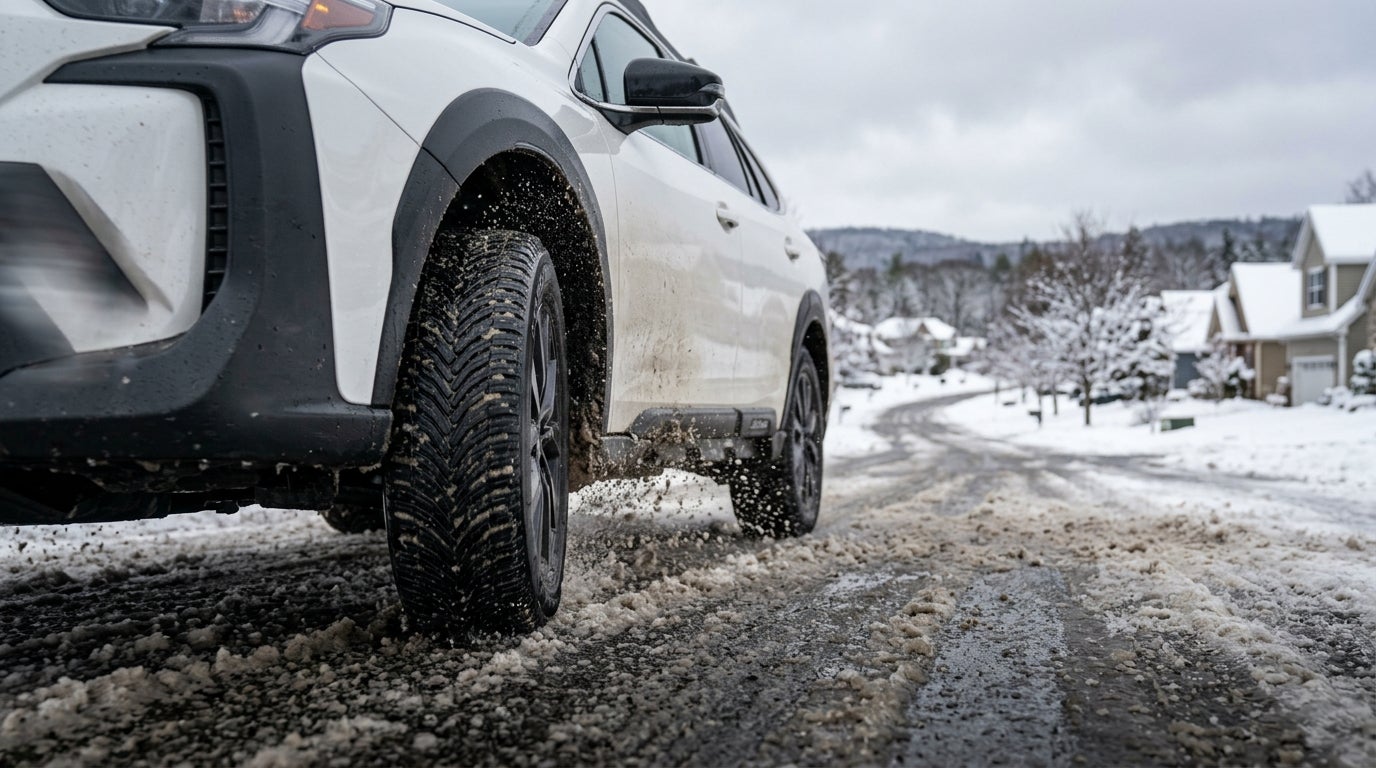
The best replacement tires for a 2025 Subaru Outback delivering all-season traction and severe snow performance are all-weather tires like the Michelin CrossClimate 2 and Continental ControlContact Tour A/S Plus. These tires earn the 3PMSF (Three-Peak Mountain Snowflake) symbol, providing robust grip on slush, ice, and heavy rain without requiring drivers to swap out tires when winter arrives.
Selecting replacement tires for a crossover requires understanding how rubber compounds interact with road conditions and mechanical drive systems. Standard all-season tires use rubber compounds that harden when ambient temperatures drop below 45 degrees Fahrenheit, leading to longer stopping distances on cold pavement. True all-weather tires utilize thermal-reactive silica compounds that stay pliable in sub-freezing temperatures while maintaining structural integrity during hot summer highway driving. Pairing a 3PMSF certified tire with Subaru's standard Symmetrical All-Wheel Drive creates exceptional stability across changing road surfaces. While the AWD transfer clutch manages mechanical torque distribution between front and rear axles, tread design dictates actual surface adhesion. Deep directional tread blocks and high-density 3D sipes actively pump water away from the contact patch and bite into packed snow, allowing driver-assist features like X-MODE® to function at maximum efficiency. For residents navigating the gently rolling residential hills of Ladue during freezing rain and winter snowstorms, having tires engineered for cold-weather adhesion ensures predictable stopping power and steering response. If you have questions about choosing the right tire specification for your routine routes, give our team at our Sunset Hills service center a quick call at (314) 476-9638 for personalized tire recommendations.Table of Contents
- What Are the Original Factory Tire Sizes and Specs for the Subaru Outback?
- Why Must All Four Tires on a Subaru Outback Have Equal Tread Depth?
- How Do Michelin CrossClimate 2, All-Terrain, and Winter Tires Compare for the Outback?
- What Are the Best Budget-Friendly Replacement Tires for the Subaru Outback?
- Which Subaru Outback Model Years and Engines Show the Highest Reliability?
- Common Questions About Subaru Outback Maintenance and Tires
What Are the Original Factory Tire Sizes and Specs for the Subaru Outback?
Original factory tire sizes for the Subaru Outback vary by trim level, utilizing 225/65R17, 225/60R18, or 225/55R19 specifications. Maintaining exact factory load indexes and speed ratings during tire replacement ensures proper cornering balance, speedometer calibration, and sensor operation for advanced safety systems. Subaru matches wheel dimensions and tire profiles to the distinct suspension tuning of each model grade:- 17-inch Fitments: Base trims and rugged models use 225/65R17 tires with a 102T load and speed rating on 17x7.0-inch wheels. The Outback Wilderness features specialized Yokohama GEOLANDAR A/T tires engineered for increased off-road puncture resistance and rim protection.
- 18-inch Fitments: Core trims such as the Premium, Limited, and Touring feature 225/60R18 tires rated at 100H mounted on 18x7.0-inch aluminum-alloy wheels, striking a balance between absorption comfort and responsive road feel.
- 19-inch Fitments: Upper grades including the Limited XT and Touring XT carry 225/55R19 tires rated at 99H on 19x7.0-inch wheels, offering a firmer sidewall profile for enhanced high-speed tracking.
Why Must All Four Tires on a Subaru Outback Have Equal Tread Depth?
All four tires on a Subaru Outback must maintain equal tread depth within a strict 2/32-inch variance to protect the Symmetrical All-Wheel Drive transfer clutch and center differential from severe friction damage. Because power continuously feeds to both front and rear axles, unequal tire circumferences force individual wheels to spin at different speeds, creating constant mechanical stress inside the drivetrain. When one tire has significantly more tread than another, its effective rolling circumference is larger. A brand-new tire with 10/32-inch tread completes fewer revolutions per mile than a worn tire with 4/32-inch tread. On a standard two-wheel-drive vehicle, this variance is unnoticeable. On an all-wheel-drive vehicle, however, the center transfer clutch interprets this rotational difference as wheel slip. The system continuously attempts to lock and adjust power distribution, generating internal heat that rapidly degrades transfer fluid, wears clutch packs, and can eventually lead to complete AWD failure. When drivers bring an Outback in for service with a single unrepairable tire, the question our service team hears most often is whether replacing just one tire will harm the drive system. If the remaining three tires have worn down by more than 2/32-inch, replacing all four tires—or having a single new replacement tire mechanically shaved to match the exact tread depth of the existing set—is required to safeguard the transmission. Similar mechanical tolerances apply across the lineup, including larger crossover options like the Subaru Ascent.How Do Michelin CrossClimate 2, All-Terrain, and Winter Tires Compare for the Outback?
Selecting between Michelin CrossClimate 2 all-weather tires, crossover all-terrain tires, and dedicated winter tires comes down to whether your driving demands year-round versatility, off-road durability, or sub-zero ice traction. For the majority of crossover owners who want strong cold-weather traction without seasonal tire swaps, all-weather options represent the most practical solution. Comparing the primary tire categories highlights key performance differences:- All-Weather Tires (Michelin CrossClimate 2): Feature a thermal-adaptive tread compound and directional V-shaped grooves that excel in wet braking and snow traction. Earning the 3PMSF rating, they deliver dependable winter performance while maintaining a smooth, quiet ride on dry pavement backed by a 60,000-mile treadwear warranty.
- All-Terrain Tires (Falken Wildpeak A/T Trail): Engineered specifically for unpaved roads, these tires feature reinforced sidewalls, chip-resistant rubber compounds, and deeper tread blocks. While they excel on gravel trails and mud, they produce slightly more cabin noise and can reduce fuel economy by roughly 1 to 2 MPG compared to touring tires.
- Dedicated Winter Tires (Bridgestone Blizzak WS90): Feature soft hydrophilic rubber compounds and intense siping designed strictly for packed snow and glare ice. They deliver ultimate winter stopping power, but the soft tread wears rapidly when driven on dry pavement in temperatures above 45 degrees Fahrenheit, requiring a dedicated secondary set of wheels and seasonal storage.
What Are the Best Budget-Friendly Replacement Tires for the Subaru Outback?
Top budget-friendly replacement tires for the Subaru Outback include the General AltiMAX RT45, Kumho Crugen HP71, and Hankook Kinergy PT, which deliver dependable wet traction and high treadwear ratings at an accessible price point. These value-focused tires meet factory load and speed specifications while providing a comfortable highway ride. Key characteristics of top budget replacement options include:- General AltiMAX RT45: Features visual alignment indicators built into the tread to alert drivers to early wear issues, alongside stiff tread blocks that enhance steering response on rain-slicked asphalt.
- Kumho Crugen HP71: Designed specifically for CUV and SUV applications, utilizing noise-canceling tread pitches to keep the cabin quiet during long highway commutes.
- Hankook Kinergy PT: Utilizes a high-grip silica compound and extra-wide circumferential grooves to resist hydroplaning while offering high mileage durability.
Which Subaru Outback Model Years and Engines Show the Highest Reliability?
Recent Subaru Outback generations, particularly fifth-generation (2015–2019) and sixth-generation (2020–2025) models, demonstrate excellent long-term reliability ratings in automotive testing. Independent evaluations from Consumer Reports consistently highlight recent Outback models for strong overall dependability, while J.D. Power places the Outback above average for long-term mechanical quality in the midsize crossover segment. Older model years from 2010 through 2014 show higher rates of owner feedback regarding early Lineartronic® CVT torque converter shudder and oil consumption on early FB25 engines. Modern Outback powertrains are built around two distinct engine designs:- 2.5L Subaru BOXER® Engine: Naturally aspirated and producing 182 horsepower and 176 lb-ft of torque, this engine pairs with a Lineartronic® CVT to achieve up to 26 city / 32 hwy MPG. Updated internal coatings and refined thermal control valves have addressed early-generation oil consumption concerns.
- 2.4L Turbocharged Subaru BOXER® Engine: Available on Limited XT and Touring XT grades, this direct-injection engine generates 260 horsepower and 277 lb-ft of torque. It increases towing capacity to 3,500 pounds and delivers effortless mountain climbing ability while maintaining strong mechanical durability when engine oil service intervals are strictly followed.