Blog

All Sunset Hills Subaru Dealer Sunset Hills New Subaru New Vehicle Reviews Model Comparisons Buying Guides Maintenance & Service Sunset Hills Subaru Service Technology & Innovation Subaru Repair Safety Subaru Road Safety Sunset Hills Subaru EV Dealership Auto Financing 2025 Subaru Crosstrek 2025 Subaru Outback Dealership Financing Hybrid Community Engagement Performance and Engineering Fuel Efficiency Leasing guides Sunset Hills Used Cars Subaru Financing Sunset Hills Subaru Loves Pets 2025 Forester Hybrid Fun Things to Do Near Sunset Hills MO Infotainment Ownership Experience Subaru Motorsports Subaru Share The Love 2024 Outback Automotive History & Evolution Automotive News Automotive Repair Tips Automotive Rumors & Insights Buying & Trade-In Process Guidance Certified Pre-Owned Charging Solutions & Infrastructure Outdoor Adventure & Camping Reliability and Quality Insights Sales Event Subaru Loyalty Program Things to do in Sunset Hills, MO Tire Care & Replacement Trade Up Advantage Vehicle Design & Innovation
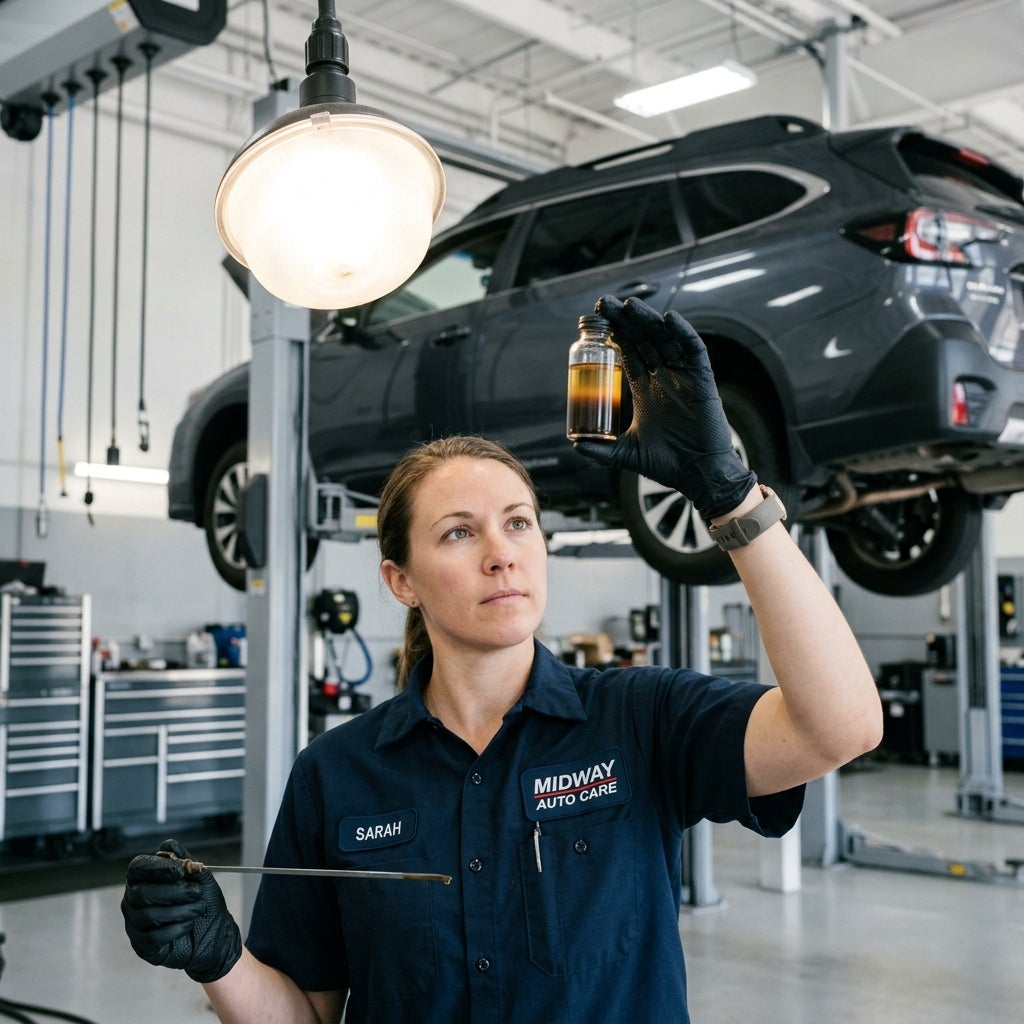
Female mechanic in a workshop inspects a glass sample jar showing fluid separation while holding a dipstick. (Representative image for illustration purposes only. Actual vehicle may vary based on trim and configuration.)

When Should You Replace Subaru CVT Fluid? Service Advisor Bottom-Line Answer

If you open your Subaru owner's manual warranty and maintenance booklet, you will likely see a curious entry under transmission maintenance: inspect fluid every 30,000 miles, replace under severe driving conditions, otherwise listed as lifetime fluid. As a professional service advisor working directly on the service drive in Sunset Hills, MO, my practical advice for Subaru owners in the St. Louis metropolitan area is straightforward: consider verifying the 'lifetime fluid' guidance in your owner's manual if you plan on keeping your Outback, Forester, Crosstrek, or Ascent beyond its warranty period. In our regional driving environment—where winter sub-zero snaps transition rapidly into 95-degree summer days with thick humidity—the real-world strain on a Continuously Variable Transmission (CVT) is substantial. Heavy stop-and-go driving along Watson Road or I-270, towing recreational gear, climbing Ozark hills, or tackling snow-slicked commutes all qualify under Subaru's official 'severe driving' definition. Under these conditions, Subaru explicitly recommends changing the Lineartronic CVTF fluid every 30,000 to 60,000 miles. For suburban commuters who experience light highway cruising with minimal heavy loads, stretching fluid service to 60,000 to 100,000 miles is technically feasible, but waiting longer than 100,000 miles significantly elevates the risk of mechanical slippage, valve body solenoid failure, pulley scoring, and total transmission breakdown. Fresh fluid acts as both a lubricant and a hydraulic power transfer medium; neglecting it is the primary root cause of major transmission claims seen in independent and dealer bays across Missouri. Meet Lucas Scroggs: 3 Years of St. Louis Area Service Experience Hello, I am Lucas Scroggs, Service Advisor at Sunset Hills Subaru. Over my three years serving drivers throughout Chesterfield, Ladue, Maryland Heights, and South County, I have personally checked in thousands of Subaru vehicles for routine oil changes, major interval services, and mechanical repair diagnostics. My daily work revolves around analyzing repair orders, consulting with our master-certified Subaru technicians, and speaking candidly with vehicle owners about maintenance vs. repair expenses. I live and work right here in St. Louis, so I see firsthand how our road conditions, quick temperature swings, and highway congestion impact vehicle longevity. My primary goal on the service drive is transparency. When a client brings in a 2018 Outback with 65,000 miles, they often ask why we recommend a CVT drain and fill when their original owner's manual wasn't aggressive about it. I explain the difference between paper maintenance schedules written by corporate marketing teams and real-world mechanical wear seen on local service lifts. Proactive maintenance preserves driving feel, protects factory warranties, and can help reduce long-term repair costs down the line. Why Subaru's 'Lifetime Fluid' Claim Requires Real-World Context To understand why transmission fluid degrades, you must look at how Subaru Lineartronic CVTs operate. Unlike a traditional automatic transmission with fixed planetary gears, a CVT utilizes a heavy-duty steel chain belt stretched across two hydraulically adjusted conical pulleys. By continuously varying the width of these pulleys, the transmission delivers infinite gear ratios for maximum engine efficiency. Because this metal-on-metal interface relies heavily on friction and hydraulic clamping force, Subaru CVTF fluid contains specialized friction modifiers, anti-foaming agents, and thermal stabilizers. As temperature spikes during heavy summer traffic or extended highway towing, these chemical additives break down through thermal oxidation. Shear forces between the steel belt and pulley faces gradually chop down fluid viscosity. Why does Subaru label it 'lifetime' in standard documentation? In manufacturer terms, 'lifetime' generally refers to the initial vehicle warranty period (often 5 years or 60,000 miles to 100,000 miles under extended factory coverage). However, if your personal definition of 'lifetime' means driving your Forester or Outback to 150,000 or 200,000 miles, leaving the original fluid inside is a high-risk gamble. Furthermore, standard driving conditions rarely exist around St. Louis. Short trips under 5 miles, cold winter starts, summer idling with full air conditioning, and driving on salted roads all trigger Subaru's official 'Severe Driving Condition' criteria. In these instances, fluid replacement is explicit, not optional. Lucas's Service Bay Perspective: a Transmission Replacement vs. a Fluid Drain and Fill "I see it every month in our service lanes: a customer comes in with a shuddering transmission at 110,000 miles having never serviced their CVT fluid. By that time, hydraulic control valves are clogged with microscopic wear debris and internal pulleys are scored. At that point, a simple fluid change won't reverse structural wear—the only option is a complete replacement assembly, which can cost anywhere from $7,000 to $8,500 with labor. Contrast that with a preventive CVT fluid drain and fill, which costs around $300 to $400 depending on the exact model and fluid spec. Performing two or three drain-and-fill services over 120,000 miles costs under $1,000 combined—a massive difference compared to an out-of-warranty transmission replacement. Preventive care isn't an upsell; it's basic financial protection for your investment." — Lucas Scroggs, Service Advisor Schedule CVT Fluid Inspection or Service What Key Maintenance Items Are Required at the 60,000-Mile Service for a Subaru? Fluid Inspections & Services At 60,000 miles, Subaru schedules its major service benchmark. Key items include: • CVT Fluid Service: Inspection for thermal discoloration, varnish smell, or metal particle contamination; recommended drain-and-fill for regional drivers. • Front & Rear Differential Fluids: Replacing gear oil (75W-90) to remove metallic filings generated by AWD clutch packs and differential ring gears. • Brake Fluid Flush: Replacing moisture-absorbed brake fluid to protect internal ABS solenoids. Our technicians utilize specialized Subaru Select Monitor diagnostic tools during the 60k service to verify transmission fluid temperature readouts and engine timing control before releasing the vehicle back to the customer. Engine & Mechanical Tune-Up Essential tune-up elements include: • Spark Plugs: Replacement of long-life Iridium spark plugs (crucial on Boxer engines to maintain optimal air-fuel efficiency). • Engine Air & Cabin Filters: Eliminates intake airflow restrictions and keeps passenger air fresh. • Full Vehicle Inspection: Steering rack boots, suspension bushings, wheel bearings, and drive belt condition check. How Subaru Symmetrical AWD Impacts Tire Wear and Differential Fluid Service Subaru's full-time Symmetrical All-Wheel Drive (AWD) is world-renowned for winter traction and driving stability, but it places unique mechanical demands on your drivetrain. Unlike slip-and-grip reactive AWD systems that only send power rearward when front wheels slip, Subaru systems send power to all four wheels continuously. Because all four wheels are linked through front, center (multi-plate transfer clutch inside the CVT), and rear differentials, tire circumference variance is critical. If tire tread depth varies by more than 2/32 of an inch between tires, the rotational speed difference forces the center clutch pack inside the CVT to slip continuously. This generates excess friction heat, rapidly degrading the CVT fluid and causing premature wear on the transfer clutch plates. To prevent AWD strain and fluid thermal breakdown: 1. Rotate Tires Every 6,000 Miles: Keeping tread wear completely even across all four positions minimizes center differential friction. 2. Service Front & Rear Differential Gear Oil: Over time, gear shearing in differential assemblies breaks down high-viscosity oil. Changing differential fluid every 30,000 to 60,000 miles keeps hypoid gear sets cool and functioning smoothly. 3. Replace Tires as Matched Sets: Never mix tire brands, tread designs, or significantly different tread depths on a Subaru AWD vehicle. What Specific Maintenance Items Make Up Subaru Ownership Costs Over 5 and 10 Years? 5-Year / 60,000-Mile Cost Profile During the first 5 years, Subaru ownership maintenance costs are predictable and modest. Expected maintenance includes 10 synthetic oil & filter changes, 10 tire rotations, cabin and engine air filters, 1 to 2 brake fluid flushes, and 1 major 60,000-mile interval service. Drivers who complete scheduled preventive items early spend significantly less per mile over time. 10-Year / 120,000-Mile Cost Profile Between years 5 and 10, maintenance includes a second 60k major service, brake pad/rotor replacements, cooling system flushes, suspension struts or sway bar links, and 2 CVT fluid drain-and-fill services. While total maintenance is slightly higher than non-AWD competitors like front-wheel-drive sedans, Subaru vehicles retain exceptionally strong resale value, offsetting long-term maintenance costs. Maintenance Milestone Subaru Estimated Cost Toyota AWD Competitor Cost Primary Service Components Included 30,000 Miles (Minor) contact for current pricing $250 - $380 Oil change, tire rotation, air filters, brake inspection, AWD differential check 60,000 Miles (Major) $750 - $1,100 $700 - $980 Boxer spark plugs, brake fluid flush, air filters, CVT fluid drain & fill, diff fluid change 100,000 Miles (Cumulative Total) $3,200 - $4,500 $3,000 - $4,200 All scheduled maintenance, brakes, tires, spark plugs, fluid refreshes over 8-10 years Planning on trading in or upgrading your Subaru? Evaluate your trade-in market value with our quick online tools: Get your value trade or check out our New Subaru Inventory. Value Your Trade Online How Often Does a 2026 Subaru Outback Need an Oil Change and What Viscosity Is Required? For 2026 Subaru Outback models (as well as 2026 Forester and Crosstrek variants), factory-recommended oil change intervals remain strictly 6,000 miles or 6 months, whichever comes first. Following this mileage threshold is critical for preventing internal carbon buildup around the piston rings and protecting variable valve timing (VVT) solenoids. Required viscosity formulas vary depending on engine powertrain trim: • 2.5L 4-Cylinder Naturally Aspirated Boxer: Requires full synthetic 0W-16 or 0W-20 oil meeting API SP / ILSAC GF-6A specifications. • 2.4L Turbocharged Boxer (XT & Wilderness trims): Requires full synthetic 0W-20 high-thermal-stability engine oil. Why is oil viscosity so precise in modern Subaru Boxer engines? Low-viscosity ultra-synthetic oils allow swift oil pressure build-up upon cold startup, reducing engine wear during Missouri winter mornings. Additionally, oil galleries feeding hydraulic timing tensioners rely on clean, un-degraded fluid. Stretching oil changes beyond 6,000 miles can cause oil burn-off, piston ring sticking, and engine sludge, leading to higher maintenance costs later in the vehicle's lifespan. Explore current model information at our New Subaru Outback Inventory page. How Often Do Subaru EyeSight Camera Systems Require Calibration? Subaru EyeSight Driver Assist Technology uses dual stereoscopic camera lenses mounted behind the windshield to manage adaptive cruise control, lane-keep assist, pre-collision braking, and throttle management. Unlike routine maintenance items like filters or oil changes, EyeSight calibration is not scheduled by mileage, but triggered by specific mechanical or body events. EyeSight camera calibration is mandatory whenever: • The front windshield is replaced or removed. • Suspension components are altered (e.g., install of lift kits, replacement of struts/springs that alter ride height). • Wheel alignment is adjusted following major steering repair or severe pothole impact. • Body repair occurs on the front structural frame or bumper assembly. • An EyeSight warning light appears on the instrument cluster. Calibration at Sunset Hills Subaru utilizes specialized target boards positioned at exact millimeter distances in a level bay environment, followed by dynamic road calibration testing using Subaru SSM4 diagnostic interface software. Practical Service Advice: OEM Subaru CVTF Fluid vs Aftermarket Alternatives Exact OEM Fluid Specs Subaru Lineartronic CVTs require precise fluid formulations (CVTF-II, CVTF-III, or High Torque CVTF for 2.4L Turbo models). These fluids are engineered with unique torque-transfer friction coefficients and specific expansion profiles under heat. Mixing incorrect fluids causes chain belt slippage. Technician Check Process Checking fluid levels is not done with a simple dipstick. Technicians must monitor fluid temperature using a diagnostic tool, cycling through gears until fluid temperature reaches exactly 95°F–113°F before inspecting fill plugs on a level lift. Correct temperature monitoring is mandatory. Universal Fluid Risks Generic 'multi-vehicle' aftermarket fluids claim compatibility but frequently fail to maintain required viscosity under sustained loads, leading to shuddering and solenoid seal degradation. Genuine factory parts preserve smooth operation. Find Subaru Parts at our dealership. Order Genuine Subaru Parts & Fluid Do Subaru Boxer Engines Require Special Spark Plug Replacement Procedures? Yes, spark plug service on a Subaru horizontally opposed Boxer engine is distinctly different from traditional inline or V6 engines. Because the engine cylinders lie flat horizontally, the cylinder heads directly face the vehicle frame rails with only a few inches of clearance on either side. Changing Boxer spark plugs requires removing the air intake box, battery, and engine bay accessories to gain access. Technicians use specialized flexible swivel extensions, thin-wall spark plug sockets, and exact torque specifications to avoid cross-threading aluminum cylinder heads or damaging coil packs. Because this labor is more involved, Subaru utilizes long-life Iridium spark plugs rated for 60,000 miles. Replacing plugs on schedule ensures complete fuel combustion, prevents ignition misfires under heavy load, and protects fragile catalytic converters. Schedule Your Subaru CVT and Preventative Maintenance at Sunset Hills Subaru Whether your Forester is approaching 30,000 miles or your Outback is due for its major 60,000-mile service, our factory-trained team at Sunset Hills Subaru is ready to assist you. Consult directly with Lucas Scroggs and our certified advisors for tailored maintenance advice built around your local driving habits. Visit our facility at 10100 Watson Rd, Sunset Hills, MO 63127. Get Directions to Sunset Hills Subaru or Call us at (314) 476-9638 to speak with our service team directly. Review our Current Service and Parts Information before booking your appointment online! Schedule Service and Diagnostics Subaru CVT Fluid Service in Sunset Hills MO | Sunset Hills Subaru
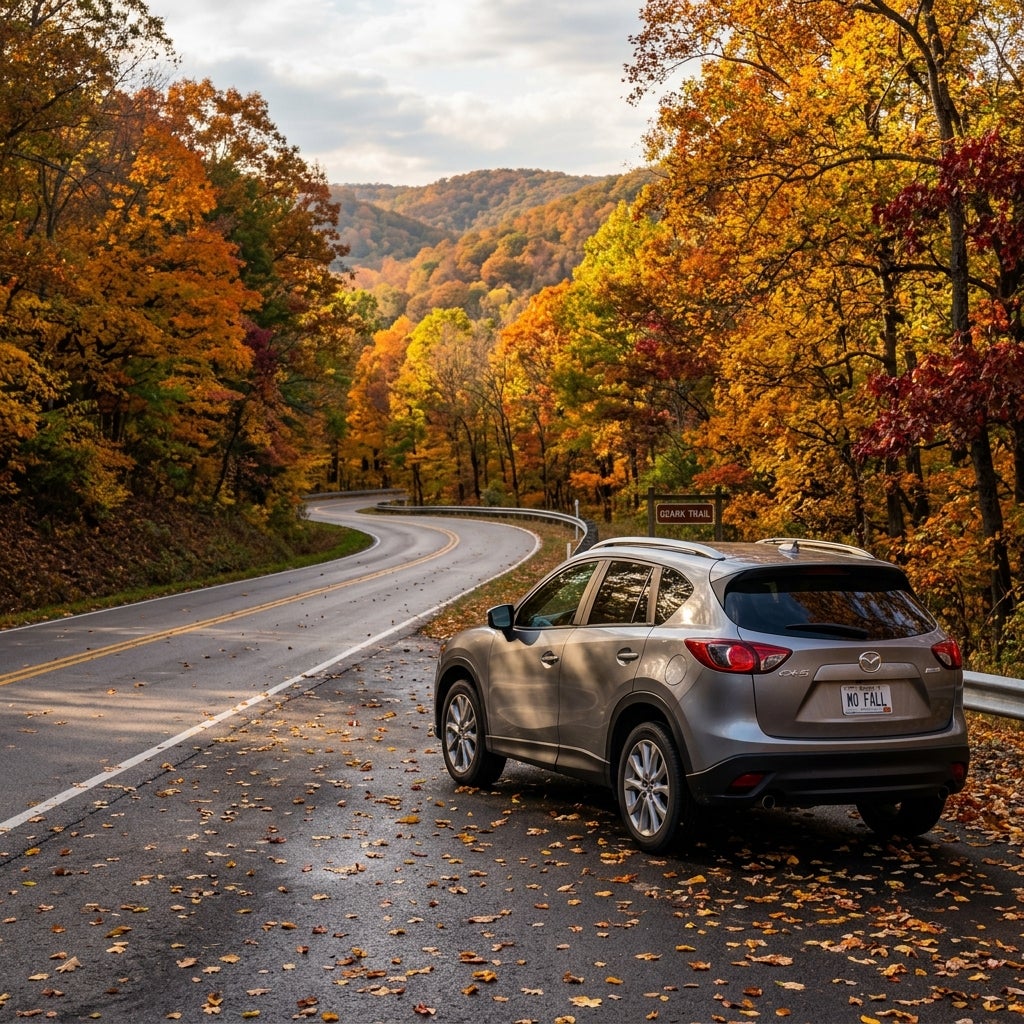
Silver SUV parked on the side of a winding road surrounded by colorful autumn trees. (Representative image for illustration purposes only. Actual vehicle may vary based on trim and configuration.)

Missouri Fall Foliage Peak Schedule: Planning Your Subaru Outback Foliage Drive West of Sunset Hills

As crisp autumn breezes descend across the Midwest, eastern Missouri transforms into a breathtaking tapestry of fiery reds, deep ambers, and brilliant golds. For drivers starting out from Sunset Hills, autumn represents the premier season for day trips west toward Wildwood, Chesterfield, and the winding bluffs of the Missouri and Meramec River Valleys. Knowing precisely when fall colors reach their zenith is the secret to planning an unforgettable foliage tour. In the Greater St. Louis metropolitan area and West County corridors, peak fall color typically arrives during mid-to-late October, while the deeper elevation shifts of the southern Ozark Highlands reach their crowning glory from late October through early November. Aligning your scenic road trips with this natural timeline ensures you experience peak vibrancy across diverse Missouri landscapes. Navigating these regional drives requires a vehicle designed to handle seasonal shifts effortlessly. The Subaru Outback stands out as the ultimate autumn companion, equipped with standard Symmetrical All-Wheel Drive for unyielding traction on damp, leaf-covered asphalt, along with 8.7 inches of ground clearance to confidently explore unpaved forest pulloffs, rural gravel access roads, and scenic overlook trails. Whether embarking on a brisk afternoon drive along Route 100 or preparing a weekend excursion into the heart of the Ozarks, understanding the timing of Missouri's foliage shift lets you capture the season at its absolute finest. When Does Fall Color Usually Peak Across Missouri Regions? Missouri's autumn leaf progression moves gradually from north to south, dictated by shifting day lengths, nocturnal temperatures, and regional topography. In Northern Missouri, cool September nights initiate early color changes among black walnuts, ash, and early maples, bringing peak viewing opportunities during the first two weeks of October. For St. Louis County locations such as Sunset Hills, Wildwood, and Chesterfield, the sweet spot for peak foliage unfolds between October 15th and October 28th. During this two-week window, sugar maples display intense oranges and scarlet tones, while native red oaks and hickories provide a rich golden backdrop across Babler State Park and Rockwoods Reservation. Missouri Region Typical Peak Window Primary Tree Species Northern Missouri Early to Mid-October Ash, Black Walnut, Soft Maple St. Louis County & Wildwood Mid-to-Late October Sugar Maple, Red Oak, Shagbark Hickory Southern Ozark Highlands Late Oct to Early Nov White Oak, Dogwood, Shortleaf Pine, Sycamore Further south, the elevated ridge lines and sheltered hollows of the Ozark Highlands absorb warmth slightly longer, holding their peak color until late October or early November. Flowering dogwoods turn deep magenta while shortleaf pines offer brilliant evergreen contrast against golden white oaks. By tracking this regional cadence, Sunset Hills drivers can extend their foliage season across nearly six full weeks of weekend drives. Scenic Day-Trip Routes West of Sunset Hills: Route 100, Highway 94, and Historic Route 66 Route 100 Corridor Departing Sunset Hills west along Manchester Road (Route 100) leads directly through the rolling wooded hills of Ellisville and Wildwood. This paved arterial twists along historic ridgelines past Glencoe and St. Albans, offering lush maple and oak canopies overhead. The Subaru Outback handles tight curves with car-like precision, making this a relaxing afternoon loop. Highway 94 Wine Route Crossing the Missouri River via Highway 40/61 toward Defiance unlocks Highway 94, a classic river bluff drive winding past historic vineyards in St. Charles and Warren counties. Towering limestone bluffs frame sweeping views of golden river bottoms, where hickory trees glow in late October sunlight. Historic Route 66 Byway Heading southwest along Interstate 44 to Old Route 66 at Pacific and Eureka leads drivers along the scenic Meramec River basin. Crimson sumacs, yellow sassafras, and purple ash trees line the two-lane highway, providing a nostalgic backdrop ideal for a crisp fall morning road trip. Conservation and Forest Areas Near Wildwood with Paved Outback Access Drivers seeking up-close foliage encounters without navigating rough unpaved trails will find exceptional options around Wildwood and West County. Rockwoods Reservation features paved access roads leading to peaceful picnic areas and the Glencoe trailhead, allowing visitors to park under dense hardwood forest canopies. Dr. Edmund A. Babler Memorial State Park offers expansive paved loop drives, scenic stone overlooks, and gentle grade parking areas tailored for effortless exploration. Just across the Missouri River, Weldon Spring Conservation Area boasts paved roads up to panoramic bluff overlook parking lots, ideal for taking in vibrant valley panoramas. Browse New Subaru Outback Inventory Why the Subaru Outback is Built for Missouri Autumn Scenic Drives Autumn driving in Missouri brings unique road challenges—from morning river fog slicking curved bluff passes to wet, fallen leaves that dramatically reduce pavement traction. The Subaru Outback is purposefully engineered to turn seasonal driving obstacles into effortless adventures. At the heart of every Outback is Subaru's standard Symmetrical All-Wheel Drive system, which continuously distributes power to all four wheels for optimum grip on slippery asphalt or damp gravel pulloffs. Coupled with 8.7 inches of ground clearance (and up to 9.5 inches on Outback Wilderness models), drivers can pull off safely onto unpaved shoulders to photograph peak colors without worrying about underside scrapes or getting bogged down in loose soil. On narrow, twisting county backroads, EyeSight Driver Assist Technology provides an added layer of security with Adaptive Cruise Control and Pre-Collision Braking. Inside, up to 76 cubic feet of cargo space easily holds hiking boots, warm jackets, camera tripods, and picnic hampers, while available heated front and rear seats ensure cozy cabin comfort during brisk October mornings. Extending Your Foliage Tour: Driving South from Sunset Hills into the Ozark Highlands When St. Louis County foliage begins to fade late in the month, a weekend trip south into the Ozark Highlands opens up a fresh canopy of color. Designated scenic routes like Highway 19, running south through Salem toward the Ozark National Scenic Riverways, present sweeping mountain ridges filled with bronze oak, bright yellow sycamore, and vibrant dogwood. Another standout drive is Highway 68 toward Meramec Spring Park near St. James, where crystal-clear spring waters reflect golden canopies. These extended day trips or overnight stays benefit from the Outback's refined highway ride, responsive steering, and impressive fuel efficiency, letting you cover hundreds of scenic miles with total peace of mind. Autumn Driving Preparation: Fall Service and Tire Checks at Sunset Hills Subaru Tire Tread & Pressure Cooling fall temperatures cause tire inflation pressures to drop. Ensuring adequate tread depth is critical for maintaining traction over slick, wet leaves and damp highway asphalt during October rains. Wipers & Visibility Morning valley fog along the Missouri River requires crystal-clear windshield wiping. Fresh wiper blades and filled washer fluid keep your forward view sharp during low-sun autumn drives. Brake System Check Navigating downhill Ozark switchbacks puts added demand on your vehicle's braking system. Have certified technicians inspect pads and rotors before setting off. Schedule Service and Diagnostics at Sunset Hills Subaru today. Leaf-Peeping Pitstops: Dining, Wineries, and Parks in Chesterfield and Augusta No foliage drive is complete without rewarding pitstops along the way. In historic Augusta, scenic outdoor winery terraces overlook golden valleys along the Katy Trail. Nearby Klondike Park offers towering white silica bluffs surrounded by vibrant woods, complete with dog-friendly walking trails and paved parking lots suited for the Subaru Outback. Heading back through Chesterfield, local orchards and farm markets provide seasonal treats like fresh apple cider and cider donuts. Stop by Faust Park to explore historic 19th-century architecture framed by mature oaks, offering convenient parking and ideal photo opportunities. Check Current Service and Parts Offers Navigating Fall Weather and Road Conditions in St. Louis County and Beyond Autumn brings shifting atmospheric conditions to Missouri roadways. Dense morning fog frequently forms along river basins like the Missouri and Meramec, sharply reducing visibility near low-lying bridges and sweeping turns. Utilizing fog lights and reducing speed helps ensure safe passage through morning valleys. Wet fallen leaves represent another stealth hazard, acting like ice under braking tires. When driving shaded curves in state parks or heavily wooded county roads, maintain gentle throttle inputs and leave extra braking distance. Additionally, October marks peak white-tailed deer activity across rural St. Louis and Franklin Counties; remaining alert during dawn and dusk drives protects both wildlife and your vehicle. Equipping Your Outback for Autumn Road Trips: Genuine Subaru Accessories All-Weather Floor Liners Protect cabin carpeting from damp trail mud, fallen leaves, and autumn rain with custom-fit rubber floor liners designed specifically for your Outback floorplan. Thule Cargo Carriers Expand your gear carrying capacity with lockable Thule roof cargo boxes or crossbar attachments, perfect for carrying camping gear, folding chairs, or extra luggage. Rear Bumper Cover Guard painted surfaces against scratches when loading heavy picnic coolers or photo equipment. Order original parts online through our Find Subaru Parts tool. Upgrading Your Autumn Ride: Trade-In Valuations and New Outback Inventory in Sunset Hills If you are planning to upgrade your current vehicle before foliage season begins, Sunset Hills Subaru makes trading in seamless. High demand for quality pre-owned vehicles means your current car may be worth more than you think. You can easily Get your value trade online in minutes. Once you know your vehicle's trade value, our friendly finance team can help you Get approved for financing with current financing options available to qualified shoppers. Value Your Trade Online Today Explore our expansive showroom inventory featuring the latest Outback trims—from the well-appointed Outback Premium and luxurious Touring to the trail-ready Outback Wilderness. Each model features state-of-the-art STARLINK Multimedia and Harman Kardon audio to play your ideal autumn playlist. Be sure to view our Current New Car Inventory and browse our full New Subaru Inventory to find the ideal color and configuration for your upcoming foliage drives. Visit Sunset Hills Subaru to Start Your Missouri Fall Foliage Adventure Today Peak autumn color in Missouri is a fleeting, magical season. Whether you are aiming for mid-October drives through Wildwood and Babler State Park or planning a late-October journey into the Ozark Highlands, having your vehicle fully prepared ensures a stress-free trip. Stop by Sunset Hills Subaru at 10100 Watson Rd in Sunset Hills, MO 63127 to test drive a new Subaru Outback, consult with our local experts on road trip prep, or schedule seasonal maintenance before the colors peak. Ready to hit the road? Get Directions to Sunset Hills Subaru or Call us at (314) 476-9638 to speak with our dedicated team today! Get Directions to Sunset Hills Subaru Missouri Fall Colors Guide in Sunset Hills MO | Sunset Hills Subaru
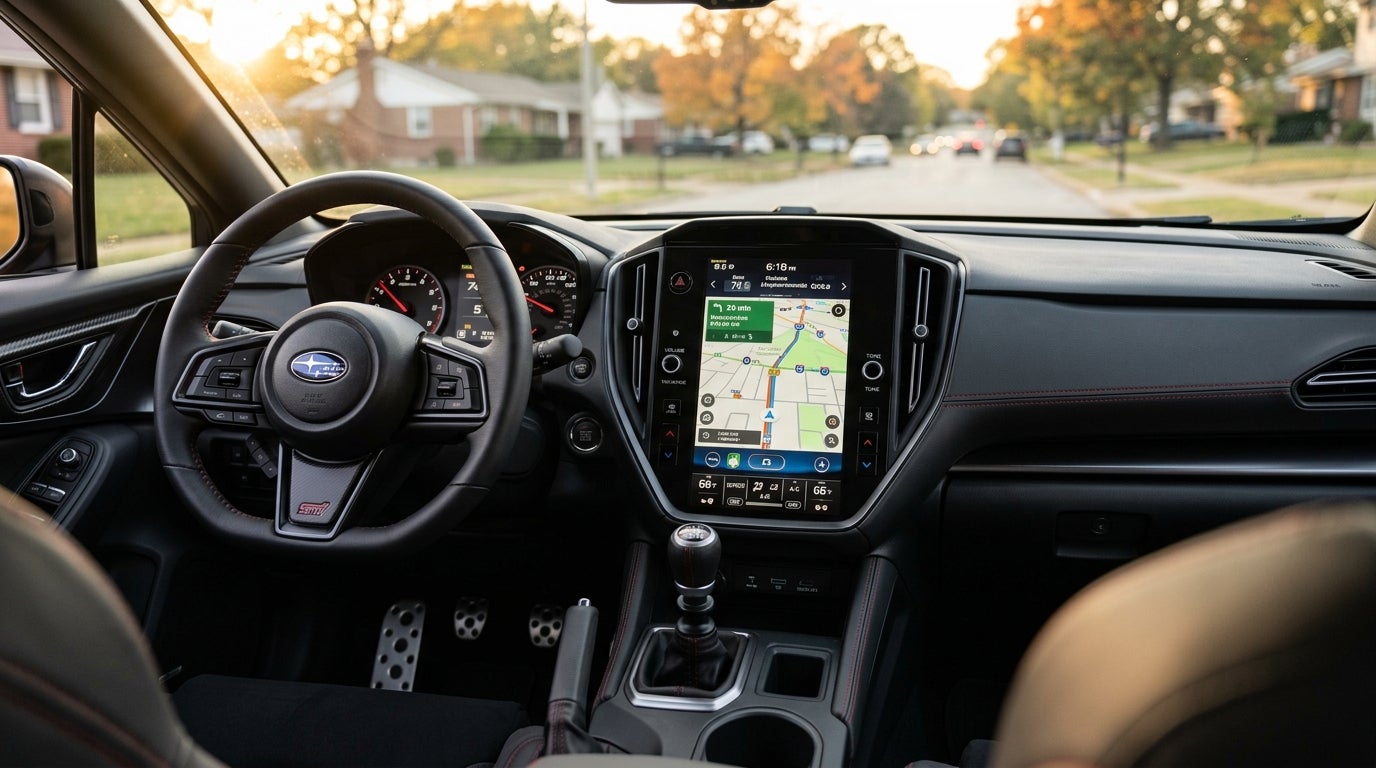
Driver seat view of a Subaru interior with a large vertical touchscreen, STI steering wheel, and manual transmission. (Representative image for illustration purposes only. Actual vehicle may vary based on trim and configuration.)

Direct Answer: How Subaru WRX and Hyundai Elantra N Interior Tech Compare

When pitting the 2026 Subaru WRX against the 2026 Hyundai Elantra N in the high-stakes arena of sport compact interior technology, driver focus and real-world usability emerge as the defining dynamic. The Subaru WRX anchors its cabin with an intuitive, vertically oriented 11.6-inch Subaru STARLINK multimedia touchscreen. Crucially for drivers in Sunset Hills, Arnold, and across greater St. Louis, this high-resolution tablet-style system preserves physical, tactile buttons for high-frequency adjustments like dual-zone climate temperature, windshield defrosters, and volume control. Powered by an interface designed for effortless split-screen functionality, the WRX seamlessly integrates standard wireless Apple CarPlay and Android Auto alongside real-world vehicle telemetry, all while backed by Subaru Symmetrical All-Wheel Drive tracking controls. Conversely, the Hyundai Elantra N takes a twin-monolithic screen approach, pairing dual 10.25-inch horizontal displays housed behind a single continuous glass panel. While the Elantra N provides exhaustive track-focused telematics—including G-force meters, lap timers, and engine oil temperature graphs within its N-Mode interface—it relies far more heavily on sub-menu navigation and capacitive touch controls. For daily commuters navigating unpredictable Midwest weather, icy morning windshields, or bumpy asphalt along I-270 and Watson Road, the WRX offers superior ergonomics, immediate control response, and tactile reassurance that doesn't require taking your eyes off the road. Drivers looking to explore this blend of rally-bred capability and modern connected technology can browse our New Subaru WRX Inventory at Sunset Hills Subaru today. Touchscreen Layouts: Subaru STARLINK 11.6-Inch Portrait vs. Hyundai Dual 10.25-Inch Displays Screen orientation drastically changes how information is processed while driving. The Subaru WRX features a 11.6-inch portrait (vertical) display that mimics modern smartphone ergonomics. This vertical layout allows turn-by-turn navigation maps to show significantly more of the route ahead—an indispensable benefit when navigating complex highway interchanges around Chesterfield, Maryland Heights, or downtown St. Louis. Furthermore, Subaru engineers recognized that touchscreens should complement, not replace, primary driving functions. Dedicated physical knobs for audio volume and tuning, along with heavy-duty toggle buttons for temperature regulation, mean you can adjust cabin comfort while wearing winter gloves without taking your eyes off the road. Subaru's high-contrast screen coating is specially formulated to resist glare even during harsh afternoon sunlight streaming through the side glass. Split-screen software functionality keeps audio selection, vehicle telemetry, and smartphone mirroring visible simultaneously, eliminating deep menu digging while behind the wheel. In contrast, the Hyundai Elantra N utilizes a horizontal layout composed of two side-by-side 10.25-inch screens. While aesthetically sleek and modern, the horizontal orientation presents map information differently. The Elantra N places climate adjustments within touch-sensitive panels and screen menus. Under direct sunlight—especially through open sunroofs on clear Midwest summer days—the high-gloss continuous glass panel on the Elantra N can suffer from glare and visible fingerprint smudges. Reach ergonomics also favor the WRX. Because the 11.6-inch STARLINK display extends downward toward the center console, key touch targets sit closer to the driver's natural hand resting position near the shift lever, reducing shoulder movement and driver fatigue on longer highway trips. Display Attribute Subaru WRX STARLINK Hyundai Elantra N Dual Displays Screen Dimensions 11.6-inch Vertical Portrait Touchscreen Dual 10.25-inch Horizontal Displays Primary Climate Controls Tactile Physical Buttons & Knobs Capacitive Touch Screen / Digital Panel Navigation Map View Extended Vertical Corridor View Wide Horizontal Panoramic View Glare & Fingerprint Resistance Anti-Reflective Matte Finish High-Gloss Glossy Glass Surface Split-Screen Usability Permanent Top/Bottom Customizable Zones Side Widget Sliding Cards Digital Gauge Clusters, Track Telematics, and Performance Displays Subaru WRX Driver Center The Subaru WRX features traditional analog tachometer and speedometer gauges flaking an executive central Driver Information Center display. This hybrid layout gives motor enthusiasts what they love most: physical needle response during aggressive gear shifts, combined with crisp digital data. The central screen outputs instant turbo boost pressure (PSI), oil temperature, torque vectoring distribution, and EyeSight safety telemetry without overwhelming visual clutter during night driving. Elantra N Digital Cluster The Elantra N uses a full 10.25-inch digital instrument cluster that shifts graphics dramatically when switching drive modes. In N-Mode, it centers a large circular tachometer surrounded by real-time lap timers, g-force meters, brake pressure graphs, and oil/coolant temperature gauges. While visually striking for weekend track day participants, the graphics can feel busy during normal commutes through St. Louis traffic. For daily driving reliability, analog dials combined with high-contrast digital displays offer instantaneous readability without screen lag or boot-up delay in extreme temperatures. Premium Cabin Audio: Harman Kardon Sound in WRX vs. Bose in Elantra N A high-performance commute demands an acoustic environment that can drown out road rumble without sacrificing clarity. The Subaru WRX offers an available 11-speaker Harman Kardon premium audio system driven by a high-output 504-watt equivalent class-D amplifier. Featuring GreenEdge technology that delivers powerful sound dynamics while drawing minimal electrical energy, this system includes dedicated dashboard tweeters, mid-range door drivers, and a specialized rear-subwoofer tuned precisely for the acoustic geometry of the WRX cabin. Subaru engineers paid meticulous attention to sound insulation in the global platform chassis, introducing floor damping sheets, acoustic windshield glass, and foam-filled pillar cavities. The result is a quiet cabin foundation that allows the Harman Kardon system to deliver punchy bass, pristine vocal clarity, and immersive staging whether cruising on I-55 toward Arnold or tackling winding backroads in St. Louis County. The Hyundai Elantra N comes equipped with an 8-speaker Bose sound system. While capable of high volume, the aggressive exhaust note and stiffer sound deadening compromises in the Elantra N mean high-frequency road noise on grooved highway pavement can overpower subtler audio details. Music lovers prioritizing rich acoustic depth during daily drives may appreciate the WRX Harman Kardon setup. To experience this acoustic clarity firsthand, check out our Current New Car Specials. Explore New Subaru WRX Models Wireless Smartphone Integration, Navigation, and Connected Services In today's connected world, seamless smartphone integration is non-negotiable. The 2026 Subaru WRX comes equipped with standard wireless Apple CarPlay and Android Auto across its main trim levels, connecting automatically within seconds of starting the vehicle. You can keep your phone safely stowed in your pocket or placed on the wireless charging pad without dealing with tangled USB cords around your shifter. Furthermore, Subaru STARLINK Safety and Security offers comprehensive remote access via your smartphone. St. Louis drivers can utilize remote engine start with climate control pre-conditioning, remote door lock/unlock, vehicle locator services, and instant SOS Emergency Assistance. On cold Missouri winter mornings, being able to warm your WRX cabin and turn on heated seats from your kitchen is a true luxury benefit. While the Hyundai Elantra N includes Bluelink connected services and built-in navigation, historical software updates have required wired connections for certain smartphone features on specific screen configurations. Subaru's ecosystem prioritizes immediate connection stability, ensuring your maps and playlists launch flawlessly every time you start your journey. How the 2026 WRX Base Trim Equipment Compares on Value A crucial structural advantage for smart shoppers in Sunset Hills and Arnold is Subaru's trim strategy. For 2026, Subaru continues to offer the reintroduced WRX Base trim, positioning real performance enthusiasm at an extraordinarily competitive starting MSRP. While the Elantra N is sold essentially as a single, fully loaded high-cost model pushing near or beyond the $35,000 threshold, the WRX Base trim delivers the exact same 2.4-liter turbocharged BOXER engine, track-tuned suspension, and standard Symmetrical All-Wheel Drive system at a significantly lower entry price point. This strategy means payment-driven buyers cross-shopping these two sport compacts don't have to sacrifice performance or essential technology to fit your needs. Even on entry models, standard features include dual center touchscreens or available STARLINK updates, automatic climate control, LED headlights, and full smartphone integration. For current lease or finance information, the WRX Base and Premium trims offer while providing four-wheel traction that the front-wheel-drive Elantra N cannot match at any price point. Buyers can explore options and get pre-approved quickly by visiting our secure portal to Get approved for financing. At Sunset Hills Subaru, our sales team can demonstrate how the WRX Base trim provides the core driving thrills, interior technology, and standard safety equipment enthusiast drivers demand—leaving extra budget in your pocket for accessories, performance tires, or regional road trips. Engine Displacement, Power Specs, and All-Wheel Drive Realities in St. Louis Subaru 2.4L Turbo BOXER The WRX features a large-displacement 2.4-liter turbocharged direct-injection Subaru BOXER engine producing 271 horsepower and 258 lb-ft of flat torque curve. The horizontally opposed piston design drops the engine's center of gravity drastically, improving cornering balance without requiring ultra-stiff, kidney-rattling suspension tuning. Hyundai 2.0L Turbo Inline-4 The Elantra N uses a smaller 2.0-liter turbocharged inline-four rated at 276 horsepower and 289 lb-ft of torque. While high on peak output, all that torque flows exclusively through the front wheels. Despite an electronic limited-slip differential, front-wheel-drive handling characteristics can vary during hard launches on slick pavement. In St. Louis, where fall leaves, rain, and winter snow affect Ladue, Arnold, and Sunset Hills roads, Subaru Symmetrical AWD continuously distributes power for instant, confidence-inspiring grip that no front-wheel-drive sports car can match. Transmission Price Deltas, Fuel Economy Ratings, and 3-to-5-Year Resale Value Transmission choices impact both upfront purchasing cost and long-term driving engagement. The Subaru WRX comes standard with a precise, short-throw 6-speed manual transmission that puts full mechanical control in the driver's hands. For those seeking automated convenience, the Subaru Performance Transmission (SPT) automatic offers paddle-shift rev matching, faster upshifts, and full integration with EyeSight Driver Assist Technology. Metric / Feature 2026 Subaru WRX 2026 Hyundai Elantra N Standard Transmission 6-Speed Manual 6-Speed Manual Optional Automated Trans Subaru Performance Transmission (SPT) 8-Speed Dual-Clutch (DCT) Optional Trans Price Delta Contact us for current pricing ~$1,500 DCT option markup EPA Estimated MPG (Manual) 19 City / 26 Hwy / 22 Combined 21 City / 28 Hwy / 24 Combined Projected 3-Year Resale Retention ~64% (Segment Leader) ~56% Projected 5-Year Resale Retention ~52% ~43% While EPA fuel economy ratings slightly favor the front-wheel-drive Elantra N during highway cruising, the Subaru WRX overwhelmingly recaptures that value on the back end through industry-leading resale performance. Historical automotive data consistently rates the Subaru WRX among the top sports cars for value retention after 3 and 5 years. Standard All-Wheel Drive, proven reliability, and legendary enthusiast demand across North America make pre-owned WRX models highly prized, insulating owners against rapid depreciation. Get Approved For Financing Subaru Factory Warranty Coverage, Maintenance Expectations, and Tire/Brake Wear Every new 2026 Subaru WRX is backed by a comprehensive factory warranty suite, including a 3-year/36,000-mile New Vehicle Limited Warranty, a 5-year/60,000-mile Powertrain Limited Warranty, and 3 years/36,000 miles of 24/7 Roadside Assistance. While Hyundai promotes a longer powertrain duration, Subaru's proven mechanical component architecture and extensive local dealership support network deliver incredible peace of mind. High-performance sports sedans require diligent maintenance. Because both the WRX and Elantra N feature sticky summer compound tires and high-friction brake systems, owners should expect tire wear intervals around 20,000 to 30,000 miles depending on driving style. However, Subaru's Symmetrical AWD spreads propulsion forces evenly across all four tires, reducing premature front tire shoulder scrub that aggressively plagues front-wheel-drive performance cars like the Elantra N. To keep your vehicle operating at peak efficiency, Sunset Hills Subaru offers state-of-the-art facility support. Drivers can conveniently Schedule Service and Diagnostics online with our factory-trained Subaru technicians. Daily Comfort and Interior Ergonomics for Chesterfield and Arnold Commuters WRX Seating Versatility The Subaru WRX features standard performance-designed front seats with high-bolstered support wrapped in durable, breathable performance cloth or Ultrasuede with red contrast stitching. Optional Recaro performance seats provide race-ready hold while retaining comfortable cushioning for daily 45-minute commutes on highway 141 or I-44. Elantra N Bucket Seats The Elantra N comes standard with N Light Sport Bucket seats featuring an illuminated N logo. While striking, the fixed headrests and extra-firm side bolsters can prove restrictive or uncomfortable during long road trips or for drivers with broader shoulders. Cargo & Passenger Utility The WRX provides exceptional rear passenger legroom and headroom, comfortably accommodating adult passengers. Its wide-opening trunk and 60/40-split folding rear seatbacks allow easy loading of sports gear, luggage, or hardware supplies, making it a true 365-day family sports sedan. Lease Information, Trade-In Valuations, and Financing for St. Louis Drivers At Sunset Hills Subaru, we make it easy to explore options for a new 2026 Subaru WRX. We offer competitive manufacturer lease programs, low-APR financing rates through Subaru Motors Finance, and customized payment plans tailored to your financial goals. If you are currently driving an older WRX, STI, or competing sport compact like a Civic Si or GTI, our pre-owned team is offering competitive trade-in values for clean trade-in vehicles. Take advantage of market demand and discover what your current vehicle is worth by visiting our easy tool to Get your value trade. Whether you are looking for current lease and finance options, our finance department works directly with national lenders and local St. Louis credit unions to explore current financing options. Browse our online tools today to start your financing pre-approval and explore payment options, and contact us about current incentives before visiting our showroom. Value Your Trade Online Test Drive the 2026 Subaru WRX at Sunset Hills Subaru Today Reading about specs and screen dimensions is one thing, but sitting in the driver's seat, experiencing the tactile response of the 11.6-inch STARLINK multimedia display, and feeling the turbocharged thrust of Symmetrical All-Wheel Drive is an experience best enjoyed in person. Sunset Hills Subaru proudly serves drivers across Sunset Hills, Arnold, Chesterfield, Ladue, and the greater St. Louis metropolitan area. Visit our showroom at 10100 Watson Rd, Sunset Hills, MO 63127 to inspect our current inventory, test out the Harman Kardon audio system, and take a 2026 WRX for a spin. Ready to take the next step? Get Directions to Sunset Hills Subaru or Call us at (314) 476-9638 to schedule your personalized tech demonstration with our product specialists today. Shop New Subaru Inventory 2026 Subaru WRX Interior Tech in Sunset Hills MO | Sunset Hills Subaru
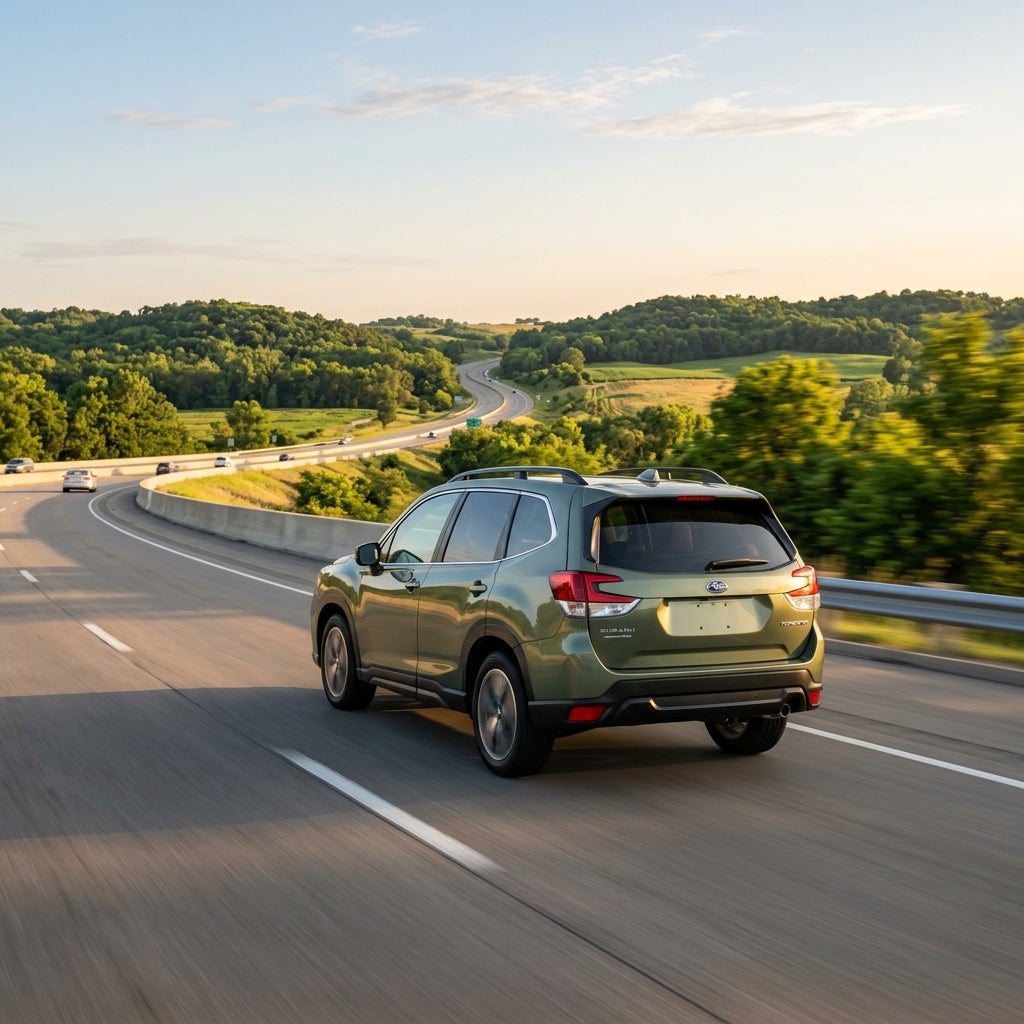
Green Subaru SUV driving along a winding highway through scenic green hills during golden hour. (Representative image for illustration purposes only. Actual vehicle may vary based on trim and configuration.)

Does Subaru Symmetrical AWD Hurt Fuel Economy? The Real MPG Comparison for Forester and Rivals

For decades, automotive folklore suggested that choosing an all-wheel-drive vehicle meant accepting a severe penalty at the fuel pump. Drivers believed that sending power to all four wheels required dragging around hundreds of pounds of extra mechanical hardware, causing fuel efficiency to plummet by 4 to 6 miles per gallon. However, modern automotive engineering—specifically Subaru Symmetrical All-Wheel Drive combined with the advanced Lineartronic Continuously Variable Transmission (CVT)—has completely rewritten that narrative. In popular compact crossovers like the Subaru Forester, Symmetrical AWD achieves up to an EPA-estimated 26 city / 33 highway MPG, virtually matching front-wheel-drive-based competitors and outperforming many rival AWD systems. When evaluating models like the Subaru Forester against primary market rivals such as the Honda CR-V, Toyota RAV4, and Nissan Rogue, the actual fuel economy variance between Subaru full-time AWD and rival part-time AWD options shrinks to a negligible 1 to 2 MPG under routine driving conditions. More importantly, while competitor entry-level models force buyers to choose between standard two-wheel drive or paying a heavy cost upgrade for a reactive AWD system, every gasoline-powered Forester comes standard with Subaru signature full-time Symmetrical AWD. Explore our New Subaru Forester Inventory to see how efficiency and standard capability come together in person. What Makes Subaru's Symmetrical All-Wheel Drive Mechanically Different From Competitor Systems? The fundamental efficiency and performance advantage of Subaru Symmetrical AWD lies in the core architecture of the vehicle. Unlike rival compact crossovers that are engineered primarily as front-wheel-drive platforms with secondary AWD components bolted on as an afterthought, every Subaru vehicle is designed from the ground up around a longitudinally mounted Subaru BOXER engine and a straight-line drivetrain. The horizontal layout of the Boxer engine sits inline with the transmission, creating a perfectly balanced, symmetrical power flow along the vehicle centerline. In typical front-wheel-drive-based competitors, the engine is mounted transversely (sideways). To send power to the rear wheels, power must change direction multiple times through complex power transfer units (PTUs), 90-degree bevel gears, and asymmetrical axle shafts. Each mechanical direction change introduces parasitic energy loss, mechanical friction, and heat generation—the exact culprits that steal fuel efficiency. Subaru linear layout eliminates transverse power redirects, delivering engine power directly to the front and rear axles with maximum efficiency. Furthermore, Subaru equal-length front and rear half-shafts mean rotational inertia is distributed evenly across all four wheels. This structural balance minimizes chassis roll, prevents torque steer, and allows the tire contact patches to work in complete harmony, ensuring zero wasted fuel when accelerating out of corners or navigating wet roadway transitions around Sunset Hills. What Is the Difference Between Full-Time AWD and Slip-and-Grip AWD? To understand fuel economy ratings, consumers must understand the mechanical distinction between continuous full-time AWD and reactive 'slip-and-grip' part-time systems. Most competing compact SUVs operate as 100% front-wheel-drive vehicles during normal conditions. When internal wheel-speed sensors detect tire slippage on wet pavement or ice, an electromagnetic clutch pack engages to send power backward to the rear wheels. While this design is intended to preserve fuel when cruising, it introduces a noticeable lag before traction is restored, creating unpredictable handling during sudden maneuvers. Subaru Symmetrical AWD operates continuously. In vehicles equipped with the Lineartronic CVT, Subaru uses an Active Torque Split AWD system that continuously distributes power—typically maintaining a 60:40 front-to-rear torque split under normal driving. Electronic sensors track accelerator position, wheel speed, steering angle, and yaw rate to instantly adjust torque distribution before tire slip occurs. Many drivers assume continuous power delivery would consume drastically more fuel than a part-time system. However, modern Subaru Lineartronic CVTs utilize high-efficiency hydraulic pumps, ultra-low viscosity fluid, and adaptive lock-up torque converters that reduce internal friction loss to near zero. Because the system is constantly engaged, there is no sudden mechanical shock or heavy hydraulic pump spool-up required to engage secondary axles. The result is seamless, continuous 4-wheel stability with fuel economy ratings that rival part-time systems. You enjoy true full-time winter confidence on icy St. Louis highways without paying a heavy penalty at the gas pump every week. Subaru Forester vs. RAV4, CR-V, and Rogue: A Head-to-Head MPG and Pricing Comparison Vehicle & Drivetrain Standard AWD? EPA Fuel Economy (City/Hwy/Comb) Starting MSRP (Est. Base) AWD Option Upcharge Subaru Forester 2.5L AWD Standard 26 / 33 / 29 MPG $29,995 $0 (Included) Toyota RAV4 2.5L FWD No (Optional) 27 / 35 / 30 MPG $28,675 N/A Toyota RAV4 2.5L AWD Optional 25 / 33 / 28 MPG $30,075 +$1,400 Honda CR-V 1.5T FWD No (Optional) 28 / 34 / 30 MPG $29,500 N/A Honda CR-V 1.5T AWD Optional 27 / 32 / 29 MPG $31,000 +$1,500 Nissan Rogue 1.5T AWD Optional 28 / 34 / 30 MPG $30,800 +$1,500 Upfront Value vs. Option Fees: When comparing vehicle prices online, rival entry prices can appear lower because they list front-wheel-drive base models. Adding AWD to a Honda CR-V or Toyota RAV4 increases the purchase price by $1,400 to $1,500. Subaru includes Symmetrical AWD as standard equipment across every single Forester trim level without charging extra. Real-World Fuel Cost Variance: Driving 15,000 miles per year with gas at $3.50 per gallon, a 1 MPG difference equals roughly $45–$60 in annual fuel expenditure. Paying an extra $1,500 upfront for an optional part-time AWD system on a competing vehicle takes over 25 years to recoup through a minor 1 MPG savings. Check out our Current New Car Specials to maximize your savings. Uncompromised Standard Safety: By choosing Subaru Forester, buyers get full-time all-weather security standard, superior ground clearance, higher resale value, and robust standard active safety features without compromise or hidden packaging upgrades. Explore New Forester Models What Is X-Mode in Subaru's Symmetrical AWD System and How Does It Affect Efficiency? Subaru X-Mode is an advanced software and electro-mechanical control software integrated into Symmetrical AWD models like the Forester, Outback, and Crosstrek. Activated via a console dial or touchscreen button, X-Mode optimizes engine throttle mapping, transmission gear ratios, front/rear coupling force, and Vehicle Dynamics Control (VDC) to master slippery surfaces, steep inclines, deep snow, and thick mud. A common concern among buyers is whether engaging X-Mode constantly drains fuel economy. The short answer is no. X-Mode is designed specifically as a low-speed tactical off-road tool. It functions at speeds up to approximately 18 to 25 mph. Once your vehicle accelerates past that threshold, X-Mode automatically disengages and returns the system to standard Active Torque Split AWD efficiency. When X-Mode is active during low-speed rock crawling or snow navigation, it prevents unnecessary wheelspin. Spinning wheels waste significant amounts of engine energy and fuel without generating forward motion. By pinning wheelspin instantly and applying individual wheel braking, X-Mode transforms engine torque into direct momentum, preserving fuel during extreme driving scenarios. How Does Standard AWD on the Solterra Compare to the AWD Availability on Its Toyota EV Rival? As electric vehicles gain market share across Missouri, shoppers evaluating the all-electric Subaru Solterra frequently compare it against its joint-venture sibling, the Toyota bZ4X. While both vehicles share an EV platform architecture, their all-wheel-drive configurations and standard equipment strategies differ significantly. Every Subaru Solterra sold in the United States comes standard with StarDrive dual-motor e-Symmetrical AWD. Electric motors are positioned at both the front and rear axles, producing a combined 215 horsepower and 249 lb-ft of instant torque. In contrast, the base Toyota bZ4X is sold as a single-motor front-wheel-drive vehicle (producing only 201 hp), requiring buyers to pay a price premium to unlock dual-motor AWD capability. Browse our New Subaru Solterra Inventory to see current trim availability. From an efficiency standpoint, the Solterra delivers an EPA-estimated range of up to 227 miles per charge. Dual e-motors eliminate mechanical driveshafts and differential power drag entirely. Power management between front and rear axles occurs at microsecond speeds via software, adjusting energy draw to maximize kWh-per-mile efficiency during highway cruising while delivering instantaneous multi-wheel traction on wet or frozen surfaces. When evaluating EV pricing, shoppers must factor in standard features. While historical federal EV tax credit structures have evolved, manufacturer lease credits and local incentives make the standard-AWD Solterra an exceptionally attractive EV value compared to single-motor rival crossovers. What Maintenance and Ownership Considerations Come With Subaru's Symmetrical AWD? Differential & CVT Fluid Intervals: Subaru Symmetrical AWD relies on front and rear gear differentials and Lineartronic CVT fluid. Replacing differential gear oil every 30,000 to 60,000 miles keeps friction drag low, protecting component longevity and maintaining optimal highway fuel efficiency over 100,000+ miles. Tire Rotation & Tread Matching: Because power is continuously routed to all four wheels, Subaru specifies that all four tires must share identical circumference (within 2/32" of tread depth). Regular tire rotations every 6,000 miles ensure even wear, preventing drivetrain strain, maintaining mechanical efficiency, and avoiding premature differential repairs. Average Repair Costs: Modern Subaru AWD units are engineered for the lifespan of the vehicle. Average transfer case or center coupling repairs are rare with proper maintenance. Routine fluid inspections are affordable and straightforward when performed by certified experts. Easily Schedule Service and Diagnostics online today. Navigating Chesterfield Commutes and Winter Driving: Crucial Factors Beyond AWD Driving across St. Louis County—from the rolling hills of Chesterfield to the low-lying stretches along the Missouri River floodplain in Maryland Heights—presents varied terrain and sudden seasonal weather challenges. Winter temperatures bring black ice across bridges on I-64, while summer downpours create hydroplaning hazards on Watson Road. While Symmetrical AWD provides foundation stability, complete winter driving confidence requires a holistic vehicle design. Subaru Forester models feature an impressive 8.7 inches of ground clearance standard (9.2 inches on Wilderness models). High ground clearance allows the Forester to sail over deep un-plowed snow and slush without snow-packing under the belly pan—a major cause of loss of traction and damaged underbody shielding in lower-slung competitor crossovers. Furthermore, driver assistance systems play a pivotal role in cold-weather safety. Subaru standard EyeSight Driver Assist technology integrates Pre-Collision Braking, Adaptive Cruise Control, and Lane Keep Assist, working alongside Symmetrical AWD to maintain safe vehicle positioning even when traction conditions deteriorate suddenly. Remember: AWD helps you accelerate and stay control, but tires stop the vehicle. Pairing Symmetrical AWD with quality winter or all-weather tires creates an unshakeable winter driving setup. Have questions about winter tire fitments? Call us at (314) 476-9638 to speak with our service team. Explore Current Service and Parts Specials What Other Factors Should Sunset Hills and Ladue Shoppers Consider Alongside AWD? For discerning vehicle shoppers in Sunset Hills, Ladue, and Kirkwood, evaluating a new crossover goes far beyond looking solely at EPA fuel economy sticker numbers. Calculating total cost of ownership over a 5-year to 8-year period reveals that Subaru vehicles consistently outperform rivals in overall value retention. Subaru vehicles consistently earn top ALG Residual Value Awards. Because standard Symmetrical AWD makes used Forester and Solterra models highly desirable in northern and Midwest markets, trade-in valuations remain exceptionally high. Strong resale value frequently offsets thousands of dollars in ownership costs—far outweighing tiny differences in weekly fuel consumption. Get your value trade estimate in minutes using our online valuation tool. Additionally, top-tier safety scores from IIHS (Insurance Institute for Highway Safety) often translate to favorable auto insurance premiums for Subaru owners. High structural crash protection combined with active AWD collision avoidance makes Subaru a smart financial choice for suburban families. AWD Buyer's Checklist: Questions to Ask Your Local Subaru Dealer Before Buying 1. Towing & Capacity Capabilities: Ask about towing limits (e.g., Forester standard 1,500 lbs vs Wilderness 3,000 lbs) and how Symmetrical AWD controls trailer sway during highway towing. 2. All-Weather Protection & Accessories: Inquire about factory accessories like heavy-duty rubber floor liners, rear seatback protectors, and splash guards. Explore options to Find Subaru Parts online. 3. Maintenance & Warranty Plans: Ask about extended powertrain protection plans that cover AWD transfer cases, CV joints, and differentials beyond the standard 5-year/60,000-mile powertrain warranty. Why St. Louis Area Drivers Trust Sunset Hills Subaru for Vehicle Selection and AWD Service For drivers throughout the greater St. Louis metropolitan region, Sunset Hills Subaru is the premier destination for new and pre-owned Subaru vehicles, authentic OEM parts, and specialized maintenance. Located conveniently at 10100 Watson Rd, Sunset Hills, MO 63127, our state-of-the-art facility is equipped with Subaru factory-trained technicians who specialize in Symmetrical AWD calibration, BOXER engine care, and electrical system diagnostics. We believe buying and maintaining a vehicle should be straightforward, transparent, and stress-free. Whether you are seeking competitive trade-in valuations, tailored auto financing terms, or certified seasonal maintenance, our friendly team is dedicated to supporting your journey. You can Get Directions to Sunset Hills Subaru or start your journey online today to Get approved for financing before your visit. Browse New Subaru Inventory Test Drive a Symmetrical AWD Subaru Forester or Solterra at Sunset Hills Subaru Reading about Subaru Symmetrical AWD engineering and EPA fuel economy numbers is one thing—feeling the smooth power delivery, immediate steering control, and confidence behind the wheel is another experience entirely. Visit Sunset Hills Subaru today to test drive the refined Forester or the futuristic, all-electric Solterra. Experience how engineered balance delivers maximum efficiency and unmatched traction across St. Louis roads. Schedule Your Test Drive Today Subaru Fuel Efficiency in Sunset Hills MO | Sunset Hills Subaru
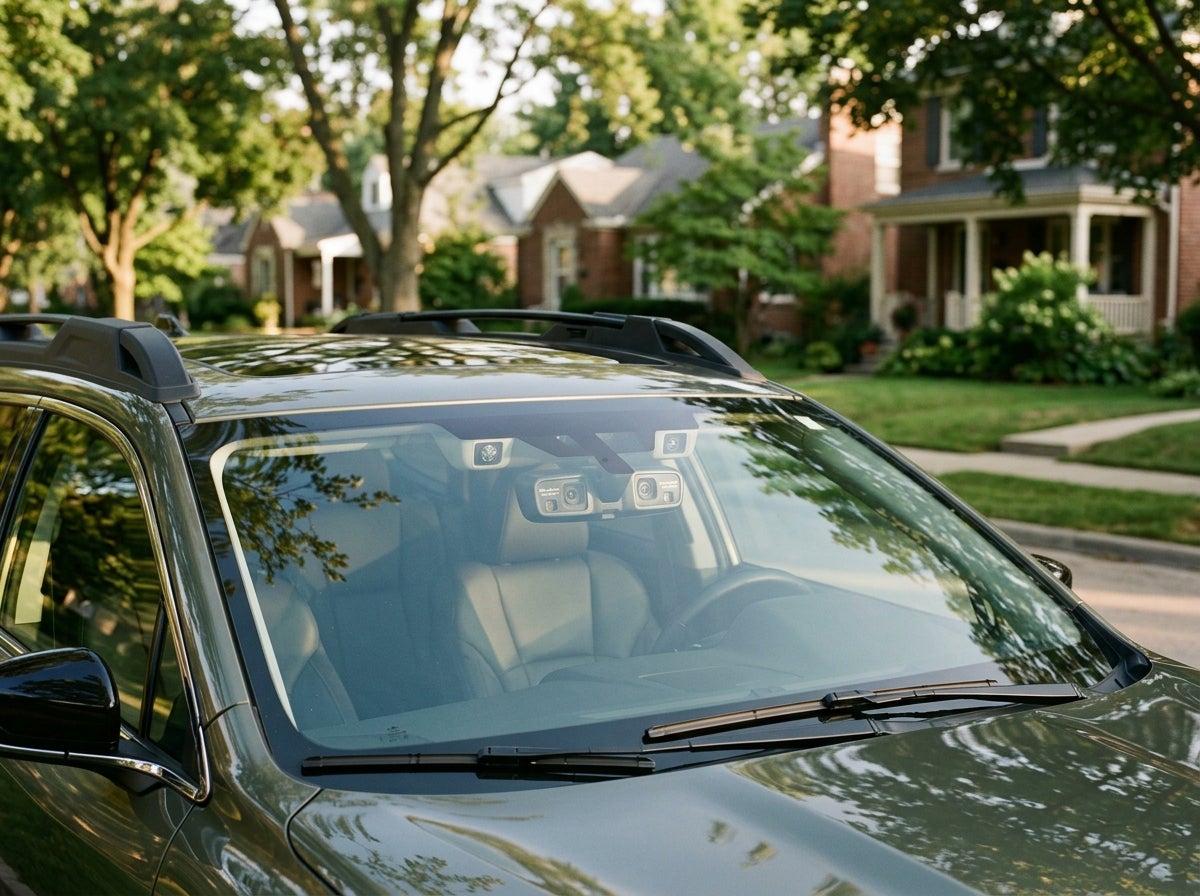
Front windshield of an olive green SUV showing mounted cameras parked on a tree-lined suburban street. (Representative image for illustration purposes only. Actual vehicle may vary based on trim and configuration.)

2026 Subaru Outback Safety Upgrade Costs: Complete Breakdown From Standalone Packages to Higher Trims

When evaluating the purchase of a new midsize crossover, few attributes carry as much weight for drivers as safety. Subaru has long maintained an industry-wide reputation for building vehicles that protect their occupants, and the 2026 Subaru Outback continues this legacy with an expanded array of active driver-assist system options. If you are researching a vehicle purchase at Sunset Hills Subaru, one of the most critical financial questions you will ask is: What does it actually cost to upgrade to enhanced safety technology on the 2026 Outback? To answer directly: baseline standard safety equipment—including Subaru's world-renowned EyeSight Driver Assist Technology—adds exactly $0 to the base window sticker because it comes factory-installed on every 2026 Outback model. However, if you desire enhanced active safety features like Blind-Spot Detection with Lane Change Assist, Rear Cross-Traffic Alert, Reverse Automatic Braking (RAB), Emergency Automatic Steering, or the DriverFocus Distraction Mitigation System, your investment will range between $1,400 and $2,995 in factory-bundled option packages on trim levels like the Outback Premium. Alternatively, stepping up directly to mid- and high-tier trims like the Limited, Touring, or Wilderness incorporates these enhanced technologies as standard equipment, representing trim tier bumps of $3,500 to $8,000 over the base model while bundling luxury amenities such as leather upholstery, premium Harman Kardon sound systems, and hands-free power rear gates. Navigating factory option sheets can sometimes feel overwhelming. At Sunset Hills Subaru, located conveniently at 10100 Watson Rd, Sunset Hills, MO 63127, our commitment is complete pricing transparency. Whether you are browsing our New Subaru Outback Inventory online or visiting our showroom in person, understanding how safety equipment breaks down financially ensures that you pay only for the technology that fits your daily driving needs and budget. Which New Safety Technologies Are Standard on the 2026 Outback vs. Paid Package Upgrades? Every 2026 Subaru Outback comes standard with the latest iteration of Subaru's EyeSight Driver Assist Technology. This core safety suite relies on dual front-facing stereo cameras mounted flush against the upper windshield inside the cabin. Standard features included at base price comprise: Advanced Adaptive Cruise Control with Lane Centering, Pre-Collision Braking, Pre-Collision Throttle Management, and Lane Departure and Sway Warning. However, Subaru delineates its active safety lineup into baseline assistance versus advanced situational protection. Advanced situational technologies rely on additional hardware components, such as wide-angle mono cameras, rear radar sensors embedded beneath the rear bumper fascia, and interior infrared facial recognition sensors. These advanced optional hardware systems power optional upgrades: Blind-Spot Detection with Lane Change Assist, Rear Cross-Traffic Alert, Reverse Automatic Braking (RAB), Emergency Automatic Steering, and the DriverFocus Distraction Mitigation System. Knowing which system includes which sensors allows you to select the exact level of protection required for your commute. Safety Feature Standard Equipment Tier Paid Upgrade Package Tier Primary Hardware Involved Adaptive Cruise Control & Lane Centering Standard (All Trims) Included Base ($0) Dual EyeSight Stereo Cameras Pre-Collision Automatic Braking Standard (All Trims) Included Base ($0) Dual EyeSight Stereo Cameras Wide-Angle Mono Camera Detection Standard (All Trims) Included Base ($0) Single Center Mono Camera Blind-Spot Detection & Rear Cross-Traffic Standard on Limited / Touring Option Package 13/15 ($1,400+) Rear Bumper Radar Sensors Emergency Automatic Steering Standard on Limited / Touring Option Package 15 ($2,995) EyeSight + Blind-Spot Radar Reverse Automatic Braking (RAB) Standard on Limited / Touring Option Package 15 ($2,995) Rear Ultrasonic Sonar Sensors DriverFocus Distraction Mitigation Standard on Touring / Limited XT Option Package 15 / Trim Step Dashboard Infrared LED Camera How Standalone Option Packages and Trim Level Upgrades Impact Total 2026 Outback Pricing Subaru structures vehicle customization around factory option packages and distinct trim tiers. Understanding the math behind these options is the key to maximizing value when buying your 2026 Outback. Option Package 13 (Premium Trim) Cost: ~$1,400 Designed for buyers who want essential blind-spot protection without adding luxury trim extras. OP 13 adds Blind-Spot Detection with Lane Change Assist and Rear Cross-Traffic Alert to the Outback Premium trim, alongside Keyless Access with Push-Button Start and a hands-free power rear gate. Option Package 15 (Premium Trim) Cost: ~$2,995 This comprehensive package builds on Option 13 by adding Emergency Automatic Steering, Reverse Automatic Braking (RAB), power moonroof, and 11.6-inch Multimedia Navigation. It offers complete active defense without moving up to higher-tier leather-trimmed models. Direct Trim Step-Up (Limited / Touring) Cost Delta: $3,500 – $8,000 Stepping up to Outback Limited or Touring automatically standardizes all safety technologies. In addition, you gain perforated leather upholstery, Harman Kardon premium audio, power-adjustable passenger seating, and ventilated front seats on Touring trims. Browse New Subaru Outback Inventory What Expert Opinions and Automotive Reviews Say About 2026 Outback Safety Features Automotive journalists and independent safety testing organizations consistently praise Subaru's approach to driver assistance. In reviews evaluating the 2026 Outback, automotive critics highlight significant real-world improvements in radar sensor processing speeds and wide-angle camera field-of-view. Key takeaways from expert reviews include: • Faster Sensor Processing: The integration of electric power brake boosters allows EyeSight to initiate emergency stopping maneuvers milliseconds faster than previous generations. • Pedestrian & Cyclist Recognition: The third wide-angle mono camera drastically increases urban pedestrian detection at intersections. • Emergency Steering Nuance: Testers note that Emergency Automatic Steering feels smooth and decisive rather than abrupt when avoiding obstacles at speeds under 50 mph. How 2026 Subaru Outback Safety Technology and Costs Compare to Midsize SUV Competitors To evaluate whether the 2026 Outback offers strong value in its safety technology packages, it is useful to examine how its packaging compares to major segment rivals like the Honda CR-V, Toyota RAV4, and Jeep Grand Cherokee. While many manufacturers lock essential active safety gear inside top-tier trim levels, Subaru includes core EyeSight protection standard on every single vehicle built. Model Base Active Safety Suite Blind-Spot & Rear Cross-Traffic Cost Reverse Automatic Braking Cost Standard AWD Safety Synergy 2026 Subaru Outback Standard (EyeSight + Mono Cam) Standard on most trims or ~$1,400 package Available on ~$2,995 package or Limited trim Yes (Symmetrical All-Wheel Drive Standard) Honda CR-V Standard (Honda Sensing) Standard on EX and above (~$32,000+) Requires Top-Tier Touring Trim (~$40,000+) No (AWD is $1,500+ Option on Base) Toyota RAV4 Standard (Toyota Safety Sense) Optional Package on LE / Standard XLE Requires High-Tier Packages (~$3,000+) No (AWD is extra option on base) Jeep Grand Cherokee Standard (Basic ADAS) Standard on Mid-Trims Requires High-Tier Lux Packages ($4,000+) No (4WD costs extra on entry trims) As demonstrated above, Subaru's competitive advantage lies in combining factory Symmetrical All-Wheel Drive with baseline EyeSight at no extra cost. When comparing competitive midsize SUVs, buyers often find they must spend $2,000 to $4,000 in add-on options simply to match the baseline foul-weather capability and active braking performance that comes standard on every 2026 Outback at Sunset Hills Subaru. Does Safety Tech Impact Efficiency, and What Are the Differences in Fuel Economy Between 2026 and 2025 Models? A common query from shoppers is whether continuous electronic scanning by multiple onboard cameras, radar units, and infrared monitoring sensors increases electrical parasitic draw enough to negatively impact overall fuel economy. Modern automotive electrical architectures are engineered for high efficiency. The microprocessors powering the 2026 Outback's EyeSight camera system operate on low-voltage DC power. The battery draw is negligible and has zero measurable impact on internal combustion engine fuel consumption. EPA fuel efficiency estimates for the 2026 Subaru Outback remain virtually unchanged from the 2025 model year: • 2.5L 4-Cylinder BOXER Engine: EPA-estimated 26 MPG City / 32 MPG Highway / 28 MPG Combined. • 2.4L Turbocharged BOXER Engine (XT / Wilderness): EPA-estimated 22 MPG City / 29 MPG Highway / 25 MPG Combined (21/26/23 for Wilderness due to aggressive gearing and all-terrain tires). In fact, driver assist technology often improves real-world fuel economy. Subaru's Advanced Adaptive Cruise Control manages throttle application during highway cruising far more smoothly than human driver inputs, eliminating rapid acceleration spikes and brake riding in stop-and-go traffic. Whether you are commuting along I-270 or taking summer road trips outside St. Louis, driving an EyeSight-equipped Outback helps maintain optimal cruise efficiency while keeping your family protected. What Maintenance Changes and Calibration Costs Accompany the 2026 Outback Redesign? While safety upgrades deliver invaluable peace of mind on the road, vehicle owners should also factor long-term ownership maintenance into their budget. Highly advanced camera and radar systems require precise physical positioning and software calibration to operate accurately. Windshield Replacement Calibration If a road pebble cracks your windshield, replacement glass must be OEM-certified to ensure proper optical clarity for EyeSight cameras. A target recalibration process is performed at our factory service center using specialized alignment targets. Recalibration costs typically range from $300 to $600, though this is often covered under comprehensive auto insurance policies. Radar & Sonar Alignment Minor fender benders or rear bumper impacts can shift rear radar sensors out of alignment. If a sensor moves even a fraction of a degree, a warning light will illuminate on your dash. Routine bumper maintenance or body repairs require diagnostic sensor angle resets to restore full function for Blind-Spot Detection. Routine Wheel Alignments Because Lane Centering relies on precise steering angle sensors synchronized with EyeSight camera input, keeping your suspension properly aligned is essential. Routine wheel alignment service ensures that auto-steering inputs match actual road trajectories perfectly. When maintenance is required, trust factory-certified technicians equipped with specialized Subaru diagnostic tools. You can easily Schedule Service and Diagnostics online or check our Current Service and Parts Specials before your visit. Schedule Service & Diagnostics How Should You Select the Appropriate 2026 Outback Trim Level for Your Daily Safety Needs? To ensure you don't overspend on technology you may not utilize—or miss out on crucial driver-assist features—use this straightforward buyer decision matrix based on your daily commute: 1. The Essential Highway Commuter (Base Trim): If your daily drive consists of standard highway miles and clear suburban arterial roads, the standard EyeSight system with Adaptive Cruise and Lane Centering provides world-class crash protection at zero extra package cost. 2. The Multi-Lane Highway Commuter (Premium with Option Package 13): If you frequently commute in multi-lane traffic, adding Blind-Spot Detection and Rear Cross-Traffic Alert ($1,400) provides critical side and rear situational awareness when merging. 3. The Busy Suburban Family (Premium with Option Package 15 or Limited Trim): If you routinely park in congested suburban school drop-off zones or tight shopping centers, Reverse Automatic Braking (RAB) is invaluable for preventing low-speed backing collisions. Navigating St. Louis Commutes and Ladue Suburban Driving with Enhanced Outback Safety Systems Living in the greater St. Louis metropolitan area presents diverse driving challenges. From the high-speed rush-hour congestion along I-270 and I-64 to navigating tight, tree-lined residential driveways in Ladue and Sunset Hills, the 2026 Outback's enhanced safety options solve real local commuting headaches. For instance, backing out of narrow driveways with obscured sightlines due to parked cars or mature landscaping becomes far stress-free with Rear Cross-Traffic Alert and Reverse Automatic Braking. When sensors detect an approaching vehicle or pedestrian from either side, the system provides audible visual alerts and can automatically apply full braking force to avoid a collision. Furthermore, during heavy summer downpours along Watson Road, EyeSight's enhanced camera processing maintains vehicle tracking accuracy when visibility drops. Financing Your Safety Upgrades: How Trade-In Value and Subaru Financing Can Help Offset Package Pricing When calculated over a 48- or 60-month auto loan term, a $1,400 to $2,995 safety package upgrade may affect your monthly payment depending on terms. Many customers find that leveraging existing vehicle equity absorbs this cost completely. At Sunset Hills Subaru, you can quickly Get your value trade online to see how much equity you hold in your current vehicle. Applying trade-in equity directly toward your down payment reduces the total financed balance, offsetting option package costs effortlessly. Additionally, taking advantage of current manufacturer financing options can keep your monthly investment surprisingly low. You can Get approved for financing online in minutes through our secure finance office. Smart Buyer Financial Tip: Safety features like Blind-Spot Detection and Reverse Automatic Braking frequently qualify drivers for savings opportunities on their auto insurance premiums. Be sure to contact your insurance provider for policy discount details on EyeSight-equipped models. Get Approved For Financing Do Experts Recommend the 2026 Outback Wilderness Safety Package for Off-Road and Winter Driving? Dual-Function X-MODE Integration The 2026 Outback Wilderness pairs standard active safety technology with Dual-Function X-MODE settings tailored specifically for Snow/Dirt and Deep Snow/Mud. Auto-tuning traction control keeps wheels planted in hazardous winter sludge. Lifted Suspension Calibration Because the Wilderness features a factory 9.5-inch ground clearance, Subaru factory engineers specifically recalibrated EyeSight camera angles and pitch sensors to account for higher ride height, delivering accurate automated braking. Expert Consensus Off-road and automotive reviewers universally recommend the Wilderness package for drivers who regularly tackle severe winter conditions, light dirt trails, or unpaved backroads due to its combination of rugged hardware and active electronic monitoring. Explore Safety-Equipped 2026 Subaru Outback Models at Sunset Hills Subaru Today Choosing the right safety package on your 2026 Subaru Outback comes down to matching your driving habits with the features that provide real value for your daily routine. Whether you prefer a cost-effective Premium trim with Option Package 13 or a top-tier Outback Touring fully equipped with DriverFocus distraction mitigation, Sunset Hills Subaru is here to help. Visit our local showroom at 10100 Watson Rd, Sunset Hills, MO 63127 or explore our extensive online inventory of new models. Get Directions to Sunset Hills Subaru or Call us at (314) 476-9638 to speak with our certified Subaru brand specialists today. Be sure to check out our Current New Car Specials for the latest current offers! View New Outback Inventory & Schedule Test Drive 2026 Subaru Outback Safety Packages in Sunset Hills MO | Sunset Hills Subaru
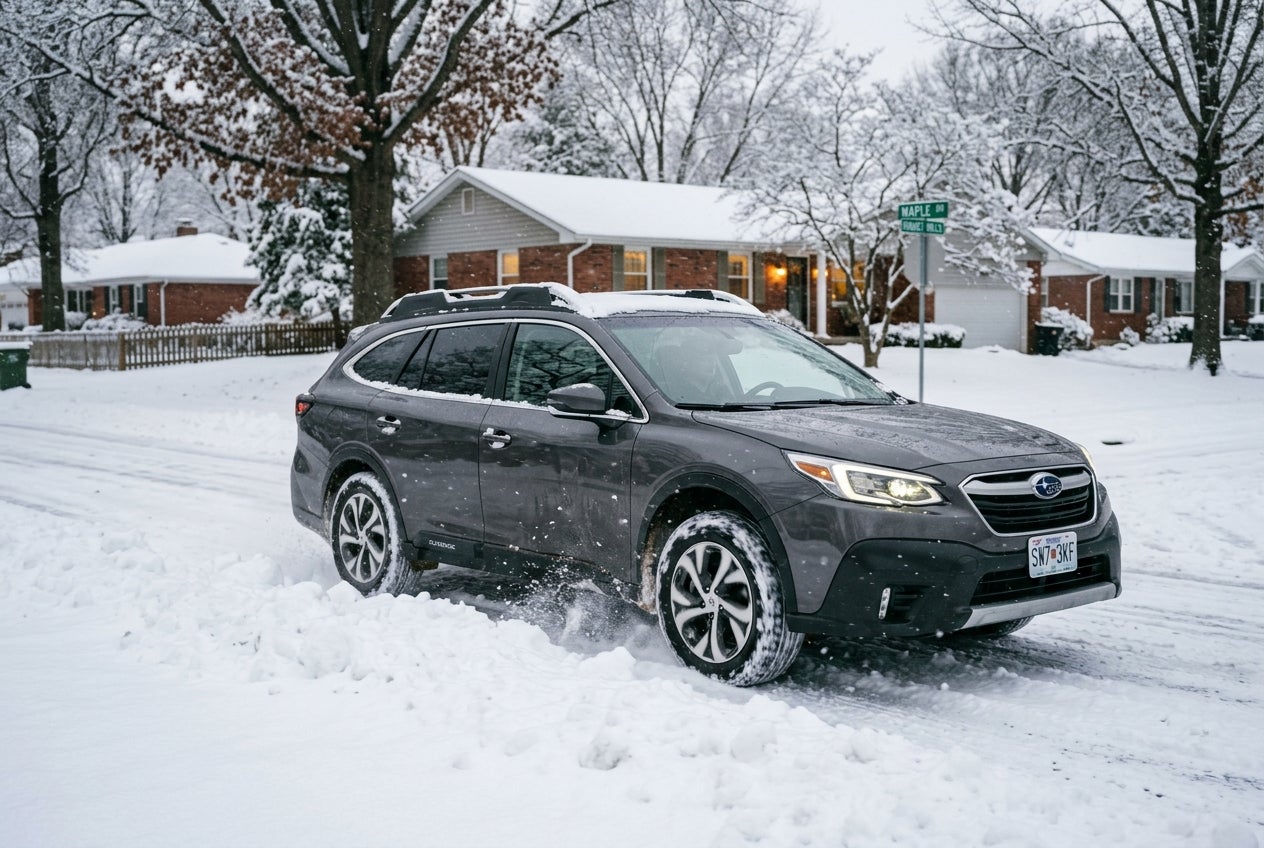
A dark grey Subaru Outback driving through deep snow on a residential street. (Representative image for illustration purposes only. Actual vehicle may vary based on trim and configuration.)

What Is the Biggest Real-World Benefit of the Subaru Outback in Snow?

What Is the Biggest Real-World Benefit of the Subaru Outback in Snow? When Midwestern winter weather transforms the roads around Sunset Hills, Kirkwood, and Ladue into an unpredictable mixture of slush, packed ice, and heavy snow drifts, drivers quickly learn that not all all-wheel drive systems are built equal. If you ask seasoned Missouri drivers what sets the Subaru Outback apart from every other crossover on the road, the key advantage often comes down to one mechanical feature: continuous, full-time Symmetrical All-Wheel Drive coupled with 8.7 inches of standard ground clearance (and up to 9.5 inches on the Wilderness edition). Unlike conventional 'part-time' or 'on-demand' AWD systems found in many competing crossovers, the Subaru Outback never waits for wheel spin before sending power to all four wheels. In slip-and-grip systems, your vehicle operates primarily in two-wheel drive until sensors detect a loss of traction. By the time those systems react on an icy patch along Watson Road or an unplowed stretch near I-44, momentum has already been lost, sending the vehicle into an unsettling slide or getting stranded altogether. In contrast, the Outback's full-time active torque split continuously feeds engine power to every wheel. Combined with generous ground clearance that glides directly over dense snow ridges left behind by highway snowplows, the Outback prevents drivers from getting high-centered—where snow packs beneath the undercarriage and lifts the tires off the pavement. Whether you are navigating early morning commutes before the snow plows arrive or pulling out of a steep, ice-covered residential driveway, this constant mechanical engagement provides instant, unwavering confidence when you need it most. You can explore our full selection of winter-ready models in our New Subaru Outback Inventory. How Subaru Symmetrical All-Wheel Drive Works in Snow and Ice The mechanical secret behind Subaru's winter supremacy lies in its engineering architecture. Every Subaru Outback features a longitudinally mounted Subaru BOXER® engine positioned in direct linear alignment with the Lineartronic® CVT transmission and symmetrical drivetrain. Because the horizontally-opposed BOXER engine sits low in the chassis, the Outback maintains a remarkably low center of gravity. This balance prevents body roll and weight-transfer instability when cornering on slick surfaces. The linear layout creates equal-length front axle shafts, ensuring equal power transfer to left and right wheels without torque steer. During winter conditions in St. Louis, the active torque split electronically monitors steering angle, acceleration, and yaw rates. It dynamically adjusts power distribution—biasing power seamlessly between front and rear axles before loss of control occurs. When one wheel encounters black ice on a bridge deck along I-270, the system instantly directs drive torque to the wheels with grip, keeping the vehicle tracking straight and predictable without disturbing vehicle balance. Subaru Outback vs. Competitor AWD Systems: Navigating Missouri Winters & Rain Missouri weather is notorious for rapid temperature swings. A morning thunderstorm can easily turn into freeze-thaw slush by evening rush hour. Understanding how the Outback's Symmetrical AWD compares to popular competitors like the Toyota RAV4 and Honda CR-V highlights why Subaru remains the premier choice for regional drivers. Most popular compact SUVs utilize an 'on-demand' system that operates as front-wheel drive under normal dry pavement conditions. When front tires begin to spin on ice or hydroplane in heavy rain, an electromagnetic clutch engages the rear axle. While efficient for mild climates, this split-second delay can mean the difference between maintaining stability and losing traction during abrupt maneuvers. Subaru's Symmetrical AWD is continuously active on all four wheels at all times. Whether accelerating away from a stoplight on wet pavement or powering through slushy highway lanes, power is instantly available at every tire contact patch. If you are comparing pre-owned options, feel free to inspect our Used Vehicle Inventory for AWD crossover models. Feature / Capability Subaru Outback (Symmetrical AWD) Toyota RAV4 (On-Demand AWD) Honda CR-V (Real Time AWD) AWD Engagement Full-Time Continuous Active Torque Split Reactive Slip-and-Grip (Front-Wheel Bias) Reactive Electronic Engagement Standard Ground Clearance 8.7 Inches (9.5 In Wilderness) 8.1 - 8.6 Inches 7.8 - 8.2 Inches Drivetrain Symmetry & Balance Symmetrical Linear Lineartronic CVT Transverse Engine / Transaxle Offset Transverse Engine / Transaxle Offset Snow Off-Road Drive Modes Standard Dual-Function X-MODE® Multi-Terrain Select (Select Trims) Snow Mode Only Why Ground Clearance and X-Mode Matter for Sunset Hills and Ladue Commuters 8.7 Inches Clearance Standard 8.7-inch ground clearance easily clears deep snow berms piled up by municipal plows at residential street corners, preventing underbody scraping or costly oil pan damage on rough roads. Dual-Function X-MODE® Available Dual-Function X-MODE includes specialized settings for 'Snow/Dirt' and 'Deep Snow/Mud'. It optimizes throttle mapping, transmission ratios, and AWD clutch engagement to maximize wheel bite. Hill Descent Control Integrated Hill Descent Control automatically manages braking on steep, unplowed driveways in rolling terrain around Sunset Hills, enabling you to focus entirely on steering safely down icy slopes. Value Your Current Trade-In Is the Outback Good for Commuting on I-44 and I-270 During St. Louis Winters? St. Louis highway commuters know how chaotic interstates like I-44 and I-270 can become during winter storms. Between sudden slush ridges between lanes and heavy crosswinds along elevated overpasses, highway winter driving requires exceptional vehicle stability and active driver support. The Subaru Outback excels in interstate conditions due to its extended wheelbase and wagon-like body profile. Unlike tall, boxy SUVs that catch heavy winter gusts, the Outback pierces through crosswinds cleanly while maintaining steady tracking across icy bridge decks and frozen slush lanes. Safety is further enhanced by standard EyeSight® Driver Assist Technology. Featuring dual optical stereo cameras, EyeSight monitors ahead to assist with Adaptive Cruise Control, Pre-Collision Braking, and Lane Keep Assist. When visibility drops during heavy winter snowfall, EyeSight can serve as an added layer of driver assistance. Are Stock Factory Tires Good Enough for Missouri Winters, or Do You Need Upgrades? Every 2025 Subaru Outback comes equipped with high-quality factory all-season tires designed to balance fuel efficiency, tread longevity, and wet traction. For the majority of standard St. Louis winter days—involving light snow, wet streets, and occasional frost—the combination of factory tires and Symmetrical AWD performs exceptionally well. However, for drivers who frequently commute before plows hit the roads or take regular trips into rural or mountainous regions, upgrading to 3-Peak Mountain Snowflake (3PMSF) rated tires provides an extra tier of braking performance on hard-packed snow and severe ice. The Outback Wilderness trim comes factory-standard with Yokohama GEOLANDAR® all-terrain tires featuring the 3PMSF rating. You can order replacement seasonal wheel setups or winter tires directly through our certified Parts Department. Winter Packages and Essential Cold-Weather Accessories at Sunset Hills Area Dealers All-Weather Comfort Standard All-Weather Package features include 3-stage heated front seats, available heated rear outboard seats, and a 360-degree heated steering wheel to warm up your drive quickly. Wiper De-Icers Windshield wiper de-icers melt frozen ice along the windshield base, preventing wiper blade freezing and keeping your glass clear during active freezing rain or winter storms. High-Wall Floor Liners Genuine Subaru high-wall floor liners and heavy-duty cargo tray liners trap melting slush, mud, and road salt, preserving your interior carpet in pristine condition. View Current Service and Parts Offers Which Outback Trim Is Best for Snow, Slush, and Rough Roads? Premium & Limited Standard 8.7-inch ground clearance, heated front seats, dual-zone climate control, and single-mode X-MODE®. Ideal for suburban daily commutes and winter highway travel. Onyx Edition Adds water-repellent StarTex® synthetic upholstery that wipes clean easily from wet snow, along with Dual-Function X-MODE® for tackling deep snow drifts. Outback Wilderness A capable severe-weather model: elevated 9.5-inch ground clearance, Yokohama GEOLANDAR® 3PMSF all-terrain tires, enhanced front bumper angles, and heavy-duty roof rails. Local Test Drive Routes Near Sunset Hills to Evaluate Subaru AWD and Suspension When evaluating a vehicle's bad-weather performance, a standard flat test drive won't reveal the whole picture. Near our dealership at 10100 Watson Rd, Sunset Hills, MO 63127, several local road stretches provide real-world insights into Outback capability. Testing along Watson Road elevation changes allows you to experience Lineartronic CVT engine braking and chassis isolation over uneven pavement joints. A quick loop down Lindbergh Boulevard lets you observe how smoothly the AWD system transfers power without sudden wheel slippage during turns. If you are comparing different Subaru SUV options during your test drive visit, we also encourage you to explore our New Subaru Forester Inventory and New Subaru Crosstrek Inventory to experience how Symmetrical AWD feels across different vehicle sizes. What to Ask Your Subaru Dealer Before Buying an Outback for Winter Driving To ensure you select the ideal setup for your winter driving habits, here is a practical buyer's checklist to ask our specialist team before finalizing your vehicle purchase: 1. Which Outback trim matches my daily commute? (Premium vs. Onyx vs. Wilderness ground clearance requirements) 2. Can factory winter accessories be pre-installed before delivery? (All-weather floor liners, splash guards, rear bumper cover) 3. How does trade-in valuation work for my current vehicle? You can easily start by getting an estimate to Get your value trade online. 4. What pre-approval options exist for new car financing? Get started in advance when you Get approved for financing through our finance center. 5. What factory warranty coverage applies to AWD and drivetrain components? Explore Current New Car Offers How St. Louis and Sunset Hills Buyers Can Order or Locate a Custom 2025 Outback Trim Finding the exact combination of exterior paint, interior upholstery, and cold-weather accessory packages is straightforward at Sunset Hills Subaru. Shoppers can easily review incoming regional shipments or search current New Subaru Inventory directly on our website. If your preferred trim level or color combination is not currently on our lot, our team can reserve an incoming transit model or guide you through a custom factory order direct from Subaru. If you are considering family-sized 3-row alternatives, you may also inspect our New Subaru Ascent Inventory. Test Drive the Subaru Outback at Sunset Hills Subaru now Experience the unmatched confidence of Subaru Symmetrical All-Wheel Drive and 8.7 inches of ground clearance for yourself. Visit Sunset Hills Subaru at 10100 Watson Rd, Sunset Hills, MO 63127, or speak with our sales specialists directly. You can Get Directions to Sunset Hills Subaru or Call us at (314) 476-9638 to schedule your personal winter capability test drive. Browse New Subaru Outback Models Subaru Outback AWD Benefits in Sunset Hills MO | Sunset Hills Subaru
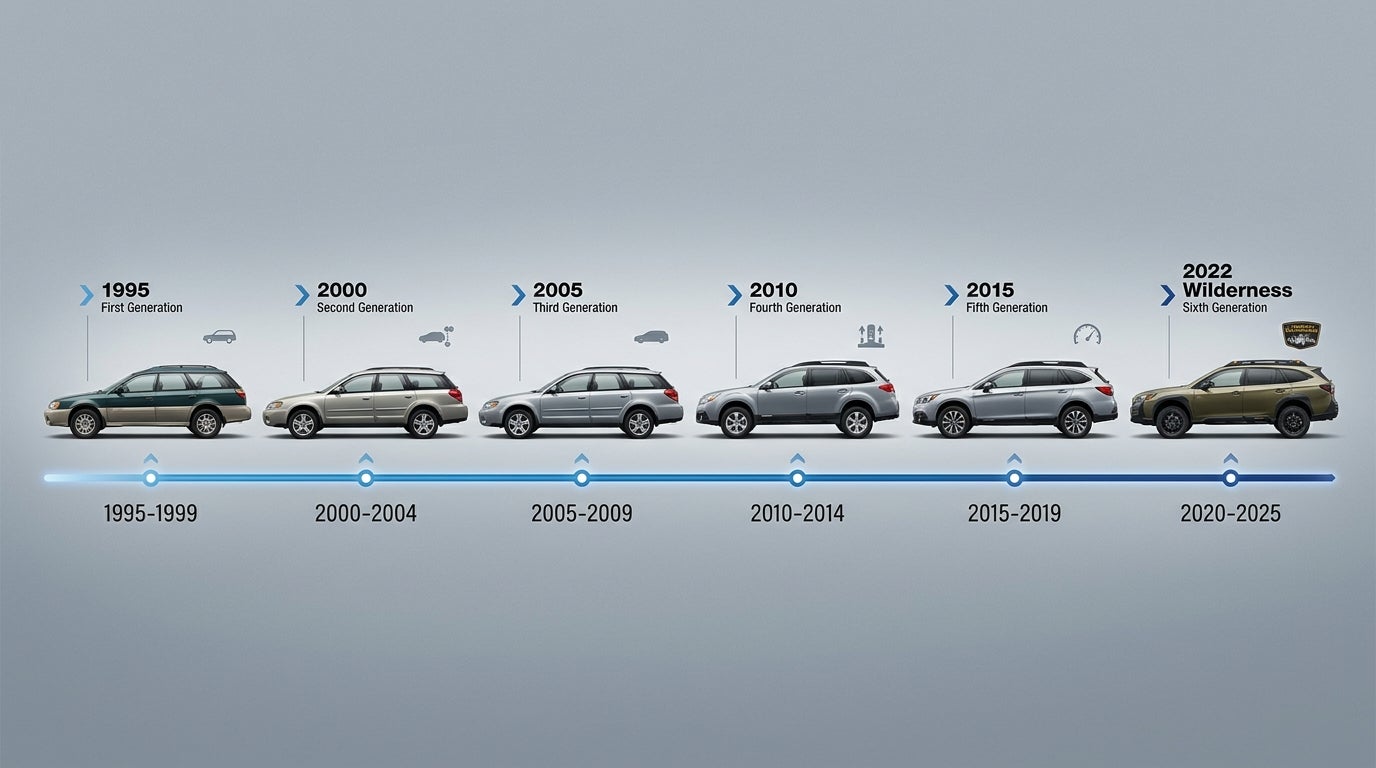
Visual timeline displaying six generations of the Subaru Outback from 1995 to 2025. (Representative image for illustration purposes only. Actual vehicle may vary based on trim and configuration.)

The Generational Evolution of the Subaru Outback: 30 Years of Midsize Crossover Innovation

Thirty years ago, the automotive landscape was strictly divided into two distinct camps: low-slung, car-based station wagons designed for suburban pavement, and heavy, body-on-frame truck SUVs that offered off-road utility at the expense of ride quality, fuel economy, and daily maneuverability. In 1994, Subaru engineered a transformative solution by elevating its established Legacy station wagon platform, increasing ground clearance to 7.5 inches, adding rugged body cladding, and equipping it with standard Symmetrical All-Wheel Drive. What began as a clever trim variation evolved over six distinct generations into a standalone crossover legend built on the ultra-rigid Subaru Global Platform, offering up to 9.5 inches of ground clearance, standard EyeSight Driver Assist technology, and advanced Lineartronic CVT efficiency. Explore our full New Subaru Outback Inventory to see how three decades of engineering have redefined midsize utility. Explore New Outback Inventory 1st Generation (1995–1999): The Elevated Utility Wagon Concept The original Subaru Outback arrived for the 1995 model year as a targeted package on the Legacy wagon platform. Featuring raised suspension, heavy-duty protective lower body cladding, high-profile mud and snow tires, and integrated fog lamps, it challenged the premise that adventure vehicles required truck chassis construction. Engine offerings included the reliable 2.2-liter EJ22 BOXER engine producing 135 horsepower, later expanded to the 2.5-liter EJ251 DOHC BOXER pushing output to 165 horsepower. Supported by iconic marketing featuring actor Paul Hogan, the 'World's First Sport-Utility Wagon' captured consumer imagination by blending car-like fuel efficiency with trail confidence. Check out our latest New Car Inventory to learn how modern Outback capability carries this original spirit forward. 2nd & 3rd Generations (2000–2009): Standalone Status & Performance Refinement 2nd Gen (2000–2004) For 2000, Subaru officially established the Outback as its own standalone model line. The chassis gained an advanced multi-link rear suspension that eliminated strut towers, drastically opening up flat trunk cargo area. Power was bolstered by the debut of the EZ30 3.0-liter 6-cylinder engine producing 212 horsepower, accompanied by Vehicle Dynamics Control (VDC) to optimize wheel traction. 3rd Gen (2005–2009) The 3rd Generation ushered in sleek, sculpted exterior lines, wider track width, and elevated safety crash-test ratings. Enthusiasts celebrated the 2.5 XT trim, which borrowed the rally-bred 2.5-liter turbocharged BOXER engine from the WRX STI to generate 250 horsepower. High-strength steel structural reinforcements improved torsional rigidity while maintaining agile pavement handling. Early Milestones Key specs across early generations: • Standard Symmetrical AWD • Introduction of H6 3.0L engine • Turbocharged 2.5 XT performance • Multi-link rear suspension • VDC electronic stability control Looking for affordable pre-owned reliability? Browse our Used Vehicle Inventory today. 4th Generation (2010–2014): Lineartronic CVT & EyeSight Safety Debut The 4th Generation represented a fundamental architectural redesign focused on maximizing interior cabin space and efficiency. Subaru expanded the roofline and wheelbase, yielding significant increases in rear legroom and total cargo volume. Crucially, 2010 marked the transition to the Lineartronic Continuously Variable Transmission (CVT), matching the 2.5-liter engine to optimal gear ratios for smooth acceleration and superior fuel efficiency. In 2013, Subaru made automotive history by introducing its proprietary EyeSight Driver Assist Technology on select Outback trims. Utilizing dual stereo cameras mounted beside the rearview mirror, EyeSight provided adaptive cruise control, pre-collision braking, and lane departure warning—setting a new benchmark for crossover safety. 4th Gen Engineering Highlights: • Standard retracting roof rack crossbars • 8.7 inches of ground clearance • Introduction of 3.6L H6 BOXER engine • Debut of EyeSight Stereo Camera Safety System • Lineartronic CVT efficiency replacement for 4-speed autos If you are considering trading in your current model, Get your value trade online in seconds. Browse Pre-Owned Outback Selection 5th Generation (2015–2019): Structural Rigidity & Acoustic Comfort The 5th Generation elevated the Outback from a utilitarian family wagon into a refined, near-luxury crossover experience. Engineers significantly increased high-strength steel usage throughout the ring-shaped reinforcement frame, boosting torsional stiffness by 67%. This increased frame rigidity dramatically reduced body roll during cornering and minimized road noise transmission into the passenger cabin. Standardization of Subaru X-Mode with Hill Descent Control gave driver-selectable traction optimization for steep grades and slippery terrain. Inside, acoustic windshield glass, soft-touch dashboard surfaces, and touchscreen STARLINK multimedia with Apple CarPlay and Android Auto created a quiet, connected environment suitable for daily St. Louis highway commutes. You can easily Schedule Service and Diagnostics for late-model Outback maintenance at our Sunset Hills service facility. 6th Generation (2020–2025): Subaru Global Platform & Wilderness Off-Road Capability Built on the groundbreaking Subaru Global Platform (SGP), the 6th Generation Outback delivers 70% higher torsional rigidity and 100% higher rear subframe rigidity compared to previous architectures. Impact energy absorption increased by 40%, elevating crash safety standards across the industry. Mechanically, the 6th Generation introduced the optional 2.4-liter Turbocharged FA24 BOXER engine (260 hp / 277 lb-ft torque) alongside an updated 2.5-liter direct-injection engine. Technological highlights include the tablet-style 11.6-inch STARLINK touchscreen and full-suite EyeSight with Advanced Adaptive Cruise Control and Lane Centering. In 2022, Subaru pushed boundaries further by launching the trail-hardened Outback Wilderness. Featuring 9.5 inches of ground clearance, revised front and rear bumpers for improved approach and departure angles, matte-black anti-glare hood decal, Yokohama Geolandar all-terrain tires, and Dual-Function X-Mode (Snow/Dirt and Deep Snow/Mud modes), the Wilderness redefined off-road capabilities in a midsize wagon platform. Explore similar capability across our New Subaru Forester Inventory and New Subaru Crosstrek Inventory lineups. Generational Breakdown: Dimensions, Clearance, & Performance Matrix Compare key structural dimensions and powertrain specifications across all six Outback generations below to see how overall passenger space expanded without sacrificing garage friendly proportions. Generation Years Overall Length Ground Clearance Base Engine Max Cargo Capacity 1st Generation 1995–1999 184.0 in 7.5 in 2.2L 4-Cyl (135 hp) 72.5 cu ft 2nd Generation 2000–2004 187.4 in 7.3 in 2.5L 4-Cyl (165 hp) 68.6 cu ft 3rd Generation 2005–2009 188.7 in 8.4 in 2.5L 4-Cyl (168 hp) 65.4 cu ft 4th Generation 2010–2014 188.2 in 8.7 in 2.5L 4-Cyl (170 hp) 71.3 cu ft 5th Generation 2015–2019 189.6 in 8.7 in 2.5L 4-Cyl (175 hp) 73.3 cu ft 6th Generation 2020–2025 191.1 in 8.7–9.5 in 2.5L Direct Inject (182 hp) 75.6 cu ft Calculate Your Vehicle's Trade Value What Does Next-Gen Chassis Engineering Reveal About the Future Outback? As Subaru develops future iterations of the Outback, chassis evolution centers on modular platform adaptability. The modular SGP architecture allows seamless integration of next-generation hybrid electric powertrains (e-BOXER technology) designed to boost low-end torque while drastically cutting emissions in stop-and-go St. Louis traffic. Future Outback engineering focuses on next-generation EyeSight system integration with wider-angle monocular cameras, enhanced thermal battery management, and lighter high-strength composite materials. Subaru continues to prioritize its iconic long-wheelbase wagon proportion, ensuring high stability without adopting cumbersome, boxy SUV profiles. For eco-conscious commuters, explore our New Subaru Solterra Inventory for zero-emission driving. Outback Elevated Wagon Design vs. Traditional Midsize SUVs for Suburban Families For families navigating daily trips around Ladue, Town & Country, and Sunset Hills, the Outback offers several practical advantages over traditional tall SUVs: 1. Lower Center of Gravity: The horizontally opposed BOXER engine sits low in the chassis, delivering nimble car-like handling and cornering stability rather than top-heavy body roll. 2. Easier Roof Cargo Loading: With a roofline lower than conventional boxy SUVs, securing kayaks, bicycles, or ski racks onto standard crossbars is effortlessly accessible. 3. Garageability & Visibility: The Outback fits easily inside standard residential garages while granting 8.7 to 9.5 inches of ground clearance to conquer unpaved access roads and deep snow drifts. Need 3-row passenger capacity? Compare the Outback against our New Subaru Ascent Inventory. What Type of Driver Chooses a Subaru Outback Over Competitors? Safety & Longevity Driven Drivers prioritizing top-tier IIHS Safety Pick+ awards, standard EyeSight driver assists, and proven mechanical durability (97% of Subarus built in the last 10 years are still on the road). Outdoor Enthusiasts Active families who weekend in the Ozarks, haul camping gear, launch canoes, or travel gravel state park trails with true all-weather Symmetrical AWD traction confidence. Smart Resale Buyers Value-conscious owners seeking industry-leading resale retention, strong fuel efficiency, and sensible maintenance costs. Contact us about financing today to start your upgrade. Apply For Online Financing Approval Which Outback Trim Level Fits Your St. Louis Driving Needs? • Outback Premium / Limited: Ideal for daily suburban commuters seeking leather-trimmed upholstery, 11.6-inch touchscreen navigation, Harman Kardon premium audio, and optimal MPG. • Outback Touring: Offers Nappa leather upholstery, ventilated front seats, 180-degree front view monitor, and ultimate long-distance highway comfort. • Outback Wilderness: Engineered for off-road trails with 9.5-inch clearance, dual X-Mode, and 3,500-lb towing capacity. Looking for sport sedan or compact vehicle instead? Explore our New Subaru Impreza Inventory or high-performance New Subaru WRX Inventory options. Maintaining an existing Outback? Easily Find Subaru Parts and check our Current Service and Parts Offers. Subie Talk Podcast: The Subaru Outback Through the Generations To take the story of the Subaru Outback even further, tune in to the Subie Talk Podcast as we explore the Outback’s evolution across the generations. We’ll look at how Subaru transformed the Outback from its rugged wagon roots into the versatile, adventure-ready SUV drivers know today, highlighting the major design changes, technology, performance, and innovations that helped shape each generation along the way. Visit Out Podcast Channel On Youtube Subaru Outback Models in Sunset Hills MO | Sunset Hills Subaru
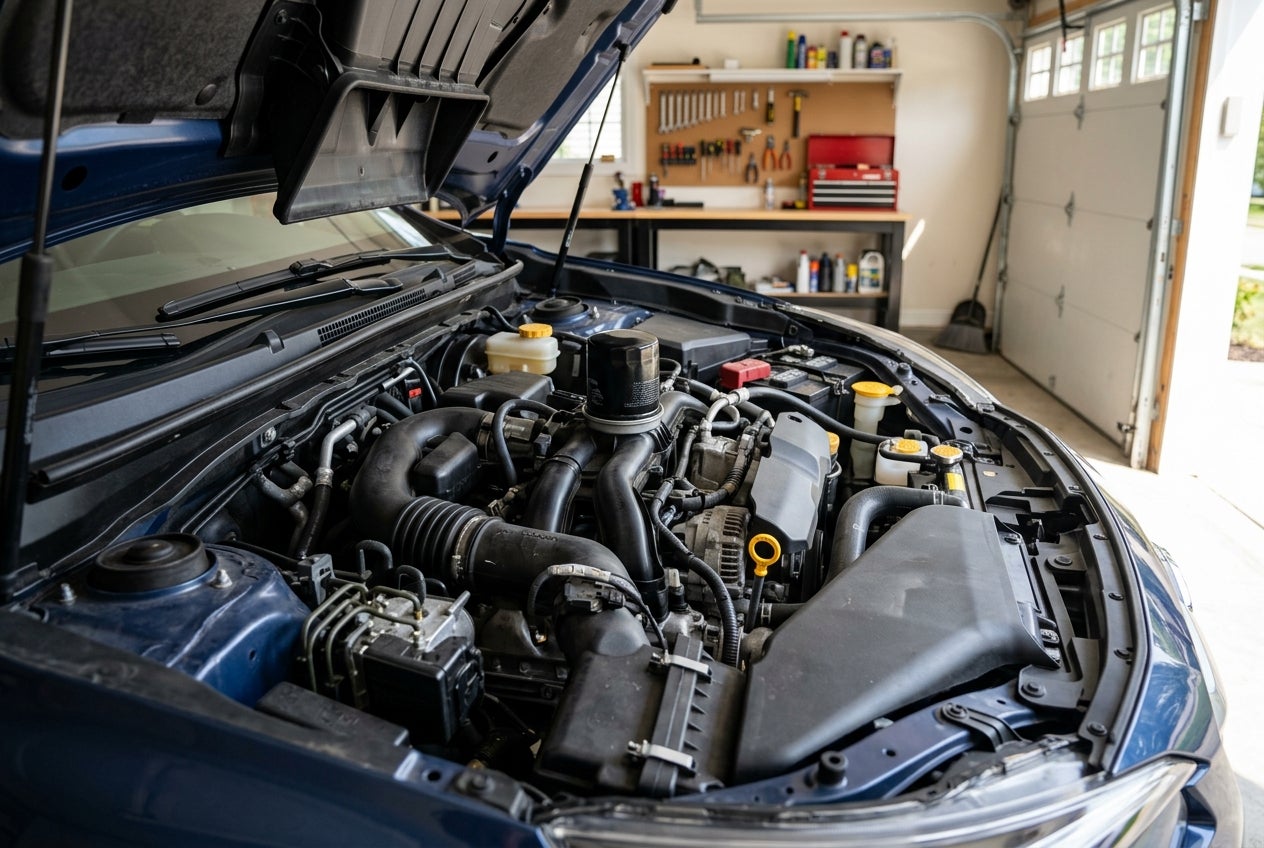
Open hood of a dark blue car parked inside an organized garage, showing the detailed engine bay. (Representative image for illustration purposes only. Actual vehicle may vary based on trim and configuration.)

Are Subaru Owners Able to Perform Long-Term Maintenance Themselves?

For generations, Subaru vehicles have built a dedicated following among drivers who appreciate rugged engineering, practical design, and mechanical transparency. Whether navigating winter snowstorms in St. Louis County or tackling weekend dirt roads, Subaru vehicles such as the Outback, Forester, and Crosstrek are built to endure. But when it comes to long-term ownership—spanning 10 years or 150,000 miles and beyond—a fundamental question arises for practical-minded vehicle owners: Are Subaru owners able to perform long-term maintenance themselves? The short answer is yes, but with clear boundaries. Subaru’s thoughtful design choices—most notably the top-mounted engine oil filter on modern Subaru BOXER engines—make routine services exceptionally accessible for home mechanics. Tasks like engine oil changes, engine and cabin air filter swaps, windshield wiper replacements, battery care, and tire rotation can easily be executed in a home driveway with basic tools. However, modern Subarus are sophisticated machines equipped with Symmetrical All-Wheel Drive (AWD), Lineartronic Continuously Variable Transmissions (CVT), and complex driver-assist tech like EyeSight® Driver Assist Technology. Services involving fluid temperatures, differential calibration, electronic sensor realignment, and deep engine access present clear technical limits. Understanding where home maintenance shines and where certified dealer expertise is essential will help you maximize your vehicle’s life while keeping safety and resale value intact. If you ever need advice or high-grade components, you can always Find Subaru Parts directly through Sunset Hills Subaru. Explore OEM Parts & Accessories Is It Feasible to Perform Basic Subaru Maintenance Yourself During the First Year? During your first 12 months of Subaru ownership, maintenance demands are relatively light and heavily focused on preventative protection. For St. Louis area commuters navigating seasonal changes—from hot Midwest summers to icy winter salt on I-44—keeping up with initial service milestones is vital to preserving long-term durability. 1. Top-Mounted Engine Oil & Filter Changes: On modern 2.0L, 2.5L, and 2.4L Turbo Subaru BOXER engines, the spin-on oil filter is conveniently located right at the top of the engine bay. Unlike traditional vehicles where you must reach around hot exhaust manifolds under the vehicle, a Subaru filter can be unscrewed from above in seconds. Draining the engine oil still requires lifting the front end safely and removing the underbody splash shield, but for DIY enthusiasts equipped with a drain pan and torque wrench, this task is straightforward. 2. Cabin & Engine Air Filter Replacements: Seasonal pollen, humidity, and winter road dust can clog your vehicle’s filters. Replacing the engine air filter requires popping quick-release metal clips on the intake box—no tools required. The cabin air filter sits directly behind the glovebox compartment and can be replaced in less than ten minutes without specialized machinery. 3. Wiper Blade Care & Washer Refills: Visibility is a core pillar of Subaru safety. Installing fresh OEM wiper inserts or blade assemblies before winter sets in is a simple DIY task. Inspecting washer fluid reservoirs and ensuring correct freeze-resistant washer fluid levels keeps your EyeSight windshield cameras clear of streaks. 4. Tire Pressure & Tread Depth Inspection: Because Subaru’s Symmetrical AWD continuously monitors traction at all four wheels, maintaining uniform tire pressure and equal tread wear is paramount. Inspecting pressures weekly using a reliable digital gauge ensures your transfer clutch and center differential operate without premature wear. If you prefer professional precision during your first year, you can check our Current Service and Parts Specials for factory-backed service offers on early maintenance services. The Subaru Ownership Lifecycle: What St. Louis Drivers Can Expect From Year 1 to Year 10 A decade of vehicle ownership represents thousands of commutes, family road trips, and changing weather conditions across Sunset Hills, Kirkwood, and Ladue. Subaru builds vehicles meant to last well past 100,000 miles, but staying ahead of factory maintenance intervals is essential. Below is a realistic structural roadmap detailing what you should expect during each phase of ownership. Years 1 to 3 (0 – 36,000 Miles) Primary Focus: Routine Maintenance & Warranty Safeguards - Oil & filter changes every 6,000 miles or 6 months. - Tire rotations every 6,000 miles to preserve AWD symmetry. - Brake system visual inspection at 12,000-mile increments. - Cabin and engine air filter replacements every 15,000 to 30,000 miles. - Covered entirely by Subaru's 3-Year / 36,000-Mile Limited Warranty for factory defects. Drivers of models like the New Subaru Forester Inventory or New Subaru Crosstrek Inventory enjoy extremely predictable running costs during this honeymoon phase. Years 4 to 7 (36,000 – 75,000 Miles) Primary Focus: Wear-and-Tear & Fluid Replacements - 30,000 & 60,000-Mile Major Services: Brake fluid flush, front & rear differential gear oil change. - Brake pad and rotor replacement (typically between 40,000 and 60,000 miles based on city stop-and-go driving). - Spark plug replacement at 60,000 miles (required on BOXER layouts due to horizontal head position). - CVT transmission inspection & scheduled fluid replacement. - Battery replacement around Year 4 or 5. Years 8 to 10+ (75,000 – 120,000+ Miles) Primary Focus: Comprehensive Mechanical Longevity - 90,000 & 120,000-Mile Major Services. - Engine coolant flush and hose inspections. - Serpentine drive belt replacement. - Suspension component care: Struts, lower control arm bushings, and sway bar end links. - Wheel bearings and CV axle boot inspections. - Valve cover gasket monitoring to address minor oil weeping before major leaks develop. Considering upgrading to a newer model as your mileage accumulates? Explore our New Subaru Inventory to see the latest technology enhancements. What Does Subaru's Warranty Cover During the 10-Year Ownership Period? Understanding factory warranty protection is vital when deciding which maintenance tasks to handle yourself versus taking to the dealership. Federal law (the Magnuson-Moss Warranty Act) protects your right to maintain your vehicle yourself or at an independent garage without voiding factory warranties, provided the work is done correctly and with compliant fluids and parts. Factory Warranty Structural Overview: - 3-Year / 36,000-Mile New Vehicle Limited Warranty: Covers bumper-to-bumper components against defects in materials or factory workmanship. Also includes Wear Item Coverage for items like wiper blades, brake pads, and clutch linings. - 5-Year / 60,000-Mile Powertrain Limited Warranty: Covers essential mechanical heart components including the BOXER engine block, cylinder heads, oil pump, timing chain, CVT transmission internals, torque converter, and AWD front/rear differential assemblies. - 5-Year / Unlimited Mileage Rust Perforation Limited Warranty: Protects against sheet metal corrosion perforation under normal driving conditions. - Federal & State Emissions Warranties: Cover key catalytic converter and electronic engine control modules for up to 8 years or 80,000 miles. Critical DIY Record-Keeping Guidelines: If you choose to change your own oil, filters, or differential fluids during the warranty period, you must maintain meticulous records. Keep all itemized receipts for Genuine Subaru OEM oil, filters, and fluid specifications. Log dates, vehicle mileage, and exact work performed in a dedicated notebook or digital log. If a powertrain issue arises, having clear documentation prevents warranty claim disputes. Planning your long-term vehicle budget or considering an extended service agreement? Get approved for financing or discuss extended protection coverage with our financial specialists at Sunset Hills Subaru. Apply for Pre-Approval & Financing How Do Subaru Maintenance Costs Typically Change From Year 1 to Year 10? Vehicle ownership expenses evolve significantly across a decade. During the early years, expenses are minimal—consisting mostly of routine synthetic oil changes and tire rotations. As your vehicle reaches mid-life and higher mileage thresholds, mechanical wear items require strategic investments to maintain factory performance and reliability. Ownership Phase Typical Mileage Key Services Needed Estimated Annual Maintenance Investment Phase 1: Early Ownership (Years 1–3) 0 – 36,000 Oil/filter changes, tire rotations, cabin/engine filters, wiper inserts. $200 – $400 / year Phase 2: Mid-Life Wear (Years 4–7) 36,001 – 75,000 Brake pads & rotors, differential fluid exchange, brake fluid flush, spark plugs, battery replacement. $600 – $1,100 / year Phase 3: High Mileage (Years 8–10+) 75,001 – 120,000+ Coolant service, serpentine belts, suspension bushings/struts, wheel bearings, valve cover gaskets, CVT fluid servicing. $1,100 – $1,800 / year Performing simple DIY tasks—such as air filter swaps and basic oil servicing—helps flatten this cost curve during early ownership. However, investing in professional major services during Phase 2 and Phase 3 protects vital drive components like the Symmetrical AWD system and Lineartronic CVT, preventing multi-thousand-dollar repair bills down the road. If you're evaluating your current car's financial future, you can Get your value trade online to evaluate your vehicle's equity position. DIY vs. Professional Servicing: Which Subaru Tasks Require Dealer Tools? While home mechanics can easily handle surface maintenance, modern engineering creates distinct boundaries where specialized diagnostic computers and physical shop tools become necessary. Ideal DIY Home Garage Tasks - Engine Oil & Filter Changes: Easy top-mounted filter access. - Engine & Cabin Air Filters: No special tools required. - Wiper Blade Replacement: Quick snap-in installation. - 12V Battery Replacement: Simple terminal disconnect with standard sockets. - Basic Exterior Light Bulbs: Simple access panels on most non-LED assemblies. Intermediate DIY (Requires Skill) - Brake Pad & Rotor Replacement: Tight space clearance; requires caliper retractors and proper torque specs. - Front & Rear Differential Fluid: Requires level vehicle positioning and specialized Torx/hex sockets. - BOXER Spark Plug Replacement: Challenging clearance due to frame rail proximity; requires specialized swivel extensions. Dealer Service (Requires Factory Tools) - Lineartronic CVT Fluid Exchange: Requires live fluid temperature monitoring via Subaru Select Monitor (SSM4) diagnostic software during filling. - EyeSight® Camera Alignment: Requires physical target targets and proprietary optical calibration software after windshield swaps or suspension lifts. - Timing Belt (Older SOHC/DOHC) / Chain Servicing: Critical engine timing setup. How Does Subaru Ownership Compare to Toyota Over a 10-Year Period in Cost and Reliability? When evaluating long-term value, shoppers frequently compare Subaru vehicles like the New Subaru Outback Inventory or Forester against competitor offerings from Toyota (such as the RAV4 or Highlander). Both Japanese manufacturers enjoy industry-leading resale values and longevity ratings, but their mechanical architectures lead to subtle differences in maintenance requirements over a 10-year period. Drive Architecture & All-Wheel Drive Upkeep: Subaru’s standard Symmetrical All-Wheel Drive is an active full-time system integrated directly into the transmission output shaft. This can provide strong traction on slippery St. Louis winter roads compared to many front-wheel-drive-based systems. However, active AWD requires strict tire diameter uniformity (tread depth within 2/32nds of an inch across all four tires) and regular front/rear differential fluid changes every 30,000 to 60,000 miles. Engine Layout Considerations: Toyota relies on inline-4 or V6 engines, whereas Subaru uses the Subaru BOXER horizontally opposed engine. The BOXER engine offers a lower center of gravity, enhancing high-speed stability and cornering composure around curves in Sunset Hills and Ladue. The trade-off is spark plug replacement access: changing inline engine spark plugs takes 20 minutes from the top, while BOXER spark plugs require working near the frame rails with specialized sockets. Total Cost of Ownership Comparison: Over 10 years and 120,000 miles, total maintenance costs between Subaru and Toyota remain remarkably close—typically within 5% to 8% of each other. Subaru owners spend slightly more on differential fluids and spark plug labor, but benefit from exceptional resale retention and unmatched capability in adverse weather. Interested in exploring new options? Check out our Current New Car Offers to compare trim features and incentives across our lineup. View New Car Offers How Does Subaru’s Fuel Economy Typically Change With Vehicle Age and Mileage? It is not uncommon for drivers to notice a slight decline in fuel efficiency (miles per gallon) as their vehicle passes 75,000 miles. On hilly terrain throughout Sunset Hills, Ladue, and surrounding St. Louis communities, engine efficiency changes become more pronounced during seasonal extremes. Primary Factors Contributing to Mileage Loss: - Mass Air Flow (MAF) & Air Sensor Film: Over time, microscopic dust and oil vapors coat the delicate heated wire inside the MAF sensor. This leads to inaccurate air intake readings, causing the engine computer to run a rich fuel mixture. - Positive Crankcase Ventilation (PCV) Valve Aging: A sticking PCV valve allows oily blow-by gases to re-enter the intake manifold, building carbon deposits on intake valves and spark plug tips. - Oxygen (O2) Sensor Degradation: Upstream air/fuel ratio sensors gradually slow their response time before triggering a Check Engine Light, leading to unburned fuel waste. - Drivetrain Resistance & Tire Inflation: Under-inflated tires or drag from worn wheel bearings and dragging brake pads increase rolling resistance, penalizing fuel economy by 2 to 4 MPG. - Ethanol Fuel Blends & Carbon Buildup: Direct-injection BOXER engines (such as the 2.4L Turbo found in the New Subaru Ascent Inventory or Outback XT) can develop carbon buildup on intake valves over 60,000+ miles, disrupting optimal fuel-air atomization. Regular maintenance—including air filter changes, MAF sensor cleaning, and timely spark plug replacement—restores original EPA fuel economy estimates. Is It Possible to Diagnose Subaru Fuel Economy Loss at Home? If you notice your fuel gauge dropping faster than usual, home diagnostics can help identify the culprit before scheduling professional service. Equipped with an inexpensive OBD-II bluetooth scanner and basic hand tools, home mechanics can perform several systematic checks. Step-by-Step DIY Diagnostic Checklist: 1. Check Short-Term & Long-Term Fuel Trims (STFT / LTFT): Plug your OBD-II scanner into the port below the steering column. View live data for LTFT. A healthy reading sits between -5% and +5%. If fuel trims exceed +10%, the engine computer is adding extra fuel to compensate for a vacuum leak or dirty MAF sensor. 2. Inspect & Clean the MAF Sensor: Remove the two small screws holding the MAF sensor on the intake tube. Spray the internal sensing wire with dedicated aerosol MAF Sensor Cleaner (never use brake cleaner). Allow it to dry completely before reinstallation. 3. Check Tire Pressure Cold: Verify pressures match the placard inside the driver's door jamb. A drop of just 5 PSI can decrease fuel efficiency by over 2% while accelerating tread wear. 4. Inspect Brake Caliper Drag: After a routine drive, safely feel near the center of each wheel hub (without touching hot brake rotors directly). If one wheel hub feels noticeably hotter than the others, a sticking brake caliper slide pin may be causing constant resistance. When home diagnostics reveal complex fuel trim irregularities or persistent Check Engine codes, contact our team to Schedule Service and Diagnostics with our factory-trained technicians. What Are Typical Reliability Issues Subaru Owners Face After 10 Years? Subaru vehicles are engineered for longevity, with over 96% of Subaru vehicles sold in the last 10 years still on the road today. However, passing the 10-year or 100,000-mile landmark means certain rubber, silicone, and mechanical components reach the end of their design lifespan. Engine Gaskets & Seals On high-mileage engines, rubber valve cover gaskets and spark plug tube seals eventually harden from engine heat cycles. This results in minor oil seepage down the sides of the block. Monitoring oil levels on the dipstick regularly prevents oil starvation. Suspension & Rubber Bushings Front lower control arm rear compliance bushings undergo constant flexing. By Year 10, rubber tearing or cracking can cause subtle steering wheel shimmy during highway braking or uneven front tire wear. Cooling System Upkeep Radiator plastic end tanks and upper/lower radiator hoses degrade over time. Flushing coolant at recommended intervals and replacing aging hoses prevents engine overheating, safeguarding cylinder head integrity. Schedule 10-Year Service Inspection What Are Typical Costs for Subaru Maintenance Services in Sunset Hills? For vehicle owners in Sunset Hills, Kirkwood, Fenton, and Greater St. Louis, budgeting for professional service is straightforward when working with an authorized dealer. Utilizing Genuine Subaru OEM parts and factory-certified technicians ensures your vehicle receives exact fluid formulations and precise torque tolerances. Why OEM Quality Matters: Generic quick-lube centers frequently use multi-vehicle global fluids that do not meet Subaru's exact friction requirements for Lineartronic CVTs or Symmetrical AWD limited-slip differentials. Using non-compliant fluids can lead to harsh shifting, shuddering under load, or accelerated component wear. At Sunset Hills Subaru, our service facility provides transparent pricing, factory-trained technicians, specialized diagnostic equipment, and comfortably appointed guest lounges. If you prefer doing minor garage work yourself, our parts counter carries original oil filters, crush washers, air filters, and specialized fluids. If you're exploring pre-owned vehicles with complete maintenance histories, feel free to browse our Used Vehicle Inventory. Where Can Drivers in Sunset Hills Find Genuine Subaru Parts and Service Support? Whether you choose to tackle routine maintenance items in your own home garage or trust our Master Certified Technicians with major service milestones, Sunset Hills Subaru is here to support your entire ownership journey. Visit us today at 10100 Watson Rd, Sunset Hills, MO 63127. Conveniently located near I-270 and I-44, our state-of-the-art facility features an Express Maintenance service lane for quick oil changes, tire rotations, and multi-point inspections without an appointment. Ready to get started? Get Directions to Sunset Hills Subaru or Call us at (314) 476-9638 to speak directly with our service and parts specialists. Schedule Service and Diagnostics Subaru DIY Maintenance Tips in Sunset Hills MO | Sunset Hills Subaru

Labor Day Sale at Sunset Hills Subaru: Exclusive Holiday Savings & Low APR Financing

The annual Labor Day Sales Event at Sunset Hills Subaru has officially arrived, bringing St. Louis and Ladue car buyers unmatched holiday opportunities to drive away in a brand-new Subaru. During this holiday event, our showroom is featuring exceptional limited-time manufacturer low APR financing, lease offers, and trade-in information designed to deliver maximum value on every new crossover and SUV in stock. Whether you have been holding out for extraordinary rates on the rugged Outback, the versatile Forester, the nimble Crosstrek, or the spacious 3-row Ascent, there has never been a more financially advantageous moment to upgrade your daily commute. Every single model available during this sale comes equipped with Subaru's legendary Symmetrical All-Wheel Drive standard, providing superior traction, stability, and peace of mind on Midwest roads in every season. Beyond our factory holiday programs, Sunset Hills Subaru is contributing current vehicle offers across our complete inventory. Check out our Current New Car Specials for more information, including finance and lease information on select 2026 models. Contact us for current pricing and financing details. Explore New Car Specials Labor Day Event Schedule, Showroom Hours, and Directions in Sunset Hills Holiday Weekend Showroom Hours & Location To accommodate busy schedules during the long weekend, our sales center is extending operating hours across the entire Labor Day holiday weekend. Conveniently located right off Watson Road, we welcome guests from Ladue, Kirkwood, Webster Groves, and greater St. Louis. Click here to Get Directions to Sunset Hills Subaru at 10100 Watson Rd, Sunset Hills, MO 63127. Holiday Weekend Sales Hours: • Friday: 9:00 AM – 8:00 PM • Saturday: 9:00 AM – 6:00 PM • Labor Day Monday: 9:00 AM – 6:00 PM Need assistance prior to arriving? Call us at (314) 476-9638 to speak directly with an event specialist. Express Buying Checklist & VIP Test Drives We respect your holiday time and aim to make your showroom transaction swift and hassle-free. To ensure a seamless purchase or lease experience, please bring the following documents with you: 1. Valid Driver's License for all listed owners 2. Current Proof of Auto Insurance 3. Most recent pay stub or income documentation 4. Title and registration for your trade-in vehicle (if applicable) 5. All original key fobs for your trade-in To help streamline your visit by scheduling an expedited VIP test drive in advance. Our team will have your selected vehicle prepped, cleaned, and waiting at the front entrance when you arrive. Featured SUV Offers: Labor Day Savings on Outback, Forester, and Crosstrek Subaru Outback The iconic utility vehicle designed for adventure. Contact us for current financing and lease information. Explore our full New Subaru Outback Inventory today to claim your trim and color preference. Subaru Forester Combining panoramic visibility, exceptional passenger room, and standard EyeSight safety technology. Contact us for current lease information. Browse our New Subaru Forester Inventory today. Subaru Crosstrek Compact agility paired with true all-terrain capability. Contact us for current financing and trade-in information. View available stock in our New Subaru Crosstrek Inventory. Browse All New SUV Inventory Upgrade Family Road Trips Around Ladue with Labor Day Specials on the 3-Row Ascent Family travels require space, uncompromised safety, and premium cabin comfort. The 3-row Subaru Ascent provides flexible 7- or 8-passenger seating configurations, up to 19 cupholders, standard tri-zone automatic climate control, and award-winning EyeSight® Driver Assist Technology. Whether you are driving children to school in Ladue or embarking on a holiday road trip across Missouri, the Ascent delivers quiet confidence behind the wheel. During our Labor Day Event, Sunset Hills Subaru is offering current finance and lease information on all Ascent trim levels including Premium, Onyx Edition, and Touring. Check our current New Subaru Ascent Inventory to compare models, color options, and feature packages tailored for your family's daily lifestyle. Maximize Your Vehicle Trade-In Value During Peak Holiday Demand Peak Demand Means Maximum Vehicle Allowance Pre-owned vehicle demand in the St. Louis area remains exceptionally strong, allowing us to offer top-dollar trade-in allowances during our Labor Day Sales Event. To replenish our used inventory, Sunset Hills Subaru is offering trade-in information when you upgrade to any new or certified pre-owned vehicle during the event. Instant Online Valuation Tool Finding out what your current car, truck, or SUV is worth takes less than two minutes. Use our simple tool to Get your value trade calculated online before visiting our dealership. Bring your online appraisal with you during the event to apply your trade-in appraisal toward your purchase. Flexible Financing, Special Holiday Rates, and Fast Online Pre-Approval At Sunset Hills Subaru, our dedicated finance center maintains relationships with major national lenders as well as local St. Louis credit unions to secure highly competitive financing terms tailored to your budget. During our Labor Day Event, qualified buyers can access current finance and lease information designed to fit your unique driving habits. Streamline your holiday car-buying experience by completing our secure digital finance application from the comfort of your home. Taking a few moments to Get approved for financing in advance allows our team to pre-arrange your options so you spend less time paperwork and more time testing out your new Subaru on the road. Apply for Pre-Approval Now Certified Pre-Owned Subaru Savings & Holiday Used Vehicle Deals Factory-Backed Warranty Every Certified Pre-Owned Subaru undergoes a rigorous 152-point inspection and includes a factory-backed 7-year/100,000-mile powertrain coverage with 24/7 roadside assistance. Reduced Holiday Pricing During the Labor Day Sale, take advantage of discounted pricing on popular pre-owned sedans and crossovers. View our full Used Vehicle Inventory for real-time availability. Performance & Sedan Deals Looking for refined sedan luxury or rally-inspired fun? Check out our New Subaru Legacy Inventory, New Subaru BRZ Inventory, or New Subaru WRX Inventory for current pricing. All-Electric & Efficient Commuting: Solterra EV and Impreza Holiday Incentives Solterra All-Electric SUV Transition seamlessly to zero-emissions driving without giving up standard all-wheel drive capability. The all-electric Subaru Solterra features generous ground clearance, fast charging capabilities, and advanced safety tech. Contact us for current lease and incentive information. Explore our New Subaru Solterra Inventory now. Impreza Hatchback Efficiency For St. Louis commuters desiring high fuel efficiency and hatchback utility, the Subaru Impreza delivers outstanding fuel economy alongside standard AWD confidence. Contact us for current lease information on this versatile compact car. View available models in our New Subaru Impreza Inventory. Reserve Your In-Stock Vehicle Online Before Holiday Inventory Sells Out Labor Day weekend is historically one of our highest-volume sales periods of the year. Due to elevated regional demand and limited factory allocations on high-demand trims like Wilderness and Touring models, high-demand vehicles sell quickly. To help you secure your preferred color, trim, and package combination, Sunset Hills Subaru offers an easy online reservation portal. Browse our online showroom, select your vehicle from our comprehensive New Subaru Inventory, and click to place a temporary deposit that reserves the vehicle for your arrival. Prefer a custom factory build? Our team can help you place a factory order. Reserve Your Subaru Online Labor Day Service Specials & Genuine Subaru Accessory Packages Seasonal Maintenance Offers Prepare your Subaru for autumn driving with service offers on synthetic oil changes, brake service, and multi-point inspections. Visit our Current Service and Parts Specials for details. Genuine Accessories & Parts Upgrade your ride with roof crossbars, kayak carriers, trailer hitches, and all-weather floor liners. Contact our department directly to Find Subaru Parts made specifically for your vehicle. Easy Service Scheduling Keep your Subaru operating at peak factory efficiency. It only takes a minute to Schedule Service and Diagnostics with our factory-certified master technicians. Why Ladue and Sunset Hills Drivers Choose Sunset Hills Subaru Sunset Hills Subaru takes immense pride in being the preferred automotive destination for drivers across Sunset Hills, Ladue, Kirkwood, and greater St. Louis. Our commitment extends far beyond offering current offers. We build long-term relationships through absolute pricing transparency, exceptional customer service, and active support for local community causes through the Subaru Love Promise. When you visit our state-of-the-art facility, you will experience a zero-pressure, welcoming environment focused entirely on helping you find the vehicle that fits your budget and lifestyle. Discover the Sunset Hills Subaru difference for yourself during our Labor Day Sales Event. Claim Your Labor Day Savings at Sunset Hills Subaru Today Contact us for current event offers, financing information, and trade-in details. Visit our showroom at 10100 Watson Rd, Sunset Hills, MO 63127 or start your purchase online right now. Lock In Your Holiday Savings Subaru Labor Day Deals in Sunset Hills MO | Sunset Hills Subaru
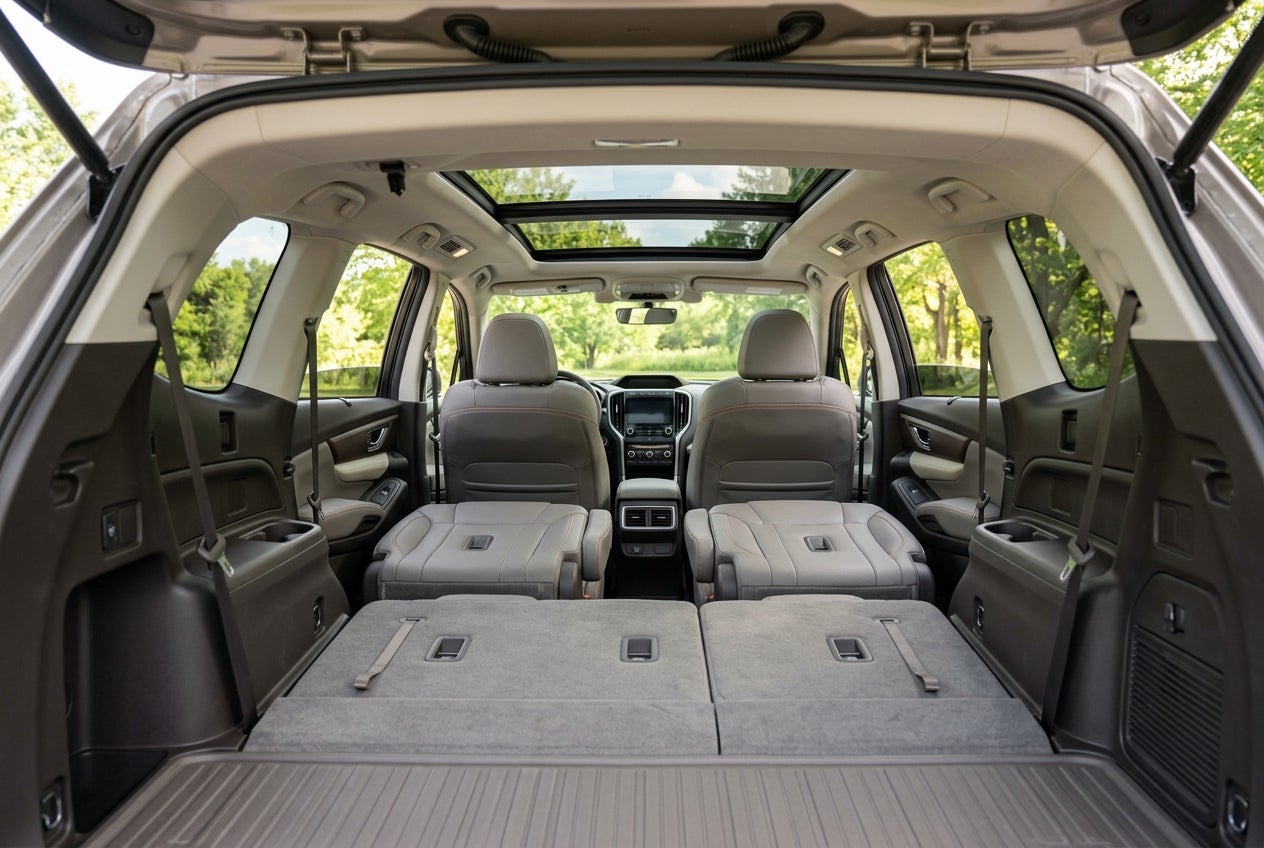
View from the open tailgate of a modern SUV showing spacious cargo area with rear seats folded flat. (Representative image for illustration purposes only. Actual vehicle may vary based on trim and configuration.)

2026 Subaru Ascent Seating Capacity: 7 or 8 Passenger Configuration Overview

When expanding families and active suburban drivers in the St. Louis metropolitan area search for a versatile three-row SUV, the immediate question that tops their list is: How many passengers can the 2026 Subaru Ascent seat? The definitive answer is that the 2026 Subaru Ascent seats either 7 or 8 passengers, depending entirely on which second-row seating architecture you choose. This level of intentional design versatility ensures that whether you are organizing the neighborhood carpool through Sunset Hills, packing up for a weekend getaway to the Ozarks, or navigating rainy morning commutes down Watson Road, the Ascent delivers tailored comfort without sacrificing standard all-wheel-drive capability. In its standard 8-passenger layout, the Subaru Ascent features a plush 60/40-split flat-folding second-row bench seat capable of accommodating three adults or child safety seats with ease. For those prioritizing effortless third-row access and executive-style comfort, selecting the 7-passenger layout replaces the bench with dual second-row captain's chairs. Boasting up to 153.5 cubic feet of total passenger volume, wide-opening rear doors that swing open to nearly 75 degrees, and low step-in heights, the 2026 Subaru Ascent sets a gold standard for accessibility and roominess. To explore available models in person, check out our New Subaru Ascent Inventory or Get Directions to Sunset Hills Subaru to tour our showroom. Comparing 7-Passenger vs. 8-Passenger Layouts in the 2026 Subaru Ascent Understanding Second-Row Architecture: Choosing between 7 and 8 passenger capacities comes down to how your family utilizes space on a daily basis. The 8-passenger configuration maximizes raw seating count, making it the ideal pick for large families or frequent team carpooling around Ladue and Sunset Hills. The second-row bench slides forward and backward seamlessly, providing flexible legroom distribution between middle and third-row occupants. Conversely, the 7-passenger configuration replaces the bench with two individual second-row captain's chairs. This leaves an open center-aisle pass-through, allowing children and teenagers to step through directly into the third row without folding down second-row seats. Heated captain's chairs are also available on higher trims, raising passenger comfort for long road trips. Third-Row Dimensions & Everyday Usability: Unlike many midsize three-row competitors where the rear seat feels like an afterthought, the 2026 Ascent offers a generous 31.7 inches of third-row legroom, 57.2 inches of shoulder room, and dedicated air vents. Reclining seatbacks in the third row further enhance comfort during longer journeys across Missouri. Interior Metric First Row Second Row Third Row Headroom (in.) 41.2 40.0 36.2 Legroom (in.) 42.2 38.6 31.7 Shoulder Room (in.) 61.1 60.3 57.2 Hip Room (in.) 57.7 56.7 47.2 How 2026 Subaru Ascent Trim Levels Dictate Passenger Seating and Cabin Comfort Base & Premium Trims Base Trim: Exclusively available in an 8-passenger layout with comfortable high-grade cloth upholstery, tri-zone automatic climate control, and 19 cupholders throughout the cabin. Premium Trim: Offers a choice between standard 8-passenger seating or optional 7-passenger captain's chairs. Features stain-resistant cloth, heated front seats, 8-way power driver seat, and second-row climate controls. Onyx Edition & Limited Onyx Edition: Built standard for 7 passengers with second-row captain's chairs and water-repellent StarTex® synthetic leather upholstery with green accent stitching—perfect for outdoorsy families. Limited Trim: Available in both 7 and 8-passenger layouts. Upscales comfort with leather-trimmed seating, 10-way power driver seat, heated second-row seats, and integrated rear door sunshades. Touring Trim Touring Trim: A premium Subaru trim level. Features exclusive 7-passenger seating with Nappa leather upholstery, ventilated front seats, panoramic power moonroof, Smart Rearview Mirror, and a 14-speaker Harman Kardon® premium audio system. Explore all trims in our New Subaru Inventory today. View Available 2026 Ascent Inventory Cargo Space and Versatility Behind Every Row of the 2026 Subaru Ascent A true family vehicle must balance passenger comfort with raw gear-hauling utility. The 2026 Subaru Ascent excels with adaptive cargo arrangements: • Behind Third Row: 18 cubic feet of storage—enough space for grocery runs, sports duffels, or stroller equipment. • Behind Second Row (Third Row Folded): Up to 43.5 cubic feet, perfect for luggage on extended family vacations. • Maximum Cargo Capacity (Both Rows Folded): Up to 76 cubic feet of flat load space. Practical amenities include a hidden under-floor storage tray to keep valuables out of sight, an available power rear gate with height memory, and standard roof rails capable of supporting kayaks, bikes, or cargo boxes. 2026 Subaru Ascent vs. Toyota Highlander: Interior Passenger Space and Maintenance Costs When comparing three-row family SUVs, buyers frequently cross-shop the 2026 Subaru Ascent against the Toyota Highlander. While both vehicles offer solid reputations, the Subaru Ascent holds distinct advantages in third-row passenger roominess, standard drivetrain value, and predictable ownership costs over a 5-year period. Comparison Metric 2026 Subaru Ascent 2026 Toyota Highlander Standard Drivetrain Symmetrical All-Wheel Drive Front-Wheel Drive (AWD extra) Total Passenger Volume Up to 153.5 cu. ft. Up to 141.8 cu. ft. Third-Row Legroom 31.7 in. 28.0 in. Standard Ground Clearance 8.7 in. 8.0 in. 5-Year Scheduled Maintenance Competitive / Predictable BOXER® service Standard Toyota maintenance schedule The Subaru Ascent provides nearly 3.7 extra inches of third-row legroom compared to the Highlander, transforming the back row from an emergency-only child space into usable seating for adults and growing teens. Furthermore, standard Symmetrical AWD on every Ascent trim eliminates the added option price tag that Toyota charges for AWD capability. Looking to trade in your current vehicle? You can Get your value trade online in minutes. Standard Subaru EyeSight Safety Features and How They Protect Your Passengers Safety is paramount when transporting up to eight passengers. Every 2026 Subaru Ascent comes equipped with the standard **EyeSight® Driver Assist Technology**, enhanced by a wide-angle mono camera that expands the system's field of view to spot pedestrians and cyclists at intersections earlier. Key EyeSight protection systems include: • Pre-Collision Braking: Applies full braking force in emergency situations to prevent or mitigate frontal impacts. • Adaptive Cruise Control with Lane Centering: Maintains safe follow distances during highway traffic on I-44 or I-270. • Blind-Spot Detection & Rear Cross-Traffic Alert: Provides visual warnings on side mirrors when vehicles enter blind zones. • Automatic Emergency Steering: Assists with evasive steering maneuvers when a collision threat is detected at speeds under 50 mph. Apply for Financing on Safety-Equipped Ascents Can You Upgrade Safety Features Yourself or Is Professional Installation Required? Factory Integration vs. DIY Upgrades: Modern automotive safety systems are deeply embedded into the vehicle's electronic control units (ECU). Primary active driver assists—such as EyeSight dual stereo cameras, radar sensors, and pre-collision braking modules—are factory-installed integrated technologies. They **cannot** be added as aftermarket DIY kits or retrofitted independently after purchase. Attempting self-installation of unapproved electrical modifications can void factory warranties and disrupt crucial sensor calibration. Professional Installation & Calibration: For optional dealer-installed safety accessories—such as auto-dimming exterior mirrors with approach lights, rear bumper covers, or dash cameras—certified technicians must perform installation. Following windshield replacement or front-end service, precise optical calibration at an authorized service center like Sunset Hills Subaru is mandatory to ensure EyeSight cameras function accurately. You can readily Schedule Service and Diagnostics with our factory-trained technicians. What Is the Price Range and Package Cost for the 2026 Subaru Ascent near Sunset Hills? Base & Premium Pricing The 2026 Subaru Ascent starts in the mid-$35,000 price range for the standard Base model. Stepping up to the popular Premium trim (starting around $38,000–$40,000) unlocks options like 7-passenger captain's chairs, keyless access, and power liftgate packages. Onyx & Limited Pricing The stylish Onyx Edition ranges near $41,000–$43,000 with blacked-out trim and StarTex seating. The Limited trim ranges around $42,000–$45,000, offering optional tech packages featuring Harman Kardon sound and panoramic glass. Touring & Incentives The top-tier Touring trim arrives fully equipped near $49,000–$50,000. Sunset Hills Subaru regularly updates seasonal offers and low-APR financing; review our Current New Car Specials to learn more about current availability. Interior Technology and Infotainment Features Compared to Rival SUVs 11.6-Inch STARLINK® Display & Connectivity: At the center of the 2026 Ascent's interior layout sits the high-resolution 11.6-inch Subaru STARLINK multimedia touchscreen. Standard wireless Apple CarPlay® and Android Auto™ allow driver and passengers to seamlessly link smartphones without cluttered cords. Cabin Connect Intercom System: Addressing the common challenge of communicating with rear passengers, the available Cabin Connect intercom amplifies the driver's voice through the rear speakers so you never have to shout to be heard in the third row. Multi-Row Device Charging & Cupholders: Keeping modern families connected, the Ascent features up to six USB-A and USB-C charging ports strategically placed across all three rows. Additionally, with 19 illuminated cupholders throughout the cabin, every passenger's drink or water bottle stays secure during travel. Compare model specs across our full fleet including the New Subaru Outback Inventory or New Subaru Forester Inventory. Explore Pre-Owned Subaru Inventory What Maintenance Is Required to Maintain Fuel Economy and AWD Performance? Maintaining peak EPA-estimated fuel economy (up to 26 MPG highway) and optimizing Symmetrical All-Wheel Drive power delivery requires adherence to simple scheduled service intervals: • Synthetic Oil Changes (Every 6,000 Miles): Keeps the 2.4-liter turbocharged Subaru BOXER® engine running clean and cool. • Tire Rotations & Tread Inspection: Essential for all-wheel-drive vehicles to maintain uniform tire circumference and prevent drivetrain binding. • Engine & Cabin Air Filter Replacements: Preserves engine intake efficiency and passenger air purity. • Differential & CVT Fluid Checks: Ensures smooth shifting performance under heavy loads or towing. Check out our Current Service and Parts Specials and source OEM parts via Find Subaru Parts. Key Questions to Ask Dealerships Before Purchasing or Customizing Your 2026 Subaru Ascent 1. Seating & Utility • Does this specific trim come in a 7-passenger or 8-passenger layout? • Can I test seat folding mechanisms with my family's car seats installed? 2. Trade & Financing • What trade-in value incentives are available today? • What special APR rates apply to the 2026 Ascent? • Can accessories be rolled into monthly financing? 3. Factory Accessories • Which factory accessories (e.g., trailer hitch, crossbars, all-weather mats) are pre-installed? • What warranty coverage protects dealer-installed options? Test Drive the 2026 Subaru Ascent Today at Sunset Hills Subaru There is no better way to determine whether the 7-passenger captain's chair setup or 8-passenger bench layout suits your lifestyle than experiencing the 2026 Subaru Ascent in person. Visit Sunset Hills Subaru at 10100 Watson Rd, Sunset Hills, MO 63127. Our friendly team is ready to walk you through trim features, help you explore financing options, and take your family on a comprehensive test drive. Have questions right now? Call us at (314) 476-9638 to speak directly with our Subaru specialists. Schedule Your Ascent Test Drive 2026 Subaru Ascent Seating Options in Sunset Hills MO | Sunset Hills Subaru
Four Subaru SUVs parked in a row outside a modern glass dealership building at sunset. (Representative image for illustration purposes only. Actual vehicle may vary based on trim and configuration.)

What Financing Rates and Lease Deals Does Subaru Offer on New 2026 Models?

What Financing Rates and Lease Deals Does Subaru Offer on New 2026 Models? Navigating the current automotive marketplace requires transparent answers about special financing rates, incentive structures, and competitive monthly lease terms. For the 2026 model year, Subaru continues to position itself as one of the most value-oriented automakers in North America by partnering with Subaru Motors Finance to deliver standout annual percentage rates (APR) and monthly lease specials. Qualified buyers visiting Sunset Hills Subaru can take advantage of promotional APR financing options available with competitive rates on flagship models like the 2026 Subaru Outback, Forester, Crosstrek, and the all-electric Trailseeker EV. These low-interest loans directly minimize long-term borrowing costs, giving St. Louis area drivers significant leverage over standard market loan rates. In addition to promotional purchase rates, Subaru Motors Finance offers customizable 36-month lease programs designed around low upfront initial payments ('due at signing') and flexible mileage tiers ranging from 10,000 to 12,000 miles per year. Whether you are commuting along I-270 or planning weekend road trips across Missouri, these specialized programs make driving a brand-new vehicle with standard Symmetrical All-Wheel Drive both practical and budget-friendly. To explore current inventory available for immediate delivery, check out our New Subaru Inventory or review our updated Current New Car Specials today. How Subaru Low APR Financing Offers Work Across New 2026 Vehicles Promotional financing through Subaru Motors Finance is structured across various repayment horizons, usually spanning 36, 48, 60, and up to 72 months depending on the model tier and promotional calendar. Lower loan terms—such as 36 or 48 months—typically unlock the absolute lowest APR tiers (often 1.9% to 2.9%), whereas extended 60- or 72-month terms are frequently set around 3.9% to 4.9%. Across popular models like the redesigned Outback crossover, the versatile Forester SUV, the nimble Crosstrek, and the spacious Ascent, these low rates serve as a primary catalyst for total lifetime savings. For eco-conscious St. Louis drivers, the 2026 Solterra EV often features the most aggressive incentive packages, including ultra-low APR paired with manufacturer bonus cash incentives to accelerate electric vehicle adoption. You can explore complete specs and availability directly within our New Subaru Solterra Inventory or look into our versatile three-row crossover selection in the New Subaru Ascent Inventory. Securing these preferred low APR rates requires meeting tier-one credit approval standards established by Subaru Motors Finance (usually defined as a FICO score of 700 or higher, alongside a healthy debt-to-income balance and verified income). However, tier-two and tier-three applicants still enjoy highly competitive financing terms that consistently beat average national retail bank rates. To put these savings in perspective: financing $35,000 at a standard national commercial bank rate of 7.5% over 60 months results in approximately $7,100 in total interest payments. In contrast, securing a promotional current APR through Sunset Hills Subaru over that same 60-month window drops your total interest paid to roughly $2,650—saving you over $4,400 in interest alone. To see where you stand and jumpstart your financing package, you can Get approved for financing before even visiting our showroom. What Are the Current 2026 Subaru Lease Specials and Monthly Payment Rates? Lease Terms & Down Payments Subaru lease structures are predominantly built on standard 36-month agreements. Monthly payment calculations reflect the difference between the vehicle's initial selling price and its residual value at the end of the 3-year term. Down payment requirements ('due at signing') vary by vehicle and current offer, which includes the first month's payment, down payment reduction, and acquisition fees. Drivers looking to lower their monthly expenditure can choose to make a higher upfront payment or leverage trade-in equity. Annual Mileage Allowances Standard Subaru lease contracts include a choice between 10,000 miles, 12,000 miles, or 15,000 miles per year. For daily commuters across St. Louis County, a 12,000-mile annual cap is the most popular selection, offering plenty of freedom for daily driving and regional road trips. Mileage overages at the end of the term are billed at a straightforward, nominal per-mile rate (based on the terms of your lease), giving drivers flexibility if their driving habits change. Acquisition Fees & Local St. Louis Terms Subaru lease agreements feature a standardized manufacturer acquisition fee (typically $595), which covers administrative expenses for setting up the lease account. At the end of your lease term, you have three clear choices: return the vehicle and lease a brand-new Subaru model, purchase your current vehicle for its pre-agreed residual value, or simply return the vehicle. Explore current monthly lease offers in our New Subaru Outback Inventory. Apply for Finance Approval What Is the Full 2026 Subaru Outback MSRP Range Across Trim Levels? The 2026 Subaru Outback remains an icon of midsize SUV utility, blending station wagon efficiency with true SUV capability. Understanding how MSRP varies across Outback trim levels helps you pick the exact balance of convenience, luxury, and trail capability for your lifestyle. 2026 Outback Trim Level Estimated MSRP Range Key Included Features Base $29,000 - $30,500 Standard AWD, Dual 7-inch STARLINK, EyeSight Tech Premium $31,500 - $33,000 11.6-inch Touchscreen, All-Weather Pkg, 10-Way Power Driver Seat Limited $36,000 - $38,000 Leather-Trimmed Upholstery, Harman Kardon Audio, Hands-Free Gate Wilderness $40,500 - $42,500 9.5-in Clearance, Yokohama GEOLANDAR Tires, Dual X-MODE Touring / Touring XT $41,000 - $43,500 Nappa Leather, Ventilated Seats, Smart Rear-View Mirror, Turbo Engine Stepping up from the Base to the Premium trim represents one of the best feature upgrades in the segment, adding the expansive 11.6-inch STARLINK multimedia display, heated front seats, dual-zone climate control, and optional blind-spot detection. Meanwhile, the rugged 2026 Subaru Outback Wilderness commands a distinct price point thanks to specialized hardware: raised suspension yielding 9.5 inches of ground clearance, front skid plates, enhanced towing capability (up to 3,500 lbs with the standard 2.4L Turbocharged Subaru BOXER engine), and durable StarTex water-repellent upholstery. Explore complete specifications in our dedicated New Subaru Outback Inventory. What Is the Cheapest Subaru Model to Buy New in 2026? For value-minded shoppers evaluating initial sticker price alongside standard feature sets, the 2026 Subaru Impreza holds the crown as the standard entry point to the Subaru lineup. Starting with an entry MSRP generally under $24,000, the 5-door hatchback layout delivers exceptional everyday utility without sacrificing technological capabilities or passenger comfort. Positioned right above the Impreza is the hugely popular 2026 Subaru Crosstrek, starting around $25,500 to $26,500. The Crosstrek builds on the hatchback platform by adding 8.7 inches of ground clearance, aggressive body cladding, and available dual-function X-MODE for off-road confidence. Browse current options in our New Subaru Impreza Inventory and New Subaru Crosstrek Inventory. What truly sets these entry-level Subaru models apart from compact vehicles such as the Honda Civic, Toyota Corolla, or Hyundai Kona is that Symmetrical All-Wheel Drive comes standard on every trim—not as an available option package. In addition, both the Impreza and Crosstrek boast exceptional ALG Residual Value Awards and consistently lower five-year total cost of ownership scores. Their minimal depreciation curve means that when it comes time to trade up or sell down the road, your vehicle retains a significantly higher proportion of its original purchase value. Destination Fees, Sales Tax, and Dealer Pricing: Do Subarus Sell at MSRP? Destination & Delivery Fees Standard manufacturer destination and delivery charges for 2026 Subaru passenger cars (Impreza, Legacy, BRZ) hover around $1,120 to $1,170, while crossover SUVs (Crosstrek, Forester, Outback, Ascent, Solterra) feature standard destination charges ranging from $1,345 to $1,450. These mandatory fees cover factory transport logistics directly from assembly plants (such as Lafayette, Indiana or Gunma, Japan) to Sunset Hills Subaru. Sunset Hills & MO Auto Sales Tax When registering a new vehicle in Sunset Hills, MO (ZIP 63127) or throughout St. Louis County, total auto sales tax is calculated based on the net purchase price (selling price minus trade-in allowance). Combined state, county, and municipal tax rates typically average around 8.5% to 9.2%. Factoring this into your finance structure prevents last-minute surprises during vehicle pickup. Do Subarus Sell at MSRP? At Sunset Hills Subaru, we take pride in straightforward, transparent pricing without hidden dealer markups or mandatory accessory add-ons. During promotional periods and dealer sales events, many new Subaru models sell at MSRP. Check out our Current New Car Specials or explore pre-owned opportunities in our Used Vehicle Inventory. View Current New Car Specials How Does the 2026 Subaru Forester Compare to the Toyota RAV4 in Price and Features? The compact crossover category is heavily contested, with the Subaru Forester and Toyota RAV4 serving as primary rivals. However, when examining feature-per-dollar value, standard equipment, and cabin space, the redesigned 2026 Subaru Forester offers a strong set of features for Missouri buyers. Feature / Specification 2026 Subaru Forester 2026 Toyota RAV4 Starting Base MSRP Starting ~$29,900 Starting ~$29,000 (FWD standard) All-Wheel Drive Standard Symmetrical AWD Optional (+$1,400 upgrade fee) Standard Safety Tech Subaru EyeSight Driver Assist Toyota Safety Sense Max Passenger Volume 111.6 cu. ft. (Superior outward sightlines) 98.9 cu. ft. Ground Clearance 8.7 Inches Standard 8.1 Inches Standard While the Toyota RAV4 advertises a slightly lower initial base MSRP, that base model comes equipped with front-wheel drive (FWD). Adding all-wheel drive to the RAV4 changes its purchase price relative to the standard-AWD equipped Forester. Furthermore, the Forester features superior window design and lower beltlines, creating market-leading outward visibility and an airy, expansive cabin feeling. Standard EyeSight Driver Assist technology includes advanced stereo cameras with broader field-of-view tracking for pedestrian protection, adaptive cruise control, and automatic emergency steering. Explore pricing and availability in our New Subaru Forester Inventory. What Features Are Included in Top-Tier Outback Touring and Wilderness Trims? Outback Touring Luxury The Outback Touring represents the pinnacle of executive comfort. Exterior highlights include power-folding side mirrors, high-gloss black pillar accents, and satin-chrome finish trim. Inside the cabin, commuters enjoy genuine Java Brown or Black Nappa leather upholstery, ventilated front seats, a heated steering wheel, and a Smart Rear-View Mirror that projects a high-definition video feed when cargo blocks rear vision. Outback Wilderness Ruggedness Designed for off-road enthusiasts and weekend campers, the Wilderness trim elevates all-terrain capability. It features raised suspension with 9.5 inches of ground clearance, matte-black anti-glare hood decal, Yokohama GEOLANDAR all-terrain tires on 17-inch matte-black alloy wheels, heavy-duty roof rails capable of supporting a rooftop tent (700-lb static load capacity), and Dual-Function X-MODE with Snow/Dirt and Deep Snow/Mud settings. Premium Infotainment & Audio Both top-tier trims feature standard 11.6-inch STARLINK Multimedia Plus systems with wireless Apple CarPlay and Android Auto integration. Premium acoustic clarity is provided by a 12-speaker Harman Kardon sound system powered by a 576-watt equivalent GreenEdge amplifier. Perfect for discerning Ladue drivers seeking luxury refinement alongside everyday practical utility. Is Extended Warranty Coverage Recommended When Buying or Financing a New Outback? Every new 2026 Subaru vehicle leaves the factory with standard warranty coverage, including a 3-year/36,000-mile limited bumper-to-bumper warranty and a 5-year/60,000-mile powertrain warranty. While this factory coverage provides great peace of mind during initial ownership, drivers planning to finance over 48, 60, or 72 months often elect to add long-term protection through genuine Subaru Added Security extended service agreements. Subaru Added Security is the only official factory-backed extended agreement explicitly created for Subaru vehicles. It extends coverage up to 10 years or 100,000 miles, covering thousands of mechanical and electronic components using only factory-trained technicians and genuine parts. Modern vehicles are sophisticated technical ecosystems featuring advanced driver-assist sensors, touchscreens, high-pressure turbochargers, and complex electrical harnesses. Extended coverage protects owners from unexpected out-of-pocket technical repair expenses down the road. When purchasing or financing through Sunset Hills Subaru, the cost of a Subaru Added Security protection plan can be bundled directly into your monthly financing contract, allowing you to lock in protection at promotional low APR interest rates. You can also review current maintenance and component specials via our Current Service and Parts Specials page or directly Schedule Service and Diagnostics with our certified technician team. Schedule Service and Diagnostics How to Maximize Your Trade-In Value to Lower Your Subaru Loan or Lease Leveraging equity in your existing vehicle is one of the most effective strategies to lower monthly finance payments or reduce up-front lease cash obligations. Follow these strategic steps to maximize your vehicle's trade value: 1. Gather Service History & Documentation Providing documented proof of regular maintenance (such as oil changes, tire rotations, and brake servicing) demonstrates vehicle care and elevates re-market value. 2. Take Care of Quick Cosmetic Detailing Performing a light detail, clearing personal items, and addressing minor cosmetic paint touch-ups ensures your appraisal generates top trade valuation. 3. Leverage Online Trade Estimation Tools Get a quick, real-market valuation online before stepping foot into the dealership so you know your vehicle's true worth. Missouri Sales Tax Offset Advantage In Missouri, trading in a pre-owned vehicle provides a substantial sales tax benefit. Tax is levied only on the net difference between your new vehicle purchase price and trade-in value. For example, purchasing a $35,000 Outback with a $15,000 trade-in means you only pay auto sales tax on $20,000—saving hundreds of dollars in tax liabilities. To start the process online from home, click to Get your value trade today. Get Your Trade Valuation Which Subaru Dealerships Offer the Best Lease and Finance Support Near Sunset Hills? Sunset Hills Subaru Location Conveniently situated at 10100 Watson Rd, Sunset Hills, MO 63127, Sunset Hills Subaru serves drivers across Sunset Hills, Kirkwood, Webster Groves, Ladue, and greater St. Louis. Get Directions to Sunset Hills Subaru or Call us at (314) 476-9638 to speak directly with our team. Unmatched Inventory Selection We maintain a vast inventory of 2026 models including sports cars like the BRZ and WRX, sedan offerings like the Legacy, and complete crossover lineups. Browse our New Subaru BRZ Inventory, explore performance in our New Subaru WRX Inventory, or check out our executive sedan in the New Subaru Legacy Inventory. Dedicated Finance Center Our finance office works directly with Subaru Motors Finance alongside top regional credit unions to secure preferred interest rates and custom payment plans. When you need replacement components or accessories, our team will help you Find Subaru Parts with original factory guarantees. Explore Your Low Subaru Financing Rate or Lease Deal at Sunset Hills Subaru Today With promotional 2026 APR financing starting as low as 1.9% to 3.9% and customizable 36-month lease offers across Outback, Forester, Crosstrek, and Solterra models, taking home a new Subaru has never been more straightforward. Experience the difference of shopping with a team committed to complete transparency, friendly service, and long-term customer satisfaction. Learn more in your vehicle buying journey today: get pre-approved online, value your current trade-in, browse our updated new vehicle inventory, or visit our Sunset Hills showroom for a personalized test drive. Browse New Subaru Vehicles 2026 Subaru Financing and Lease Deals in Sunset Hills MO | Sunset Hills Subaru
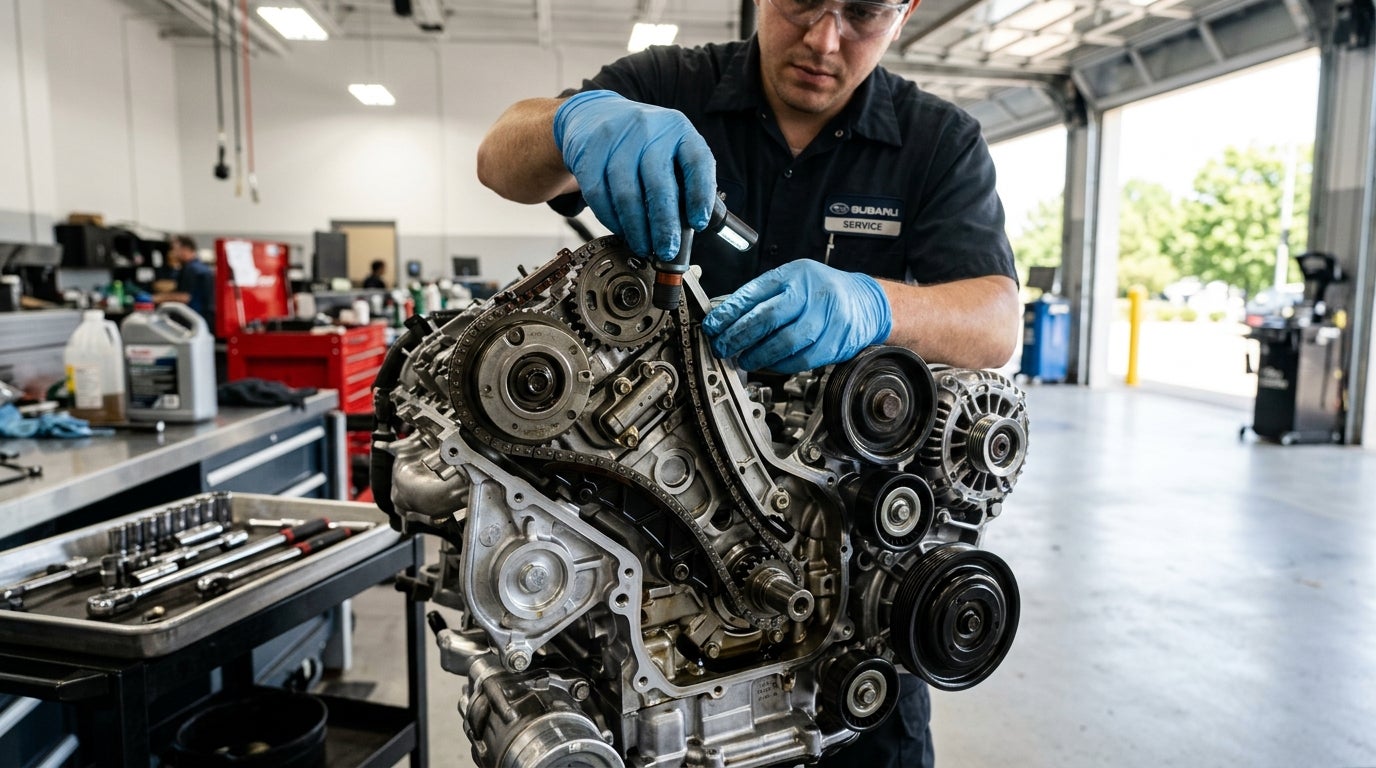
A Subaru service technician inspecting an exposed car engine timing chain in an auto repair shop. (Representative image for illustration purposes only. Actual vehicle may vary based on trim and configuration.)

Subaru Timing Belt vs. Timing Chain: The Direct Answer & Replacement Intervals

Subaru Timing Belt vs. Timing Chain: The Direct Answer & Replacement Intervals If you drive a Subaru around Sunset Hills or Ladue, knowing whether your engine uses a timing belt or a timing chain is one of the single most critical factors in maintaining long-term engine reliability. Here is the straightforward answer straight from our factory workshop: Subaru rubber timing belts require scheduled replacement every 105,000 miles or 7 years (whichever occurs first). On the other hand, Subaru metal timing chains are engineered to last the full lifecycle of the vehicle engine without scheduled replacement, provided regular engine oil changes are performed. To break down precisely what this means for your vehicle, we sat down for an in-depth interview with Kyle Marcum, Master Technician at Sunset Hills Subaru. With over 7 years of hands-on experience diagnosing, servicing, and rebuilding horizontal Boxer engines—from classic EJ series powerplants to modern FB, FA, and EZ configurations—Kyle shares his expert technical insights on timing maintenance, warning signs, and prevention strategies for Suburban St. Louis drivers. Schedule Timing Service & Diagnostics Meet Master Tech Kyle Marcum: Expert Subaru Engine Care in Sunset Hills Interviewer: Kyle, thank you for joining us today. You've been working on Subaru Boxer engines here in Sunset Hills for 7 years. To kick things off, why is the timing system such a passionate topic among Subaru owners? Kyle Marcum: Thanks for having me. The Subaru Boxer engine is unique because the cylinders lay horizontally opposed. That means the camshafts on each cylinder head are separated by a significant distance across the engine bay. Whether your Boxer relies on a long, reinforced rubber timing belt or a dual roller timing chain, that component is responsible for perfectly synchronizing the crankshaft with the overhead camshafts. If that synchronization slips even by a few teeth, the engine stops running properly—or worse, sustains severe internal damage. Understanding whether you have a belt or chain dictates your entire maintenance budget over 100,000 miles. Drivers commuting around Sunset Hills, Kirkwood, and Ladue often ask us if their vehicle needs immediate timing belt service. When customers bring their vehicles to our dealership, whether they are checking out our New Subaru Inventory or coming in for routine maintenance, clarifying their engine family gives them total clarity and complete confidence. Q: Which Subaru Models Have a Timing Belt Versus a Timing Chain? Interviewer: Kyle, Subaru transitioned many of its engines from timing belts to timing chains over the past decade and a half. Can you break down which models and model years feature belts versus chains? Belt-Driven Subaru Models (EJ Engine Family) Kyle Marcum: The legacy EJ engine architecture relies on a rubber composite timing belt with heavy internal tensile cords. Models requiring belt replacement at 105k miles include: • Outback & Legacy: 2.5L 4-cylinder models up through 2012. • Forester: 2.5L 4-cylinder models up through 2010. • Impreza: 2.5L non-turbo models up through 2011. • WRX & WRX STI: All EJ25-powered performance models up through 2021 STI. Chain-Driven Subaru Models (FB / FA / EZ Families) Beginning around 2011, Subaru introduced modern FB and FA series engines equipped with maintenance-free metal timing chains: • Forester: 2011+ (FB25 / 1.8T / 2.5L DI) • Impreza: 2012+ (FB20) • Outback & Legacy: 2013+ (FB25) & 3.6R 6-cyl (EZ36) • Crosstrek: All years (2013+) (FB20 / FB25) • Ascent, WRX (2015+), BRZ: All modern FA20/FA24/FA24T engines. Key Differences & Model Quick-Reference If you drive a newer model like those found in our New Subaru Forester Inventory or New Subaru Outback Inventory, your vehicle uses a timing chain designed for the life of the motor. However, if you are shopping pre-owned or maintaining a late 2000s model, keeping track of that 105,000-mile belt deadline is vital to avoid mechanical failure. Q: What Happens When a Timing Belt Snaps on an Interference Subaru Engine? Interviewer: Kyle, we often hear the term 'interference engine' when discussing timing belts. What does that mean in simple terms, and what actually happens inside a Subaru engine if a timing belt breaks while driving down Interstate 44? Kyle Marcum: Virtually all modern Subaru engines—both belt and chain driven—are interference design engines. In an interference engine, the physical space where the intake and exhaust valves open overlaps with the space the piston occupies at top-dead-center. The timing belt acts like a precision conductor, ensuring the valves move out of the way before the piston travels upward. If a timing belt snaps or strips its teeth while the engine is running at 3,000 RPM, the camshafts instantly freeze while the crankshaft keeps spinning. The pistons smash into the open valves at high velocity. The result is bent intake and exhaust valves, damaged piston crowns, cracked valve guides, and often complete cylinder head destruction. Instead of a routine belt service, you are looking at thousands of dollars in engine rebuilding or full engine replacement. Schedule Service and Diagnostics Q: What Does a Bad Timing Belt Sound Like, and Are Timing Chains Louder? Interviewer: Drivers often ask if they can hear a failing timing belt or chain before catastrophic failure happens. What acoustic warning signs should owners listen for? Timing Belt Acoustic Symptoms Kyle Marcum: Timing belts themselves are quiet because they are rubber. However, a failing hydraulic belt tensioner or worn idler pulley produces distinct sounds: • Ticking or Rapping: A failed tensioner piston tapping against the engine block behind the timing cover. • High-Pitched Squeak or Grinding: Seizing bearing in the cogged or smooth idler pulleys. • Slapping Sound: Belt slack hitting the plastic timing cover at cold startup. Timing Chain Acoustic Symptoms Timing chains emit a subtle mechanical hum under normal operation. However, excessive noise indicates maintenance issues: • Metallic Rattling on Cold Start: Oil starvation or low engine oil pressure delaying hydraulic chain tensioner activation. • Continuous Marbles-in-a-Can Noise: Stretched chain links or worn composite chain guides due to neglected oil change intervals. Kyle's Expert Advice Never ignore unusual noises coming from the front lower section of your engine. For chain engines, keeping fresh oil at proper levels is the single most crucial factor. If you notice strange noises on your vehicle, visit our certified technicians or Call us at (314) 476-9638 to schedule an immediate inspection. Q: What Should You Check Before Buying a Used Subaru with a Timing Belt? Interviewer: Many pre-owned vehicle shoppers in St. Louis and Sunset Hills look at older Subaru models known for their longevity. What pre-purchase steps should they take regarding the timing system? Kyle Marcum: If you are browsing our Used Vehicle Inventory or shopping private sales, check these critical items: 1. Service Records: Verify documented proof that the timing belt, water pump, hydraulic tensioner, and idler pulleys were replaced at or before 105,000 miles (or 7 years). 2. Timing Cover Sticker: Reputable shops place a date and mileage sticker on top of the plastic timing belt cover upon replacement. 3. Visual Inspection: Look for front camshaft or crankshaft oil leaks that could saturate and degrade a rubber belt prematurely. 4. Trade Value Evaluation: If buying a replacement vehicle, consider trading in your vehicle with our tool to Get your value trade toward a certified model. Q: What Is the Most Difficult Step in DIY Timing Belt Replacement, and What Special Tools Are Needed? Interviewer: Modern automotive enthusiasts sometimes tackle maintenance at home. Is replacing a Subaru timing belt a viable DIY project, and what makes it challenging? Kyle Marcum: Replacing a Subaru timing belt is technically demanding due to the horizontal Boxer layout. Here are the toughest steps and special tool requirements: • Crank Pulley Bolt Torque: Breaking free the factory crank pulley bolt requires over 130+ ft-lbs of breakaway torque. You need a dedicated Subaru Crank Pulley Holder Tool to prevent the engine from rotating while breaking the bolt loose. • Camshaft Alignment (DOHC Models): Dual Overhead Cam (DOHC) engines like the EJ255/EJ257 have four separate camshaft pulleys. Under valve spring tension, the left-hand camshafts will snap violently out of position if not locked in place with a specialized Cam Lock Tool. • Precision Tooth Alignment: Lining up the hash marks on the timing belt with the notch marks on the crank sprocket and four cam gears leaves zero room for error. A single tooth misalignment causes misfires or engine damage. • Genuine OEM Components: Some aftermarket timing kits often suffer early hydraulic tensioner failures. We always recommend genuine factory parts from our parts center to Find Subaru Parts designed for exact OEM tolerances. Order OEM Subaru Timing Parts Q: How Long Does It Take an Experienced Mechanic to Replace a Subaru Timing Belt? Interviewer: When a customer schedules a timing belt service at Sunset Hills Subaru, how long is their vehicle typically in the service bay, and what extra parts are serviced simultaneously? Kyle Marcum: In a professional dealership environment, a full timing belt replacement typically takes 3 to 5 hours of labor depending on whether it is a Single Overhead Cam (SOHC) or Dual Overhead Cam (DOHC) turbo configuration. Crucially, replacing only the rubber belt is a mistake. To do the job right and prevent duplicate labor charges later, certified technicians install a complete timing service kit including: • New Water Pump & Gasket (driven directly by the timing belt) • New Hydraulic Belt Tensioner Assembly • New Cogged & Smooth Idler Pulleys • Fresh Engine Coolant & Thermostat • Inspection of Front Camshaft & Crankshaft Oil Seals. Q: How Do I Find a Qualified Mechanic in Sunset Hills, MO, and Does Warranty Cover Timing Service? Interviewer: What should local St. Louis drivers know about technician qualifications and warranty coverage when scheduling service? Factory-Trained Certification Kyle Marcum: Always choose technicians who complete specialized Subaru Academy training. Horizontal Boxer engines require precise torque sequences and tool knowledge that general repair shops may not possess. Routine Maintenance vs. Warranty Routine 105,000-mile timing belt replacement is considered wear-and-tear maintenance and is not covered by factory warranties. However, if a timing chain component fails under factory or Certified Pre-Owned (CPO) Powertrain warranty, it is typically covered—provided service records confirm scheduled oil changes. Local Dealership Advantage Maintaining clear service records at an authorized center protects your vehicle's warranty status and resale value. Check our Current Service and Parts Information for current seasonal service offers. Q: What Questions Should You Ask a Mechanic Before Approving a Subaru Timing Replacement? Interviewer: Before a vehicle owner signs a repair order, what key questions should they ask their service advisor? Kyle Marcum: I recommend asking these four essential questions: 1. Are genuine OEM Subaru parts being installed? 2. Does the estimate include replacing the water pump, tensioner, and all idler pulleys? 3. Will camshaft and crankshaft oil seals be inspected and replaced if leaking? 4. What warranty backs the parts and labor for this repair? If you are considering upgrading your vehicle or exploring options, you can also explore our Get approved for financing options or check Current New Car Inventory. At Sunset Hills Subaru, we provide transparent line-item estimates including genuine OEM components, factory coolant replacement, and full parts and labor warranty protection. View Current Service Specials Key Takeaways: Maintaining Your Subaru Timing System in Suburban St. Louis Timing Belt Rule Replace rubber timing belts every 105,000 miles or 7 years. Replace the water pump, tensioner, and idlers at the same time to protect your interference engine. Timing Chain Care Timing chains are built for engine life but require clean engine oil. Maintain regular oil change intervals to keep hydraulic chain tensioners functioning properly. Expert Support Trust factory-certified Master Techs like Kyle Marcum at Sunset Hills Subaru for expert diagnostic care, genuine OEM parts, and complete confidence on the road. Explore our full range of new Subaru vehicles: New Subaru Crosstrek Inventory | New Subaru Ascent Inventory | New Subaru Impreza Inventory | New Subaru WRX Inventory | New Subaru Legacy Inventory | New Subaru BRZ Inventory | New Subaru Solterra Inventory Schedule Your Subaru Timing Belt or Chain Inspection at Sunset Hills Subaru Don't leave your engine's reliability to chance. Whether your Subaru is due for its 105,000-mile timing belt replacement or you want our factory-trained Master Technicians to inspect your timing chain system, Sunset Hills Subaru is here to serve drivers across Sunset Hills, Ladue, Kirkwood, and the entire St. Louis area. Visit our state-of-the-art service center at 10100 Watson Rd, Sunset Hills, MO 63127 or contact our service advisors directly by phone. Get Directions to Sunset Hills Subaru or Call us at (314) 476-9638 today. Schedule Service Appointment Value Your Trade-In Subaru Timing Maintenance in Sunset Hills MO | Sunset Hills Subaru Subaru Timing Maintenance in Sunset Hills MO | Sunset Hills Subaru

Contact Us

Fill out this form below and we'll contact you shortly
*Required Fields