Blog / Maintenance & Service

Blog

All Maintenance & Service Sunset Hills Subaru Dealer Sunset Hills New Subaru New Vehicle Reviews Model Comparisons Buying Guides Sunset Hills Subaru Service Technology & Innovation Subaru Repair Safety Subaru Road Safety Sunset Hills Subaru EV Dealership Auto Financing 2025 Subaru Crosstrek 2025 Subaru Outback Dealership Financing Hybrid Community Engagement Performance and Engineering Fuel Efficiency Leasing guides Sunset Hills Used Cars Subaru Financing Sunset Hills Subaru Loves Pets 2025 Forester Hybrid Fun Things to Do Near Sunset Hills MO Infotainment Ownership Experience Subaru Motorsports Subaru Share The Love 2024 Outback Automotive History & Evolution Automotive News Automotive Repair Tips Automotive Rumors & Insights Buying & Trade-In Process Guidance Certified Pre-Owned Charging Solutions & Infrastructure Outdoor Adventure & Camping Reliability and Quality Insights Sales Event Subaru Loyalty Program Things to do in Sunset Hills, MO Tire Care & Replacement Trade Up Advantage Vehicle Design & Innovation
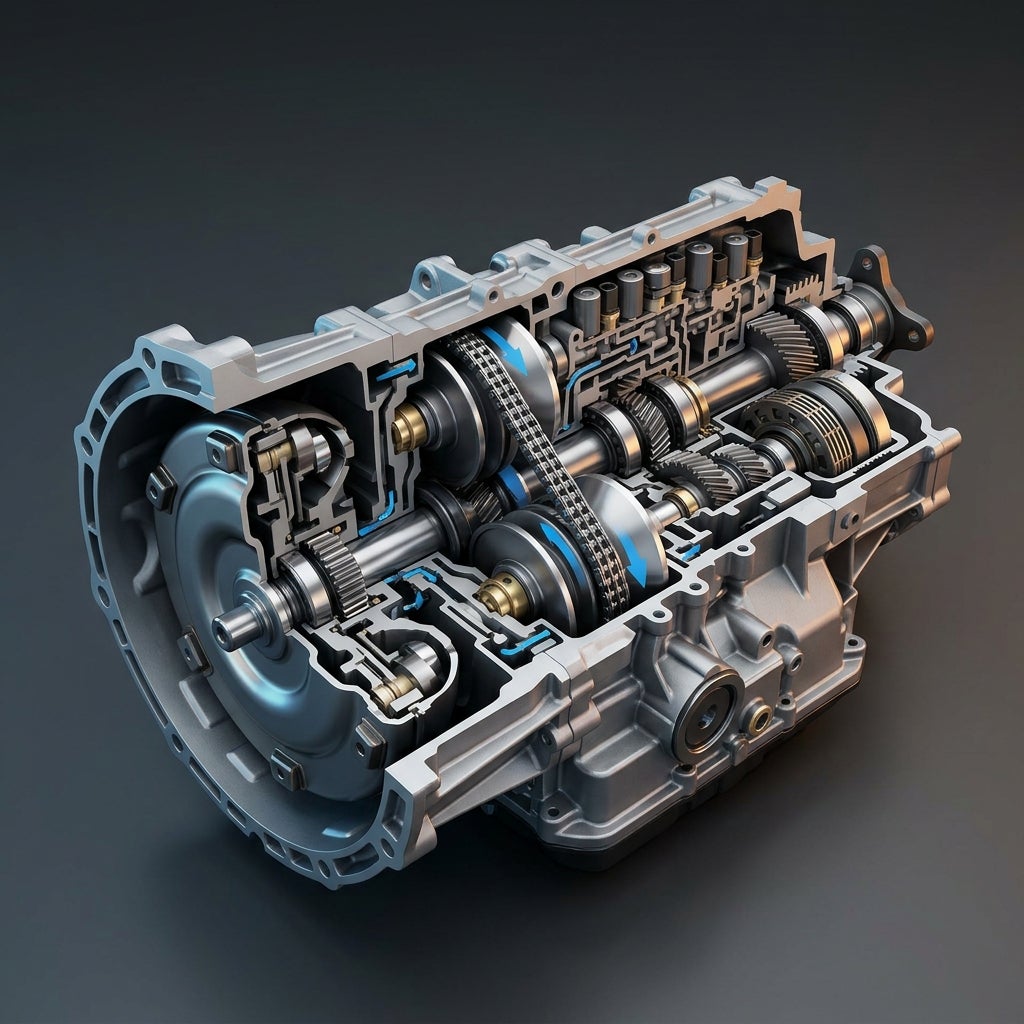
A detailed 3D cutaway visualization of a car transmission showing internal gears, chain belt, and fluid pathways. (Representative image for illustration purposes only. Actual vehicle may vary based on trim and configuration.)

How Long Does a Subaru CVT Transmission Last? Direct Lifespan Answer & Key Takeaway

When properly maintained, a Subaru Lineartronic Continuously Variable Transmission (CVT) typically lasts between 100,000 and 150,000 miles under standard driving conditions, with many well-cared-for vehicles reaching well beyond 200,000 miles on their original transmission assembly. Unlike conventional automatic transmissions that rely on fixed planetary gear sets, Subaru's unique chain-driven CVT dynamically adjusts gear ratios for optimal torque efficiency and seamless acceleration across Greater St. Louis roadways. The actual longevity of your Subaru CVT hinges on three primary factors: routine fluid maintenance, driving habits, and climate exposure. Drivers navigating daily stop-and-go commuting along Watson Road or suburban commutes through Sunset Hills experience distinct thermal stresses on transmission fluid. While early CVT iterations encountered minor growing pains, modern Subaru Lineartronic units are engineered for high durability. Exploring our New Subaru Inventory or taking proactive care of your current vehicle ensures maximum return on your automotive investment. Understanding Lineartronic CVT Technology and Symmetrical All-Wheel Drive Integration Subaru’s proprietary Lineartronic CVT stands apart from traditional CVTs used by other manufacturers. Most competitive CVTs utilize a push-belt design that relies on heavy side pressure and friction. Subaru, by contrast, engineered a high-strength steel chain-driven pulley system. This chain design allows smaller pulley diameters, expanding the overall ratio coverage while reducing internal mechanical friction. Because the Lineartronic CVT is mounted longitudinally directly behind Subaru's iconic horizontally opposed BOXER engine, it integrates seamlessly with Symmetrical All-Wheel Drive (AWD). Power flows directly in a straight line from the crankshaft through the transmission into the active torque split center differential, delivering immediate power distribution to all four wheels without energy-robbing right-angle turns in the drivetrain. This continuous torque delivery keeps engine RPMs in their optimal powerband during highway merges on Interstate 270 or winter driving conditions in St. Louis. Drivers looking for premium performance and efficiency can check out our New Subaru Outback Inventory to experience Lineartronic technology firsthand. What Are the Common Problems with Subaru CVT Transmissions? While Subaru CVTs are widely recognized for their reliability, high-mileage units or vehicles with neglected maintenance schedules can experience specific technical issues. Understanding early warning signs helps owners address minor component wear before it leads to major repairs. 1. Valve Body & Torque Converter Solenoid Failure: The most frequent mechanical failure point is the torque converter lock-up duty solenoid housed inside the transmission valve body. When this solenoid fails, drivers may experience engine stalling when coming to a stop or a flashing AT OIL TEMP light on the instrument cluster. 2. Acceleration Shudder or Hesitation: Over time, fluid degradation can reduce hydraulic clamping force on the pulleys, leading to minor slippage or shuddering under heavy throttle application. 3. Factory Extended Warranty Support: To reassure owners, Subaru extended the factory transmission warranty to 10 years or 100,000 miles for several earlier model years (including select 2010–2018 vehicles). This extension covers full diagnostic inspections and valve body or transmission replacements completed by certified technicians. If you notice erratic shifting or warning lights on your dash, browse our Current Service and Parts Specials and schedule a comprehensive diagnostic check with our factory-trained service team. Subaru Service Schedules: How Often Does a Subaru CVT Need Transmission Maintenance? Inspection Intervals (30,000–60,000 Miles) Subaru recommends inspecting the CVT fluid visual quality, temperature sensors, and line pressure every 30,000 miles. For standard commuter driving around St. Louis, a full fluid exchange is typically performed between 45,000 and 60,000 miles to preserve smooth chain engagement. Debunking 'Lifetime Fluid' Owner manuals occasionally refer to CVT fluid as 'filled for life' under light duty. However, master technicians agree that heat cycles, heavy traffic, and summer temperatures break down fluid viscosity. Replacing fluid is essential for high-mileage longevity. Severe Driving Conditions If you regularly tow trailers, carry heavy cargo, or drive in hilly terrain around Chesterfield, fluid replacement every 30,000 miles is strongly advised. Schedule Service and Diagnostics Are Subarus Reliable Vehicles? Modern Engine Durability and Head Gasket Fixes Subaru has consistently ranked near the top of industry reliability ratings from Consumer Reports and J.D. Power. A common question prospective buyers ask is: 'Did Subaru fix the head gasket issues in newer models?' The answer is an emphatic yes. Older single-overhead-cam EJ-series engines (produced prior to 2011) used single-layer graphite head gaskets that were prone to weeping over time. Starting with the introduction of the modern FB-series engines (FB20 2.0L, FB25 2.5L, and FA24 2.4L Turbo), Subaru completely re-engineered the engine block with multi-layer steel (MLS) head gaskets and independent cooling jackets. Modern Subaru engines also feature timing chains (replacing old rubber timing belts) designed to last the life of the vehicle without periodic replacement intervals. Combined with advanced EyeSight Driver Assist Safety systems, modern Subarus offer outstanding durability. Looking to upgrade your daily commuter? Explore our versatile New Subaru Forester Inventory or check out our premium New Subaru Crosstrek Inventory for long-term dependability. Engine Series Production Era Gasket Architecture Timing Mechanism Legacy EJ-Series (EJ25) 1998 – 2011 Single-Layer Coating Rubber Timing Belt (105k replace) Modern FB/FA-Series 2012 – Present Multi-Layer Steel (MLS) Maintenance-Free Chain Is Subaru Symmetrical All-Wheel Drive Reliable Across St. Louis and Chesterfield Terrain? St. Louis weather presents rapid seasonal shifts—from humid summer asphalt heat to icy winter commutes across Chesterfield and Maryland Heights. Subaru's Symmetrical All-Wheel Drive system is renowned for its exceptional physical balance and durability over 100,000+ miles. Unlike slip-and-grip systems found in traditional front-wheel-drive crossovers that only engage rear wheels after wheelspin occurs, Subaru Symmetrical AWD actively powers all four wheels continuously. Electronic sensors continuously measure steering wheel angle, yaw rate, and wheel speed to adjust power distribution via the electronically controlled hydraulic transfer clutch inside the CVT. Because mechanical loads are evenly spread across front and rear differentials, drivetrain components experience balanced wear over time. If you require maximum family capability with 3-row seating and AWD confidence, explore our New Subaru Ascent Inventory or test drive the iconic New Subaru Legacy Inventory today. Is Subaru Expensive to Maintain Compared to Other Brands? 5-Year Cost of Ownership Data from independent automotive analysis firms shows Subaru average annual maintenance costs range between $450 and $600 during the first five years, putting it on par with Honda and Toyota. 10-Year Long-Term Estimates Over a 10-year ownership period, routine maintenance costs average approximately $6,000 to $7,200. Standard maintenance tasks (oil changes, tire rotations, cabin filters) are competitively priced. Competitive Advantage When accounting for all-wheel-drive capability, Subaru maintenance costs are significantly lower than European luxury crossovers, which require specialized synthetic fluids and higher labor rates. Vehicle Brand Avg. Annual Maintenance (Yrs 1-5) Est. 10-Year Maintenance Total Standard Drivetrain Subaru $480 - $550 $6,200 Symmetrical AWD Standard Toyota $440 - $510 $5,900 FWD Standard / AWD Optional Honda $460 - $530 $6,100 FWD Standard / AWD Optional Are Subaru Repair Parts Expensive and Why Does Genuine OEM CVT Fluid Matter? Subaru repair parts are competitively priced against domestic and Asian import competitors. However, when servicing the Lineartronic CVT, fluid selection is non-negotiable: you should use Genuine Subaru Genuine OEM CVT Fluid (CVTF-II or CVTF-III). Generic or universal multi-vehicle fluids lack the specific static friction modifiers required for Subaru's high-torque steel chain pulley design. Using non-OEM transmission fluid can cause chain slippage, excessive thermal expansion, seal degradation, and premature pump failure, which voids warranty coverage. Need authentic factory parts or specialized lubricants for your DIY garage project or routine upkeep? Order directly through our online store to Find Subaru Parts designed specifically for your model. Find Subaru Parts Which Subaru Model Holds Its Value Best for Resale and Trade-In? Subaru Crosstrek The Crosstrek routinely wins ALG Residual Value Awards, retaining up to 60–65% of its original value after 36 months thanks to intense pre-owned market demand. Subaru Outback & Forester Both models maintain exceptionally low depreciation curves. Documented service records showing regular CVT fluid exchanges boost trade-in appraisals by up to 15%. Subaru WRX & BRZ Performance enthusiasts look for clean maintenance histories. Check out our New Subaru WRX Inventory or New Subaru BRZ Inventory for high residual value choices. Ready to trade up to a brand-new vehicle? You can easily Get your value trade online in just a few clicks or explore our broad selection of certified Used Vehicle Inventory at Sunset Hills Subaru. How Much Does a New Subaru Cost in 2027 and Does Subaru Offer Free Maintenance? New Subaru vehicle pricing remains among the most accessible in the all-wheel-drive crossover market. Starting MSRP ranges span from mid-$20,000s for compact models up to mid-$40,000s for fully equipped 3-row family SUVs: • Impreza & Crosstrek: Starting ~$25,000 – $32,000 • Forester & Outback: Starting ~$29,000 – $41,000 • Ascent 3-Row SUV: Starting ~$35,000 – $49,000 • Solterra EV: Explore New Subaru Solterra Inventory for zero-emissions electric driving. Factory Warranty & Maintenance Coverage Every new Subaru includes a standard 3-Year / 36,000-Mile Bumper-to-Bumper Limited Warranty alongside a 5-Year / 60,000-Mile Powertrain Warranty. While complimentary routine maintenance varies by regional incentive programs, Sunset Hills Subaru frequently features service offers covering initial oil changes and tire rotations. Check out our latest Current New Car Offers or Get approved for financing to contact the dealership for current financing and purchase information. Daily Driving Tips to Extend CVT Lifespan for Ladue and Chesterfield Drivers Adopting smooth driving habits greatly reduces internal friction and heat stress within your CVT transmission. Here are key practical recommendations from certified Subaru service technicians: • Allow Proper Engine & Fluid Warm-Up: In cold winter months around Ladue and Sunset Hills, allow your vehicle to idle for 30–60 seconds before shifting into Drive. Cold CVT fluid is thicker and requires brief circulation to maintain proper line pressure. • Avoid Complete Stops Before Shifting: Always come to a complete, full stop before shifting between Reverse and Drive. Shifting while rolling forces internal clutches to absorb kinetic momentum, creating premature fluid shear. • Smooth Acceleration Modulation: Moderate throttle inputs allow the hydraulic pulleys to adjust smoothly, maintaining maximum torque efficiency on Highway 40 / I-64. • Respect Rated Towing Limits: Do not exceed manufacturer towing guidelines (typically 1,500 lbs to 5,000 lbs depending on model). Excess trailer loads raise transmission fluid temperatures rapidly. Get Your Trade Valuation Protect Your Subaru CVT Drivetrain at Sunset Hills Subaru Whether you need routine CVT fluid maintenance, expert mechanical diagnostics, or are exploring the latest Subaru models equipped with Symmetrical All-Wheel Drive, the dedicated team at Sunset Hills Subaru is ready to assist you. Also explore our New Subaru Impreza Inventory for efficient daily driving. Visit us at 10100 Watson Rd, Sunset Hills, MO 63127. Get Directions to Sunset Hills Subaru or Call us at (314) 476-9638 to schedule your service appointment or vehicle test drive today. Schedule Service and Diagnostics Subaru CVT Transmission Longevity in Sunset Hills MO | Sunset Hills Subaru
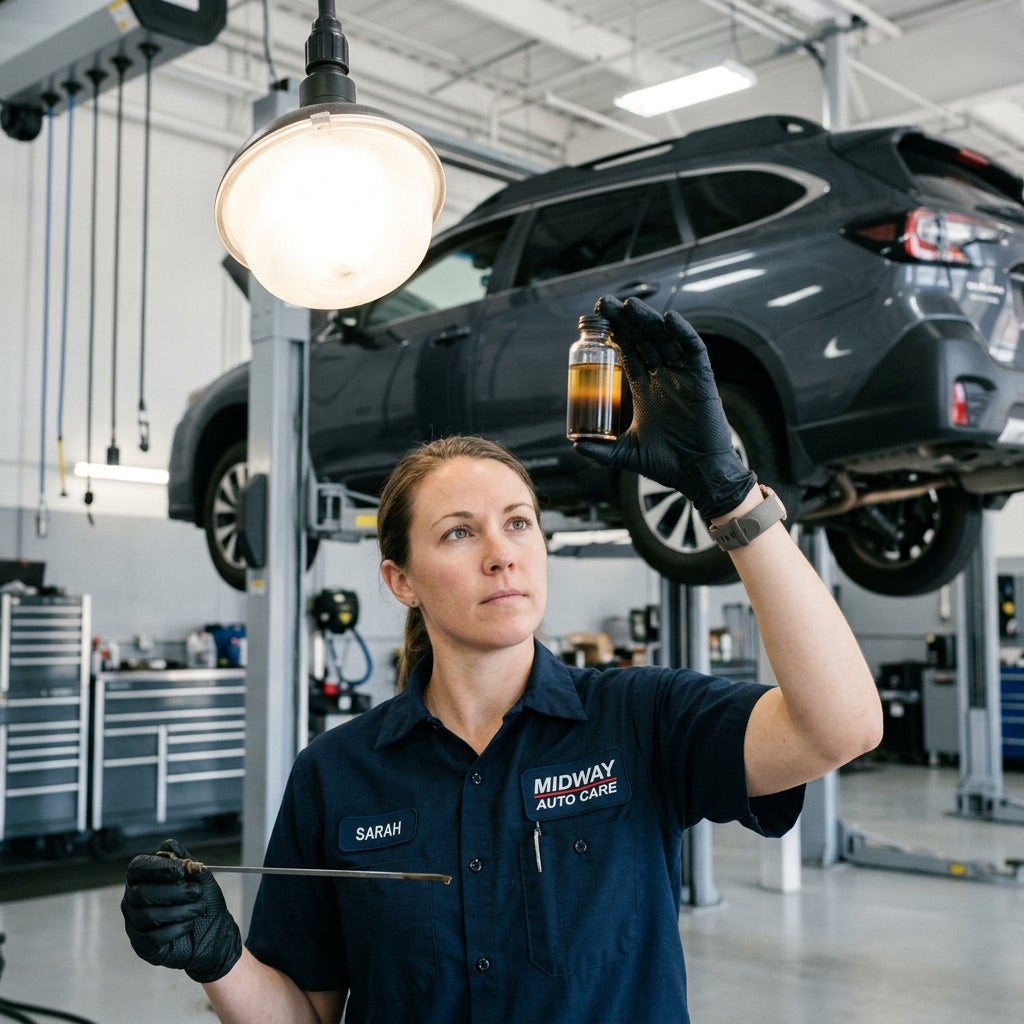
Female mechanic in a workshop inspects a glass sample jar showing fluid separation while holding a dipstick. (Representative image for illustration purposes only. Actual vehicle may vary based on trim and configuration.)

When Should You Replace Subaru CVT Fluid? Service Advisor Bottom-Line Answer

If you open your Subaru owner's manual warranty and maintenance booklet, you will likely see a curious entry under transmission maintenance: inspect fluid every 30,000 miles, replace under severe driving conditions, otherwise listed as lifetime fluid. As a professional service advisor working directly on the service drive in Sunset Hills, MO, my practical advice for Subaru owners in the St. Louis metropolitan area is straightforward: consider verifying the 'lifetime fluid' guidance in your owner's manual if you plan on keeping your Outback, Forester, Crosstrek, or Ascent beyond its warranty period. In our regional driving environment—where winter sub-zero snaps transition rapidly into 95-degree summer days with thick humidity—the real-world strain on a Continuously Variable Transmission (CVT) is substantial. Heavy stop-and-go driving along Watson Road or I-270, towing recreational gear, climbing Ozark hills, or tackling snow-slicked commutes all qualify under Subaru's official 'severe driving' definition. Under these conditions, Subaru explicitly recommends changing the Lineartronic CVTF fluid every 30,000 to 60,000 miles. For suburban commuters who experience light highway cruising with minimal heavy loads, stretching fluid service to 60,000 to 100,000 miles is technically feasible, but waiting longer than 100,000 miles significantly elevates the risk of mechanical slippage, valve body solenoid failure, pulley scoring, and total transmission breakdown. Fresh fluid acts as both a lubricant and a hydraulic power transfer medium; neglecting it is the primary root cause of major transmission claims seen in independent and dealer bays across Missouri. Meet Lucas Scroggs: 3 Years of St. Louis Area Service Experience Hello, I am Lucas Scroggs, Service Advisor at Sunset Hills Subaru. Over my three years serving drivers throughout Chesterfield, Ladue, Maryland Heights, and South County, I have personally checked in thousands of Subaru vehicles for routine oil changes, major interval services, and mechanical repair diagnostics. My daily work revolves around analyzing repair orders, consulting with our master-certified Subaru technicians, and speaking candidly with vehicle owners about maintenance vs. repair expenses. I live and work right here in St. Louis, so I see firsthand how our road conditions, quick temperature swings, and highway congestion impact vehicle longevity. My primary goal on the service drive is transparency. When a client brings in a 2018 Outback with 65,000 miles, they often ask why we recommend a CVT drain and fill when their original owner's manual wasn't aggressive about it. I explain the difference between paper maintenance schedules written by corporate marketing teams and real-world mechanical wear seen on local service lifts. Proactive maintenance preserves driving feel, protects factory warranties, and can help reduce long-term repair costs down the line. Why Subaru's 'Lifetime Fluid' Claim Requires Real-World Context To understand why transmission fluid degrades, you must look at how Subaru Lineartronic CVTs operate. Unlike a traditional automatic transmission with fixed planetary gears, a CVT utilizes a heavy-duty steel chain belt stretched across two hydraulically adjusted conical pulleys. By continuously varying the width of these pulleys, the transmission delivers infinite gear ratios for maximum engine efficiency. Because this metal-on-metal interface relies heavily on friction and hydraulic clamping force, Subaru CVTF fluid contains specialized friction modifiers, anti-foaming agents, and thermal stabilizers. As temperature spikes during heavy summer traffic or extended highway towing, these chemical additives break down through thermal oxidation. Shear forces between the steel belt and pulley faces gradually chop down fluid viscosity. Why does Subaru label it 'lifetime' in standard documentation? In manufacturer terms, 'lifetime' generally refers to the initial vehicle warranty period (often 5 years or 60,000 miles to 100,000 miles under extended factory coverage). However, if your personal definition of 'lifetime' means driving your Forester or Outback to 150,000 or 200,000 miles, leaving the original fluid inside is a high-risk gamble. Furthermore, standard driving conditions rarely exist around St. Louis. Short trips under 5 miles, cold winter starts, summer idling with full air conditioning, and driving on salted roads all trigger Subaru's official 'Severe Driving Condition' criteria. In these instances, fluid replacement is explicit, not optional. Lucas's Service Bay Perspective: a Transmission Replacement vs. a Fluid Drain and Fill "I see it every month in our service lanes: a customer comes in with a shuddering transmission at 110,000 miles having never serviced their CVT fluid. By that time, hydraulic control valves are clogged with microscopic wear debris and internal pulleys are scored. At that point, a simple fluid change won't reverse structural wear—the only option is a complete replacement assembly, which can cost anywhere from $7,000 to $8,500 with labor. Contrast that with a preventive CVT fluid drain and fill, which costs around $300 to $400 depending on the exact model and fluid spec. Performing two or three drain-and-fill services over 120,000 miles costs under $1,000 combined—a massive difference compared to an out-of-warranty transmission replacement. Preventive care isn't an upsell; it's basic financial protection for your investment." — Lucas Scroggs, Service Advisor Schedule CVT Fluid Inspection or Service What Key Maintenance Items Are Required at the 60,000-Mile Service for a Subaru? Fluid Inspections & Services At 60,000 miles, Subaru schedules its major service benchmark. Key items include: • CVT Fluid Service: Inspection for thermal discoloration, varnish smell, or metal particle contamination; recommended drain-and-fill for regional drivers. • Front & Rear Differential Fluids: Replacing gear oil (75W-90) to remove metallic filings generated by AWD clutch packs and differential ring gears. • Brake Fluid Flush: Replacing moisture-absorbed brake fluid to protect internal ABS solenoids. Our technicians utilize specialized Subaru Select Monitor diagnostic tools during the 60k service to verify transmission fluid temperature readouts and engine timing control before releasing the vehicle back to the customer. Engine & Mechanical Tune-Up Essential tune-up elements include: • Spark Plugs: Replacement of long-life Iridium spark plugs (crucial on Boxer engines to maintain optimal air-fuel efficiency). • Engine Air & Cabin Filters: Eliminates intake airflow restrictions and keeps passenger air fresh. • Full Vehicle Inspection: Steering rack boots, suspension bushings, wheel bearings, and drive belt condition check. How Subaru Symmetrical AWD Impacts Tire Wear and Differential Fluid Service Subaru's full-time Symmetrical All-Wheel Drive (AWD) is world-renowned for winter traction and driving stability, but it places unique mechanical demands on your drivetrain. Unlike slip-and-grip reactive AWD systems that only send power rearward when front wheels slip, Subaru systems send power to all four wheels continuously. Because all four wheels are linked through front, center (multi-plate transfer clutch inside the CVT), and rear differentials, tire circumference variance is critical. If tire tread depth varies by more than 2/32 of an inch between tires, the rotational speed difference forces the center clutch pack inside the CVT to slip continuously. This generates excess friction heat, rapidly degrading the CVT fluid and causing premature wear on the transfer clutch plates. To prevent AWD strain and fluid thermal breakdown: 1. Rotate Tires Every 6,000 Miles: Keeping tread wear completely even across all four positions minimizes center differential friction. 2. Service Front & Rear Differential Gear Oil: Over time, gear shearing in differential assemblies breaks down high-viscosity oil. Changing differential fluid every 30,000 to 60,000 miles keeps hypoid gear sets cool and functioning smoothly. 3. Replace Tires as Matched Sets: Never mix tire brands, tread designs, or significantly different tread depths on a Subaru AWD vehicle. What Specific Maintenance Items Make Up Subaru Ownership Costs Over 5 and 10 Years? 5-Year / 60,000-Mile Cost Profile During the first 5 years, Subaru ownership maintenance costs are predictable and modest. Expected maintenance includes 10 synthetic oil & filter changes, 10 tire rotations, cabin and engine air filters, 1 to 2 brake fluid flushes, and 1 major 60,000-mile interval service. Drivers who complete scheduled preventive items early spend significantly less per mile over time. 10-Year / 120,000-Mile Cost Profile Between years 5 and 10, maintenance includes a second 60k major service, brake pad/rotor replacements, cooling system flushes, suspension struts or sway bar links, and 2 CVT fluid drain-and-fill services. While total maintenance is slightly higher than non-AWD competitors like front-wheel-drive sedans, Subaru vehicles retain exceptionally strong resale value, offsetting long-term maintenance costs. Maintenance Milestone Subaru Estimated Cost Toyota AWD Competitor Cost Primary Service Components Included 30,000 Miles (Minor) contact for current pricing $250 - $380 Oil change, tire rotation, air filters, brake inspection, AWD differential check 60,000 Miles (Major) $750 - $1,100 $700 - $980 Boxer spark plugs, brake fluid flush, air filters, CVT fluid drain & fill, diff fluid change 100,000 Miles (Cumulative Total) $3,200 - $4,500 $3,000 - $4,200 All scheduled maintenance, brakes, tires, spark plugs, fluid refreshes over 8-10 years Planning on trading in or upgrading your Subaru? Evaluate your trade-in market value with our quick online tools: Get your value trade or check out our New Subaru Inventory. Value Your Trade Online How Often Does a 2026 Subaru Outback Need an Oil Change and What Viscosity Is Required? For 2026 Subaru Outback models (as well as 2026 Forester and Crosstrek variants), factory-recommended oil change intervals remain strictly 6,000 miles or 6 months, whichever comes first. Following this mileage threshold is critical for preventing internal carbon buildup around the piston rings and protecting variable valve timing (VVT) solenoids. Required viscosity formulas vary depending on engine powertrain trim: • 2.5L 4-Cylinder Naturally Aspirated Boxer: Requires full synthetic 0W-16 or 0W-20 oil meeting API SP / ILSAC GF-6A specifications. • 2.4L Turbocharged Boxer (XT & Wilderness trims): Requires full synthetic 0W-20 high-thermal-stability engine oil. Why is oil viscosity so precise in modern Subaru Boxer engines? Low-viscosity ultra-synthetic oils allow swift oil pressure build-up upon cold startup, reducing engine wear during Missouri winter mornings. Additionally, oil galleries feeding hydraulic timing tensioners rely on clean, un-degraded fluid. Stretching oil changes beyond 6,000 miles can cause oil burn-off, piston ring sticking, and engine sludge, leading to higher maintenance costs later in the vehicle's lifespan. Explore current model information at our New Subaru Outback Inventory page. How Often Do Subaru EyeSight Camera Systems Require Calibration? Subaru EyeSight Driver Assist Technology uses dual stereoscopic camera lenses mounted behind the windshield to manage adaptive cruise control, lane-keep assist, pre-collision braking, and throttle management. Unlike routine maintenance items like filters or oil changes, EyeSight calibration is not scheduled by mileage, but triggered by specific mechanical or body events. EyeSight camera calibration is mandatory whenever: • The front windshield is replaced or removed. • Suspension components are altered (e.g., install of lift kits, replacement of struts/springs that alter ride height). • Wheel alignment is adjusted following major steering repair or severe pothole impact. • Body repair occurs on the front structural frame or bumper assembly. • An EyeSight warning light appears on the instrument cluster. Calibration at Sunset Hills Subaru utilizes specialized target boards positioned at exact millimeter distances in a level bay environment, followed by dynamic road calibration testing using Subaru SSM4 diagnostic interface software. Practical Service Advice: OEM Subaru CVTF Fluid vs Aftermarket Alternatives Exact OEM Fluid Specs Subaru Lineartronic CVTs require precise fluid formulations (CVTF-II, CVTF-III, or High Torque CVTF for 2.4L Turbo models). These fluids are engineered with unique torque-transfer friction coefficients and specific expansion profiles under heat. Mixing incorrect fluids causes chain belt slippage. Technician Check Process Checking fluid levels is not done with a simple dipstick. Technicians must monitor fluid temperature using a diagnostic tool, cycling through gears until fluid temperature reaches exactly 95°F–113°F before inspecting fill plugs on a level lift. Correct temperature monitoring is mandatory. Universal Fluid Risks Generic 'multi-vehicle' aftermarket fluids claim compatibility but frequently fail to maintain required viscosity under sustained loads, leading to shuddering and solenoid seal degradation. Genuine factory parts preserve smooth operation. Find Subaru Parts at our dealership. Order Genuine Subaru Parts & Fluid Do Subaru Boxer Engines Require Special Spark Plug Replacement Procedures? Yes, spark plug service on a Subaru horizontally opposed Boxer engine is distinctly different from traditional inline or V6 engines. Because the engine cylinders lie flat horizontally, the cylinder heads directly face the vehicle frame rails with only a few inches of clearance on either side. Changing Boxer spark plugs requires removing the air intake box, battery, and engine bay accessories to gain access. Technicians use specialized flexible swivel extensions, thin-wall spark plug sockets, and exact torque specifications to avoid cross-threading aluminum cylinder heads or damaging coil packs. Because this labor is more involved, Subaru utilizes long-life Iridium spark plugs rated for 60,000 miles. Replacing plugs on schedule ensures complete fuel combustion, prevents ignition misfires under heavy load, and protects fragile catalytic converters. Schedule Your Subaru CVT and Preventative Maintenance at Sunset Hills Subaru Whether your Forester is approaching 30,000 miles or your Outback is due for its major 60,000-mile service, our factory-trained team at Sunset Hills Subaru is ready to assist you. Consult directly with Lucas Scroggs and our certified advisors for tailored maintenance advice built around your local driving habits. Visit our facility at 10100 Watson Rd, Sunset Hills, MO 63127. Get Directions to Sunset Hills Subaru or Call us at (314) 476-9638 to speak with our service team directly. Review our Current Service and Parts Information before booking your appointment online! Schedule Service and Diagnostics Subaru CVT Fluid Service in Sunset Hills MO | Sunset Hills Subaru
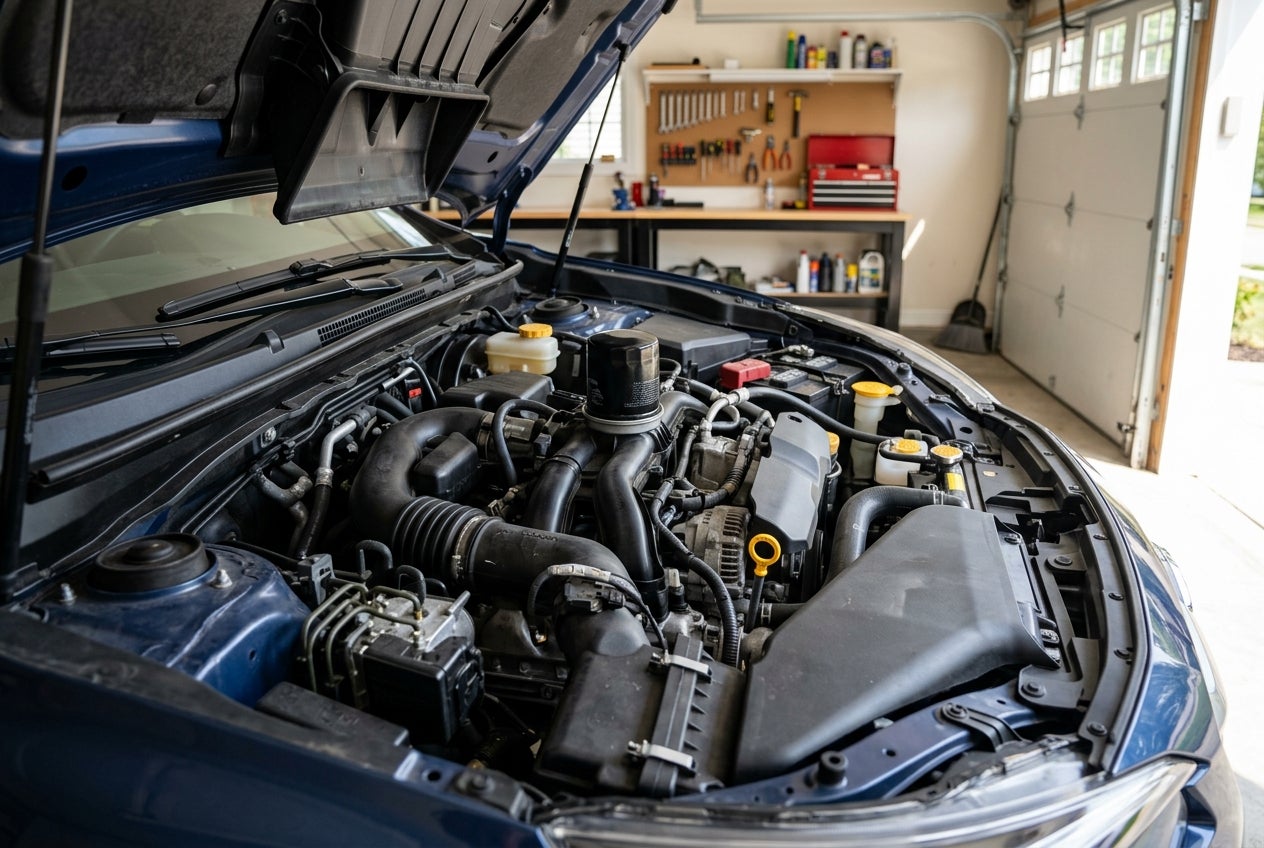
Open hood of a dark blue car parked inside an organized garage, showing the detailed engine bay. (Representative image for illustration purposes only. Actual vehicle may vary based on trim and configuration.)

Are Subaru Owners Able to Perform Long-Term Maintenance Themselves?

For generations, Subaru vehicles have built a dedicated following among drivers who appreciate rugged engineering, practical design, and mechanical transparency. Whether navigating winter snowstorms in St. Louis County or tackling weekend dirt roads, Subaru vehicles such as the Outback, Forester, and Crosstrek are built to endure. But when it comes to long-term ownership—spanning 10 years or 150,000 miles and beyond—a fundamental question arises for practical-minded vehicle owners: Are Subaru owners able to perform long-term maintenance themselves? The short answer is yes, but with clear boundaries. Subaru’s thoughtful design choices—most notably the top-mounted engine oil filter on modern Subaru BOXER engines—make routine services exceptionally accessible for home mechanics. Tasks like engine oil changes, engine and cabin air filter swaps, windshield wiper replacements, battery care, and tire rotation can easily be executed in a home driveway with basic tools. However, modern Subarus are sophisticated machines equipped with Symmetrical All-Wheel Drive (AWD), Lineartronic Continuously Variable Transmissions (CVT), and complex driver-assist tech like EyeSight® Driver Assist Technology. Services involving fluid temperatures, differential calibration, electronic sensor realignment, and deep engine access present clear technical limits. Understanding where home maintenance shines and where certified dealer expertise is essential will help you maximize your vehicle’s life while keeping safety and resale value intact. If you ever need advice or high-grade components, you can always Find Subaru Parts directly through Sunset Hills Subaru. Explore OEM Parts & Accessories Is It Feasible to Perform Basic Subaru Maintenance Yourself During the First Year? During your first 12 months of Subaru ownership, maintenance demands are relatively light and heavily focused on preventative protection. For St. Louis area commuters navigating seasonal changes—from hot Midwest summers to icy winter salt on I-44—keeping up with initial service milestones is vital to preserving long-term durability. 1. Top-Mounted Engine Oil & Filter Changes: On modern 2.0L, 2.5L, and 2.4L Turbo Subaru BOXER engines, the spin-on oil filter is conveniently located right at the top of the engine bay. Unlike traditional vehicles where you must reach around hot exhaust manifolds under the vehicle, a Subaru filter can be unscrewed from above in seconds. Draining the engine oil still requires lifting the front end safely and removing the underbody splash shield, but for DIY enthusiasts equipped with a drain pan and torque wrench, this task is straightforward. 2. Cabin & Engine Air Filter Replacements: Seasonal pollen, humidity, and winter road dust can clog your vehicle’s filters. Replacing the engine air filter requires popping quick-release metal clips on the intake box—no tools required. The cabin air filter sits directly behind the glovebox compartment and can be replaced in less than ten minutes without specialized machinery. 3. Wiper Blade Care & Washer Refills: Visibility is a core pillar of Subaru safety. Installing fresh OEM wiper inserts or blade assemblies before winter sets in is a simple DIY task. Inspecting washer fluid reservoirs and ensuring correct freeze-resistant washer fluid levels keeps your EyeSight windshield cameras clear of streaks. 4. Tire Pressure & Tread Depth Inspection: Because Subaru’s Symmetrical AWD continuously monitors traction at all four wheels, maintaining uniform tire pressure and equal tread wear is paramount. Inspecting pressures weekly using a reliable digital gauge ensures your transfer clutch and center differential operate without premature wear. If you prefer professional precision during your first year, you can check our Current Service and Parts Specials for factory-backed service offers on early maintenance services. The Subaru Ownership Lifecycle: What St. Louis Drivers Can Expect From Year 1 to Year 10 A decade of vehicle ownership represents thousands of commutes, family road trips, and changing weather conditions across Sunset Hills, Kirkwood, and Ladue. Subaru builds vehicles meant to last well past 100,000 miles, but staying ahead of factory maintenance intervals is essential. Below is a realistic structural roadmap detailing what you should expect during each phase of ownership. Years 1 to 3 (0 – 36,000 Miles) Primary Focus: Routine Maintenance & Warranty Safeguards - Oil & filter changes every 6,000 miles or 6 months. - Tire rotations every 6,000 miles to preserve AWD symmetry. - Brake system visual inspection at 12,000-mile increments. - Cabin and engine air filter replacements every 15,000 to 30,000 miles. - Covered entirely by Subaru's 3-Year / 36,000-Mile Limited Warranty for factory defects. Drivers of models like the New Subaru Forester Inventory or New Subaru Crosstrek Inventory enjoy extremely predictable running costs during this honeymoon phase. Years 4 to 7 (36,000 – 75,000 Miles) Primary Focus: Wear-and-Tear & Fluid Replacements - 30,000 & 60,000-Mile Major Services: Brake fluid flush, front & rear differential gear oil change. - Brake pad and rotor replacement (typically between 40,000 and 60,000 miles based on city stop-and-go driving). - Spark plug replacement at 60,000 miles (required on BOXER layouts due to horizontal head position). - CVT transmission inspection & scheduled fluid replacement. - Battery replacement around Year 4 or 5. Years 8 to 10+ (75,000 – 120,000+ Miles) Primary Focus: Comprehensive Mechanical Longevity - 90,000 & 120,000-Mile Major Services. - Engine coolant flush and hose inspections. - Serpentine drive belt replacement. - Suspension component care: Struts, lower control arm bushings, and sway bar end links. - Wheel bearings and CV axle boot inspections. - Valve cover gasket monitoring to address minor oil weeping before major leaks develop. Considering upgrading to a newer model as your mileage accumulates? Explore our New Subaru Inventory to see the latest technology enhancements. What Does Subaru's Warranty Cover During the 10-Year Ownership Period? Understanding factory warranty protection is vital when deciding which maintenance tasks to handle yourself versus taking to the dealership. Federal law (the Magnuson-Moss Warranty Act) protects your right to maintain your vehicle yourself or at an independent garage without voiding factory warranties, provided the work is done correctly and with compliant fluids and parts. Factory Warranty Structural Overview: - 3-Year / 36,000-Mile New Vehicle Limited Warranty: Covers bumper-to-bumper components against defects in materials or factory workmanship. Also includes Wear Item Coverage for items like wiper blades, brake pads, and clutch linings. - 5-Year / 60,000-Mile Powertrain Limited Warranty: Covers essential mechanical heart components including the BOXER engine block, cylinder heads, oil pump, timing chain, CVT transmission internals, torque converter, and AWD front/rear differential assemblies. - 5-Year / Unlimited Mileage Rust Perforation Limited Warranty: Protects against sheet metal corrosion perforation under normal driving conditions. - Federal & State Emissions Warranties: Cover key catalytic converter and electronic engine control modules for up to 8 years or 80,000 miles. Critical DIY Record-Keeping Guidelines: If you choose to change your own oil, filters, or differential fluids during the warranty period, you must maintain meticulous records. Keep all itemized receipts for Genuine Subaru OEM oil, filters, and fluid specifications. Log dates, vehicle mileage, and exact work performed in a dedicated notebook or digital log. If a powertrain issue arises, having clear documentation prevents warranty claim disputes. Planning your long-term vehicle budget or considering an extended service agreement? Get approved for financing or discuss extended protection coverage with our financial specialists at Sunset Hills Subaru. Apply for Pre-Approval & Financing How Do Subaru Maintenance Costs Typically Change From Year 1 to Year 10? Vehicle ownership expenses evolve significantly across a decade. During the early years, expenses are minimal—consisting mostly of routine synthetic oil changes and tire rotations. As your vehicle reaches mid-life and higher mileage thresholds, mechanical wear items require strategic investments to maintain factory performance and reliability. Ownership Phase Typical Mileage Key Services Needed Estimated Annual Maintenance Investment Phase 1: Early Ownership (Years 1–3) 0 – 36,000 Oil/filter changes, tire rotations, cabin/engine filters, wiper inserts. $200 – $400 / year Phase 2: Mid-Life Wear (Years 4–7) 36,001 – 75,000 Brake pads & rotors, differential fluid exchange, brake fluid flush, spark plugs, battery replacement. $600 – $1,100 / year Phase 3: High Mileage (Years 8–10+) 75,001 – 120,000+ Coolant service, serpentine belts, suspension bushings/struts, wheel bearings, valve cover gaskets, CVT fluid servicing. $1,100 – $1,800 / year Performing simple DIY tasks—such as air filter swaps and basic oil servicing—helps flatten this cost curve during early ownership. However, investing in professional major services during Phase 2 and Phase 3 protects vital drive components like the Symmetrical AWD system and Lineartronic CVT, preventing multi-thousand-dollar repair bills down the road. If you're evaluating your current car's financial future, you can Get your value trade online to evaluate your vehicle's equity position. DIY vs. Professional Servicing: Which Subaru Tasks Require Dealer Tools? While home mechanics can easily handle surface maintenance, modern engineering creates distinct boundaries where specialized diagnostic computers and physical shop tools become necessary. Ideal DIY Home Garage Tasks - Engine Oil & Filter Changes: Easy top-mounted filter access. - Engine & Cabin Air Filters: No special tools required. - Wiper Blade Replacement: Quick snap-in installation. - 12V Battery Replacement: Simple terminal disconnect with standard sockets. - Basic Exterior Light Bulbs: Simple access panels on most non-LED assemblies. Intermediate DIY (Requires Skill) - Brake Pad & Rotor Replacement: Tight space clearance; requires caliper retractors and proper torque specs. - Front & Rear Differential Fluid: Requires level vehicle positioning and specialized Torx/hex sockets. - BOXER Spark Plug Replacement: Challenging clearance due to frame rail proximity; requires specialized swivel extensions. Dealer Service (Requires Factory Tools) - Lineartronic CVT Fluid Exchange: Requires live fluid temperature monitoring via Subaru Select Monitor (SSM4) diagnostic software during filling. - EyeSight® Camera Alignment: Requires physical target targets and proprietary optical calibration software after windshield swaps or suspension lifts. - Timing Belt (Older SOHC/DOHC) / Chain Servicing: Critical engine timing setup. How Does Subaru Ownership Compare to Toyota Over a 10-Year Period in Cost and Reliability? When evaluating long-term value, shoppers frequently compare Subaru vehicles like the New Subaru Outback Inventory or Forester against competitor offerings from Toyota (such as the RAV4 or Highlander). Both Japanese manufacturers enjoy industry-leading resale values and longevity ratings, but their mechanical architectures lead to subtle differences in maintenance requirements over a 10-year period. Drive Architecture & All-Wheel Drive Upkeep: Subaru’s standard Symmetrical All-Wheel Drive is an active full-time system integrated directly into the transmission output shaft. This can provide strong traction on slippery St. Louis winter roads compared to many front-wheel-drive-based systems. However, active AWD requires strict tire diameter uniformity (tread depth within 2/32nds of an inch across all four tires) and regular front/rear differential fluid changes every 30,000 to 60,000 miles. Engine Layout Considerations: Toyota relies on inline-4 or V6 engines, whereas Subaru uses the Subaru BOXER horizontally opposed engine. The BOXER engine offers a lower center of gravity, enhancing high-speed stability and cornering composure around curves in Sunset Hills and Ladue. The trade-off is spark plug replacement access: changing inline engine spark plugs takes 20 minutes from the top, while BOXER spark plugs require working near the frame rails with specialized sockets. Total Cost of Ownership Comparison: Over 10 years and 120,000 miles, total maintenance costs between Subaru and Toyota remain remarkably close—typically within 5% to 8% of each other. Subaru owners spend slightly more on differential fluids and spark plug labor, but benefit from exceptional resale retention and unmatched capability in adverse weather. Interested in exploring new options? Check out our Current New Car Offers to compare trim features and incentives across our lineup. View New Car Offers How Does Subaru’s Fuel Economy Typically Change With Vehicle Age and Mileage? It is not uncommon for drivers to notice a slight decline in fuel efficiency (miles per gallon) as their vehicle passes 75,000 miles. On hilly terrain throughout Sunset Hills, Ladue, and surrounding St. Louis communities, engine efficiency changes become more pronounced during seasonal extremes. Primary Factors Contributing to Mileage Loss: - Mass Air Flow (MAF) & Air Sensor Film: Over time, microscopic dust and oil vapors coat the delicate heated wire inside the MAF sensor. This leads to inaccurate air intake readings, causing the engine computer to run a rich fuel mixture. - Positive Crankcase Ventilation (PCV) Valve Aging: A sticking PCV valve allows oily blow-by gases to re-enter the intake manifold, building carbon deposits on intake valves and spark plug tips. - Oxygen (O2) Sensor Degradation: Upstream air/fuel ratio sensors gradually slow their response time before triggering a Check Engine Light, leading to unburned fuel waste. - Drivetrain Resistance & Tire Inflation: Under-inflated tires or drag from worn wheel bearings and dragging brake pads increase rolling resistance, penalizing fuel economy by 2 to 4 MPG. - Ethanol Fuel Blends & Carbon Buildup: Direct-injection BOXER engines (such as the 2.4L Turbo found in the New Subaru Ascent Inventory or Outback XT) can develop carbon buildup on intake valves over 60,000+ miles, disrupting optimal fuel-air atomization. Regular maintenance—including air filter changes, MAF sensor cleaning, and timely spark plug replacement—restores original EPA fuel economy estimates. Is It Possible to Diagnose Subaru Fuel Economy Loss at Home? If you notice your fuel gauge dropping faster than usual, home diagnostics can help identify the culprit before scheduling professional service. Equipped with an inexpensive OBD-II bluetooth scanner and basic hand tools, home mechanics can perform several systematic checks. Step-by-Step DIY Diagnostic Checklist: 1. Check Short-Term & Long-Term Fuel Trims (STFT / LTFT): Plug your OBD-II scanner into the port below the steering column. View live data for LTFT. A healthy reading sits between -5% and +5%. If fuel trims exceed +10%, the engine computer is adding extra fuel to compensate for a vacuum leak or dirty MAF sensor. 2. Inspect & Clean the MAF Sensor: Remove the two small screws holding the MAF sensor on the intake tube. Spray the internal sensing wire with dedicated aerosol MAF Sensor Cleaner (never use brake cleaner). Allow it to dry completely before reinstallation. 3. Check Tire Pressure Cold: Verify pressures match the placard inside the driver's door jamb. A drop of just 5 PSI can decrease fuel efficiency by over 2% while accelerating tread wear. 4. Inspect Brake Caliper Drag: After a routine drive, safely feel near the center of each wheel hub (without touching hot brake rotors directly). If one wheel hub feels noticeably hotter than the others, a sticking brake caliper slide pin may be causing constant resistance. When home diagnostics reveal complex fuel trim irregularities or persistent Check Engine codes, contact our team to Schedule Service and Diagnostics with our factory-trained technicians. What Are Typical Reliability Issues Subaru Owners Face After 10 Years? Subaru vehicles are engineered for longevity, with over 96% of Subaru vehicles sold in the last 10 years still on the road today. However, passing the 10-year or 100,000-mile landmark means certain rubber, silicone, and mechanical components reach the end of their design lifespan. Engine Gaskets & Seals On high-mileage engines, rubber valve cover gaskets and spark plug tube seals eventually harden from engine heat cycles. This results in minor oil seepage down the sides of the block. Monitoring oil levels on the dipstick regularly prevents oil starvation. Suspension & Rubber Bushings Front lower control arm rear compliance bushings undergo constant flexing. By Year 10, rubber tearing or cracking can cause subtle steering wheel shimmy during highway braking or uneven front tire wear. Cooling System Upkeep Radiator plastic end tanks and upper/lower radiator hoses degrade over time. Flushing coolant at recommended intervals and replacing aging hoses prevents engine overheating, safeguarding cylinder head integrity. Schedule 10-Year Service Inspection What Are Typical Costs for Subaru Maintenance Services in Sunset Hills? For vehicle owners in Sunset Hills, Kirkwood, Fenton, and Greater St. Louis, budgeting for professional service is straightforward when working with an authorized dealer. Utilizing Genuine Subaru OEM parts and factory-certified technicians ensures your vehicle receives exact fluid formulations and precise torque tolerances. Why OEM Quality Matters: Generic quick-lube centers frequently use multi-vehicle global fluids that do not meet Subaru's exact friction requirements for Lineartronic CVTs or Symmetrical AWD limited-slip differentials. Using non-compliant fluids can lead to harsh shifting, shuddering under load, or accelerated component wear. At Sunset Hills Subaru, our service facility provides transparent pricing, factory-trained technicians, specialized diagnostic equipment, and comfortably appointed guest lounges. If you prefer doing minor garage work yourself, our parts counter carries original oil filters, crush washers, air filters, and specialized fluids. If you're exploring pre-owned vehicles with complete maintenance histories, feel free to browse our Used Vehicle Inventory. Where Can Drivers in Sunset Hills Find Genuine Subaru Parts and Service Support? Whether you choose to tackle routine maintenance items in your own home garage or trust our Master Certified Technicians with major service milestones, Sunset Hills Subaru is here to support your entire ownership journey. Visit us today at 10100 Watson Rd, Sunset Hills, MO 63127. Conveniently located near I-270 and I-44, our state-of-the-art facility features an Express Maintenance service lane for quick oil changes, tire rotations, and multi-point inspections without an appointment. Ready to get started? Get Directions to Sunset Hills Subaru or Call us at (314) 476-9638 to speak directly with our service and parts specialists. Schedule Service and Diagnostics Subaru DIY Maintenance Tips in Sunset Hills MO | Sunset Hills Subaru
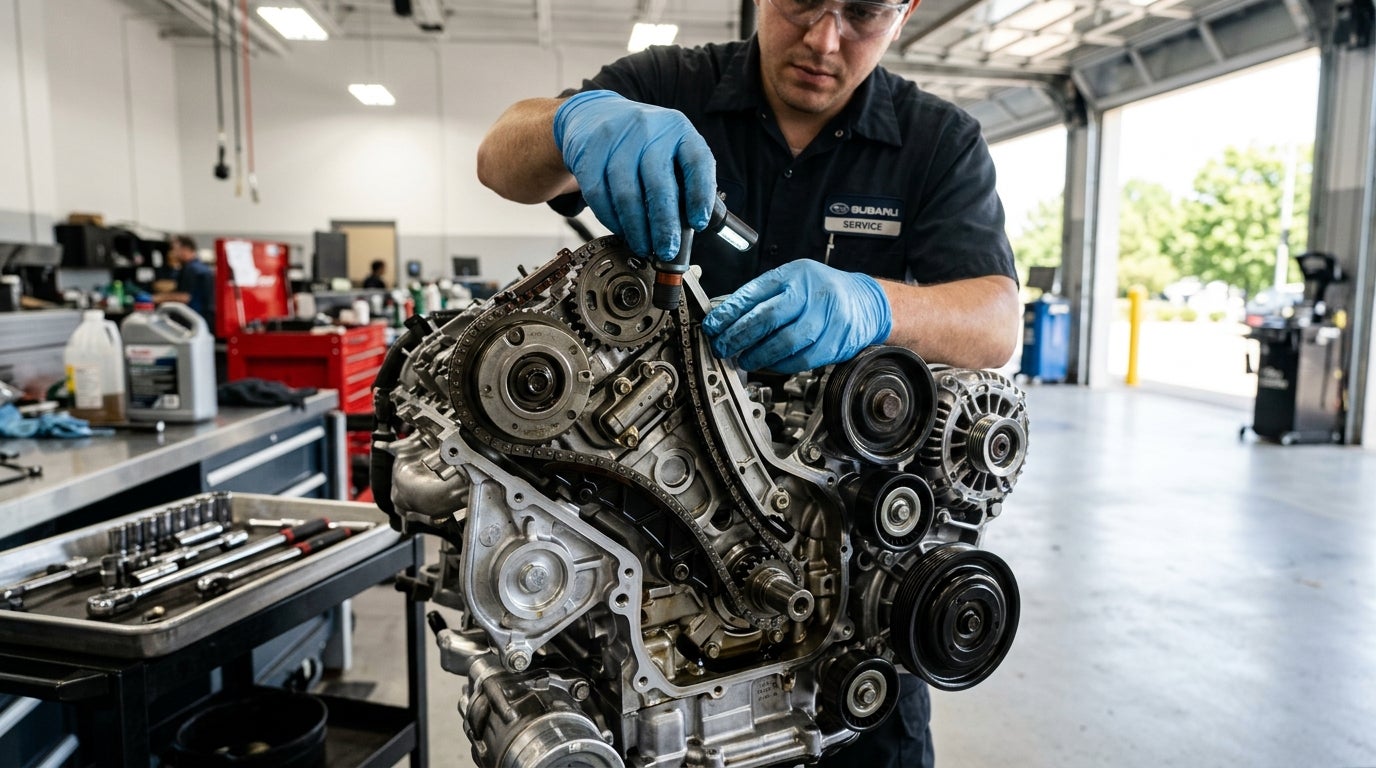
A Subaru service technician inspecting an exposed car engine timing chain in an auto repair shop. (Representative image for illustration purposes only. Actual vehicle may vary based on trim and configuration.)

Subaru Timing Belt vs. Timing Chain: The Direct Answer & Replacement Intervals

Subaru Timing Belt vs. Timing Chain: The Direct Answer & Replacement Intervals If you drive a Subaru around Sunset Hills or Ladue, knowing whether your engine uses a timing belt or a timing chain is one of the single most critical factors in maintaining long-term engine reliability. Here is the straightforward answer straight from our factory workshop: Subaru rubber timing belts require scheduled replacement every 105,000 miles or 7 years (whichever occurs first). On the other hand, Subaru metal timing chains are engineered to last the full lifecycle of the vehicle engine without scheduled replacement, provided regular engine oil changes are performed. To break down precisely what this means for your vehicle, we sat down for an in-depth interview with Kyle Marcum, Master Technician at Sunset Hills Subaru. With over 7 years of hands-on experience diagnosing, servicing, and rebuilding horizontal Boxer engines—from classic EJ series powerplants to modern FB, FA, and EZ configurations—Kyle shares his expert technical insights on timing maintenance, warning signs, and prevention strategies for Suburban St. Louis drivers. Schedule Timing Service & Diagnostics Meet Master Tech Kyle Marcum: Expert Subaru Engine Care in Sunset Hills Interviewer: Kyle, thank you for joining us today. You've been working on Subaru Boxer engines here in Sunset Hills for 7 years. To kick things off, why is the timing system such a passionate topic among Subaru owners? Kyle Marcum: Thanks for having me. The Subaru Boxer engine is unique because the cylinders lay horizontally opposed. That means the camshafts on each cylinder head are separated by a significant distance across the engine bay. Whether your Boxer relies on a long, reinforced rubber timing belt or a dual roller timing chain, that component is responsible for perfectly synchronizing the crankshaft with the overhead camshafts. If that synchronization slips even by a few teeth, the engine stops running properly—or worse, sustains severe internal damage. Understanding whether you have a belt or chain dictates your entire maintenance budget over 100,000 miles. Drivers commuting around Sunset Hills, Kirkwood, and Ladue often ask us if their vehicle needs immediate timing belt service. When customers bring their vehicles to our dealership, whether they are checking out our New Subaru Inventory or coming in for routine maintenance, clarifying their engine family gives them total clarity and complete confidence. Q: Which Subaru Models Have a Timing Belt Versus a Timing Chain? Interviewer: Kyle, Subaru transitioned many of its engines from timing belts to timing chains over the past decade and a half. Can you break down which models and model years feature belts versus chains? Belt-Driven Subaru Models (EJ Engine Family) Kyle Marcum: The legacy EJ engine architecture relies on a rubber composite timing belt with heavy internal tensile cords. Models requiring belt replacement at 105k miles include: • Outback & Legacy: 2.5L 4-cylinder models up through 2012. • Forester: 2.5L 4-cylinder models up through 2010. • Impreza: 2.5L non-turbo models up through 2011. • WRX & WRX STI: All EJ25-powered performance models up through 2021 STI. Chain-Driven Subaru Models (FB / FA / EZ Families) Beginning around 2011, Subaru introduced modern FB and FA series engines equipped with maintenance-free metal timing chains: • Forester: 2011+ (FB25 / 1.8T / 2.5L DI) • Impreza: 2012+ (FB20) • Outback & Legacy: 2013+ (FB25) & 3.6R 6-cyl (EZ36) • Crosstrek: All years (2013+) (FB20 / FB25) • Ascent, WRX (2015+), BRZ: All modern FA20/FA24/FA24T engines. Key Differences & Model Quick-Reference If you drive a newer model like those found in our New Subaru Forester Inventory or New Subaru Outback Inventory, your vehicle uses a timing chain designed for the life of the motor. However, if you are shopping pre-owned or maintaining a late 2000s model, keeping track of that 105,000-mile belt deadline is vital to avoid mechanical failure. Q: What Happens When a Timing Belt Snaps on an Interference Subaru Engine? Interviewer: Kyle, we often hear the term 'interference engine' when discussing timing belts. What does that mean in simple terms, and what actually happens inside a Subaru engine if a timing belt breaks while driving down Interstate 44? Kyle Marcum: Virtually all modern Subaru engines—both belt and chain driven—are interference design engines. In an interference engine, the physical space where the intake and exhaust valves open overlaps with the space the piston occupies at top-dead-center. The timing belt acts like a precision conductor, ensuring the valves move out of the way before the piston travels upward. If a timing belt snaps or strips its teeth while the engine is running at 3,000 RPM, the camshafts instantly freeze while the crankshaft keeps spinning. The pistons smash into the open valves at high velocity. The result is bent intake and exhaust valves, damaged piston crowns, cracked valve guides, and often complete cylinder head destruction. Instead of a routine belt service, you are looking at thousands of dollars in engine rebuilding or full engine replacement. Schedule Service and Diagnostics Q: What Does a Bad Timing Belt Sound Like, and Are Timing Chains Louder? Interviewer: Drivers often ask if they can hear a failing timing belt or chain before catastrophic failure happens. What acoustic warning signs should owners listen for? Timing Belt Acoustic Symptoms Kyle Marcum: Timing belts themselves are quiet because they are rubber. However, a failing hydraulic belt tensioner or worn idler pulley produces distinct sounds: • Ticking or Rapping: A failed tensioner piston tapping against the engine block behind the timing cover. • High-Pitched Squeak or Grinding: Seizing bearing in the cogged or smooth idler pulleys. • Slapping Sound: Belt slack hitting the plastic timing cover at cold startup. Timing Chain Acoustic Symptoms Timing chains emit a subtle mechanical hum under normal operation. However, excessive noise indicates maintenance issues: • Metallic Rattling on Cold Start: Oil starvation or low engine oil pressure delaying hydraulic chain tensioner activation. • Continuous Marbles-in-a-Can Noise: Stretched chain links or worn composite chain guides due to neglected oil change intervals. Kyle's Expert Advice Never ignore unusual noises coming from the front lower section of your engine. For chain engines, keeping fresh oil at proper levels is the single most crucial factor. If you notice strange noises on your vehicle, visit our certified technicians or Call us at (314) 476-9638 to schedule an immediate inspection. Q: What Should You Check Before Buying a Used Subaru with a Timing Belt? Interviewer: Many pre-owned vehicle shoppers in St. Louis and Sunset Hills look at older Subaru models known for their longevity. What pre-purchase steps should they take regarding the timing system? Kyle Marcum: If you are browsing our Used Vehicle Inventory or shopping private sales, check these critical items: 1. Service Records: Verify documented proof that the timing belt, water pump, hydraulic tensioner, and idler pulleys were replaced at or before 105,000 miles (or 7 years). 2. Timing Cover Sticker: Reputable shops place a date and mileage sticker on top of the plastic timing belt cover upon replacement. 3. Visual Inspection: Look for front camshaft or crankshaft oil leaks that could saturate and degrade a rubber belt prematurely. 4. Trade Value Evaluation: If buying a replacement vehicle, consider trading in your vehicle with our tool to Get your value trade toward a certified model. Q: What Is the Most Difficult Step in DIY Timing Belt Replacement, and What Special Tools Are Needed? Interviewer: Modern automotive enthusiasts sometimes tackle maintenance at home. Is replacing a Subaru timing belt a viable DIY project, and what makes it challenging? Kyle Marcum: Replacing a Subaru timing belt is technically demanding due to the horizontal Boxer layout. Here are the toughest steps and special tool requirements: • Crank Pulley Bolt Torque: Breaking free the factory crank pulley bolt requires over 130+ ft-lbs of breakaway torque. You need a dedicated Subaru Crank Pulley Holder Tool to prevent the engine from rotating while breaking the bolt loose. • Camshaft Alignment (DOHC Models): Dual Overhead Cam (DOHC) engines like the EJ255/EJ257 have four separate camshaft pulleys. Under valve spring tension, the left-hand camshafts will snap violently out of position if not locked in place with a specialized Cam Lock Tool. • Precision Tooth Alignment: Lining up the hash marks on the timing belt with the notch marks on the crank sprocket and four cam gears leaves zero room for error. A single tooth misalignment causes misfires or engine damage. • Genuine OEM Components: Some aftermarket timing kits often suffer early hydraulic tensioner failures. We always recommend genuine factory parts from our parts center to Find Subaru Parts designed for exact OEM tolerances. Order OEM Subaru Timing Parts Q: How Long Does It Take an Experienced Mechanic to Replace a Subaru Timing Belt? Interviewer: When a customer schedules a timing belt service at Sunset Hills Subaru, how long is their vehicle typically in the service bay, and what extra parts are serviced simultaneously? Kyle Marcum: In a professional dealership environment, a full timing belt replacement typically takes 3 to 5 hours of labor depending on whether it is a Single Overhead Cam (SOHC) or Dual Overhead Cam (DOHC) turbo configuration. Crucially, replacing only the rubber belt is a mistake. To do the job right and prevent duplicate labor charges later, certified technicians install a complete timing service kit including: • New Water Pump & Gasket (driven directly by the timing belt) • New Hydraulic Belt Tensioner Assembly • New Cogged & Smooth Idler Pulleys • Fresh Engine Coolant & Thermostat • Inspection of Front Camshaft & Crankshaft Oil Seals. Q: How Do I Find a Qualified Mechanic in Sunset Hills, MO, and Does Warranty Cover Timing Service? Interviewer: What should local St. Louis drivers know about technician qualifications and warranty coverage when scheduling service? Factory-Trained Certification Kyle Marcum: Always choose technicians who complete specialized Subaru Academy training. Horizontal Boxer engines require precise torque sequences and tool knowledge that general repair shops may not possess. Routine Maintenance vs. Warranty Routine 105,000-mile timing belt replacement is considered wear-and-tear maintenance and is not covered by factory warranties. However, if a timing chain component fails under factory or Certified Pre-Owned (CPO) Powertrain warranty, it is typically covered—provided service records confirm scheduled oil changes. Local Dealership Advantage Maintaining clear service records at an authorized center protects your vehicle's warranty status and resale value. Check our Current Service and Parts Information for current seasonal service offers. Q: What Questions Should You Ask a Mechanic Before Approving a Subaru Timing Replacement? Interviewer: Before a vehicle owner signs a repair order, what key questions should they ask their service advisor? Kyle Marcum: I recommend asking these four essential questions: 1. Are genuine OEM Subaru parts being installed? 2. Does the estimate include replacing the water pump, tensioner, and all idler pulleys? 3. Will camshaft and crankshaft oil seals be inspected and replaced if leaking? 4. What warranty backs the parts and labor for this repair? If you are considering upgrading your vehicle or exploring options, you can also explore our Get approved for financing options or check Current New Car Inventory. At Sunset Hills Subaru, we provide transparent line-item estimates including genuine OEM components, factory coolant replacement, and full parts and labor warranty protection. View Current Service Specials Key Takeaways: Maintaining Your Subaru Timing System in Suburban St. Louis Timing Belt Rule Replace rubber timing belts every 105,000 miles or 7 years. Replace the water pump, tensioner, and idlers at the same time to protect your interference engine. Timing Chain Care Timing chains are built for engine life but require clean engine oil. Maintain regular oil change intervals to keep hydraulic chain tensioners functioning properly. Expert Support Trust factory-certified Master Techs like Kyle Marcum at Sunset Hills Subaru for expert diagnostic care, genuine OEM parts, and complete confidence on the road. Explore our full range of new Subaru vehicles: New Subaru Crosstrek Inventory | New Subaru Ascent Inventory | New Subaru Impreza Inventory | New Subaru WRX Inventory | New Subaru Legacy Inventory | New Subaru BRZ Inventory | New Subaru Solterra Inventory Schedule Your Subaru Timing Belt or Chain Inspection at Sunset Hills Subaru Don't leave your engine's reliability to chance. Whether your Subaru is due for its 105,000-mile timing belt replacement or you want our factory-trained Master Technicians to inspect your timing chain system, Sunset Hills Subaru is here to serve drivers across Sunset Hills, Ladue, Kirkwood, and the entire St. Louis area. Visit our state-of-the-art service center at 10100 Watson Rd, Sunset Hills, MO 63127 or contact our service advisors directly by phone. Get Directions to Sunset Hills Subaru or Call us at (314) 476-9638 today. Schedule Service Appointment Value Your Trade-In Subaru Timing Maintenance in Sunset Hills MO | Sunset Hills Subaru Subaru Timing Maintenance in Sunset Hills MO | Sunset Hills Subaru
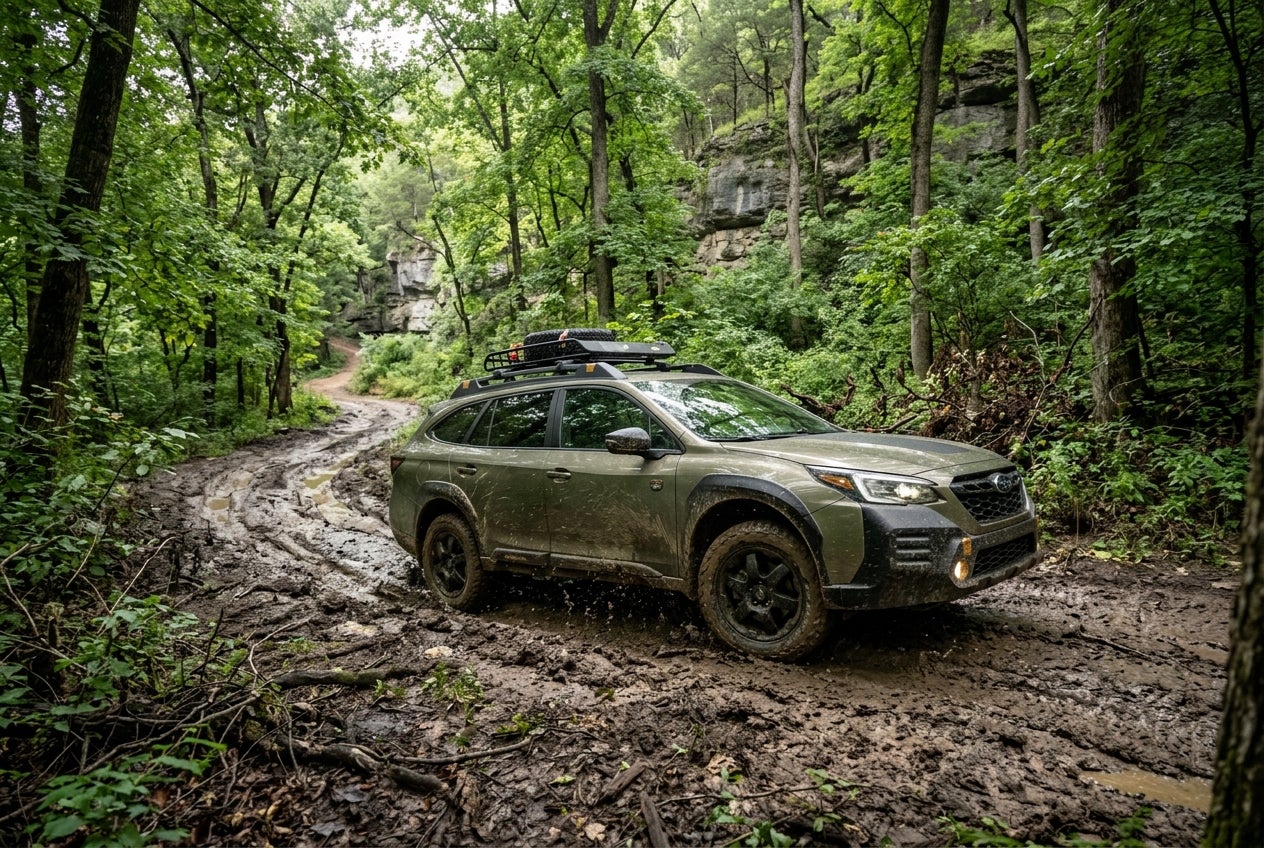

Olive green Subaru Outback Wilderness driving through a deep, muddy dirt road surrounded by dense green forest. (Representative image for illustration purposes only. Actual vehicle may vary based on trim and configuration.)

How Dual-Function X-MODE Optimizes Traction on Rocky and Muddy Park Trails

Navigating Missouri's unpaved backcountry—from the limestone bluffs of Castlewood State Park to the muddy floodplain trails along the Meramec River—demands far more from an all-wheel-drive system than standard wet-asphalt commuting. Subaru's Dual-Function X-MODE is an advanced, software-integrated traction management system engineered specifically to overcome the physical limits of traditional all-wheel drive when pavement turns into loose rock, rutted dirt, and deep river mud. At the core of Dual-Function X-MODE is a total remapping of four key vehicle systems: engine throttle responsiveness, the Symmetrical All-Wheel Drive electronically controlled transfer clutch, transmission gear reduction logic within the Lineartronic CVT, and Vehicle Dynamics Control (VDC) wheel-slip management. In standard driving, Subaru AWD continuously balances torque split for fuel efficiency and smooth cornering. However, when a tire loses grip on a slippery rock ledge or sinks into river silt, standard traction control typically cuts engine power to prevent wheel spin—a response that can completely stall forward momentum precisely when you need momentum most. When engaged via the center console control knob or touchscreen interface, Dual-Function X-MODE alters these parameters instantly. Engine throttle sensitivity is calibrated to deliver ultra-precise low-rpm torque output, preventing accidental power spikes that cause tires to dig deeper into soft ground. Simultaneously, the hydraulic multi-plate transfer clutch increases locking pressure by up to 25%, locking the front and rear axles into a firm 50/50 torque split. By combining this proactive axle locking with targeted individual wheel braking via the VDC system, Dual-Function X-MODE acts as an electronic differential lock, redirecting engine power away from airborne or slipping wheels directly to the tires with firm traction. Understanding 'Snow/Dirt' vs. 'Deep Snow/Mud' Modes on Unpaved Terrain Snow/Dirt Mode: Maximum Grip & Control The 'Snow/Dirt' setting is calibrated for semi-firm surfaces where tire tread can easily bite into the ground if wheel spin is kept to a minimum. Ideal for packed dirt trails, dry riverbed gravel, embedded limestone rock staircases, and hard-packed forest roads, this mode maintains active VDC intervention. If a tire begins to slip while climbing a rocky ledge, the system immediately applies brake force to that specific wheel while maintaining smooth throttle delivery to the resting tires. This prevents rock throw, protects delicate trail surfaces, and provides predictable control. Key Characteristics of Snow/Dirt Mode: • Active VDC traction control prevents wheel spin • Smooth, linear throttle response for low-speed crawling • Early Hill Descent Control engagement under 12 mph • Ideal for gravel access roads and rocky inclines Deep Snow/Mud Mode: Unrestricted Momentum In stark contrast, 'Deep Snow/Mud' mode is designed for soft, fluid surfaces where maintaining momentum requires tire tread self-cleaning. When driving through thick riverbank silt or waterlogged clay along the Meramec, mud quickly fills the tread grooves of standard tires, turning them into slick racing slicks. Deep Snow/Mud mode intentionally disables VDC wheel-slip torque suppression and allows controlled wheel spin. As the wheels spin at higher RPMs, centrifugal force flings packed mud out of the tire tread, allowing the rubber edges to dig deep for fresh traction beneath the slurry. Key Characteristics of Deep Snow/Mud Mode: • Deactivates engine torque cuts from traction control • Permits high-RPM wheel spin to clean mud from tire treads • Holds lower CVT gear ratios for high torque availability • Essential for deep mud ruts, wet riverbanks, and loose sand Navigating Castlewood State Park and Meramec River Trails in Variable Weather Castlewood Bluffs The steep access routes and gravel staging areas around Castlewood State Park present sharp elevation changes over exposed limestone shelf rock. High-torque low-gear management prevents rollback and keeps vehicle balance centered. Meramec River Basins Low-lying trailheads along the Meramec River quickly accumulate saturated silt and clay after late-summer thunderstorms. Deep Snow/Mud mode ensures continuous wheel rotation to cut through topsoil sludge down to stable ground. Hill Descent Control Integrated automatically into X-MODE, Hill Descent Control manages ABS braking on steep downhill trail drops. Drivers can focus entirely on steering without lockup risks on wet gravel or exposed tree roots. Local outdoor enthusiasts in St. Louis County know that weather conditions near the Meramec River basin can transform a dry dirt trail into a treacherous mud passage in under twenty minutes. When descending steep 15-degree grades near the bluffs, human brake modulation often causes wheel lockup, turning tires into sled runners across slick wet clay. Hill Descent Control reads wheel speed sensors continuously, applying hydraulic brake pressure to individual wheels at speeds under 12 mph. This allows you to steer around obstacle hazards and exposed tree roots with total confidence. What the Wilderness Package on the 2024 Subaru Forester Adds for Rugged Trailheads For outdoor adventurers seeking to venture beyond standard park boundaries, the 2024 Subaru Forester Wilderness elevates trail capability with factory-engineered hardware upgrades. Ground clearance jumps from the standard 8.7 inches to an impressive 9.2 inches thanks to longer coil springs and re-tuned dampers. This extra half-inch provides critical clearance over jutting limestone shelf rock and deep trail ruts along riverbank access routes. Mechanically, the Forester Wilderness features revised final drive gearing (4.11:1 ratio vs 3.70:1 standard), delivering improved low-end torque climbing power for crawling up steep grades. Underbody protection includes a standard front aluminum skid plate, protecting critical engine components from boulder impacts. Inside, water-resistant StarTex® synthetic leather seating makes clearing away wet mud and dog hair effortless after an afternoon on the trail. Forester Wilderness Trail Specs: • Ground Clearance: 9.2 inches • Approach Angle: 23.5 degrees (vs 20.0 standard) • Departure Angle: 25.4 degrees (vs 24.6 standard) • Breakover Angle: 21.0 degrees (vs 19.6 standard) • Towing Capacity: 3,000 lbs (with engine oil cooler) • Roof Rack Load: 800 lbs static / 220 lbs dynamic Interested in exploring rugged capability for your local excursions? You can browse our New Subaru Forester Inventory online today. Explore New Subaru Forester Models 2024 Subaru Outback Exterior Dimensions for Tight Trailhead Parking Areas Trailhead staging areas near popular St. Louis County parks—such as Castlewood's lower river parking lots or Chubb Trail access points—are notoriously cramped, featuring narrow entry turnarounds, tight tree lines, and low-hanging branches. Knowing your vehicle's physical footprint ensures stress-free parking and maneuvering in tight quarters. Dimension Specification 2024 Subaru Outback Standard/Onyx 2024 Subaru Outback Wilderness Overall Length 191.1 inches 191.1 inches Overall Width (with mirrors) 74.2 inches (82.0 with mirrors) 74.2 inches (82.0 with mirrors) Overall Height (with roof rails) 66.1 inches 66.9 inches Wheelbase 108.1 inches 108.1 inches Turning Circle Diameter 38.0 feet (19.0 ft radius) 38.0 feet (19.0 ft radius) Ground Clearance 8.7 inches 9.5 inches Despite its expansive interior cargo volume of up to 76 cubic feet, the Outback maintains a tight 38-foot turning circle. This agility allows drivers to perform swift u-turns on narrow dead-end park roads without running off into hidden shoulder ditches. Furthermore, the integrated swing-out crossbars on standard Outback roof rails stow flat when not carrying kayaks or cargo boxes, keeping overhead roof clearance low under low tree canopy. Preparing Your Subaru Brakes and Engine Coolant for Late Summer St. Louis Heat Brake System Heat Management Late August in St. Louis frequently brings temperatures topping 90°F with intense humidity. When descending steep gravel roads near Castlewood, continuous light brake application transfers intense thermal energy to brake rotors and friction pads. If brake pads are worn below 4mm or brake fluid has absorbed atmospheric moisture over time, thermal fade can significantly increase stopping distances. Prior to any late-summer outdoor trip, inspect pad thickness, rotor surface glaze, and fluid boiling point. Replacing aging brake fluid prevents pedal spottiness under heavy descent loads. Cooling System Health Under Load Low-speed trail crawling with Dual-Function X-MODE active generates high heat in both the engine and CVT transmission because airflow through the front radiator grille is drastically reduced compared to highway speeds. Standard cooling systems must rely heavily on electric radiator fans and coolant fluid integrity to dissipate heat. Ensure your coolant reservoir is filled to the full mark with genuine Subaru Super Coolant, which offers extended protection against boiling up to 265°F under pressure. Inspect upper and lower radiator hoses for softness or cracking. Managing Summer Tire Pressure and Wheel Alignments Before Highway and Trail Driving Thermal Expansion Ambient summer heat causes tire air pressure to expand by roughly 1 PSI for every 10°F rise in temperature. Setting cold PSI correctly before heading out prevents highway over-inflation. X-MODE Calibration Subaru's Symmetrical AWD and X-MODE require matching tire rolling circumferences. Uneven tire pressure tricks wheel-speed sensors, leading to premature AWD clutch wear. Laser Alignment Impacts with rocky ledges or deep trail potholes throw off suspension camber and toe angles. Precision four-wheel laser alignments eliminate highway vibration and tire cupping. Check Current Service and Parts Information Complete Pre-Trip Subaru Maintenance Checklist: Air Filters, Fluids, and Inspections Executing a structured pre-trip inspection ensures your vehicle performs flawlessly whether cruising down I-44 or traversing dirt trailheads. Airborne dust on dry summer park access roads quickly clogs engine air filters, reducing fuel economy and throttle response. Similarly, cabin HEPA filters trap ragweed and pollen, keeping interior air clean during dusty group drives. Essential Filter & Fluid Checklist: 1. Engine Air Filter: Replace every 12,000–15,000 miles (or sooner if frequently driving dusty gravel). 2. Cabin Air Filter: Replace annually to maintain HVAC air volume and clear summer allergens. 3. Engine Oil & Filter: Verify full capacity with 0W-20 or 0W-16 synthetic oil for heat dissipation. 4. Differential Gear Oil: Inspect front and rear differential oil for contamination after deep water crossings. Beyond fluids and filters, a comprehensive multipoint safety inspection evaluates suspension ball joints, tie rod ends, CV axle boots, and battery health. Off-road flexing puts added strain on rubber suspension bushings; catching a cracked CV boot early prevents dirt contamination and expensive axle shaft replacements later. Looking for genuine replacement filters or OEM gear oils before your trip? You can readily Find Subaru Parts through our factory-direct online portal. Essential Recovery Gear and Safety Items to Pack in Your Subaru Trunk Even with Subaru's formidable Symmetrical AWD and Dual-Function X-MODE, unexpected trail hazards like fallen tree limbs, sudden washouts, or flash mud pools can turn an enjoyable afternoon into a recovery scenario. Responsible off-pavement driving requires carrying dedicated recovery gear suited for Missouri's terrain. Recommended Backcountry Safety Equipment: • Heavy-Duty Tow Strap & Soft Shackles: Rated for at least 15,000 lbs minimum breaking strength (never use metal hooks on kinetic recovery ropes). • High-Traction Recovery Boards: Essential for bridging deep mud ruts along Meramec riverbanks or providing grip under high-centered tires. • Portable 12V Air Compressor & Tire Deflator: Allows you to lower tire pressure for soft sand/mud traction and re-inflate back to street pressure before highway driving. • Tire Plug Kit & Folding Shovel: Quickly repair tread punctures from sharp limestone rocks and clear mud from around tire contact points. • Rechargeable LED Headlamps & First Aid Kit: Essential for unforeseen trail delays past sunset near Ladue and Sunset Hills parks. Planning for Regional Outdoor Trips: Ownership Costs and Factory Warranty Coverage Factory Warranty Boundaries Every new 2024 Subaru includes a 3-Year/36,000-Mile New Vehicle Limited Warranty alongside a 5-Year/60,000-Mile Powertrain Limited Warranty. These warranties protect against manufacturing defects in key mechanical components including the BOXER engine, Lineartronic CVT transmission, and Symmetrical AWD transfer system. Understanding what is covered versus routine maintenance allows you to accurately budget for frequent weekend outdoor excursions across St. Louis County. Wear & Tear Budgeting Frequent trail driving increases wear on consumable maintenance items. Budgeting for regular tire rotations (every 6,000 miles), wheel alignments after rough trail excursions, brake pad replacements, and air filter changes keeps long-term cost of ownership predictable. Planning your next adventure vehicle purchase? You can easily Apply for financing online before visiting our dealership. Get Approved for Financing How Sunset Hills Buyers Can Reserve Trims and Schedule Same-Day Pre-Trip Service 1. Online Reserve Browse live inbound inventory for highly sought-after Wilderness and Onyx Edition models. Lock in your exact exterior color and option package online before delivery. 2. Express Service Take advantage of Express Service lanes for rapid pre-trip oil changes, tire rotations, and multi-point inspections with no appointment necessary for routine items. 3. Trade Valuations Upgrading to an outdoor-ready SUV? Utilize our quick online tool to Get your value trade appraisal towards a new Crosstrek or Outback. Residents across Sunset Hills, Ladue, and surrounding St. Louis communities can check real-time availability for New Subaru Inventory or inspect top-tier pre-owned options in our Used Vehicle Inventory directly from our website. Schedule Your Pre-Trip Inspection or Test Drive at Sunset Hills Subaru Today Whether you are preparing your trusty Outback for a weekend excursion along the Meramec River, or looking to experience Dual-Function X-MODE firsthand on a new Forester Wilderness, the dedicated team at Sunset Hills Subaru is ready to assist. Conveniently located on Watson Road, our factory-trained technicians and sales specialists are proud to serve outdoor enthusiasts throughout St. Louis County. Visit us at 10100 Watson Rd, Sunset Hills, MO 63127 or call us directly. Get Directions to Sunset Hills Subaru or Call us at (314) 476-9638 to schedule your service or test drive appointment today. Schedule Service and Diagnostics

Low-angle shot of a white SUV driving through slushy snow on a residential street in winter. (Representative image for illustration purposes only. Actual vehicle may vary based on trim and configuration.)

What Tires Are Best for a 2025 Subaru Outback for All-Season and Snow Performance?

The best replacement tires for a 2025 Subaru Outback delivering all-season traction and severe snow performance are all-weather tires like the Michelin CrossClimate 2 and Continental ControlContact Tour A/S Plus. These tires earn the 3PMSF (Three-Peak Mountain Snowflake) symbol, providing robust grip on slush, ice, and heavy rain without requiring drivers to swap out tires when winter arrives. Selecting replacement tires for a crossover requires understanding how rubber compounds interact with road conditions and mechanical drive systems. Standard all-season tires use rubber compounds that harden when ambient temperatures drop below 45 degrees Fahrenheit, leading to longer stopping distances on cold pavement. True all-weather tires utilize thermal-reactive silica compounds that stay pliable in sub-freezing temperatures while maintaining structural integrity during hot summer highway driving. Pairing a 3PMSF certified tire with Subaru's standard Symmetrical All-Wheel Drive creates exceptional stability across changing road surfaces. While the AWD transfer clutch manages mechanical torque distribution between front and rear axles, tread design dictates actual surface adhesion. Deep directional tread blocks and high-density 3D sipes actively pump water away from the contact patch and bite into packed snow, allowing driver-assist features like X-MODE® to function at maximum efficiency. For residents navigating the gently rolling residential hills of Ladue during freezing rain and winter snowstorms, having tires engineered for cold-weather adhesion ensures predictable stopping power and steering response. If you have questions about choosing the right tire specification for your routine routes, give our team at our Sunset Hills service center a quick call at (314) 476-9638 for personalized tire recommendations. Table of Contents What Are the Original Factory Tire Sizes and Specs for the Subaru Outback? Why Must All Four Tires on a Subaru Outback Have Equal Tread Depth? How Do Michelin CrossClimate 2, All-Terrain, and Winter Tires Compare for the Outback? What Are the Best Budget-Friendly Replacement Tires for the Subaru Outback? Which Subaru Outback Model Years and Engines Show the Highest Reliability? Common Questions About Subaru Outback Maintenance and Tires What Are the Original Factory Tire Sizes and Specs for the Subaru Outback? Original factory tire sizes for the Subaru Outback vary by trim level, utilizing 225/65R17, 225/60R18, or 225/55R19 specifications. Maintaining exact factory load indexes and speed ratings during tire replacement ensures proper cornering balance, speedometer calibration, and sensor operation for advanced safety systems. Subaru matches wheel dimensions and tire profiles to the distinct suspension tuning of each model grade: 17-inch Fitments: Base trims and rugged models use 225/65R17 tires with a 102T load and speed rating on 17x7.0-inch wheels. The Outback Wilderness features specialized Yokohama GEOLANDAR A/T tires engineered for increased off-road puncture resistance and rim protection. 18-inch Fitments: Core trims such as the Premium, Limited, and Touring feature 225/60R18 tires rated at 100H mounted on 18x7.0-inch aluminum-alloy wheels, striking a balance between absorption comfort and responsive road feel. 19-inch Fitments: Upper grades including the Limited XT and Touring XT carry 225/55R19 tires rated at 99H on 19x7.0-inch wheels, offering a firmer sidewall profile for enhanced high-speed tracking. Maintaining the factory outer tire diameter is essential for vehicle electronic calibration. Subaru's EyeSight® Driver Assist technology relies on precise vehicle height, tilt angles, and wheel speed inputs to operate adaptive cruise control and pre-collision braking accurately. Reviewing your vehicle's door-jamb tire placard or checking Subaru Outback factory specifications ensures you select a replacement tire size that preserves original engineering parameters. Why Must All Four Tires on a Subaru Outback Have Equal Tread Depth? All four tires on a Subaru Outback must maintain equal tread depth within a strict 2/32-inch variance to protect the Symmetrical All-Wheel Drive transfer clutch and center differential from severe friction damage. Because power continuously feeds to both front and rear axles, unequal tire circumferences force individual wheels to spin at different speeds, creating constant mechanical stress inside the drivetrain. When one tire has significantly more tread than another, its effective rolling circumference is larger. A brand-new tire with 10/32-inch tread completes fewer revolutions per mile than a worn tire with 4/32-inch tread. On a standard two-wheel-drive vehicle, this variance is unnoticeable. On an all-wheel-drive vehicle, however, the center transfer clutch interprets this rotational difference as wheel slip. The system continuously attempts to lock and adjust power distribution, generating internal heat that rapidly degrades transfer fluid, wears clutch packs, and can eventually lead to complete AWD failure. When drivers bring an Outback in for service with a single unrepairable tire, the question our service team hears most often is whether replacing just one tire will harm the drive system. If the remaining three tires have worn down by more than 2/32-inch, replacing all four tires—or having a single new replacement tire mechanically shaved to match the exact tread depth of the existing set—is required to safeguard the transmission. Similar mechanical tolerances apply across the lineup, including larger crossover options like the Subaru Ascent. How Do Michelin CrossClimate 2, All-Terrain, and Winter Tires Compare for the Outback? Selecting between Michelin CrossClimate 2 all-weather tires, crossover all-terrain tires, and dedicated winter tires comes down to whether your driving demands year-round versatility, off-road durability, or sub-zero ice traction. For the majority of crossover owners who want strong cold-weather traction without seasonal tire swaps, all-weather options represent the most practical solution. Comparing the primary tire categories highlights key performance differences: All-Weather Tires (Michelin CrossClimate 2): Feature a thermal-adaptive tread compound and directional V-shaped grooves that excel in wet braking and snow traction. Earning the 3PMSF rating, they deliver dependable winter performance while maintaining a smooth, quiet ride on dry pavement backed by a 60,000-mile treadwear warranty. All-Terrain Tires (Falken Wildpeak A/T Trail): Engineered specifically for unpaved roads, these tires feature reinforced sidewalls, chip-resistant rubber compounds, and deeper tread blocks. While they excel on gravel trails and mud, they produce slightly more cabin noise and can reduce fuel economy by roughly 1 to 2 MPG compared to touring tires. Dedicated Winter Tires (Bridgestone Blizzak WS90): Feature soft hydrophilic rubber compounds and intense siping designed strictly for packed snow and glare ice. They deliver ultimate winter stopping power, but the soft tread wears rapidly when driven on dry pavement in temperatures above 45 degrees Fahrenheit, requiring a dedicated secondary set of wheels and seasonal storage. For drivers who spend most of their time on highway pavement but want confidence during winter weather, all-weather tires eliminate the expense and storage hassle of maintaining separate seasonal tire sets. What Are the Best Budget-Friendly Replacement Tires for the Subaru Outback? Top budget-friendly replacement tires for the Subaru Outback include the General AltiMAX RT45, Kumho Crugen HP71, and Hankook Kinergy PT, which deliver dependable wet traction and high treadwear ratings at an accessible price point. These value-focused tires meet factory load and speed specifications while providing a comfortable highway ride. Key characteristics of top budget replacement options include: General AltiMAX RT45: Features visual alignment indicators built into the tread to alert drivers to early wear issues, alongside stiff tread blocks that enhance steering response on rain-slicked asphalt. Kumho Crugen HP71: Designed specifically for CUV and SUV applications, utilizing noise-canceling tread pitches to keep the cabin quiet during long highway commutes. Hankook Kinergy PT: Utilizes a high-grip silica compound and extra-wide circumferential grooves to resist hydroplaning while offering high mileage durability. Maintaining value-tier tires requires rigorous service habits. Performing tire rotations every 6,000 miles and maintaining precise inflation pressures prevents premature shoulder wear. When replacing tires or sourcing maintenance components, turning to verified channels for ordering genuine OEM parts and tire accessories ensures your replacement components fit correctly every time. Which Subaru Outback Model Years and Engines Show the Highest Reliability? Recent Subaru Outback generations, particularly fifth-generation (2015–2019) and sixth-generation (2020–2025) models, demonstrate excellent long-term reliability ratings in automotive testing. Independent evaluations from Consumer Reports consistently highlight recent Outback models for strong overall dependability, while J.D. Power places the Outback above average for long-term mechanical quality in the midsize crossover segment. Older model years from 2010 through 2014 show higher rates of owner feedback regarding early Lineartronic® CVT torque converter shudder and oil consumption on early FB25 engines. Modern Outback powertrains are built around two distinct engine designs: 2.5L Subaru BOXER® Engine: Naturally aspirated and producing 182 horsepower and 176 lb-ft of torque, this engine pairs with a Lineartronic® CVT to achieve up to 26 city / 32 hwy MPG. Updated internal coatings and refined thermal control valves have addressed early-generation oil consumption concerns. 2.4L Turbocharged Subaru BOXER® Engine: Available on Limited XT and Touring XT grades, this direct-injection engine generates 260 horsepower and 277 lb-ft of torque. It increases towing capacity to 3,500 pounds and delivers effortless mountain climbing ability while maintaining strong mechanical durability when engine oil service intervals are strictly followed. Maintaining powertrain health on elevated terrain and highway commutes around Sunset Hills requires keeping engine cooling systems, battery connections, and CVT fluids serviced on schedule. Horizontal engine architecture, shared across performance models like the Subaru BRZ, relies on clean oil to protect lower cylinder walls and valve trains over long mileage intervals. Common Questions About Subaru Outback Maintenance and Tires Keeping a Subaru Outback operating smoothly requires consistent tire maintenance, steady electrical system voltage, and timely fluid inspections. Following factory service guidelines protects the vehicle's long-term reliability while preserving all-wheel-drive capability across every season. Q: How often should I rotate the tires on my Subaru Outback? Tires should be rotated every 6,000 miles or at every synthetic oil change interval. Regular rotation moves tires between front steering positions and rear load-bearing positions, ensuring even tread wear across all four positions. Because uneven front-to-rear wear stress the all-wheel-drive transfer clutch, staying consistent with rotations protects your vehicle's mechanical components while extending overall tire lifespan. Q: Can I install all-terrain tires on an Outback without a suspension lift? Crossover-specific all-terrain tires like the Falken Wildpeak A/T Trail can be installed in original factory sizes ( 225/65R17 or 225/60R18) on stock suspension without tire rubbing. These tires feature outer dimensions that fit within factory wheel wells while providing reinforced sidewall protection for gravel roads and light trail driving. Q: What happens if I drive on tires with different tread depths? Driving on tires with tread depth variances exceeding 2/32-inch forces the all-wheel-drive system to continuously compensate for differing wheel speeds. This constant engagement generates extreme heat and friction in the transfer clutch assembly, accelerating fluid breakdown and increasing the risk of expensive internal transmission damage. Q: Why is my Outback battery losing charge quickly? Modern Outbacks feature sophisticated onboard electronics, including EyeSight® Driver Assist camera modules, security telematics, and touchscreen displays that place continuous demands on the electrical system. Short driving trips do not allow the alternator enough time to recharge the battery fully, which can lead to low voltage conditions. Having your battery tested during routine service visits ensures stable system performance. Q: Do all-weather tires affect fuel economy on the Subaru Outback? High-quality all-weather tires like the Michelin CrossClimate 2 have a minimal impact on fuel economy, typically reducing efficiency by less than 1 MPG compared to standard summer touring tires. The enhanced cold-weather traction and wet braking safety provided by 3PMSF certified tires far outweigh any minor change in fuel consumption. If your Outback requires a tire inspection, tread depth evaluation, or routine maintenance service, our factory-trained service technicians are ready to assist. Contact our team by calling (314) 476-9638, stop by our Sunset Hills service location at 10100 Watson Rd, Sunset Hills, MO 63127, or save time by scheduling your next service appointment online today. © 2026 Sunset Hills Subaru. All rights reserved. Vehicle specification data © JATO Dynamics Limited. 2025 Subaru Outback Tire Guide in Sunset Hills MO | Sunset Hills Subaru
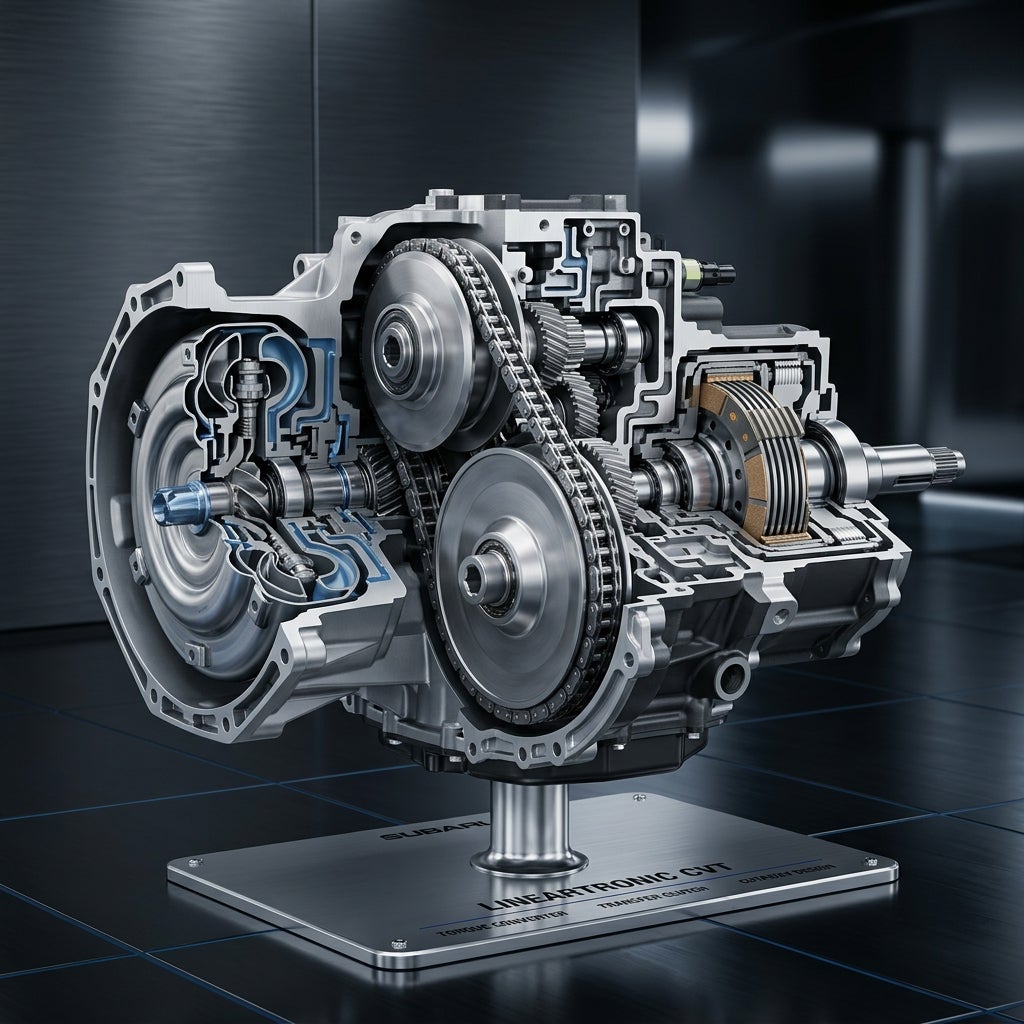
Cutaway view of a Subaru Lineartronic CVT showing torque converter, chain-driven pulleys, and transfer clutch pack. (Representative image for illustration purposes only. Actual vehicle may vary based on trim and configuration.)

Do Subaru CVTs Last as Long as Traditional Automatic Transmissions? The Expert Verdict

Do Subaru CVTs Last as Long as Traditional Automatic Transmissions? The Expert Verdict For years, automotive forums and driveway mechanics have debated the long-term durability of Continuously Variable Transmissions (CVTs) compared to traditional step-gear torque-converter automatics. Early implementations of CVTs across the automotive industry in the late 2000s earned a reputation for premature wear, sluggish rubber-band acceleration, and high replacement costs. However, when examining Subaru's engineered-in-house Lineartronic CVT, the short answer to whether it can match or exceed the lifespan of a traditional automatic is an emphatic YES — provided proper maintenance protocols are followed. Modern Subaru Lineartronic CVTs regularly achieve 200,000 to 250,000 miles or more without major mechanical overhauls. Unlike early push-belt CVT designs utilized by other manufacturers, Subaru engineered a unique, high-torque steel pull-chain system that drastically reduces friction, heat, and internal slippage. When paired with routine fluid exchanges rather than relying on outdated 'lifetime fluid' marketing claims, the Subaru CVT stands as one of the most reliable modern drivetrains on the market today. At Sunset Hills Subaru, located at 10100 Watson Rd in Sunset Hills, MO, our service center regularly inspects, maintains, and services high-mileage Subarus that commute daily across St. Louis County, Ladue, and Kirkwood. Below, Service Manager Shawn King brings 21 years of hands-on Subaru master diagnostic experience to answer every critical question regarding Lineartronic CVT design, real-world longevity, maintenance requirements, and overall vehicle value. Meet Shawn King: 21 Years of Subaru Service Expertise in St. Louis County Interviewer: Welcome, Shawn. Over your 21 years in Subaru service management here at Sunset Hills Subaru, you've seen the mechanical transition from traditional 4-speed and 5-speed automatic transmissions to the modern Lineartronic CVT across the entire Subaru lineup. What is your perspective on this evolution? Shawn King: 'Thanks for having me. When Subaru first introduced the Lineartronic CVT in North America around 2010 on the Outback and Legacy, customers and technicians were understandably cautious. Up to that point, 4EAT and 5EAT torque-converter automatics were simple, bulletproof boxes, but they sacrificed fuel economy and engine performance. Over two decades, I've watched Subaru refine their CVT architecture through three distinct generations. Today, when a customer asks me if a modern CVT will last as long as their old 2005 Outback automatic, I can look them in the eye and say yes—and in many cases, with far less mechanical stress on the engine.' Shawn King: 'We service thousands of vehicles every year from commuters taking I-270 daily to drivers handling steep, rolling topography in Ladue and Sunset Hills. The longevity of any transmission boils down to mechanical friction management, thermal management, and fluid hygiene. Throughout this Q&A, I want to demystify how these transmissions operate and share actionable maintenance strategies that keep our customers' vehicles thriving beyond 200,000 miles.' Q: How Does a Subaru Lineartronic CVT Work Mechanically Compared to a Traditional Automatic? Interviewer: Shawn, to help us understand lifespan, can you break down the physical mechanical differences between a traditional planetary automatic and Subaru's Lineartronic system? Shawn King: 'A conventional step-gear automatic transmission relies on multiple sets of complex planetary gears, hydraulic valve bodies, multi-plate clutch packs, and a torque converter. To accelerate, hydraulic pressure engages and disengages distinct gear ratios—say, 1st through 6th or 8th gear. Every shift creates a momentary interruption of power and a minor mechanical shock as clutches engage.' Shawn King: 'Subaru's Lineartronic CVT dispenses with fixed-gear sets entirely. Instead, it utilizes two hydraulically adjustable, cone-shaped pulleys connected by a ultra-durable, high-tensile steel chain. By continuously altering the width of the primary (input) and secondary (output) pulleys, the effective diameter around which the chain loops changes seamlessly. This provides an infinite range of gear ratios between its lowest and highest mechanical limits.' Shawn King: 'What makes Subaru's design especially unique is its longitudinal placement and integration with Symmetrical All-Wheel Drive. In a typical front-wheel-drive CVT, components are crammed transaxle-style into a tight transverse box. Subaru aligns the Lineartronic inline with the Boxer engine. This symmetrical layout allows for larger, sturdier pulley shafts, superior oil distribution, and reduced thermal hot spots.' Shawn King: 'Because the engine can stay continuously in its peak power or efficiency band without harsh gear changes, mechanical strain on the internal combustion engine itself is noticeably diminished. Whether you are driving a New Subaru Outback Inventory model or a versatile family SUV, the seamless transfer of power protects both the engine crank and the drive axles from sudden torque spikes.' Q: Are Traditional Torque-Converter Automatics Inherently More Durable Than CVTs? Friction & Wear Components Traditional automatics contain dozens of friction disks, brake bands, and internal clutch packs that wear down during every shift change. Over 150,000 miles, clutch material sheds into the ATF fluid. CVTs eliminate shift clutches entirely, transferring drive torque continuously through hydraulic pressure clamping force across the steel chain and pulley interface. Mechanical Shock & Driveline Stress Gear shifting creates torsional shock loads through the driveshaft, differentials, and engine mounts. By eliminating gear steps, a Subaru CVT delivers uninterrupted, fluid torque application. This smooth energy transfer significantly reduces fatigue failure risks in secondary driveline components like U-joints and axle CV shafts over long ownership cycles. Thermal Management & Fluid Sensitivity Traditional automatics are somewhat more tolerant of dirty or oxidized fluid before slipping becomes noticeable. CVTs rely heavily on high hydraulic clamping pressure (up to 800+ PSI) and specialised traction fluid to prevent chain slippage. While highly durable, CVTs demand strict adherence to fluid maintenance to match step-gear lifespan. Shawn King's Verdict: 'It is a misconception that traditional automatics are fundamentally indestructible. Anyone who owned an 80s or 90s automatic knows clutches burn out and valve bodies clog. The modern Lineartronic CVT actually has far fewer moving components. When maintained with high-grade genuine fluid, its structural endurance matches or exceeds classic automatics.' Check Current Service and Parts Offers Q: How Does Subaru's Chain-Driven CVT Compare to Nissan's Belt-Driven CVT in Reliability? Interviewer: Many consumers associate some CVTs with reliability concerns from certain brands, including Nissan. Why is Subaru's engineering fundamentally different? Shawn King: 'This is the single most important distinction in automotive CVT technology. Most high-volume CVT failures in competitor vehicles stemmed from push-belt designs manufactured by Jatco. A push-belt consists of hundreds of small steel elements held together by flexible steel bands. Under high torque load, push-belts can experience micro-slippage against the smooth pulley faces, generating metal shavings and extreme heat that destroys hydraulic control valves.' Shawn King: 'Subaru partnered with Schaeffler LuK to pioneer a short-pitch steel pull-chain system for Lineartronic. Rather than pushing elements, Subaru's chain pulls across the pulleys. The chain pins grip into tiny recessed grooves on the pulley cones mechanically rather than relying solely on surface friction. This short-pitch design allows for smaller pulley radiuses, expanding the overall ratio coverage while handling immense torque loads without slipping.' Shawn King: 'Because the chain grips mechanically without slipping, Subaru Lineartronic CVTs can withstand high-torque turbocharged engines like the 2.4L BOXER found in the Outback XT, Ascent, and WRX. You can explore our New Subaru Ascent Inventory or test drive a New Subaru WRX Inventory model to experience how crisp and immediate power delivery feels with this robust chain architecture.' Q: How Many Miles Can a Well-Maintained Subaru CVT Transmission Realistically Last? Interviewer: Shawn, based on the thousands of vehicles that enter Sunset Hills Subaru's service bays annually, what realistic mileage figures should St. Louis drivers expect? Shawn King: 'With diligent fluid servicing, reaching 200,000 to 250,000 miles on an original Subaru CVT is standard in our workshop. In fact, we regularly service fleet vehicles, commuter cars, and family haulers from around St. Louis County that have eclipsed 220,000 miles without a single transmission teardown. Conversely, vehicles where fluid service was neglected after 100,000 miles often start showing valve body solenoid wear or thermal fatigue between 130,000 and 150,000 miles.' Expected Lifespan by Maintenance Schedule (St. Louis Driving Profile) Maintenance Protocol Fluid Service Interval Estimated CVT Lifespan Common Service Needs Neglected ('Lifetime' belief) Never changed (100k+ miles) 120,000 - 150,000 miles Solenoid failure, valve body replacement, thermal varnish build-up Standard Factory Routine Every 60,000 miles 175,000 - 220,000 miles Minor O-ring seals, torque converter lockup solenoid inspection Proactive / Severe Duty Every 30,000 - 45,000 miles 220,000 - 275,000+ miles Routine gasket and fluid swap only; optimal hydraulic pressure retention Whether you are interested in keeping your current car for another decade or looking through our Used Vehicle Inventory for a dependable pre-owned Forester or Legacy, verifying documented CVT fluid maintenance is the key indicator of long-term reliability. Q: How Often Should Subaru CVT Fluid Be Changed for Peak Longevity? Interviewer: The owner's manual mentions 'inspecting' fluid, and many owners have heard that CVT fluid is 'lifetime.' Is CVT fluid truly lifetime? Shawn King: 'Let me clear this up once and for all: no mechanical fluid subjected to heat and shear forces lasts forever. The phrase 'lifetime fluid' in automotive parlance strictly refers to the factory powertrain warranty period (e.g., 5 years or 60,000 miles). If you want your Subaru to operate smoothly past 150,000 miles, relying on 'lifetime' fluid is a recipe for premature wear.' Shawn King: 'Subaru's own severe-duty service schedule explicitly recommends fluid exchanges every 24,000 to 36,000 miles. In St. Louis County, where we experience hot 90°F+ summer stop-and-go gridlock on I-64, coupled with sub-zero winter cold snaps, virtually all local vehicles qualify as operating under severe conditions. I recommend a full drain, refill, and electronic re-adaptation procedure every 30,000 to 60,000 miles.' Shawn King: 'It's also essential to use exact factory-specified fluid—such as Subaru CVTF-II or High Torque CVTF (Orange/Clear depending on engine pairing). Generic multi-vehicle ATF/CVT fluids lack the specific traction coefficient additives needed for steel chain engagement, which can cause internal slippage. You can easily Schedule Service and Diagnostics online with our factory-trained master technicians.' Q: What Causes Premature Failure in Subaru CVT Transmissions? 1. Thermal Degradation & Heat Stress Transmission fluid loses its viscosity and traction capabilities when exposed to sustained temperatures above 220°F. Excessive towing over vehicle capacity, long mountain climbs in summer heat, or stuck radiator coolers break down chemical shear stability, accelerating metal wear on pulleys. 2. Fluid Contamination & Improper Fill Procedure Subaru CVTs do not have a standard dipstick and must be level-checked at precise fluid temperatures (95°F–113°F) using Subaru Select Monitor diagnostic software. Quick-lube shops frequently drain CVT fluid by mistake when attempting oil changes, or overfill/underfill the unit, causing immediate cavitation or burn-out. 3. Solenoid Varnish & Valve Body Contamination As old fluid oxidizes, micro-varnish forms inside the intricate passages of the lower valve body. This causes sensitive hydraulic control solenoids (such as the torque converter lockup solenoid) to stick or throw diagnostic trouble codes, resulting in rough operation if fluid changes are ignored. If you are servicing your vehicle or repairing auxiliary cooling components, always insist on genuine factory components. You can directly Find Subaru Parts through our dedicated Sunset Hills Subaru parts department. Order Genuine Subaru Parts Q: What Are the Early Warning Signs That a Subaru CVT Transmission Is Failing? Interviewer: What symptom should prompt a driver to bring their car in for inspection immediately before minor trouble becomes major damage? Shawn King: 'Subarus give distinct early signals when transmission health starts deteriorating. Recognizing these symptoms early can mean the difference between a simple valve body or solenoid replacement versus needing a full assembly replacement.' Key Warning Symptoms to Watch For: • Shuddering or Judder During Acceleration: A low-frequency vibration felt through the seat or floorboard when accelerating from a stop, often caused by torque converter lockup slip or fluid breakdown. • High-Pitched Whining Noise: A pitched whine that increases with engine RPM, signaling bearing wear or hydraulic pump strain. • Delayed Engagement: Pausing 2 to 3 seconds before Drive or Reverse engages after shifting from Park. • Flashing 'AT OIL TEMP' Light: Indicates transmission fluid temperature has exceeded safe operating limits (typically 248°F+). • Engine Stalling when Coming to a Stop: Occurs when a sticking lockup solenoid fails to disengage the torque converter as vehicle speed drops to zero.' If you notice any of these signs while driving along Watson Road or I-44, stop by our shop immediately or Call us at (314) 476-9638 to speak directly with our service advising team. Q: Does Driving in Extreme Conditions or Hilly Ladue Terrain Affect Subaru CVT Longevity? Interviewer: How do local topography and St. Louis weather patterns impact the transmission compared to flat, mild regions? Shawn King: 'Topography and climate have a profound influence on internal hydraulic pressure and heat generation. Driving through hilly residential neighborhoods in Ladue, Town and Country, or Sunset Hills forces the CVT to constantly adjust pulley clamping pressure as vehicle pitch changes under variable load. Continuous elevation changes combined with stop-and-go suburban driving increase fluid thermal cycles compared to steady highway cruising.' Shawn King: 'Furthermore, St. Louis experiences dramatic Midwest seasonal extremes. In August, outdoor temperatures hit 95°F with extreme humidity, putting maximum heat load on the engine and transmission coolers during heavy traffic. In January, temperatures plummet below zero, causing transmission fluid to thicken overnight. Until the fluid reaches optimal operating temperature, hydraulic pressures fluctuate. Subarus equipped with X-MODE manage low-speed traction exceptionally well on snow and ice, but engaging X-MODE or hill descent control increases transmission duty cycles. This local driving environment is exactly why proactive 30,000 to 45,000 mile fluid inspections are essential in our region.' Whether you drive a compact commuter like a New Subaru Impreza Inventory selection or an adventurous crossover like the New Subaru Forester Inventory line, maintaining optimal fluid health ensures seamless performance regardless of terrain or season. Q: How Do Subaru CVTs Compare to Toyota e-CVTs in Terms of Reliability? Interviewer: Consumers often hear that Toyota's hybrid 'e-CVT' is practically unkillable because it has no belts or chains. How does Subaru's mechanical Lineartronic compare, and how do hybrid Subarus bridge this gap? Shawn King: 'It's important to clarify terminology because 'e-CVT' and mechanical CVT operate on completely different principles. Toyota's hybrid e-CVT is a planetary power-split device driven by two electric motor-generators. It has no belts, no chains, and no hydraulic clamping pulleys. From a purely mechanical standpoint, e-CVTs have virtually zero wear components, making them exceptionally reliable in hybrid applications.' Shawn King: 'Subaru's gas-powered Lineartronic is a true mechanical continuously variable transmission using a steel chain and variable hydraulic pulleys. It is designed to provide direct mechanical AWD coupling and real-time mechanical torque distribution across rugged off-road terrains—something planetary power-split devices struggle with without heavy electric motor intervention.' Shawn King: 'In Subaru's hybrid vehicles—such as the Crosstrek Hybrid or upcoming Forester Hybrid models—Subaru combines electric drive assist with reinforced transmission casing designs. If you are seeking absolute zero-emissions driving with no internal combustion transmission maintenance whatsoever, you can also explore our New Subaru Solterra Inventory for an all-electric SUV option.' Q: Should You Rebuild or Replace a Subaru CVT Transmission if It Fails? Option A: Valve Body Replacement If diagnostic trouble codes point to a failed torque converter solenoid or hydraulic valve body sticking, you do NOT need to replace the entire transmission. Sunset Hills Subaru can replace the internal valve body assembly and harness without removing the transmission from the vehicle, saving thousands in labor costs. Option B: Factory Remanufactured Unit When mechanical pulleys or chains sustain severe wear, a Genuine Subaru Factory Remanufactured Transmission assembly is far superior to third-party rebuilds. Factory units are rebuilt on dedicated OEM precision assembly lines, incorporate all revised superseding parts, and come backed by a nationwide Subaru warranty. Option C: Vehicle Equity & Trade Evaluation If a vehicle is over 12 years old with high mileage, major transmission replacement costs should be evaluated against total vehicle equity. In many cases, trade-in value applied toward a newer model with fresh factory warranty protection is the most financially sensible decision. Before deciding on major repairs, you can evaluate your vehicle's current equity quickly online—click here to Get your value trade estimate in minutes, or explore options to Contact us for financing information on a newer replacement vehicle. Value Your Current Trade Online Q: Does CVT Service History Affect Resale Value, and Where Can You Get a Pre-Purchase Inspection in St. Louis County? Interviewer: How significantly does documented transmission maintenance impact used market value when an owner decides to trade or sell? Shawn King: 'Documented service history directly correlates with trade-in appraisal values and private resale speed. When our appraisal team inspects a trade-in, a clean CARFAX record showing regular Subaru dealer fluid exchanges indicates that the driveline has been cared for meticulously. Buyers in the pre-owned market actively seek out cars with verifiable service records, especially for popular models like the Outback, Forester, and Crosstrek.' Shawn King: 'For anyone shopping for a used Subaru in St. Louis County, getting a Certified Pre-Purchase Inspection (PPI) at Sunset Hills Subaru is the best insurance policy available. Our factory technicians hook up SSM4 diagnostics to check real-time CVT fluid deterioration counters, hydraulic stall pressures, and historical thermal excursion logs before you commit to buying.' Looking to upgrade your daily commute? Browse our extensive inventory of New Subaru Inventory models, examine our certified New Subaru Crosstrek Inventory options, or review our current Current New Car Offers. Keep Your Subaru Running Strong: Expert Transmission Service at Sunset Hills Subaru The myth that CVTs cannot match the longevity of traditional automatic transmissions has been thoroughly debunked by Subaru's robust steel-chain Lineartronic engineering. With routine fluid services scheduled every 30,000 to 60,000 miles, your Subaru CVT is engineered to deliver smooth, fuel-efficient performance well beyond 200,000 miles on St. Louis roads. Whether you need to inspect your transmission fluid, schedule routine maintenance, evaluate your trade-in, or explore new vehicles like the stylish New Subaru Legacy Inventory or sporty New Subaru BRZ Inventory, our expert team at Sunset Hills Subaru is ready to serve you. Visit us at 10100 Watson Rd, Sunset Hills, MO 63127 or Get Directions to Sunset Hills Subaru today. Schedule Transmission Service Explore New Subaru Inventory




A gray Subaru Solterra electric SUV parked and charging at a modern public EV charging station. (Representative image for illustration purposes only. Actual vehicle may vary based on trim and configuration.)

Navigating the 2026 Subaru Solterra Battery Software Recall in St. Louis: What Local Owners Need to Know

As electric vehicle technology continues to leap forward, proactive updates are a natural part of ensuring peak performance, longevity, and safety. Recently, Subaru of America announced a specialized campaign known as the WRG-26 battery software recall, directly affecting certain 2026 Subaru Solterra models. For drivers navigating the busy corridors of Interstate 270, the rolling hills of Sunset Hills, or the leafy, quiet neighborhoods of Ladue, keeping this sophisticated electric SUV running at its absolute best is paramount. This guide is crafted to offer you a clear, calm, and highly detailed look at what this recall means, how it protects your vehicle's advanced engineering, and how Sunset Hills Subaru is fully prepared to handle the update swiftly and seamlessly. At Sunset Hills Subaru, located conveniently at 10100 Watson Rd, Sunset Hills, MO 63127, we view safety campaigns not as a design failure, but as a commitment to continuous improvement. The modern automotive landscape relies heavily on sophisticated Electronic Control Units (ECUs) to balance charging speeds, thermal management, and power delivery. When a manufacturer identifies an opportunity to optimize these algorithms, they initiate campaigns like the WRG-26. If you own or lease a 2026 Solterra in the St. Louis area, you can rest assured that our team of factory-trained EV specialists has the precise diagnostic equipment, direct factory support, and specialized training required to address this software campaign in a single, efficient visit. To find our dealership and plan your visit, you can quickly Get Directions to Sunset Hills Subaru. We understand that your time is highly valuable, and learning about a manufacturer campaign can raise immediate questions about vehicle safety, daily driving habits, and long-term battery health. Throughout this comprehensive resource, we will break down the exact technical parameters of the WRG-26 update, clarify the difference between standard diagnostics and recall software patches, and discuss the exceptional warranty coverage that backs every Solterra. Our goal is to ensure you possess all the facts, allowing you to drive with complete confidence through every seasonal shift that our unique Missouri climate brings. Understanding the WRG-26 Battery ECU Recall and Its Impact on Your Solterra To understand the WRG-26 campaign, it helps to understand how a modern electric vehicle battery functions. Your Solterra utilizes a highly advanced, high-voltage lithium-ion battery pack. This pack is managed by a dedicated Electronic Control Unit (ECU) running complex proprietary software. This ECU acts as the brain of the battery, constantly monitoring cell voltage, state of charge, and internal temperatures. The WRG-26 recall specifically addresses a software defect within this ECU's programming. Under highly specific, rare operating conditions—such as extreme temperature fluctuations paired with repeated rapid power demands—the existing software might miscalculate the battery's internal resistance or thermal thresholds. If left unaddressed, this miscalculation could lead to premature power limitations or, in highly uncommon cases, thermal stress on individual cells. A common question among local drivers is: Can the WRG‑26 battery ECU software defect damage the Solterra’s high‑voltage battery over time? The answer is that while the risk of actual physical damage is exceptionally low, prolonged operation with unoptimized software can cause uneven stress across battery cells, potentially accelerating minor capacity degradation over many years. The update acts as a preventative shield, restructuring the software's parameter limits to ensure the battery operates safely within its ideal thermal and chemical zones. By updating the software promptly, you completely eliminate this risk, ensuring your battery maintains its ideal health profile. For peace of mind, owners often ask: How many recalls does the 2026 Subaru Solterra have on record, and are they all fixable? Currently, the WRG-26 is the primary software campaign on record for this specific model year, and it is 100% fixable via a straightforward diagnostic port update at our dealership. Subaru's engineering philosophy has always prioritized preventative safety and long-term durability. By proactively deploying this software correction, the brand ensures that every Solterra on the road remains a standard-bearer for reliability. The update doesn't require physical disassembly of your battery pack or the installation of complex mechanical hardware. Instead, it is a clean, digital calibration. Our factory-trained technicians connect your Solterra to Subaru’s secure, proprietary diagnostic network, flash the updated firmware directly to the battery ECU, and run a comprehensive verification cycle to ensure the new parameters are active and operating flawlessly. Because the update is entirely digital, it is completed without altering the fundamental character of your vehicle. It simply refines the underlying calculations, making the vehicle smarter and more resilient to harsh environments—like a humid St. Louis summer or a freezing Midwestern winter. It is this dedication to detail that preserves the resale value and mechanical integrity of your vehicle, allowing you to enjoy the quiet, responsive performance of your electric SUV for years to come. How to Schedule Your 2026 Subaru Solterra WRG-26 Recall and Battery Health Check Near Sunset Hills, MO Step 1: Use Our Online Scheduler To schedule the WRG-26 recall and a comprehensive battery health check, the fastest and most convenient method is to utilize our intuitive online scheduling platform. Simply navigate to our website, enter your vehicle details (including your VIN if available), and select the WRG-26 recall option. You can choose a date and time that fits seamlessly into your busy schedule. Our portal is accessible 24/7, allowing you to book your appointment from the comfort of your home in Sunset Hills or your office in downtown St. Louis. Step 2: Connect With Our Specialists If you prefer personal assistance or have specific questions regarding parts availability or loaner vehicles, our dedicated service advisors are standing by. You can easily Call us at (314) 476-9638 to speak directly with an EV service specialist. We will verify your vehicle's recall status, explain the process step-by-step, and ensure that a specialized EV technician and a dedicated diagnostic bay are reserved specifically for your arrival, minimizing your waiting time. Step 3: Enjoy Convenient Hours & Amenities At Sunset Hills Subaru, we design our service experience around your convenience. We offer flexible early morning, daytime, and Saturday service hours to accommodate diverse schedules. While our certified technicians perform the software update and a complimentary multi-point safety inspection, you can relax in our modern, comfortable customer lounge equipped with high-speed Wi-Fi, premium coffee, and quiet workspaces, or take advantage of our convenient local shuttle service. Schedule Your Free Recall Service Now Is There a Mobile Service Option for the Solterra Battery Software Update in the St. Louis Area? With the rise of mobile tire changes, detailing, and minor maintenance, many local electric vehicle owners naturally wonder: Is there a mobile service option for the Solterra battery software update in the St. Louis area? While some minor vehicle services can be performed in a driveway, the WRG-26 software update requires a secure, hardwired connection to Subaru’s proprietary diagnostic network and highly specialized power-stabilizing equipment. Because of these strict technical requirements, a mobile service van cannot safely perform this update. To protect your vehicle's delicate electrical architecture, the campaign must be performed within a certified, static dealership workshop environment. To make up for this, Sunset Hills Subaru offers exceptional alternative convenience features. We understand that taking time out of your day to visit a dealership can be challenging. To assist, we offer premium service loaner vehicles (subject to availability) so you can go about your day uninterrupted. Additionally, we provide convenient valet pickup and delivery services for qualifying maintenance visits in surrounding areas like Ladue and Kirkwood. Bringing your vehicle into our state-of-the-art facility on Watson Road also ensures that your Solterra receives a comprehensive multi-point inspection, checking vital systems like suspension, brakes, and tire wear patterns that a mobile technician might miss. Will the WRG-26 Software Update Change How Your Solterra Drives, and Can the Defect Damage Your Battery? One of the most frequent questions we receive from performance-conscious drivers is: Will the WRG‑26 software update change how my Solterra drives or its range after the recall? It is highly reassuring to know that this software patch does not alter the responsive, linear acceleration or the engaging driving dynamics that define the Solterra. The update operates strictly behind the scenes. It optimizes the threshold parameters of the battery management system to prevent unnecessary power restrictions under extreme conditions, without reducing the vehicle's standard power output or compromising its signature Symmetrical All-Wheel Drive system. Furthermore, your EPA-estimated driving range will remain unaffected. The update is designed to preserve your range by managing the battery's energy state more efficiently, particularly when navigating the high-speed merges of Highway 40 or climbing the rolling hills of St. Louis County. Regarding potential damage, neglecting the update over a long period could theoretically expose the battery cells to elevated thermal stress during rapid charging or heavy load cycles, which could lead to minor cell imbalance. Getting the update completed promptly at Sunset Hills Subaru prevents any potential long-term physical degradation of the high-voltage pack, ensuring you get the absolute maximum lifespan out of your investment. How the Battery ECU Software Recall Differs From a Standard Battery Health Check It is common to confuse manufacturer recalls with routine diagnostic checks, but they serve distinct purposes. When asking: How is the 2026 Subaru Solterra battery ECU recall different from a regular battery health check?, it is helpful to look at the scope. The WRG-26 recall is a specific, manufacturer-mandated action designed to rewrite the operational logic of the battery's control unit. It corrects a known software variable to guarantee safety and compliance. In contrast, a standard battery health check is a diagnostic measurement. It assesses the current physical state of your battery pack, measuring overall capacity retention, cell voltage balance, and internal resistance to give you a clear picture of how your battery is aging. Fortunately, you do not have to choose between the two. To the question: Can I get a battery health check done at the same time as the WRG‑26 recall on my Solterra?, the answer is a resounding yes. In fact, we highly recommend it. When you bring your Solterra to Sunset Hills Subaru for the WRG-26 update, our technicians will gladly perform a comprehensive battery health check as part of the service. This dual approach ensures your software is fully up to date while providing you with a detailed report on your battery's current capacity. To explore our current service and parts offers. View Current Service and Parts Information Subaru Solterra Battery Warranty: Coverage, Capacity Guarantees, and Second-Owner Transfers Exceptional Capacity Guarantees For long-term peace of mind, understanding your warranty is crucial. Owners often ask: What percentage of battery capacity degradation is guaranteed under the Subaru warranty? Subaru protects Solterra owners with a robust capacity guarantee. Under the standard high-voltage battery warranty, Subaru guarantees that the battery will retain at least 70% of its original capacity for a duration of 8 years or 100,000 miles, whichever comes first. If capacity falls below this 70% threshold within the warranty window, Subaru will repair or replace the pack to restore compliance. Software Coverage & Recalls Another common point of clarity is: Are software updates for the Solterra battery management system covered under warranty? Absolutely. Any manufacturer-initiated software updates, safety recall campaigns (such as the WRG-26), or diagnostic recalibrations related to the electric drivetrain and battery management systems are completed at absolutely zero cost to the vehicle owner. There are no deductibles, diagnostic fees, or hidden charges when bringing your vehicle to an authorized dealer like Sunset Hills Subaru for recall execution. Seamless Second-Owner Transfer If you are purchasing a pre-owned electric vehicle or planning to sell your vehicle in the future, you may ask: Does the Subaru Solterra battery warranty transfer to a second owner? Yes, the Subaru high-voltage battery warranty is fully transferable to subsequent owners. The 8-year/100,000-mile warranty remains attached to the vehicle's unique VIN, requiring no transfer fees or complex paperwork. This transferable warranty dramatically enhances the resale appeal of the Solterra, protecting your investment long-term. What Factors Matter More Than This Recall for Long-Term Solterra Battery Health? While campaigns like the WRG-26 are highly important, daily driving habits and charging routines have a far more profound impact on your battery's long-term capacity. When considering: What factors matter more than this recall for long‑term battery health on a 2026 Solterra?, the primary factor is your charging behavior. Lithium-ion batteries experience the least physical stress when kept between a 20% and 80% state of charge (SoC) for routine daily driving. Routinely charging to 100% or letting the vehicle sit near 0% for extended periods can accelerate capacity loss over time. It is best to save 100% charging for long-distance road trips where the range is immediately utilized. Another critical factor is the frequency of DC fast charging. While DC fast charging is highly convenient for road trips, relying on it as your primary daily charging method exposes the battery to sustained high currents and temperatures. Utilizing Level 2 AC home charging for your daily needs is significantly gentler on the battery cells. Additionally, managing thermal exposure is vital. Whenever possible, park your Solterra in a shaded area during scorching St. Louis summers or inside a garage during freezing winter nights. To keep a close eye on your vehicle's physical condition, you might ask: How often should I get a battery health check for my Subaru Solterra? We recommend having our service team perform a battery health diagnostic once a year or every 12,000 miles during your routine tire rotation and multi-point inspection. Fast Charging Your 2026 Solterra from 10% to 80% Around Ladue and Sunset Hills For active drivers who frequently travel across the St. Louis metropolitan area, understanding public charging capabilities is key. A vital question for trip planning is: How long does it take to fast charge the 2026 Solterra from 10% to 80%? Under ideal weather conditions, utilizing a high-speed DC fast charger with a capacity of 150 kW or higher, the 2026 Solterra can replenish its high-voltage battery from 10% to 80% in approximately 35 minutes. This rapid charging capability makes it incredibly easy to grab a quick lunch, enjoy a coffee, or run errands while your vehicle prepares for its next journey. The public charging infrastructure in affluent St. Louis suburbs like Sunset Hills and Ladue has expanded dramatically. Excellent high-speed public chargers are located near major shopping hubs, grocery stores, and highway intersections. For those interested in stepping into this advanced electric lifestyle, you can explore our New Subaru Solterra Inventory to find a model that perfectly matches your preferences. Furthermore, the 2026 Solterra features an upgraded battery thermal management system that pre-conditions the battery pack during cold Missouri winters, ensuring optimized charging speeds even when temperatures drop below freezing. Explore New Subaru Solterra Inventory How the 2026 Subaru Solterra Compares to the Hyundai Ioniq 5 and Kia EV6 When shopping for a modern electric SUV, local buyers frequently compare major competitors. An essential question is: How does the 2026 Subaru Solterra compare to the Hyundai Ioniq 5 and Kia EV6? While the Hyundai Ioniq 5 and Kia EV6 offer highly compelling styling and quick straight-line acceleration, they are primarily designed as on-road, urban vehicles. The Subaru Solterra, on the other hand, stands out as a true adventure vehicle, purpose-built to handle harsh terrain and unpredictable weather with ease. Feature 2026 Subaru Solterra Hyundai Ioniq 5 Kia EV6 Symmetrical AWD Standard on All Trims Available (Extra Cost Upgrade) Available (Extra Cost Upgrade) Ground Clearance 8.3 Inches 6.3 Inches 6.1 Inches Off-Road Assist System Dual-Function X-MODE with Grip Control Standard Traction Control Only Standard Traction Control Only Active Family Utility Standard Roof Rails & Mudguards Limited Utility Options Sport-Focused Profile Symmetrical All-Wheel Drive Unlike its competitors where All-Wheel Drive is an expensive upgrade option, every 2026 Solterra comes standard with Subaru's legendary Symmetrical AWD. This dual-motor layout distributes power continuously and instantly to all four wheels, ensuring exceptional grip on slippery winter roads or muddy trails. Class-Leading Ground Clearance With an impressive 8.3 inches of ground clearance, the Solterra towers over the Ioniq 5 (6.3 inches) and the EV6 (6.1 inches). This height allows you to navigate unpaved paths, deep winter snow, and steep driveway transitions without worrying about scraping your vehicle's underbody. Dual-Function X-MODE The Solterra features specialized X-MODE with Hill Descent Control and Grip Control. This advanced system optimizes electric motor output and traction control parameters for specific low-grip conditions like deep snow, dirt, or wet mud, giving you unparalleled off-road capability. 2026 Subaru Solterra Trims, Starting MSRP, and Total Recalls on Record When planning your next vehicle purchase, budget and trim options are primary considerations. Prospective owners frequently ask: What is the starting MSRP of the 2026 Subaru Solterra trims? The Solterra is available in three highly content-rich trims: Premium, Limited, and Touring. While exact pricing can vary based on dealer packages and factory options, the Premium trim typically starts around $44,995, offering standard Symmetrical AWD and Subaru EyeSight. The mid-tier Limited trim, which adds features like a larger 12.3-inch multimedia screen, a 360-degree panoramic view monitor, and a power rear liftgate, starts around $48,495. The top-of-the-line Touring trim starts around $51,995, delivering premium luxury amenities like a panoramic glass roof, ventilated front seats, and a digital rearview mirror. Regarding overall reliability and safety, knowing the safety campaign history is highly reassuring. The 2026 Solterra has an exceptional reliability rating, with only the WRG-26 battery software recall on active record. This proactive safety campaign represents the high standard of safety Subaru demands of its vehicles. Rather than waiting for real-world issues, the manufacturer proactively deploys these software refinements to protect owners long before any symptoms appear, ensuring that your Solterra remains a safe, dependable, and highly secure long-term investment. Why the 2026 Solterra’s Performance Fits the Hilly Terrain of Ladue and Sunset Hills The geography of the St. Louis metropolitan area is surprisingly diverse. The rolling hills, wooded valleys, and steep residential avenues that characterize beautiful suburbs like Sunset Hills and Ladue require a vehicle that offers unwavering stability and traction. On rainy spring afternoons or during sudden winter snowstorms, navigating steep winding roads can become stressful. The Solterra's instant electric torque, paired with its Symmetrical AWD system, ensures smooth, continuous power delivery that keeps the vehicle firmly planted, eliminating wheel spin and boosting driver confidence on any gradient. Furthermore, the standard EyeSight Safety Assist suite acts as an extra set of eyes on busy corridors like Watson Road and Lindbergh Boulevard. Features like Pre-Collision Braking, Lane Keep Assist, and Adaptive Cruise Control integrate seamlessly with the electric drivetrain to manage typical suburban driving hazards. Whether you are dropping the kids off at local St. Louis schools, commuting to work, or taking a weekend trip out to Missouri wine country, the Solterra provides a peaceful, exceptionally safe driving environment designed to handle our local topography with ease. Schedule Your Free WRG-26 Software Update at Sunset Hills Subaru at your convenience If you are a 2026 Subaru Solterra owner in the St. Louis area, when you're ready to complete this vital safety campaign. The team of certified electric vehicle professionals at Sunset Hills Subaru is ready to perform your free WRG-26 software update and a complimentary battery health check. Our modern facility, comfortable amenities, and customer-first approach guarantee a stress-free experience from start to finish. Ready to get started? You can quickly Schedule Service and Diagnostics online, or Call us at (314) 476-9638 to speak with our service department. If you are curious about what your current vehicle is worth, you can easily Get your value trade using our convenient online tool, or browse our New Subaru Inventory to see our latest models. Visit us today at 10100 Watson Rd, Sunset Hills, MO 63127, and let us show you why we are the trusted automotive resource for the entire St. Louis community. Schedule Your Recall Appointment
A service advisor showing a tablet to a customer at a modern car dealership service counter. (Representative image for illustration purposes only. Actual vehicle may vary based on trim and configuration.)

What I Tell Our Customers About Subaru Service Transparency

Demystifying the Shop: Our Commitment to Subaru Service Transparency Four years of serving as the Service Director here at Sunset Hills Subaru has shown me that trust in the service bay is built on clear communication. Every maintenance visit should begin with a straightforward explanation of what our factory-trained technicians are doing and why they are doing it. We work hard to remove the mystery from automotive maintenance, ensuring that every driver feels confident in the care their vehicle receives. Daily commutes from Ladue in a family-sized Subaru Ascent or local weekend trips in a versatile Subaru Outback require a vehicle in peak mechanical condition. Our team keeps routine maintenance predictable and affordable, and we encourage drivers to look through our current service and parts specials. When a vehicle is due for maintenance, owners can easily schedule a service appointment online or call our team directly at (314) 476-9638. For those who prefer to speak with us in person, our service center location on Watson Road is easy to find. Table of Contents Inside the Checklist: What the Subaru Multi-Point Inspection Covers Proprietary Technology: Why the Subaru Select Monitor Matters for Diagnostics Clear Estimates and Open Communication: Navigating Your Repair Quotes and Invoices The Science of Lubrication: Why Modern Boxer Engines Require 0W-20 Synthetic Oil Beyond the Oil Change: Demystifying Major Service Milestones and Technical Calibrations Inside the Checklist: What the Subaru Multi-Point Inspection Covers Every routine visit to our facility begins with a comprehensive multi-point inspection designed to give you a complete health report of your vehicle. Our technicians systematically evaluate critical safety and performance components, categorizing their condition using a straightforward green, yellow, and red system. Green indicates the component is in great shape, yellow means it is showing wear and should be monitored, and red indicates an item requires immediate attention to ensure safety. During this inspection, we check fluid levels, measure brake pad thickness, test battery health, and measure tire tread depth to ensure your Symmetrical All-Wheel Drive system wears its rubber evenly. We also inspect steering, suspension, and the camera window areas for the EyeSight® Driver Assist system. This detailed checklist ensures you have a written record of your vehicle's exact condition before any work is performed. For owners driving older vehicles facing significant wear, this detailed report provides the clarity needed to make long-term decisions, such as deciding whether to invest in major repairs or explore our current new vehicle specials for a fresh start. Proprietary Technology: Why the Subaru Select Monitor Matters for Diagnostics Modern vehicles are highly advanced computers on wheels, and diagnosing them requires specialized tools. Many local owners ask if independent mechanics have access to the Subaru Select Monitor, which is our proprietary diagnostic tool. While independent shops can use universal OBD-II scanners to read basic engine fault codes, they generally lack the specialized software and hardware access provided by the official factory tool. The proprietary diagnostic system allows our factory-trained technicians to communicate directly with your vehicle's individual control modules. This deep-level access is necessary for reading proprietary manufacturer codes, updating powertrain software, and performing precise sensor calibrations on the horizontally opposed Boxer engine. For families driving near Sunset Hills Park, having these systems communicating correctly is vital for the active safety features they rely on every day. Using generic diagnostic tools can result in incomplete diagnoses, missed software updates, or improperly calibrated safety systems. Clear Estimates and Open Communication: Navigating Your Repair Quotes and Invoices Requesting a detailed written estimate before authorizing any repair work is the best way to maintain control over your vehicle's maintenance. A transparent estimate should clearly separate the cost of labor, individual components, shop supplies, and applicable taxes. This breakdown prevents unexpected surprises on your final invoice and ensures you understand exactly what you are paying for. If your vehicle requires replacement components, we always recommend utilizing genuine Subaru parts to guarantee factory-spec fitment, durability, and warranty protection. If you ever look over an invoice and feel that the service charges seem incorrect, the best path forward is open, direct communication. I recommend speaking directly with the Service Manager first, as most billing questions or misunderstandings can be resolved quickly in a polite conversation. If a resolution cannot be reached at that level, the next step is to escalate the matter to the Dealer Principal. Our goal is always to maintain complete financial accountability, ensuring you feel respected and valued throughout the entire process. The Science of Lubrication: Why Modern Boxer Engines Require 0W-20 Synthetic Oil The unique engineering of the horizontally opposed engine requires highly specific lubrication to operate efficiently and reliably over its lifespan. Most modern models require 0W-20 synthetic oil, which is formulated to flow quickly through the tight internal tolerances of the flat-four cylinder layout. This low-viscosity oil reduces internal friction, maximizes fuel efficiency, and provides critical lubrication to the upper cylinder walls immediately upon a cold start. If an independent shop uses an incorrect oil grade or conventional oil, it can lead to increased engine wear, accelerated oil consumption, and reduced fuel economy. Over time, using the wrong lubricants can even void your powertrain warranty coverage if oil-related engine damage occurs. To prevent these issues, we recommend using Subaru Certified Motor Oil, which is specifically engineered and tested for these powerplants. Under normal driving conditions, this high-quality synthetic fluid must be changed every 6,000 miles or six months, whichever comes first, to maintain optimal engine health. Beyond the Oil Change: Demystifying Major Service Milestones and Technical Calibrations As your vehicle reaches major mileage milestones, the required maintenance tasks expand beyond routine oil changes and tire rotations. The 30,000-mile major service is a critical milestone that includes a mandatory brake fluid flush to remove moisture from the hydraulic system, alongside replacing the engine air filter and cabin air filter. While some owners wonder if spark plugs are replaced at this interval, they are actually rated for longer durability and are typically changed at the 60,000-mile mark. During the 30,000-mile visit, our technicians also inspect the front and rear differential fluids to ensure the gear oil is clean and free of metal debris. Another highly technical procedure we perform is the EyeSight® calibration, which is required after a windshield replacement, suspension modification, or front-end alignment. This process is incredibly precise, requiring a perfectly flat service bay, specialized aiming targets, and proprietary software to ensure the dual cameras accurately calculate distances. If you ever experience a breakdown or emergency on the road, remember that your vehicle is supported by manufacturer-backed service quality through Subaru Roadside Assistance at 1-800-261-2155, which is included with your warranty coverage. For any questions about your maintenance schedule or to coordinate emergency support, please call our service team at (314) 476-9638 or stop by our service center at 10100 Watson Rd, Sunset Hills, MO 63127. © 2026 Sunset Hills Subaru. All rights reserved.

AI generated: Cinematic close-up, a modern silver Subaru Outback elevated on a professional hydraulic lift inside a pristine, high-end automotive service bay in Sunset Hills, Missouri, a focused technician in clean charcoal workwear using precision tools to install a gleaming new genuine brake rotor and ceramic pads, sharp focus on the intricate metallic textures of the braking assembly, bright clinical workshop lighting blended with warm late-afternoon sunlight streaming through large glass bay doors, lush midwestern suburban greenery and a soft blue sky visible in the blurred background, low-angle perspective emphasizing safety and mechanical integrity, ultra-realistic, polished concrete floors, sophisticated atmosphere, vibrant yet professional color palette of metallic silver, deep blues, and amber highlights, 8k resolution, photorealistic.

Expert Subaru Brake Replacement in Sunset Hills, MO

Expert Subaru Brake Replacement in Sunset Hills, MO When you are navigating the bustling corridors of Watson Road or merging onto the fast-paced traffic of I-44, your Subaru's braking system is not just a mechanical assembly—it is your primary line of defense. At Sunset Hills Subaru, we understand that owners of the Forester, Outback, and Crosstrek demand a higher standard of safety. In the heart of Sunset Hills, Missouri, our service center stands as a beacon of automotive integrity, specializing in the delicate nuances of Subaru's unique stopping technology. Every time you press that pedal, a complex symphony of hydraulic pressure and friction material works to keep you and your family secure. We believe that maintaining this system requires more than just a quick fix; it requires the specialized knowledge of factory-trained experts who live and breathe the Subaru brand. Our commitment to excellence begins with the use of genuine Subaru brake components. Unlike generic parts found at local chain shops, OEM Subaru pads and rotors are engineered specifically for your vehicle's weight, balance, and advanced safety features like EyeSight® Driver Assist Technology. In Sunset Hills, where the weather can shift from a humid summer afternoon to a slick, icy winter morning in a matter of hours, the reliability of your brakes is non-negotiable. By choosing expert service at Sunset Hills Subaru, you are investing in the longevity of your vehicle and the uncompromising safety that has made Subaru a leader in the industry. We invite you to experience the difference that professional, local expertise makes in your daily commute. Schedule Your Precision Brake Diagnostic Why Subaru Braking Systems Are Unique Symmetrical All-Wheel Drive Integration Subaru's Symmetrical All-Wheel Drive system is world-renowned for its balance and traction, but many drivers don't realize how deeply it is integrated with the braking system. In a Subaru, the brakes do more than just stop the wheels; they work in tandem with the VDC (Vehicle Dynamics Control) to manage torque distribution. When you enter a sharp corner in Sunset Hills, the system may apply subtle braking pressure to individual wheels to help the vehicle rotate and maintain its intended path. This active torque vectoring requires brake pads with a specific friction coefficient and heat dissipation profile. Using non-spec parts can disrupt this delicate balance, potentially compromising the legendary handling characteristics of your WRX or Ascent. EyeSight® Driver Assist Synergy Modern Subarus are equipped with EyeSight®, a dual-camera system that monitors traffic and can initiate Pre-Collision Braking. This system expects a very specific response time and bite force from the braking hardware. If you have installed aftermarket pads that don't meet these precise engineering tolerances, the EyeSight® system might not be able to stop the vehicle within the distances calculated by its software. At Sunset Hills Subaru, we ensure that every brake replacement respects the electronic architecture of your car. Protecting the integrity of these advanced systems is why we advocate so strongly for genuine parts and professional calibration by technicians who understand the digital and mechanical intersection of your Subaru. 5 Warning Signs Your Subaru Needs New Brakes 1. High-Pitched Squealing Subaru brake pads are designed with small metal tabs called wear indicators. When your pads reach a critical thickness, these tabs make contact with the rotor, producing a distinct chirping or squealing sound. This is your Subaru literally telling you it is time for service before more expensive damage occurs. 2. Steering Wheel Shaking If you feel a rhythmic pulsation or vibration through the steering wheel when applying the brakes at highway speeds on I-270, it usually points to warped rotors. This 'runout' prevents the pads from making smooth contact, reducing your stopping efficiency and increasing wear on your suspension. 3. Soft or Spongy Pedal Do you have to 'pump' the brakes or push the pedal nearly to the floor before the car slows down? This can indicate air in the hydraulic lines or moisture in the brake fluid. In our Sunset Hills climate, humidity can degrade brake fluid faster than you might think. Additionally, keep an ear out for Grinding Noises, which suggest that the friction material is completely gone and you are now experiencing metal-on-metal contact. This is a safety emergency and can lead to total brake failure. Finally, never ignore Dashboard Warning Lights. If the 'BRAKE' or 'ABS' light illuminates, it's time to Schedule Service and Diagnostics immediately with our team. The Dangers of Delayed Brake Maintenance Ignoring brake wear is a gamble that no driver should take. As brake pads thin, the heat generated during stopping has nowhere to dissipate, leading to a phenomenon known as 'brake fade.' During a long descent or in stop-and-go Sunset Hills traffic, your brakes could lose their effectiveness precisely when you need them most. Furthermore, delaying a simple pad replacement often leads to a 'cascading failure.' When pads are worn to the backing plate, they gouge the rotors, necessitating a much more expensive replacement of the entire wheel assembly rather than a simple maintenance service. From a safety perspective, the statistics are sobering. A vehicle with worn brakes can require up to 20-30% more distance to come to a complete stop. At 60 MPH, that could be the difference between a safe stop and a rear-end collision. In Missouri, where we face rain, snow, and ice, that stopping distance is even more critical. Compromised braking performance makes it harder for your ABS and Traction Control systems to do their jobs, leaving you vulnerable on slick roads. Don't wait for a close call to prioritize your maintenance. If you are worried about the cost of repairs, you can Get approved for financing through our secure online portal to ensure your safety isn't delayed. Trade In Your Vehicle for a New Subaru Genuine Subaru Parts vs. Aftermarket Alternatives While the local auto parts store might offer a alternative set of pads, the hidden costs of aftermarket parts are significant. Genuine Subaru pads are formulated with a specific semi-metallic or ceramic blend that matches the rotor's hardness. This ensures: Noise Reduction: Subaru parts include specialized shims and lubricants to eliminate that annoying low-speed squeak. Dust Control: OEM parts are designed to produce less corrosive dust, keeping your alloy wheels looking new for longer. Guaranteed Fitment: There is no 'universal' fit in the Subaru world. Our parts are engineered to the millimeter for models like the New Subaru Ascent Inventory and the New Subaru Forester Inventory. When you use Find Subaru Parts through our dealership, you are receiving components backed by a national warranty, ensuring that your investment is protected as you drive across Sunset Hills and beyond. Our Multi-Point Brake Inspection Process At Sunset Hills Subaru, we don't just 'look' at your brakes. We perform a comprehensive physical and digital health check on the entire system. Our process includes: 1. Visual Inspection: We check the remaining life of your pads and look for uneven wear patterns that might suggest a sticking caliper. 2. Rotor Analysis: We use precision micrometers to measure rotor thickness. If there is enough material, we can often resurface them; otherwise, we recommend replacement to prevent overheating. 3. Hydraulic Health: We inspect every inch of the brake lines for cracks, leaks, or corrosion—especially important for older vehicles exposed to Missouri's winter road salt. 4. Fluid Quality Test: We test the boiling point of your brake fluid to ensure it hasn't absorbed too much water, which can cause internal rust and pedal fade. 5. Hardware Lubrication: We clean and grease the slide pins and contact points to ensure smooth, quiet operation every time you slow down. This level of detail is what sets us apart from the corner garage. We want you to leave our lot with the absolute certainty that your brakes are in showroom condition. Schedule Your Professional Brake Service Today Don't let your brake maintenance fall by the wayside. Our online scheduling tool is available 24/7, allowing you to book an appointment that fits your busy St. Louis lifestyle. Whether you need a quick inspection or a full four-wheel brake overhaul, our team is ready to provide the high-quality care your Subaru deserves. Book Your Service Appointment Understanding the Components: Pads, Rotors, and Calipers The Brake Pads The sacrificial part of the system. These pads squeeze the rotors to create friction. On a Subaru, they typically last 30,000 to 50,000 miles depending on your driving habits in Sunset Hills traffic. The Brake Rotors The large metal discs that spin with your wheels. They must be perfectly flat and smooth. If they become 'pitted' or warped, they must be replaced to ensure safe stopping. The Brake Calipers The hydraulic 'clamps' that hold the pads. While they last longer than pads or rotors, they can seize due to age or corrosion, causing the brakes to 'drag' and overheat. Component Inspection Interval Typical Lifespan Brake Pads Every 6,000 Miles 30,000 - 70,000 Miles Brake Rotors Every 12,000 Miles Varies by thickness Brake Fluid Every 30,000 Miles 30 Months Brake Lines Every 12,000 Miles Vehicle Lifetime Brake Fluid Flush: The Forgotten Maintenance Step Brake fluid is 'hygroscopic,' which is a fancy scientific way of saying it acts like a sponge for moisture. Even in a sealed system, moisture eventually finds its way into the fluid. In the humid Missouri summers, this process can happen even faster. When the water content in your brake fluid gets too high, it lowers the boiling point of the fluid. Under heavy braking—like when you're coming down a steep hill near Castlewood State Park—the fluid can actually boil, creating gas bubbles in your lines. Since gas is compressible and liquid isn't, your brake pedal will suddenly feel like it's stepping on a marshmallow, and your stopping power will vanish. Subaru recommends a full brake fluid flush every 30,000 miles or 30 months. This isn't just about performance; it's about longevity. That moisture doesn't just lower the boiling point; it also causes internal corrosion in your ABS pump and calipers. Replacing an ABS module can cost thousands of dollars, whereas a simple fluid flush is an affordable preventative measure. At Sunset Hills Subaru, we use specialized equipment to pressure-bleed your system, ensuring that every drop of old, contaminated fluid is replaced with fresh, high-performance Subaru DOT 3 or DOT 4 fluid. It's the cheapest insurance policy you can buy for your car's braking system. Driving in Sunset Hills: Local Factors Affecting Brake Wear Living in the 63127 area presents unique challenges for your vehicle. The stop-and-go nature of Watson Road and the daily congestion on Lindbergh Boulevard mean your brakes are working harder than a car driven in rural areas. Furthermore, St. Louis winters are notorious for the use of magnesium chloride and road salt. These chemicals are great for melting ice, but they are incredibly corrosive to your brake rotors and calipers. If you don't wash your undercarriage regularly, this salt can cause the brake pads to 'bind' in their brackets, leading to rapid, uneven wear. We also see many drivers who commute from the more hilly areas of South County. Constant downhill braking creates immense heat, which can lead to 'glazing' of the brake pads—a condition where the friction material becomes smooth and hard like glass, losing its ability to grip the rotor. Because we are a local Sunset Hills business, we know exactly what to look for when your car comes onto our lift. We recommend a quick inspection after every winter season to ensure that the salt and grit haven't begun to compromise your safety. While you're here, feel free to browse our New Subaru Inventory if you're thinking about upgrading to a model with the latest safety tech. View Current Service & Parts Specials The Sunset Hills Subaru Service Advantage Factory-Trained Technicians Our technicians aren't generalists; they are specialists. They attend regular training sessions provided by Subaru of America to stay current on every new model, from the electric New Subaru Solterra Inventory to the performance-tuned New Subaru WRX Inventory. This means they can spot potential issues that a general mechanic might miss, such as a slightly leaking axle boot that is dripping grease onto your brake rotor. Amenities and Convenience We know your time is valuable. That's why we offer a comfortable waiting area with high-speed Wi-Fi, complimentary coffee, and shuttle services to keep your day moving. If your brake service requires more time, we offer loaner vehicles to ensure you aren't stranded. We treat our customers like neighbors because you are. From the moment you Call us at (314) 476-9638, you will experience a level of transparency and hospitality that is rare in the automotive world. Frequently Asked Questions About Subaru Brakes How long does a brake replacement take? Typically, a standard front or rear brake replacement takes about 1.5 to 2 hours. If you are having all four wheels serviced and a fluid flush, plan for about 3 to 4 hours. We offer shuttle services to Watson Road shopping areas to make the wait easy. Do I really need to replace my rotors every time? Not necessarily. If your rotors are still above the minimum 'discard' thickness and aren't warped, we can 'turn' them to create a fresh surface. However, modern Subaru rotors are designed for lightness and heat dissipation, meaning they often don't have enough extra metal to be safely surfaced more than once. Is there a 'break-in' period for new pads? Yes! For the first 200 miles, try to avoid extremely hard, panic stops. This allows the friction material to 'bed' properly into the rotors, ensuring the longest possible life and the quietest operation. Are my brakes covered under warranty? Brake pads are considered 'wear items' and are typically not covered by the 3-year/36,000-mile bumper-to-bumper warranty unless there is a manufacturer defect. However, Genuine Subaru parts installed by our team come with their own parts-and-labor warranty for peace of mind. Get Approved for Service Financing Authentic Subaru Parts & Accessories For the DIY enthusiasts in Sunset Hills who enjoy spending a Saturday afternoon in the garage, our parts department is your best resource. When you buy from us, you aren't just getting a box with a part number; you're getting the assurance that you're installing the exact same components that the factory used in Japan. We stock everything from standard pads for the New Subaru Impreza Inventory to high-performance components for the New Subaru BRZ Inventory. Looking to upgrade? We also offer STI performance brake upgrades for several models, providing even more bite and fade resistance for those who enjoy spiritied driving. Our parts experts can help you identify exactly what you need based on your VIN, ensuring you never have to make a second trip because a part didn't fit. Find Subaru Parts online today and have them ready for pickup at our Watson Road location. Visit Sunset Hills Subaru for Your Brake Needs Your safety is our priority, and it starts with a healthy braking system. From the precision engineering of the New Subaru Outback Inventory to the reliability of our Used Vehicle Inventory, every car we touch is treated with the utmost care. Don't leave your stopping power to chance. Whether you've noticed a new sound or it's simply been a while since your last check, our team is here to help. Get Directions to Sunset Hills Subaru and visit us at 10100 Watson Rd, Sunset Hills, MO 63127. Our service hours are designed to accommodate your schedule, and our staff is ready to answer any questions you may have. For immediate assistance or to speak with a service advisor directly, please Call us at (314) 476-9638. We look forward to serving you and keeping your Subaru performing at its peak for years to come. Schedule Your Brake Inspection Now

AI generated: Cinematic macro photography of a modern vehicle's digital instrument cluster, focused on a variety of glowing dashboard warning symbols including amber engine icons and red safety indicators, sleek steering wheel with brushed metallic accents in the foreground, soft interior cabin lighting, twilight atmosphere with golden hour sunlight softly blurring through the windshield, realistic textures of soft-touch dashboard materials, deep blacks and cool blue backlighting contrasted against vibrant orange and red illuminated icons, shallow depth of field, sharp focus on the dashboard display, sophisticated and reassuring mood, high-resolution automotive interior photography, suburban landscape blurred in the distance.

Subaru Warning Light Glossary: Your Complete Guide to Dashboard Peace of Mind

Subaru Warning Light Glossary: Your Complete Guide to Dashboard Peace of Mind Driving through Sunset Hills, MO, in your Subaru should be an experience defined by confidence and safety. However, when a mysterious symbol suddenly glows on your dashboard, that peace of mind can quickly turn into anxiety. At Sunset Hills Subaru, we believe that an informed driver is a safer driver. Your Subaru is equipped with a sophisticated onboard diagnostic system designed to monitor everything from engine timing to the pressure in your spare tire. Understanding these signals is the first step in ensuring your vehicle's longevity. This comprehensive glossary is designed to demystify those glowing icons. Whether you are navigating the summer heat on Watson Road or preparing for a cross-country adventure in your Outback, knowing when a light requires an immediate stop versus a scheduled check-up is vital. Our goal is to empower you with expert knowledge, so you never feel overwhelmed by your car's communication. If you ever feel unsure, our team is just a phone call away at (314) 476-9638 to help guide you through any technical concerns. The Color-Coded Language of Your Subaru Subaru uses a universal 'traffic light' logic for its dashboard indicators. This color-coded system is designed to convey the urgency of a situation at a single glance. Red indicators are the most critical. When you see a red light, it typically signifies a serious malfunction or a safety system that requires immediate attention. In many cases, continuing to drive with a red light could lead to catastrophic engine failure or a dangerous loss of vehicle control. Amber or Yellow lights represent caution. These are the most common lights and usually indicate that a system is not operating correctly but does not pose an immediate threat to the vehicle's operation. However, ignoring these can lead to secondary issues. For example, a yellow tire pressure light might not stop you from driving today, but it will certainly affect your fuel economy and tire wear over the next week. We recommend that you Schedule Service and Diagnostics whenever a yellow warning persists. Green and Blue lights are generally informational. A blue coolant light simply means the engine hasn't reached operating temperature yet—perfectly normal on a cool morning. Green lights often signal that a system like your turn signals, high beams, or Cruise Control is active. These are 'indicator' lights rather than 'warning' lights, letting you know your Subaru is doing exactly what you asked it to do. Understanding this hierarchy helps you stay calm when a light appears. If it's red, find a safe place to pull over immediately. If it's amber, plan to visit us soon. If it's blue or green, simply keep an eye on it as it reflects the current state of your vehicle's features. We invite you to Get Directions to Sunset Hills Subaru if you need a professional to verify any of these signals. Critical Red Alerts: When to Pull Over Safely Oil Pressure Warning This is perhaps the most dangerous light. It indicates that oil is not circulating properly through your Boxer engine. Without lubrication, metal-on-metal contact will destroy your engine in minutes. Stop the car immediately and check your oil levels. Charge System Light Commonly called the battery light, this actually means the alternator isn't charging the battery. Your car is running solely on stored electrical power, which will eventually run out, causing the engine to stall. This is critical in Missouri heat where AC usage is high. Brake System Light If this light stays on after you've released the parking brake, you may have low brake fluid or a hydraulic failure. Your stopping distance could be severely compromised. Pull over safely and do not attempt to drive if the pedal feels spongy. The Infamous Check Engine Light (CEL) The Check Engine Light, or Malfunction Indicator Lamp (MIL), is the most misunderstood light on the dashboard. It is connected to your Subaru's Engine Control Unit (ECU) and can be triggered by hundreds of different 'fault codes.' A steady amber light usually means there is an issue with the emissions system. This could be as simple as a loose gas cap—if the cap isn't tightened until it clicks, the system detects an evaporative leak and triggers the light. However, it can also signal more complex issues like a failing oxygen sensor, a misfiring spark plug, or a clogged catalytic converter. Because the light is generic, you cannot know the cause without a diagnostic tool. At Sunset Hills Subaru, we use factory-grade scanners to read the exact code stored in your car's memory, ensuring we fix the problem right the first time. Crucial Warning: If your Check Engine Light is flashing, this indicates a severe engine misfire. A flashing CEL means that unburned fuel is entering the exhaust system, which can overheat and destroy your catalytic converter in a matter of seconds—a very expensive repair. If the light flashes, reduce your speed and seek service immediately. Regular maintenance is the best way to keep this light off. Many CEL triggers are related to neglected service items like old spark plugs or dirty air filters. If you are worried about the cost of repairs, you can Get approved for financing for your service needs to ensure your vehicle stays in top shape without breaking the budget. Don't let a small sensor issue turn into a major overhaul. Expert Diagnostics at Sunset Hills Subaru Why guess what that light means when you can know for sure? Our Sunset Hills service center is staffed by factory-trained technicians who live and breathe Subaru engineering. We don't just clear the code; we find the root cause. Using the latest Subaru Select Monitor tools, we can view real-time data from your engine to pinpoint exactly what's wrong, saving you time and money. Schedule Your Diagnostic Appointment Subaru EyeSight® and Driver Assist Indicators EyeSight 'Off' Light If you see a yellow icon with a slash through a camera, EyeSight has been disabled. This often happens due to heavy rain, direct sunlight blinding the cameras, or a fogged-up windshield. It usually clears once conditions improve. Pre-Collision Braking This light indicates the system that automatically applies brakes to avoid a frontal collision is either active or disabled. If it stays yellow without you manually turning it off, the sensors may need calibration. Lane Departure Warning This flashes when the vehicle detects you are drifting out of your lane without a turn signal. If the light remains on steadily, there may be an issue with the steering angle sensor or camera alignment. Drivetrain and Performance Icons Your Subaru's Symmetrical All-Wheel Drive is a masterpiece of engineering, but it requires specific monitoring. The AT OIL TEMP light is one you should never ignore. It indicates the transmission fluid is overheating. This often happens when towing heavy loads or driving through deep mud or snow. If this light comes on, stop the vehicle and let the engine idle until the light goes out. We also have the AWD Warning Light. On some models, this indicates a mismatch in tire sizes. Because the AWD system is 'always on,' having one tire that is a different brand or significantly more worn than the others can cause mechanical strain. This is why we always recommend replacing tires in sets of four. If you're looking for a fresh start, check out our New Subaru Inventory to see the latest in AWD technology. Adventure-ready models like the New Subaru Forester feature X-MODE. When active, this light shows the system is optimizing engine output and transmission ratios for low-friction surfaces. It's an indicator of peak performance, not a warning, but it will automatically turn off once you exceed 25 MPH. Tire Pressure and Safety Systems TPMS Light The horseshoe-shaped icon with an exclamation point. It means at least one tire is under-inflated. In Sunset Hills, shifting temperatures can cause this light to trigger as the air in your tires expands or contracts. ABS Warning Anti-lock Braking System. If this glows, your normal brakes will work, but you won't have the pulse-braking feature that prevents skidding during emergencies. It's often caused by a dirty wheel speed sensor. VDC Light Vehicle Dynamics Control. If this light flickers while you're driving, it means the system is currently working to stabilize the car on a slippery road. If it stays on, the stability control system is deactivated. Maintain Your Subaru Performance The best way to keep your dashboard clear is through proactive, scheduled maintenance. Most warning lights are triggered by components reaching the end of their lifecycle. By following your Subaru's maintenance schedule, we can replace these parts before they fail and leave you stranded. Explore our Current Service and Parts Specials to keep your vehicle running efficiently and affordably. View Service Specials Green and Blue Indicator Lights Not every light is a cause for alarm. The Blue Coolant Temperature Light is a common sight for Subaru owners. This light indicates that the engine coolant is below operating temperature. You should drive gently until the light turns off. If this light ever turns Red, however, you must stop immediately, as the engine is overheating. Other green indicators include the Eco Mode light, which signals you are driving in a manner that maximizes fuel efficiency. For owners of the New Subaru Solterra Inventory, you may see specific indicators regarding regenerative braking and battery status. These are helpful tools to help you get the most out of every mile. The High Beam Indicator (blue) and Turn Signal Indicators (green) are standard across all vehicles. Additionally, the Cruise Control Indicator will glow green when the system is ready and active. If these lights fail to appear when the systems are engaged, it could indicate a blown fuse or a faulty bulb in the instrument cluster itself. Understanding these indicators allows you to focus on the road ahead. If you're curious about how these features look in person, feel free to browse our Used Vehicle Inventory and take a test drive to see the dashboard in action. Local Driving Conditions in Sunset Hills, MO Today is June 15, 2026, and summer is in full swing here in Sunset Hills. Our humid Missouri summers and intense heat can be particularly hard on your Subaru's sensors and battery. High temperatures can cause battery fluid to evaporate, leading to a Charge System Warning. Additionally, the heat causes tire pressure to rise, which might trigger your TPMS light if they were filled during a cooler spring day. We frequently see drivers coming in from Watson Road with 'phantom' warning lights triggered by extreme weather. Our team knows how to calibrate your vehicle for local conditions, ensuring your sensors aren't crying wolf. If you've been putting off a check-up, now is the perfect time to Schedule Service and Diagnostics before your next summer road trip. The Risks of Ignoring Dashboard Warnings Ignoring a warning light is like ignoring a smoke detector in your home. While the problem might be a simple battery replacement, it could also be the first sign of a major fire. In automotive terms, a small $150 sensor replacement today can prevent a $5,000 engine rebuild next month. For instance, a yellow transmission light might indicate a minor solenoid issue. If ignored, that solenoid could fail completely, causing internal damage to the gears. Furthermore, warning lights often disable safety features. If your ABS or EyeSight lights are on, those systems may not intervene when you need them most. Safety is the core of the Subaru brand, and we want to ensure every feature is fully operational. If you're worried about the trade-in impact of a glowing dashboard, Get your value trade today to see where you stand. Another risk is fuel efficiency. A Check Engine Light related to an O2 sensor or fuel trim can reduce your MPG by up to 40%. In a city like Sunset Hills, where stop-and-go traffic is common, that adds up to hundreds of dollars in wasted fuel every year. By addressing lights early, you save money at the pump and at the repair shop. We recommend keeping a small log of when lights appear—did it happen while accelerating, or while the engine was cold? This information is incredibly helpful for our technicians. Ready for an upgrade? Explore our Current New Car Specials and trade in your old vehicle for a new model with the latest diagnostic technology. Genuine Subaru Parts vs. Aftermarket Sensors Precision Calibration Subaru sensors are calibrated to exact tolerances. Aftermarket parts often use 'close enough' logic, which can lead to recurring warning lights even after a repair is 'finished.' Genuine parts ensure perfect communication. Warranty Protection Using Genuine Subaru Parts installed at our dealership often comes with its own warranty protection. This gives you peace of mind that if the part fails again, you're covered. Find Subaru Parts for your specific model here. Vehicle Longevity Your Subaru is built to last 200,000 miles and beyond. Using high-quality sensors and components is the only way to reach those milestones without constant electronic headaches. Invest in quality today for a better drive tomorrow. Order Genuine Subaru Parts Frequently Asked Warning Light Questions Q: Can I drive with a yellow light? A: Generally, yes, but only to your nearest service center. Avoid heavy acceleration or long trips until the issue is diagnosed. Q: Why is my light flashing? A: A flashing light is an emergency. It usually signifies a problem that is currently damaging a component, such as an engine misfire. Pull over safely. Q: How do I reset my maintenance light? A: While there are DIY ways, we recommend letting us reset it during your oil change. This ensures the system is correctly calibrated for your next interval. Q: Will my car fail inspection with a light on? A: In Missouri, a Check Engine Light is an automatic failure for emissions testing. It's best to resolve it before your registration is due. Proactive Care: Beyond the Dashboard At Sunset Hills Subaru, we believe that the best warning light is the one that never turns on. Regular fluid checks, battery health tests, and tire rotations are the unsung heroes of vehicle reliability. When you bring your car in for a routine oil change, our technicians perform a multi-point inspection, looking for frayed belts, leaking gaskets, or corroded sensors that might trigger a light in the future. This proactive approach is what keeps Subaru owners on the road longer than almost any other brand. Whether you drive a rugged New Subaru Outback or a performance-tuned New Subaru WRX, our commitment to your safety remains the same. Don't wait for a signal—stay ahead of the curve and keep your Subaru running at peak efficiency for years to come. Trust Sunset Hills Subaru for Your Service Needs Whether you have a single amber light or a dashboard full of questions, the team at Sunset Hills Subaru is ready to help. Located at 10100 Watson Rd, Sunset Hills, MO 63127, we are conveniently positioned to serve the entire St. Louis area. Our state-of-the-art facility and expert staff ensure that your Subaru receives the care it deserves. Don't let dashboard lights dampen your driving experience. Get Directions to Sunset Hills Subaru and visit us today for a comprehensive diagnostic scan. We look forward to seeing you and keeping your Subaru adventure going strong. Schedule Service and Diagnostics

AI generated: A photorealistic, cinematic shot of a 2020 Subaru Outback driving through a heavy Midwestern rainstorm on a wet asphalt road in Sunset Hills, Missouri. The focal point is the windshield, where high-quality wiper blades are mid-sweep, creating a perfectly clear, transparent arc through the heavy droplets and mist. The surrounding environment features lush green oak trees and rolling hills typical of the St. Louis area, blurred slightly by the speed and rain. The lighting is moody and overcast with cool blue and slate gray tones, punctuated by the warm glow of the Subaru's LED headlights cutting through the downpour. The composition is a dynamic three-quarter front view, highlighting the beads of water on the metallic gray paint and the sophisticated sensors behind the clear glass. The atmosphere evokes a sense of safety, reliability, and total visibility despite the challenging Missouri weather.

Clear Vision for the Show-Me State: 2020 Subaru Wiper Blade Replacement

Clear Vision for the Show-Me State: 2020 Subaru Wiper Blade Replacement Living in Sunset Hills, you know that Missouri weather is anything but predictable. One moment you're enjoying a clear afternoon on Watson Road, and the next, a sudden Midwestern downpour or a late-season dusting of sleet can completely obscure your view. For owners of the 2020 Subaru lineup—including the versatile Forester, the adventurous Outback, and the family-focused Ascent—maintaining crystal-clear visibility isn't just about convenience; it's a fundamental pillar of the Subaru safety philosophy. When your wipers begin to fail, they don't just leave streaks; they compromise the sophisticated sensors that help keep you safe. At Sunset Hills Subaru, we believe that every mile driven in the 63127 area should be done with total confidence. Fresh, high-quality wiper blades are your first line of defense against the elements, ensuring that your EyeSight® Driver Assist technology has an unobstructed view of the road ahead. Whether you're commuting into St. Louis or heading out for a weekend at the Lake of the Ozarks, starting your journey with a clear windshield is the best way to ensure you and your passengers arrive safely. The Science of Visibility: Why 2020 Subaru Models Require Specific Blades The windshield of a 2020 Subaru is a masterpiece of automotive glass engineering. Unlike flatter windshields of the past, modern Subaru models feature complex curvatures designed to optimize aerodynamics and minimize wind noise. This specific geometry requires a wiper blade with a precise tension map. Genuine Subaru OEM blades are engineered with a contoured spring steel beam that maintains uniform pressure across the entire length of the blade, regardless of the windshield's arc. Generic 'one-size-fits-all' blades often struggle with these modern curves. You might notice 'lift-off' at higher highway speeds or missed spots in the center of the glass where the blade fails to make contact. By choosing parts specifically designed for your model, you ensure that the rubber element stays flat against the glass, effectively clearing water, snow, and road grime in a single pass. Furthermore, the 2020 model year marked a significant refinement in Subaru's material science. The rubber compounds used in Genuine Subaru parts are infused with high-grade synthetic polymers that resist the 'cooking' effect of the Missouri summer sun. While aftermarket blades may use cheaper organic rubber that hardens and cracks within months of exposure to UV rays, OEM components are tested to withstand the extreme temperature swings common in St. Louis. When you visit our service center, you're getting more than just a piece of rubber; you're getting a component that was wind-tunnel tested to ensure it doesn't chatter or whistle at 70 MPH. It’s this attention to detail that separates a true Subaru experience from a standard repair. Check out our New Subaru Inventory to see how these engineering standards are applied across our latest models. Warning Signs: When to Replace Your Subaru Wipers Streaking & Smearing If your wipers leave a film of water or milky streaks across the glass, the rubber edge has likely lost its sharp 'squeegee' profile. This is often caused by road oils or sap that has bonded to the blade. Skipping & Chattering When a blade develops a 'set' or becomes rigid, it will jump across the glass rather than gliding smoothly. This usually indicates that the rubber has hardened due to extreme heat or age. Split or Torn Rubber Physical damage is the most obvious sign. In St. Louis, ice and heavy snow can easily tear the delicate rubber away from the metal frame, leading to metal-on-glass contact which can scratch your windshield. Don't Wait for the Next Storm Our expert technicians at Sunset Hills Subaru can swap your blades in minutes while performing a complimentary multi-point inspection. Ensure your 2020 Subaru is ready for anything Missouri throws your way. Schedule Your Professional Wiper Installation OEM vs. Aftermarket: Protecting Your EyeSight® Driver Assist Technology If your 2020 Subaru is equipped with the EyeSight® Driver Assist Technology, your windshield is more than just glass—it’s a crucial sensor array. The dual cameras located near the rearview mirror 'see' the road to provide Pre-Collision Braking and Adaptive Cruise Control. If your wipers leave streaks or a hazy film directly in the cameras' field of vision, the system may disable itself to prevent inaccurate readings. Subaru recommends Genuine Subaru Wiper Blades because they are specifically tested to ensure they do not leave the type of residue or streaking that triggers EyeSight system errors. Aftermarket blades with 'water-repellent' coatings can sometimes leave a silicone film that interferes with the optical clarity required by the cameras. By using OEM parts from Sunset Hills Subaru, you're protecting the integrity of your vehicle's most advanced safety features. For more information on keeping your safety systems in peak condition, you can Call us at (314) 476-9638 to speak with a service advisor. 2020 Subaru Wiper Size Reference Guide While your owner's manual contains this data, we've compiled the most common 2020 Subaru model sizes here for your convenience. Please note that sizes can vary by trim level; always confirm with our parts department before purchasing. 2020 Model Driver Side Passenger Side Rear Blade Forester 26" 17" 14" Outback 26" 18" 12" Ascent 26" 20" 12" Crosstrek 26" 16" 12" Impreza 26" 16" 12" Step-by-Step: DIY 2020 Subaru Wiper Replacement 1. Enter Service Position: On many 2020 Subaru models, the wipers are tucked below the hood line for aerodynamics. With the ignition in the 'ON' position, turn it 'OFF' and immediately push the wiper stalk upward for two seconds. The arms will move to a vertical position on the glass. 2. Lift and Protect: Gently pull the wiper arm away from the windshield until it locks in the upright position. Pro-tip: Place a folded towel on the windshield directly under the arm. If the arm accidentally snaps down without a blade attached, the towel prevents the metal arm from cracking your glass. 3. Release the Blade: Locate the small tab on the underside of the wiper hook (the J-hook). Press the tab and slide the blade downward toward the base of the arm. It should slide off easily. 4. Install New Blade: Slide the new Genuine Subaru blade into the hook until you hear a distinct 'click'. This ensures the locking mechanism is engaged. 5. Test: Gently lower the arm back to the glass, remove your towel, and cycle the wipers to ensure smooth operation. Prefer to Do It Yourself? Our parts department stocks the exact blades your 2020 Subaru was born with. Skip the guesswork at the big-box stores and get the right fit the first time. You can even browse our Find Subaru Parts tool online to see what's in stock right now in Sunset Hills. Order Genuine Subaru Wiper Blades Maintaining Your New Blades: Pro Tips from Our Service Team Clean the Edge Once a month, wipe the rubber edge of your blades with a clean cloth dipped in washer fluid. This removes road film and debris that causes streaking. Winter Care Never use your wipers to clear heavy ice. The jagged edges of ice will slice the rubber. Use a scraper first, or let your Subaru's wiper de-icer (if equipped) do the work. Avoid Car Wash Wax Spray-on waxes at automatic car washes can build up on the rubber, causing it to skip. Wipe the blades down after every wash to maintain flexibility. The Impact of St. Louis Weather on Your Windshield St. Louis is notorious for its weather 'mood swings.' In the 63127 ZIP code, we deal with high humidity in the summer that traps pollutants against your glass, and heavy road salt in the winter that can corrode the internal springs of your wiper arms. These local factors mean that a wiper blade that might last 12 months in a milder climate may only last 6 months here in Sunset Hills. We recommend a 'seasonal switch'—changing your blades in the late fall to prepare for winter slush, and again in the late spring to ensure you're ready for the heavy thunderstorms of early summer. If you're considering an upgrade to a newer model with even better visibility features, why not Get your value trade and see what your current Subaru is worth toward a new one? Beyond Wipers: A Comprehensive Visibility Strategy Washer Fluid: We use Genuine Subaru washer fluid that includes a de-icing agent and specialized surfactants to help the blades glide smoothly. Nozzle Alignment: Over time, washer nozzles can become clogged or misaligned. Our team ensures the spray hits the 'sweet spot' for maximum clearing efficiency. Chip Repair: Small chips can quickly turn into cracks that ruin a wiper blade. We can inspect your glass for damage before it becomes a safety hazard. Visit Sunset Hills Subaru for Expert Care Located conveniently at 10100 Watson Rd, Sunset Hills, MO 63127, our service department is ready to help you maintain your Subaru's legendary safety and performance. Whether you need a quick wiper blade swap or a more comprehensive diagnostic, our factory-trained technicians have the tools and experience to do the job right. Get Directions to Sunset Hills Subaru and stop by today. No appointment? No problem—ask about our express service options for maintenance items like wiper replacement. View Service Specials Frequently Asked Questions About Subaru Wipers Are wiper blades covered under my Subaru warranty? Many 2020 Subaru models were sold with a 3-year/36,000-mile Wear Item Limited Warranty. This often includes one free set of replacement wiper blades within that window. Contact our service team to see if your vehicle is still eligible. How long does the rear wiper blade last? Rear blades generally last longer because they aren't exposed to the same constant wind and debris as the front. However, because they are often forgotten, the rubber can dry out and scratch the rear glass. We recommend checking it every time you replace your front blades. Do I need special 'Winter' blades? Subaru's OEM beam-style blades are designed as all-season components. They lack the external metal framework of traditional blades, meaning there are no hinges to freeze up in St. Louis winters. They provide excellent performance in both snow and rain. Can I just buy the rubber 'refills'? For many 2020 models, Subaru offers rubber inserts (refills) that slide into your existing OEM frames. This is a more cost-effective and eco-friendly way to maintain visibility if your metal or plastic frames are still in good condition. Experience the Sunset Hills Subaru Difference At Sunset Hills Subaru, we aren't just selling parts; we're helping you protect what matters most. Clear vision is the foundation of safe driving, and our commitment to your safety starts with the smallest details—like a perfectly fitted set of wiper blades. Whether you're driving a New Subaru Forester or maintaining your trusted 2020 Outback, we are here to support you for every Missouri mile. Ready for an upgrade or need a different type of service? From our Credit Application to our Used Vehicle Inventory, we offer a full suite of resources to keep you moving forward with confidence. Visit us today and see why Sunset Hills drivers trust us with their most important journeys. Schedule Your Next Maintenance Visit

Contact Us

Fill out this form below and we'll contact you shortly
*Required Fields