Blog / Maintenance & Service

Why Don't More Automobile Manufacturers Use Boxer Engines? The Bottom-Line Trade-Offs

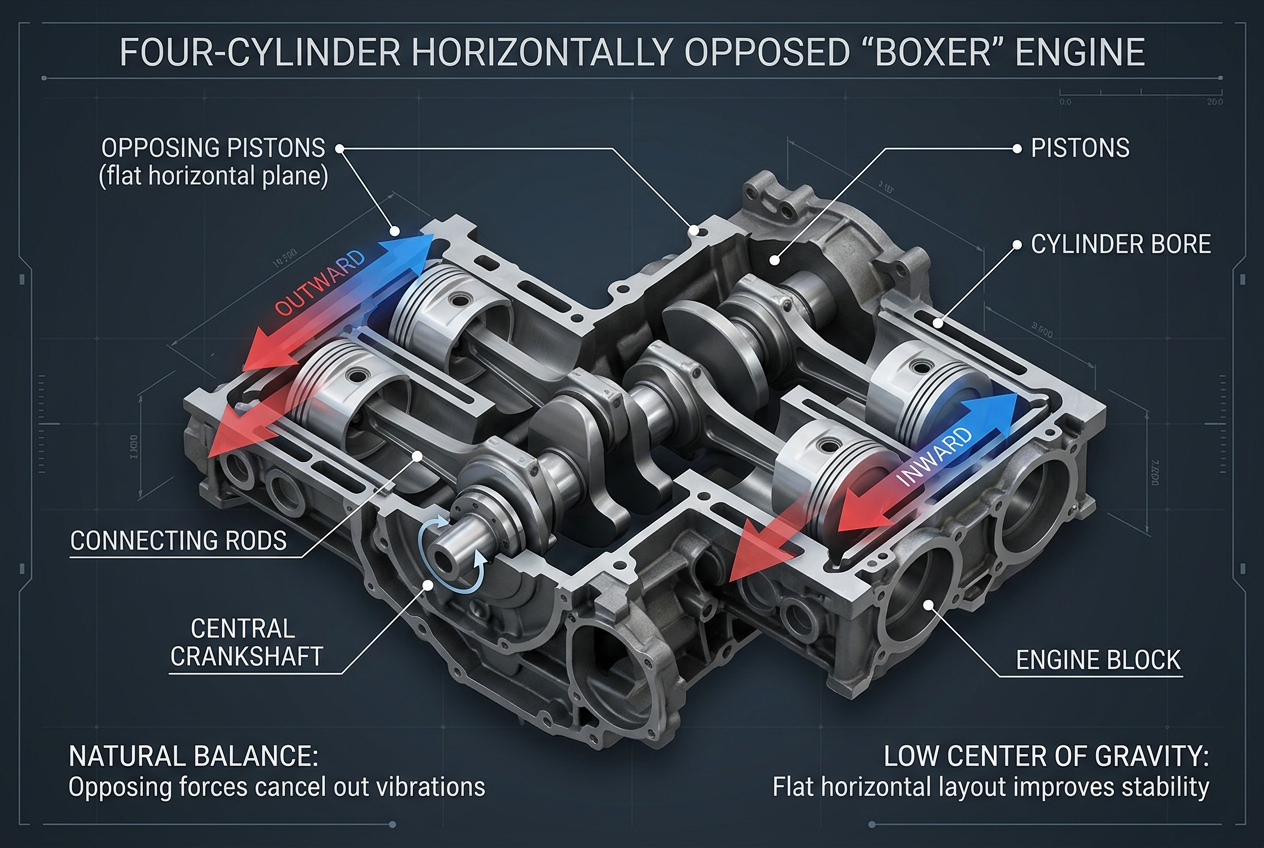
Boxer engine Diagram
If you have ever carved through the twisting, rolling bends of highway near Sunset Hills or taken a brisk morning drive along the Missouri River bluffs, you have likely felt the unmistakable handling signature of a horizontally opposed engine. Known universally as the boxer engine, this unique powerplant lies at the heart of modern engineering fascination. Enthusiasts revere it for its flat architecture, silky-smooth power delivery, and ultra-low center of gravity. Yet, when you look across the vast automotive landscape, only two major manufacturers—Subaru and Porsche—remain dedicated to mass-producing boxer engines for passenger vehicles.
Why haven't automotive giants like Toyota, Ford, General Motors, or Honda adopted flat engine layouts for their high-volume commuter vehicles? The answer comes down to a set of uncompromising engineering and economic trade-offs. While a boxer engine delivers inherent primary rotational balance and unmatched lateral chassis stability, it places strict demands on vehicle design. A boxer engine requires a significantly wider engine bay, which complicates front suspension geometry and wheel-turn clearance. Economically, it demands dual cylinder heads, twin camshaft banks, duplicated exhaust manifolds, and complex timing mechanisms. This effectively doubles specific component tooling costs compared to standard inline-four configurations. Furthermore, tight clearances between horizontal cylinder heads and chassis frame rails make routine maintenance—such as spark plug replacement—more labor-intensive. For mass-market automakers focused on maximum modularity and minimum assembly cost, the traditional inline or V-engine remains the path of least resistance. However, for dedicated engineers at Subaru, those trade-offs are reasonable trade-offs for safety, control, and driving dynamics that no upright engine can mirror.

How Does a Boxer Engine Work Mechanically, and Why Is It Called a Boxer Engine?

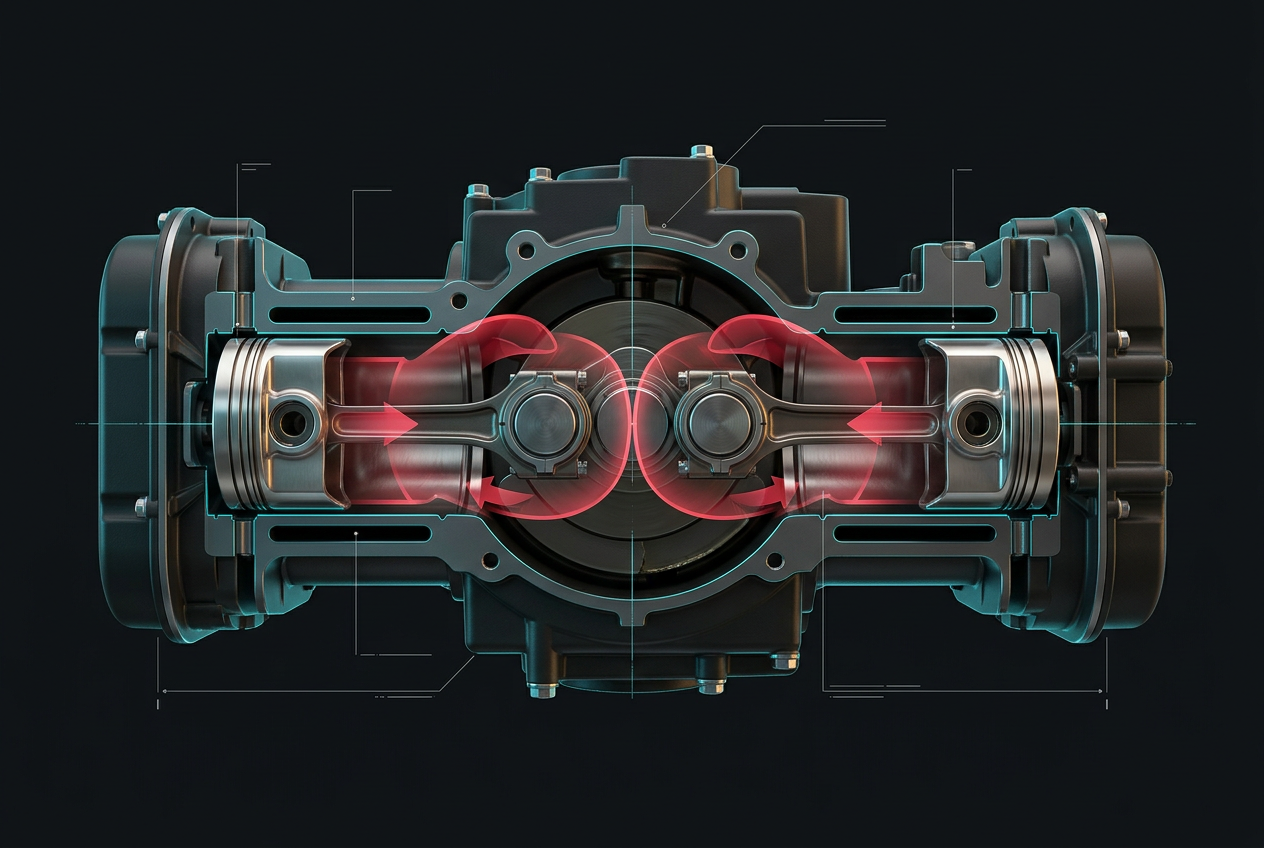
To understand the magic of a boxer engine, you have to look inside the cylinder block. In a traditional upright inline engine, pistons move vertically up and down in a single bank. In a V-engine, pistons move diagonally in two angled banks sharing common crankpins. In a true boxer engine, the cylinders lie horizontally flat, facing one another across a central crankshaft. Opposing pairs of pistons move inward and outward simultaneously along a horizontal plane.
This unique motion is precisely why the engine earned its pugilistic nickname. When you view the engine from above with its timing covers off, the opposing pistons punch toward each other and retreat in perfect synchronization—resembling a prizefighter tapping their gloves together before a round in the ring. Beyond its evocative name, this mechanical layout delivers an extraordinary advantage: cancellation of primary vibrational forces. Because opposing pistons reach top dead center (TDC) at the exact same moment on individual crankpins 180 degrees apart, their inertia forces cancel each other out naturally. There is no need for heavy, power-robbing balance shafts required by inline-four or V6 engines.
Cutaway view of a horizontally opposed boxer engine showing two pistons, connecting rods, and red movement arrows. (Representative image for illustration purposes only. Actual vehicle may vary based on trim and configuration.)
The mechanical patent for this genius configuration dates back to 1896, when legendary automotive pioneer Karl Benz patented the 'Kontra-Motor'(counter-engine). Benz recognized that laying cylinders flat offered superior balance and cooling efficiency for early motorized carriages. Over a century later, that same core mechanical principle powers every modern vehicle in the New Subaru Inventory.

Who First Developed the Boxer Engine, and When Did Subaru Adopt It?

While Karl Benz created the initial design in 1896, the first mass-market automobile to bring the boxer engine to international prominence was the original Volkswagen Beetle, designed by Ferdinand Porsche in the late 1930s. The air-cooled flat-four became world-famous for its durability, simple construction, and compact height. Post-war sports car development solidified the boxer's reputation, with Porsche adopting flat-four and flat-six engines for its racing programs and iconic 911 series.
Subaru's history with the flat engine began in 1966 with the launch of the groundbreaking Subaru 1000. Subcompact vehicles of that era suffered from heavy front-wheel vibration, harsh torque steer, and cramped cabins. Subaru engineers realized that laying a water-cooled four-cylinder engine completely flat created a perfectly symmetrical, compact powertrain layout that solved all three issues simultaneously.
The success of the Subaru 1000 laid the foundation for Subaru's defining engineering triumph: pairing the flat boxer engine directly with Symmetrical All-Wheel Drive. Because a boxer engine is short lengthwise and symmetrical along its crankshaft line, drive shafts can extend rearward and laterally with perfect structural balance. By the 1970s and 1980s, Subaru made the boxer engine the core identity of its brand architecture. Today, whether navigating winter slush along Watson Road or taking suburban road trips across Missouri, this historical commitment ensures exceptional vehicle control.
Over nearly six decades, Subaru has refined the boxer engine through generations of naturally aspirated, turbocharged, and hybrid configurations. From the rugged New Subaru Outback Inventory to the rally-bred New Subaru WRX Inventory, Subaru remains the only manufacturer in the world to equip its entire core lineup with horizontally opposed engines.

What Is the Difference Between a Porsche Boxer Engine and a Subaru Boxer Engine?

Porsche Engineering Focus

Porsche engineers flat engines tailored for high-rpm track performance and rear/mid-engine vehicle chassis layouts. Porsche utilizes exotic dry-sump oiling systems with external reservoirs to prevent oil starvation under violent lateral g-forces. Displacement ranges from 2.0L turbo flat-fours in the 718 Cayman to high-revving 4.0L atmospheric flat-sixes in the 911 GT3, prioritizing maximum horsepower per liter and premium price points.

Subaru Engineering Focus

Subaru optimizes its BOXER® engines for daily reliability, high thermal efficiency, and linear low-end torque for suburban commuting. Utilizing user-friendly wet-sump lubrication and longitudinal front mounting, Subaru engines integrate directly with Symmetrical AWD transmissions. Displacements include the 2.0L and 2.5L Subaru BOXER® four-cylinder models and the 2.4L turbocharged direct-injection engine.

Everyday Missouri Usability

While Porsche delivers track-focused luxury sports cars, Subaru democratizes boxer engineering. Drivers in Ladue, Chesterfield, and Sunset Hills enjoy rally-proven balance, exceptional winter traction, and long-term fuel efficiency in family-friendly crossovers like the New Subaru Forester Inventory and New Subaru Crosstrek Inventory.

Why Is a Boxer Engine Wider Than a V-Engine or Inline Engine?

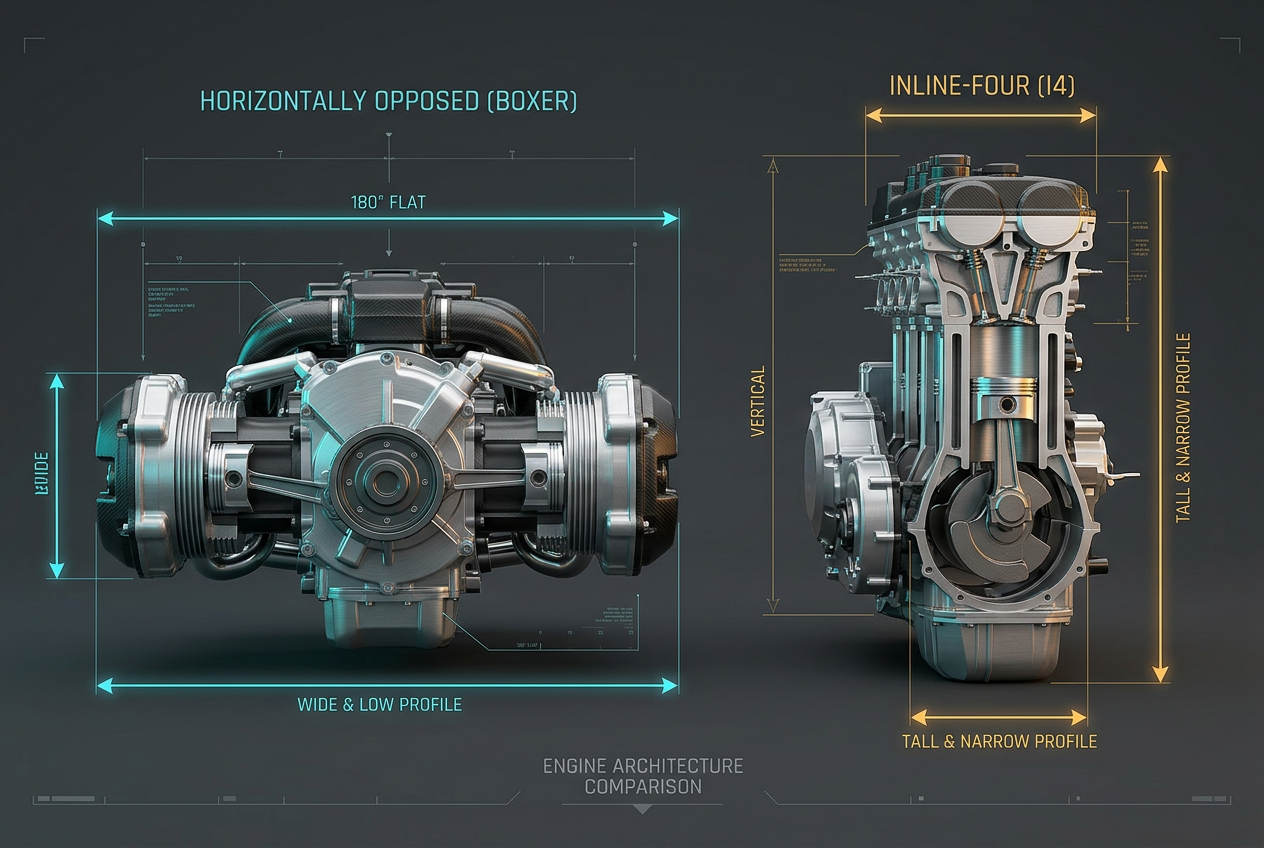
The primary physical characteristic that separates a boxer engine from upright designs is its dimensional profile. An inline-four engine stands tall and narrow. A V6 engine splits its cylinders at a 60-degree or 90-degree angle, creating a wedge shape. A boxer engine, by contrast, lays its cylinder banks completely flat at 180 degrees.
Because the cylinder heads push directly outward toward the vehicle's structural frame rails, a boxer engine occupies substantial horizontal width inside the engine compartment. For standard front-wheel-drive transverse engine vehicles (where the engine sits sideways between the front wheels), a flat engine is simply too wide to fit without severely restricting front wheel steering lock angles. mainstream automakers designing compact front-wheel-drive sedans cannot accommodate flat engines without widening the vehicle's track width significantly.
Technical rendering comparing a wide, low horizontally opposed boxer engine with a tall, narrow inline-four engine. (Representative image for illustration purposes only. Actual vehicle may vary based on trim and configuration.)
Packaging modern turbocharger plumbing, catalytic converters, and high-voltage hybrid electronics around wide cylinder heads presents additional structural challenges. Subaru overcomes this challenge by engineering dedicated longitudinal vehicle platforms where the wide boxer engine sits squarely centered between symmetrical front suspension towers.

The Financial Barrier: Why Universal Modular Platforms Favor Inline Engines

In the modern automotive industry, profitability is driven by platform modularity and manufacturing economies of scale. Major global auto groups build tens of millions of vehicles using shared engine families. The ubiquitous inline-four engine is the absolute champion of manufacturing efficiency. An inline engine requires only one cylinder head casting, one head gasket, one set of camshaft drive belts or chains, and one exhaust manifold assembly.
Building a boxer engine, on the other hand, demands duplicate componentry across the board. The table below outlines the core structural and manufacturing cost factors that make inline engines the default choice for mainstream OEMs—and highlights why Subaru's commitment to flat engine architecture represents such a significant engineering investment:

Engineering & Manufacturing Feature

Standard Inline-4 Engine

Standard V6 Engine

Subaru BOXER® Flat-4 Engine

Cylinder Head Assemblies

1 Single Head

2 Dual Heads (Angled)

2 Dual Heads (Opposed)

Camshaft Overhead Banks

1 Bank (SOHC/DOHC)

2 Banks

2 Separate Banks

Engine Center of Gravity

High Vertical Mass

Moderate Vertical Mass

Ultra-Low Horizontal Mass

Primary Rotational Balance

Requires Balance Shafts

Requires Balance Shafts

Inherent Self-Canceling Balance

Exhaust Manifold Routing

Single Side Clearance

Dual Side Clearance

Symmetrical Underside Routing

Platform Versatility

Transverse / FWD Focus

Transverse or Longitudinal

Dedicated Longitudinal AWD Platform

For high-volume manufacturers focused purely on profit margins, doubling cylinder head tooling and assembly line complexity makes flat engines financially unfeasible. Subaru, however, maintains dedicated assembly plants in Gunma, Japan, designed specifically around boxer engine production. This allows Subaru to produce flat-four engines at scale while passing the important safety and performance benefits directly to owners.

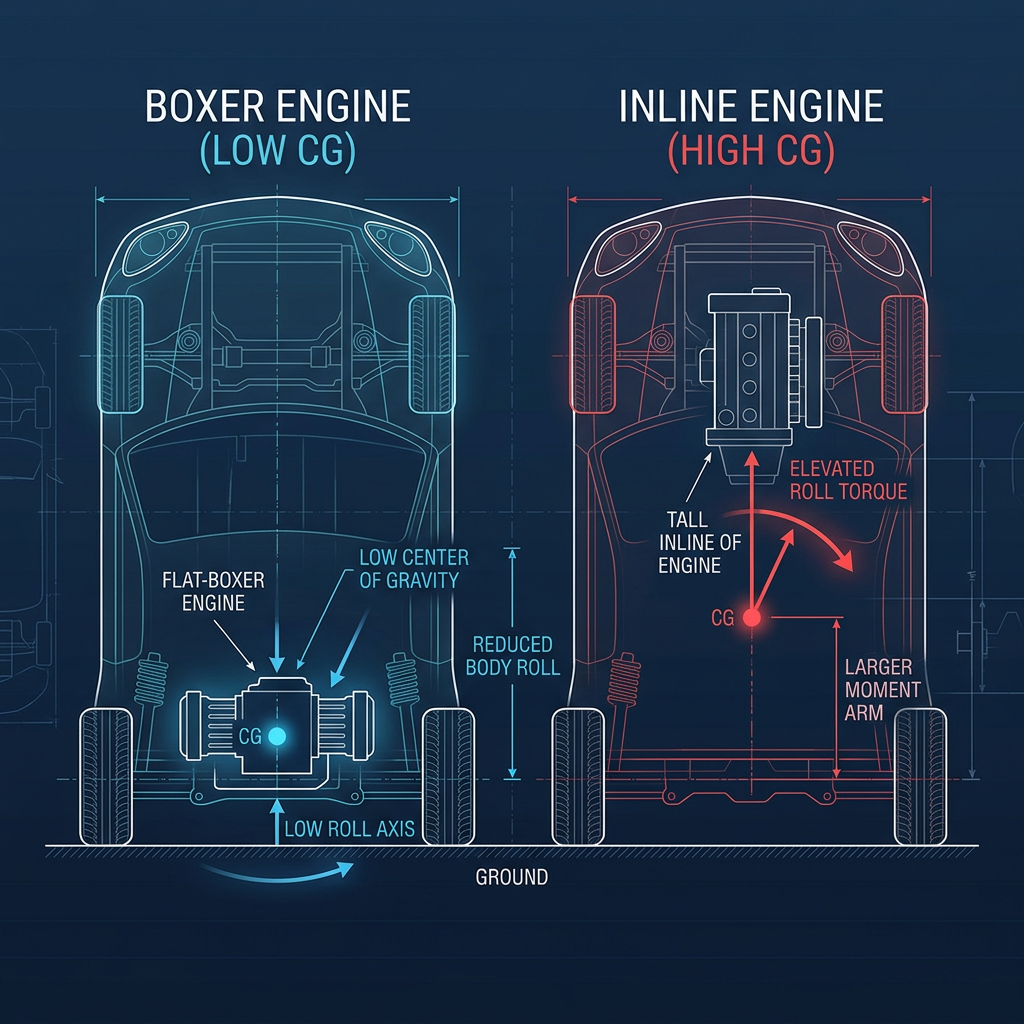
How Does a Boxer Engine Lower a Car's Center of Gravity for Drivers?

Reduced Body Roll

By placing heavy engine components—such as the engine block, pistons, and valve gear—inches lower in the chassis, the car's overall center of mass drops dramatically. When making sharp turns around Maryland Heights or navigating highway off-ramps in St. Louis, lower center of gravity minimizes lateral body lean without requiring overly stiff suspension setups.

Cornering Precision

A vehicle with a low center of gravity transfers weight across its tires far more evenly during sudden evasive maneuvers or spirited driving. Drivers experience crisp steering response, neutral cornering balance, and predictable chassis feedback on twisting backroads through Chesterfield and Sunset Hills.

Enhanced Passive Safety

Beyond handling, low engine placement offers critical crash protection. In a severe head-on collision, the low profile of the Subaru BOXER® engine allows it to slide cleanly underneath the passenger cabin floor pan rather than pushing backward into the footwell, keeping driver and passengers protected.
Diagram comparing center of gravity and body roll between a flat boxer engine and a tall inline engine layout. (Representative image for illustration purposes only. Actual vehicle may vary based on trim and configuration.)

How Much Does Spark Plug Replacement Cost on a Boxer Engine and How Is It Serviced?

One of the most frequent questions car buyers ask about flat engines involves maintenance accessibility. On a traditional inline-four engine, spark plugs sit right on top of the cylinder head, fully exposed under the engine plastic cover. Replacing them is a quick 20-minute task with standard sockets.
On a boxer engine, the cylinder heads point horizontally straight toward the inner wheel wells and frame rails. Space between the spark plug ignition coils and the frame wall is restricted to just a few inches. Changing spark plugs requires removing the air intake ducting, battery, or washer fluid reservoir, and using specialized swivel extension sockets to extract plugs at an angle.
Because spark plug replacement on a boxer engine involves additional labor steps, pricing varies by model and engine displacement; please contact our service department for current details. However, modern Subaru vehicles use long-life iridium spark plugs rated for 60,000 miles, meaning plug replacement is an infrequent scheduled maintenance item rather than an annual headache.
Having your boxer engine serviced by factory-trained technicians at certified facilities ensures proper torque specs and correct OEM plug gap tolerances. Inspect our Current Service and Parts Information before your next service appointment.

Is a Boxer Engine the Exact Same Thing as a Flat Engine, and How Does It Compare to a V-Engine?

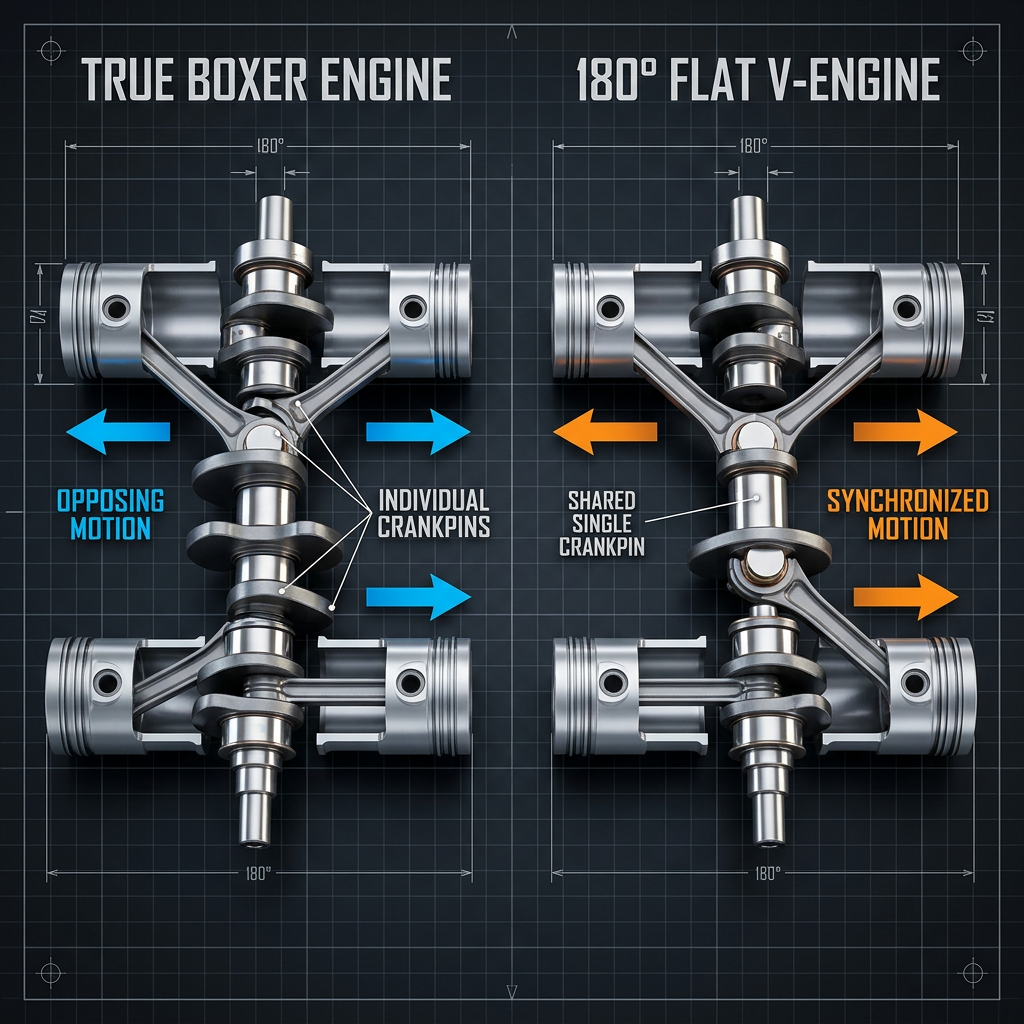
True Boxer Engine

In a true boxer engine, each opposing piston connects to its own individual crankpin on the crankshaft. Opposing pistons move simultaneously inward toward the crankshaft and outward toward the heads. This opposing push-pull motion creates perfect mechanical balance and gives Subaru engines their famous smoothness.

180° Flat V-Engine

While all boxer engines are flat engines, not all flat engines are true boxers! A 180-degree flat V-engine (such as the Ferrari Testarossa flat-12) shares a single crankpin between opposing pistons. As one piston moves left, the opposing piston moves left in the same direction, eliminating the punch-and-counterpunch motion.

Standard 60° V-Engine

Standard 60-degree V6 or 90-degree V8 engines position cylinders upright in a V shape. While compact lengthwise, V-engines have higher center-of-gravity profiles and produce secondary rocking couples, requiring heavy counterweights and external dampening shafts.
Technical diagram comparing a True Boxer Engine with individual crankpins to a 180-degree Flat V-Engine with shared crankpins. (Representative image for illustration purposes only. Actual vehicle may vary based on trim and configuration.)

Are Boxer Engines Used in Motorcycles and Specialized Aviation?

Two-Wheeled Legends: BMW & Honda

Automobiles are not the only transport segment that benefits from horizontal engines. BMW Motorrad has built world-famous flat-twin 'Boxer' motorcycles (such as the R1250GS adventure series) since 1923. Cylinder heads extending into the air stream provide exceptional natural air cooling. Honda also uses a silky-smooth flat-six boxer engine in its flagship Gold Wing touring motorcycle, placing engine weight ultra-low for effortless low-speed maneuvering.

General Aviation: Lycoming & Continental

In general aviation, flat-four and flat-six engines made by manufacturers like Lycoming and Continental power the majority of single-engine propeller aircraft (such as Cessna and Piper planes). The flat profile allows sleek aerodynamic nose cowlings, while air cooling and self-balancing design maximize operational reliability high above the clouds.

Which Automakers Currently Manufacture Cars with Boxer Engines Today?

Today, the modern boxer automotive landscape features three primary brand connections:
1. Subaru Corporation: The world's primary practitioner of boxer engineering. Subaru equips every gasoline vehicle in its portfolio with horizontally opposed engines—including the New Subaru Outback Inventory, New Subaru Forester Inventory, New Subaru Crosstrek Inventory, New Subaru Ascent Inventory, New Subaru Impreza Inventory, New Subaru WRX Inventory, and rear-wheel-drive New Subaru BRZ Inventory.
2. Porsche: Continues flat-engine manufacturing for sports cars like the 911 (flat-six) and 718 Boxster/Cayman (turbo flat-four). 3. Toyota: Offers boxer power in the GR86 sports car—a vehicle joint-developed with Subaru and powered by Subaru's 2.4-liter BOXER® engine.
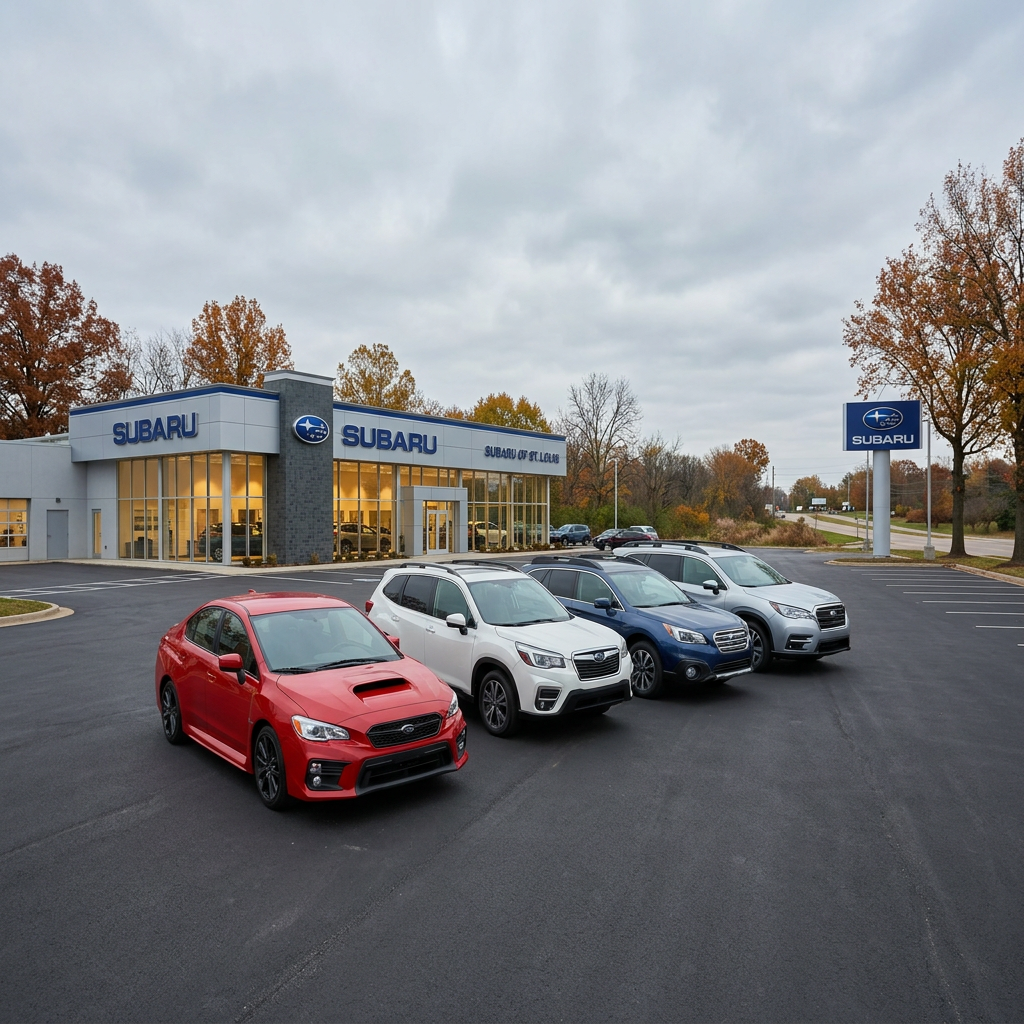
Four modern Subaru vehicles parked outside a Subaru dealership on a cloudy autumn day. (Representative image for illustration purposes only. Actual vehicle may vary based on trim and configuration.)
Interested in upgrading your daily drive around St. Louis? Discover how easily you can transition to a balanced boxer engine. Check your current vehicle value using our online tool to Get your trade-in value, or apply online to Apply for financing before visiting our showroom.

Experience the Superior Balance of a Subaru Boxer Engine at Sunset Hills Subaru

While other manufacturers shy away from flat engines due to production complexities, Subaru's decades of engineering dedication deliver unmatched tangible benefits for drivers in Sunset Hills, Maryland Heights, Chesterfield, and Ladue. From confidence-inspiring lateral stability in sudden downpours to smooth, vibration-free highway cruising across Missouri, the Subaru BOXER® engine transforms your daily commute.
Visit Sunset Hills Subaru located at 10100 Watson Rd, Sunset Hills, MO 63127. Our friendly, knowledgeable team is ready to demonstrate the unique engineering advantages of boxer engine balance in person. Get Directions to Sunset Hills Subaru or Call (314) 476-9638 to speak directly with our team.
Boxer Engine Benefits & Trade-Offs in Sunset Hills, MO | Sunset Hills Subaru
Posted in:

Related Posts

WRX

How Mileage Impacts Subaru WRX Resale Value: The Bottom Line on Depreciation

When sports car enthusiasts evaluate depreciation, the Subaru WRX consistently stands in a class of its own. While most performance compacts suffer heavy value drops during their first five years on the road, the WRX maintains exceptional residual value across the Midwest, boasting an average 5-year depreciation rate of just 35% to 42%. That means a well-maintained WRX retains nearly 60% to 65% of its initial sticker price after half a decade of real-world driving. However, mileage remains the single most influential variable affecting what buyers and dealerships are willing to pay for a used WRX. Every odometer click decreases a vehicle's monetary valuation, but the WRX curve is unique. Significant valuation changes occur at key mileage thresholds: 36,000 miles (end of the initial bumper-to-bumper warranty), 60,000 miles (expiration of factory powertrain coverage and major service milestone), and 100,000 miles (the psychological boundary for high-mileage classification). Despite these natural drops, WRX owners who maintain meticulous, documented routine service, preserve the vehicle in stock factory condition, and protect the Symmetrical All-Wheel Drive system offset high-mileage penalties far more effectively than owners of competing front-wheel-drive hot hatches. For drivers commuting along Highway 270, I-44, or Manchester Road through Chesterfield, Ladue, and St. Louis, understanding these mileage thresholds helps protect your automotive equity. Whether you plan to drive your rally-bred sedan for two years or ten, understanding how mileage interacts with vehicle history, factory warranty terms, and local market demand ensures you maximize your trade-in value when you are ready for your next vehicle at Sunset Hills Subaru. Mileage Tiers and Price Drops: What Every 10,000 Miles Costs a WRX Owner Low Mileage & Warranty Thresholds (0 to 60,000 Miles) Under 30,000 Miles (Prime Value Bracket): WRX models in this bracket command top tier pricing on the pre-owned market. Having full factory 3-year/36,000-mile bumper-to-bumper warranty remaining makes these units highly desirable to buyers seeking new car peace of mind without new car MSRP. Depreciation is minimal, typically dropping only 12% to 18% from original purchase price. 30,000 to 60,000 Miles (Powertrain Warranty Safety Zone): Crossing the 36,000-mile mark triggers a minor market adjustment as basic warranty coverage expires. However, because Subaru protects the engine and Symmetrical AWD under the 5-year/60,000-mile factory powertrain warranty, demand remains strong. Suburb commuters in Chesterfield and St. Louis trading in at this stage retain roughly 68% to 75% of original MSRP. Mid to High Mileage Tiers (60,000 to 100,000+ Miles) 60,000 to 100,000 Miles (Out-of-Warranty Transition): At 60,000 miles, powertrain warranty coverage ends and major routine service items (spark plugs, differential flushes, brake fluid) become due. This threshold typically causes a 10% to 15% valuation adjustment. However, documented factory maintenance at a dealer protects market value far better than average market trends. 100,000+ Miles (Enthusiast & High Mileage Market): Crossing six figures on the odometer reduces valuation, but the WRX maintains a passionate secondary market. Enthusiasts seeking affordable AWD performance actively buy clean, unmodded 100k+ mile WRXs. Well cared for examples still sell for 35% to 45% of original sticker, outperforming segment peers. Mileage Bracket Warranty Status Est. Residual Value % Key Valuation Factors 0 - 30,000 Miles Full Factory Warranty 82% - 88% Pristine condition, minimal wear, near-new trade value 30,000 - 60,000 Miles Powertrain Warranty Active 68% - 75% 36k warranty transition, minor tire/brake wear factor 60,000 - 100,000 Miles Out of Factory Warranty 50% - 62% Service records crucial; spark plug & fluid service history 100,000+ Miles Out of Warranty 35% - 45% Strong enthusiast demand; unmodded status commands premium Does the Subaru WRX Hold Its Value Better Than Competitors Like the Golf GTI? Subaru WRX 5-Yr Retained Value: 58% - 65% Standard Symmetrical All-Wheel Drive gives the WRX an undeniable resale advantage in Midwest markets like St. Louis. Year-round weather capability keeps pre-owned demand exceptionally consistent regardless of gas price fluctuations. VW Golf GTI 5-Yr Retained Value: 48% - 54% While refined, the front-wheel-drive Volkswagen Golf GTI suffers steeper depreciation. Higher ongoing European maintenance costs and lack of standard AWD reduce secondary market appetite in snow belt regions. Civic Si & Elantra N 5-Yr Retained Value: 50% - 57% The Honda Civic Si holds strong resale thanks to Honda brand reliability, but lacks AWD traction. The Hyundai Elantra N offers performance but experiences aggressive early year depreciation. Independent industry residual value studies consistently rank the Subaru WRX among the top sports compact cars for value retention. In the St. Louis metropolitan region, severe winter weather, changing road conditions, and hilly terrain in neighborhoods around Ladue and Sunset Hills fuel strong demand for pre-owned all-wheel-drive performance sedans. When comparing 5-year total ownership costs, higher WRX residual values frequently offset fuel expenses, giving WRX owners a lower overall cost to own than Golf GTI or Hyundai Elantra N drivers. What Is Your WRX Worth Today? Get an Instant Trade-In Valuation Curious how your current mileage, vehicle history, and local market demand affect your WRX's market value? At Sunset Hills Subaru, our appraisal experts analyze real-time St. Louis market transactions to offer top dollar for clean pre-owned WRX models. Whether you have 15,000 miles or 115,000 miles, find out what your vehicle is worth in minutes. Get Your Trade-In Value Online Are Manual Transmission Subaru WRXs Worth More on the Used Market? 6-Speed Manual Transmission Demand In the sports compact segment, manual transmissions have become increasingly rare. Approximately 75% to 80% of new WRX buyers opt for the 6-speed manual transmission. On the secondary market in enthusiast hubs across Maryland Heights and Ladue, 6-speed manual models may command a higher resale value over automatic models with similar mileage. Manual WRXs appeal to driving purists who value engagement, mechanical simplicity, and lower long-term transmission rebuild costs as odometers pass 100,000 miles. Subaru Performance Transmission (SPT) The Subaru Performance Transmission (SPT automatic/CVT) brings distinct advantages that appeal to daily commuters. Featuring paddle shifters, faster upshifts, and full integration with standard Subaru EyeSight Driver Assist Technology, automatic models attract buyers seeking performance paired with stress-free traffic handling along I-64 and Watson Road. While automatic WRX models experience slightly higher initial depreciation, clean lower-mileage units remain highly sought after by urban buyers. Stock vs. Modified: How Aftermarket Tuning Impacts High-Mileage WRX Values The Unmodded Stock Premium Among pre-owned automotive appraisers, an unmodded, factory-original Subaru WRX is referred to as a 'unicorn.' Because many WRX owners add performance parts, clean stock vehicles command top dollar regardless of odometer mileage. Buyers know an unmodified car has likely not been subjected to excessive engine boost pressure, aggressive launch control, or poor custom tuning. Keeping your WRX in 100% stock mechanical condition is the single most effective way to preserve trade-in value as mileage accumulates over 60,000 miles. The Modification Depreciation Penalty While aftermarket upgrades like ECU reflash tunes, downpipes, cold air intakes, and lowered coilover suspensions cost thousands to install, they almost universally reduce trade-in value by 15% to 30%. Dealerships and certified pre-owned buyers view heavy modifications as red flags for accelerated powertrain stress. Additionally, ECU tunes can void remaining factory powertrain warranties. If you do modify your WRX, keep all original factory parts so you can return the car to stock before valuation. What Engine and Drivetrain Specs Keep High-Mileage WRXs Running Strong? 2.4L Turbo Subaru BOXER The 2.4-liter turbocharged Subaru BOXER (FA24) engine features horizontally opposed pistons. This design creates a low center of gravity, reduces vibration, and delivers 271 horsepower and 258 lb-ft of torque. Increased displacement over prior generations reduces engine strain at highway speeds, promoting long-term reliability well past 100,000 miles. Twin-Scroll Turbo Systems Featuring an electronic wastegate and twin-scroll turbocharger layout, the WRX engine delivers near-instantaneous boost response starting low in the RPM band. Robust oil cooling passages and advanced thermal management prevent oil breakdown, ensuring turbo housing and bearing longevity across years of suburban driving. Symmetrical AWD System Unlike reactive slip-and-grip systems found in competitors, Subaru Symmetrical All-Wheel Drive distributes power continuously to all four wheels. Center differentials and active torque vectoring maintain traction while protecting drivetrain components from uneven mechanical wear. Protect Your WRX Resale Value with Certified Subaru Service in Sunset Hills The single best defense against high-mileage depreciation is a documented history of factory-certified service. Routine oil changes, tire rotations, brake fluid flushes, and differential maintenance performed by factory-trained technicians automatically upload to your vehicle history report, proving to future buyers that your WRX was cared for with genuine OEM Subaru parts. Schedule Certified WRX Maintenance Subaru WRX Maintenance Cost, Service Intervals, and 5-Year Ownership Expenses Calculating the total cost of owning a sports sedan involves far more than your monthly car payment. Over a 5-year driving period in St. Louis (assuming 12,000 to 15,000 miles driven annually), routine maintenance, insurance, fuel, and service intervals directly influence your overall financial outcome. When compared against European competitors like the Volkswagen Golf GTI, the WRX delivers impressive long-term value. Ownership Expense Category (5-Year / 60k Miles) Subaru WRX (2.4L Turbo AWD) VW Golf GTI (2.0L Turbo FWD) Estimated 5-Year Maintenance Budget $2,450 - $2,950 $3,400 - $4,100 Synthetic Oil Change Interval Every 6,000 miles / 6 months Every 10,000 miles / 12 months Spark Plug Replacement Milestone 60,000 miles 80,000 miles Differential & AWD Fluid Services Front/Rear diff flushes at 30k & 60k Front differential fluid service Estimated Annual Fuel Cost (15k mi/yr) estimated to vary by driving habits and service history (Req Premium 91+) estimated to vary by driving habits and service history (Req Premium 91+) Est. Annual Insurance Premium (St. Louis) $1,650 - $2,100 / year $1,550 - $1,950 / year WRX Maintenance Advantage Subaru replacement parts, filters, and fluid specifications are widely available and often more affordable than some European import parts. Routine 6,000-mile synthetic oil service keeps the FA24 turbocharger lubricated while keeping annual upkeep budgets reasonable for St. Louis drivers. Golf GTI Maintenance Overhead While the Golf GTI offers slightly higher fuel efficiency, European specialty labor rates and higher component costs (such as dual-clutch transmission fluid flushes and electronic sensor replacements) increase 5-year maintenance budgets more than the WRX. Which Car Offers Better Winter Driving Capability for St. Louis Drivers? WRX Symmetrical AWD Standard continuous all-wheel drive routes engine torque to all four wheels simultaneously. On icy hills in Chesterfield or slush-covered roads in Ladue during Missouri winter storms, the WRX delivers unmatched acceleration traction, vehicle stability, and confidence. Front-Wheel Drive Rivals Front-wheel drive competitors like the Golf GTI and Honda Civic Si rely on front tire traction for both steering and propulsion. In heavy Midwest snowfall, front wheels struggle for grip on inclines, requiring winter tires to match basic AWD capability. Resale Value Impact Because winter driving capability is a top priority for Midwest car buyers, pre-owned AWD vehicles sell faster and retain higher trade-in values. Used car buyers willingly pay a premium for high-mileage WRXs knowing they provide reliable year-round transportation. Starting Price, Factory Warranty Coverage, and Total 5-Year Ownership Costs When evaluating entry pricing, factory warranty protection, and overall cost to own, the Subaru WRX presents a compelling financial argument for performance-minded buyers in St. Louis and Sunset Hills. Subaru WRX Package • Starting MSRP Range: ~$32,700 - $41,500 (Base to GT / TR Trims) • Basic Warranty: 3 Years / 36,000 Miles • Powertrain Warranty: 5 Years / 60,000 Miles • Corrosion Perforation: 5 Years / Unlimited Miles • 24/7 Roadside Assistance: 3 Years / 36,000 Miles • 5-Year Retained Equity: ~58% - 65% of original price VW Golf GTI Package • Starting MSRP Range: ~$31,900 - $40,500 (S to Autobahn Trims) • Basic Warranty: 4 Years / 50,000 Miles • Powertrain Warranty: 4 Years / 50,000 Miles • Corrosion Perforation: 7 Years / 100,000 Miles • 24/7 Roadside Assistance: 3 Years / 36,000 Miles • 5-Year Retained Equity: ~48% - 54% of original price Which Service Intervals Should WRX Owners in Sunset Hills Follow? To preserve maximum trade-in value and ensure long-term mechanical reliability, follow this factory-recommended maintenance plan at Sunset Hills Subaru. Keeping precise electronic records through our certified service department gives future buyers complete confidence. Interval Milestone Core Maintenance Services Resale Impact 6,000 Miles / 6 Months Full synthetic oil & filter change, tire rotation, multi-point inspection Establishes clean vehicle history log 12,000 Miles / 12 Months Oil service, tire rotation, cabin air filter replacement, brake pad inspection Maintains tire wear and air quality records 30,000 Miles / 30 Months Engine air filter, brake fluid replacement, front & rear differential fluid inspection Critical milestone for mid-life warranty valuation 60,000 Miles / 60 Months Spark plug replacement, differential fluid flush, transmission fluid service, coolant inspection Protects powertrain health past factory warranty View Current Service and Parts Specials Explore Pre-Owned WRX Inventory or Value Your Trade at Sunset Hills Subaru Whether you are looking to purchase a new rally-bred WRX, trade in your current high-mileage vehicle, or schedule routine maintenance to protect your car's resale value, Sunset Hills Subaru is your trusted St. Louis area resource. Conveniently located at 10100 Watson Rd, Sunset Hills, MO 63127, our dealership provides expert appraisals, factory-trained technicians, and an extensive lineup of new and certified pre-owned Subaru vehicles. Ready to experience the performance and strong resale value retention of the Subaru WRX for yourself? Contact our team today at (314) 476-9638 or click below to explore our current inventory. Browse New Subaru WRX Inventory Subaru WRX Resale Value Insights in Sunset Hills MO | Sunset Hills Subaru

2025 Subaru Legacy

Which Midsize Sedan Retains Higher Resale Value After 5 Years?

Which Midsize Sedan Retains Higher Resale Value After 5 Years? When purchasing a midsize sedan, initial purchase price and fuel efficiency are only part of the financial equation. The true cost of vehicle ownership is heavily dictated by five-year depreciation—the difference between what you pay today and what the car is worth when you trade it in or sell it half a decade down the road. According to long-term automotive residual data from ALG (Automotive Lease Guide) and Kelley Blue Book (KBB), the Subaru Legacy compares favorably with midsize competitors like the Toyota Camry, Honda Accord, and Nissan Altima in retaining its original value over a five-year horizon. While the Camry and Accord have long maintained reputations for reliability, the Subaru Legacy holds a unique financial advantage in suburban markets like St. Louis and Chesterfield. Standard Symmetrical All-Wheel Drive (AWD), exceptional safety scores from the IIHS, and demonstrably lower average repair costs over time elevate secondhand demand. When winter weather hits Eastern Missouri, pre-owned buyers actively seek out all-weather sedans, directly insulating Legacy trade-in equity against steep market drops. Whether you plan to finance a new sedan or lease for three to five years, choosing a vehicle with industry-leading resale retention preserves thousands of dollars in equity. Explore our current New Subaru Legacy Inventory to discover how engineering excellence translates directly into long-term financial smarts. Explore New Subaru Legacy Inventory 5-Year Midsize Sedan Depreciation Comparison: Subaru Legacy vs. Camry, Accord, and Altima To understand why the Subaru Legacy dominates five-year value retention, it helps to examine empirical residual figures across the midsize segment. Depreciation accounts for nearly 40% to 50% of total five-year vehicle ownership expenses. A sedan that retains even 5% to 8% more of its sticker price after 60 months puts thousands of dollars back into your wallet when it is time to upgrade. Midsize Sedan Model Standard Drivetrain Est. 5-Year Retained Value % 5-Year Depreciation Loss (on $30k MSRP) Regional Used Demand (MO) Subaru Legacy Symmetrical AWD 54.5% - 57.2% ~$12,840 Very High (AWD Premium) Toyota Camry Front-Wheel Drive (FWD) 51.0% - 53.8% ~$14,100 High Honda Accord Front-Wheel Drive (FWD) 50.2% - 52.5% ~$14,490 High Nissan Altima Front-Wheel Drive (FWD) 42.0% - 45.1% ~$16,800 Moderate Why Retained Equity Matters in St. Louis Initial purchase price is only the starting point. Midsize sedans equipped with standard Front-Wheel Drive often experience steeper value cliffs once they reach 60,000 to 80,000 miles. In Missouri, where seasonal transitions bring freezing rain, slush, and heavy summer downpours, pre-owned buyers specifically search out All-Wheel Drive models. Because standard AWD is built into every Subaru Legacy (excluding specific niche specs), second-hand buyers are willing to pay a premium. This elevated demand keeps trade-in valuations remarkably high at dealerships across Sunset Hills and Ladue. When balancing your initial price tag against retained trade-in equity, the Legacy regularly proves to be the most financially prudent choice in its class. Furthermore, Subaru's controlled production volumes prevent market saturation. Unlike fleet-heavy sedans like the Nissan Altima, the Legacy maintains tighter pre-owned inventory supplies, ensuring used car managers offer top dollar when you decide to upgrade. How Symmetrical All-Wheel Drive and Safety Ratings Protect Legacy Resale Value Symmetrical AWD Engineering Unlike slip-and-grip AWD systems found in competing vehicles that only engage rear wheels after traction is lost, Subaru Symmetrical All-Wheel Drive actively routes power continuously to all four wheels. Placed along the vehicle's centerline, this balanced powertrain provides exceptional stability, preventing mechanical wear and tear associated with abrupt torque shifts and maintaining long-term hardware durability. Top Safety Pick+ Legacy Safety credentials heavily dictate pre-owned vehicle desirability. The Subaru Legacy consistently earns the Insurance Institute for Highway Safety (IIHS) Top Safety Pick+ rating—the industry standard for crashworthiness. Engineered with Subaru’s Global Platform and Ring-Shaped Reinforcement Frame, the Legacy protects occupants through advanced crumple zones and rigid cabin structural integrity. Pre-Owned Market Impact When family buyers and daily commuters search the used market, safety and all-weather traction are non-negotiable priorities. Secondhand shoppers willingly pay higher market rates for a vehicle with proven structural safety records and year-round confidence. This structural confidence creates a resilient floor for trade-in values at five years. What Driver Assistance and Safety Systems Come Standard on the Subaru Legacy? Every modern Subaru Legacy comes standard with Subaru EyeSight Driver Assist Technology, a suite of advanced active safety systems that act like an extra pair of eyes on the road. Unlike competitor sedans that locked these features behind expensive trim upgrades in earlier model years, Subaru democratized active safety across the entire Legacy lineup. Standard EyeSight capabilities include: • Pre-Collision Braking System: Applies full braking force in emergency situations to prevent or mitigate frontal impacts. • Advanced Adaptive Cruise Control with Lane Centering: Maintains preset distances from traffic while keeping the sedan centered in its lane on highways like I-64 and I-270. • Lane Departure and Sway Warning: Monitors lane markings and alerts drivers if the vehicle drifts unintentionally. • Pre-Collision Throttle Management: Cuts power if an obstacle is detected directly ahead to prevent accidental acceleration. By drastically reducing minor fender benders and severe collisions, standard EyeSight technology helps maintain clean Vehicle History Reports (CARFAX). A used sedan with a clean, collision-free history commands significantly higher trade-in values after 5 years. Pre-owned buyers prioritize modern safety tech. Knowing that a 5-year-old Legacy carries the exact same core active safety hardware as brand-new models makes pre-owned Legacy inventory highly sought after across Missouri. Browse New Subaru Inventory Understanding Total Cost of Ownership: Subaru Legacy Maintenance Costs vs. Resale Gain Evaluating vehicle economics strictly by initial cost misses the bigger picture. True financial intelligence lies in calculating total cost of ownership (TCO)—balancing routine maintenance costs against five-year retained equity. A car with slightly higher routine service requirements can easily yield superior net wealth if its depreciation curve is dramatically flatter. Over a 5-year or 60,000-mile period, average Subaru Legacy maintenance costs range between $1,800 and $2,400 total (roughly $360 to $480 per year for standard scheduled servicing). While all-wheel drive models require differential fluid checks and balanced tire wear, the Legacy’s unexpected repair frequency is statistically lower than the overall industry average. Because major powertrain failures are rare when factory guidelines are met, Legacy owners avoid costly out-of-pocket mechanical repairs. When you combine low unexpected maintenance expenses with a 54%+ 5-year residual value retention, the net cost of owning a Legacy is significantly lower than owning FWD competitors that depreciate by 50% to 58% over the same timeframe. Ownership Expense Category Subaru Legacy (5-Year Est.) Average FWD Midsize Sedan Financial Advantage 5-Year Maintenance & Servicing $2,100 $1,950 -$150 (AWD Fluid/Tires) 5-Year Unexpected Repairs $650 $1,100 +$450 (High Build Reliability) 5-Year Retained Equity ($30k vehicle) $16,800 $14,100 +$2,700 (Flatter Depreciation) Net Financial Impact +$14,050 Retained Value +$11,050 Retained Value +$3,000 Legacy Advantage Recommended Subaru Legacy Maintenance Schedule and DIY Care Tips Factory Intervals Subaru recommends routine maintenance every 6,000 miles or 6 months (whichever comes first). Key milestones include: • 6,000 Miles: Synthetic oil change, tire rotation, safety inspection. • 12,000 Miles: Cabin air filter replacement, brake system check. • 30,000 Miles: Engine air filter, brake fluid flush, inspection of AWD differential fluids. • 60,000 Miles: Spark plug replacement (BOXER engine service) and transmission fluid inspection. 0W-20 Synthetic Oil What motor oil weight is recommended for the Subaru Legacy? Standard naturally aspirated 2.5L BOXER engines require 0W-20 synthetic motor oil. Synthetic oil optimizes cold-weather startup lubrication during Missouri winters and reduces internal friction. DIY vs. Dealer Care Can basic maintenance on a Subaru Legacy be performed at home? Yes! Budget-conscious owners can easily replace cabin air filters, engine air filters, wiper blades, and check fluid levels. However, spark plug swaps on horizontal BOXER engines and EyeSight recalibrations require specialized dealer tools best handled at factory service centers. What Do Routine and Major Subaru Legacy Services Cost Around Sunset Hills, Missouri? Understanding routine service pricing around St. Louis helps owners budget effectively. Around Sunset Hills, MO, typical dealership service costs align with the following ranges: • Standard Minor Service (6k / 18k / 24k miles): $85 - $130 (Includes synthetic oil, OEM filter, tire rotation, and multi-point inspection). • 30,000-Mile Major Service: $350 - $490 (Includes engine/cabin filters, brake fluid exchange, differential inspection, and fuel system service). • 60,000-Mile Major Service: $650 - $890 (Adds spark plug replacement, complete brake fluid flush, and transmission fluid diagnostics). • 90,000-Mile Service: $450 - $650 (Covers comprehensive fluid exchanges, belt inspection, and mechanical diagnostics). Does the Subaru factory warranty cover routine maintenance costs? The standard Subaru 3-year/36,000-mile bumper-to-bumper warranty and 5-year/60,000-mile powertrain warranty cover manufacturing defects and mechanical repairs, but do not cover wear-and-tear routine maintenance like oil changes or brake pads. However, completing scheduled maintenance at authorized facilities ensures full warranty protection without claim disputes. Why Dealer Maintenance Records Boost Resale Equity When trading in your sedan at Sunset Hills Subaru, having a clean, digital maintenance history logged through factory-certified service departments adds tangible value. Pre-owned vehicle buyers pay top dollar for vehicles with documented OEM upkeep. Be sure to review our Current Service and Parts Information before booking your appointment to maximize savings on routine care. Schedule Service and Diagnostics Why All-Wheel Drive and CVT Fluid Service Intervals Impact Long-Term Expenses Why All-Wheel Drive Increases Long-Term Expenses Slightly Operating a continuously engaged Symmetrical AWD system adds minor service requirements compared to simple FWD layouts. Front and rear differentials require gear oil inspections and drain/fills roughly every 30,000 to 60,000 miles. Additionally, because Subaru’s AWD system relies on identical wheel rotation speeds, tire tread depths must match within 2/32nds of an inch across all four tires. Uneven tire wear can strain the central transfer clutch, making routine tire rotations crucial. CVT Fluid Service Requirements How often does a Subaru Legacy Lineartronic Continuously Variable Transmission (CVT) require fluid service? Subaru officially considers CVT fluid a 'lifetime' fill under normal driving conditions, but factory technicians strongly advise inspecting CVT fluid every 30,000 miles and performing a complete fluid drain/fill every 60,000 to 90,000 miles—especially under 'severe' driving conditions such as frequent stop-and-go commuting around St. Louis or towing. Proactive CVT fluid changes preserve transmission shift performance, protect internal steel chains, and prevent catastrophic repair costs down the road. Common Repairs, EyeSight Recalibration, and Legacy XT Fuel Requirements Most Common Repairs What are the most common repair costs for a Subaru Legacy beyond 80,000 miles? Typical maintenance items include wheel bearing replacements ($350-$500 per hub), front lower control arm bushings ($300-$450), and brake rotor replacement ($400-$600 per axle). Engine components like timing chains in modern BOXER engines are designed to last the full vehicle lifespan. EyeSight Recalibration Does Subaru EyeSight recalibration increase windshield replacement costs? Yes. Replacing a windshield on an EyeSight-equipped Legacy requires precision optical recalibration of the dual stereo cameras ($250-$450 fee). However, most auto insurance policies cover this under glass coverage, and factory recalibration ensures active safety features function accurately. Legacy XT Fuel Specs Does the turbocharged Subaru Legacy XT require premium fuel? No! The 2.4L Turbocharged Subaru BOXER engine (260 hp) is engineered to run efficiently on 87-octane regular unleaded gasoline. You enjoy sports-sedan acceleration without being forced to pay premium fuel prices at St. Louis gas pumps. Why Chesterfield and Ladue Commuters Choose the Legacy for Suburban Reliability Daily commuting across the St. Louis metropolitan area presents diverse challenges—from tight merges on Highway 141 to winter snow accumulation along I-64 and I-270. Drivers from Chesterfield, Ladue, Maryland Heights, and Kirkwood choose the Subaru Legacy because it blends midsize sedan luxury with robust foul-weather capability. Inside, the Legacy boasts acoustic windshield glass, whisper-quiet cabin insulation, and standard Apple CarPlay / Android Auto integration. Unlike bulky SUVs that sacrifice highway fuel economy, the Legacy delivers up to 35 MPG highway while maintaining unwavering all-wheel drive traction. When local drivers are ready to transition into a new car after five years, the strong regional reputation of Subaru in St. Louis County means certified dealerships and private buyers alike compete for pre-owned Legacy stock. Protecting your resale equity begins with choosing a car built for Missouri roads. Get Your Trade-In Value Practical Checklist to Maximize Your Sedan's Trade-In Value After 5 Years To guarantee your Subaru Legacy commands top-tier residual pricing when it comes time to sell or trade, follow these five actionable steps throughout your ownership term: 1. Maintain Detailed Maintenance Records: Organize digital or physical receipts for every oil change, brake service, and tire rotation. Comprehensive service logs prove diligent ownership to dealership appraisers. 2. Demand Genuine Subaru OEM Parts: Insist on genuine Subaru filters, fluids, and brake pads during routine maintenance to protect factory mechanical standards. 3. Protect Interior Upholstery: Utilize floor mats, clean leather conditioning products, and fix small spills immediately to prevent permanent stains or sun fading. 4. Address Minor Body Blemishes Promptly: Fix small paint chips or dented door dings early to prevent rust formation in humid Missouri summers. 5. Utilize Online Appraisal Tools Early: Before walking into a showroom, use an instant online appraisal tool to establish a firm baseline valuation for your vehicle. Value Your Trade and Explore Legacy Inventory at Sunset Hills Subaru Ready to experience how the Subaru Legacy combines strong 5-year resale value retention, confident all-weather stability, and premium comfort? The team at Sunset Hills Subaru is here to assist you through every step of your automotive journey. Whether you are looking to appraise your current vehicle using our Get your value trade portal, explore competitive auto financing options with our experts via Get approved for financing, or test drive a new Legacy, we deliver an uncompromised dealership experience. Visit us today at 10100 Watson Rd, Sunset Hills, MO 63127 or reach our friendly sales team directly by phone at Call (314) 476-9638. Conveniently located just off I-270, we are proud to serve drivers from St. Louis, Chesterfield, Ladue, and beyond. Click to Get Directions to Sunset Hills Subaru and discover the Subaru difference! Subaru Legacy Resale Value in Sunset Hills MO | Sunset Hills Subaru
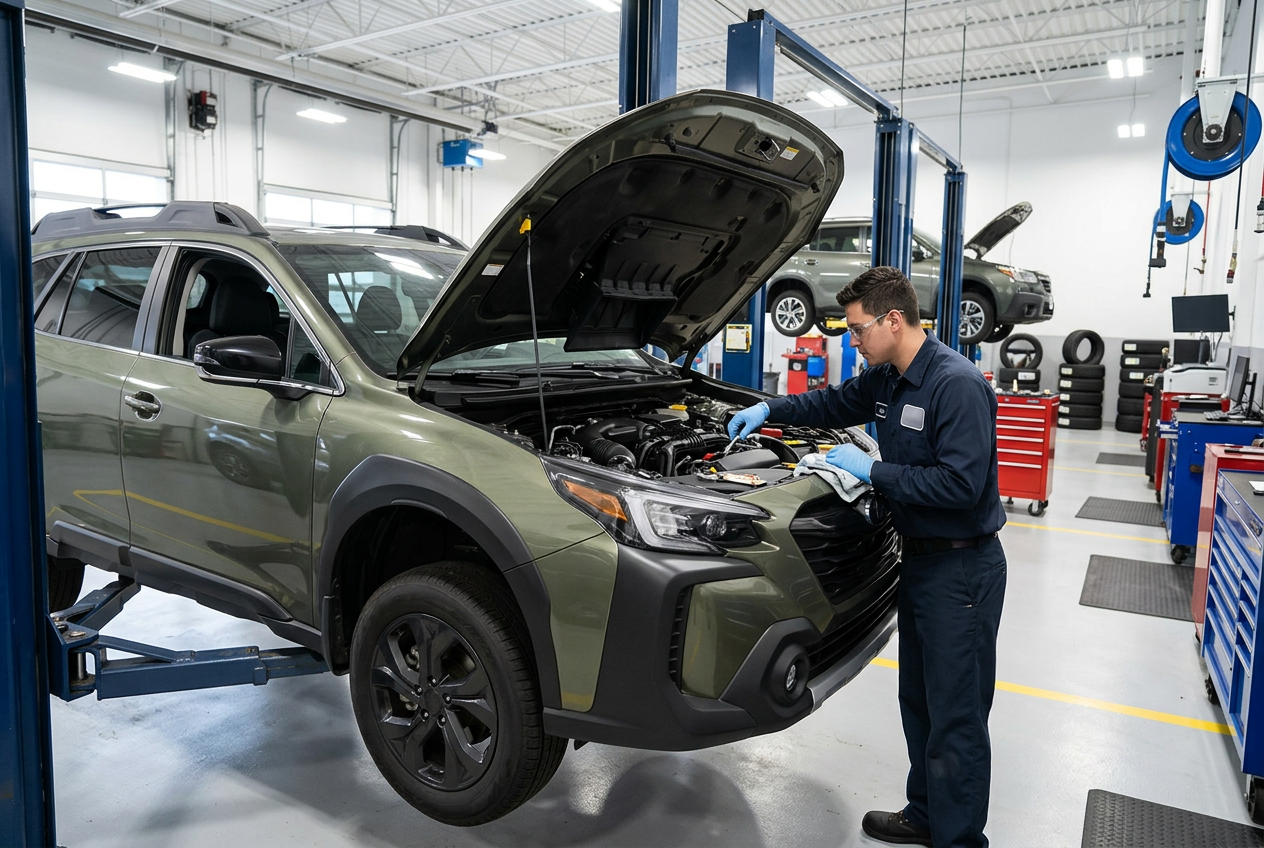
tech looking at Subaru outback

Subaru Outback Oil Change Cost: What to Expect at the Dealership

If you are planning your vehicle's regular maintenance routine, a essential question is: How much does a routine oil change cost for a Subaru Outback? At Sunset Hills Subaru in Sunset Hills, Missouri, a routine synthetic oil change for a Subaru Outback typically ranges between $75 and $150. This comprehensive service includes premium Genuine Subaru 0W-20 synthetic oil specifically formulated for Subaru BOXER® engines, an OEM high-filtration oil filter replacement, a brand-new drain plug crush washer to ensure a leak-free seal, and a complementary multi-point safety inspection performed by factory-certified technicians. Exact costs can vary slightly based on the specific Outback powertrain equipped under your hood. Standard Outback trims powered by the naturally aspirated 2.5-liter Subaru BOXER® 4-cylinder engine generally sit at the lower end of the range ($75 to $95), requiring 4.4 quarts of 0W-20 full synthetic oil. Upper trim levels—such as the Outback XT and Outback Wilderness equipped with the turbocharged 2.4-liter Subaru BOXER® engine—require 4.8 quarts of synthetic oil and dedicated heavy-duty filter elements, placing service near $95 to $120. View Current Service & Parts Specials How Often Should a Subaru Outback Receive an Oil Change? Subaru officially recommends a routine oil change interval of 6,000 miles or 6 months, whichever comes first, under normal driving conditions. Adhering to this timeframe maintains optimal viscosity, prevents harmful sludge accumulation inside internal engine galleries, and protects precision timing chain assemblies. However, drivers commuting throughout Greater St. Louis, Chesterfield, and Maryland Heights frequently experience driving scenarios that fall under Subaru's Severe Driving Schedule. Severe driving conditions include repeated short trips under 5 miles, extended engine idling in traffic, frequent cold-weather starts during Missouri winters, or driving on dusty gravel trails. Under severe conditions, Subaru recommends shortening oil change intervals to 3,000 to 5,000 miles or every 3 to 4 months. Frequent oil refreshes combat moisture accumulation and fuel dilution, safeguarding long-term BOXER engine health. Synthetic vs. Conventional: Why Subaru Outback Oil Changes Cost What They Do Modern Subaru BOXER® engines utilize ultra-low viscosity 0W-20 full synthetic oil engineered for rapid lubrication during cold engine ignition and maximum heat dispersion under heavy loads. Unlike older engines that ran on conventional oil, boxer engines position cylinders horizontally. Full synthetic oil provides continuous oil film strength across horizontal cylinder walls, preventing dry starts and internal friction. While quick-lube drive-thru outlets may advertise introductory pricing, they frequently use non-OEM generic oil filters lacking mandatory internal bypass valve pressure settings. Genuine Subaru top-mounted oil filters incorporate precise spring-loaded bypass valves (rated at 23 PSI) to maintain steady oil flow even under freezing conditions. Why Choose Dealership Service at Sunset Hills Subaru? • Factory-Trained Technicians: Master technicians who specialize exclusively in Subaru Boxer engines, Symmetrical AWD, and Lineartronic CVTs. • Genuine OEM Components: Factory-approved 0W-20 synthetic fluid and high-efficiency filters designed specifically for your vehicle. • Multi-Point Inspection: Complete health check of brake pad wear, tire tread depth, suspension bushings, battery health, and fluid levels. What Are the Local Estimated Subaru Outback Maintenance Costs Through 36,000 Miles Near Sunset Hills, Missouri? For vehicle owners living around Sunset Hills, Ladue, Kirkwood, and South St. Louis County, managing routine automotive upkeep is simple and predictable. During the first 3 years or 36,000 miles of vehicle ownership, standard maintenance expenses for a Subaru Outback typically average between $350 and $550 per year ($1,050 to $1,650 total cumulative). Year 1 (0 – 12,000 Miles) • 6,000-Mile Service: Synthetic Oil & Filter + Tire Rotation (contact us for current pricing) • 12,000-Mile Service: Synthetic Oil Change, Tire Rotation, Cabin Air Filter Replacement ($160 - $210) Estimated Year 1 Total: $270 - $350 Year 2 (12,001 – 24,000 Miles) • 18,000-Mile Service: Synthetic Oil & Filter + Tire Rotation (contact us for current pricing) • 24,000-Mile Service: Synthetic Oil Change, Engine Air Filter, Cabin Filter, Brake System Check ($220 - $280) Estimated Year 2 Total: $330 - $420 Year 3 (24,001 – 36,000 Miles) • 30,000-Mile Major Service: Synthetic Oil, Brake Fluid Flush, Tire Rotation, Air Filters, AWD Inspection ($350 - $480) • 36,000-Mile Service: Synthetic Oil & Filter ($75 - $110) Estimated Year 3 Total: $425 - $590 Schedule Service and Diagnostics How Does the Outback 5-Year Cost to Own Compare to a Toyota RAV4? When evaluated over a standard 5-year ownership period (60,000 miles), total upkeep expenses for the Subaru Outback remain comparable to midsize and compact crossover rivals such as the Toyota RAV4. Ownership Factor (5-Year / 60,000 Miles) Subaru Outback (2.5L AWD) Toyota RAV4 (2.5L AWD) Routine Scheduled Maintenance $2,100 - $2,600 $1,950 - $2,450 Standard All-Wheel Drive Standard Symmetrical AWD Optional AWD Addition Front/Rear Differential Fluid Service Included at 30k / 60k Interval Included at 30k / 60k Interval Estimated 5-Year Repair Reserve $650 - $900 $600 - $850 While routine scheduled oil and fluid services for a Subaru Outback cost roughly $150 to $200 more across 5 years than a front-wheel-drive baseline vehicle, the Outback delivers full-time Symmetrical All-Wheel Drive standard across every single trim level, providing superior traction on wet roads, ice, and midwestern winter snow. Does the Subaru Outback Hold Its Resale Value Well Over Time? Yes! The Subaru Outback consistently earns top industry recognition from automotive research authorities such as Kelley Blue Book (KBB) and ALG for maintaining exceptional residual value retention. Subaru models consistently rank near the top of all midsize crossover segments in 3-year and 5-year trade-in equity. Completing all factory-recommended routine maintenance at an authorized dealer like Sunset Hills Subaru directly protects your trade-in equity. Having continuous CARFAX service entries showing timely synthetic oil changes, genuine filter replacements, and scheduled fluid flushes reassures prospective future buyers and maximizes valuation when you choose to Get your value trade for a new vehicle. What Factory Warranty Protection Comes Standard with a New Subaru Outback? Every brand-new Subaru Outback purchased at Sunset Hills Subaru is backed by robust factory warranty coverage: • 3-Year / 36,000-Mile New Vehicle Limited Warranty: Comprehensive coverage covering bumper-to-bumper electrical, mechanical, and operational assembly components. • 5-Year / 60,000-Mile Powertrain Limited Warranty: Covers internal engine parts, timing chains, oil pumps, Lineartronic CVT transmission, transaxle, and front/rear differential gearboxes. • 5-Year / Unlimited Mileage Rust Perforation Warranty: Protects body sheet metal against corrosion perforation. Maintaining documented records of mandatory oil changes and factory maintenance intervals ensures your powertrain limited warranty coverage remains fully intact throughout its effective lifespan. What Larger Scheduled Service Expenses Should a Subaru Outback Owner Budget For? Beyond routine oil and filter changes every 6,000 miles, long-term ownership involves key periodic maintenance milestones. Budgeting for these milestones ensures smooth operation and avoids unexpected mechanical repairs. 30,000-Mile Service ($350 - $480) Includes synthetic oil change, complete brake fluid flush, replacement of engine air filter and cabin micro-filter, tire rotation, and full differential inspection. 60,000-Mile Service ($450 - $750) Major service interval adding iridium spark plug replacement, front and rear differential gear oil replacement, Lineartronic CVT fluid condition inspection, and brake system flush. 90,000-Mile Service ($500 - $850) Re-evaluates spark plugs, cooling system coolant flush, serpentine drive belt inspection, brake pad and rotor servicing, and full suspension check. Find Genuine OEM Subaru Parts How Much Does a 60,000-Mile Major Service Cost for a Subaru Outback? The 60,000-mile service is one of the most critical milestones in your Outback's lifetime, typically costing between $450 and $750 depending on model year and trim. A primary factor in labor costs for this service is replacing iridium spark plugs inside the Subaru BOXER® engine layout. Because BOXER engine cylinders lie horizontally parallel to the chassis, spark plugs are situated tightly against side frame rails. Factory-trained technicians use specialized universal ratchets and torque gauges to replace spark plugs efficiently without damaging cylinder threads. During the 60,000-mile inspection, technicians also examine EyeSight® Driver Assist sensors, perform diagnostic computer scans, replace synthetic gear oil in front and rear differential housings, and flush brake fluid. What Are the Most Common Long-Term Maintenance Items for a Subaru Outback? Is the Subaru Outback expensive to maintain over 10 years compared to competitors? Independent automotive study data shows that 10-year cumulative maintenance and repair costs for a Subaru Outback average around $5,800 to $6,800. This positions the Outback slightly below average for all-wheel-drive crossovers in the midsize class. Common maintenance items encountered past 100,000 miles include: • Wheel Bearings & Hub Assemblies: ($350 - $500 per wheel after extended highway driving) • CV Axle Boots & Joints: ($250 - $450 per axle due to normal rubber wear over time) • Lineartronic CVT Fluid Exchange: ($280 - $420 specialized fluid replacement) • Suspension Struts & Lower Control Arms: ($600 - $950 per axle) Replacing oil and filters regularly at standard 6,000-mile intervals prevents premature thermal degradation of surrounding engine gaskets and seals, keeping 10-year ownership expenses predictable and low. Does Subaru Offer Prepaid Maintenance Plans to Learn About Service Plans? Yes! Drivers purchasing or leasing a vehicle at Sunset Hills Subaru can take advantage of prepaid maintenance options designed to shield against future inflation and optimize long-term maintenance budgets. Maintain the Love Program Included on eligible new Subaru leases in select regions, covering routine oil changes, tire rotations, and inspections for the first 2 years or 24,000 miles at zero out-of-pocket cost. Subaru Added Security® Maintenance Plans Allows owners to prepay for scheduled routine maintenance (up to 3 years/36,000 miles or 5 years/60,000 miles), locking in current labor rates and synthetic oil prices. Explore New Subaru Outback Inventory What Unique Features and Service Needs Does the Subaru Outback Wilderness Trim Include? The rugged Subaru Outback Wilderness trim is factory-engineered for extreme off-road adventures, featuring raised suspension with 9.5 inches of ground clearance, revised final drive gear ratios, dual-function X-MODE®, and Yokohama GEOLANDAR® all-terrain tires. Wilderness Specific Maintenance Items: • 2.4L Turbocharged Oil Requirements: Requires 4.8 quarts of synthetic oil per change ($95 - $120). • Rear Differential Fluid Inspection: Off-road driving through water or mud requires inspecting rear differential oil and transfer case fluid for moisture ingress. • All-Terrain Tire Rotations: Deep tread patterns require diligent 6,000-mile cross-rotations to ensure even wear. Schedule Your Subaru Outback Service at Sunset Hills Subaru Ready to give your Subaru Outback the expert attention it deserves? Trust the factory-trained technicians at Sunset Hills Subaru in Sunset Hills, MO. Whether you need a simple 6,000-mile routine synthetic oil change or a 60,000-mile major service, our team uses only Genuine Subaru OEM fluids and components to keep your vehicle running like new. Visit us at 10100 Watson Rd, Sunset Hills, MO 63127 or Call (314) 476-9638 to speak directly with a service advisor. Convenient online scheduling is available 24/7! Subaru Outback Synthetic Oil Change in Sunset Hills MO | Sunset Hills Subaru