
How Does a Subaru BOXER Engine Protect Passengers During a Front-End Crash?
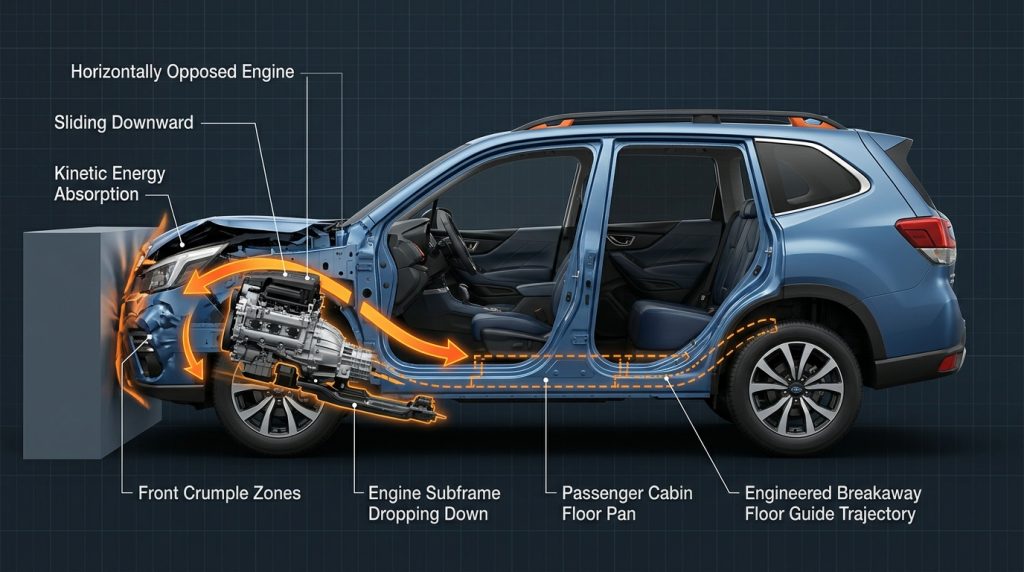
During a severe front-end collision, the Subaru BOXER engine protect s occupants by breaking away from its structural mounts and sliding downward underneath the passenger cabin floor pan rather than pushing backward into the footwell. Its horizontally opposed, flat profile provides the physical clearance necessary for front crumple zones to crush predictably and absorb kinetic impact energy before directing the engine beneath the vehicle frame.
In a traditional vehicle equipped with an inline or V-shaped engine, the tall profile of the cylinder block creates a massive barrier during a head-on collision. Upon heavy frontal impact, collision force pushes a tall engine block straight back toward the firewall, increasing the risk of cabin intrusion and footwell deformation. Subaru engineers resolved this hazard by taking advantage of the flat layout of the Subaru BOXER engine. Because the cylinders lie horizontal at a 180-degree angle, the powertrain maintains a compact height profile. This flat design positions the center of heavy mechanical mass lower in the engine bay and aligns it perfectly with angled floor guides beneath the front frame.
Whether evaluating a full-frontal crash into a rigid barrier or a small-overlap collision against an oncoming object, this low-profile engine architecture changes how crash energy dissipates. During an impact, tens of thousands of pounds of kinetic force move through the front bumper beams and longitudinal frame rails. As front crumple zones deform, engineered breakaway bolts on the engine subframe yield, forcing the engine down toward the pavement along guided floor ramps.
Every model built with this flat powertrain structure shares this safety engineering. Drivers looking at the new Subaru Outback lineup, exploring new Subaru Forester options, or examining new Subaru Crosstrek inventory benefit from this structural design. The same protective engine motion is built into three-row vehicles like our new Subaru Ascent models, executive sedans like our new Subaru Legacy sedans, practical hatchbacks like our new Subaru Impreza hatchbacks, and performance cars like our new Subaru WRX inventory and new Subaru BRZ coupes, as well as electric crossover options like our new Subaru Solterra EV models.
For commuters traveling from Ladue along Ladue Road toward Forest Park, having a powertrain engineered to drop below the floor pan provides real peace of mind in high-density traffic. To see how these safety systems come together in person, visit our showroom location or give our team a quick call to learn more.
Table of Contents
- What Engineering Features Allow the BOXER Engine to Slide Under the Cabin During an Impact?
- How Do Front Crumple Zones and Low Engine Profile Work Together in a Collision?
- What Is Subaru’s Ring-Shaped Reinforcement Frame and How Does It Protect the Cabin?
- Does the BOXER Engine Drop-Down Safety Feature Apply to All Subaru Models?
- Common Questions About Subaru BOXER Engine Collision Safety
- Test Drive a Safety-Focused Subaru
What Engineering Features Allow the BOXER Engine to Slide Under the Cabin During an Impact?
Shear bolts, breakaway subframe mounts, angled floor guides, and specialized structural crossmembers force the engine downward under heavy frontal impact loads. When a crash occurs, these components act in sequence to separate the powertrain from the chassis and guide it safely away from driver and passenger footwells.
The engine subframe serves as the primary mounting structure holding the powertrain in place under normal driving conditions. During severe frontal deceleration, kinetic energy transfers through the subframe. Specialized shear mounts hold the engine securely during daily operation but are calibrated to yield cleanly when impact forces exceed pre-set safety thresholds. As these shear bolts snap under collision stress, the engine separates from its primary structural supports.
Once the mounts detach, angled steel guides built into the lower frame rail assembly control the path of the engine block. These guides slope downward toward the undercarriage at a precise pitch. Instead of moving horizontally straight back into the firewall, the flat engine follows the trajectory established by these structural ramps. The floor pan itself features reinforced longitudinal ribs that prevent upward deformation while providing a smooth slide surface for the detached engine and transmission.
Key components responsible for this downward displacement include:
- Engine Breakaway Mounts: Calibrated steel brackets and shear bolts that break cleanly upon severe frontal impact.
- Angled Lower Subframe Rails: Steel frame channels positioned at a downward slope to direct powertrain motion toward the ground.
- Reinforced Floor Ramp Assemblies: Underbody steel plates designed to deflect mechanical mass away from driver footwells.
- Collapsible Steering Column & Driveshaft: Structural shafts engineered with telescoping slip joints that collapse under load without pushing into the interior cabin.
Planning for a new vehicle requires looking at both physical safety engineering and ownership convenience. You can complete our secure online financing application from home to prepare before visiting our lot, or check our current inventory to see available offers.
Engine & Performance
Powertrain specs by trim
| Feature | Limited | Limited XT | Outback Wilderness | Premium | Touring | Touring XT |
|---|---|---|---|---|---|---|
| Engine | 2.5L | 2.4L | 2.4L | 2.5L | 2.5L | 2.4L |
| Horsepower | 180 hp | 260 hp | 260 hp | 180 hp | 180 hp | 260 hp |
| Torque | 178 lb-ft | 277 lb-ft | 277 lb-ft | 178 lb-ft | 178 lb-ft | 277 lb-ft |
| Transmission | Lineartronic CVT | High-torque Lineartronic CVT | High-torque Lineartronic CVT | Lineartronic CVT | Lineartronic CVT | High-torque Lineartronic CVT |
| Drivetrain | All-wheel drive | All-wheel drive | All-wheel drive | All-wheel drive | All-wheel drive | All-wheel drive |
How Do Front Crumple Zones and Low Engine Profile Work Together in a Collision?
A flat engine profile creates crucial empty volume in the upper engine bay, allowing front crumple zones to compress fully and absorb maximum kinetic energy during a crash. Because the engine block is short, frame rails and bumper beams have greater distance to deform inward before contacting rigid mechanical components.
When a front-end crash occurs, energy management unfolds in distinct stages across milliseconds:
- Initial Bumper and Beam Deformation: Front bumper structures, crush boxes, and outer frame extensions collapse, absorbing initial low-speed energy.
- Longitudinal Frame Compression: Structural frame rails buckle progressively along pre-formed dimples, converting impact velocity into controlled structural deformation.
- Subframe Mount Separation: High-impact loads trigger shear bolts on the engine cradle, freeing the flat engine from its primary mounting points.
- Powertrain Downward Displacement: The engine slides down the angled lower subframe guides beneath the floor pan while the front structure finishes crumpling.
In small-overlap frontal collisions—where impact force hits only the outer 25 percent of the vehicle front end—traditional tall engines can rotate into the cabin frame. A flat engine layout sits lower than the principal side frame rails. During a small-overlap crash, impact forces push the outer structure inward while the low engine mass stays beneath the main crush path, reducing structural binding and helping pass energy cleanly along the opposite side rail.
Maintaining structural integrity after an accident requires factory-engineered replacement parts. If you ever require post-collision restoration or structural service, you can order genuine Subaru replacement parts directly through our dealership.
What Is Subaru’s Ring-Shaped Reinforcement Frame and How Does It Protect the Cabin?
The Ring-Shaped Reinforcement Frame is a structural safety cage linking the roof pillars, side door frames, side sills, and floor crossmembers into interconnected loops surrounding the passenger cabin. During a front-end collision, this continuous steel shell redirects crash forces around the passenger compartment while maintaining structural cabin volume.
High-strength and ultra-high-strength steel alloys make up these structural rings. When the front crumple zones absorb initial impact forces and the engine begins its downward slide, residual kinetic energy reaches the front A-pillars and floor sills. Rather than allowing these structural boundaries to buckle inward, the reinforced frame transfers energy upward into the roof structure and downward along the side sills toward the rear axle.
This structural ring framework delivers critical cabin protection benefits:
- Intrusion Prevention: Maintains interior footwell and occupant space even during high-velocity impacts.
- Multi-Directional Energy Dispersion: Channels frontal collision energy along top, side, and bottom load paths away from passengers.
- Rigid Passenger Survival Cell: Protects occupants from severe cabin collapse in frontal, side, and rollover events.
For drivers in Sunset Hills commuting along busy local routes like Lindbergh Boulevard, this structural shell surrounds the cabin to help protect what matters most—your family. If you are considering trading in your current car for a model featuring this safety frame, you can value your trade online in just a few minutes.
Does the BOXER Engine Drop-Down Safety Feature Apply to All Subaru Models?
Every gas and hybrid model utilizing the horizontally opposed engine architecture includes the breakaway subframe and drop-down safety design as standard engineering. From compact hatchbacks to three-row SUVs, all models leverage this layout to help prevent engine intrusion into the cabin during a head-on crash.
When shoppers inspect vehicles on our showroom floor, a common question is whether the engine drop-down safety mechanism is limited to larger crossovers or included across the entire lineup. We walk them through the engine bay to demonstrate how even entry-level models feature the exact same breakaway subframe geometry and angled floor guides as top-tier SUVs.
Vehicle safety engineering relies on consistent structural principles across every trim level, regardless of engine output or transmission pairing. For example, specifications across the crossover lineup demonstrate how powertrain variations share standardized chassis protection standards:
| Trim Level | Engine Displacement | Horsepower | Torque | Transmission | Drivetrain |
|---|---|---|---|---|---|
| Premium | 2.5L | 180 hp | 178 lb-ft | Lineartronic CVT | All-wheel drive |
| Limited | 2.5L | 180 hp | 178 lb-ft | Lineartronic CVT | All-wheel drive |
| Touring | 2.5L | 180 hp | 178 lb-ft | Lineartronic CVT | All-wheel drive |
| Limited XT | 2.4L | 260 hp | 277 lb-ft | High-torque Lineartronic CVT | All-wheel drive |
| Touring XT | 2.4L | 260 hp | 277 lb-ft | High-torque Lineartronic CVT | All-wheel drive |
| Outback Wilderness | 2.4L | 260 hp | 277 lb-ft | High-torque Lineartronic CVT | All-wheel drive |
Every model in our new Subaru inventory comes standard with Symmetrical All-Wheel Drive, providing you confidence in all-weather conditions on wet roads or snowy Missouri winters. To keep your current vehicle operating with factory precision and safety, you can easily schedule a service appointment with our factory-trained service technicians.
Common Questions About Subaru BOXER Engine Collision Safety
Q: Does a BOXER engine behave differently in a small-overlap collision compared to a full-frontal crash?
In a full-frontal impact, crash energy distributes evenly across both longitudinal frame rails, driving the engine straight down along angled subframe guides beneath the center floor pan. In a small-overlap collision, force hits only one front corner, bypassing central bumper structures. Because the flat engine sits low between the frame rails, it avoids binding against side structures, allowing outer crumple zones to absorb force while the engine separates cleanly from its mounts.
Q: Are BOXER engine mounts designed to break apart during a severe crash?
Engine mounts feature engineered shear bolts and breakaway brackets designed to yield under specific frontal crash loads. During normal driving, cornering, and acceleration, these heavy-duty steel mounts support engine weight and dampen vibration. When high-G impact forces occur during a severe collision, the shear bolts break intentionally, freeing the powertrain to move downward along guided subframe tracks away from the cabin.
Q: Is the low engine position alone enough to prevent cabin intrusion during a head-on impact?
Low physical height is a primary advantage, but it works in combination with active structural systems. The low profile provides space for the engine to slide, but angled floor guides, shear mounts, crumple zones, and the Ring-Shaped Reinforcement Frame must act together to control crash energy. Without these guided structural paths, low placement alone would not guarantee clean displacement under the passenger floor pan.
Q: How does Pre-Collision Throttle Management help reduce frontal impact damage?
Included as part of the EyeSight® Driver Assist technology suite, Pre-Collision Throttle Management detects objects ahead of the vehicle. If a driver attempts to accelerate toward an obstacle, the system cuts engine power to help reduce impact velocity and potential crash severity. Reducing vehicle speed prior to impact lowers total kinetic energy, making it easier for front crumple zones and breakaway engine mounts to manage forces safely.
Q: What happens to the transmission and driveshaft when the engine drops downward?
The transmission connects directly to the rear of the engine block and drops downward along the same trajectory during a crash. The prop shaft and driveshaft feature telescoping shear joints and universal joints engineered to collapse under axial compression. As the powertrain slides beneath the floor, these shafts compress and yield rather than buckling upward into the passenger compartment floor tunnel.
To view current offers on routine maintenance or structural inspections, check our current service and parts specials.
Pricing
Pricing by trim
| Feature | Limited | Limited XT | Outback Wilderness | Premium | Touring | Touring XT |
|---|---|---|---|---|---|---|
| Base MSRP | $41,715 | $44,365 | $44,995 | $34,995 | $45,395 | $47,995 |
| Destination charge | $1,450 | $1,450 | $1,450 | $1,450 | $1,450 | $1,450 |
Test Drive a Safety-Focused Subaru
Subaru builds vehicles designed around passenger protection, combining flat engine architecture, advanced driver-assist features, and structural cabin reinforcement. Experience how balanced handling, low center of gravity, and engineering excellence feel on the road by scheduling a test drive with our team today.
Whether exploring efficient daily commuters or spacious family SUVs, every model is Built for Safety, Designed for Your Busy Life. Stop by our dealership at 10100 Watson Rd, Sunset Hills, MO 63127, browse our used vehicle inventory online, or call us at (314) 476-9638 to find the right vehicle for your family.
© 2026 Sunset Hills Subaru. All rights reserved.
Connect with us


- August 2026
- July 2026
- June 2026
- May 2026
- April 2026
- March 2026
- February 2026
- January 2026
- December 2025
- November 2025
- October 2025
- September 2025
- August 2025
- July 2025
- June 2025
- May 2025
- April 2025
- March 2025
- February 2025
- January 2025
- December 2024
- November 2024
- October 2024
- September 2024
- August 2024
- July 2024
- June 2024
- May 2024
- April 2024
- March 2024
- February 2024
- January 2024
- December 2023
- November 2023
- October 2023
- September 2023
- July 2023
- June 2023
- May 2023
- April 2023
- March 2023
- February 2023
- January 2023
- December 2022
- November 2022
Archives
- 2024 Outback
- 2025 Forester Hybrid
- 2025 Subaru Crosstrek
- 2025 Subaru Outback
- Auto Financing
- Automotive News
- Automotive Repair Tips
- Automotive Rumors & Insights
- Buying & Trade-In Process Guidance
- Buying Guides
- Charging Solutions & Infrastructure
- Community Engagement
- Dealership Financing
- Fuel Efficiency
- Fun Things to Do Near Sunset Hills MO
- Infotainment
- Leasing guides
- Maintenance & Service
- Model Comparisons
- New Vehicle Reviews
- Outdoor Adventure & Camping
- Ownership Experience
- Performance and Engineering
- Reliability and Quality Insights
- Safety
- Subaru Financing
- Subaru Loyalty Program
- Subaru Motorsports
- Subaru Repair
- Subaru Road Safety
- Subaru Share The Love
- Sunset Hills New Subaru
- Sunset Hills Subaru Dealer
- Sunset Hills Subaru EV Dealership
- Sunset Hills Subaru Loves Pets
- Sunset Hills Subaru Service
- Sunset Hills Used Cars
- Technology & Innovation
- Technology & Innovation
- Things to do in Sunset Hills, MO
- Tire Care & Replacement
- Trade Up Advantage
- Uncategorized
- Vehicle Design & Innovation
Categories