
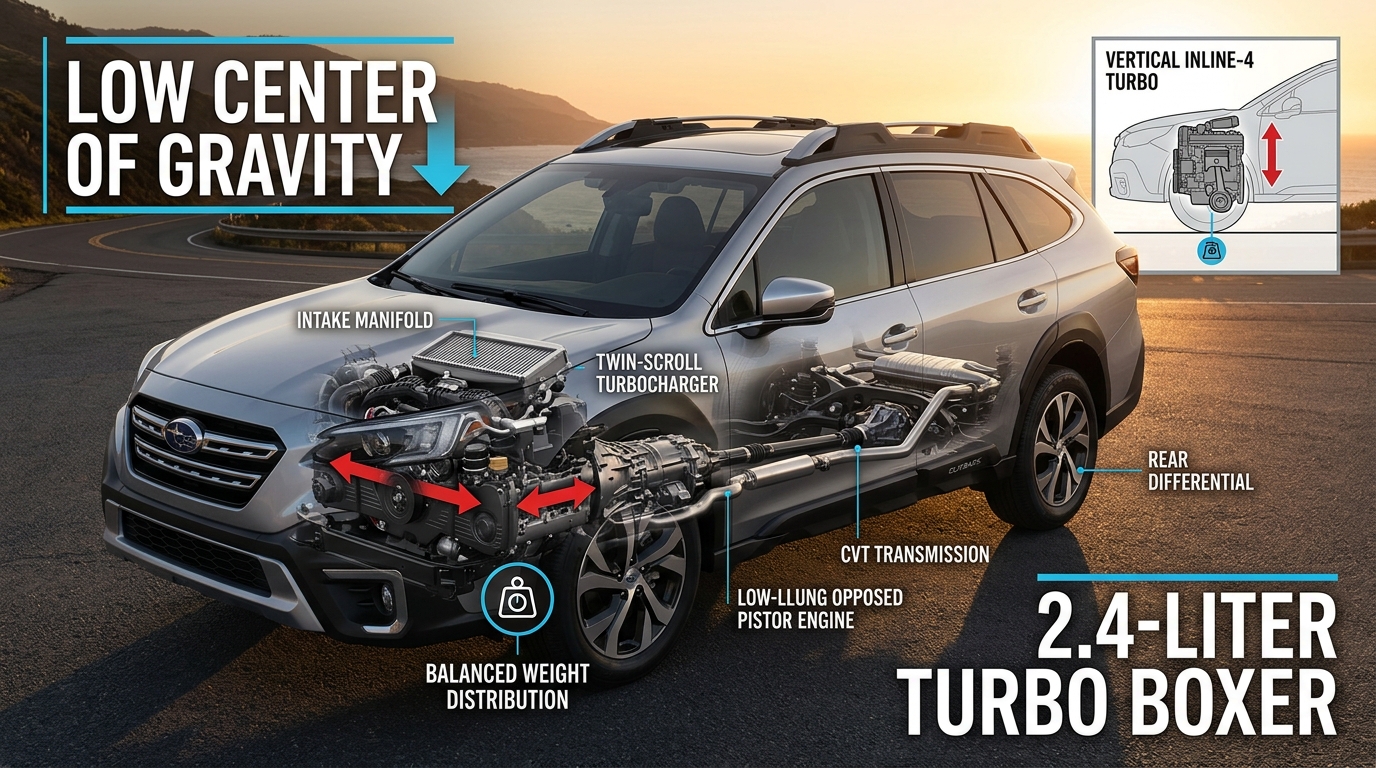
By positioning opposing pistons to cancel out mechanical forces, pairing a twin-scroll turbocharger with a top-mounted intercooler, and sitting lower in the chassis, the turbo BOXER layout offers sharper cornering stability, immediate response, and efficient front-to-back chassis packaging.
Unlike standard upright inline-4 engines used by competitors like Honda, Toyota, or Hyundai, a flat BOXER engine sits horizontally in line with the drivetrain. In an inline engine, four vertical pistons move up and down, generating secondary vibrations that require heavy internal counter-balance shafts to smooth out. In contrast, the 2.4-liter turbocharged Subaru BOXER engine positions two cylinders on each side moving horizontally toward and away from each other. This punch-counterpunch motion naturally cancels out primary and secondary engine vibration without adding weight or extra moving parts.
From an engineering perspective, the physical packaging under the hood provides distinct mechanical advantages. Because the cylinders lay flat, the top of the engine block sits significantly lower in the engine bay. Lowering mass reduces body roll during cornering and enhances overall balance, giving drivers confidence in all-weather conditions. While a horizontally opposed block is wider between the frame rails than a tall, narrow inline-4, its shorter front-to-back length allows the engine to slide under the cabin floor frame in a severe frontal collision rather than intruding into the passenger footwell.
Drivers navigating daily commutes through Ladue will notice the combination of a low center of gravity and immediate low-rpm torque output. Subaru pairs its modern turbo BOXER powerplants with a top-mounted intercooler fed directly by a functional hood scoop. This design minimizes intake tract length, virtually eliminating turbo lag and delivering quick throttle response when passing or merging onto interstate highways.
If you are exploring the entire model lineup, our team at Sunset Hills Subaru is ready to walk you through every option. You can examine our new Subaru WRX models for rally-inspired performance, browse our new Subaru Outback inventory or new Subaru Ascent models for turbocharged family versatility, or compare non-turbo options across our new Subaru Forester lineup, new Subaru Crosstrek inventory, new Subaru Impreza models, new Subaru Legacy inventory, new Subaru BRZ selection, and fully electric new Subaru Solterra inventory. Drop by our Sunset Hills showroom or give our team a quick call to learn more.
Table of Contents
- Which Current Subaru Models Feature a Turbocharged BOXER Engine?
- What Are the Performance and Handling Benefits of a Turbo BOXER Layout?
- Does a Turbocharged Subaru Engine Require Premium Gasoline and Cost More to Insure?
- How Reliable Are Subaru Turbo BOXER Engines for Long-Term Ownership?
- How Should You Choose Between a WRX, Outback XT, or Ascent in Sunset Hills?
- Frequently Asked Questions About Subaru Turbocharged BOXER Engines
Which Current Subaru Models Feature a Turbocharged BOXER Engine?
Subaru equips three primary model lines with its flagship 2.4-liter turbocharged Subaru BOXER four-cylinder engine: the performance-tuned WRX, the 3-row Ascent family SUV, and high-output trims of the Outback crossover SUV. Known internally as the FA24F, this direct-injection engine replaced earlier 2.0-liter turbocharged generations to provide broader torque bands and improved thermal efficiency.
In sports car applications, the 2026 WRX utilizes the 2.4-liter turbocharged Subaru BOXER engine tuned to generate 271 hp and 258 lb-ft of torque. This output is routed through standard Symmetrical All-Wheel Drive via a standard 6-speed manual transmission or an available high-torque continuous variable transmission. The WRX remains a standalone icon for drivers seeking high-output turbocharged performance paired with true mechanical engagement.
For midsize utility, the 2026 Outback offers two distinct engine configurations. Standard trim levels feature a naturally aspirated 2.5-liter engine producing 180 hp and 178 lb-ft of torque. Upgrading to the Limited XT or Touring XT unlocks the 2.4-liter turbocharged Subaru BOXER producing 260 hp and 277 lb-ft of torque mated to a High-torque Lineartronic CVT. The rugged Outback Wilderness also includes this 260-horsepower turbocharged engine as standard equipment, giving off-road enthusiasts maximum low-end climbing power.
The 2026 Ascent family SUV utilizes the same 2.4-liter turbocharged Subaru BOXER engine delivering 260 hp and 277 lb-ft of torque across all trims, providing 3-row capability and a 5,000-pound maximum towing capacity when properly equipped. Historically, Subaru first introduced turbocharged flat engines in 1980 on the Leone and BRAT before refining them through decades of World Rally Championship competition with the Legacy RS and Impreza WRX.
You can inspect all available turbocharged configurations in our new Subaru inventory, where you can also review current new vehicle specials and check out current service and parts specials before scheduling a visit.
Engine & Performance
Powertrain specs by trim
| Feature | Limited | Limited XT | Outback Wilderness | Premium | Touring | Touring XT |
|---|---|---|---|---|---|---|
| Engine | 2.5L | 2.4L | 2.4L | 2.5L | 2.5L | 2.4L |
| Horsepower | 180 hp | 260 hp | 260 hp | 180 hp | 180 hp | 260 hp |
| Torque | 178 lb-ft | 277 lb-ft | 277 lb-ft | 178 lb-ft | 178 lb-ft | 277 lb-ft |
| Transmission | Lineartronic CVT | High-torque Lineartronic CVT | High-torque Lineartronic CVT | Lineartronic CVT | Lineartronic CVT | High-torque Lineartronic CVT |
| Drivetrain | All-wheel drive | All-wheel drive | All-wheel drive | All-wheel drive | All-wheel drive | All-wheel drive |
Fuel Economy
Fuel economy and range by trim
| Feature | Limited | Limited XT | Outback Wilderness | Premium | Touring | Touring XT |
|---|---|---|---|---|---|---|
| MPG | 25 city / 31 hwy / 27 combined | 21 city / 29 hwy / 24 combined | 21 city / 27 hwy / 23 combined | 25 city / 31 hwy / 27 combined | 25 city / 31 hwy / 27 combined | 21 city / 29 hwy / 24 combined |
What Are the Performance and Handling Benefits of a Turbo BOXER Layout?
Pairing a turbocharger with a flat BOXER cylinder configuration delivers lower vehicle body sway, predictable cornering balance, and efficient intake airflow dynamics. By positioning four cylinders horizontally at 180 degrees, the heavy engine block sits low in the engine bay, reducing overall chassis center of gravity and stabilizing the vehicle during evasive maneuvers or spirited mountain driving.
Key mechanical advantages of the turbocharged flat-four layout include:
- Lower Center of Gravity: Placing internal reciprocating components horizontally keeps engine weight closer to the road surface, reducing body roll without requiring an overly stiff, uncomfortable suspension tune.
- Inherent Balance: Opposing piston motions cancel out unbalanced kinetic forces, resulting in smooth revving up to high RPMs without vibration-damping counter-shafts.
- Top-Mounted Intercooler Efficiency: Mounting the intercooler directly above the engine intake manifold shortens charge-pipe length, allowing compressed air to enter the combustion chambers with minimal boost lag.
- Trail-Ready Protection: Keeping the intercooler elevated on top of the block protects delicate cooling fins from flying gravel, mud, and water hazards when driving off paved roads.
- Symmetrical Drivetrain Alignment: The flat engine profile connects in a direct line with the transmission and center differential, creating an even, balanced weight distribution from side to side.
Subaru utilizes a twin-scroll turbocharger architecture on the FA24 engine. A twin-scroll setup separates exhaust gas channels into twin inlets within the turbo housing, utilizing exhaust pulses from alternating cylinders to spool the turbine wheel quickly at low engine speeds. Full engine torque of 277 lb-ft is available as low as 2,000 RPM in the Outback XT and Ascent, delivering effortless acceleration when pulling heavy loads or climbing highway grades.
If you are considering a pre-owned performance or utility model, feel free to browse our wide selection of pre-owned vehicle inventory to find certified turbocharged options that fit your driving requirements.
Does a Turbocharged Subaru Engine Require Premium Gasoline and Cost More to Insure?
Fuel requirements for Subaru turbocharged BOXER engines depend entirely on the vehicle model and its factory computer calibration. The high-performance 2026 WRX requires 91-octane premium unleaded gasoline to achieve its full rated output of 271 hp. While the engine management system can adjust timing to run on regular fuel in an emergency, routine use of premium gasoline prevents pre-ignition knock and maintains peak performance.
Conversely, utility models powered by the 2.4-liter turbo engine—including the 2026 Outback Limited XT, Outback Touring XT, Outback Wilderness, and Ascent—are specifically engineered and calibrated to run on 87-octane regular unleaded fuel. Owners enjoy 260 hp and 277 lb-ft of torque without paying a premium price at the gas pump during routine fills.
Insurance costs for turbocharged Subaru vehicles reflect vehicle classification rather than engine layout alone. The 3-row Ascent and family-oriented Outback XT trims usually command standard SUV insurance premiums comparable to non-turbo utility vehicles. The WRX sports sedan, classified as a performance vehicle, can see slightly higher insurance premiums due to driver demographics and sports-car insurance grouping.
Selecting a turbocharged trim represents a step up in equipment and capability across the Outback lineup:
- Outback Premium: Starting MSRP of $34,995 (plus $1,450 destination charge) with the standard 180-hp 2.5L engine.
- Outback Limited: Base MSRP of $41,715 (plus $1,450 destination charge) with standard 180-hp 2.5L engine.
- Outback Limited XT: Base MSRP of $44,365 (plus $1,450 destination charge) adding the 260 hp turbocharged engine and High-torque Lineartronic CVT.
- Outback Wilderness: Base MSRP of $44,995 (plus $1,450 destination charge) featuring standard 260 hp turbo power, raised suspension, and trail gear.
- Outback Touring: Base MSRP of $45,395 (plus $1,450 destination charge) featuring luxury amenities with the 180-hp engine.
- Outback Touring XT: Base MSRP of $47,995 (plus $1,450 destination charge) combining peak luxury equipment with 260 hp turbocharged performance.
To explore your purchase options, you can complete our quick, secure online credit application to receive pre-approval details before stopping by the dealership.
Pricing
Pricing by trim
| Feature | Limited | Limited XT | Outback Wilderness | Premium | Touring | Touring XT |
|---|---|---|---|---|---|---|
| Base MSRP | $41,715 | $44,365 | $44,995 | $34,995 | $45,395 | $47,995 |
| Destination charge | $1,450 | $1,450 | $1,450 | $1,450 | $1,450 | $1,450 |
How Reliable Are Subaru Turbo BOXER Engines for Long-Term Ownership?
Modern Subaru turbocharged engines, particularly the FA24 2.4-liter turbocharged Subaru BOXER, demonstrate exceptional long-term reliability and high-mileage durability when properly maintained. Engineered with high-strength alloy cylinder blocks, forged connecting rods, and advanced thermal management systems, current turbo BOXER designs are built to withstand elevated combustion pressures and high heat.
Maintaining a turbo BOXER engine requires disciplined adherence to factory service intervals. Because turbochargers share engine oil for shaft lubrication and cooling, changing engine oil and filters at recommended 6,000-mile intervals prevents thermal oil breakdown and sludge buildup inside oil feed lines. Using full-synthetic oil of the correct viscosity ensures protection during cold engine starts and under heavy load conditions.
Long-term maintenance considerations for turbocharged BOXER engines include:
- Regular Spark Plug Replacement: Direct-injection turbocharged engines place higher electrical loads on spark plugs, requiring replacement every 60,000 miles to preserve clean combustion and fuel efficiency.
- Air Filter Upkeep: A clean engine air filter prevents dirt particles from impinging on the high-speed turbocharger compressor wheel or entering intake pathways.
- Cooling System Flushing: Replacing engine coolant at designated factory intervals protects internal aluminum water jackets and turbo cooling passages from internal corrosion.
- Direct-Injection Valve Care: Periodic intake valve cleaning removes natural carbon deposits that can accumulate on intake valve stems over long ownership periods.
Subaru backs every new turbocharged model with a 5-year / 60,000-mile powertrain warranty covering the engine block, internal components, turbocharger assembly, and drivetrain. When replacement maintenance items are required, our genuine Subaru parts department supplies factory-certified filters, fluids, and components engineered to exact OEM tolerances.
How Should You Choose Between a WRX, Outback XT, or Ascent in Sunset Hills?
Choosing the ideal turbocharged Subaru model comes down to balancing seating requirements, cargo flexibility, towing capacity, and personal driving style. All three models feature standard Symmetrical All-Wheel Drive and advanced driver assistance, but each tailors the 2.4-liter turbocharged Subaru BOXER engine to a distinct driving experience.
When shoppers compare turbo models in our showroom, they usually test out seat adjustments and rear cargo access before setting out on a test drive along Watson Road. Drivers seeking pure enthusiast performance prefer the WRX for its firm sport-tuned suspension, sharp steering rack, and available 6-speed manual transmission. The WRX delivers immediate throttle response, making daily highway merging or spirited driving engaging and responsive.
Families looking for versatile 5-passenger utility with extra power find the Outback Limited XT, Touring XT, or Outback Wilderness ideal. Delivering 260 hp and 277 lb-ft of torque, the Outback XT tackles highway passing effortlessly while providing up to 3,500 pounds of towing capacity and up to about 35 cubic feet of rear cargo space. The raised ground clearance makes it equally comfortable navigating rough weather or heading out on weekend road trips.
For larger families requiring 7- or 8-passenger capacity, the 2026 Ascent uses its 260 hp turbocharged engine to haul full passenger loads and cargo effortlessly. Featuring standard EyeSight® Driver Assist technology, flexible 60/40 split-folding rear seats, and a maximum 5,000-pound tow rating, the Ascent provides smooth, confident power for long highway journeys.
When you are ready to make a move, you can easily value your trade-in online to get an accurate estimate of your current vehicle’s worth.
Frequently Asked Questions About Subaru Turbocharged BOXER Engines
Q: Does Subaru use turbocharged BOXER engines across its entire lineup? Subaru offers its 2.4-liter turbocharged Subaru BOXER engine in specific performance and high-tier utility trims, including the WRX sedan, the 3-row Ascent SUV, and the Outback Limited XT, Touring XT, and Outback Wilderness models. Core trims of models like the Forester, Crosstrek, and Impreza use naturally aspirated BOXER engines designed primarily for maximum fuel efficiency.
Q: Why does Subaru place the intercooler on top of the engine instead of in the front bumper? Subaru places the intercooler on top of the engine block fed by a functional hood scoop to keep air intake pathways as short as possible. This top-mounted location reduces boost lag, improves throttle response, and protects delicate intercooler cooling fins from off-road rock impacts, deep water crossings, and road debris encountered during highway driving.
Q: How does the flat BOXER engine layout reduce engine vibration compared to an inline engine? The BOXER engine places cylinders horizontally in two opposing banks. As opposing pistons move toward and away from each other simultaneously, their mechanical forces naturally cancel out primary and secondary engine vibrations. This flat motion eliminates the need for heavy internal counter-balance shafts used in upright inline-4 engines.
Q: Does a turbocharged BOXER engine take up more space under the hood? A BOXER engine is wider between the chassis frame rails than a tall inline-4 engine, but it is significantly shorter in total height and front-to-back length. This compact vertical profile lowers the vehicle’s center of gravity and allows the engine structure to drop beneath the passenger cabin floor during severe frontal collision impacts.
Q: Can I use regular 87-octane fuel in an Outback XT or Ascent turbo? Yes, the 2.4-liter turbocharged BOXER engine in the Outback XT, Outback Wilderness, and Ascent is specifically factory-calibrated to run on 87-octane regular unleaded gasoline without damage or loss of reliability. Only the performance-focused WRX requires 91-octane premium gasoline to deliver its maximum rated 271 hp.
Whether you want to test drive a turbocharged WRX, Outback XT, or Ascent, our team at Sunset Hills Subaru is ready to assist you every step of the way. Stop by visit our dealership address at 10100 Watson Rd, Sunset Hills, MO 63127, give our knowledgeable sales team a call at (314) 476-9638, or easily schedule a service appointment online to keep your turbocharged Subaru running smoothly for miles to come.
© 2026 Sunset Hills Subaru. All rights reserved.
Connect with us


- August 2026
- July 2026
- June 2026
- May 2026
- April 2026
- March 2026
- February 2026
- January 2026
- December 2025
- November 2025
- October 2025
- September 2025
- August 2025
- July 2025
- June 2025
- May 2025
- April 2025
- March 2025
- February 2025
- January 2025
- December 2024
- November 2024
- October 2024
- September 2024
- August 2024
- July 2024
- June 2024
- May 2024
- April 2024
- March 2024
- February 2024
- January 2024
- December 2023
- November 2023
- October 2023
- September 2023
- July 2023
- June 2023
- May 2023
- April 2023
- March 2023
- February 2023
- January 2023
- December 2022
- November 2022
Archives
- 2024 Outback
- 2025 Forester Hybrid
- 2025 Subaru Crosstrek
- 2025 Subaru Outback
- Auto Financing
- Automotive News
- Automotive Repair Tips
- Automotive Rumors & Insights
- Buying & Trade-In Process Guidance
- Buying Guides
- Charging Solutions & Infrastructure
- Community Engagement
- Dealership Financing
- Fuel Efficiency
- Fun Things to Do Near Sunset Hills MO
- Infotainment
- Leasing guides
- Maintenance & Service
- Model Comparisons
- New Vehicle Reviews
- Outdoor Adventure & Camping
- Ownership Experience
- Performance and Engineering
- Reliability and Quality Insights
- Safety
- Subaru Financing
- Subaru Loyalty Program
- Subaru Motorsports
- Subaru Repair
- Subaru Road Safety
- Subaru Share The Love
- Sunset Hills New Subaru
- Sunset Hills Subaru Dealer
- Sunset Hills Subaru EV Dealership
- Sunset Hills Subaru Loves Pets
- Sunset Hills Subaru Service
- Sunset Hills Used Cars
- Technology & Innovation
- Technology & Innovation
- Things to do in Sunset Hills, MO
- Tire Care & Replacement
- Trade Up Advantage
- Uncategorized
- Vehicle Design & Innovation
Categories