Blog / Model Comparisons

Is the Toyota Corolla Cross or Subaru Crosstrek More Reliable for Long-Term Ownership?

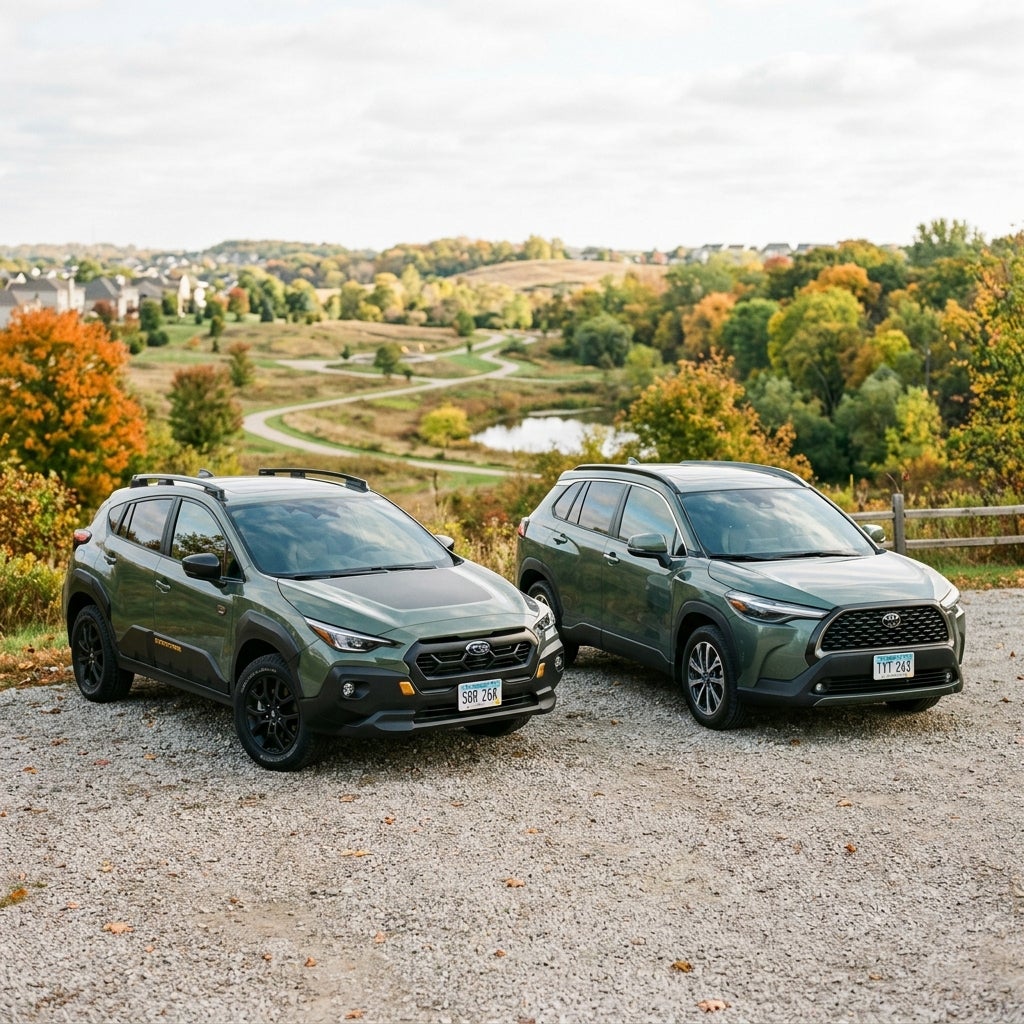
Two olive green compact SUVs parked side by side on a gravel lot overlooking a scenic autumn landscape. (Representative image for illustration purposes only. Actual vehicle may vary based on trim and configuration.)

Powertrain Reliability and Engine Options: 2.0L & 2.5L Subaru BOXER vs. Toyota 2.0L

Subaru Engineering: Subaru BOXER Advantages

The Subaru Crosstrek offers two proven naturally aspirated powertrains: a standard 2.0-liter 4-cylinder Subaru BOXER producing 152 horsepower and an upgraded 2.5-liter 4-cylinder Subaru BOXER yielding 182 horsepower and 178 lb-ft of torque. The horizontally opposed BOXER engine design lays flat in the engine bay, channeling rotational force directly into the transmission without requiring right-angle direction changes. Key long-term mechanical traits of the modern BOXER engine include: • Self-Balancing Motion: Horizontal pistons cancel out lateral vibrations, placing less strain on engine mounts, crank bearings, and accessories over 100,000+ miles. • Maintenance-Free Timing Chains: Modern BOXER engines utilize robust timing chains designed for the life of the vehicle, eliminating costly 60k-mile timing belt replacements. • Optimal Thermal Efficiency: Modern multi-way cooling control valves ensure rapid engine warmup during cold Missouri winters, minimizing cold-start wear.

Toyota Engineering: 2.0L Dynamic Force

The standard non-hybrid Toyota Corolla Cross relies on a 2.0-liter Dynamic Force inline 4-cylinder engine producing 169 horsepower and 151 lb-ft of torque. Like Subaru, Toyota incorporates high-compression direct and port fuel injection alongside a timing chain design. While the Toyota 2.0L engine is undeniably reliable in high-volume urban commuter applications, its upright inline orientation positions weight higher in the engine bay. Over extended ownership past decade milestones, both engines require regular synthetic oil changes, spark plug replacements around 60k to 100k miles, and coolant flushes. However, the Crosstrek's available 2.5L engine offers superior low-end torque for highway passing and merging under full vehicle loads.

Engine & Spec Feature

Subaru Crosstrek 2.0L / 2.5L

Toyota Corolla Cross 2.0L

Engine Configuration

Horizontally Opposed 4-Cylinder BOXER

Inline 4-Cylinder Dynamic Force

Horsepower Rating

152 hp (2.0L) / 182 hp (2.5L)

169 hp (2.0L)

Torque Output

145 lb-ft (2.0L) / 178 lb-ft (2.5L)

151 lb-ft (2.0L)

Timing System

Lifetime Maintenance-Free Chain

Lifetime Maintenance-Free Chain

Center of Gravity

Ultra-Low Horizontal Center

Standard Upright Height

AWD Systems Compared: Subaru Symmetrical AWD vs. Toyota Corolla Cross AWD Options

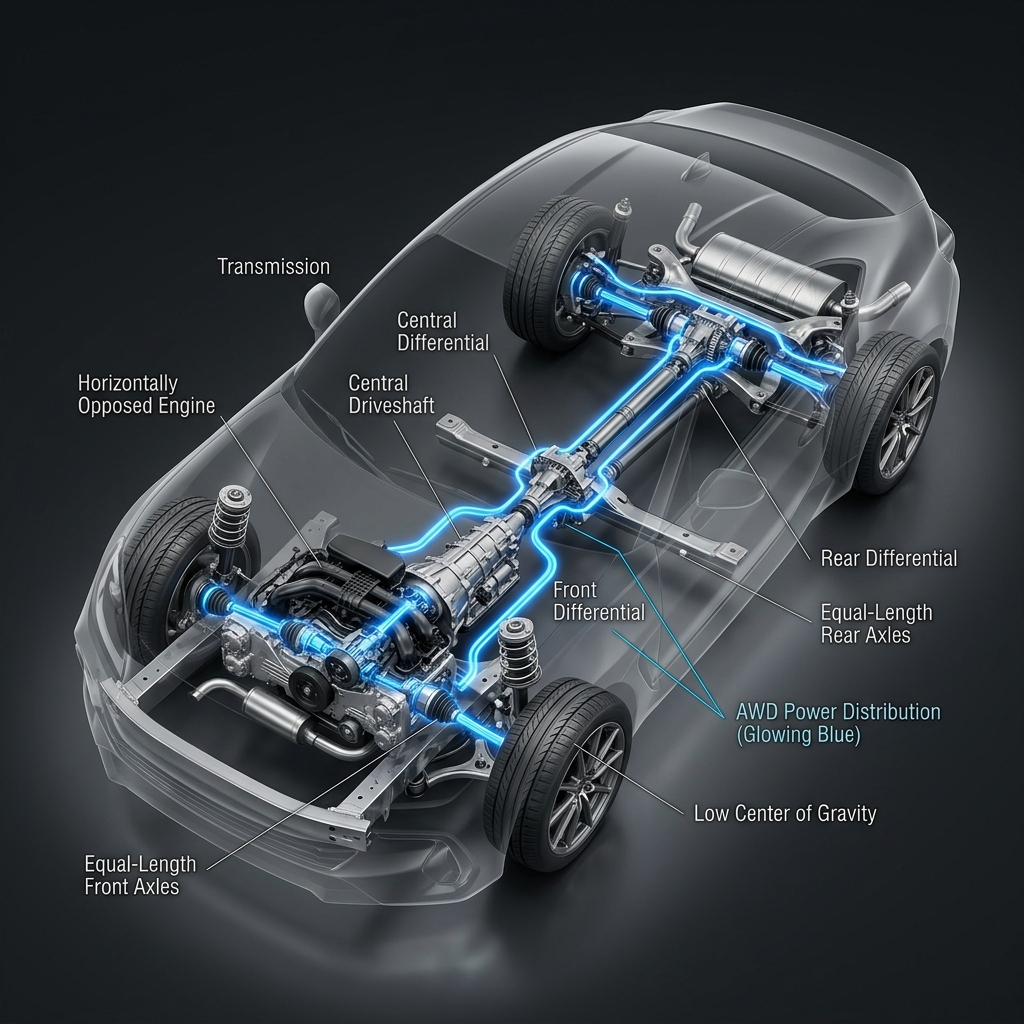
A critical benchmark for long-term dependability in Midwest driving is how an SUV delivers power to all four wheels during heavy downpours, icy winter mornings, and unpaved rural roads. Subaru Symmetrical All-Wheel Drive (Standard on Every Crosstrek): Subaru equips every single Crosstrek with standard full-time Symmetrical AWD. This system features a completely balanced, linear drivetrain layout from front to back. Power is continuously routed to all four wheels, continuously monitoring wheel speed, steering angle, and yaw rate. Because it is a permanent mechanical system utilizing an electronically controlled variable hydraulic transfer clutch, there is zero delay when engaging all four wheels. Mechanical wear is distributed evenly across front and rear differentials, reducing point-load stress on individual components over a 10-to-15 year ownership lifespan.
Toyota Corolla Cross AWD Options: On gas-powered Toyota Corolla Cross models, front-wheel drive is standard, while Dynamic Torque Control AWD is available as an extra-cost option. This system operates primarily as a front-wheel-drive platform, only engaging the rear driveshaft via an electromagnetic coupling when slip is detected at the front wheels. While efficient for dry highway cruising, the constant cycling between FWD and AWD on slick or patchy ice can accelerate wear on engagement clutches over high mileage. On Corolla Cross Hybrid models, Toyota uses an electronic rear motor (E-Four) without a physical driveshaft connecting front to rear.
3D diagram of a transparent car displaying a symmetrical all-wheel drive powertrain with glowing blue energy paths. (Representative image for illustration purposes only. Actual vehicle may vary based on trim and configuration.)
Long-Term Durability Takeaway: Continuous mechanical distribution on the Crosstrek prevents localized overheating of clutch packs during prolonged snow navigation or muddy incline climbs around Sunset Hills and St. Louis County.

Real-World Fuel Economy (MPG) and Driving Range on a Full Tank

Long-term ownership cost is heavily governed by fuel expenditures over 100,000 to 150,000 miles. Comparing fuel tank capacity alongside EPA estimated ratings reveals surprising practical highway cruising ranges.

2026 Subaru Crosstrek

• 2.0L AWD: 27 City / 34 Hwy / 29 Combined MPG • 2.5L AWD: 26 City / 33 Hwy / 29 Combined MPG • Fuel Tank Capacity: Generous 17 Gallons • Full Tank Range: Up to 564 Miles on Highway Thanks to its large 16.6-gallon fuel tank, the gas-powered Crosstrek offers exceptional highway range between pit stops, making regional road trips effortless.

Toyota Corolla Cross (Gas)

• 2.0L FWD: 31 City / 33 Hwy / 32 Combined MPG • 2.0L AWD: 29 City / 32 Hwy / 30 Combined MPG • Fuel Tank Capacity: 12 Gallons (AWD model) • Full Tank Range: Approx 396 Miles on Highway While city MPG is slightly higher on gas Corolla Cross models, the smaller fuel tank requires more frequent stops at the pump.

Corolla Cross Hybrid

• 2.0L Hybrid AWD: 45 City / 38 Hwy / 42 Combined MPG • Fuel Tank Capacity: 11 Gallons • Full Tank Range: Approx 445 Miles Combined The Corolla Cross Hybrid leads in urban stop-and-go efficiency, though high-speed highway efficiency narrows the gap relative to gas crossovers.

Ground Clearance, Approach Angles, and Suspension Durability

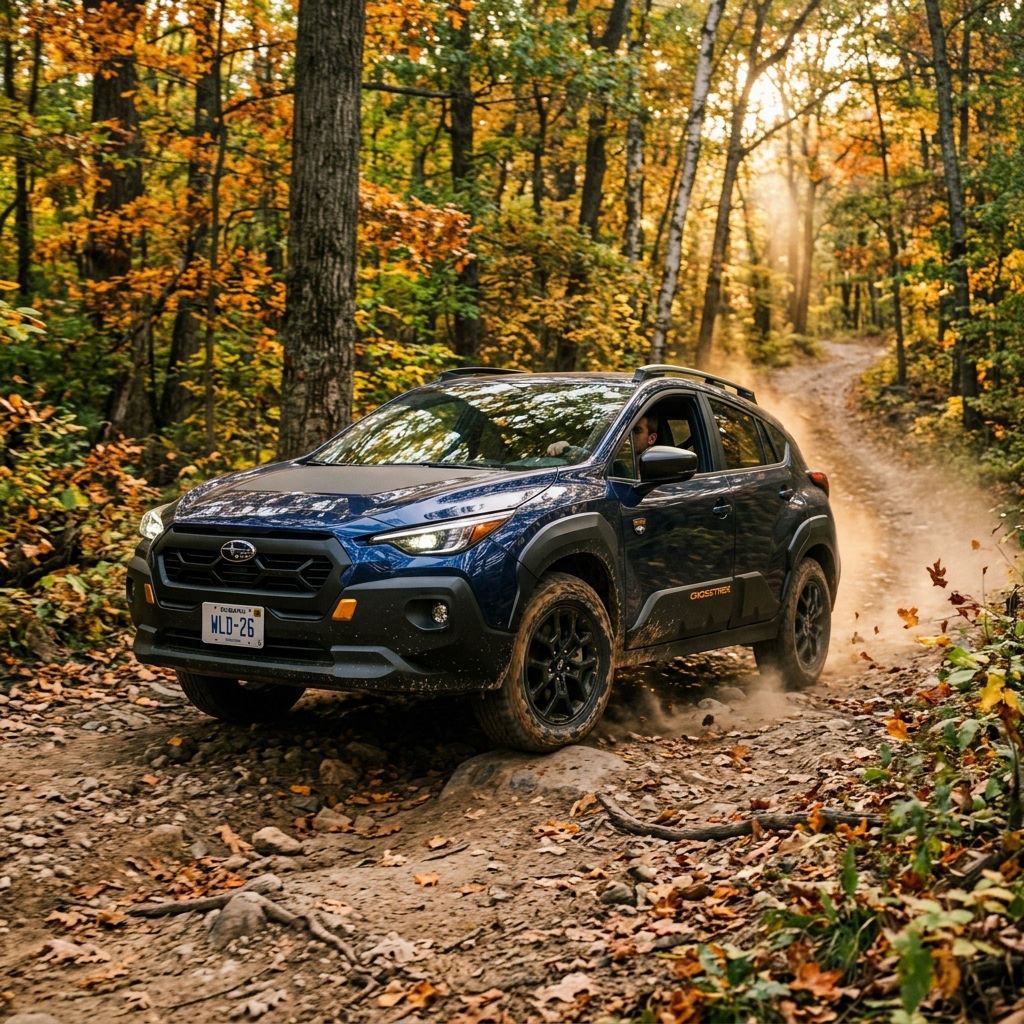
Ground clearance is often viewed strictly as an off-road metric, but for long-term ownership in suburban Missouri, it directly impacts undercarriage longevity, oil pan safety, exhaust shield preservation, and bumper fascia protection when tackling high curbs or deep snowdrifts. • Subaru Crosstrek: Delivers a class-leading 8.7 inches of ground clearance standard on base, Premium, Sport, and Limited trims. Step up to the adventure-ready Crosstrek Wilderness, and ground clearance increases to an impressive 9.3 inches. • Toyota Corolla Cross: Offers 8.1 inches of ground clearance across standard trim levels, which is respectably tall for a sedan-derived crossover but leaves low-hanging exhaust piping and front air dams more vulnerable to steep driveway scrapes. Furthermore, the Subaru Crosstrek features generous approach (18.0 degrees) and departure (30.1 degrees) angles. Long-travel four-wheel independent suspension with heavy-duty lower control arm bushings absorbs severe road impacts, protecting wheel alignments and strut towers over a decade of daily driving.
A dark blue Subaru Crosstrek Wilderness drives down a rocky dirt trail surrounded by autumn foliage. (Representative image for illustration purposes only. Actual vehicle may vary based on trim and configuration.)

Off-Road Capability: What is Subaru's X-MODE and Is the Corolla Cross Suitable for Trails?

For outdoor enthusiasts who spend weekends camping at Babler State Park, kayaking on the Meramec River, or navigating unpaved rural gravel roads, off-road traction control systems play a massive role in vehicle safety and mechanical stress reduction. Subaru X-MODE® System explained: Subaru’s X-MODE® is an advanced software and mechanical management system that optimizes engine output, transmission ratio, AWD front/rear clutch engagement, and VDC (Vehicle Dynamics Control) braking. At the push of a button, X-MODE reduces wheel spin on slippery surfaces. Higher Crosstrek trims feature Dual-Function X-MODE with dedicated settings for Snow/Dirt and Deep Snow/Mud. Deep Snow/Mud mode allows controlled wheel slippage to build momentum and clear tire treads without cutting engine throttle. Integrated Hill Descent Control (HDC) automatically maintains a steady vehicle speed when descending steep inclines, sparing your service brakes from extreme thermal buildup.
Is the Toyota Corolla Cross Suitable for Trails? The Toyota Corolla Cross AWD includes a basic light-trail mode setting designed to brake a spinning wheel on mild dirt roads or wet pavement. However, its lower ground clearance, front-biased AWD coupling, shorter suspension travel, and lack of advanced hill descent speed management make it best suited for light suburban weather rather than true off-paved trail exploration. Driving the Corolla Cross over rocky, rutted trails places increased physical stress on its lower body cladding, floor pans, and bumper covers.

Towing Capacities and Utility for Active Suburban Lifestyles

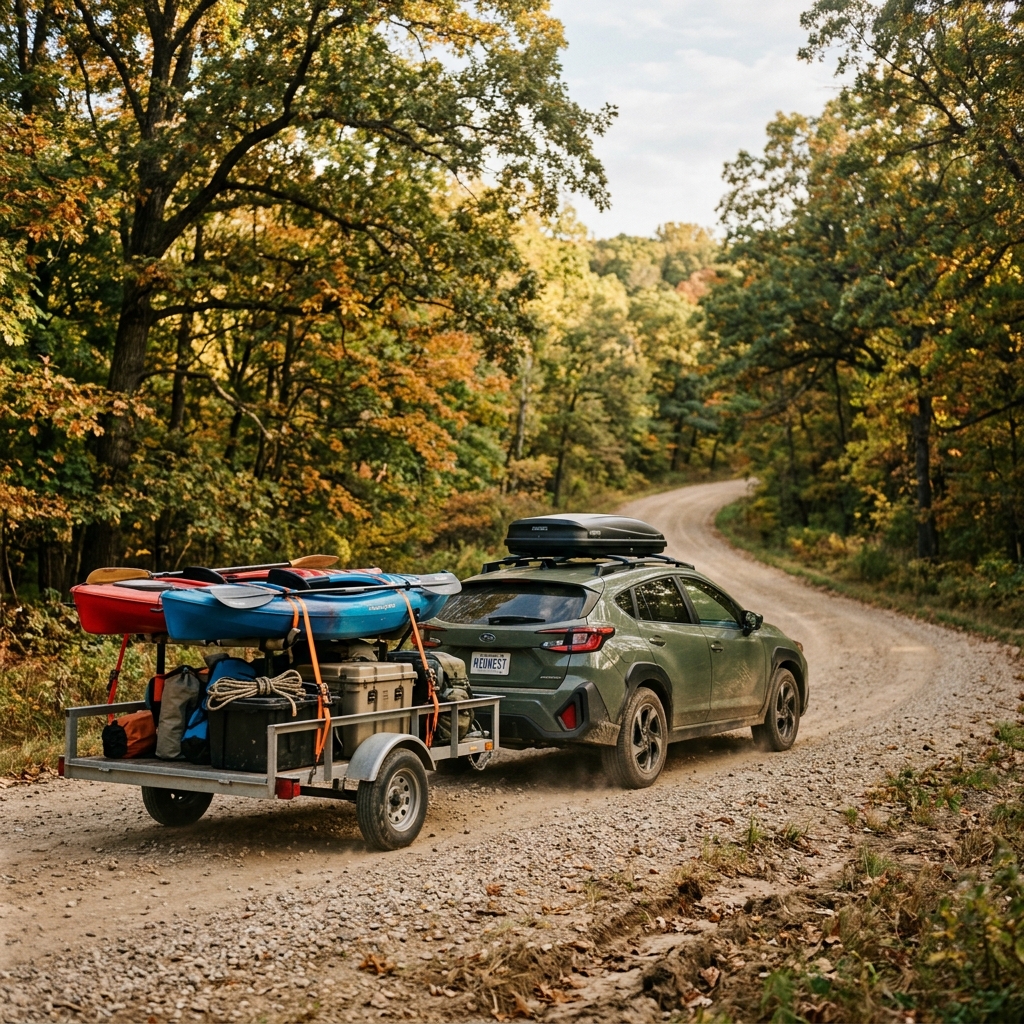
A subcompact SUV should adapt to your active lifestyle, whether that means pulling a small utility trailer with lawn equipment, hauling lightweight aluminum boats, or carrying heavy hitch-mounted electric bike racks. • Subaru Crosstrek Towing: Standard 2.0L and 2.5L Crosstrek models deliver a 1,500 lbs towing capacity. However, the rugged Crosstrek Wilderness trim boosts towing capacity up to 3,500 lbs thanks to an upgraded transmission oil cooler, revised final drive ratio, and reinforced unibody rear frame structure. • Toyota Corolla Cross Towing: All non-hybrid and hybrid Corolla Cross models are limited to a maximum towing capacity of 1,500 lbs, with no factory option available to increase rating for heavier loads. For long-term chassis durability, operating a vehicle well below its maximum tow threshold reduces frame fatigue, rear coil spring sagging, and transmission heat generation.
An olive green SUV towing a trailer loaded with kayaks and camping gear down a winding gravel road through a forest. (Representative image for illustration purposes only. Actual vehicle may vary based on trim and configuration.)

Hybrid Option Availability and Long-Term Battery Dependability

Subaru Powertrain Longevity

Subaru focuses heavily on high-durability, naturally aspirated gas BOXER engines with mechanical simplicity. Fewer high-voltage electronic control modules mean fewer complex thermal management systems to service past 100,000 miles, keeping long-term maintenance straightforward and cost-effective.

Toyota Hybrid Tech

Toyota's 5th-generation hybrid system pairs a 2.0L engine with lithium-ion traction batteries and rear electronic drive motors. While fuel efficiency is exceptional, high-voltage battery replacement out-of-warranty (typically after 8-10 years or 100,000 miles) can run $3,000 to $5,000.

Cold Weather Endurance

Extreme Midwest winter freezes temporarily reduce hybrid battery efficiency and range. Subaru's mechanical AWD gas powertrain operates with 100% torque output regardless of ambient sub-zero temperatures, providing uncompromised winter starting power.

Interior Quality, Cargo Space, and Cabin Wear Resistance Over Time

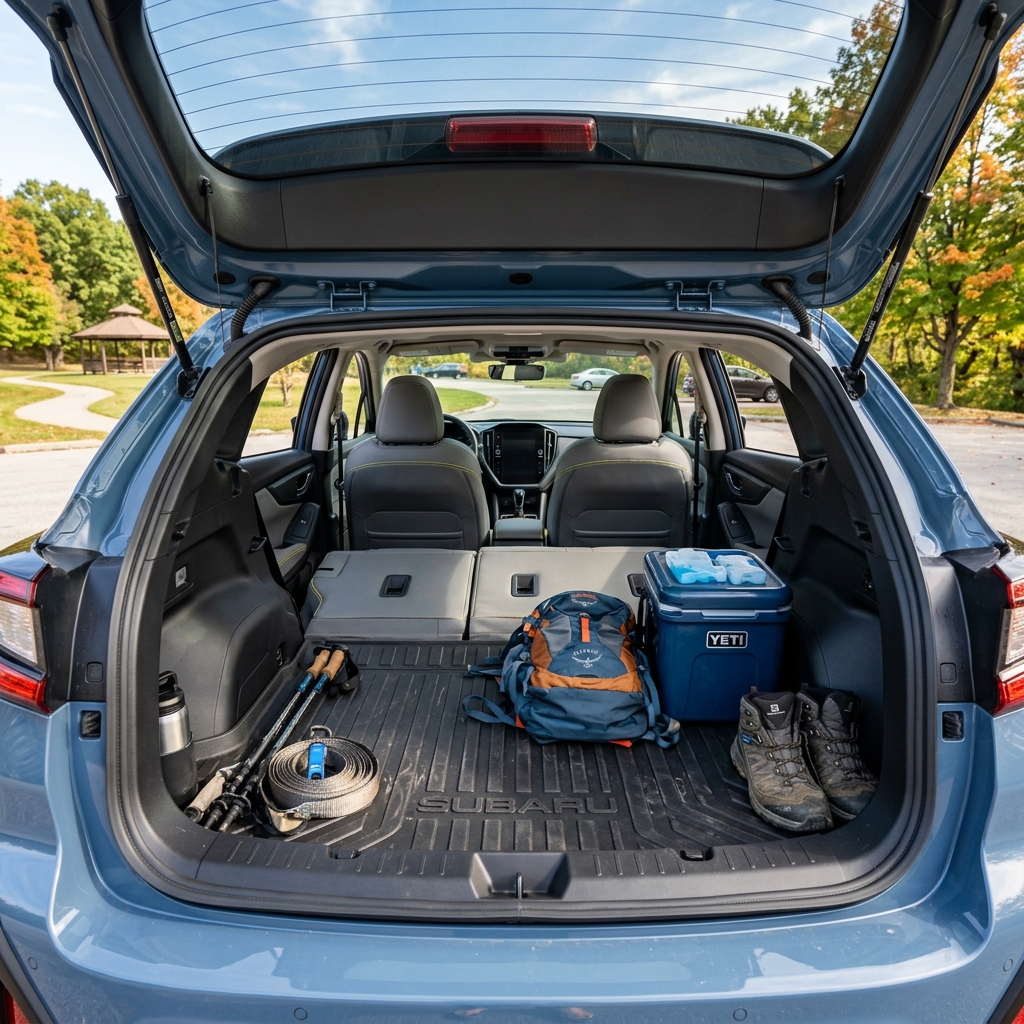
A vehicle cabin must withstand a decade of muddy boots, spilled coffee, pets, and summer sun exposure without cracking, fading, or developing loose trim rattles. • Subaru StarTex® Upholstery: Available on Crosstrek Sport and Wilderness models, StarTex® is a synthetic, water-repellent material that actively resists moisture, mud, and stains. Unlike traditional leather which can dry and crack over time, or cloth which absorbs liquid spills, StarTex cleans effortlessly with a damp cloth. • Toyota SofTex®: Toyota offers SofTex synthetic leather on higher Corolla Cross trims, which provides soft touch surfaces but lacks the water-repellent, heavy-duty abrasion resistance engineered into Subaru StarTex. Cargo Space & Passenger Comfort: The Subaru Crosstrek provides a wide rear cargo opening, up to 20 cubic feet of rear cargo space, expanding to 55 cubic feet with rear 60/40 split seats folded flat. Rear seat legroom in the Crosstrek (36.5 inches) noticeably exceeds the Corolla Cross (32.0 inches), providing significantly better comfort for growing families and adult passengers in Ladue.
Open trunk of a blue Subaru packed with an Osprey backpack, Yeti cooler, hiking boots, and trekking poles. (Representative image for illustration purposes only. Actual vehicle may vary based on trim and configuration.)

Safety Electronics and Driver-Assist System Longevity: EyeSight vs. Safety Sense

Subaru EyeSight®

Subaru’s standard EyeSight® Driver Assist Technology uses dual color stereoscopic cameras mounted flush behind the windshield inside the cabin. Positioned behind the glass, the cameras are protected from road debris, stone chips, salt spray, and front-end bumper impacts, ensuring lower long-term repair costs.

Toyota Safety Sense 3.0

Toyota Safety Sense 3.0 relies on a combination of a windshield camera and a millimeter-wave radar sensor mounted directly in the front grille emblem. Grille-mounted sensors are more susceptible to road gravel impact, salt accumulation, and costly recalibration following minor fender benders.

10-Year Maintenance Outlook

Subaru’s latest generation EyeSight system features a wider field of view and updated processing software. Because the cameras sit safely behind thermal glass wiped by windshield wipers, sensor performance remains highly reliable across all four Missouri seasons.

Chesterfield and Greater St. Louis Driving Conditions: Which Subcompact SUV Fits Best?

Living and driving in the Greater St. Louis area demands a versatile vehicle capable of handling shifting road conditions. From steep grade climbs along the Missouri River valley in Chesterfield to rapid weather changes on I-270 and I-64, vehicle stability is essential. During winter freezes, highway black ice forms rapidly over bridges and overpasses. Subaru’s full-time Symmetrical AWD provides continuous mechanical traction to counteract sudden rear-end breakaway, outperforming reactive AWD systems that delay torque transfer until after front tire slip has already commenced.
Spring brings heavy rainstorms to Maryland Heights and Sunset Hills, filling road depressions with standing water. The Crosstrek’s standard 8.7-inch ride height easily clears pooled water and flash flood debris that would threaten passenger car oil pans and underbody shields. Whether you are commuting daily to downtown St. Louis, running weekend errands in Ladue, or heading out on outdoor adventures across Missouri, visit us at 10100 Watson Rd. You can easily Get Directions to Sunset Hills Subaru and test drive a new Crosstrek today.

Maintenance Schedules, Warranty Coverage, and Financing Your SUV

Maximizing 10-year reliability requires strict adherence to routine factory service intervals. Both Subaru and Toyota recommend standard oil and filter changes every 6,000 miles or 6 months, along with tire rotations and brake inspections. At Sunset Hills Subaru, our factory-certified technicians utilize genuine OEM components, specialized diagnostic equipment, and Subaru-approved fluids engineered specifically for BOXER engines and Lineartronic CVTs. When you need routine maintenance or multi-point inspections, you can conveniently Schedule Service and Diagnostics online.
Looking to upgrade from your current vehicle? High residual values for used Subaru Crosstrek models make trading in a smart financial decision. You can instantly Get your value trade online to see how much equity you have toward a new 2026 Crosstrek. For current financing information, Call us at (314) 476-9638 or apply online to learn more.

Test Drive the Reliable Subaru Crosstrek at Sunset Hills Subaru Today

images (7)
While both the Toyota Corolla Cross and Subaru Crosstrek represent strong choices in the subcompact crossover segment, the Subaru Crosstrek delivers superior long-term engineering advantages: standard full-time Symmetrical All-Wheel Drive, higher ground clearance, StarTex stain-resistant upholstery, greater towing capacity, and exceptional winter handling across St. Louis County. Experience the difference in person at Sunset Hills Subaru. Our friendly sales professionals are ready to walk you through trim levels, review current finance offers, and set up an extended test drive tailored to your schedule.
Subcompact SUV Reliability in Sunset Hills MO | Sunset Hills Subaru
Posted in:

Related Posts

Forester in Downtown STL

Is the 2026 Subaru Forester Worth Buying Over the Toyota RAV4?

The 2026 Subaru Forester delivers a different value proposition than the 2026 Toyota RAV4 due to its standard full-time Symmetrical All-Wheel Drive, superior 8.7 inches of ground clearance, expansive about 111 cubic feet passenger cabin, and standard EyeSight® Driver Assist Technology across every trim level. While the RAV4 charges extra for all-weather capability on base gas models, the Forester includes continuous mechanical traction and a lower starting price point of $29,995 MSRP. For local buyers evaluating compact crossovers, the distinction comes down to standard equipment and real-world winter readiness. Toyota equips base gas RAV4 trims with front-wheel drive, requiring shoppers to pay a premium to add all-wheel drive. In contrast, every Forester built for the 2026 model year leaves the factory with Subaru's permanent AWD system engaged at all times. This setup routes power continuously to all four wheels, adjusting torque balance instantly before tire slip occurs rather than waiting for front-wheel slippage first. Beyond drivetrain mechanics, the Forester provides standard comfort and visibility advantages that elevate daily commuting. The upright roofline creates exceptional outward sightlines through large glass panels, minimizing blind spots during highway lane changes. Front row occupants benefit from 43.3 inches of legroom, while rear passengers enjoy class-leading head and hip room. When comparing feature-for-feature content at similar price points, the Forester includes standard adaptive cruise control, steering-responsive LED headlights, and automated emergency steering that cost extra on competing compact crossovers. At Sunset Hills Subaru, we invite you to compare the Forester against competitor benchmarks in person. You can prequalify online for financing to review flexible loan structures from home, check our Sunset Hills showroom address for test-drive directions, or give our sales team a call directly at (314) 476-9638 to speak with a specialist today. Table of Contents Which SUV Performs Better During St. Louis Winter Storms: Forester AWD or RAV4? How Does Subaru X-MODE Compare to Toyota Multi-Terrain Select and Ground Clearance? Which Vehicle Has Better Passenger Space, Cargo Room, and Touchscreen Size? How Do Fuel Economy, Fuel Tank Range, and Forester Towing Capacity Compare? What Standard Safety Features and Ratings Give the 2026 Forester an Edge Over the RAV4? How Do Advertised Prices and Financing Options Compare? Key Buying Questions St. Louis Drivers Ask When Comparing Forester and RAV4 Step Into the 2026 Subaru Forester at Sunset Hills Subaru Which SUV Performs Better During St. Louis Winter Storms: Forester AWD or RAV4? St. Louis winters challenge SUVs, and the Forester’s full-time Symmetrical All-Wheel Drive system provides strong traction and control compared to the RAV4’s setup. Coupled with a longitudinally mounted 2.5L Boxer engine that lowers the vehicle's center of gravity, the Forester maintains steady directional control on ice, slush, and unplowed suburban roads. When winter weather strikes the St. Louis region, road conditions transition rapidly from freezing rain to packed snow. The Forester handles these severe shifts using a balanced powertrain layout where the engine, transmission, and center differential sit along the vehicle's centerline. Power distributes evenly to all four wheels, delivering predictable steering control when navigating icy highway ramps or rutted neighborhood streets. In contrast, non-hybrid RAV4 models equipped with optional AWD rely on an on-demand system that operates primarily in front-wheel drive until wheel spin is detected. By the time the secondary axle engages, traction has already been compromised. RAV4 Hybrid models utilize an independent electric motor on the rear axle that lacks a physical driveshaft link, which can result in inconsistent rear-wheel torque delivery on steep, low-friction inclines. 2026 Subaru Forester Drivetrain Specifications Standard Engine 2.5L 4-Cylinder Subaru Boxer Horsepower (Gas / Hybrid) 180 hp / 194 hp Torque (Gas / Hybrid) 178 lb-ft / 199 lb-ft Transmission Lineartronic CVT All-Weather Drivetrain System Standard Symmetrical All-Wheel Drive For drivers navigating hilly terrain around Chesterfield, where winter slush pools along rolling residential routes near the Missouri River basin, this permanent mechanical link translates directly into vehicle stability and traction. To explore our current stock of all-weather crossovers, browse our new Subaru Forester inventory online, or take a look through our pre-owned vehicle selection for additional budget options. Engine & Performance Powertrain specs by trim Feature Base AWD Limited Limited Hybrid Premium Premium Hybrid Sport Engine 2.5L 2.5L 2.5L 2.5L 2.5L 2.5L Horsepower 180 hp 180 hp 194 hp 180 hp 194 hp 180 hp Torque 178 lb-ft 178 lb-ft 199 lb-ft 178 lb-ft 199 lb-ft 178 lb-ft Transmission Lineartronic CVT Lineartronic CVT Lineartronic CVT Lineartronic CVT Lineartronic CVT Lineartronic CVT Drivetrain All-wheel drive All-wheel drive All-wheel drive All-wheel drive All-wheel drive All-wheel drive Engine & Performance (continued) Feature Sport Hybrid Touring Touring Hybrid Wilderness Engine 2.5L 2.5L 2.5L 2.5L Horsepower 194 hp 180 hp 194 hp 180 hp Torque 199 lb-ft 178 lb-ft 199 lb-ft 178 lb-ft Transmission Lineartronic CVT Lineartronic CVT Lineartronic CVT Lineartronic CVT Drivetrain All-wheel drive All-wheel drive All-wheel drive All-wheel drive How Does Subaru X-MODE Compare to Toyota Multi-Terrain Select and Ground Clearance? Subaru X-MODE® offers a different traction-management approach than Toyota Multi-Terrain Select by directly modulating engine throttle, transmission gear ratios, all-wheel drive torque split, and individual wheel braking to eliminate wheel spin before momentum is lost. Paired with standard ground clearance of 8.7 inches —which reaches 9.3 inches on the Wilderness trim—the Forester clears deep snow and obstacles that scrape under the RAV4's 8.1-inch clearance limit. While Toyota's Multi-Terrain Select allows drivers to dial in pre-set traction control thresholds for mud, sand, or rock, it operates within the boundaries of an on-demand drivetrain. When a tire loses traction on a steep, snow-covered hill, the system must apply braking pressure to the spinning wheel after the loss of grip occurs. Subaru's dual-function X-MODE® includes dedicated settings for Snow/Dirt and Deep Snow/Mud. It pre-loads the center differential and increases traction sensitivity before you enter hazardous terrain. Ground Clearance & Off-Road Traction Comparison Capability Feature 2026 Subaru Forester 2026 Toyota RAV4 Standard Ground Clearance 8.7 Inches 8.1 Inches Maximum Ground Clearance (Off-Road) 9.3 Inches (Wilderness) 8.6 Inches (TRD Off) Standard All-Wheel Drive Yes (Every Trim) No (Optional) Advanced Terrain System Dual-Function X-MODE® Multi-Terrain Select Low-Speed Hill Descent Control Standard with X-MODE® Available Ground clearance is equally critical when tackling unplowed winter roads or unpaved trailheads. The Forester's 8.7-inch baseline clearance prevents snowpack from lifting the undercarriage off the road surface, preserving tire contact with the asphalt. The rugged Forester Wilderness elevates ride height to 9.3 inches while adding underbody skid plates, Yokohama GEOLANDAR® all-terrain tires, and a revised final drive ratio. Buyers seeking maximum capability across Subaru's lineup can explore larger family options like our new Subaru Ascent models or view performance options like our new Subaru BRZ selection. To apply your trade-in value on a new crossover, you can estimate your trade-in value online in just a few clicks. New Subaru Forester Inventory Which Vehicle Has Better Passenger Space, Cargo Room, and Touchscreen Size? The 2026 Subaru Forester offers significantly more interior room than the Toyota RAV4, providing about 111 cubic feet of total passenger volume compared to the RAV4's about 99 cubic feet. Centered in the dashboard is an available tablet-style 11.6-inch touchscreen display, which provides a larger visual interface than the RAV4's standard 8-inch or available 10.5-inch screens. Step inside the Forester cabin and the boxy, glass-focused design pays immediate dividends in passenger comfort. The tall roofline grants abundant headroom in both seating rows, making entry and exit effortless through wide-opening rear doors. Rear seat legroom measures a generous 39.4 inches, allowing adult passengers or growing teenagers to stretch out comfortably on long road trips. Interior Dimensions & Infotainment Comparison Interior Specification 2026 Subaru Forester 2026 Toyota RAV4 Total Passenger Volume 110.8 Cubic Feet 98.9 Cubic Feet Front Legroom 43.3 Inches 41.0 Inches Rear Legroom 39.4 Inches 37.8 Inches Max Cargo Volume (Seats Folded) Up to 74.4 Cubic Feet 69.8 Cubic Feet Central Display Screen Size 11.6-Inch Tablet Screen 8.0 to 10.5 Inches Cargo flexibility is another core Forester advantage. The rear hatch opening measures wider than most compact rivals, eliminating awkward angling when loading bulky items. With the 60/40-split rear seatbacks folded flat, the Forester accommodates up to about 74 cubic feet of cargo volume (about 69 cubic feet on models with a power moonroof or hybrid battery). For active households in Maryland Heights packing outdoor gear or water sports equipment for weekend trips around Creve Coeur Lake, this flat load floor handles oversized coolers and bicycle frames with ease. In-cabin technology is structured around Subaru's vertically oriented 11.6-inch multimedia display. Featuring high-contrast icons, physical volume and tuning knobs, and integrated climate controls, the system supports wireless Apple CarPlay® and Android Auto™ integration. The RAV4's horizontally mounted screen offers smaller display real estate and requires wired or upgraded wireless connections depending on trim choice. Check our new Subaru inventory to compare interior upholstery choices and tech packages across our current showroom stock. Dimensions & Capacity Capacity and dimensions by trim Feature Base AWD Limited Limited Hybrid Premium Premium Hybrid Sport Seating 5 5 5 5 5 5 Cargo 29.6 cu ft 27.5 cu ft 27.5 cu ft 27.5 cu ft 27.5 cu ft 27.5 cu ft Curb weight 3,510 lbs 3,613 lbs 3,911 lbs 3,569 lbs 3,873 lbs 3,611 lbs Towing — — 1,500 lbs — 1,500 lbs — Payload 1,026 lbs 928 lbs 928 lbs 952 lbs 952 lbs 942 lbs Dimensions & Capacity (continued) Feature Sport Hybrid Touring Touring Hybrid Wilderness Seating 5 5 5 5 Cargo 27.5 cu ft 27.5 cu ft 27.5 cu ft 27.5 cu ft Curb weight 3,913 lbs 3,664 lbs 3,946 lbs 3,675 lbs Towing 1,500 lbs — 1,500 lbs 3,500 lbs Payload 942 lbs 886 lbs 886 lbs — How Do Fuel Economy, Fuel Tank Range, and Forester Towing Capacity Compare? The 2026 Subaru Forester Hybrid delivers an EPA-rated combined driving range of up to 581 miles on a single tank, matching long-distance road trip capability with high fuel efficiency. Standard gas Forester models achieve up to 33 mpg highway, while the off-road-ready Forester Wilderness delivers a maximum 3,500-pound towing capacity. Efficiency in the standard gas Forester comes from a refined 2.5L four-cylinder Boxer engine paired with a Lineartronic Continuously Variable Transmission (CVT). The EPA estimates fuel economy at 26 mpg city and 33 mpg highway on most trims. Thanks to a generous 16.6-gallon fuel tank capacity, standard gas models offer well over 450 miles of highway range between fill-ups using standard 87-octane gasoline. For buyers prioritizing extreme fuel economy, the 2026 Forester Hybrid combines the 2.5L engine with an electric motor system to generate a total of 194 horsepower and 199 lb-ft of torque. EPA fuel economy ratings land at 35 mpg city and 34 mpg highway. The hybrid powertrain stores electrical energy without compromising interior cargo floor height or passenger room. Fuel Economy, Range, and Utility Capability Performance Metric 2026 Forester (Gas) 2026 Forester Hybrid EPA Highway Fuel Economy Up to 33 MPG 34 MPG EPA City Fuel Economy Up to 26 MPG 35 MPG Maximum Total Cruising Range Over 480 Miles Up to 581 Miles Maximum Towing Capacity 1,500 lbs (3,500 Wilderness) 1,500 lbs Fuel Requirement 87 Octane Regular 87 Octane Regular Towing capability varies based on how you configure your vehicle. Standard gas and hybrid Forester models carry a 1,500-pound towing rating, ideal for light utility trailers, bike racks, or small pop-up campers. Upgrading to the Forester Wilderness increases trailering capacity to 3,500 pounds thanks to an auxiliary transmission oil cooler, reinforced hitch mounting points, and a revised final drive ratio. This allows outdoor enthusiasts to tow compact ski boats, teardrop campers, or utility trailers with total peace of mind. Fuel Economy Fuel economy and range by trim Trim MPG Base AWD 26 city / 33 hwy / 29 combined Limited 26 city / 33 hwy / 29 combined Limited Hybrid 35 city / 34 hwy / 35 combined Premium 26 city / 33 hwy / 29 combined Premium Hybrid 35 city / 34 hwy / 35 combined Sport 25 city / 32 hwy / 28 combined Sport Hybrid 35 city / 34 hwy / 35 combined Touring 25 city / 32 hwy / 28 combined Touring Hybrid 35 city / 34 hwy / 35 combined Wilderness 24 city / 28 hwy / 26 combined What Standard Safety Features and Ratings Give the 2026 Forester an Edge Over the RAV4? The 2026 Subaru Forester earned the Insurance Institute for Highway Safety's highest award—a 2026 IIHS TOP SAFETY PICK+ —achieving "Good" crashworthiness ratings across all evaluated impact tests. Every Forester includes standard EyeSight® Driver Assist Technology, which utilizes wide-field stereo cameras mounted behind the windshield to monitor surrounding road activity. Subaru's commitment to driver security begins with structural crash protection. The Forester is built around a Ring-Shaped Reinforcement Frame structure that absorbs impact energy and routes it around the passenger compartment. In IIHS testing, the Forester achieved top "Good" marks in driver-side small overlap front, passenger-side small overlap front, updated moderate overlap front, and updated side-impact evaluations. IIHS Crash Test Ratings & Driver-Assist Features Safety Evaluation / Feature 2026 Subaru Forester 2026 Toyota RAV4 IIHS Overall Safety Award TOP SAFETY PICK+ TOP SAFETY PICK Small Overlap Front Impact Good (Top Rating) Good Updated Moderate Overlap Front Good (Top Rating) Marginal / Acceptable Standard Pre-Collision Braking Standard (EyeSight®) Standard (TSS) Automatic Emergency Steering Standard on Most Trims Not Available DriverFocus® Distraction Monitor Available Not Available Safety technology in the Forester operates continuously to prevent accidents before they occur. The standard EyeSight® system includes: Advanced Adaptive Cruise Control with Lane Centering: Automatically manages speed and distance while keeping the vehicle centered in its lane during highway travel. Pre-Collision Braking: Applies full braking force in emergency situations when an impending frontal obstruction is detected. Automatic Emergency Steering: Works in tandem with Pre-Collision Braking to provide evasive steering support within the lane at speeds under 50 mph. Pre-Collision Throttle Management: Reduces engine power output if an obstacle is detected directly ahead while accelerating from a stop. Higher trims feature DriverFocus® Distraction Mitigation, which utilizes a facial-recognition camera to detect signs of driver fatigue or eye distraction, issuing visual and audible alerts to keep your attention on the road ahead. Safety & Driver Assistance Safety and driver-assistance features by trim All trims from Base AWD to Wilderness come with standard ABS, Isofix preparation for child seats, height-adjustable front and rear head restraints with two and three head restraints respectively, and safety seat belts at all seating positions featuring pre-tensioners and height adjustment for both driver and passenger front seats. Rear center seat belts with 3-point restraints are also standard across the range. Additionally, every trim includes an accident data recorder as a standard feature. The anti-collision system, branded EyeSight®, is standard equipment on all trims and operates with automatic emergency braking and brake light activation. It functions both below and above 30 mph, with a minimum activation speed of 7 mph. A pedestrian and cyclist avoidance system, along with visual and acoustic warnings, are also standard features in the anti-collision suite on all trims. The anti-collision system's ability to brake at low speed in front varies by trim: it is present on Base AWD, Limited, Premium, Premium Hybrid, and Sport, but not included on Limited Hybrid, Sport Hybrid, Touring, Touring Hybrid, and Wilderness. Autonomous driving at level 2 partial automation is not offered on any trim. How Do Advertised Prices and Financing Options Compare? The 2026 Subaru Forester starts at an MSRP of $29,995 MSRP, delivering full-time all-wheel drive, EyeSight® safety tech, and LED headlights as standard equipment. Comparing sticker prices against equivalent all-wheel drive RAV4 trims reveals that the Forester offers a lower overall cost of entry and better feature packaging across its entire lineup. Toyota advertises low entry prices on base front-wheel-drive RAV4 trims, but adding all-wheel drive raises the purchase price significantly. When cross-shopping AWD models, the Forester Base trim delivers a complete suite of power accessories, automatic climate control, and driver-assist monitors for under thirty thousand dollars. 2026 Subaru Forester Trim Level MSRP Breakdown Trim Level Drivetrain Starting MSRP Forester Base AWD 2.5L Gas / CVT $29,995 Forester Premium AWD 2.5L Gas / CVT $31,995 Forester Premium Hybrid 2.5L Hybrid / eCVT $34,730 Forester Sport AWD 2.5L Gas / CVT $34,795 Forester Limited AWD 2.5L Gas / CVT $35,995 Forester Wilderness AWD 2.5L Gas / CVT $36,995 Forester Sport Hybrid 2.5L Hybrid / eCVT $37,930 Forester Limited Hybrid 2.5L Hybrid / eCVT $38,995 Forester Touring AWD 2.5L Gas / CVT $39,995 Forester Touring Hybrid 2.5L Hybrid / eCVT $41,545 Manufacturer Destination Charge Standard All Trims $1,450 When structuring your auto loan, our finance center provides transparent terms without hidden mandatory dealer fees. Qualified credit applicants can explore flexible payment terms through Subaru Motors Finance, including competitive interest rates and extended term arrangements. Buyers trading in an existing vehicle can apply positive trade equity directly toward their purchase to lower monthly payments. Visit our finance specialists to review current finance options, down payment plans, and trade-in valuations. You can get directions to our dealership at 10100 Watson Rd, Sunset Hills, MO 63127 or give our finance department a call at (314) 476-9638 to discuss custom auto loan structures today. Pricing Pricing by trim Trim Base MSRP Destination charge Base AWD $29,995 $1,450 Limited $35,995 $1,450 Limited Hybrid $38,995 $1,450 Premium $31,995 $1,450 Premium Hybrid $34,730 $1,450 Sport $34,795 $1,450 Sport Hybrid $37,930 $1,450 Touring $39,995 $1,450 Touring Hybrid $41,545 $1,450 Wilderness $36,995 $1,450 Get approved for financing Key Buying Questions St. Louis Drivers Ask When Comparing Forester and RAV4 Q: Is all-wheel drive standard on the 2026 Subaru Forester and Toyota RAV4? Every 2026 Forester trim includes Symmetrical All-Wheel Drive as a standard feature, ensuring consistent performance without extra cost. On the 2026 Toyota RAV4 gas models, front-wheel drive is standard, and all-wheel drive is an optional upgrade that increases the vehicle's retail price. Q: What is the ground clearance difference between the Forester and RAV4? The 2026 Forester features 8.7 inches of standard ground clearance on base, Premium, Sport, Limited, and Touring trims, while the off-road Forester Wilderness offers 9.3 inches. The standard Toyota RAV4 provides 8.1 inches of ground clearance, giving the Forester a clear advantage when driving through deep winter snow or over unpaved trail obstacles. Q: Does the 2026 Forester come in a hybrid model? Subaru offers the 2026 Forester Hybrid in Premium, Sport, Limited, and Touring trim configurations. The hybrid powertrain pairs a 2.5L Boxer engine with electric motors to output 194 total system horsepower, an EPA-estimated 35 mpg city, and an overall driving range of up to 581 miles on a single tank. Q: How much cargo space is available in the 2026 Subaru Forester? The Forester provides about 30 cubic feet of cargo volume behind the second-row seats on base trims and up to about 74 cubic feet with the 60/40-split rear seats folded flat. Models equipped with a power moonroof or hybrid battery maintain up to about 69 cubic feet of maximum rear cargo capacity. Q: What is the maximum towing capacity of the 2026 Forester? Standard gas and hybrid 2026 Forester models carry a maximum towing capacity of 1,500 pounds when properly equipped. The rugged Forester Wilderness trim features an upgraded auxiliary transmission cooler and revised gearing that increases towing capacity to 3,500 pounds. Step Into the 2026 Subaru Forester at Sunset Hills Subaru Choosing the 2026 Subaru Forester gives local drivers an exceptional blend of all-weather confidence, interior comfort, advanced safety engineering, and long-term resale value. Whether you are navigating icy winter commutes or packing up for weekend outdoor trips, the Forester's standard Symmetrical All-Wheel Drive and spacious cabin make it the benchmark choice in the compact crossover class. Our experienced team at Sunset Hills Subaru is here to help you explore trim levels, test-drive your preferred powertrain, and secure transparent financing terms tailored to your budget. Contact us today or visit our showroom to experience the Subaru difference firsthand. New Subaru Forester Inventory Vehicle specification data © JATO Dynamics Limited. 2026 Subaru Forester in Sunset Hills MO | Sunset Hills Subaru

2026 Subaru Outback

2026 Subaru Outback vs 2026 Subaru Forester: Crossover Comparison

The 2026 Subaru Outback emerges as the strong option for suburban families who need maximum interior space and available turbocharged power, while the 2026 Subaru Forester takes the top spot for drivers seeking superior fuel economy and easier suburban maneuverability. The Outback offers up to about 35 cu ft of rear cargo volume and available 260 hp performance, whereas the Forester delivers up to 35 combined MPG in its Limited Hybrid trim at a lower entry price. Which 2026 Subaru Outback or Forester Is the Best Choice for Chesterfield Families? The 2026 Subaru Outback is best for buyers prioritizing passenger stretch-out room and heavy-duty cargo capability, whereas the 2026 Subaru Forester is the superior fit for daily commuting around Chesterfield's rolling hills where compact dimensions and efficient 29 combined MPG shine. Both models come equipped with standard Symmetrical All-Wheel Drive, giving local drivers unwavering confidence in all-weather conditions during sudden Missouri winter storms or heavy rain. Choosing between these two midsize and compact crossovers comes down to how your household balances interior dimensions against vehicle footprint. The 2026 Subaru Outback features a total overall length of 191.7 in on a 108.1 in wheelbase, creating a midsize vehicle profile that glides comfortably over highway expansion joints. Inside, passengers enjoy generous hip and shoulder room alongside an expansive rear cargo area that handles sporting gear, luggage, and outdoor equipment without crowding the second row. Conversely, the redesigned 2026 Subaru Forester measures 183.3 in in overall length with a 105.1 in wheelbase. This tighter exterior footprint makes navigating crowded parking spaces at suburban shopping centers and maneuvering through tight suburban neighborhood streets noticeably effortless. Despite its smaller overall footprint, the Forester features a taller roofline that provides 41.2 in of front headroom and an upright seating position with exceptional outward visibility in every direction. For busy households managing weekday school runs and weekend trips to local parks, both vehicles deliver unmatched utility and peace of mind. Browsing our selection of new Forester crossovers highlights how Subaru engineering maximizes interior volume within a compact frame, while exploring our inventory of quality pre-owned vehicles demonstrates how both models retain their long-term durability and structural integrity over years of active driving. See Outback Inventory Comparing Price and Trim Value for 2026 Subaru Outback and Forester The 2026 Subaru Forester delivers a significantly lower barrier to entry with a base MSRP of $29,995 compared to the 2026 Subaru Outback Limited starting at $41,715 base MSRP. Both vehicles carry a standard manufacturer destination charge of $1,450, maintaining transparent, straightforward pricing across their respective lineups. The 2026 Subaru Forester lineup spans three distinct trim levels: the Base AWD starting at $29,995 MSRP, the mid-tier Limited at $35,995 MSRP, and the flagship Limited Hybrid at $38,995 MSRP. Starting under thirty thousand dollars, the Forester Base AWD comes standard with Symmetrical All-Wheel Drive, EyeSight® Driver Assist technology, and 17 in alloy wheels. Moving up to the Forester Limited adds luxury amenities such as leather upholstery, a 10-way power driver's seat, and an available Harman Kardon® 11-speaker sound system. The Limited Hybrid trim introduces a high-efficiency powertrain while adding standard feature enhancements like a 12.3 in digital instrument cluster display and a 12.3 in navigation touch screen. The 2026 Subaru Outback lineup focuses on higher-tier equipment configurations, beginning with the Limited at $41,715 MSRP. Step up to the Limited XT at $44,365 MSRP to unlock the turbocharged 2.4L engine, while the rugged Outback Wilderness commands $44,995 MSRP. The Outback Limited comes comprehensively equipped right from the start, featuring a standard 12.1 in vertical touch screen, leather-trimmed upholstery, a 12-speaker Harman Kardon® premium audio system, and heated front and rear seats. The Outback Wilderness justifies its price point with off-road suspension upgrades, 17 in matte-black alloy wheels wrapped in 225/65R17 all-terrain tires, and durable StarTex® water-repellent upholstery. Buyers planning their vehicle upgrade can begin by evaluating your current trade-in value online to estimate equity before finalizing a purchase. Completing an online credit application further simplifies the buying process by organizing options from home. Pricing Manufacturer-listed pricing per trim, across compared vehicles. 2026 Subaru Outback Trim MSRP 2026 Subaru Forester Trim MSRP Limited $41,715 Base AWD $29,995 Limited XT $44,365 Limited $35,995 Outback Wilderness $44,995 Limited Hybrid $38,995 View Current New Car Specials Room for All Your Family Adventures: Cargo and Passenger Space in the 2026 Subaru Outback vs Forester The 2026 Subaru Outback provides superior overall cargo volume with about 35 cu ft behind the rear seats and up to about 80.5 cu ft with seats folded, surpassing the Forester's about 30 cu ft base cargo area. This extra capacity makes the Outback the ultimate long-distance gear hauler for family vacations, camping excursions, and big-box store runs. Passenger room in both vehicles is exceptionally generous, though distributed slightly differently due to their body shapes. The Outback offers a wider cabin feel with 57.9 in of front shoulder room and 57.4 in of rear shoulder room, along with 39.5 in of rear legroom that allows tall adults to relax comfortably on extended highway trips. Its overall interior volume totals a spacious 4,125.8 l, creating a relaxed, wagon-like seating posture that minimizes fatigue during long hours behind the wheel. The Forester leverages its tall, boxy SUV architecture to deliver impressive vertical cabin space. Front occupants enjoy 41.2 in of headroom (compared to the Outback's 40.2 in), while rear passengers benefit from 39.4 in of legroom and 39.6 in of headroom. Cargo measurements on the Forester vary slightly by trim: the Base AWD provides about 30 cu ft behind the rear seats and about 74 cu ft max cargo volume, whereas the Limited and Limited Hybrid trims offer about 27.5 cu ft rear cargo space and about 69 cu ft total space due to cabin trim packaging. Both models feature a wide 43.3 in opening between the rear wheelhouses, allowing flat items like dog crates or folded strollers to slide in without catching. Selecting the right vehicle often comes down to matching your weekly cargo requirements. Reviewing our new Subaru Outback inventory lets you explore midsize cabin space in detail, while browsing genuine Subaru accessories and cargo organization items helps customize your cargo area with sidewall protectors, heavy-duty floor liners, and custom-fit cargo nets. Dimensions & Capacity Capacity and dimensions by trim Specification 2026 Subaru Outback 2026 Subaru Forester Seating 5 5 Cargo 34.6 cu ft 29.6 cu ft Curb weight 3,799 lbs 3,510 lbs Performance and Driving Feel of the 2026 Subaru Outback and Forester The 2026 Subaru Outback Limited XT and Outback Wilderness dominate high-output performance with a turbocharged 2.4L Subaru BOXER engine producing 260 hp and 277 lb-ft of torque, outperforming the Forester lineup's peak 194 hp hybrid powertrain. This added power delivers rapid highway merging and strong uphill acceleration, even when fully loaded with passengers and cargo. The baseline powertrains of both models share a foundational architecture. The standard 2026 Subaru Outback Limited utilizes a naturally aspirated 2.5L Subaru BOXER 4-cylinder engine generating 180 hp at 5,800 rpm and 178 lb-ft of torque at 4,800 rpm, paired with a smooth Lineartronic CVT. The 2026 Subaru Forester Base AWD and Limited trims employ the exact same 2.5L engine output ( 180 hp at 5,800 rpm and 178 lb-ft of torque at 3,700 rpm), reaching peak torque slightly earlier in the rev range for responsive low-speed acceleration around town. For drivers seeking a blend of electrification and low-end response, the Forester Limited Hybrid introduces an active hybrid system. It pairs a 2.5L 4-cylinder engine with a transmission-integrated electric motor generating 118 hp and 199 lb-ft of electric torque. Combined system output reaches 194 hp, delivering immediate off-the-line throttle response and smooth, quiet operation in stop-and-go traffic. Ride and handling characteristics cater to different driving preferences. The Outback's longer wheelbase and lower overall height ( 67.5 in on Limited) impart a car-like composure with controlled body movements through corners. The Outback Wilderness increases overall height to 68.3 in for extra obstacle clearance on rough trails. The Forester rides on an elevated chassis providing 8.7 in of unladen ground clearance across all trims, giving drivers an authoritative view of the road ahead and effortless clearance over snow ruts or unpaved driveways. Both models come standard with Active Torque Vectoring and electronic stability control to maintain neutral, predictable line-tracking through sharp bends. Engine & Performance Powertrain specs by trim Specification 2026 Subaru Outback 2026 Subaru Forester Drivetrain All-wheel drive All-wheel drive Engine 2.5L 2.5L Horsepower 180 hp 180 hp Torque 178 lb-ft 178 lb-ft Transmission Lineartronic CVT Lineartronic CVT Shop New Outback Models Fuel Savings for Commuters: Efficiency of the 2026 Subaru Outback Compared to the Forester The 2026 Subaru Forester Limited Hybrid leads the comparison in efficiency, delivering EPA ratings of 35 city / 34 hwy / 35 combined MPG and a calculated range of 581 miles, outclassing the Outback's most efficient trim. For commuters traveling daily from quiet residential streets in Ladue to bustling commercial centers across the St. Louis metro area, the Forester Hybrid offers substantial long-term fuel savings. Gas-powered variants of the Forester also deliver impressive efficiency. The Forester Base AWD and Limited trims achieve 26 city / 33 hwy / 29 combined MPG. Equipped with a 16.6 gal main fuel tank, these models offer an estimated total cruising range of 481 miles on regular 87-octane fuel, making weekly refueling stops quick and economical. The 2026 Subaru Outback Limited balances midsize utility with efficient highway cruising, earning EPA ratings of 25 city / 31 hwy / 27 combined MPG. Thanks to its larger 18 gal fuel tank, the Outback Limited boasts an impressive highway cruising range of 486 miles. Selecting the higher-output turbocharged engine trades a small amount of efficiency for maximum acceleration: the Outback Limited XT rates at 21 city / 29 hwy / 24 combined MPG (432-mile total range), while the trail-ready Outback Wilderness achieves 21 city / 27 hwy / 23 combined MPG (414-mile total range). Both vehicles operate on standard 87-octane regular unleaded gasoline, ensuring predictable operating costs regardless of which trim or powertrain configuration you choose. Fuel Economy Fuel economy and range by trim Specification 2026 Subaru Outback 2026 Subaru Forester MPG 25 city / 31 hwy / 27 combined 26 city / 33 hwy / 29 combined Get Approved for Financing Smart Tech That Keeps You Connected: Infotainment and Safety Features in the 2026 Subaru Outback and Forester Both vehicles deliver top-tier occupant protection with standard EyeSight® Driver Assist technology and IIHS TOP SAFETY PICK+ accolades, while the Outback offers a standard 12.1-inch touch screen multimedia interface across its Limited trims compared to the Forester's varying 7-inch dual display or available 11.6-inch/12.3-inch screens. Modern infotainment integration ensures seamless access to navigation, music, and hands-free communication on every journey. In the 2026 Subaru Outback Limited, interior technology centers around a high-resolution 12.1 in vertical touch screen display. The system features standard 3D navigation capability, voice-activated controls, internet data feeds, wireless Apple CarPlay, wireless Android Auto, and a 12-speaker Harman Kardon® premium sound system with a dedicated subwoofer. Remote services powered by the Subaru STARLINK® system allow drivers to activate remote vehicle start, lock or unlock doors, set cabin climate controls, and receive maintenance alerts directly from a smartphone. The 2026 Subaru Forester provides a tailored tech experience across its trim hierarchy. The Base AWD trim features dual fixed 7 in dashboard center display screens with standard Bluetooth® connectivity, Apple CarPlay, Android Auto, and 4 speakers. Stepping up to the Forester Limited Hybrid elevates cabin technology significantly, introducing a 12.3 in reconfigurable TFT instrument cluster, an 11.6 in center touch screen navigation system, a wireless charging pad, and an 11-speaker Harman Kardon® audio system. Safety remains a core pillar of both designs. Subaru's EyeSight® Driver Assist system comes standard on every Outback and Forester, utilizing high-resolution stereo cameras to monitor traffic flow, activate Pre-Collision Braking, and maintain Adaptive Cruise Control with full stop-and-go functionality. The Outback includes 8 airbags (driver knee airbag, front side airbags, and full-length side curtain airbags), while the Forester includes 7 airbags. Additional active safety equipment across both models includes Blind Spot Detection with Rear Cross Traffic Alert, Lane Departure Warning with steering intervention, and an automatic tire pressure monitoring system that displays individual tire pressures. Warranty, Maintenance, and Service Options for 2026 Subaru Outback and Forester Owners Every 2026 Subaru Outback and Forester comes backed by identical factory coverage, including a 3-year/36,000-mile new vehicle limited warranty and a 5-year/60,000-mile powertrain warranty alongside 36 months or 36,000 miles of roadside assistance. This comprehensive manufacturer coverage ensures long-term reliability and financial protection for every owner. Subaru's factory warranty suite includes several key layers of protection: New Vehicle Limited Warranty: 36 months or 36,000 miles covering comprehensive vehicle components. Powertrain Limited Warranty: 60 months or 60,000 miles protecting engine internals, transmission components, and all-wheel-drive system hardware. Rust Perforation / Anti-Corrosion Warranty: 60 months with unlimited mileage coverage against sheet metal rust-through. Paint Warranty: 36 months or 36,000 miles covering original paint finishes. Subaru Roadside Assistance: 36 months or 36,000 miles of 24/7 emergency roadside support including flat tire changes, emergency fuel delivery, lockout service, and towing to an authorized Subaru facility. Owners can reach emergency services directly by calling Subaru Roadside Assistance: 1-800-782-2783. Maintaining your vehicle according to OEM schedules protects resale value and ensures peak operational efficiency. Sunset Hills Subaru provides a state-of-the-art service department staffed by factory-trained technicians who specialize in Subaru BOXER engines, Lineartronic CVTs, and Symmetrical All-Wheel Drive maintenance. Customers can streamline routine visits by scheduling your next service appointment online and manage maintenance needs by viewing current service and parts information before visiting our service center. Schedule Service Today 2026 Subaru Outback vs Forester Buyer FAQs for Missouri Suburban Lifestyles Choosing between the 2026 Subaru Outback and Forester comes down to whether your household demands extra cargo space and towing potential or maximum fuel economy and easy parking agility. Below are direct answers to common questions asked by local shoppers comparing these two award-winning crossovers. <strong>Q: Which Subaru model offers more cargo space for active families?</strong> The 2026 Subaru Outback offers more overall cargo capacity, providing about 35 cu ft behind the rear seats and expanding to about 80.5 cu ft with the second row folded flat. The 2026 Subaru Forester provides about 30 cu ft behind the rear seats in its Base AWD trim ( about 27.5 cu ft in Limited trims) and up to about 74 cu ft maximum cargo volume. Families carrying large sports bags, camping gear, or bulky items will appreciate the Outback's extra rear floor length. <strong>Q: Is the Outback Limited XT worth the price premium over the Forester Limited?</strong> The Outback Limited XT ( $44,365 MSRP) is well worth the investment for drivers who prioritize robust acceleration and highway passing power. Its 2.4L turbocharged Subaru BOXER engine delivers 260 hp and 277 lb-ft of torque, representing an 80-horsepower jump over the Forester Limited's 180 hp 2.5L engine ( $35,995 MSRP). However, for daily suburban commuting where fuel economy and maneuverability take priority, the Forester Limited offers exceptional comfort at a more affordable MSRP. <strong>Q: Which vehicle gets better real-world fuel economy for daily commuting?</strong> The 2026 Subaru Forester Limited Hybrid achieves the highest fuel efficiency of the comparison, earning EPA ratings of 35 city / 34 hwy / 35 combined MPG and a 581-mile operating range. Standard gas-powered Forester models also lead non-turbo Outback models, returning 26 city / 33 hwy / 29 combined MPG compared to the Outback Limited's 25 city / 31 hwy / 27 combined MPG. <strong>Q: How do I test drive both models at Sunset Hills Subaru?</strong> You can compare the 2026 Subaru Outback and Forester in person by visiting our Sunset Hills showroom location at 10100 Watson Rd. Give our team a quick call at (314) 476-9638 to set up side-by-side test drives, or explore our complete online inventory of new Subaru vehicles to pick your favorite trim and color options before arriving. Shop New Forester Models Vehicle specification data © JATO Dynamics Limited. 2026 Subaru Outback in Sunset Hills MO | Sunset Hills Subaru
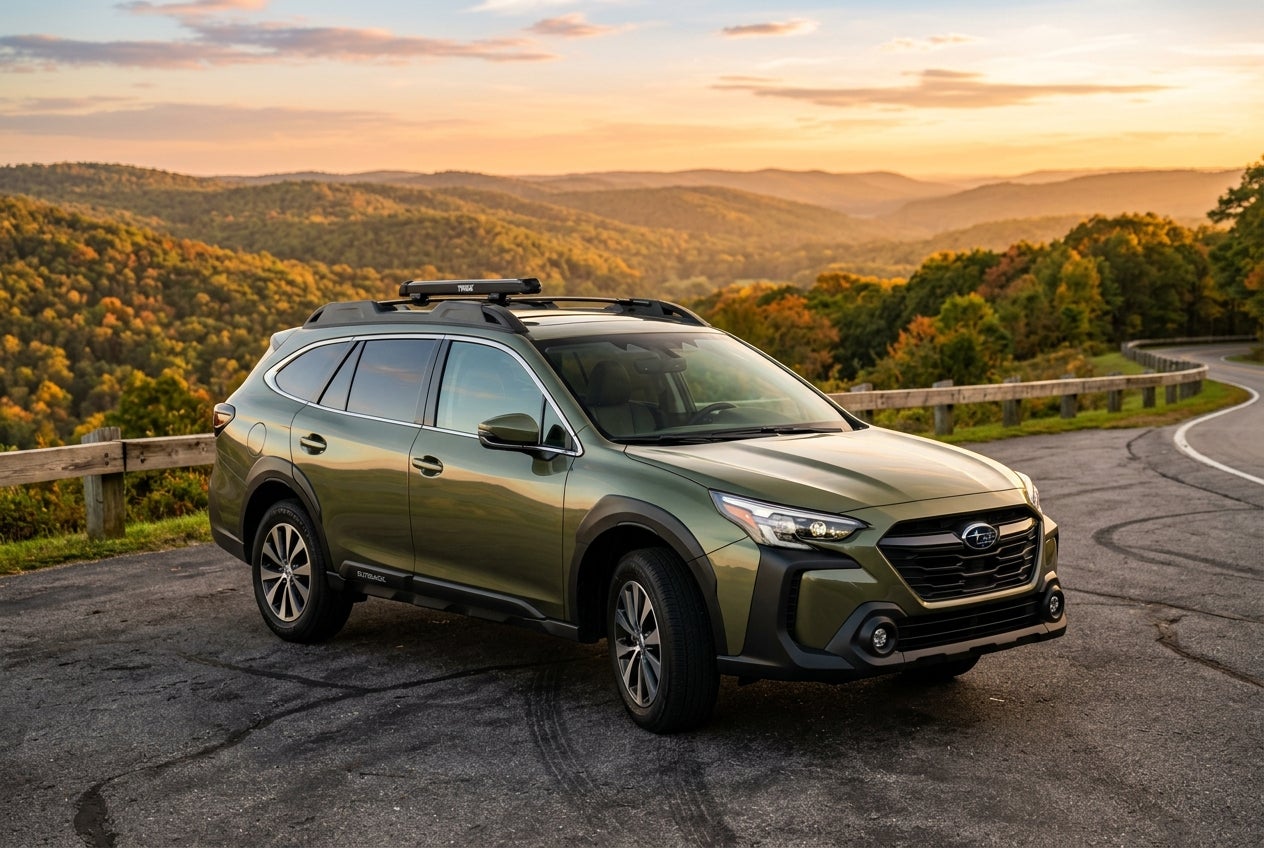
Olive green Subaru Outback parked at a scenic mountain overlook during a warm autumn sunset. (Representative image for illustration purposes only. Actual vehicle may vary based on trim and configuration.)

2026 Subaru Outback vs 2026 Hyundai Santa Fe Comparison

The 2026 Subaru Outback outperforms the 2026 Hyundai Santa Fe for most crossover buyers by offering standard Active Torque Split All-Wheel-Drive, significantly greater rear cargo volume, and superior fuel economy at an approachable starting base MSRP of $41,715 for the Limited trim. While the Santa Fe Calligraphy includes a third row, the Outback provides a more practical seating footprint, superior all-weather stability, and better long-term usability for active suburban drivers. Which SUV Offers the value for Chesterfield Families: 2026 Subaru Outback or 2026 Hyundai Santa Fe? The 2026 Subaru Outback Limited delivers greater initial and long-term financial value than the 2026 Hyundai Santa Fe Calligraphy by equipping standard all-wheel drive, a competitive base MSRP of $41,715, and a lower $1,450 destination charge. When evaluating trim levels across both lineups, standard features play a crucial role in overall cost effectiveness. The Outback lineup includes well-appointed trim tiers such as the Limited, Limited XT, and rugged Outback Wilderness. The Limited trim comes comprehensively standard with a 12.1 -inch navigation touchscreen, leather-trimmed upholstery, a 12 -speaker harman/kardon® audio system, and power-adjustable heated front seats. To match that level of luxury in the competition, buyers must look at top-tier variants like the Hyundai Santa Fe Calligraphy 2.5, Hyundai Santa Fe Calligraphy 2.5 AWD, Calligraphy Hybrid, or Calligraphy Hybrid AWD. Subaru maintains a clear pricing advantage when accounting for standard mechanical hardware. Every Outback comes standard with Symmetrical All-Wheel Drive, whereas adding all-wheel drive to a Santa Fe requires upgrading to an AWD trim. For drivers negotiating the gently rolling hills and seasonal winter road conditions around Chesterfield, standard all-weather traction eliminates the need to pay extra for essential peace of mind. Furthermore, trade-in retention and predictable maintenance costs reinforce the Outback's value proposition. Before selecting your next crossover, you can easily value your trade-in online to see how much equity you hold in your current vehicle. Browsing pre-owned inventory options also highlights how well Subaru crossovers retain their value over time compared to class rivals. Pricing Manufacturer-listed pricing per trim, across compared vehicles. 2026 Subaru Outback Trim MSRP 2026 Hyundai Santa Fe Trim MSRP Limited $41,715 Hyundai Santa Fe Calligraphy 2.5 — View New Car Inventory How Do the 2026 Subaru Outback and Hyundai Santa Fe Compare in Cargo and Passenger Space for Weekend Trips? The 2026 Subaru Outback offers far superior everyday cargo utility, supplying about 35 cu ft of luggage capacity behind its second row compared to just about 15 cu ft in the 2026 Hyundai Santa Fe. While the Santa Fe squeezes in a small third row to accommodate 6 passengers in a 2+2+2 captain's chair configuration, that extra row severely restricts rear storage space when all seats are in use. For families packing stroller equipment, sports gear, or coolers, the Santa Fe's about 15 cu ft rear well quickly becomes cramped. By contrast, the 5 -passenger Outback prioritizes spacious, two-row comfort with 43 in of front legroom and 39.5 in of rear legroom. Lowering the rear seats expands the Outback's cargo deck to a massive about 80.5 cu ft, featuring a long cargo area length of 75.9 in and a low loading floor height of 28.3 in that makes loading heavy gear effortless. Weight and dimensions further impact real-world versatility. The Limited trim has a manageable curb weight of 3,799 lbs, whereas the Santa Fe Hyundai Santa Fe Calligraphy 2.5 FWD weighs 4,343 lbs and its AWD counterpart scales at 4,486 lbs. The Outback's lighter footprint contributes to agile handling without sacrificing cabin roominess. Seating Capacity: Outback seats 5 comfortably; Santa Fe seats 6 with tight third-row legroom ( 30 in). Trunk Cargo (Seats Up): Outback provides about 35 cu ft; Santa Fe offers about 15 cu ft. Maximum Cargo (Seats Folded): Outback expands to about 80.5 cu ft; Santa Fe reaches about 80 cu ft. Exploring our new Subaru Outback inventory reveals flexible cargo management features, including retractable roof crossbars and durable cargo hooks. If you plan to haul dirty trail equipment or camping supplies around Maryland Heights, equipping your cabin with genuine OEM parts like all-weather floor liners and rear seatback protectors keeps your interior in pristine condition. Dimensions & Capacity Capacity and dimensions by trim Specification 2026 Subaru Outback 2026 Hyundai Santa Fe Seating 5 6 Cargo 34.6 cu ft 14.6 cu ft Curb weight 3,799 lbs 4,343 lbs Which Model Delivers Superior Performance and Fuel Efficiency on Chesterfield's Rolling Terrain? The 2026 Subaru Outback Limited delivers superior overall fuel economy with an EPA-estimated 25 city / 31 hwy / 27 combined MPG, easily outpacing the gas-powered 2026 Hyundai Santa Fe Calligraphy FWD, which yields 20 city / 29 hwy / 24 combined MPG. Powertrain engineering directly shapes how these crossovers handle daily driving duties. The standard Outback engine is a 2.5L Subaru BOXER 4-cylinder producing 180 hp and 178 lb-ft of torque, paired with a smooth Lineartronic CVT. For drivers wanting punchier acceleration, the Limited XT and Outback Wilderness upgrade to a 2.4L turbocharged Subaru BOXER engine delivering 260 hp and 277 lb-ft of torque via a High-torque Lineartronic CVT. The Santa Fe Calligraphy uses a 2.5L Smartstream turbocharged 4-cylinder generating 277 hp and 311 lb-ft of torque mated to an 8-speed SHIFTRONIC automatic transmission, while the Calligraphy Hybrid uses a 1.6L turbo hybrid setup making 231 hp and 271 lb-ft of torque. While the Santa Fe generates higher peak horsepower numbers on paper, the Outback's horizontally opposed engine design sits lower in the chassis. This creates a lower center of gravity that significantly reduces body roll through sharp turns and winding neighborhood streets. Coupled with standard Active Torque Split All-Wheel-Drive, the Outback provides confident, neutral handling on wet roads or light gravel trails. Fuel range also favors the Subaru. Thanks to its 18 -gal fuel tank capacity and 27 MPG combined rating, the 2.5L Outback boasts a calculated highway cruising range of 486 mi on regular unleaded gasoline. The gas Santa Fe Hyundai Santa Fe Calligraphy 2.5 FWD offers a 425 mi range from its 17.7 -gal tank. Take a look at our current selection of new Subaru models to test drive both powertrain options and experience Symmetrical AWD firsthand. Engine & Performance Powertrain specs by trim Specification 2026 Subaru Outback 2026 Hyundai Santa Fe Drivetrain All-wheel drive Front-wheel drive Engine 2.5L 2.5L Horsepower 180 hp 277 hp Torque 178 lb-ft 311 lb-ft Transmission Lineartronic CVT SHIFTRONIC Fuel Economy Fuel economy and range by trim Specification 2026 Subaru Outback 2026 Hyundai Santa Fe MPG 25 city / 31 hwy / 27 combined 20 city / 29 hwy / 24 combined New Subaru Outback Inventory What Smart Tech Features in the 2026 Subaru Outback and Hyundai Santa Fe Simplify Your Commute? The 2026 Subaru Outback simplifies daily driving with a prominent 12.1 -inch vertical touchscreen display, standard wireless Apple CarPlay®, wireless Android Auto™, and a 12 -speaker harman/kardon® premium audio system with a dedicated subwoofer. Subaru balances digital innovation with user-friendly ergonomic physical controls. The Outback's central infotainment setup integrates high-resolution 3D navigation, voice-activated controls, and over-the-air update capability while retaining intuitive physical buttons for primary climate and volume adjustments. Drivers can monitor critical vehicle data via the 12.3 -inch reconfigurable digital instrument cluster. Convenience features inside the Limited and Limited XT trims include: Wireless Device Connectivity: Standard wireless phone integration alongside a wireless charging pad. Plentiful Power Ports: 2 front USB charging ports and 2 rear USB charging ports keep everyone's devices powered. Customized Comfort: 10 -way power driver's seat with 2-position memory and manual thigh support. Premium Acoustics: 12 -speaker harman/kardon® surround sound system powered by a dedicated amplifier. The Santa Fe Calligraphy features dual 12.3 -inch panoramic screens and a 12 -speaker Bose® audio system. However, its heavy reliance on touch-capacitive HVAC menus can require more driver attention away from the road during quick adjustments. If your household requires even larger three-row passenger tech integration, you can also explore our three-row Subaru Ascent inventory to compare infotainment options across the Subaru family. How Do Safety Systems in the 2026 Subaru Outback and Hyundai Santa Fe Protect Families on School Routes? The 2026 Subaru Outback protects passengers with standard EyeSight® Driver Assist technology, an IIHS TOP SAFETY PICK+ award, and 8 standard airbags strategically placed throughout the cabin. EyeSight® acts as an extra set of eyes on busy suburban roads. Utilizing advanced stereoscopic cameras mounted near the rearview mirror, the system monitors traffic movement, optimizes adaptive cruise control, and warns you when swaying outside your lane. If a potential collision is detected ahead, automatic pre-collision braking can apply full braking force to help avoid or mitigate an impact. Standard active safety equipment across the Outback Limited, Limited XT, and Outback Wilderness includes: Pre-Collision System: Pre-collision braking and throttle management active above 7 mph. Blind Spot Detection: Overtaking sensors with lane change assist and rear cross-traffic alert. Reverse Automatic Braking: Brakes automatically at low speeds when obstacles are detected behind the bumper. Comprehensive Airbag Curtain: 8 standard airbags, including driver's knee airbag and side-curtain coverage for front and rear outboard seats. The Hyundai Santa Fe Calligraphy comes equipped with Forward Collision Avoidance Assist (FCA) with Junction Turning and 9 airbags. In IIHS crash testing, both vehicles achieved top "Good" ratings across driver-side small overlap, moderate overlap, and side-impact barrier tests. However, Subaru's long-standing reputation for structural integrity and EyeSight® reliability provides exceptional reassurance during everyday family commutes. To see how Subaru prioritizes active protection across its entire lineup, check out the new Subaru BRZ lineup or drop by our showroom for a walkthrough of EyeSight® functions. What Warranty and Maintenance Benefits Should Buyers Expect from the 2026 Subaru Outback and Hyundai Santa Fe? The 2026 Subaru Outback includes a 3 -year/ 36,000 -mile comprehensive bumper-to-bumper OEM warranty, a 5 -year/ 60,000 -mile powertrain warranty, and 3 years or 36,000 miles of dedicated Subaru Roadside Assistance. While Hyundai offers a 5 -year/ 60,000 -mile basic warranty and 10 -year/ 100,000 -mile powertrain coverage on the Santa Fe, Subaru backs its vehicles with exceptional build quality and a proven track record of long-term durability. According to industry data, the vast majority of Subaru vehicles sold over the last decade remain on the road today. When unexpected issues arise on the road, Subaru owners benefit from specialized manufacturer support. Emergency towing, jump-starts, flat tire changes, and lockout services are covered under the standard warranty period. You can contact Subaru Roadside Assistance: 1-800-782-2783 24 hours a day, 7 days a week for immediate, factory-backed support that directs your vehicle to authorized service centers utilizing genuine Subaru parts. Routine maintenance is straightforward and affordable. Our factory-trained technicians at Sunset Hills Subaru understand the precise calibration required for Subaru BOXER engines and Lineartronic CVTs. You can easily schedule a service appointment online for routine oil changes, tire rotations, or multi-point inspections. When you are ready to finalize your purchase, our finance department allows you to apply for financing online from the comfort of home. Current Service and Parts Offers 2026 Subaru Outback vs 2026 Hyundai Santa Fe: Answers to Common Buyer Questions The 2026 Subaru Outback stands out as the overall winner for active buyers, offering standard Symmetrical All-Wheel Drive, superior usable trunk space, better fuel efficiency, and a comfortable ride at an accessible starting MSRP of $41,715. Q: Is the 2026 Subaru Outback better suited for severe weather than the Hyundai Santa Fe? Yes, the 2026 Subaru Outback comes standard with Symmetrical All-Wheel Drive on every single trim level, including the Limited, Limited XT, and Outback Wilderness. This full-time system continuously distributes power to all four wheels for instant traction on wet, icy, or snow-covered roads. The 2026 Hyundai Santa Fe Calligraphy comes standard with front-wheel drive, requiring an optional upgrade to obtain all-wheel drive capability. Q: Which SUV offers more usable cargo space for gear and groceries? The 2026 Subaru Outback provides significantly more trunk space behind its second row, offering about 35 cu ft of cargo volume compared to just about 15 cu ft in the 2026 Hyundai Santa Fe when its third row is raised. Folding the second-row seats flat expands the Outback's cargo capacity to about 80.5 cu ft, making it far more practical for hauling oversized gear, camping equipment, or luggage. Q: How does fuel economy compare between the Outback and Santa Fe? The 2026 Subaru Outback Limited with the 2.5L engine achieves an EPA-estimated 25 city / 31 hwy / 27 combined MPG. The gas-powered 2026 Hyundai Santa Fe Hyundai Santa Fe Calligraphy 2.5 FWD gets 20 city / 29 hwy / 24 combined MPG. The Outback's superior efficiency and 18 -gallon fuel tank deliver a longer highway cruising range of 486 mi. Q: Is the higher price of the Hyundai Santa Fe Calligraphy worth it over the Outback Limited? For most buyers, the Subaru Outback Limited offers much better value. Starting at a base MSRP of $41,715 with a $1,450 destination charge, the Outback comes standard with all-wheel drive, leather seating, a 12.1 -inch touchscreen, and a harman/kardon® sound system. The Santa Fe Calligraphy carries a higher price tag and larger delivery charge, making the Outback a more cost-effective investment. Ready to discover the confidence of Symmetrical All-Wheel Drive for your family's next adventure? Visit Sunset Hills Subaru at 10100 Watson Rd, Sunset Hills, MO 63127, or give our sales team a call at (314) 476-9638. You can also map directions to our Sunset Hills showroom and schedule a test drive today! Shop New Subaru Outback Vehicle specification data © JATO Dynamics Limited. 2026 Subaru Outback in Sunset Hills MO | Sunset Hills Subaru