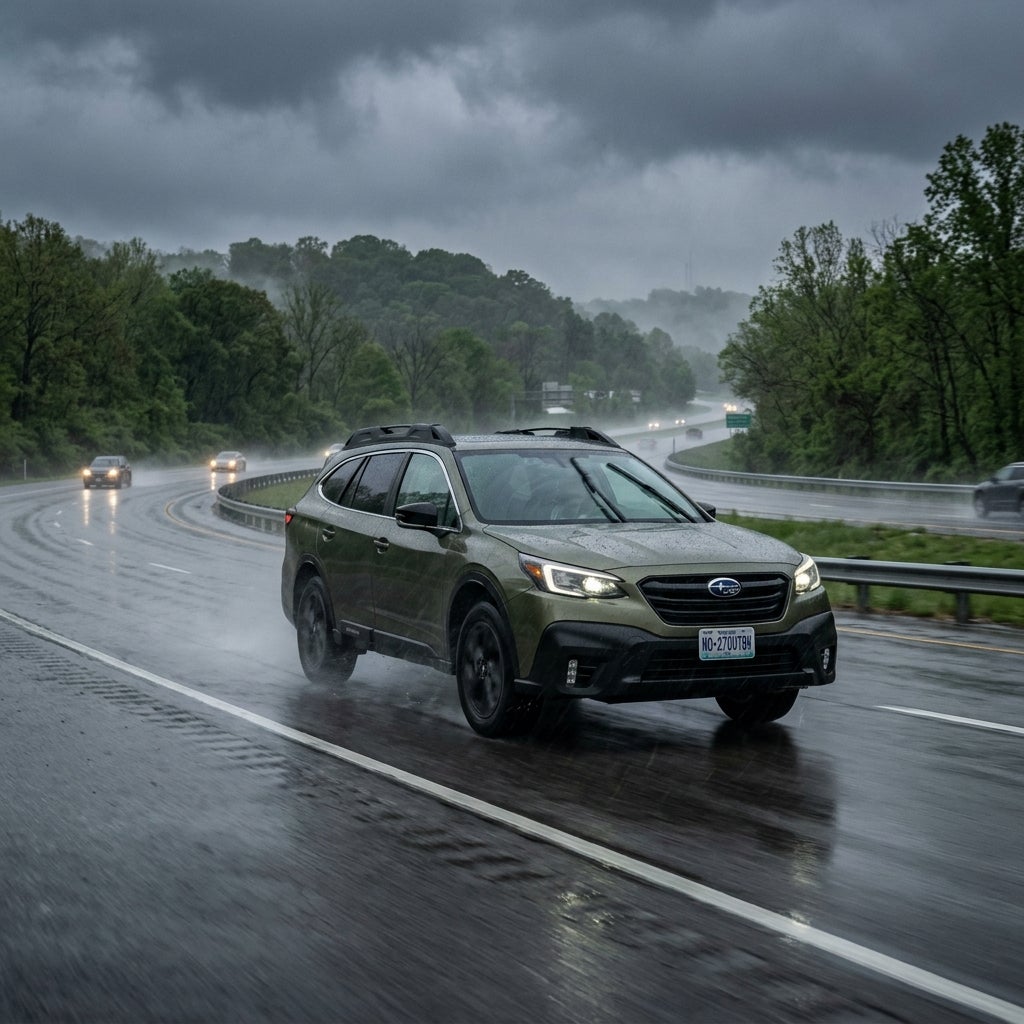
When heavy thunderstorm cells roll across Jefferson County and the greater St. Louis
metropolitan area, localized rain downpours convert routine commutes on Interstate 55,
Highway 141, and Watson Road into challenging environments. Navigating standing water,
unexpected hydroplaning pockets, and slick, oil-slicked asphalt requires a drivetrain that
actively anticipates loss of grip rather than reacting after a tire begins to spin. Subaru
Symmetrical All-Wheel Drive (AWD) is engineered specifically around this proactive
philosophy. By routing engine power continuously to all four wheels through a balanced,
linear layout, Subaru provides an extraordinary level of directional stability, wet-pavement
tracking, and emergency maneuverability. Unlike conventional part-time or slip-and-grip all-wheel drive systems found in many
competing crossovers, Subaru's Symmetrical AWD operates full-time. Engine output is
mechanically aligned along the vehicle's centerline, feeding equal-length front and rear
driveshafts. This symmetry eliminates heavy side-to-side weight transfer imbalances during
sudden steering inputs on wet surfaces. Whether you are driving home through Arnold during a
spring deluge or negotiating rain-slicked curves near the Meramec River, continuous power
distribution ensures that every tire carries its share of driving force, drastically
reducing the risk of initial wheel slip before it can jeopardize your safety. At Sunset Hills Subaru, we assist drivers from Arnold, Sunset Hills, Fenton, and
Mehlville in understanding how this unique engineering translates into daily peace of mind.
Explore our New Subaru Inventory to see how standard
Symmetrical AWD comes built into nearly every model, giving local commuters an unbeatable
safety edge when Missouri weather turns treacherous. Browse New Subaru Inventory What Makes Subaru Symmetrical AWD Different From Standard AWD Systems? To understand why Subaru handles heavy rain with such composure, one must examine
the internal architecture under the hood. Most front-wheel-drive-based crossovers
feature a transversely mounted engine (placed sideways). When all-wheel drive is added
to a transverse platform, power must undergo right-angle turns through complex gearboxes
and unequal-length driveshafts before reaching the rear wheels. This asymmetrical weight
balance can induce torque steer—a phenomenon where hard acceleration on wet asphalt
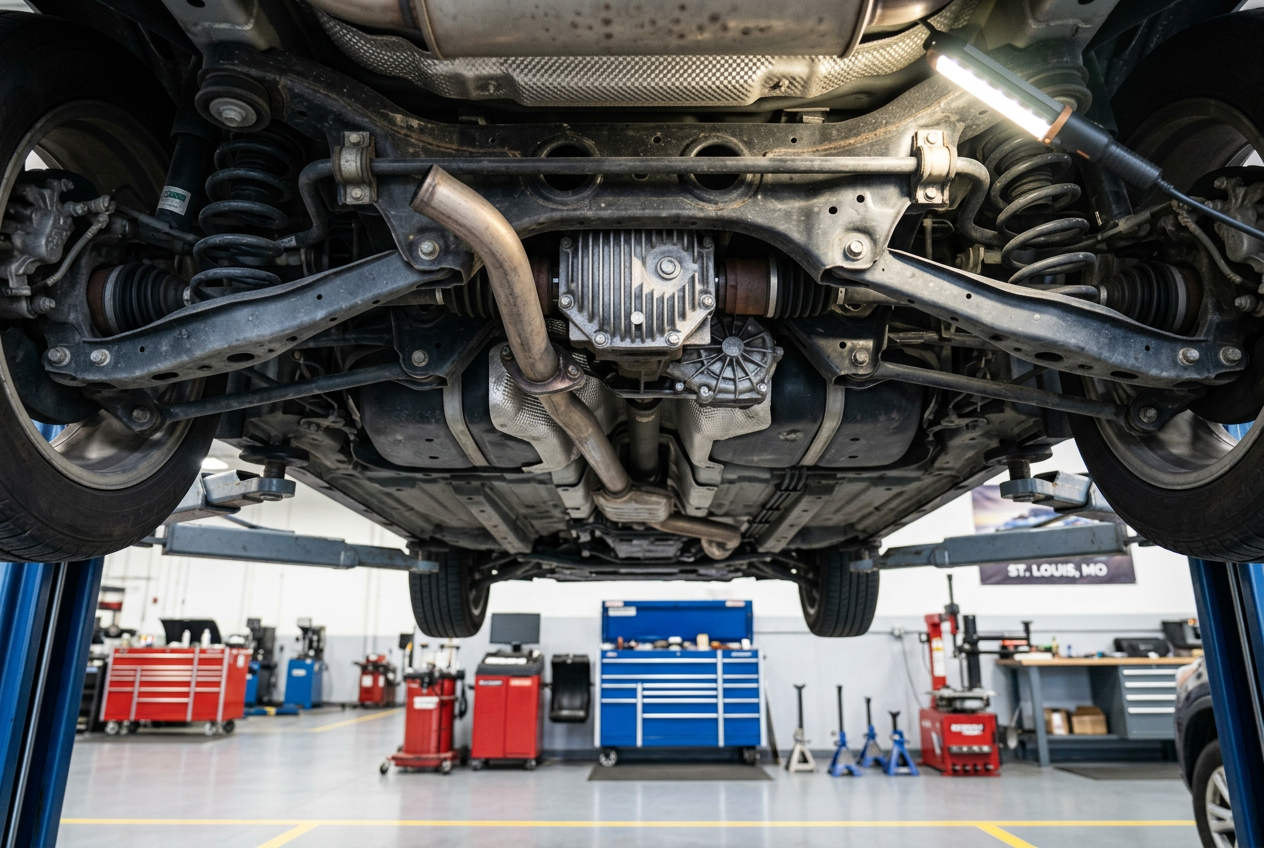
pulls the steering wheel left or right. Subaru solves this challenge at the structural level. The Subaru BOXER engine
features horizontally opposed pistons laid completely flat, mounted longitudinally along
the vehicle centerline. Because the engine sits inline with the transmission and
driveshafts, the entire powertrain displays perfect left-to-right lateral symmetry.
Equal-length axle shafts supply identical power pulses to both driver-side and
passenger-side wheels simultaneously. On wet or flooded roads, this balance prevents
sudden lateral weight shifts, keeping the tires firmly planted and steering response
completely predictable. Furthermore, the low center of gravity inherent to the Subaru BOXER engine reduces
body roll during sudden avoidance maneuvers on wet pavement. If a sudden obstacle
appears during a downpour on I-270, a Subaru chassis responds smoothly without
unsettling the rear suspension, giving driver and passengers maximum stability. Key Architectural Advantages: • Full-time power transfer to all
four wheels • Longitudinal, flat engine design lowers vehicle center of gravity •
Equal-length front driveshafts eliminate torque steer • Perfectly balanced chassis
weight distribution left-to-right Comparing Subaru Symmetrical AWD to Honda Real Time AWD and Toyota Dynamic Torque Control When evaluating SUV safety in rainy weather around Arnold and Sunset Hills, buyers often
compare Subaru against popular alternatives like Honda Real Time AWD and Toyota Dynamic
Torque Control. While these systems provide all-wheel drive capability, their engineering
philosophies differ fundamentally from Subaru's full-time architecture during heavy rain
conditions. Subaru Symmetrical AWD System Type: Full-Time Active Torque Split
AWD Operation in Rain: Continuously powers all four wheels
(typically 60/40 front/rear default split). Prevents wheel spin before traction loss
occurs. Mechanical Balance: Symmetric layout with inline BOXER
engine eliminates torque steer and lateral bias. Honda Real Time AWD System Type: Part-Time / Slip-and-Grip AWD Operation
in Rain: Operates primarily as 100% front-wheel drive under normal
conditions. Engages rear clutch pack only after front wheels detect
slip. Mechanical Balance: Transverse engine introduces slight
lag during sudden hydroplaning transitions. Toyota Dynamic Torque System Type: On-Demand Electromagnetic AWD Operation
in Rain: Defaults to front-wheel drive to save fuel, routing up to 50% torque
rearward when wheel spin sensors trigger. Mechanical Balance: Requires electronic clutch pack engagement, which can feel less immediate in heavy
standing water. AWD Feature / Technology Subaru Symmetrical AWD Honda Real Time AWD Toyota Dynamic Torque Control Primary Operating Mode Continuous Full-Time 4-Wheel Engagement Front-Wheel Drive Default (Reactive Rear) Front-Wheel Drive Default (On-Demand Rear) Reaction Time in Rain Instantaneous (Zero Lag) Requires Front Slip Detection Requires Sensor Activation Weight Balance Symmetrical / Low Center of Gravity Transverse Front-Heavy Transverse Front-Heavy Standing Water Handling High Hydroplane Resistance & Directional Stability Moderate Stability under active slip Moderate Stability under active slip How Subaru Symmetrical AWD Manages Torque and Wheel Slip in Heavy Rain and Standing
Water When cruising along I-55 near Arnold during a torrential downpour, hitting a sudden
patch of standing water can cause one or more tires to lose contact with the road
surface. Hydroplaning happens when a wedge of water builds up between the tire tread and
asphalt faster than the tread grooves can evacuate it. Subaru's Lineartronic Continuously Variable Transmission (CVT) pairs with an
electronically controlled Multi-Plate Transfer (MPT) clutch system—known as Active
Torque Split AWD. Dozens of times per second, the vehicle's central computer monitors
steering wheel angle, yaw rate, wheel speeds, and throttle position. If the front wheels
encounter standing water and begin to hydroplane, the electronic center differential
immediately increases hydraulic pressure on the clutch pack, transferring extra drive
torque to the rear wheels with solid traction. By maintaining continuous forward momentum through the tires that still have grip,
the vehicle tracks completely straight without twitching or pulling. To keep this system
operating at peak performance, local owners can Schedule Service
and Diagnostics at Sunset Hills Subaru for comprehensive multi-point
inspections. Schedule Service and Diagnostics The Role of Subaru VDC, Traction Control, and Active Torque Vectoring in Rain Symmetrical AWD works hand-in-hand with a suite of active chassis electronics designed
to keep your vehicle stable during high-stress wet weather scenarios. Three core
technologies form this safety foundation: Vehicle Dynamics Control (VDC), Traction Control
System (TCS), and Active Torque Vectoring. Vehicle Dynamics Control (VDC) VDC uses advanced yaw-rate sensors, lateral G-sensors, and wheel speed sensors to
constantly monitor whether the vehicle is following your intended steering path. If
severe understeer (plowing straight ahead) or oversteer (tail-sliding) begins on wet
pavement, VDC applies precise braking force to individual wheels and adjusts engine
output to pull the chassis back into line. Traction Control System (TCS) When accelerating from a complete stop on slick asphalt—such as turning onto Highway
141 from an inclined intersection in Arnold—TCS prevents driver-induced wheel spin. By
gently braking a spinning tire or modulating engine torque, TCS ensures maximum launch
traction without harsh jerky hesitations. Active Torque Vectoring During emergency lane changes or sharp cornering in rainy weather, Active Torque
Vectoring applies light braking force to the inside front wheel while routing engine
power to the outside wheels. This creates a subtle turn-in rotation, helping the vehicle
respond immediately to steering wheel adjustments without pushing wide into neighboring
lanes. Driving Through Deep Water and Mud: How Subaru X-Mode Provides Low-Speed Traction Heavy summer and autumn storms in Jefferson County frequently cause localized flash
flooding, runoff accumulation, and mud on low-lying secondary roads near the Meramec
River basin. When speeds drop below 25 mph and conditions worsen, standard driving modes
can benefit from dedicated off-road management. Subaru dual-function X-Mode (available on models like the Forester, Outback,
Crosstrek, and Ascent) optimizes low-speed traction at the press of a button or dial
turn. When engaged, X-Mode recalculates throttle sensitivity, locking the central MPT
clutch faster to lock front and rear power distribution. It also increases initial brake
lockup on spinning wheels to act as a limited-slip differential. In Deep Snow/Mud mode, X-Mode allows controlled wheel spin to fling thick mud out of
tire treads, ensuring continuous forward movement. Integrated Hill Descent Control
manages automatic braking down steep, slick inclines, letting drivers focus entirely on
steering safety. How Subaru EyeSight Driver Assist Performs During Heavy Rain and Dense Fog Subaru EyeSight Driver Assist Technology acts as an extra pair of eyes on the road,
utilizing dual color stereo cameras mounted inside the upper windshield. In moderate to
heavy rain, EyeSight continues to track vehicles ahead, lane markings, and obstacles ahead
to support Pre-Collision Braking, Adaptive Cruise Control, and Lane Keep Assist. On wet asphalt, Pre-Collision Braking adjusts stopping distance calculations to account
for reduced pavement friction. Furthermore, Adaptive Cruise Control automatically maintains
a conservative following distance when wipers are operating at regular speeds. However,
during extreme weather—such as torrential cloudbursts, intense water spray from semi-trucks,
or thick river fog—the optical camera view can be temporarily obscured. When visibility
degrades beyond clear recognition thresholds, EyeSight will emit a friendly chime and
illuminate a yellow dashboard indicator informing the driver that the system is temporarily
disengaged. Once windshield wipers clear the field of view or fog clears, EyeSight
automatically re-engages. Interested in experiencing EyeSight safety in person? Explore our New Subaru Outback Inventory or test drive the
family-friendly New Subaru Ascent Inventory at Sunset Hills
Subaru. Explore New Subaru Outback Inventory Keeping EyeSight Sensors and Windshields Clear During Stormy Weather Because EyeSight uses optical cameras mounted behind the upper windshield glass,
proper glass maintenance is directly linked to active system availability during heavy
rains around Arnold and Sunset Hills. Essential Maintenance Best Practices: 1. Replace
Wiper Blades Semi-Annually: Streaking or chatter across the camera zone
obscures line recognition. Genuine Subaru Wiper Blades are tailored specifically to wipe
the full camera sweep zone clear. 2. Prevent Interior Window
Fogging: Run your climate control with the AC compressor engaged on defrost
mode. Moisture film on interior windshield glass in front of camera lenses can trigger
safety cutoffs. 3. Use Quality Washer Fluid: High-performing
washer fluid helps eliminate road grime, bug residue, and oil film buildup thrown up by
highway traffic on wet roads. 4. Never Touch Camera Lenses: Avoid wiping or touching the internal EyeSight stereo lenses inside the cabin; oil from
fingertips can permanently damage optical coatings. Essential Wet-Weather Maintenance: Differential Fluid, CVT Fluid, and Tire Rotations Maintaining flawless wet-weather traction requires keeping the mechanical components of
Symmetrical AWD in peak health. Over time, fluid degradation or improper tire maintenance
can compromise power delivery responsiveness. Differential Gear Oil Front and rear differential gear oils lubricate ring and pinion gears. Driving
through standing water or flooded roadways can expose diff breathers to moisture.
Regular fluid inspections prevent internal gear corrosion and breakdown. Lineartronic CVT Fluid CVT fluid powers the hydraulic multi-plate transfer clutch that manages
front-to-rear torque split. High temperatures during summer commuting or heavy towing
break down fluid viscosity. Periodic service ensures instantaneous clutch pack
locking. Tire Rotations (6k Miles) Rotating tires every 6,000 miles guarantees even tread wear across all four corners.
Uniform tread depth ensures that all four tires rotate at identical rates, eliminating
center differential strain on rain-slick highways. Check out our service and parts information for current offers on routine maintenance,
fluid flushes, and tire care. Why All Four Tires Must Be Replaced Simultaneously on a Subaru AWD Vehicle One of the most critical maintenance requirements for any Subaru driver in Arnold or
Sunset Hills is maintaining strict tire circumference matching across all four wheels.
Subaru factory specifications require that all four tires be within 1/4 inch (2/32 in.
tread depth) of each other in overall circumference. The Mechanical & Safety Reasons: • Center
Differential Heat & Wear: If one tire is significantly newer or older than
the others, it rotates at a different revolutions-per-mile rate. The electronic center
differential interprets this constant speed difference as continuous wheel slip, causing
internal multi-plate clutch packs to drag, slip, generate extreme heat, and prematurely
fail. • Hydroplaning Instability: Mixing tires with uneven tread
depth results in unequal water evacuation rates across wheels. During sudden heavy rain
on Highway 141, one tire may hydroplane while the other holds grip, generating unwanted
vehicle yaw. Need genuine Subaru replacement tires? You can easily Find Subaru Parts and factory-approved tires through
Sunset Hills Subaru. Find Subaru Parts & Tires Is Symmetrical AWD Standard on Models Like the 2024 Subaru Crosstrek for Local Buyers? Yes! Unlike many competing brand lineups where all-wheel drive requires purchasing
expensive optional packages or upgrading to high-end trim levels, Subaru builds Symmetrical
All-Wheel Drive as standard equipment across almost its entire lineup. For suburban
commuters in Arnold and Sunset Hills, MO, this represents tremendous long-term value and
standard safety. Subaru Model Symmetrical AWD Status Wet-Weather Driving Advantage Inventory Link 2024 Subaru Crosstrek Standard Across All Trims Compact agility with 8.7 in. ground clearance for flooded urban roads New Subaru Crosstrek Inventory 2024 Subaru Outback Standard Across All Trims Long wheelbase stability with X-Mode deep rain handling New Subaru Outback Inventory 2024 Subaru Forester Standard Across All Trims High seating position with maximum EyeSight camera field of view New Subaru Forester Inventory 2024 Subaru Impreza Standard Across All Trims Hatchback versatility with active torque vectoring in tight downpours New Subaru Impreza Inventory 2024 Subaru Legacy Standard Across All Trims Refined sedan comfort with all-weather highway cruising prowess New Subaru Legacy Inventory 2024 Subaru WRX Standard Across All Trims Performance-tuned Symmetrical AWD for precise cornering in rain New Subaru WRX Inventory Whether you are considering the popular New Subaru
Crosstrek Inventory, spacious New Subaru Forester
Inventory, sporty New Subaru Impreza Inventory,
sophisticated New Subaru Legacy Inventory, high-performance New Subaru WRX Inventory, track-ready rear-wheel drive New Subaru BRZ Inventory, or all-electric dual-motor New Subaru Solterra Inventory, Sunset Hills Subaru offers
unmatched selection. Local Missouri Driving Safety: Navigating Rain-Slick Commutes Between Arnold, Sunset
Hills, and St. Louis Commuters traveling between Arnold in Jefferson County and Sunset Hills or downtown
St. Louis face unique road geography. Crossing the Meramec River bridge on I-55 during
autumn rainstorms often presents sudden crosswinds combined with slick metal bridge
joints. Interstate 270 interchanges present sharp cloverleaf ramps where water pools
quickly on off-camber pavement. Subaru Symmetrical AWD shines in these exact localized conditions. By maintaining
continuous four-wheel grip, your vehicle tracks reliably through standing puddles, slick
bridge transitions, and tight exit ramps without sudden kickbacks or loss of steering
feel. Ready to upgrade your rainy-day drive? Sunset Hills Subaru makes transitioning into
a new or pre-owned Subaru simple. You can Get Your Trade-In
Value online in minutes, browse our quality Used
Vehicle Inventory, or Get approved for financing before visiting our dealership. Experience Safe Wet-Weather Driving with Sunset Hills Subaru when convenient Don't let unpredictable Missouri rainstorms compromise your safety on the road. Visit
Sunset Hills Subaru when convenient to test drive a new Crosstrek, Outback, Forester, or
Ascent equipped with standard Symmetrical All-Wheel Drive. Discover how superior
engineering, advanced EyeSight driver assistance, and low-center-of-gravity balance
transform rainy driving from stressful to complete confidence. Check out our Current New Car Specials for attractive
lease and finance offers. Need to visit us from Arnold or St. Louis? Get Directions to Sunset Hills Subaru at
10100 Watson Rd, Sunset Hills, MO 63127 or Call us at (314)
476-9638 to speak directly with our team. Get Approved for Financing when convenient Subaru Symmetrical AWD Benefits in Sunset Hills MO | Sunset Hills Subaru