Blog / Safety

Demystifying 2025 EyeSight Technology: How Subaru’s Latest Safety Suite Protects St. Louis Drivers

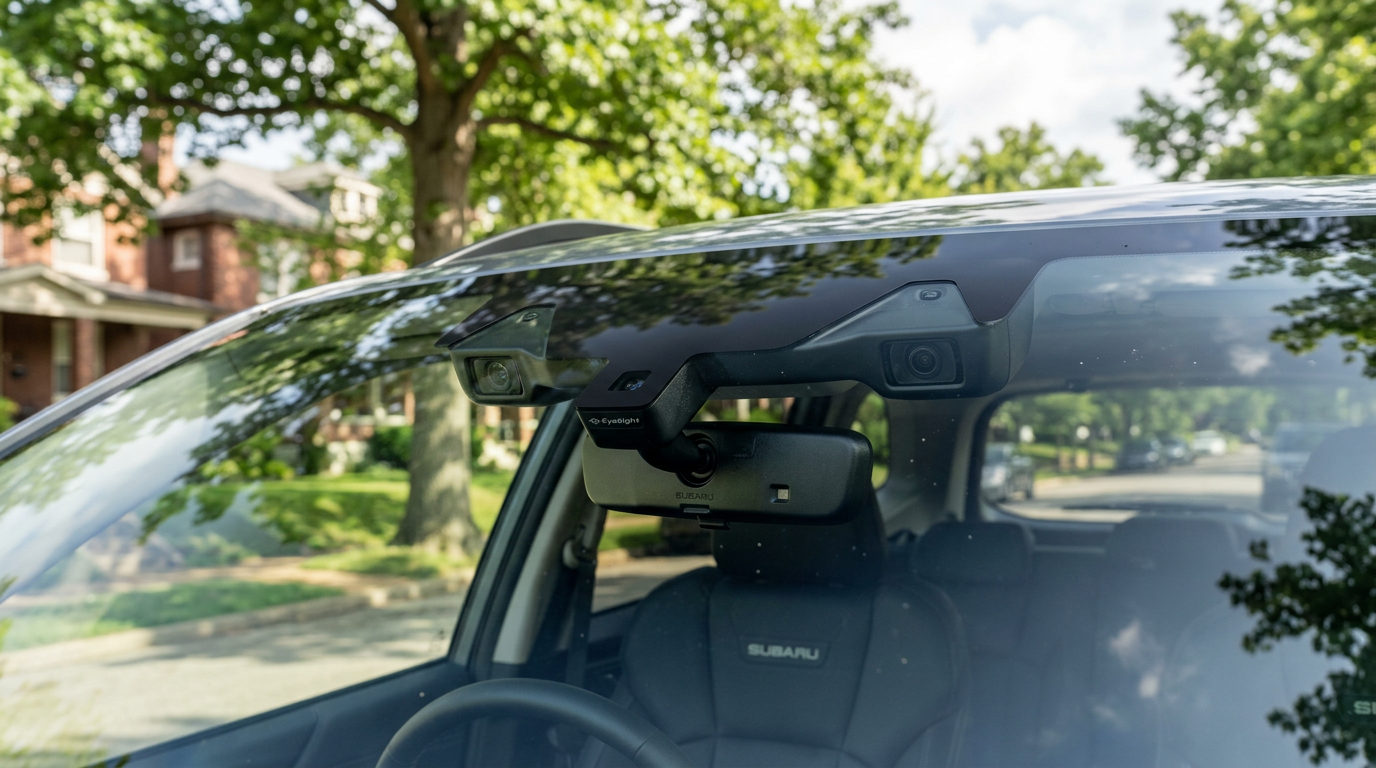
Subaru EyeSight driver-assist safety cameras mounted on a windshield near the rearview mirror. (Representative image for illustration purposes only. Actual vehicle may vary based on trim and configuration.)
For generations of drivers in Sunset Hills, Ladue, and the surrounding St. Louis communities, safety isn’t just an optional luxury feature on a spec sheet—it is an absolute prerequisite. As our local roadways grow increasingly complex, from the rapid merge points on Interstate 270 to the bustling commuter lanes of Watson Road, having an intelligent co-pilot is no longer a futuristic concept. It is a daily necessity. Subaru has long stood at the absolute forefront of automotive safety, pioneered by its revolutionary EyeSight Driver Assist Technology. Now, with the arrival of the 2025 model year, this acclaimed safety suite has undergone its most sophisticated evolution yet, introducing state-of-the-art camera hardware, vastly improved software processing, and a heightened level of awareness tailored for the safety-conscious luxury driver.
At Sunset Hills Subaru, we believe that understanding the technology behind your vehicle’s safety systems is the key to driving with absolute confidence. The 2025 EyeSight suite represents a monumental leap forward, transitioning from a system that simply reacts to immediate hazards to an ecosystem that actively anticipates potential conflicts before they materialize. Whether you are navigating the historic, tree-lined residential corridors of Ladue or managing the stop-and-go rush hour traffic heading into downtown St. Louis, this updated technology is engineered to protect you, your passengers, and everyone else sharing the road. To experience these updates firsthand, you can Get Directions to Sunset Hills Subaru and visit our showroom for a personalized demonstration.
Our dealership is proud to serve as the premier local authority on Subaru’s engineering advancements. We know that our clients demand more than just generic marketing summaries; they want a granular, engineering-focused breakdown of how these systems operate in real-world scenarios. In this comprehensive guide, we will break down the structural, optical, and software changes that define the 2025 EyeSight system. We’ll explore how physical windshield integration improves reliability, why the new wide-angle mono camera is a game-changer for intersection safety, and how the redesigned 2025 Subaru Forester sets a new standard for compact SUV protection. If you have immediate questions, feel free to Call us at (314) 476-9638 to speak with one of our certified Subaru technology specialists.

What is new with the Subaru EyeSight technology for the 2025 model year?

For the 2025 model year, Subaru did not simply polish existing features; they overhauled the underlying digital architecture of the EyeSight suite. The absolute biggest upgrade lies in the system's software integration and raw processing capabilities. Equipped with next-generation dual-core processors, the 2025 system can process visual data at nearly double the speed of outgoing models. This means the time between detecting an obstacle and initiating a safety intervention—such as pre-collision braking or throttle mitigation—has been slashed to mere milliseconds. When driving along the gently rolling, tree-lined roads of Sunset Hills, where a hidden driveway or a sudden deer crossing can require split-second evasiveness, this dramatic reduction in latency is a profound advantage.
Furthermore, the control algorithms have been recalibrated to behave with a much higher degree of human-like fluidity. In previous iterations, drivers occasionally noted that adaptive cruise control interventions or lane-keep assists could feel slightly rigid or mechanical. For 2025, the system operates with smooth, progressive inputs. When another vehicle cuts into your lane on the highway, the system gently rolls off the throttle and applies progressive brake pressure, rather than executing a abrupt and unsettling deceleration. This sophisticated, elegant execution elevates the driving experience, turning advanced driver assist technology from an intrusive safety net into a natural, seamless extension of your own driving inputs.
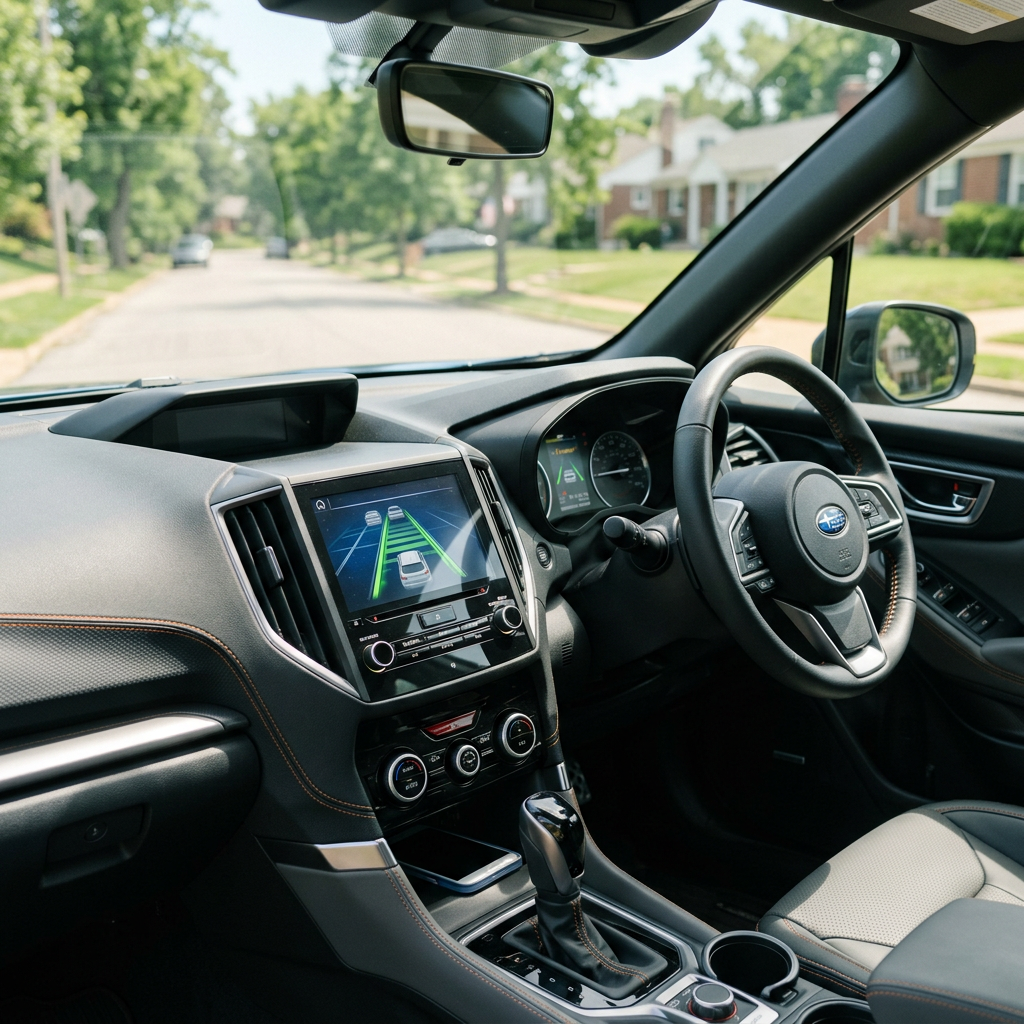
Interior view of a right-hand drive Subaru showing the dashboard, infotainment screen, and steering wheel. (Representative image for illustration purposes only. Actual vehicle may vary based on trim and configuration.)
The refined 2025 interface provides clear, non-distracting visual cues to ensure you are always aware of your vehicle's safety status.

Has the camera hardware changed physically for 2025?

Windshield Integration

Historically, Subaru's EyeSight cameras were housed in a pod suspended slightly away from the front glass. For 2025, the physical housing has been completely redesigned to mount flush directly against the windshield. This structural integration eliminates the open gap between the lens and the glass, preventing cabin dust, condensation, and accidental fingerprints from obstructing the camera's view, ensuring the system remains operational in all conditions.

Compact Profile

The physical footprint of the EyeSight enclosure has been reduced by over 30 percent. This sleeker, more compact design maximizes the driver's forward field of vision. By tucking the camera housing neatly behind the rearview mirror, Subaru engineers have successfully minimized the visual clutter in the upper windshield area, allowing you to enjoy a completely unobstructed view of your surroundings.

Advanced Lens Coatings

To combat the challenging lighting conditions of early morning and late evening commutes, the 2025 lenses feature a specialized anti-reflective and hydrophobic coating. This advanced coating actively disperses glare from oncoming headlights and prevents internal reflection, keeping the optical path crystal-clear and allowing the high-resolution sensors to track lane markings and vehicles flawlessly.

What models get the wide-angle mono camera in 2025 and how does it improve intersection safety?

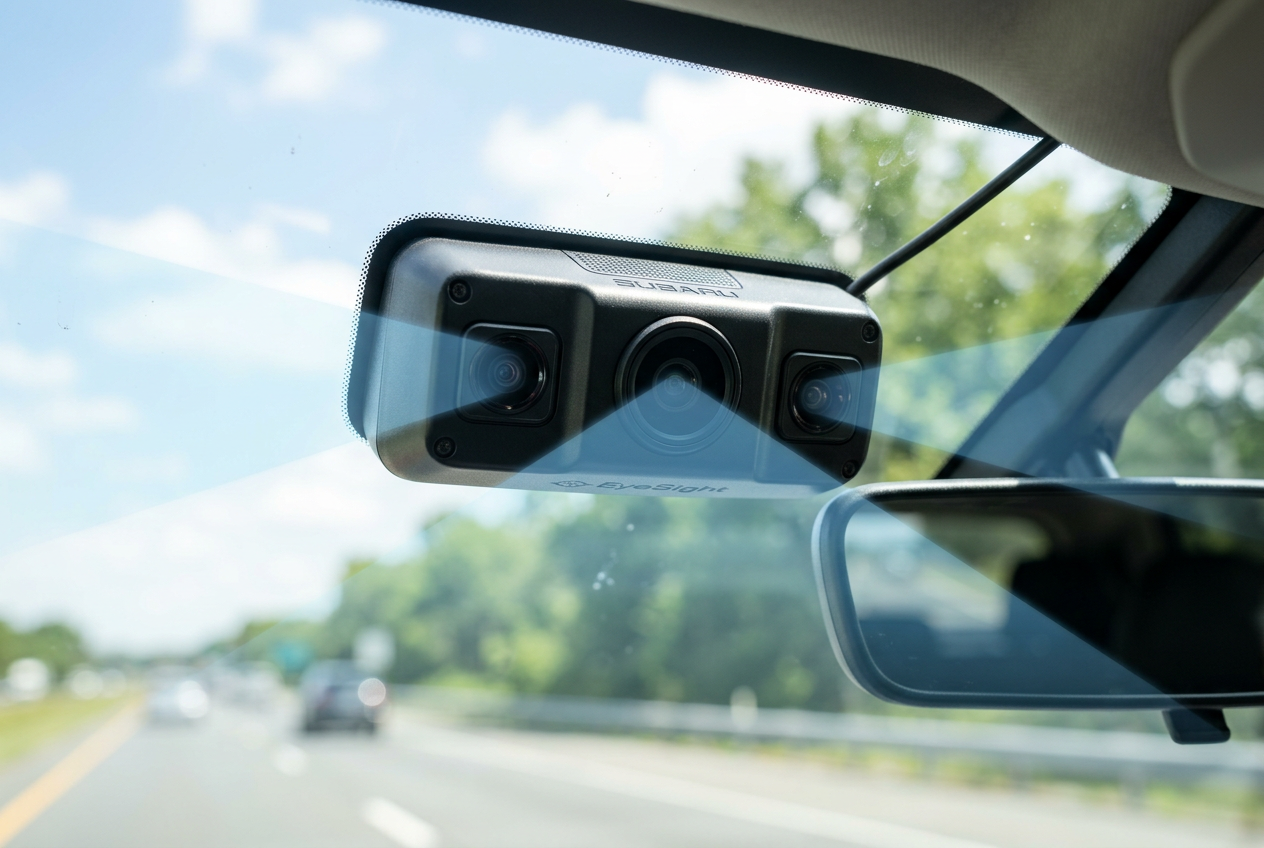
One of the most revolutionary additions to the 2025 safety suite is the introduction of a third, wide-angle mono camera working in tandem with the traditional dual-camera stereoscopic setup. This innovative three-camera configuration is featured prominently across highly popular models in our New Subaru Inventory, including the completely redesigned 2025 Subaru Forester, the rugged 2025 Subaru Outback, and the family-focused 2025 Subaru Ascent. By incorporating this third sensor, Subaru has dramatically expanded the system's horizontal field of view, allowing the vehicle to monitor areas that were previously blind spots for older driver-assist systems.
This expanded view is specifically engineered to address one of the most dangerous driving environments: busy suburban intersections. When you are making a turn at a complex intersection, the wide-angle mono camera scanning ahead can detect pedestrians, bicyclists, and cross-traffic coming from the sides much earlier than a dual-camera system. If a cyclist suddenly enters your path while you are turning, the system can instantly alert you and apply the brakes if necessary. This added layer of defense is invaluable for navigating high-traffic St. Louis intersections, such as those along Lindbergh Boulevard or near major shopping centers, where multiple lanes of movement and pedestrian crossings require maximum driver vigilance.
Does the 2025 Subaru Forester feature an updated version of EyeSight?

Yes, the fully redesigned 2025 Subaru Forester serves as the shining showcase for this updated safety technology. As an SUV designed specifically to elevate the daily family commute, the Forester comes standard with the advanced three-camera EyeSight system on almost every trim level. This integration is highly critical for families navigating school zones, residential neighborhoods, and congested parking lots around top-rated schools in Ladue and Sunset Hills. The Forester's structural redesign allowed engineers to embed the cameras perfectly into the cabin's upper trim, making it more integrated than ever before.
Beyond physical integration, the 2025 Forester benefits from an updated electric brake booster. This hardware upgrade works in perfect synergy with EyeSight, enabling the pre-collision system to initiate braking much more rapidly and smoothly. Whether you are slowing down for a sudden backup on the highway or reacting to a pedestrian stepping off a curb, the braking intervention is prompt yet controlled, reducing passenger discomfort while maximizing safety. Discover our current selection and schedule a test drive by browsing our New Subaru Forester Inventory.

Does the 2025 EyeSight system offer hands-free driving?

It is critical to clarify the exact capabilities of the 2025 Subaru EyeSight system. EyeSight is a Level 2 driver assistance system, not a fully autonomous or hands-free system. Subaru's safety philosophy is built around driver collaboration rather than driver replacement. The system is designed to act as an extra set of eyes and a supportive hand, keeping you centered in your lane and maintaining a safe distance from other vehicles, but it always requires you to keep your hands on the wheel and your attention on the road ahead.
To ensure driver engagement, the 2025 system utilizes steering wheel touch sensors and advanced cabin monitoring cameras to detect if your hands leave the wheel or if your eyes wander from the road. If the system detects a lack of driver input, it will initiate a series of progressive visual and audible warnings. This collaborative approach ensures that you remain the primary decision-maker while driving, utilizing EyeSight as a powerful, reassuring safeguard rather than a replacement for active, attentive driving.
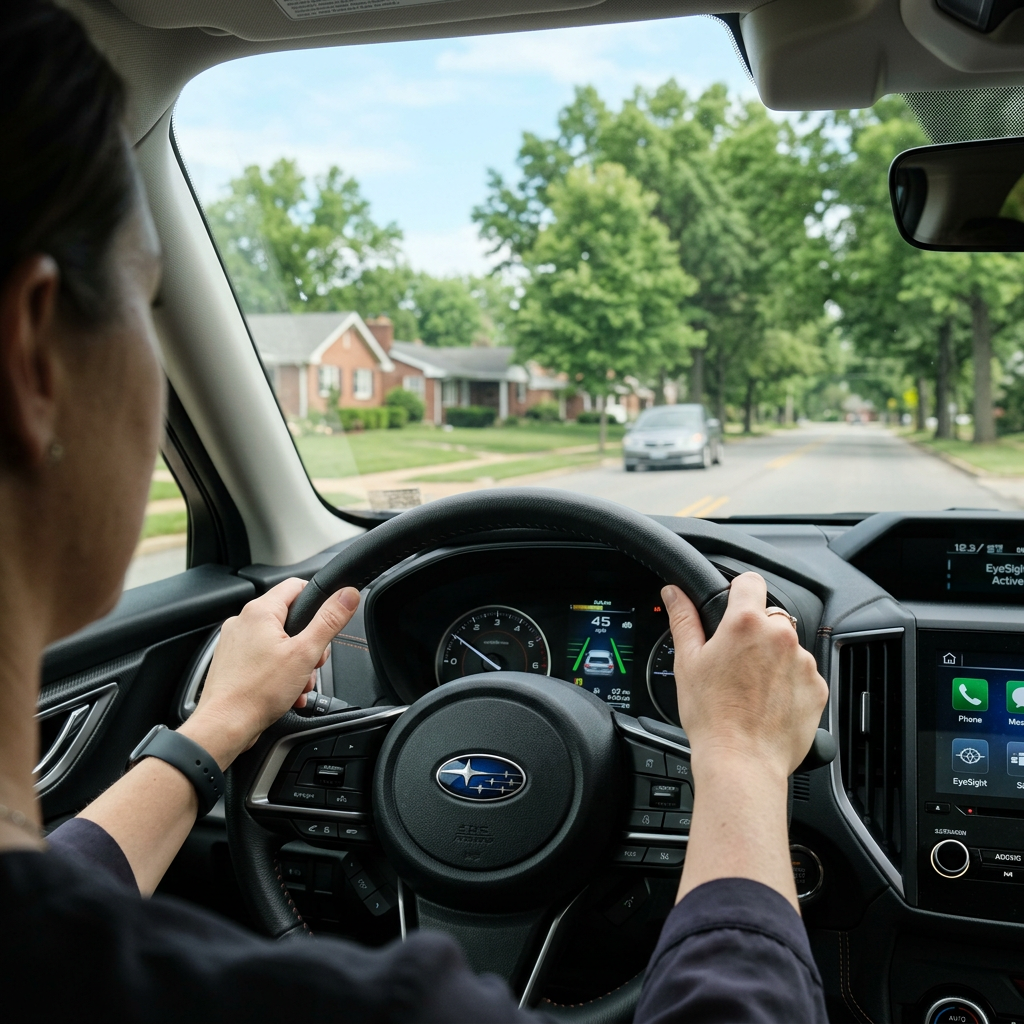
Woman's hands on a Subaru steering wheel while driving down a tree-lined residential street. (Representative image for illustration purposes only. Actual vehicle may vary based on trim and configuration.)

How does the 2025 Subaru EyeSight system work under different weather conditions and can it detect animals?

Weather Adaptability

St. Louis weather can change in an instant, bringing heavy summer downpours, thick autumn fog, or winter snowstorms. Because EyeSight is an optical system, its performance can be temporarily affected by extreme weather that reduces human visibility. However, the 2025 model uses high-dynamic-range (HDR) sensors that process contrast significantly better, allowing it to track lane lines and brake lights through dense rain and fog much more effectively than prior generations.

Large Animal Detection

For drivers on dark, suburban roads bordering wooded areas, wildlife is a constant hazard. The 2025 EyeSight software features expanded neural network training, allowing it to recognize the unique shapes and movement profiles of large animals, such as deer. If an animal enters the roadway ahead, the system can identify the hazard and initiate Pre-Collision Braking to mitigate or avoid a collision.

Practical Maintenance

To maintain optimal performance in challenging weather, keep your windshield clean and free of streaks. Use high-quality wiper blades and clear any ice or heavy snow buildup from the camera area before setting off. If the cameras ever become blocked, a simple dash indicator will notify you, and the system will temporarily pause until visibility is restored.

What is Emergency Stop Assist and at what speed does EyeSight's Pre-Collision Braking operate?

Emergency Stop Assist is a critical, life-saving addition to the 2025 EyeSight suite. If you are driving on the highway with Advanced Adaptive Cruise Control and Lane Centering active, and you suddenly experience a medical emergency or become completely unresponsive, the system steps in. After issuing multiple progressive visual and audible warnings with no driver response, Emergency Stop Assist will automatically activate the hazard lights, slow the vehicle down progressively, and bring it to a complete, safe stop within its lane of travel. This safety feature provides immense peace of mind, protecting not only the vehicle's occupants but other drivers on the road.
Complementing this is the system's Pre-Collision Braking, which operates across a highly versatile speed range. Designed to detect potential frontal collisions with vehicles, pedestrians, or cyclists, the system can apply full braking force automatically to mitigate or entirely avoid an accident. It operates at speeds from 1 mph up to approximately 100 mph, offering protection in both slow-speed parking lot maneuvers and high-speed highway travel. If you suspect your system requires diagnostic testing or verification, please Schedule Service and Diagnostics with our factory-trained technicians at Sunset Hills Subaru.
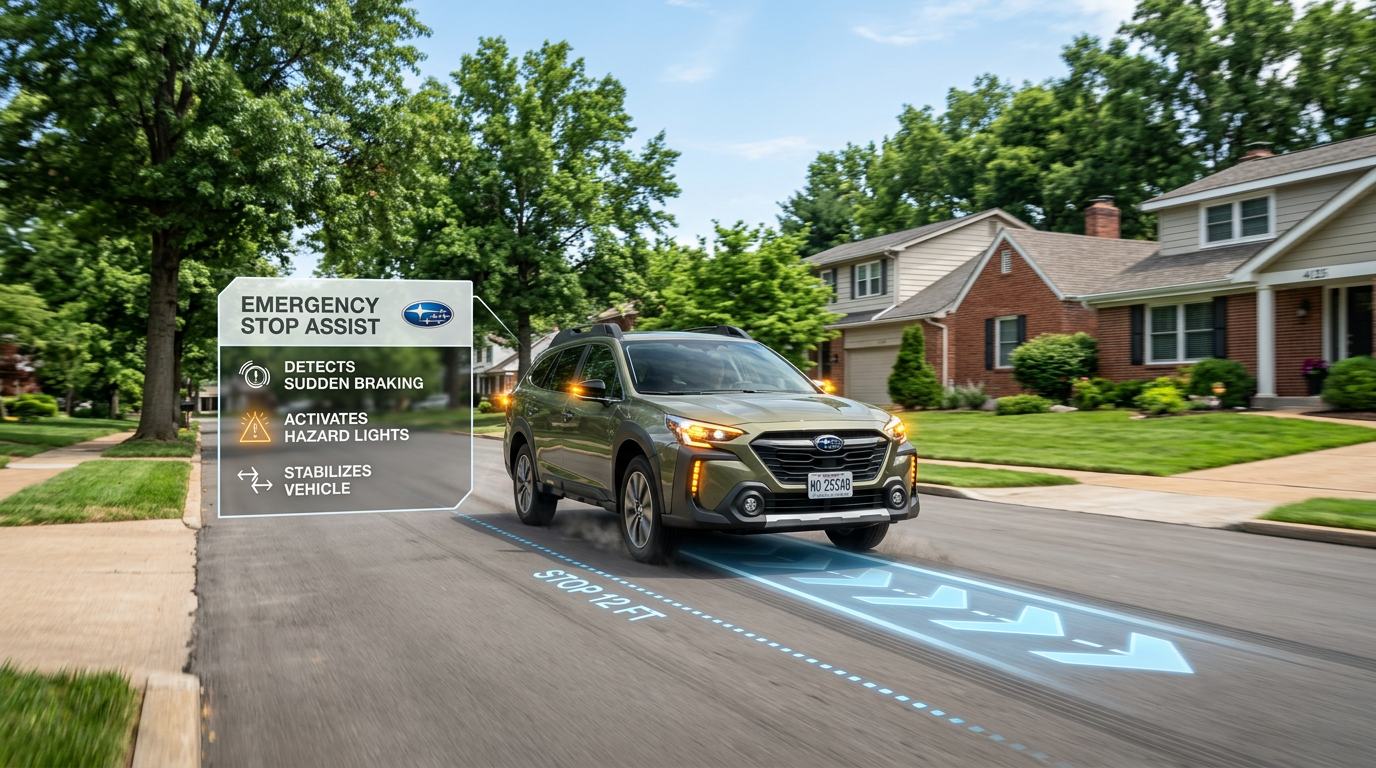
A green Subaru SUV braking on a suburban street with graphics illustrating Emergency Stop Assist features. (Representative image for illustration purposes only. Actual vehicle may vary based on trim and configuration.)

How does Adaptive Cruise Control with Lane Centering function during your daily commute?

For many St. Louis drivers, the daily commute involves navigating heavy highway congestion along Interstate 270, US-40, or Watson Road. This stop-and-go pattern can be mentally exhausting and physically draining over time. Subaru's Advanced Adaptive Cruise Control with Lane Centering is specifically engineered to reduce this commuter fatigue, transforming your daily drive into a calm, relaxed experience.
The system works by letting you select a desired speed and a following distance from the vehicle ahead. Using its high-resolution camera array, the 2025 EyeSight system continuously monitors the traffic flow, automatically adjusting the throttle and braking to maintain that safe gap—even down to a complete stop. When traffic moves again, a simple tap of the resume button or accelerator pedal gently restarts your forward progress, keeping you moving smoothly.
Simultaneously, the Lane Centering feature provides gentle steering assistance to keep your vehicle positioned securely in the middle of your lane. Rather than ping-ponging between the left and right lane markings, the 2025 system actively tracks the lane boundaries and the path of the vehicle ahead to calculate a smooth, natural driving line. This means you spend less effort making micro-corrections on sweeping curves, arriving at your destination feeling energized rather than drained.
By combining throttle, braking, and steering management, the 2025 Subaru EyeSight system acts as a highly vigilant co-pilot, keeping you safe and comfortable. Whether you are driving the spacious family-oriented three-row Ascent or commuting in the sleek, sporty Legacy, this technology is designed to make every mile of your journey easier and more enjoyable.

What does the Pre-Collision Throttle Management feature do and does EyeSight include blind-spot monitoring?

Pre-Collision Throttle Management

Have you ever accidentally put your vehicle into Drive instead of Reverse in a tight parking spot? Pre-Collision Throttle Management is designed specifically to prevent this common, stressful error. If the EyeSight cameras detect an obstacle directly ahead (like a brick wall, parking barrier, or another vehicle) and you press the accelerator hard, the system will cut engine power to minimize the force of impact, giving you precious seconds to react and apply the brakes.

Blind-Spot Detection Integration

While the core EyeSight system utilizes forward-facing cameras, it works in perfect harmony with Subaru's radar-based Blind-Spot Detection. This integrated system monitors your rear quarter panels, illuminating a bright warning icon in your side mirrors if a vehicle is traveling in your blind spot. If you signal to change lanes while a vehicle is detected, the warning icon flashes rapidly to alert you, ensuring safe lane changes on busy multi-lane roads.

Rear Cross-Traffic Alert

Backing out of a driveway or a crowded space at a local grocery store can be highly stressful. Rear Cross-Traffic Alert utilizes the same rear radar sensors to scan for oncoming vehicles approaching from either side. If a vehicle is detected, the system warns you with audible and visual alerts. Combined with EyeSight's forward capabilities, this provides 360 degrees of comprehensive awareness to keep you and your vehicle safe.

Navigating Lindbergh Boulevard and Ladue Roads with 2025 Subaru EyeSight

Driving around Sunset Hills and Ladue presents unique challenges that demand a highly intelligent, responsive safety system. Our historic neighborhoods feature beautiful winding roads, mature trees that cast shifting shadows across the pavement, and busy commercial corridors like Lindbergh Boulevard. Navigating these routes requires constant adjustments as you move from high-speed highways to tight, pedestrian-heavy school zones and complex shopping center entrances. The 2025 EyeSight system is uniquely suited to handle these transitions, offering specialized features that adapt to your driving environment.
For example, when driving through pedestrian-heavy school zones, the high-resolution camera system is constantly scanning the sidewalk, ready to alert you if a student steps off the curb unexpectedly. In tight suburban parking lots, Pre-Collision Throttle Management protects your bumper from accidental dings, while Rear Cross-Traffic Alert ensures you can back out of spaces with absolute confidence. If you are ready to upgrade your current vehicle to a 2025 model equipped with these safety advancements, we invite you to utilize our convenient online tool to Get your value trade and discover how affordable your next upgrade can be.
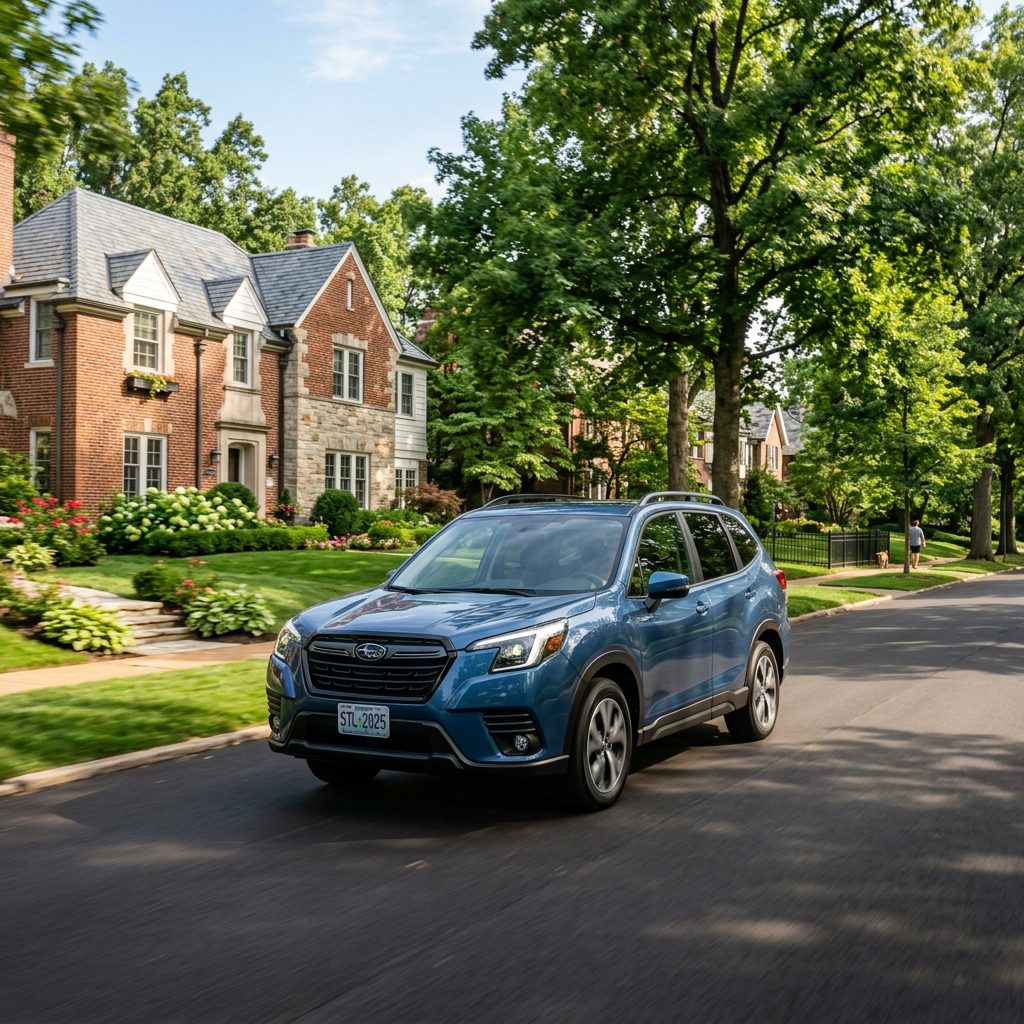
Keeping Your EyeSight Cameras Calibrated at Sunset Hills Subaru

The Importance of Calibration

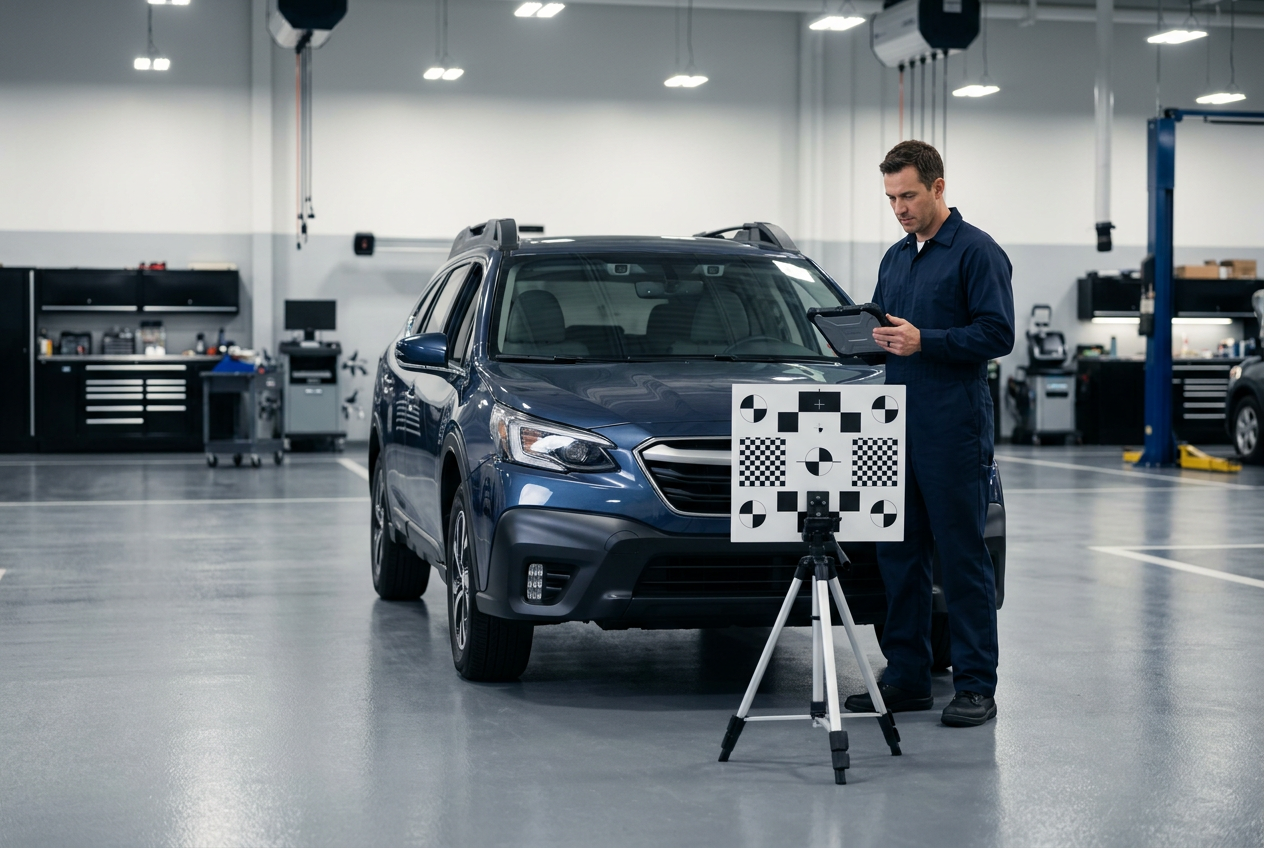
Because the EyeSight system relies on precise mathematical measurements to calculate distances and speeds, the cameras must remain perfectly aligned. Over time, minor occurrences like hitting a large pothole, windshield replacements, or installing aftermarket suspension lifts can shift the cameras slightly out of spec, requiring professional calibration to restore proper safety functions.

OEM Windshield Replacement

If your windshield is damaged by road debris, it is vital to replace it with a genuine OEM windshield. Aftermarket glass often has subtle distortions that can degrade the cameras' ability to track lane lines and vehicles accurately. At our dealership, we use only certified OEM glass and specialized diagnostic tools to ensure your new windshield integrates seamlessly with your safety suite. Find Subaru Parts directly through our website.

Expert Service & Specials

Our modern service department is fully equipped with specialized diagnostic targets and software required to perform precise physical calibrations. Our factory-trained technicians ensure your EyeSight system is operating exactly as the engineers intended, maintaining factory safety standards. Check out our Current Service and Parts Specials for savings on your next visit.

Experience the Next Generation of Safety: Test Drive a 2025 Subaru at Sunset Hills Subaru Today

Reading about advanced safety engineering is one thing, but experiencing its protective embrace on the road is entirely another. At Sunset Hills Subaru, we invite you to visit our convenient showroom in Sunset Hills, MO, to take a 2025 model out for a comprehensive test drive. Our knowledgeable team of Subaru enthusiasts is standing by to demonstrate each of these features in real-world scenarios, helping you find the perfect model tailored to your family's unique lifestyle.
We offer a stress-free, luxury shopping experience with flexible options to suit your needs. You can easily Get approved for financing online before your visit to save time, and check out our Current New Car Specials to discover exceptional offers on our latest lineup. From the rugged Outback to the redesigned Forester, we are confident you will find a vehicle that elevates your daily drive while offering the industry's most advanced safety protection.
images (7)
Sunset Hills Subaru 10100 Watson Rd, Sunset Hills, MO 63127 Sales & Tech Support:(314) 476-9638| Get Directions to Sunset Hills Subaru
Posted in:

Related Posts

Eyesight calibration

Are Subaru Safety Sensors and EyeSight Cameras Reliable as Cars Age?

The direct answer is yes. Subaru EyeSight stereo cameras and rear radar modules are solid-state electronic systems engineered to endure well beyond 10 to 15 years and over 200,000 miles without fundamental mechanical degradation. Unlike moving mechanical parts subject to physical friction, solid-state sensors do not simply wear out from accumulated mileage. Drivers across Greater St. Louis routinely pilot decade-old Foresters and Outbacks with fully functioning driver-assist systems intact. However, long-term reliability is not entirely maintenance-free. While the optical processing units and internal microchips remain durable, the system relies on external variables: optical clarity through the windshield, precise physical calibration, electrical voltage stability, and vulnerability to severe weather. As your vehicle passes the 100,000-mile mark, issues rarely stem from internal electronics; instead, they result from road debris pitting the glass, uncalibrated windshield replacements, or failing 12-volt battery power. When maintained properly, Subaru EyeSight remains one of the most durable and cost-effective advanced driver-assistance systems (ADAS) in the automotive industry. How Subaru EyeSight Hardware Operates Over 100,000 Miles and Beyond Unlike the majority of automotive manufacturers who place radar modules and ultrasonic sensors exposed inside front grilles or lower bumpers, Subaru engineered EyeSight around high-mounted stereo optical cameras. Positioned safely inside the vehicle's upper windshield frame, these dual lenses mimic human binocular vision to calculate distance, relative velocity, and object shapes. This deliberate placement delivers a major long-term reliability benefit: the primary electronic hardware remains shielded inside a climate-controlled passenger cabin. It avoids gravel strikes, road salt, corrosive brine, minor parking lot collisions, and moisture intrusion that routinely ruin bumper-mounted radar arrays on competing crossovers. Because optical glass and camera sensors experience zero mechanical movement, system fidelity remains sharp well past six-digit odometer readings as long as the windshield glass remains clean and chip-free. Why Older Subaru EyeSight Cameras Temporarily Disable When an EyeSight warning indicator illuminates alongside an amber dashboard prompt, many owners assume the hardware has permanently failed. In reality, Subaru utilizes a fail-safe operating design: rather than making inaccurate calculations under compromised visual conditions, the system safely disables itself until sightlines return to baseline. Atmospheric Moisture & Frost During humid Missouri autumn mornings and freezing winter conditions, condensation, frost, or interior windshield fog directly over the stereo lenses blocks visibility. Running the front windshield defroster cleared the line of sight within minutes, restoring full functionality. Direct Solar Glare Driving directly into dawn or dusk sun angles can temporarily blind optical lenses much like human eyes. Once the road changes heading or the sun passes overhead, the cameras recalibrate their exposure levels and re-engage automatic cruise and pre-collision systems. Interior Glass Haze Over years of ownership, dashboard plastic outgassing and cabin dust create an invisible oily sheen across the interior glass. Routine gentle cleaning of the windshield glass around the camera aperture ensures pristine optical clarity for reliable processing. Windshield Replacements and Sensor Recalibration: Critical Care for Aging Subarus The most frequent trigger for safety sensor trouble on older Subarus is improper windshield replacement. Genuine Subaru OEM glass is engineered with specific optical distortion tolerances, acoustic sound dampening, and heated camera defrosting grids built directly into the upper viewing aperture. When third-party glass shops install non-OEM windshields with minor microscopic ripples, stereo cameras experience refraction errors, causing adaptive cruise dropouts or false lane-departure warnings. Furthermore, every windshield replacement demands professional dynamic and static recalibration. Using factory diagnostic targets, technicians align camera focal points precisely to the chassis ride height. Skipping this step risks compromised emergency braking performance. Schedule Service and Diagnostics Warning Signs of Aging EyeSight and Blind-Spot Sensor Malfunctions Understanding the difference between normal visual cutouts and genuine electronic faults keeps your vehicle operating safely without unnecessary repair expenditures. Persistent Amber Warnings If the EyeSight OFF amber warning remains lit on clear days during normal driving, the electronic control module has registered an active Diagnostic Trouble Code (DTC). This indicates an electrical fault, connection loss, or camera hardware problem rather than environmental blindness. Rear Radar BSD/RCTA Alerts Blind Spot Detection (BSD) and Rear Cross-Traffic Alert (RCTA) use radar modules tucked behind the rear bumper cover. On higher-mileage vehicles, road salt accumulation or minor bumper impacts can bend the mounting brackets, causing false alerts or system shutdown. Adaptive Cruise Dropouts Sudden disengagement of adaptive cruise control on smooth highway stretches without adverse weather points toward subtle camera angle drift or an aging 12-volt battery unable to maintain stable reference voltage under electrical accessory load. EyeSight Durability vs. Boxer Engine and Symmetrical AWD Longevity When assessing whether Subaru safety sensors hold up over time, comparing electronic longevity to the mechanical powertrain provides valuable perspective. Does Subaru Symmetrical AWD outlast electronic on-demand AWD systems? In practice, Subaru's continuous mechanical AWD layout uses full-time torque distribution through robust planetary gearsets or electronic multi-plate transfer clutches. Unlike front-wheel-drive systems that rely on delayed electronic clutch packs when front slippage occurs, Subaru Symmetrical AWD distributes power continuously, reducing sudden torque spikes and wear. Meanwhile, modern Subaru Boxer engines have addressed historical head-gasket vulnerabilities with multi-layer steel gaskets, though common maintenance focal points around 120,000 to 150,000 miles include monitoring minor oil seepage around cam carriers, PCV valve cleanliness, and CVT valve body solenoid function. Remarkably, the EyeSight optical cameras and safety sensors routinely exhibit fewer failure rates and lower maintenance costs over 150,000 miles than either engine accessory gaskets or suspension bushings. The 200,000-Mile Club: What Percentage of Subarus Make It Past 10 Years? According to industry registration data from Experian and automotive lifespan studies, an impressive many Subarus sold over the past 10 years are still on the road today. The average lifespan of a Subaru spans 12 to 15 years, with typical mileage potential reaching 200,000 to 250,000 miles when following factory service schedules. Subaru Outback The Outback consistently ranks among the top five passenger vehicles in America most likely to surpass 200,000 miles, driven by rugged chassis design and durable Lineartronic CVT cooling systems. Subaru Forester With its upright greenhouse glass structure and accessible mechanical layout, the Forester remains an enduring favorite for high-mileage commuters seeking long-term ownership with low depreciation. Subaru Crosstrek Built upon the rigid Subaru Global Platform, the Crosstrek delivers exceptional chassis stiffness and proven suspension components that easily weather harsh Midwest roadway freeze-thaw cycles. Get your value trade Subaru Maintenance Schedules and Warning Signs of a Failing CVT What maintenance is required to keep a Subaru running past 200,000 miles? Factory guidance calls for regular servicing every 6,000 miles or six months, whichever arrives first, encompassing synthetic engine oil, OEM oil filters, and tire rotations. Key milestones occur at 30,000 miles (brake fluid and cabin/engine filters), 60,000 miles (spark plugs and differential fluids), and 90,000 miles. How often should you replace the CVT fluid in a Subaru? While factory literature lists CVT fluid as inspected periodically under normal driving, severe driving conditions—including stop-and-go commuting, freezing winter conditions, and hilly terrain—warrant fluid exchange every 30,000 to 60,000 miles. Warning signs of a failing Subaru CVT include noticeable shuddering or bucking under steady acceleration, delayed engagement between Park, Reverse, and Drive (longer than 1.5 seconds), high-pitched whining or grinding noises from worn pulley bearings, or sudden dashboard illumination of the AT Oil Temp warning lamp. Service Interval Recommended Maintenance Item System Impact Every 6,000 Miles Full Synthetic Oil, OEM Filter, Tire Rotation Engine longevity, AWD torque balance 30,000 Miles Brake Fluid Flush, Air & Cabin Filter, Severe CVT Inspection Braking response, EyeSight camera clarity 60,000 Miles Front/Rear Differential Fluid, Spark Plugs, CVT Fluid Flush Drivetrain durability, transmission efficiency 90,000–105,000 Miles Coolant Flush, Accessory Belts, Suspension Bushing Check Thermal regulation, ride height & ADAS aim How Subaru Safety Reliability Compares to Honda CR-V and Toyota RAV4 Evaluating how Subaru reliability compares to the Honda CR-V and Toyota RAV4 requires looking at ADAS architecture, repair expenses, and manufacturer warranties across multi-year ownership. Subaru EyeSight Subaru mounts optical cameras inside the cabin, avoiding bumper radar road damage. The 2027 Forester includes a 3-year/36,000-mile basic warranty and 5-year/60,000-mile powertrain warranty, while the 2027 Crosstrek Limited Hybrid includes an 8-year/100,000-mile hybrid warranty. High long-term owner satisfaction stems from lower grille repair costs. Honda Sensing Honda CR-V pairs a windshield camera with a millimeter-wave radar in the lower grille. While highly accurate in heavy downpours, low bumper radar units are vulnerable to rock damage, parking dings, and bracket misalignments that require costly front-end teardown recalibrations after five to eight years. Toyota Safety Sense Toyota RAV4 uses emblem-integrated millimeter-wave radar coupled with monocular cameras. While exceptionally dependable overall, emblem replacements after minor front collisions carry high parts replacement expenses, though long-term software support remains dependable past 10 years. Is It Worth Buying a Used Subaru with Over 150,000 Miles? Is it worth buying a used Subaru with over 150,000 miles? Yes, provided you complete a focused pre-purchase inspection. A high-mileage Subaru that received verified 6,000-mile oil changes and regular transmission fluid servicing represents strong value for shoppers. Pre-Purchase Inspection Checklist: • EyeSight Camera Scan: Verify diagnostic trouble codes with a scan tool to confirm zero stored optical sensor faults. • Windshield Clarity: Check that the windshield is either OEM Subaru glass or high-grade glass with zero stone chips in the camera path. • Rear Radar Brackets: Inspect under the rear bumper cover for excessive rust or bent radar brackets. • CVT Drive Test: Confirm smooth low-speed throttle transitions without hesitation or shuddering. • Suspension & Alignment: Worn control arm bushings or sagging springs alter suspension geometry, which directly affects lane-keep assist precision. Used Vehicle Inventory Navigating Chesterfield, Maryland Heights, and Ladue Commutes with Older EyeSight Systems Chesterfield Valley River Fog & Highway 40 St. Louis drivers regularly encounter dense microclimate river fog along I-64/Highway 40 through Chesterfield Valley. Because EyeSight relies on optical contrast, heavy fog may prompt a brief system standby alert. Maintain generous following distances and let your vehicle's symmetrical AWD keep traction secure until valley fog burns off. Rolling Ladue Hills & Maryland Heights Grime Negotiating winding tree-canopied lanes through Ladue creates sudden transitions from deep tree shade to intense morning glare. Meanwhile, commuter traffic near Maryland Heights lakes often splatters road film across windshields during autumn storms. Fresh wiper blades and quality washer fluid preserve instant optical camera clarity. Maintain Your Subaru EyeSight and Safety Systems at Sunset Hills Subaru Whether you are driving a 2015 Outback with over 150,000 miles or looking ahead to the latest 2027 Forester with 3-year/36,000-mile basic and 5-year/60,000-mile powertrain coverage, proper maintenance ensures your safety sensors remain factory-precise. At Sunset Hills Subaru, our factory-certified technicians utilize specialized optical calibration boards, genuine OEM glass, and Subaru diagnostic tools to keep your driver-assist systems in peak condition. Visit us at 10100 Watson Rd in Sunset Hills, MO 63127, or speak directly with our service specialists by calling Call (314) 476-9638. Need directions from Chesterfield, Maryland Heights, or Ladue? Simply Get Directions to Sunset Hills Subaru and experience dedicated support from St. Louis area Subaru experts. Get Directions to Sunset Hills Subaru Subaru EyeSight in Sunset Hills, MO | Sunset Hills Subaru
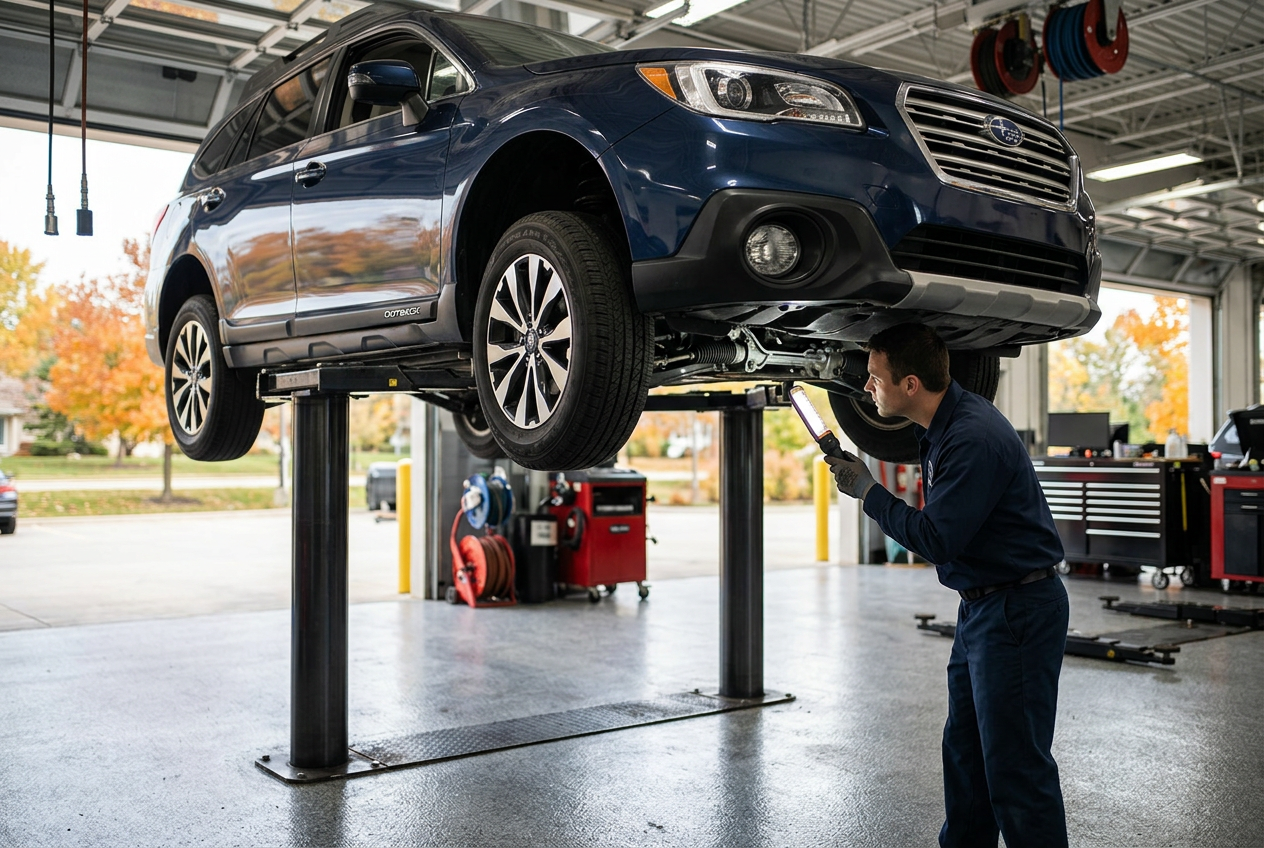
tech working on a 2017 Subaru outback

Is There a Safety Recall for the 2017 Subaru Outback Steering Column?

Is There a Safety Recall for the 2017 Subaru Outback Steering Column? Yes, there is a federal safety recall affecting specific 2017 Subaru Outback models regarding the steering column assembly. National Highway Traffic Safety Administration campaign 16V292000 (Subaru campaign WTD-65) covers vehicles manufactured between February 29, 2016, and May 6, 2016, due to an improperly machined steering column shaft that can fail and prevent steering wheel rotation from turning the front wheels. A secondary campaign, 16V716000, covers models built between September 21 and September 23, 2016, for a steering beam knee-guard bracket weld issue. Safety recalls are conducted to correct potential manufacturing defects before they compromise driver control. In campaign 16V292000, Subaru determined that a batch of steering column shafts received inadequate tool machining during component manufacturing. Under certain driving conditions, the internal shaft splines can wear down or fail to mesh properly with the steering mechanism. When this failure happens, turning the steering wheel may result in zero movement at the front road wheels. Because total loss of steering control creates an immediate hazard, Subaru advised affected vehicle owners not to drive their vehicles until an inspection could be completed. In addition to campaign 16V292000, Subaru issued campaign 16V716000 for a separate structural issue involving the steering support structure. That campaign addresses a knee-guard bracket attached to the steering beam assembly that may have received incomplete or defective factory welds. If a vehicle with this condition is involved in a collision, the bracket might not properly restrain an unbelted driver's lower body, increasing collision injury risks. Both campaigns require precise diagnostic verification by certified factory-trained technicians to confirm whether a specific vehicle requires component replacement. Drivers seeking clarity on whether their vehicle requires attention can contact our service advisors directly at (314) 476-9638 or visit our Sunset Hills facility for a rapid 17-character vehicle identification number search. Table of Contents Which Build Dates Were Affected and What Caused the Steering Defect? What Are the Safety Risks, Warning Signs, and Power Steering Impacts? Can a Used 2017 Subaru Outback Be Sold With an Open Safety Recall? How Do Technicians Inspect and Repair the Steering Column Assembly? Frequently Asked Questions About the 2017 Subaru Outback Steering Column Recall How Owners Can Verify Recall Status and Schedule Repairs Which Build Dates Were Affected and What Caused the Steering Defect? The steering column shaft recall applies exclusively to 2017 Subaru Outback and Legacy vehicles built within specific factory production windows in 2016, rather than across the entire 2017 model year. The primary recall, NHTSA campaign 16V292000, isolates vehicles produced from February 29, 2016, through May 6, 2016. The root cause was traced to cutting tools at the steering column supplier's manufacturing facility that wore beyond acceptable tolerances during production. As a result, improper grooves were machined into the inner shaft of the steering column assembly. Over time, these defective grooves prevent the upper steering shaft from securely engaging the lower shaft coupling, creating a situation where the driver turns the wheel without engaging the steering gear. The secondary recall, NHTSA campaign 16V716000, targets a narrower build window spanning September 21, 2016, through September 23, 2016. This issue stems from improper automated welding processes applied to the knee-guard bracket mounted on the steering beam. Rather than affecting rotational steering mechanics, this defect relates strictly to occupant restraint integrity during severe front impacts. Determining exact vehicle build dates requires looking at the vehicle safety certification label located on the driver side door pillar or running an official VIN lookup. Vehicles manufactured outside these two specific calendar windows do not contain the defective machining or weld patterns and are not subject to these safety notices. Owners driving through Chesterfield can confirm their vehicle's exact build date by requesting a quick service history lookup with our service department. What Are the Safety Risks, Warning Signs, and Power Steering Impacts? A failing steering column shaft presents a critical safety hazard because it can lead to a complete loss of directional steering control while the vehicle is in motion. If the inner shaft splines strip or disengage, the connection between the steering wheel in the cabin and the steering rack attached to the front wheels is broken. Drivers facing this failure will experience total free-spinning of the steering wheel without any response from the tires. Consequently, Subaru issued an explicit stop-drive advisory for campaign 16V292000, instructing owners not to operate affected vehicles until a technical lot inspection confirmed the steering column was safe. Potential physical warning signs that may precede total disengagement include: Excessive play or loose feeling in the steering wheel before wheel resistance is felt. Unusual grinding, clicking, or clunking sounds originating from directly behind the instrument cluster when turning. Binding or uneven mechanical resistance during low-speed parking maneuvers. Catching or slipping sensations while executing turning movements. This recall does not stem from a failure within the electric power steering assist motor, electronic control unit, or steering sensors. The underlying defect is strictly mechanical, involving the physical column shaft and beam brackets. As a result, power steering warning lights on the dashboard may not illuminate to signal an impending mechanical shaft slip, making immediate physical inspection essential if any looseness or noise is detected. Can a Used 2017 Subaru Outback Be Sold With an Open Safety Recall? Federal law strictly prohibits franchised auto dealerships from selling any new or certified pre-owned vehicle that has an uncompleted safety recall. When a pre-owned vehicle arrives at a franchised retail location, technicians perform a mandatory VIN audit to verify that all factory safety campaigns have been satisfied before the vehicle can be listed for sale. If an open recall exists, the dealership must complete the necessary repair work free of charge prior to delivery. In contrast, federal regulations do not restrict private individual sellers from selling used cars with open recalls. Private sellers are not legally obligated to check recall status or complete repairs before transferring a title. Consequently, individuals shopping the secondary market should independently verify the 17-character VIN through official databases to confirm whether open recalls remain on the vehicle. Prospective buyers researching vehicle options, comparing pre-owned utility vehicles, or evaluating new Subaru Outback models and new Subaru BRZ inventory can rely on our service desk to run a comprehensive VIN safety check on any vehicle they are considering. How Do Technicians Inspect and Repair the Steering Column Assembly? Inspecting a 2017 Subaru Outback for the steering column recall is a straightforward process that takes our factory-trained technicians approximately 10 to 15 minutes to complete. During the initial technical inspection, the technician accesses the lower instrument panel to locate the manufacturing lot number stamped on the outer steering column housing. This lot number reveals the exact production date and batch of the steering shaft component. If the lot number falls outside the defective supplier batch, the vehicle is cleared, and no further mechanical work is required. If the lot number matches the recalled batch, a complete replacement of the steering column assembly is performed at no cost to the vehicle owner. The replacement process involves several technical steps: Safely disconnecting the vehicle battery and disarming the supplemental restraint system airbag modules. Removing the lower dashboard trim, steering column covers, and combination switch wiring harnesses. Unbolting the steering column shaft coupling from the intermediate shaft joint. Extracting the compromised steering column unit and installing a brand-new OEM column assembly. Reassembling interior trim, reconnecting electrical connectors, and performing an electronic sensor calibration. Executing a comprehensive four-wheel alignment to ensure the steering wheel is centered and the vehicle tracks straight. The complete column replacement repair typically requires about 1 to 2 hours of shop service time. Suburban commuters from Maryland Heights can easily schedule a service appointment online to complete this safety verification, or order genuine Subaru parts directly through our dedicated service center. Frequently Asked Questions About the 2017 Subaru Outback Steering Column Recall Q: How can I check if my 2017 Subaru Outback has an open recall? Owners can check recall status by locating their 17-character vehicle identification number (VIN) on the lower driver-side corner of the windshield or on their vehicle registration card. Entering this number into the official NHTSA recall lookup tool or providing it to our service team will display all open safety campaigns associated with that specific vehicle. Q: Does the steering column recall repair cost anything? No, all safety recall inspections and replacement repairs are performed completely free of charge to the vehicle owner. Subaru covers all parts and labor costs associated with completing official safety recalls at authorized retail service centers. Q: Is a wheel alignment necessary after replacing the steering column? Yes, replacing the steering column requires disconnecting the mechanical steering linkage, which alters the physical alignment between the steering wheel center and the steering rack. Technicians perform a full four-wheel alignment following column replacement to ensure accurate steering wheel position and proper tire wear. Q: Can I drive my 2017 Outback if I hear clunking noises while turning? If your vehicle exhibits steering column noise, looseness, or slipping sensations, you should not continue driving it. Because campaign 16V292000 involves potential loss of steering control, vehicles showing active symptoms should be parked safely and transported via towing to an authorized service center for immediate inspection. Q: Are open recall checks available if I am cross-shopping other Subaru models? Yes, our service advisors can verify recall history and campaign completion for any Subaru vehicle. Whether you are reviewing a pre-owned crossover or considering options from our new Subaru Ascent lineup, we provide complete safety campaign verification for full peace of mind. How Owners Can Verify Recall Status and Schedule Repairs Addressing open safety recalls is a fundamental aspect of maintaining vehicle reliability and passenger safety. If you own a 2017 Subaru Outback, confirming whether your vehicle was manufactured within the affected 2016 production windows takes only a few minutes. Our factory-trained service team possesses the specialized diagnostic tools and genuine OEM replacement parts needed to inspect your steering column lot number and complete any necessary repairs quickly. All recall-related inspections, component replacements, and alignment checks are provided free of charge under manufacturer recall guidelines. To verify your VIN or schedule a recall inspection, contact our service team at (314) 476-9638 or drop by our Sunset Hills location today. © 2026 Sunset Hills Subaru. All rights reserved. 2017 Subaru Outback Recall Info in Sunset Hills MO | Sunset Hills Subaru

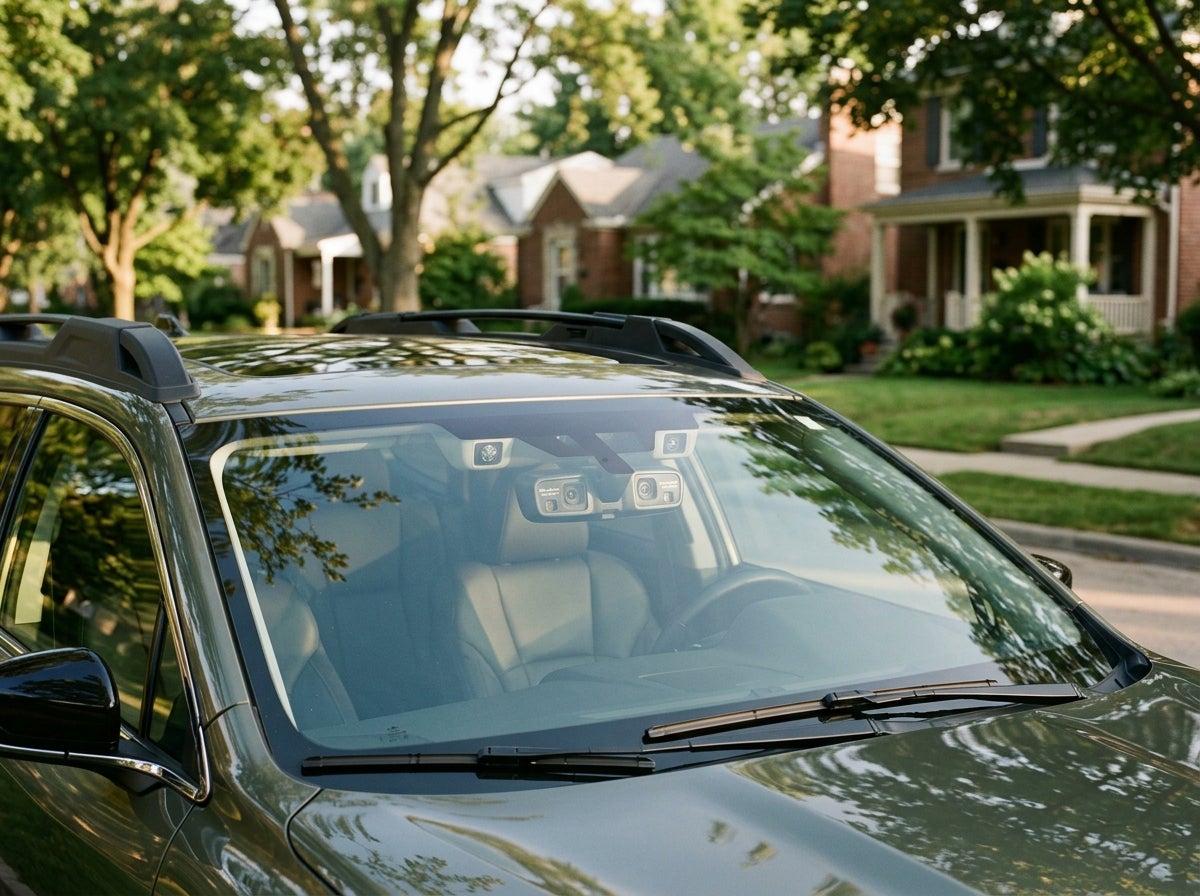
Front windshield of an olive green SUV showing mounted cameras parked on a tree-lined suburban street. (Representative image for illustration purposes only. Actual vehicle may vary based on trim and configuration.)

2026 Subaru Outback Safety Upgrade Costs: Complete Breakdown From Standalone Packages to Higher Trims

When evaluating the purchase of a new midsize crossover, few attributes carry as much weight for drivers as safety. Subaru has long maintained an industry-wide reputation for building vehicles that protect their occupants, and the 2026 Subaru Outback continues this legacy with an expanded array of active driver-assist system options. If you are researching a vehicle purchase at Sunset Hills Subaru, one of the most critical financial questions you will ask is: What does it actually cost to upgrade to enhanced safety technology on the 2026 Outback? To answer directly: baseline standard safety equipment—including Subaru's world-renowned EyeSight Driver Assist Technology—adds exactly $0 to the base window sticker because it comes factory-installed on every 2026 Outback model. However, if you desire enhanced active safety features like Blind-Spot Detection with Lane Change Assist, Rear Cross-Traffic Alert, Reverse Automatic Braking (RAB), Emergency Automatic Steering, or the DriverFocus Distraction Mitigation System, your investment will range between $1,400 and $2,995 in factory-bundled option packages on trim levels like the Outback Premium. Alternatively, stepping up directly to mid- and high-tier trims like the Limited, Touring, or Wilderness incorporates these enhanced technologies as standard equipment, representing trim tier bumps of $3,500 to $8,000 over the base model while bundling luxury amenities such as leather upholstery, premium Harman Kardon sound systems, and hands-free power rear gates. Navigating factory option sheets can sometimes feel overwhelming. At Sunset Hills Subaru, located conveniently at 10100 Watson Rd, Sunset Hills, MO 63127, our commitment is complete pricing transparency. Whether you are browsing our New Subaru Outback Inventory online or visiting our showroom in person, understanding how safety equipment breaks down financially ensures that you pay only for the technology that fits your daily driving needs and budget. Which New Safety Technologies Are Standard on the 2026 Outback vs. Paid Package Upgrades? Every 2026 Subaru Outback comes standard with the latest iteration of Subaru's EyeSight Driver Assist Technology. This core safety suite relies on dual front-facing stereo cameras mounted flush against the upper windshield inside the cabin. Standard features included at base price comprise: Advanced Adaptive Cruise Control with Lane Centering, Pre-Collision Braking, Pre-Collision Throttle Management, and Lane Departure and Sway Warning. However, Subaru delineates its active safety lineup into baseline assistance versus advanced situational protection. Advanced situational technologies rely on additional hardware components, such as wide-angle mono cameras, rear radar sensors embedded beneath the rear bumper fascia, and interior infrared facial recognition sensors. These advanced optional hardware systems power optional upgrades: Blind-Spot Detection with Lane Change Assist, Rear Cross-Traffic Alert, Reverse Automatic Braking (RAB), Emergency Automatic Steering, and the DriverFocus Distraction Mitigation System. Knowing which system includes which sensors allows you to select the exact level of protection required for your commute. Safety Feature Standard Equipment Tier Paid Upgrade Package Tier Primary Hardware Involved Adaptive Cruise Control & Lane Centering Standard (All Trims) Included Base ($0) Dual EyeSight Stereo Cameras Pre-Collision Automatic Braking Standard (All Trims) Included Base ($0) Dual EyeSight Stereo Cameras Wide-Angle Mono Camera Detection Standard (All Trims) Included Base ($0) Single Center Mono Camera Blind-Spot Detection & Rear Cross-Traffic Standard on Limited / Touring Option Package 13/15 ($1,400+) Rear Bumper Radar Sensors Emergency Automatic Steering Standard on Limited / Touring Option Package 15 ($2,995) EyeSight + Blind-Spot Radar Reverse Automatic Braking (RAB) Standard on Limited / Touring Option Package 15 ($2,995) Rear Ultrasonic Sonar Sensors DriverFocus Distraction Mitigation Standard on Touring / Limited XT Option Package 15 / Trim Step Dashboard Infrared LED Camera How Standalone Option Packages and Trim Level Upgrades Impact Total 2026 Outback Pricing Subaru structures vehicle customization around factory option packages and distinct trim tiers. Understanding the math behind these options is the key to maximizing value when buying your 2026 Outback. Option Package 13 (Premium Trim) Cost: ~$1,400 Designed for buyers who want essential blind-spot protection without adding luxury trim extras. OP 13 adds Blind-Spot Detection with Lane Change Assist and Rear Cross-Traffic Alert to the Outback Premium trim, alongside Keyless Access with Push-Button Start and a hands-free power rear gate. Option Package 15 (Premium Trim) Cost: ~$2,995 This comprehensive package builds on Option 13 by adding Emergency Automatic Steering, Reverse Automatic Braking (RAB), power moonroof, and 11.6-inch Multimedia Navigation. It offers complete active defense without moving up to higher-tier leather-trimmed models. Direct Trim Step-Up (Limited / Touring) Cost Delta: $3,500 – $8,000 Stepping up to Outback Limited or Touring automatically standardizes all safety technologies. In addition, you gain perforated leather upholstery, Harman Kardon premium audio, power-adjustable passenger seating, and ventilated front seats on Touring trims. Browse New Subaru Outback Inventory What Expert Opinions and Automotive Reviews Say About 2026 Outback Safety Features Automotive journalists and independent safety testing organizations consistently praise Subaru's approach to driver assistance. In reviews evaluating the 2026 Outback, automotive critics highlight significant real-world improvements in radar sensor processing speeds and wide-angle camera field-of-view. Key takeaways from expert reviews include: • Faster Sensor Processing: The integration of electric power brake boosters allows EyeSight to initiate emergency stopping maneuvers milliseconds faster than previous generations. • Pedestrian & Cyclist Recognition: The third wide-angle mono camera drastically increases urban pedestrian detection at intersections. • Emergency Steering Nuance: Testers note that Emergency Automatic Steering feels smooth and decisive rather than abrupt when avoiding obstacles at speeds under 50 mph. How 2026 Subaru Outback Safety Technology and Costs Compare to Midsize SUV Competitors To evaluate whether the 2026 Outback offers strong value in its safety technology packages, it is useful to examine how its packaging compares to major segment rivals like the Honda CR-V, Toyota RAV4, and Jeep Grand Cherokee. While many manufacturers lock essential active safety gear inside top-tier trim levels, Subaru includes core EyeSight protection standard on every single vehicle built. Model Base Active Safety Suite Blind-Spot & Rear Cross-Traffic Cost Reverse Automatic Braking Cost Standard AWD Safety Synergy 2026 Subaru Outback Standard (EyeSight + Mono Cam) Standard on most trims or ~$1,400 package Available on ~$2,995 package or Limited trim Yes (Symmetrical All-Wheel Drive Standard) Honda CR-V Standard (Honda Sensing) Standard on EX and above (~$32,000+) Requires Top-Tier Touring Trim (~$40,000+) No (AWD is $1,500+ Option on Base) Toyota RAV4 Standard (Toyota Safety Sense) Optional Package on LE / Standard XLE Requires High-Tier Packages (~$3,000+) No (AWD is extra option on base) Jeep Grand Cherokee Standard (Basic ADAS) Standard on Mid-Trims Requires High-Tier Lux Packages ($4,000+) No (4WD costs extra on entry trims) As demonstrated above, Subaru's competitive advantage lies in combining factory Symmetrical All-Wheel Drive with baseline EyeSight at no extra cost. When comparing competitive midsize SUVs, buyers often find they must spend $2,000 to $4,000 in add-on options simply to match the baseline foul-weather capability and active braking performance that comes standard on every 2026 Outback at Sunset Hills Subaru. Does Safety Tech Impact Efficiency, and What Are the Differences in Fuel Economy Between 2026 and 2025 Models? A common query from shoppers is whether continuous electronic scanning by multiple onboard cameras, radar units, and infrared monitoring sensors increases electrical parasitic draw enough to negatively impact overall fuel economy. Modern automotive electrical architectures are engineered for high efficiency. The microprocessors powering the 2026 Outback's EyeSight camera system operate on low-voltage DC power. The battery draw is negligible and has zero measurable impact on internal combustion engine fuel consumption. EPA fuel efficiency estimates for the 2026 Subaru Outback remain virtually unchanged from the 2025 model year: • 2.5L 4-Cylinder BOXER Engine: EPA-estimated 26 MPG City / 32 MPG Highway / 28 MPG Combined. • 2.4L Turbocharged BOXER Engine (XT / Wilderness): EPA-estimated 22 MPG City / 29 MPG Highway / 25 MPG Combined (21/26/23 for Wilderness due to aggressive gearing and all-terrain tires). In fact, driver assist technology often improves real-world fuel economy. Subaru's Advanced Adaptive Cruise Control manages throttle application during highway cruising far more smoothly than human driver inputs, eliminating rapid acceleration spikes and brake riding in stop-and-go traffic. Whether you are commuting along I-270 or taking summer road trips outside St. Louis, driving an EyeSight-equipped Outback helps maintain optimal cruise efficiency while keeping your family protected. What Maintenance Changes and Calibration Costs Accompany the 2026 Outback Redesign? While safety upgrades deliver invaluable peace of mind on the road, vehicle owners should also factor long-term ownership maintenance into their budget. Highly advanced camera and radar systems require precise physical positioning and software calibration to operate accurately. Windshield Replacement Calibration If a road pebble cracks your windshield, replacement glass must be OEM-certified to ensure proper optical clarity for EyeSight cameras. A target recalibration process is performed at our factory service center using specialized alignment targets. Recalibration costs typically range from $300 to $600, though this is often covered under comprehensive auto insurance policies. Radar & Sonar Alignment Minor fender benders or rear bumper impacts can shift rear radar sensors out of alignment. If a sensor moves even a fraction of a degree, a warning light will illuminate on your dash. Routine bumper maintenance or body repairs require diagnostic sensor angle resets to restore full function for Blind-Spot Detection. Routine Wheel Alignments Because Lane Centering relies on precise steering angle sensors synchronized with EyeSight camera input, keeping your suspension properly aligned is essential. Routine wheel alignment service ensures that auto-steering inputs match actual road trajectories perfectly. When maintenance is required, trust factory-certified technicians equipped with specialized Subaru diagnostic tools. You can easily Schedule Service and Diagnostics online or check our Current Service and Parts Specials before your visit. Schedule Service & Diagnostics How Should You Select the Appropriate 2026 Outback Trim Level for Your Daily Safety Needs? To ensure you don't overspend on technology you may not utilize—or miss out on crucial driver-assist features—use this straightforward buyer decision matrix based on your daily commute: 1. The Essential Highway Commuter (Base Trim): If your daily drive consists of standard highway miles and clear suburban arterial roads, the standard EyeSight system with Adaptive Cruise and Lane Centering provides world-class crash protection at zero extra package cost. 2. The Multi-Lane Highway Commuter (Premium with Option Package 13): If you frequently commute in multi-lane traffic, adding Blind-Spot Detection and Rear Cross-Traffic Alert ($1,400) provides critical side and rear situational awareness when merging. 3. The Busy Suburban Family (Premium with Option Package 15 or Limited Trim): If you routinely park in congested suburban school drop-off zones or tight shopping centers, Reverse Automatic Braking (RAB) is invaluable for preventing low-speed backing collisions. Navigating St. Louis Commutes and Ladue Suburban Driving with Enhanced Outback Safety Systems Living in the greater St. Louis metropolitan area presents diverse driving challenges. From the high-speed rush-hour congestion along I-270 and I-64 to navigating tight, tree-lined residential driveways in Ladue and Sunset Hills, the 2026 Outback's enhanced safety options solve real local commuting headaches. For instance, backing out of narrow driveways with obscured sightlines due to parked cars or mature landscaping becomes far stress-free with Rear Cross-Traffic Alert and Reverse Automatic Braking. When sensors detect an approaching vehicle or pedestrian from either side, the system provides audible visual alerts and can automatically apply full braking force to avoid a collision. Furthermore, during heavy summer downpours along Watson Road, EyeSight's enhanced camera processing maintains vehicle tracking accuracy when visibility drops. Financing Your Safety Upgrades: How Trade-In Value and Subaru Financing Can Help Offset Package Pricing When calculated over a 48- or 60-month auto loan term, a $1,400 to $2,995 safety package upgrade may affect your monthly payment depending on terms. Many customers find that leveraging existing vehicle equity absorbs this cost completely. At Sunset Hills Subaru, you can quickly Get your value trade online to see how much equity you hold in your current vehicle. Applying trade-in equity directly toward your down payment reduces the total financed balance, offsetting option package costs effortlessly. Additionally, taking advantage of current manufacturer financing options can keep your monthly investment surprisingly low. You can Get approved for financing online in minutes through our secure finance office. Smart Buyer Financial Tip: Safety features like Blind-Spot Detection and Reverse Automatic Braking frequently qualify drivers for savings opportunities on their auto insurance premiums. Be sure to contact your insurance provider for policy discount details on EyeSight-equipped models. Get Approved For Financing Do Experts Recommend the 2026 Outback Wilderness Safety Package for Off-Road and Winter Driving? Dual-Function X-MODE Integration The 2026 Outback Wilderness pairs standard active safety technology with Dual-Function X-MODE settings tailored specifically for Snow/Dirt and Deep Snow/Mud. Auto-tuning traction control keeps wheels planted in hazardous winter sludge. Lifted Suspension Calibration Because the Wilderness features a factory 9.5-inch ground clearance, Subaru factory engineers specifically recalibrated EyeSight camera angles and pitch sensors to account for higher ride height, delivering accurate automated braking. Expert Consensus Off-road and automotive reviewers universally recommend the Wilderness package for drivers who regularly tackle severe winter conditions, light dirt trails, or unpaved backroads due to its combination of rugged hardware and active electronic monitoring. Explore Safety-Equipped 2026 Subaru Outback Models at Sunset Hills Subaru Today Choosing the right safety package on your 2026 Subaru Outback comes down to matching your driving habits with the features that provide real value for your daily routine. Whether you prefer a cost-effective Premium trim with Option Package 13 or a top-tier Outback Touring fully equipped with DriverFocus distraction mitigation, Sunset Hills Subaru is here to help. Visit our local showroom at 10100 Watson Rd, Sunset Hills, MO 63127 or explore our extensive online inventory of new models. Get Directions to Sunset Hills Subaru or Call us at (314) 476-9638 to speak with our certified Subaru brand specialists today. Be sure to check out our Current New Car Specials for the latest current offers! View New Outback Inventory & Schedule Test Drive 2026 Subaru Outback Safety Packages in Sunset Hills MO | Sunset Hills Subaru