
Blog / Maintenance & Service

Clear Vision for the Show-Me State: 2020 Subaru Wiper Blade Replacement

Blue Subaru Forester driving on a wet residential street during a rainy day.

Clear Vision for the Show-Me State: 2020 Subaru Wiper Blade Replacement

As we move through May 2026, the unpredictable spring weather in Sunset Hills, MO 63127, reminds us that visibility is the most critical component of automotive safety. Whether you are navigating the heavy downpours on I-270 or dealing with the misty mornings near Watson Road, your 2020 Subaru relies on its wiper blades to maintain a clear line of sight. For owners of the 2020 Forester, Outback, and Crosstrek, the wiper system is more than just a convenience; it is a vital partner to your vehicle's safety technology.

Subaru vehicles are engineered for adventure, but that adventure requires a pristine windshield. Over time, the rubber elements on your factory blades begin to degrade due to UV exposure, temperature fluctuations, and environmental debris. If you've noticed that your wipers aren't performing like they used to, it's time to prioritize a replacement. At Sunset Hills Subaru, we understand the specific nuances of the 2020 model year lineup, ensuring you get the exact fit and performance your vehicle demands. Get Directions to Sunset Hills Subaru and let our experts help you restore your vision today.

Signs Your Subaru Wipers Need Immediate Attention

Identifying wear patterns early can save you from a dangerous situation during a St. Louis storm. The most common sign is streaking, which occurs when the rubber edge has hardened or cracked, leaving bands of water across your field of vision. This often happens because the wiper frame no longer applies even pressure across the glass.

Chattering is another major red flag. If your wipers 'hop' across the windshield, it’s a sign that the rubber has taken a permanent set or the arm tension is off. This creates an incredibly distracting noise and fails to clear water effectively. Additionally, look for split rubber where the wiping element begins to detach from the metal or plastic frame. If you hear squeaking every time the wipers cycle, the protective coating on the rubber has likely worn away, leading to friction that can eventually score your windshield glass.

A person's hand on a steering wheel during a heavy thunderstorm with lightning over the St. Louis skyline.

2020 Subaru Wiper Blade Size Specifications

Using the wrong size blade can lead to 'blind spots' on your glass or cause the blades to collide and damage the wiper motor. Refer to the chart below for the exact measurements required for your 2020 model. If you are unsure, you can always Find Subaru Parts by searching with your specific VIN.

2020 Model

Driver Side

Passenger Side

Rear Blade

Forester

26"

17"

14"

Outback

26"

18"

14"

Ascent

26"

20"

12"

Crosstrek

26"

16"

12"

Impreza

26"

16"

12"

Legacy

26"

18"

None

WRX / STI

26"

16"

None

BRZ

22"

20"

None

Expert Care: Scheduling Your Seasonal Maintenance

At Sunset Hills Subaru, we recommend inspecting your wiper blades every six months—ideally during your spring and fall oil changes. Our certified technicians don't just look at the rubber; we check the wiper arm tension, the integrity of the washer fluid lines, and the health of the spray nozzles. Many drivers overlook these small components until they fail during a heavy storm. By bundling your wiper inspection with your routine maintenance, you ensure that your vehicle is always prepared for whatever the St. Louis sky throws your way.

OEM vs. Aftermarket: Why Genuine Subaru Parts Matter
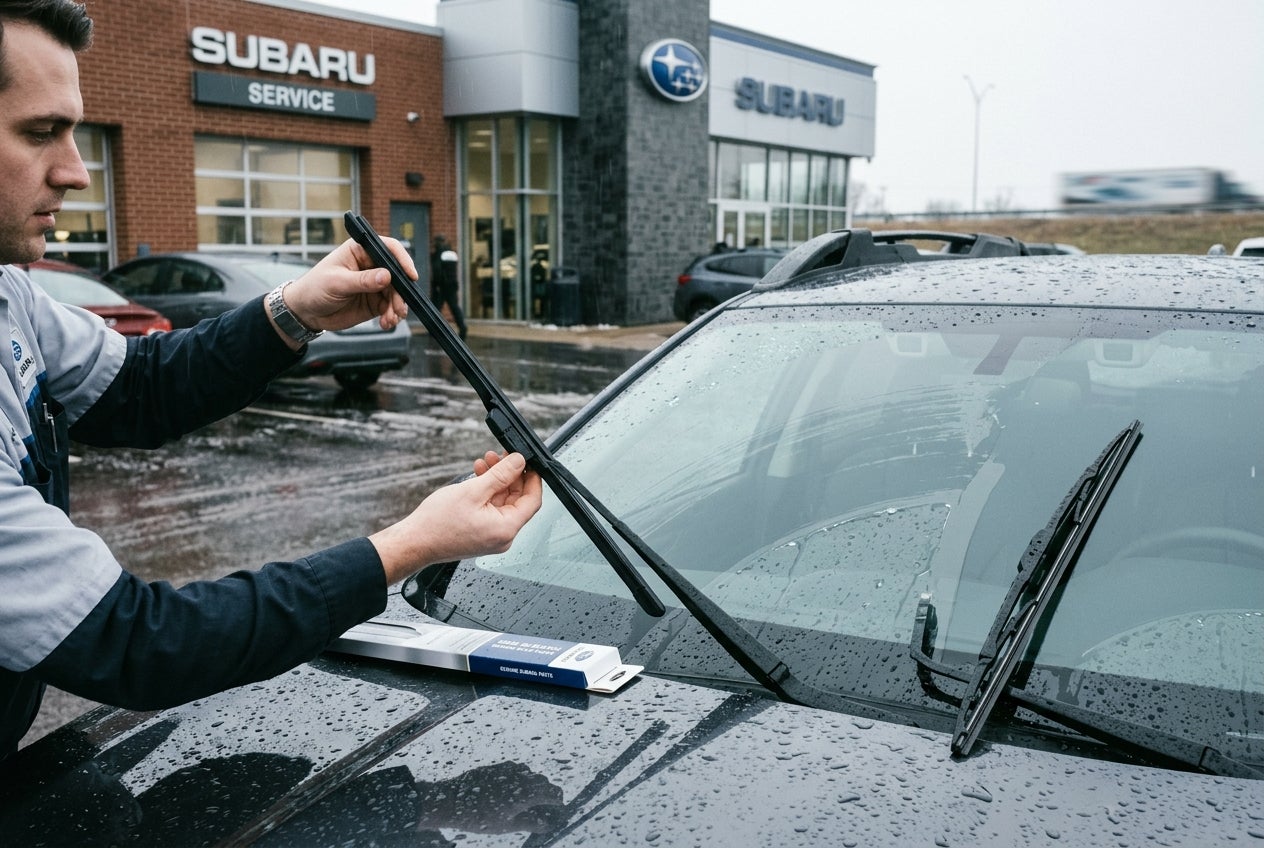
A service technician holding a new windshield wiper blade over a car at a Subaru dealership.

While big-box stores offer generic blades, they often lack the precision engineering required for the 2020 Subaru windshield. Subaru uses specific beam-style blades and frame-style connectors that are designed to match the exact curvature of your glass. This ensures that the entire length of the blade makes contact, preventing those frustrating missed spots in the center of the driver's view.

Genuine Subaru blades are also tested for durability against the unique chemical compositions of road salts and cleaning agents. Using OEM parts maintains the aerodynamic profile of your vehicle, preventing 'wind lift' at highway speeds. If you're looking to upgrade your driving experience, checking out our New Subaru Inventory will show you how the latest models continue to prioritize these engineering details.

The Impact of St. Louis Weather on Wiper Longevity

Living in Sunset Hills means your Subaru deals with the 'Gateway to the West' climate—which is famously hard on rubber components. The high humidity in the summer can cause rubber to become soft and 'tacky,' leading to chattering. Conversely, the freezing winters in 63127 cause the rubber to become brittle, leading to the cracking and splitting we mentioned earlier.

To extend the life of your wipers, we recommend cleaning the blades with a damp cloth and a bit of glass cleaner once a month. This removes the buildup of road salt, pollen, and sap that can degrade the rubber. If you're concerned about how weather is affecting your car's overall value, you can always Get your value trade to see what your well-maintained Subaru is worth today.

Step-by-Step: DIY 2020 Subaru Wiper Installation
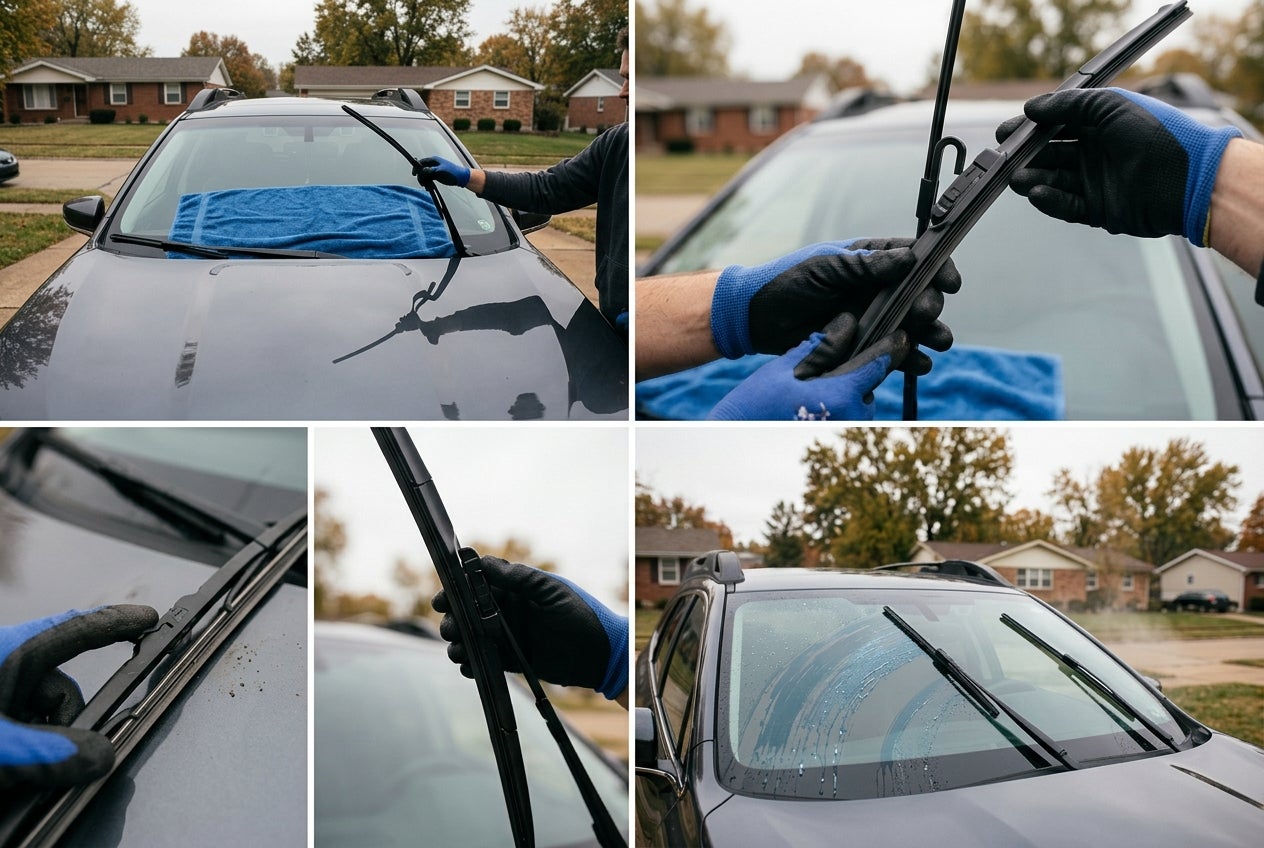
Collage of photos showing a person in blue work gloves replacing windshield wiper blades on a gray car.

1. Prep the Area: Before you begin, place a folded towel on your windshield. This is a critical safety step; if the wiper arm snaps back without a blade attached, it can easily crack your windshield.
2. Lift the Arm: Pull the wiper arm away from the glass until it stays in a vertical position.
3. Release the Old Blade: Most 2020 Subaru models use a standard J-hook. Locate the small tab where the blade meets the arm, press it, and slide the blade down toward the base of the arm.
4. Install the New Blade: Slide the new blade onto the hook until you hear a distinct 'click.' This confirms the locking mechanism is engaged.
5. Test: Gently lower the arm back to the glass and run a brief cycle with washer fluid to ensure smooth operation.

Get the Right Parts the First Time

Don't guess on sizes or fitment. Our parts department carries the full line of genuine Subaru wiper blades specifically for the 2020 Forester, Outback, Ascent, and more. We also offer seasonal specials that can make refreshing your vision more affordable than ever.

Advanced Safety: Wipers and the Subaru EyeSight® System

For 2020 Subaru owners, the EyeSight® Driver Assist Technology is your co-pilot. This system relies on dual cameras mounted behind the top of your windshield to monitor traffic and activate Pre-Collision Braking. If your wipers are streaking or leaving a film directly in front of these cameras, the system's performance can be compromised.

In heavy rain, the cameras need a clear 'window' to see the road ahead. Old, worn blades that fail to clear the upper portion of the windshield can cause the EyeSight system to temporarily disable itself. Maintaining your wipers isn't just about your vision—it's about ensuring your car's most advanced safety features can do their job properly.
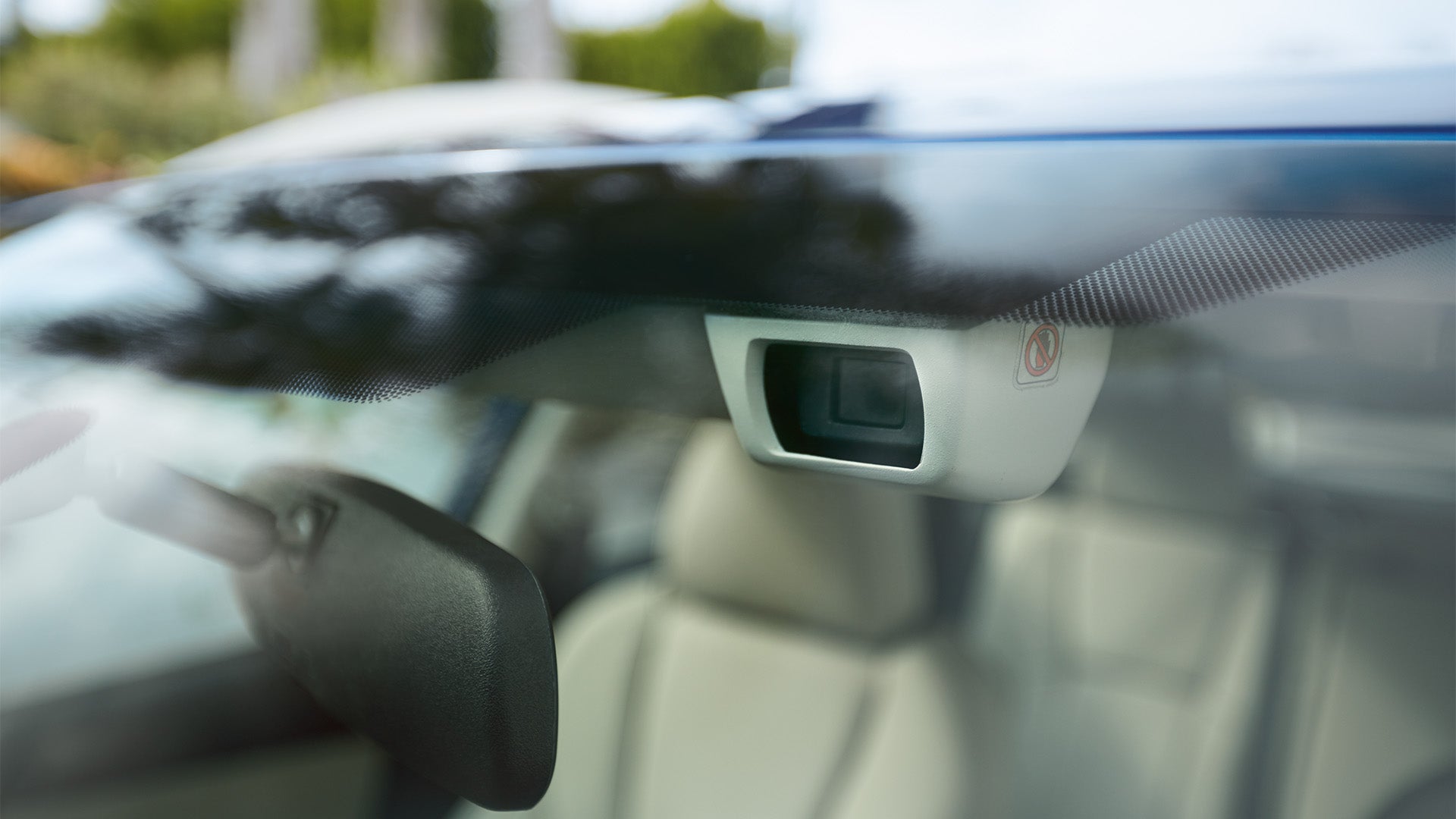
Car's eyesight camera and rear view mirror inside vehicle.

Don't Forget the Rear Wiper Blade

Outback & Forester: These models feature an integrated rear blade that is often neglected. Because they sit on the back of the vehicle, they collect more road grime and exhaust soot than the front blades.

Crosstrek & Ascent: The rear wiper is essential for backing up safely in the rain. Ensure you check the plastic housing for cracks, as Missouri's freeze-thaw cycles can make these parts brittle.

Installation Tip: Rear blades often use a unique 'snap-in' fit rather than a J-hook. If you're struggling with the swap, our team at Sunset Hills can handle it in minutes.

Windshield Fluid and Washer System Health
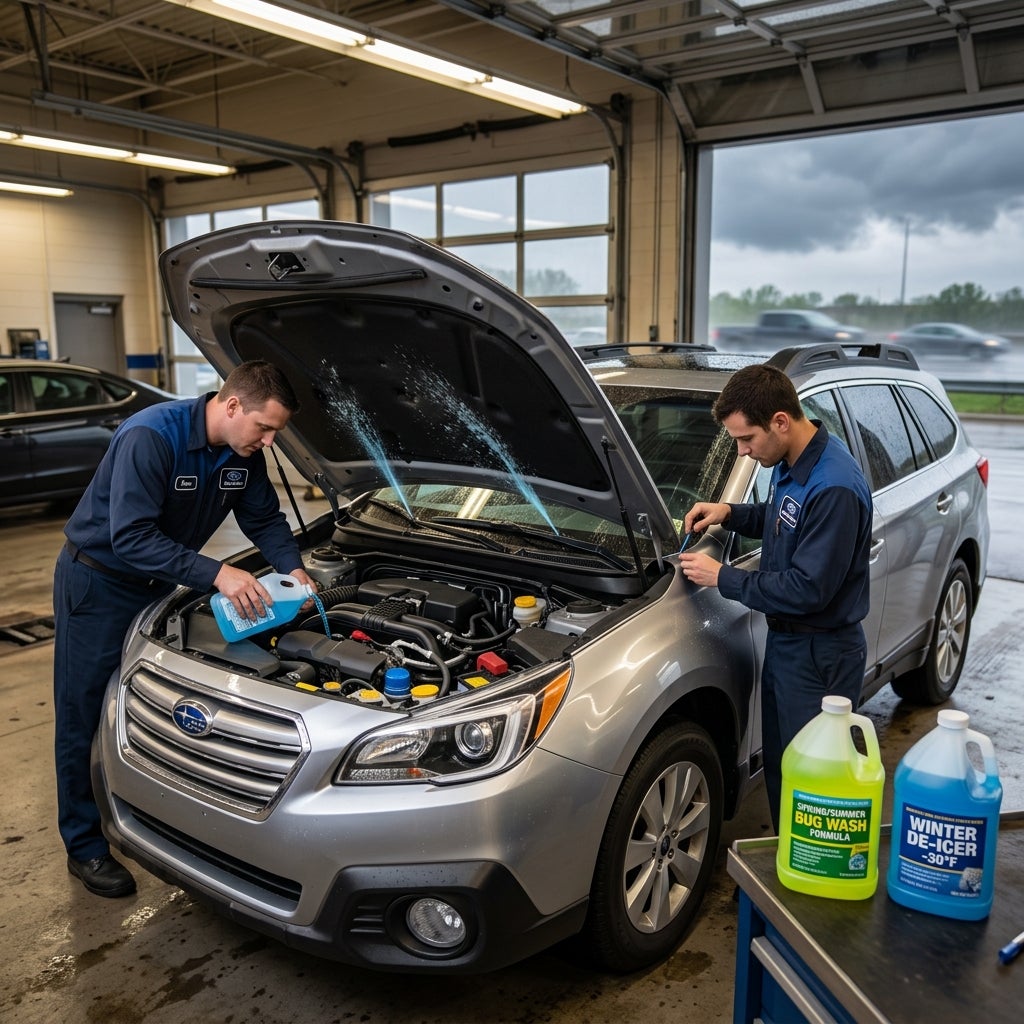
Two auto mechanics servicing a silver Subaru SUV in a repair shop.

Your wipers are only half of the visibility equation. A healthy washer system is vital for removing bugs and road film. During the spring, we recommend using a fluid with a bug-wash additive. In the winter, ensure you're using a de-icing formula to prevent the pump from freezing. If your spray nozzles are producing a weak stream, they may be clogged with wax or debris. Our team checks these levels and clears nozzles during every Schedule Service and Diagnostics visit to ensure total system health.

Ready for a Fresh Start? Visit Us Today

Sunset Hills Subaru is your local destination for all things Subaru maintenance. Whether you need a quick wiper swap or a full vehicle inspection, our friendly staff is here to help. We are conveniently located at 10100 Watson Rd, Sunset Hills, MO 63127.

Get Directions to Sunset Hills Subaru or Call us at (314) 476-9638 to check our current parts availability.

The Full Subaru Health Check
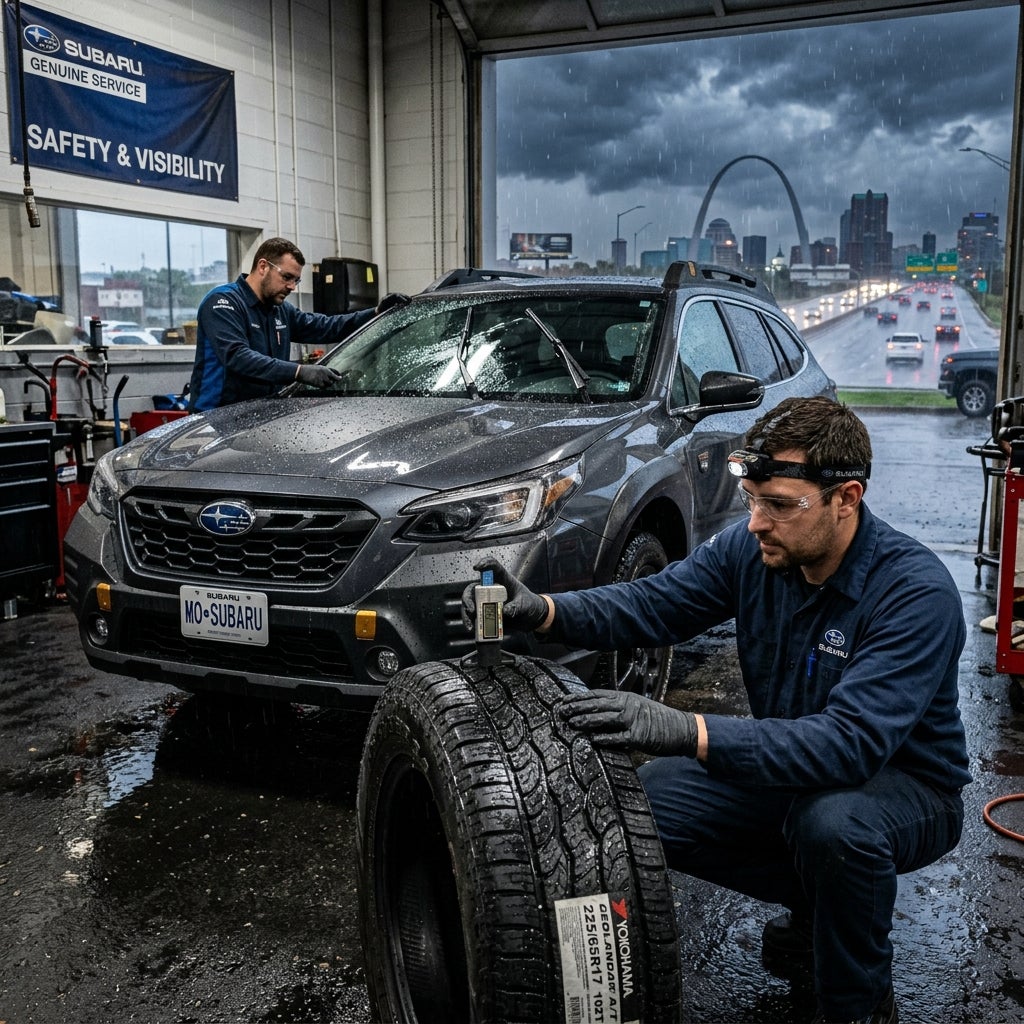
Technicians servicing a Subaru in a garage overlooking St. Louis during a storm.

Tire Health: While we check your wipers, we'll also glance at your tires. Proper tread is essential for hydroplaning resistance in MO rain.
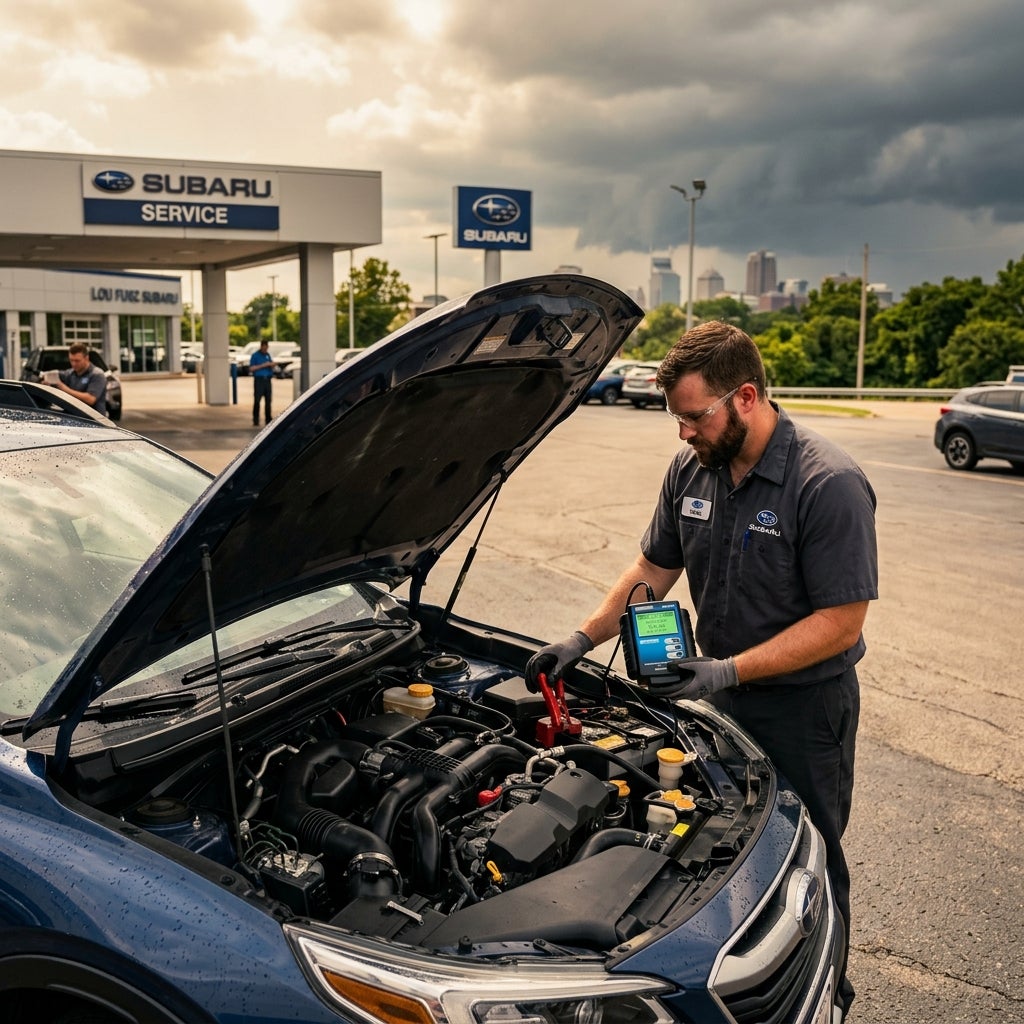
A service technician in a grey uniform tests a blue Subaru’s battery with a diagnostic tool at a dealership.

Battery Performance: Heat and humidity can drain a battery. We offer complimentary testing to ensure your 2020 Subaru starts every time.

A car salesman showing a tablet to a customer in a Subaru dealership showroom at sunset.

Upgrade Options: Thinking of a newer model? Get your value trade today and see how easy it is to move into a 2026 Subaru.

Common Wiper Replacement Troubleshooting

Blades Lifting: If your wipers seem to float or miss the windshield at highway speeds, you may have installed a non-aerodynamic aftermarket blade. Genuine Subaru blades are designed to use the wind to press the blade closer to the glass.

Persistent Noise: If new blades still squeak, you might have a buildup of 'road film' or old wax on the windshield. A deep clean with a dedicated glass stripper often solves the issue.

Wiper Motor Issues: If your wipers move slowly or get stuck, the issue might be internal rather than the blades themselves. In these cases, it's best to seek professional help. You can Get approved for financing for larger repairs if your 2020 Subaru needs more than just a quick maintenance refresh.

Schedule Your Professional Wiper Installation at Sunset Hills Subaru
Exterior of auto service center with EXPRESS signage and cars visible inside.

Don't compromise your safety for another rainy day in St. Louis. At Sunset Hills Subaru, we make it easy to maintain your 2020 Subaru with genuine parts and expert service. From simple wiper swaps to complex diagnostics, we are your trusted community resource. Visit us today at 10100 Watson Rd and experience the difference that genuine Subaru care makes for your peace of mind.
Posted in:

Related Posts

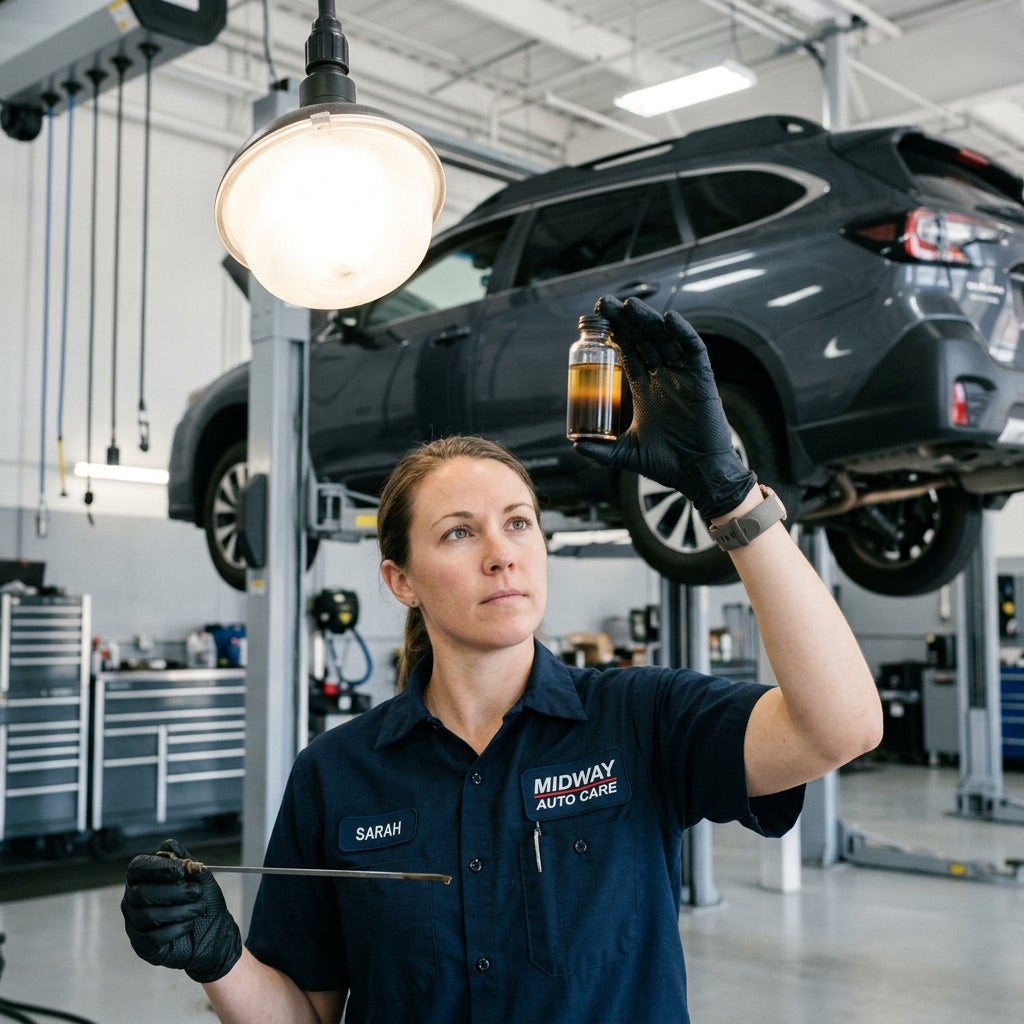
Female mechanic in a workshop inspects a glass sample jar showing fluid separation while holding a dipstick. (Representative image for illustration purposes only. Actual vehicle may vary based on trim and configuration.)

When Should You Replace Subaru CVT Fluid? Service Advisor Bottom-Line Answer

If you open your Subaru owner's manual warranty and maintenance booklet, you will likely see a curious entry under transmission maintenance: inspect fluid every 30,000 miles, replace under severe driving conditions, otherwise listed as lifetime fluid. As a professional service advisor working directly on the service drive in Sunset Hills, MO, my practical advice for Subaru owners in the St. Louis metropolitan area is straightforward: consider verifying the 'lifetime fluid' guidance in your owner's manual if you plan on keeping your Outback, Forester, Crosstrek, or Ascent beyond its warranty period. In our regional driving environment—where winter sub-zero snaps transition rapidly into 95-degree summer days with thick humidity—the real-world strain on a Continuously Variable Transmission (CVT) is substantial. Heavy stop-and-go driving along Watson Road or I-270, towing recreational gear, climbing Ozark hills, or tackling snow-slicked commutes all qualify under Subaru's official 'severe driving' definition. Under these conditions, Subaru explicitly recommends changing the Lineartronic CVTF fluid every 30,000 to 60,000 miles. For suburban commuters who experience light highway cruising with minimal heavy loads, stretching fluid service to 60,000 to 100,000 miles is technically feasible, but waiting longer than 100,000 miles significantly elevates the risk of mechanical slippage, valve body solenoid failure, pulley scoring, and total transmission breakdown. Fresh fluid acts as both a lubricant and a hydraulic power transfer medium; neglecting it is the primary root cause of major transmission claims seen in independent and dealer bays across Missouri. Meet Lucas Scroggs: 3 Years of St. Louis Area Service Experience Hello, I am Lucas Scroggs, Service Advisor at Sunset Hills Subaru. Over my three years serving drivers throughout Chesterfield, Ladue, Maryland Heights, and South County, I have personally checked in thousands of Subaru vehicles for routine oil changes, major interval services, and mechanical repair diagnostics. My daily work revolves around analyzing repair orders, consulting with our master-certified Subaru technicians, and speaking candidly with vehicle owners about maintenance vs. repair expenses. I live and work right here in St. Louis, so I see firsthand how our road conditions, quick temperature swings, and highway congestion impact vehicle longevity. My primary goal on the service drive is transparency. When a client brings in a 2018 Outback with 65,000 miles, they often ask why we recommend a CVT drain and fill when their original owner's manual wasn't aggressive about it. I explain the difference between paper maintenance schedules written by corporate marketing teams and real-world mechanical wear seen on local service lifts. Proactive maintenance preserves driving feel, protects factory warranties, and can help reduce long-term repair costs down the line. Why Subaru's 'Lifetime Fluid' Claim Requires Real-World Context To understand why transmission fluid degrades, you must look at how Subaru Lineartronic CVTs operate. Unlike a traditional automatic transmission with fixed planetary gears, a CVT utilizes a heavy-duty steel chain belt stretched across two hydraulically adjusted conical pulleys. By continuously varying the width of these pulleys, the transmission delivers infinite gear ratios for maximum engine efficiency. Because this metal-on-metal interface relies heavily on friction and hydraulic clamping force, Subaru CVTF fluid contains specialized friction modifiers, anti-foaming agents, and thermal stabilizers. As temperature spikes during heavy summer traffic or extended highway towing, these chemical additives break down through thermal oxidation. Shear forces between the steel belt and pulley faces gradually chop down fluid viscosity. Why does Subaru label it 'lifetime' in standard documentation? In manufacturer terms, 'lifetime' generally refers to the initial vehicle warranty period (often 5 years or 60,000 miles to 100,000 miles under extended factory coverage). However, if your personal definition of 'lifetime' means driving your Forester or Outback to 150,000 or 200,000 miles, leaving the original fluid inside is a high-risk gamble. Furthermore, standard driving conditions rarely exist around St. Louis. Short trips under 5 miles, cold winter starts, summer idling with full air conditioning, and driving on salted roads all trigger Subaru's official 'Severe Driving Condition' criteria. In these instances, fluid replacement is explicit, not optional. Lucas's Service Bay Perspective: a Transmission Replacement vs. a Fluid Drain and Fill "I see it every month in our service lanes: a customer comes in with a shuddering transmission at 110,000 miles having never serviced their CVT fluid. By that time, hydraulic control valves are clogged with microscopic wear debris and internal pulleys are scored. At that point, a simple fluid change won't reverse structural wear—the only option is a complete replacement assembly, which can cost anywhere from $7,000 to $8,500 with labor. Contrast that with a preventive CVT fluid drain and fill, which costs around $300 to $400 depending on the exact model and fluid spec. Performing two or three drain-and-fill services over 120,000 miles costs under $1,000 combined—a massive difference compared to an out-of-warranty transmission replacement. Preventive care isn't an upsell; it's basic financial protection for your investment." — Lucas Scroggs, Service Advisor Schedule CVT Fluid Inspection or Service What Key Maintenance Items Are Required at the 60,000-Mile Service for a Subaru? Fluid Inspections & Services At 60,000 miles, Subaru schedules its major service benchmark. Key items include: • CVT Fluid Service: Inspection for thermal discoloration, varnish smell, or metal particle contamination; recommended drain-and-fill for regional drivers. • Front & Rear Differential Fluids: Replacing gear oil (75W-90) to remove metallic filings generated by AWD clutch packs and differential ring gears. • Brake Fluid Flush: Replacing moisture-absorbed brake fluid to protect internal ABS solenoids. Our technicians utilize specialized Subaru Select Monitor diagnostic tools during the 60k service to verify transmission fluid temperature readouts and engine timing control before releasing the vehicle back to the customer. Engine & Mechanical Tune-Up Essential tune-up elements include: • Spark Plugs: Replacement of long-life Iridium spark plugs (crucial on Boxer engines to maintain optimal air-fuel efficiency). • Engine Air & Cabin Filters: Eliminates intake airflow restrictions and keeps passenger air fresh. • Full Vehicle Inspection: Steering rack boots, suspension bushings, wheel bearings, and drive belt condition check. How Subaru Symmetrical AWD Impacts Tire Wear and Differential Fluid Service Subaru's full-time Symmetrical All-Wheel Drive (AWD) is world-renowned for winter traction and driving stability, but it places unique mechanical demands on your drivetrain. Unlike slip-and-grip reactive AWD systems that only send power rearward when front wheels slip, Subaru systems send power to all four wheels continuously. Because all four wheels are linked through front, center (multi-plate transfer clutch inside the CVT), and rear differentials, tire circumference variance is critical. If tire tread depth varies by more than 2/32 of an inch between tires, the rotational speed difference forces the center clutch pack inside the CVT to slip continuously. This generates excess friction heat, rapidly degrading the CVT fluid and causing premature wear on the transfer clutch plates. To prevent AWD strain and fluid thermal breakdown: 1. Rotate Tires Every 6,000 Miles: Keeping tread wear completely even across all four positions minimizes center differential friction. 2. Service Front & Rear Differential Gear Oil: Over time, gear shearing in differential assemblies breaks down high-viscosity oil. Changing differential fluid every 30,000 to 60,000 miles keeps hypoid gear sets cool and functioning smoothly. 3. Replace Tires as Matched Sets: Never mix tire brands, tread designs, or significantly different tread depths on a Subaru AWD vehicle. What Specific Maintenance Items Make Up Subaru Ownership Costs Over 5 and 10 Years? 5-Year / 60,000-Mile Cost Profile During the first 5 years, Subaru ownership maintenance costs are predictable and modest. Expected maintenance includes 10 synthetic oil & filter changes, 10 tire rotations, cabin and engine air filters, 1 to 2 brake fluid flushes, and 1 major 60,000-mile interval service. Drivers who complete scheduled preventive items early spend significantly less per mile over time. 10-Year / 120,000-Mile Cost Profile Between years 5 and 10, maintenance includes a second 60k major service, brake pad/rotor replacements, cooling system flushes, suspension struts or sway bar links, and 2 CVT fluid drain-and-fill services. While total maintenance is slightly higher than non-AWD competitors like front-wheel-drive sedans, Subaru vehicles retain exceptionally strong resale value, offsetting long-term maintenance costs. Maintenance Milestone Subaru Estimated Cost Toyota AWD Competitor Cost Primary Service Components Included 30,000 Miles (Minor) contact for current pricing $250 - $380 Oil change, tire rotation, air filters, brake inspection, AWD differential check 60,000 Miles (Major) $750 - $1,100 $700 - $980 Boxer spark plugs, brake fluid flush, air filters, CVT fluid drain & fill, diff fluid change 100,000 Miles (Cumulative Total) $3,200 - $4,500 $3,000 - $4,200 All scheduled maintenance, brakes, tires, spark plugs, fluid refreshes over 8-10 years Planning on trading in or upgrading your Subaru? Evaluate your trade-in market value with our quick online tools: Get your value trade or check out our New Subaru Inventory. Value Your Trade Online How Often Does a 2026 Subaru Outback Need an Oil Change and What Viscosity Is Required? For 2026 Subaru Outback models (as well as 2026 Forester and Crosstrek variants), factory-recommended oil change intervals remain strictly 6,000 miles or 6 months, whichever comes first. Following this mileage threshold is critical for preventing internal carbon buildup around the piston rings and protecting variable valve timing (VVT) solenoids. Required viscosity formulas vary depending on engine powertrain trim: • 2.5L 4-Cylinder Naturally Aspirated Boxer: Requires full synthetic 0W-16 or 0W-20 oil meeting API SP / ILSAC GF-6A specifications. • 2.4L Turbocharged Boxer (XT & Wilderness trims): Requires full synthetic 0W-20 high-thermal-stability engine oil. Why is oil viscosity so precise in modern Subaru Boxer engines? Low-viscosity ultra-synthetic oils allow swift oil pressure build-up upon cold startup, reducing engine wear during Missouri winter mornings. Additionally, oil galleries feeding hydraulic timing tensioners rely on clean, un-degraded fluid. Stretching oil changes beyond 6,000 miles can cause oil burn-off, piston ring sticking, and engine sludge, leading to higher maintenance costs later in the vehicle's lifespan. Explore current model information at our New Subaru Outback Inventory page. How Often Do Subaru EyeSight Camera Systems Require Calibration? Subaru EyeSight Driver Assist Technology uses dual stereoscopic camera lenses mounted behind the windshield to manage adaptive cruise control, lane-keep assist, pre-collision braking, and throttle management. Unlike routine maintenance items like filters or oil changes, EyeSight calibration is not scheduled by mileage, but triggered by specific mechanical or body events. EyeSight camera calibration is mandatory whenever: • The front windshield is replaced or removed. • Suspension components are altered (e.g., install of lift kits, replacement of struts/springs that alter ride height). • Wheel alignment is adjusted following major steering repair or severe pothole impact. • Body repair occurs on the front structural frame or bumper assembly. • An EyeSight warning light appears on the instrument cluster. Calibration at Sunset Hills Subaru utilizes specialized target boards positioned at exact millimeter distances in a level bay environment, followed by dynamic road calibration testing using Subaru SSM4 diagnostic interface software. Practical Service Advice: OEM Subaru CVTF Fluid vs Aftermarket Alternatives Exact OEM Fluid Specs Subaru Lineartronic CVTs require precise fluid formulations (CVTF-II, CVTF-III, or High Torque CVTF for 2.4L Turbo models). These fluids are engineered with unique torque-transfer friction coefficients and specific expansion profiles under heat. Mixing incorrect fluids causes chain belt slippage. Technician Check Process Checking fluid levels is not done with a simple dipstick. Technicians must monitor fluid temperature using a diagnostic tool, cycling through gears until fluid temperature reaches exactly 95°F–113°F before inspecting fill plugs on a level lift. Correct temperature monitoring is mandatory. Universal Fluid Risks Generic 'multi-vehicle' aftermarket fluids claim compatibility but frequently fail to maintain required viscosity under sustained loads, leading to shuddering and solenoid seal degradation. Genuine factory parts preserve smooth operation. Find Subaru Parts at our dealership. Order Genuine Subaru Parts & Fluid Do Subaru Boxer Engines Require Special Spark Plug Replacement Procedures? Yes, spark plug service on a Subaru horizontally opposed Boxer engine is distinctly different from traditional inline or V6 engines. Because the engine cylinders lie flat horizontally, the cylinder heads directly face the vehicle frame rails with only a few inches of clearance on either side. Changing Boxer spark plugs requires removing the air intake box, battery, and engine bay accessories to gain access. Technicians use specialized flexible swivel extensions, thin-wall spark plug sockets, and exact torque specifications to avoid cross-threading aluminum cylinder heads or damaging coil packs. Because this labor is more involved, Subaru utilizes long-life Iridium spark plugs rated for 60,000 miles. Replacing plugs on schedule ensures complete fuel combustion, prevents ignition misfires under heavy load, and protects fragile catalytic converters. Schedule Your Subaru CVT and Preventative Maintenance at Sunset Hills Subaru Whether your Forester is approaching 30,000 miles or your Outback is due for its major 60,000-mile service, our factory-trained team at Sunset Hills Subaru is ready to assist you. Consult directly with Lucas Scroggs and our certified advisors for tailored maintenance advice built around your local driving habits. Visit our facility at 10100 Watson Rd, Sunset Hills, MO 63127. Get Directions to Sunset Hills Subaru or Call us at (314) 476-9638 to speak with our service team directly. Review our Current Service and Parts Information before booking your appointment online! Schedule Service and Diagnostics Title Tags Subaru CVT Fluid Service in Sunset Hills MO | Sunset Hills Subaru Meta Description Keywords Open Graph Twitter Card Canonical Article Metadata Geographic Targeting { "@context": "https://schema.org", "@graph": [ { "@type": "NewsArticle", "@id": "#article", "headline": "When Should You Replace Subaru CVT Fluid? Service Advisor Bottom-Line Answer", "datePublished": "2026-09-01T20:30:00.254Z", "dateModified": "2026-09-01T20:46:12.436Z", "author": { "@id": "#author" }, "publisher": { "@id": "#dealer" }, "wordCount": 2162, "description": "Learn when to replace Subaru CVT fluid. Severe driving conditions require changes every 30,000 to 60,000 miles to prevent major transmission damage." }, { "@type": "Person", "@id": "#author", "name": "Lucas Scroggs", "worksFor": { "@id": "#dealer" }, "jobTitle": "Service Advisor" }, { "@type": "AutoDealer", "@id": "#dealer", "name": "Sunset Hills Subaru", "description": "Sunset Hills Subaru is a full-service Subaru dealership serving the St. Louis area, offering new and pre-owned vehicles, financing, and expert maintenance, all with a strong focus on customer service and community involvement.", "url": "https://www.sunsethillssubaru.com", "telephone": "+13144769638", "image": { "@type": "ImageObject", "url": "https://assets.app.hrizn.io/public/uploads/ac3d25d8-7397-441f-bed1-a086c6d82f2a/c4fe791c-e1bc-4f3e-ad74-bcea1dcd3c3f/1776711411817_images__7_.jpg" }, "logo": { "@type": "ImageObject", "url": "https://assets.app.hrizn.io/public/uploads/ac3d25d8-7397-441f-bed1-a086c6d82f2a/c4fe791c-e1bc-4f3e-ad74-bcea1dcd3c3f/1776711386560_DealerLogo.png" }, "sameAs": [ "https://www.facebook.com/sunsethillssubaru", "https://www.instagram.com/sunsethillssubaru", "https://youtube.com/@sunsethillssubaru", "https://www.tiktok.com/@sunsethillssubaru", "https://www.dealerrater.com/dealer/Sunset-Hills-Subaru", "https://www.cars.com/dealers/152141/sunset-hills-subaru", "https://www.autotrader.com/car-dealers/sunset-hills-mo/71819691/sunset-hills-subaru", "https://www.cargurus.com/Cars/m-Sunset-Hills-Subaru-sp300949", "https://www.carfax.com/Reviews-Sunset-Hills-Subaru", "https://maps.google.com/?cid=6793552624642991938" ], "address": { "@type": "PostalAddress", "streetAddress": "10100 Watson Rd", "addressLocality": "Sunset Hills", "addressRegion": "MO", "postalCode": "63127", "addressCountry": "US" }, "areaServed": { "@type": "GeoCircle", "geoMidpoint": { "@type": "GeoCoordinates", "latitude": "38.555542", "longitude": "-90.3981166" }, "geoRadius": "48280" }, "geo": { "@type": "GeoCoordinates", "latitude": "38.555542", "longitude": "-90.3981166" }, "openingHours": [ "Mo 09:00-20:00", "Tu 09:00-20:00", "We 09:00-20:00", "Th 09:00-20:00", "Fr 09:00-20:00", "Sa 09:00-18:00" ] }, { "@type": "FAQPage", "@id": "#faq", "mainEntity": [ { "@type": "Question", "name": "What Key Maintenance Items Are Required at the 60,000-Mile Service for a Subaru?", "acceptedAnswer": { "@type": "Answer", "text": "Fluid Inspections & Services At 60,000 miles, Subaru schedules its major service benchmark. Key items include: • CVT Fluid Service: Inspection for thermal discoloration, varnish smell, or metal particle contamination; recommended drain-and-fill for regional drivers. • Front & Rear Differential Fluids: Replacing gear oil (75W-90) to remove metallic filings generated by AWD clutch packs and differential ring gears. • Brake Fluid Flush: Replacing moisture-absorbed brake fluid to protect internal ABS solenoids. Our technicians utilize specialized Subaru Select Monitor diagnostic tools during the 60k service to verify transmission fluid temperature readouts and engine timing control before releasing the vehicle back to the customer. Engine & Mechanical Tune-Up Essential tune-up elements include: • Spark Plugs: Replacement of long-life Iridium spark plugs (crucial on Boxer engines to maintain optimal air-fuel efficiency). • Engine Air & Cabin Filters: Eliminates intake airflow restrictions and keeps passenger air fresh. • Full Vehicle Inspection: Steering rack boots, suspension bushings, wheel bearings, and drive belt condition check." } }, { "@type": "Question", "name": "What Specific Maintenance Items Make Up Subaru Ownership Costs Over 5 and 10 Years?", "acceptedAnswer": { "@type": "Answer", "text": "5-Year / 60,000-Mile Cost Profile During the first 5 years, Subaru ownership maintenance costs are predictable and modest. Expected maintenance includes 10 synthetic oil & filter changes, 10 tire rotations, cabin and engine air filters, 1 to 2 brake fluid flushes, and 1 major 60,000-mile interval service. Drivers who complete scheduled preventive items early spend significantly less per mile over time. 10-Year / 120,000-Mile Cost Profile Between years 5 and 10, maintenance includes a second 60k major service, brake pad/rotor replacements, cooling system flushes, suspension struts or sway bar links, and 2 CVT fluid drain-and-fill services. While total maintenance is slightly higher than non-AWD competitors like front-wheel-drive sedans, Subaru vehicles retain exceptionally strong resale value, offsetting long-term maintenance costs." } }, { "@type": "Question", "name": "How Often Does a 2026 Subaru Outback Need an Oil Change and What Viscosity Is Required?", "acceptedAnswer": { "@type": "Answer", "text": "For 2026 Subaru Outback models (as well as 2026 Forester and Crosstrek variants), factory-recommended oil change intervals remain strictly 6,000 miles or 6 months , whichever comes first. Following this mileage threshold is critical for preventing internal carbon buildup around the piston rings and protecting variable valve timing (VVT) solenoids. Required viscosity formulas vary depending on engine powertrain trim: • 2.5L 4-Cylinder Naturally Aspirated Boxer: Requires full synthetic 0W-16 or 0W-20 oil meeting API SP / ILSAC GF-6A specifications. • 2.4L Turbocharged Boxer (XT & Wilderness trims): Requires full synthetic 0W-20 high-thermal-stability engine oil. Why is oil viscosity so precise in modern Subaru Boxer engines? Low-viscosity ultra-synthetic oils allow swift oil pressure build-up upon cold startup, reducing engine wear during Missouri winter mornings. Additionally, oil galleries feeding hydraulic timing tensioners rely on clean, un-degraded fluid. Stretching oil changes beyond 6,000 miles can cause oil burn-off, piston ring sticking, and engine sludge, leading to higher maintenance costs later in the vehicle's lifespan." } }, { "@type": "Question", "name": "How Often Do Subaru EyeSight Camera Systems Require Calibration?", "acceptedAnswer": { "@type": "Answer", "text": "Subaru EyeSight Driver Assist Technology uses dual stereoscopic camera lenses mounted behind the windshield to manage adaptive cruise control, lane-keep assist, pre-collision braking, and throttle management. Unlike routine maintenance items like filters or oil changes, EyeSight calibration is not scheduled by mileage, but triggered by specific mechanical or body events. EyeSight camera calibration is mandatory whenever: • The front windshield is replaced or removed. • Suspension components are altered (e.g., install of lift kits, replacement of struts/springs that alter ride height). • Wheel alignment is adjusted following major steering repair or severe pothole impact. • Body repair occurs on the front structural frame or bumper assembly. • An EyeSight warning light appears on the instrument cluster. Calibration at Sunset Hills Subaru utilizes specialized target boards positioned at exact millimeter distances in a level bay environment, followed by dynamic road calibration testing using Subaru SSM4 diagnostic interface software." } }, { "@type": "Question", "name": "Do Subaru Boxer Engines Require Special Spark Plug Replacement Procedures?", "acceptedAnswer": { "@type": "Answer", "text": "Yes, spark plug service on a Subaru horizontally opposed Boxer engine is distinctly different from traditional inline or V6 engines. Because the engine cylinders lie flat horizontally, the cylinder heads directly face the vehicle frame rails with only a few inches of clearance on either side. Changing Boxer spark plugs requires removing the air intake box, battery, and engine bay accessories to gain access. Technicians use specialized flexible swivel extensions, thin-wall spark plug sockets, and exact torque specifications to avoid cross-threading aluminum cylinder heads or damaging coil packs. Because this labor is more involved, Subaru utilizes long-life Iridium spark plugs rated for 60,000 miles. Replacing plugs on schedule ensures complete fuel combustion, prevents ignition misfires under heavy load, and protects fragile catalytic converters." } } ] } ] }

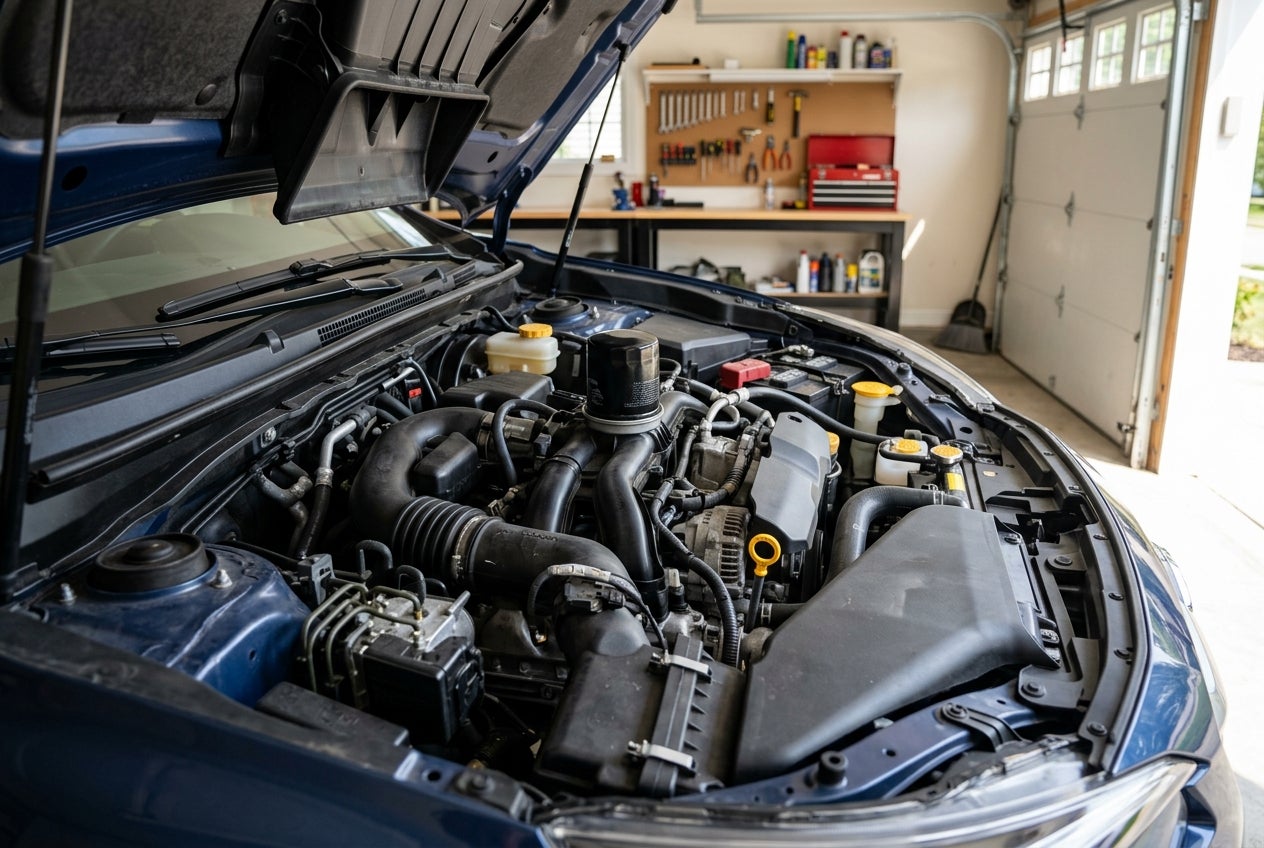
Open hood of a dark blue car parked inside an organized garage, showing the detailed engine bay. (Representative image for illustration purposes only. Actual vehicle may vary based on trim and configuration.)

Are Subaru Owners Able to Perform Long-Term Maintenance Themselves?

For generations, Subaru vehicles have built a dedicated following among drivers who appreciate rugged engineering, practical design, and mechanical transparency. Whether navigating winter snowstorms in St. Louis County or tackling weekend dirt roads, Subaru vehicles such as the Outback, Forester, and Crosstrek are built to endure. But when it comes to long-term ownership—spanning 10 years or 150,000 miles and beyond—a fundamental question arises for practical-minded vehicle owners: Are Subaru owners able to perform long-term maintenance themselves? more The short answer is yes, but with clear boundaries. Subaru’s thoughtful design choices—most notably the top-mounted engine oil filter on modern Subaru BOXER engines—make routine services exceptionally accessible for home mechanics. Tasks like engine oil changes, engine and cabin air filter swaps, windshield wiper replacements, battery care, and tire rotation can easily be executed in a home driveway with basic tools. However, modern Subarus are sophisticated machines equipped with Symmetrical All-Wheel Drive (AWD), Lineartronic Continuously Variable Transmissions (CVT), and complex driver-assist tech like EyeSight® Driver Assist Technology. Services involving fluid temperatures, differential calibration, electronic sensor realignment, and deep engine access present clear technical limits. Understanding where home maintenance shines and where certified dealer expertise is essential will help you maximize your vehicle’s life while keeping safety and resale value intact. If you ever need advice or high-grade components, you can always Find Subaru Parts directly through Sunset Hills Subaru. Explore OEM Parts & Accessories Is It Feasible to Perform Basic Subaru Maintenance Yourself During the First Year? During your first 12 months of Subaru ownership, maintenance demands are relatively light and heavily focused on preventative protection. For St. Louis area commuters navigating seasonal changes—from hot Midwest summers to icy winter salt on I-44—keeping up with initial service milestones is vital to preserving long-term durability. 1. Top-Mounted Engine Oil & Filter Changes: On modern 2.0L, 2.5L, and 2.4L Turbo Subaru BOXER engines, the spin-on oil filter is conveniently located right at the top of the engine bay. Unlike traditional vehicles where you must reach around hot exhaust manifolds under the vehicle, a Subaru filter can be unscrewed from above in seconds. Draining the engine oil still requires lifting the front end safely and removing the underbody splash shield, but for DIY enthusiasts equipped with a drain pan and torque wrench, this task is straightforward. 2. Cabin & Engine Air Filter Replacements: Seasonal pollen, humidity, and winter road dust can clog your vehicle’s filters. Replacing the engine air filter requires popping quick-release metal clips on the intake box—no tools required. The cabin air filter sits directly behind the glovebox compartment and can be replaced in less than ten minutes without specialized machinery. 3. Wiper Blade Care & Washer Refills: Visibility is a core pillar of Subaru safety. Installing fresh OEM wiper inserts or blade assemblies before winter sets in is a simple DIY task. Inspecting washer fluid reservoirs and ensuring correct freeze-resistant washer fluid levels keeps your EyeSight windshield cameras clear of streaks. 4. Tire Pressure & Tread Depth Inspection: Because Subaru’s Symmetrical AWD continuously monitors traction at all four wheels, maintaining uniform tire pressure and equal tread wear is paramount. Inspecting pressures weekly using a reliable digital gauge ensures your transfer clutch and center differential operate without premature wear. If you prefer professional precision during your first year, you can check our Current Service and Parts Specials for factory-backed service offers on early maintenance services. The Subaru Ownership Lifecycle: What St. Louis Drivers Can Expect From Year 1 to Year 10 A decade of vehicle ownership represents thousands of commutes, family road trips, and changing weather conditions across Sunset Hills, Kirkwood, and Ladue. Subaru builds vehicles meant to last well past 100,000 miles, but staying ahead of factory maintenance intervals is essential. Below is a realistic structural roadmap detailing what you should expect during each phase of ownership. Years 1 to 3 (0 – 36,000 Miles) Primary Focus: Routine Maintenance & Warranty Safeguards - Oil & filter changes every 6,000 miles or 6 months. - Tire rotations every 6,000 miles to preserve AWD symmetry. - Brake system visual inspection at 12,000-mile increments. - Cabin and engine air filter replacements every 15,000 to 30,000 miles. - Covered entirely by Subaru's 3-Year / 36,000-Mile Limited Warranty for factory defects. Drivers of models like the New Subaru Forester Inventory or New Subaru Crosstrek Inventory enjoy extremely predictable running costs during this honeymoon phase. Years 4 to 7 (36,000 – 75,000 Miles) Primary Focus: Wear-and-Tear & Fluid Replacements - 30,000 & 60,000-Mile Major Services: Brake fluid flush, front & rear differential gear oil change. - Brake pad and rotor replacement (typically between 40,000 and 60,000 miles based on city stop-and-go driving). - Spark plug replacement at 60,000 miles (required on BOXER layouts due to horizontal head position). - CVT transmission inspection & scheduled fluid replacement. - Battery replacement around Year 4 or 5. Years 8 to 10+ (75,000 – 120,000+ Miles) Primary Focus: Comprehensive Mechanical Longevity - 90,000 & 120,000-Mile Major Services. - Engine coolant flush and hose inspections. - Serpentine drive belt replacement. - Suspension component care: Struts, lower control arm bushings, and sway bar end links. - Wheel bearings and CV axle boot inspections. - Valve cover gasket monitoring to address minor oil weeping before major leaks develop. Considering upgrading to a newer model as your mileage accumulates? Explore our New Subaru Inventory to see the latest technology enhancements. What Does Subaru's Warranty Cover During the 10-Year Ownership Period? Understanding factory warranty protection is vital when deciding which maintenance tasks to handle yourself versus taking to the dealership. Federal law (the Magnuson-Moss Warranty Act) protects your right to maintain your vehicle yourself or at an independent garage without voiding factory warranties, provided the work is done correctly and with compliant fluids and parts. Factory Warranty Structural Overview: - 3-Year / 36,000-Mile New Vehicle Limited Warranty: Covers bumper-to-bumper components against defects in materials or factory workmanship. Also includes Wear Item Coverage for items like wiper blades, brake pads, and clutch linings. - 5-Year / 60,000-Mile Powertrain Limited Warranty: Covers essential mechanical heart components including the BOXER engine block, cylinder heads, oil pump, timing chain, CVT transmission internals, torque converter, and AWD front/rear differential assemblies. - 5-Year / Unlimited Mileage Rust Perforation Limited Warranty: Protects against sheet metal corrosion perforation under normal driving conditions. - Federal & State Emissions Warranties: Cover key catalytic converter and electronic engine control modules for up to 8 years or 80,000 miles. Critical DIY Record-Keeping Guidelines: If you choose to change your own oil, filters, or differential fluids during the warranty period, you must maintain meticulous records. Keep all itemized receipts for Genuine Subaru OEM oil, filters, and fluid specifications. Log dates, vehicle mileage, and exact work performed in a dedicated notebook or digital log. If a powertrain issue arises, having clear documentation prevents warranty claim disputes. Planning your long-term vehicle budget or considering an extended service agreement? Get approved for financing or discuss extended protection coverage with our financial specialists at Sunset Hills Subaru. Apply for Pre-Approval & Financing How Do Subaru Maintenance Costs Typically Change From Year 1 to Year 10? Vehicle ownership expenses evolve significantly across a decade. During the early years, expenses are minimal—consisting mostly of routine synthetic oil changes and tire rotations. As your vehicle reaches mid-life and higher mileage thresholds, mechanical wear items require strategic investments to maintain factory performance and reliability. Ownership Phase Typical Mileage Key Services Needed Estimated Annual Maintenance Investment Phase 1: Early Ownership (Years 1–3) 0 – 36,000 Oil/filter changes, tire rotations, cabin/engine filters, wiper inserts. $200 – $400 / year Phase 2: Mid-Life Wear (Years 4–7) 36,001 – 75,000 Brake pads & rotors, differential fluid exchange, brake fluid flush, spark plugs, battery replacement. $600 – $1,100 / year Phase 3: High Mileage (Years 8–10+) 75,001 – 120,000+ Coolant service, serpentine belts, suspension bushings/struts, wheel bearings, valve cover gaskets, CVT fluid servicing. $1,100 – $1,800 / year Performing simple DIY tasks—such as air filter swaps and basic oil servicing—helps flatten this cost curve during early ownership. However, investing in professional major services during Phase 2 and Phase 3 protects vital drive components like the Symmetrical AWD system and Lineartronic CVT, preventing multi-thousand-dollar repair bills down the road. If you're evaluating your current car's financial future, you can Get your value trade online to evaluate your vehicle's equity position. DIY vs. Professional Servicing: Which Subaru Tasks Require Dealer Tools? While home mechanics can easily handle surface maintenance, modern engineering creates distinct boundaries where specialized diagnostic computers and physical shop tools become necessary. Ideal DIY Home Garage Tasks - Engine Oil & Filter Changes: Easy top-mounted filter access. - Engine & Cabin Air Filters: No special tools required. - Wiper Blade Replacement: Quick snap-in installation. - 12V Battery Replacement: Simple terminal disconnect with standard sockets. - Basic Exterior Light Bulbs: Simple access panels on most non-LED assemblies. Intermediate DIY (Requires Skill) - Brake Pad & Rotor Replacement: Tight space clearance; requires caliper retractors and proper torque specs. - Front & Rear Differential Fluid: Requires level vehicle positioning and specialized Torx/hex sockets. - BOXER Spark Plug Replacement: Challenging clearance due to frame rail proximity; requires specialized swivel extensions. Dealer Service (Requires Factory Tools) - Lineartronic CVT Fluid Exchange: Requires live fluid temperature monitoring via Subaru Select Monitor (SSM4) diagnostic software during filling. - EyeSight® Camera Alignment: Requires physical target targets and proprietary optical calibration software after windshield swaps or suspension lifts. - Timing Belt (Older SOHC/DOHC) / Chain Servicing: Critical engine timing setup. How Does Subaru Ownership Compare to Toyota Over a 10-Year Period in Cost and Reliability? When evaluating long-term value, shoppers frequently compare Subaru vehicles like the New Subaru Outback Inventory or Forester against competitor offerings from Toyota (such as the RAV4 or Highlander). Both Japanese manufacturers enjoy industry-leading resale values and longevity ratings, but their mechanical architectures lead to subtle differences in maintenance requirements over a 10-year period. Drive Architecture & All-Wheel Drive Upkeep: Subaru’s standard Symmetrical All-Wheel Drive is an active full-time system integrated directly into the transmission output shaft. This can provide strong traction on slippery St. Louis winter roads compared to many front-wheel-drive-based systems. However, active AWD requires strict tire diameter uniformity (tread depth within 2/32nds of an inch across all four tires) and regular front/rear differential fluid changes every 30,000 to 60,000 miles. Engine Layout Considerations: Toyota relies on inline-4 or V6 engines, whereas Subaru uses the Subaru BOXER horizontally opposed engine. The BOXER engine offers a lower center of gravity, enhancing high-speed stability and cornering composure around curves in Sunset Hills and Ladue. The trade-off is spark plug replacement access: changing inline engine spark plugs takes 20 minutes from the top, while BOXER spark plugs require working near the frame rails with specialized sockets. Total Cost of Ownership Comparison: Over 10 years and 120,000 miles, total maintenance costs between Subaru and Toyota remain remarkably close—typically within 5% to 8% of each other. Subaru owners spend slightly more on differential fluids and spark plug labor, but benefit from exceptional resale retention and unmatched capability in adverse weather. Interested in exploring new options? Check out our Current New Car Offers to compare trim features and incentives across our lineup. View New Car Offers How Does Subaru’s Fuel Economy Typically Change With Vehicle Age and Mileage? It is not uncommon for drivers to notice a slight decline in fuel efficiency (miles per gallon) as their vehicle passes 75,000 miles. On hilly terrain throughout Sunset Hills, Ladue, and surrounding St. Louis communities, engine efficiency changes become more pronounced during seasonal extremes. Primary Factors Contributing to Mileage Loss: - Mass Air Flow (MAF) & Air Sensor Film: Over time, microscopic dust and oil vapors coat the delicate heated wire inside the MAF sensor. This leads to inaccurate air intake readings, causing the engine computer to run a rich fuel mixture. - Positive Crankcase Ventilation (PCV) Valve Aging: A sticking PCV valve allows oily blow-by gases to re-enter the intake manifold, building carbon deposits on intake valves and spark plug tips. - Oxygen (O2) Sensor Degradation: Upstream air/fuel ratio sensors gradually slow their response time before triggering a Check Engine Light, leading to unburned fuel waste. - Drivetrain Resistance & Tire Inflation: Under-inflated tires or drag from worn wheel bearings and dragging brake pads increase rolling resistance, penalizing fuel economy by 2 to 4 MPG. - Ethanol Fuel Blends & Carbon Buildup: Direct-injection BOXER engines (such as the 2.4L Turbo found in the New Subaru Ascent Inventory or Outback XT) can develop carbon buildup on intake valves over 60,000+ miles, disrupting optimal fuel-air atomization. Regular maintenance—including air filter changes, MAF sensor cleaning, and timely spark plug replacement—restores original EPA fuel economy estimates. Is It Possible to Diagnose Subaru Fuel Economy Loss at Home? If you notice your fuel gauge dropping faster than usual, home diagnostics can help identify the culprit before scheduling professional service. Equipped with an inexpensive OBD-II bluetooth scanner and basic hand tools, home mechanics can perform several systematic checks. Step-by-Step DIY Diagnostic Checklist: 1. Check Short-Term & Long-Term Fuel Trims (STFT / LTFT): Plug your OBD-II scanner into the port below the steering column. View live data for LTFT. A healthy reading sits between -5% and +5%. If fuel trims exceed +10%, the engine computer is adding extra fuel to compensate for a vacuum leak or dirty MAF sensor. 2. Inspect & Clean the MAF Sensor: Remove the two small screws holding the MAF sensor on the intake tube. Spray the internal sensing wire with dedicated aerosol MAF Sensor Cleaner (never use brake cleaner). Allow it to dry completely before reinstallation. 3. Check Tire Pressure Cold: Verify pressures match the placard inside the driver's door jamb. A drop of just 5 PSI can decrease fuel efficiency by over 2% while accelerating tread wear. 4. Inspect Brake Caliper Drag: After a routine drive, safely feel near the center of each wheel hub (without touching hot brake rotors directly). If one wheel hub feels noticeably hotter than the others, a sticking brake caliper slide pin may be causing constant resistance. When home diagnostics reveal complex fuel trim irregularities or persistent Check Engine codes, contact our team to Schedule Service and Diagnostics with our factory-trained technicians. What Are Typical Reliability Issues Subaru Owners Face After 10 Years? Subaru vehicles are engineered for longevity, with over 96% of Subaru vehicles sold in the last 10 years still on the road today. However, passing the 10-year or 100,000-mile landmark means certain rubber, silicone, and mechanical components reach the end of their design lifespan. Engine Gaskets & Seals On high-mileage engines, rubber valve cover gaskets and spark plug tube seals eventually harden from engine heat cycles. This results in minor oil seepage down the sides of the block. Monitoring oil levels on the dipstick regularly prevents oil starvation. Suspension & Rubber Bushings Front lower control arm rear compliance bushings undergo constant flexing. By Year 10, rubber tearing or cracking can cause subtle steering wheel shimmy during highway braking or uneven front tire wear. Cooling System Upkeep Radiator plastic end tanks and upper/lower radiator hoses degrade over time. Flushing coolant at recommended intervals and replacing aging hoses prevents engine overheating, safeguarding cylinder head integrity. Schedule 10-Year Service Inspection What Are Typical Costs for Subaru Maintenance Services in Sunset Hills? For vehicle owners in Sunset Hills, Kirkwood, Fenton, and Greater St. Louis, budgeting for professional service is straightforward when working with an authorized dealer. Utilizing Genuine Subaru OEM parts and factory-certified technicians ensures your vehicle receives exact fluid formulations and precise torque tolerances. Why OEM Quality Matters: Generic quick-lube centers frequently use multi-vehicle global fluids that do not meet Subaru's exact friction requirements for Lineartronic CVTs or Symmetrical AWD limited-slip differentials. Using non-compliant fluids can lead to harsh shifting, shuddering under load, or accelerated component wear. At Sunset Hills Subaru, our service facility provides transparent pricing, factory-trained technicians, specialized diagnostic equipment, and comfortably appointed guest lounges. If you prefer doing minor garage work yourself, our parts counter carries original oil filters, crush washers, air filters, and specialized fluids. If you're exploring pre-owned vehicles with complete maintenance histories, feel free to browse our Used Vehicle Inventory. Where Can Drivers in Sunset Hills Find Genuine Subaru Parts and Service Support? Whether you choose to tackle routine maintenance items in your own home garage or trust our Master Certified Technicians with major service milestones, Sunset Hills Subaru is here to support your entire ownership journey. Visit us today at 10100 Watson Rd, Sunset Hills, MO 63127. Conveniently located near I-270 and I-44, our state-of-the-art facility features an Express Maintenance service lane for quick oil changes, tire rotations, and multi-point inspections without an appointment. Ready to get started? Get Directions to Sunset Hills Subaru or Call us at (314) 476-9638 to speak directly with our service and parts specialists. Schedule Service and Diagnostics Title Tags Subaru DIY Maintenance Tips in Sunset Hills MO | Sunset Hills Subaru Meta Description Keywords Open Graph Twitter Card Canonical Article Metadata Geographic Targeting

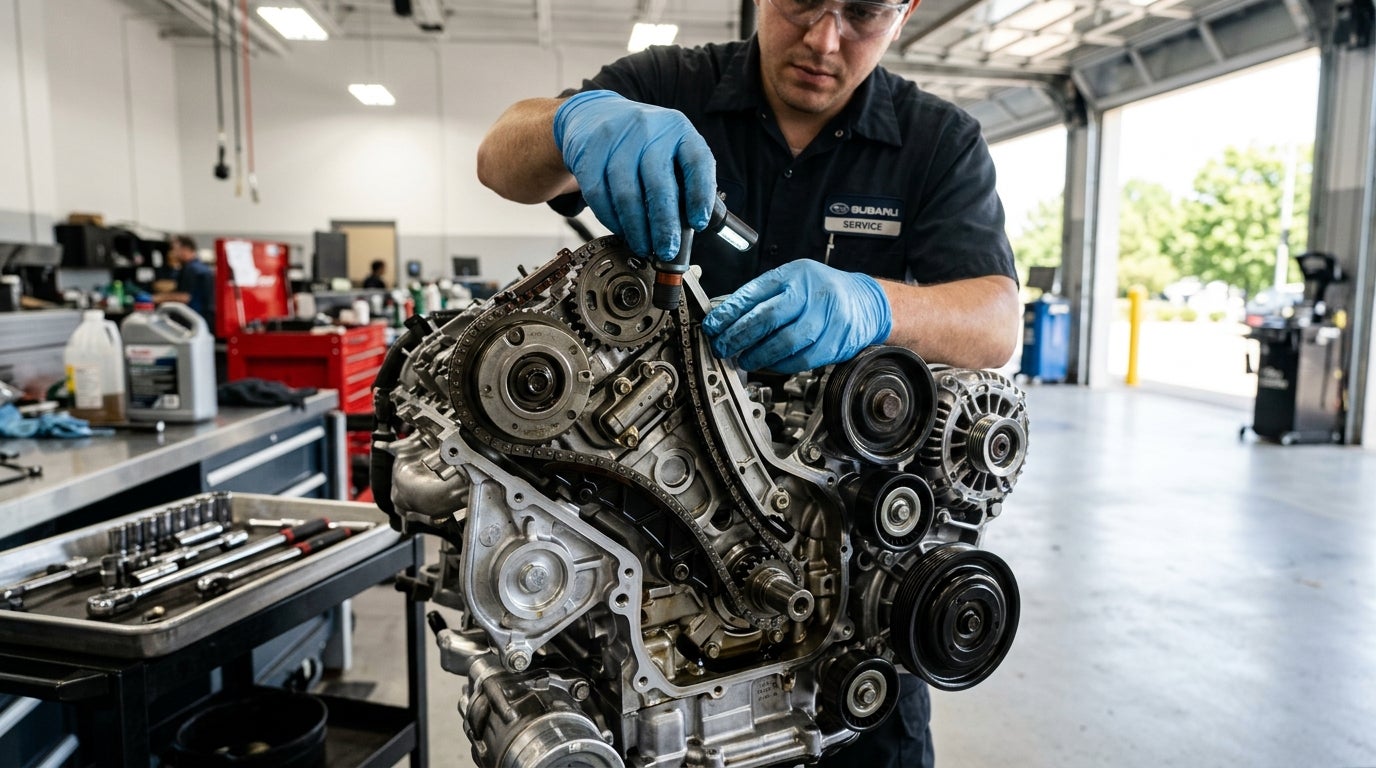
A Subaru service technician inspecting an exposed car engine timing chain in an auto repair shop. (Representative image for illustration purposes only. Actual vehicle may vary based on trim and configuration.)

Subaru Timing Belt vs. Timing Chain: The Direct Answer & Replacement Intervals

Subaru Timing Belt vs. Timing Chain: The Direct Answer & Replacement Intervals If you drive a Subaru around Sunset Hills or Ladue, knowing whether your engine uses a timing belt or a timing chain is one of the single most critical factors in maintaining long-term engine reliability. Here is the straightforward answer straight from our factory workshop: Subaru rubber timing belts require scheduled replacement every 105,000 miles or 7 years (whichever occurs first). On the other hand, Subaru metal timing chains are engineered to last the full lifecycle of the vehicle engine without scheduled replacement, provided regular engine oil changes are performed. more To break down precisely what this means for your vehicle, we sat down for an in-depth interview with Kyle Marcum, Master Technician at Sunset Hills Subaru. With over 7 years of hands-on experience diagnosing, servicing, and rebuilding horizontal Boxer engines—from classic EJ series powerplants to modern FB, FA, and EZ configurations—Kyle shares his expert technical insights on timing maintenance, warning signs, and prevention strategies for Suburban St. Louis drivers. Schedule Timing Service & Diagnostics Meet Master Tech Kyle Marcum: Expert Subaru Engine Care in Sunset Hills Interviewer: Kyle, thank you for joining us today. You've been working on Subaru Boxer engines here in Sunset Hills for 7 years. To kick things off, why is the timing system such a passionate topic among Subaru owners? Kyle Marcum: Thanks for having me. The Subaru Boxer engine is unique because the cylinders lay horizontally opposed. That means the camshafts on each cylinder head are separated by a significant distance across the engine bay. Whether your Boxer relies on a long, reinforced rubber timing belt or a dual roller timing chain, that component is responsible for perfectly synchronizing the crankshaft with the overhead camshafts. If that synchronization slips even by a few teeth, the engine stops running properly—or worse, sustains severe internal damage. Understanding whether you have a belt or chain dictates your entire maintenance budget over 100,000 miles. Drivers commuting around Sunset Hills, Kirkwood, and Ladue often ask us if their vehicle needs immediate timing belt service. When customers bring their vehicles to our dealership, whether they are checking out our New Subaru Inventory or coming in for routine maintenance, clarifying their engine family gives them total clarity and complete confidence. Q: Which Subaru Models Have a Timing Belt Versus a Timing Chain? Interviewer: Kyle, Subaru transitioned many of its engines from timing belts to timing chains over the past decade and a half. Can you break down which models and model years feature belts versus chains? Belt-Driven Subaru Models (EJ Engine Family) Kyle Marcum: The legacy EJ engine architecture relies on a rubber composite timing belt with heavy internal tensile cords. Models requiring belt replacement at 105k miles include: • Outback & Legacy: 2.5L 4-cylinder models up through 2012. • Forester: 2.5L 4-cylinder models up through 2010. • Impreza: 2.5L non-turbo models up through 2011. • WRX & WRX STI: All EJ25-powered performance models up through 2021 STI. Chain-Driven Subaru Models (FB / FA / EZ Families) Beginning around 2011, Subaru introduced modern FB and FA series engines equipped with maintenance-free metal timing chains: • Forester: 2011+ (FB25 / 1.8T / 2.5L DI) • Impreza: 2012+ (FB20) • Outback & Legacy: 2013+ (FB25) & 3.6R 6-cyl (EZ36) • Crosstrek: All years (2013+) (FB20 / FB25) • Ascent, WRX (2015+), BRZ: All modern FA20/FA24/FA24T engines. Key Differences & Model Quick-Reference If you drive a newer model like those found in our New Subaru Forester Inventory or New Subaru Outback Inventory, your vehicle uses a timing chain designed for the life of the motor. However, if you are shopping pre-owned or maintaining a late 2000s model, keeping track of that 105,000-mile belt deadline is vital to avoid mechanical failure. Q: What Happens When a Timing Belt Snaps on an Interference Subaru Engine? Interviewer: Kyle, we often hear the term 'interference engine' when discussing timing belts. What does that mean in simple terms, and what actually happens inside a Subaru engine if a timing belt breaks while driving down Interstate 44? Kyle Marcum: Virtually all modern Subaru engines—both belt and chain driven—are interference design engines. In an interference engine, the physical space where the intake and exhaust valves open overlaps with the space the piston occupies at top-dead-center. The timing belt acts like a precision conductor, ensuring the valves move out of the way before the piston travels upward. If a timing belt snaps or strips its teeth while the engine is running at 3,000 RPM, the camshafts instantly freeze while the crankshaft keeps spinning. The pistons smash into the open valves at high velocity. The result is bent intake and exhaust valves, damaged piston crowns, cracked valve guides, and often complete cylinder head destruction. Instead of a routine belt service, you are looking at thousands of dollars in engine rebuilding or full engine replacement. Schedule Service and Diagnostics Q: What Does a Bad Timing Belt Sound Like, and Are Timing Chains Louder? Interviewer: Drivers often ask if they can hear a failing timing belt or chain before catastrophic failure happens. What acoustic warning signs should owners listen for? Timing Belt Acoustic Symptoms Kyle Marcum: Timing belts themselves are quiet because they are rubber. However, a failing hydraulic belt tensioner or worn idler pulley produces distinct sounds: • Ticking or Rapping: A failed tensioner piston tapping against the engine block behind the timing cover. • High-Pitched Squeak or Grinding: Seizing bearing in the cogged or smooth idler pulleys. • Slapping Sound: Belt slack hitting the plastic timing cover at cold startup. Timing Chain Acoustic Symptoms Timing chains emit a subtle mechanical hum under normal operation. However, excessive noise indicates maintenance issues: • Metallic Rattling on Cold Start: Oil starvation or low engine oil pressure delaying hydraulic chain tensioner activation. • Continuous Marbles-in-a-Can Noise: Stretched chain links or worn composite chain guides due to neglected oil change intervals. Kyle's Expert Advice Never ignore unusual noises coming from the front lower section of your engine. For chain engines, keeping fresh oil at proper levels is the single most crucial factor. If you notice strange noises on your vehicle, visit our certified technicians or Call us at (314) 476-9638 to schedule an immediate inspection. Q: What Should You Check Before Buying a Used Subaru with a Timing Belt? Interviewer: Many pre-owned vehicle shoppers in St. Louis and Sunset Hills look at older Subaru models known for their longevity. What pre-purchase steps should they take regarding the timing system? Kyle Marcum: If you are browsing our Used Vehicle Inventory or shopping private sales, check these critical items: 1. Service Records: Verify documented proof that the timing belt, water pump, hydraulic tensioner, and idler pulleys were replaced at or before 105,000 miles (or 7 years). 2. Timing Cover Sticker: Reputable shops place a date and mileage sticker on top of the plastic timing belt cover upon replacement. 3. Visual Inspection: Look for front camshaft or crankshaft oil leaks that could saturate and degrade a rubber belt prematurely. 4. Trade Value Evaluation: If buying a replacement vehicle, consider trading in your vehicle with our tool to Get your value trade toward a certified model. Q: What Is the Most Difficult Step in DIY Timing Belt Replacement, and What Special Tools Are Needed? Interviewer: Modern automotive enthusiasts sometimes tackle maintenance at home. Is replacing a Subaru timing belt a viable DIY project, and what makes it challenging? Kyle Marcum: Replacing a Subaru timing belt is technically demanding due to the horizontal Boxer layout. Here are the toughest steps and special tool requirements: • Crank Pulley Bolt Torque: Breaking free the factory crank pulley bolt requires over 130+ ft-lbs of breakaway torque. You need a dedicated Subaru Crank Pulley Holder Tool to prevent the engine from rotating while breaking the bolt loose. • Camshaft Alignment (DOHC Models): Dual Overhead Cam (DOHC) engines like the EJ255/EJ257 have four separate camshaft pulleys. Under valve spring tension, the left-hand camshafts will snap violently out of position if not locked in place with a specialized Cam Lock Tool. • Precision Tooth Alignment: Lining up the hash marks on the timing belt with the notch marks on the crank sprocket and four cam gears leaves zero room for error. A single tooth misalignment causes misfires or engine damage. • Genuine OEM Components: Some aftermarket timing kits often suffer early hydraulic tensioner failures. We always recommend genuine factory parts from our parts center to Find Subaru Parts designed for exact OEM tolerances. Order OEM Subaru Timing Parts Q: How Long Does It Take an Experienced Mechanic to Replace a Subaru Timing Belt? Interviewer: When a customer schedules a timing belt service at Sunset Hills Subaru, how long is their vehicle typically in the service bay, and what extra parts are serviced simultaneously? Kyle Marcum: In a professional dealership environment, a full timing belt replacement typically takes 3 to 5 hours of labor depending on whether it is a Single Overhead Cam (SOHC) or Dual Overhead Cam (DOHC) turbo configuration. Crucially, replacing only the rubber belt is a mistake. To do the job right and prevent duplicate labor charges later, certified technicians install a complete timing service kit including: • New Water Pump & Gasket (driven directly by the timing belt) • New Hydraulic Belt Tensioner Assembly • New Cogged & Smooth Idler Pulleys • Fresh Engine Coolant & Thermostat • Inspection of Front Camshaft & Crankshaft Oil Seals. Q: How Do I Find a Qualified Mechanic in Sunset Hills, MO, and Does Warranty Cover Timing Service? Interviewer: What should local St. Louis drivers know about technician qualifications and warranty coverage when scheduling service? Factory-Trained Certification Kyle Marcum: Always choose technicians who complete specialized Subaru Academy training. Horizontal Boxer engines require precise torque sequences and tool knowledge that general repair shops may not possess. Routine Maintenance vs. Warranty Routine 105,000-mile timing belt replacement is considered wear-and-tear maintenance and is not covered by factory warranties. However, if a timing chain component fails under factory or Certified Pre-Owned (CPO) Powertrain warranty, it is typically covered—provided service records confirm scheduled oil changes. Local Dealership Advantage Maintaining clear service records at an authorized center protects your vehicle's warranty status and resale value. Check our Current Service and Parts Information for current seasonal service offers. Q: What Questions Should You Ask a Mechanic Before Approving a Subaru Timing Replacement? Interviewer: Before a vehicle owner signs a repair order, what key questions should they ask their service advisor? Kyle Marcum: I recommend asking these four essential questions: 1. Are genuine OEM Subaru parts being installed? 2. Does the estimate include replacing the water pump, tensioner, and all idler pulleys? 3. Will camshaft and crankshaft oil seals be inspected and replaced if leaking? 4. What warranty backs the parts and labor for this repair? If you are considering upgrading your vehicle or exploring options, you can also explore our Get approved for financing options or check Current New Car Inventory. At Sunset Hills Subaru, we provide transparent line-item estimates including genuine OEM components, factory coolant replacement, and full parts and labor warranty protection. View Current Service Specials Key Takeaways: Maintaining Your Subaru Timing System in Suburban St. Louis Timing Belt Rule Replace rubber timing belts every 105,000 miles or 7 years. Replace the water pump, tensioner, and idlers at the same time to protect your interference engine. Timing Chain Care Timing chains are built for engine life but require clean engine oil. Maintain regular oil change intervals to keep hydraulic chain tensioners functioning properly. Expert Support Trust factory-certified Master Techs like Kyle Marcum at Sunset Hills Subaru for expert diagnostic care, genuine OEM parts, and complete confidence on the road. Explore our full range of new Subaru vehicles: New Subaru Crosstrek Inventory | New Subaru Ascent Inventory | New Subaru Impreza Inventory | New Subaru WRX Inventory | New Subaru Legacy Inventory | New Subaru BRZ Inventory | New Subaru Solterra Inventory Schedule Your Subaru Timing Belt or Chain Inspection at Sunset Hills Subaru Don't leave your engine's reliability to chance. Whether your Subaru is due for its 105,000-mile timing belt replacement or you want our factory-trained Master Technicians to inspect your timing chain system, Sunset Hills Subaru is here to serve drivers across Sunset Hills, Ladue, Kirkwood, and the entire St. Louis area. Visit our state-of-the-art service center at 10100 Watson Rd, Sunset Hills, MO 63127 or contact our service advisors directly by phone. Get Directions to Sunset Hills Subaru or Call us at (314) 476-9638 today. Schedule Service Appointment Value Your Trade-In Title Tags Subaru Timing Maintenance in Sunset Hills MO | Sunset Hills Subaru Meta Description Keywords Open Graph Twitter Card Canonical Article Metadata Geographic Targeting Title Tags Subaru Timing Maintenance in Sunset Hills MO | Sunset Hills Subaru Meta Description Keywords Open Graph Twitter Card Canonical Article Metadata Geographic Targeting