Do Subaru CVTs Last as Long as Traditional Automatic Transmissions? The Expert Verdict
For years, automotive forums and driveway mechanics have debated the long-term durability of Continuously Variable Transmissions (CVTs) compared to traditional step-gear torque-converter automatics. Early implementations of CVTs across the automotive industry in the late 2000s earned a reputation for premature wear, sluggish rubber-band acceleration, and high replacement costs. However, when examining Subaru’s engineered-in-house Lineartronic CVT, the short answer to whether it can match or exceed the lifespan of a traditional automatic is an emphatic YES — provided proper maintenance protocols are followed.
Modern Subaru Lineartronic CVTs regularly achieve 200,000 to 250,000 miles or more without major mechanical overhauls. Unlike early push-belt CVT designs utilized by other manufacturers, Subaru engineered a unique, high-torque steel pull-chain system that drastically reduces friction, heat, and internal slippage. When paired with routine fluid exchanges rather than relying on outdated ‘lifetime fluid’ marketing claims, the Subaru CVT stands as one of the most reliable modern drivetrains on the market today.
At Sunset Hills Subaru, located at 10100 Watson Rd in Sunset Hills, MO, our service center regularly inspects, maintains, and services high-mileage Subarus that commute daily across St. Louis County, Ladue, and Kirkwood. Below, Service Manager Shawn King brings 21 years of hands-on Subaru master diagnostic experience to answer every critical question regarding Lineartronic CVT design, real-world longevity, maintenance requirements, and overall vehicle value.
Meet Shawn King: 21 Years of Subaru Service Expertise in St. Louis County
Interviewer: Welcome, Shawn. Over your 21 years in Subaru service management here at Sunset Hills Subaru, you’ve seen the mechanical transition from traditional 4-speed and 5-speed automatic transmissions to the modern Lineartronic CVT across the entire Subaru lineup. What is your perspective on this evolution?
Shawn King: ‘Thanks for having me. When Subaru first introduced the Lineartronic CVT in North America around 2010 on the Outback and Legacy, customers and technicians were understandably cautious. Up to that point, 4EAT and 5EAT torque-converter automatics were simple, bulletproof boxes, but they sacrificed fuel economy and engine performance. Over two decades, I’ve watched Subaru refine their CVT architecture through three distinct generations. Today, when a customer asks me if a modern CVT will last as long as their old 2005 Outback automatic, I can look them in the eye and say yes—and in many cases, with far less mechanical stress on the engine.’
Shawn King: ‘We service thousands of vehicles every year from commuters taking I-270 daily to drivers handling steep, rolling topography in Ladue and Sunset Hills. The longevity of any transmission boils down to mechanical friction management, thermal management, and fluid hygiene. Throughout this Q&A, I want to demystify how these transmissions operate and share actionable maintenance strategies that keep our customers’ vehicles thriving beyond 200,000 miles.’
Q: How Does a Subaru Lineartronic CVT Work Mechanically Compared to a Traditional Automatic?
Interviewer: Shawn, to help us understand lifespan, can you break down the physical mechanical differences between a traditional planetary automatic and Subaru’s Lineartronic system?
Shawn King: ‘A conventional step-gear automatic transmission relies on multiple sets of complex planetary gears, hydraulic valve bodies, multi-plate clutch packs, and a torque converter. To accelerate, hydraulic pressure engages and disengages distinct gear ratios—say, 1st through 6th or 8th gear. Every shift creates a momentary interruption of power and a minor mechanical shock as clutches engage.’
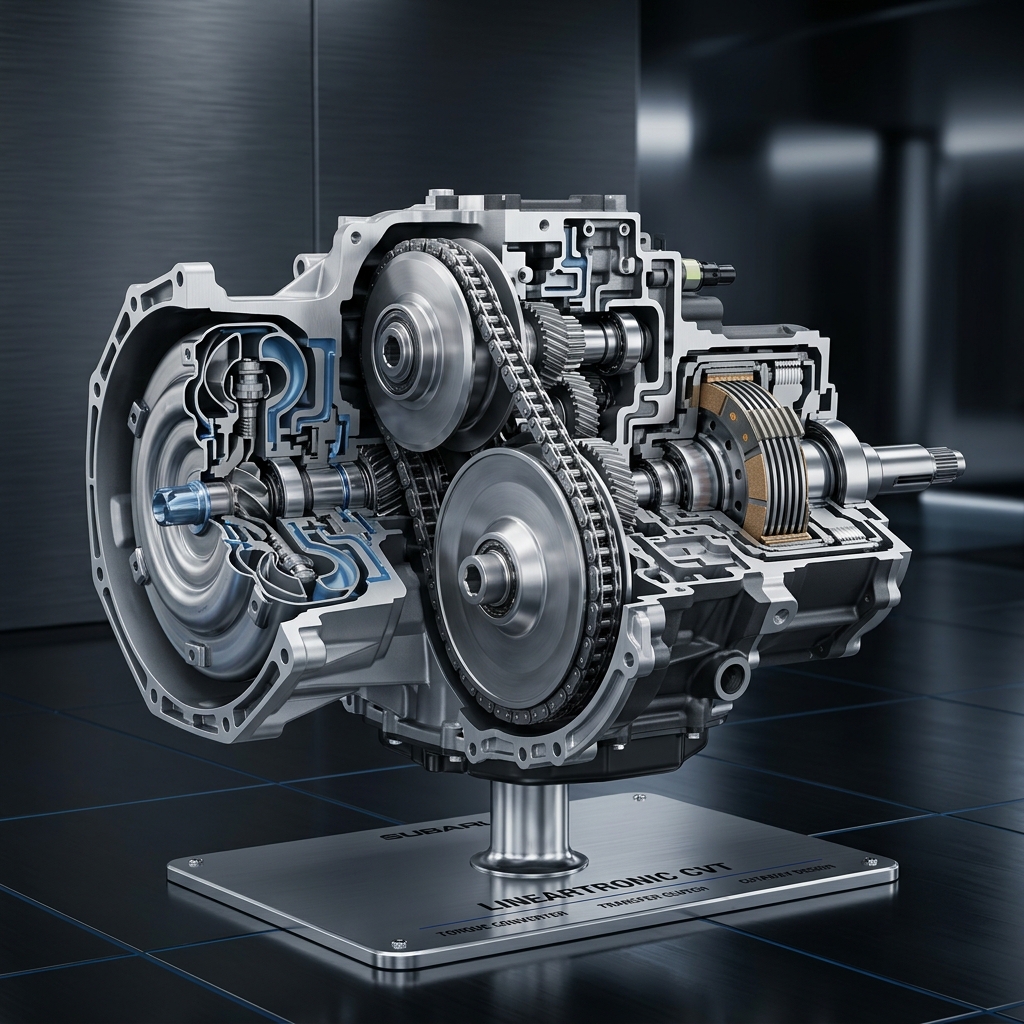
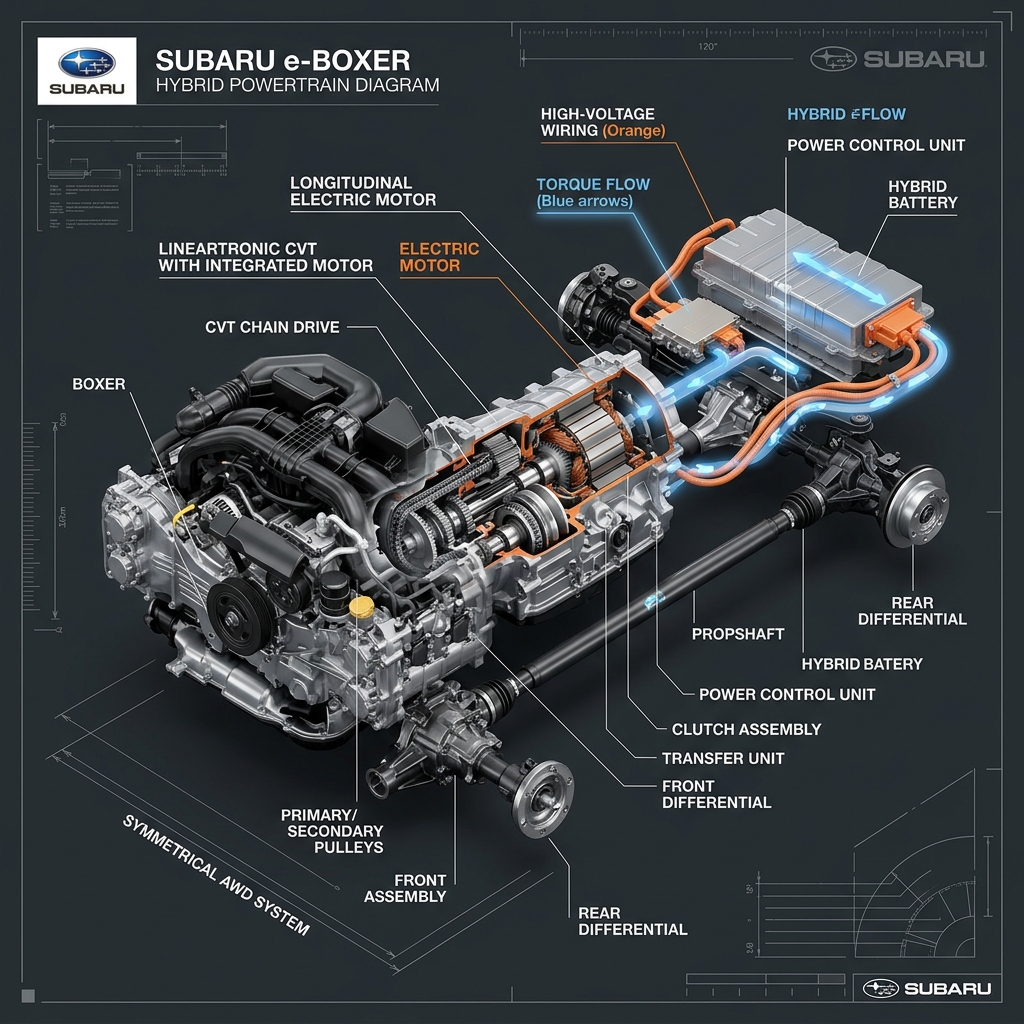
Shawn King: ‘Subaru’s Lineartronic CVT dispenses with fixed-gear sets entirely. Instead, it utilizes two hydraulically adjustable, cone-shaped pulleys connected by a ultra-durable, high-tensile steel chain. By continuously altering the width of the primary (input) and secondary (output) pulleys, the effective diameter around which the chain loops changes seamlessly. This provides an infinite range of gear ratios between its lowest and highest mechanical limits.’
Shawn King: ‘What makes Subaru’s design especially unique is its longitudinal placement and integration with Symmetrical All-Wheel Drive. In a typical front-wheel-drive CVT, components are crammed transaxle-style into a tight transverse box. Subaru aligns the Lineartronic inline with the Boxer engine. This symmetrical layout allows for larger, sturdier pulley shafts, superior oil distribution, and reduced thermal hot spots.’
Shawn King:‘Because the engine can stay continuously in its peak power or efficiency band without harsh gear changes, mechanical strain on the internal combustion engine itself is noticeably diminished. Whether you are driving a New Subaru Outback Inventory model or a versatile family SUV, the seamless transfer of power protects both the engine crank and the drive axles from sudden torque spikes.’
Q: Are Traditional Torque-Converter Automatics Inherently More Durable Than CVTs?
Friction & Wear Components
Traditional automatics contain dozens of friction disks, brake bands, and internal clutch packs that wear down during every shift change. Over 150,000 miles, clutch material sheds into the ATF fluid. CVTs eliminate shift clutches entirely, transferring drive torque continuously through hydraulic pressure clamping force across the steel chain and pulley interface.
Mechanical Shock & Driveline Stress
Gear shifting creates torsional shock loads through the driveshaft, differentials, and engine mounts. By eliminating gear steps, a Subaru CVT delivers uninterrupted, fluid torque application. This smooth energy transfer significantly reduces fatigue failure risks in secondary driveline components like U-joints and axle CV shafts over long ownership cycles.
Thermal Management & Fluid Sensitivity
Traditional automatics are somewhat more tolerant of dirty or oxidized fluid before slipping becomes noticeable. CVTs rely heavily on high hydraulic clamping pressure (up to 800+ PSI) and specialised traction fluid to prevent chain slippage. While highly durable, CVTs demand strict adherence to fluid maintenance to match step-gear lifespan.
Shawn King’s Verdict: ‘It is a misconception that traditional automatics are fundamentally indestructible. Anyone who owned an 80s or 90s automatic knows clutches burn out and valve bodies clog. The modern Lineartronic CVT actually has far fewer moving components. When maintained with high-grade genuine fluid, its structural endurance matches or exceeds classic automatics.’
Q: How Does Subaru's Chain-Driven CVT Compare to Nissan's Belt-Driven CVT in Reliability?
Interviewer: Many consumers associate some CVTs with reliability concerns from certain brands, including Nissan. Why is Subaru’s engineering fundamentally different?
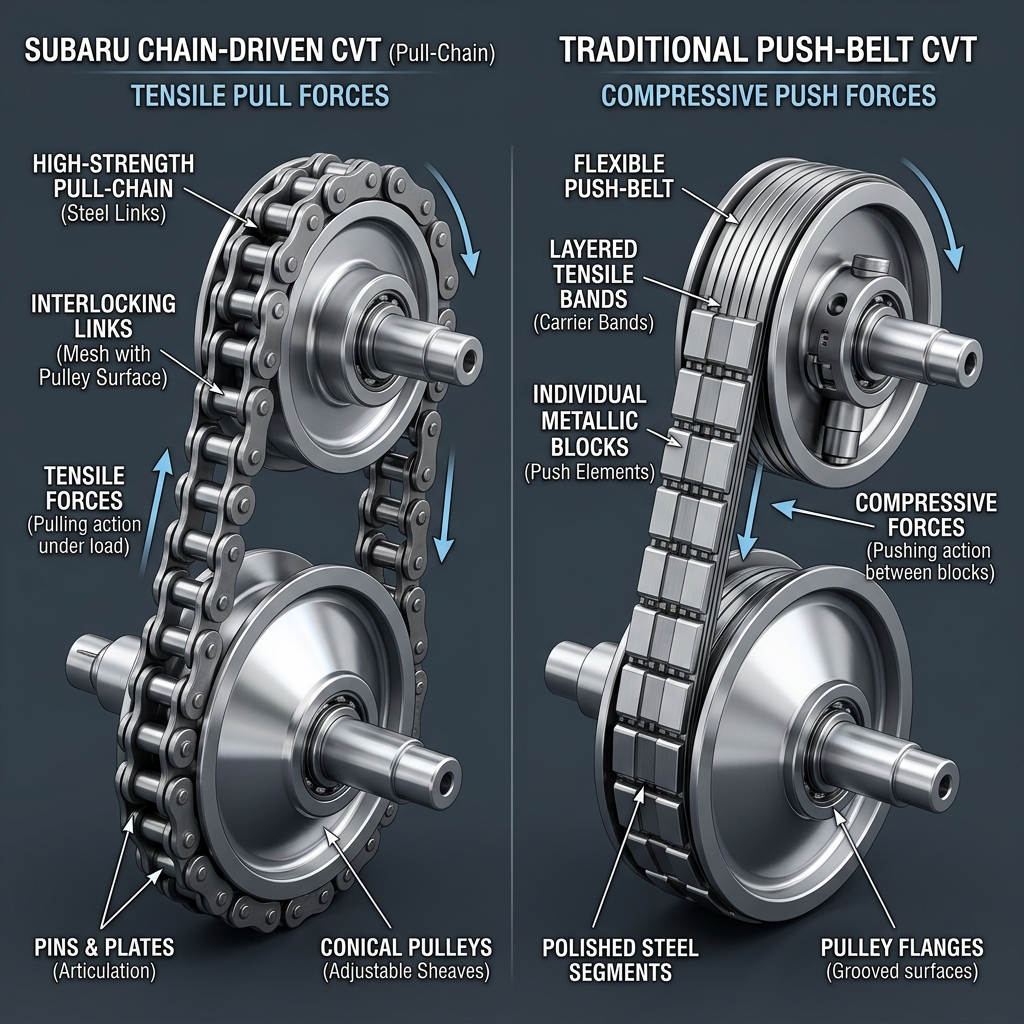
Shawn King: ‘This is the single most important distinction in automotive CVT technology. Most high-volume CVT failures in competitor vehicles stemmed from push-belt designs manufactured by Jatco. A push-belt consists of hundreds of small steel elements held together by flexible steel bands. Under high torque load, push-belts can experience micro-slippage against the smooth pulley faces, generating metal shavings and extreme heat that destroys hydraulic control valves.’
Shawn King: ‘Subaru partnered with Schaeffler LuK to pioneer a short-pitch steel pull-chain system for Lineartronic. Rather than pushing elements, Subaru’s chain pulls across the pulleys. The chain pins grip into tiny recessed grooves on the pulley cones mechanically rather than relying solely on surface friction. This short-pitch design allows for smaller pulley radiuses, expanding the overall ratio coverage while handling immense torque loads without slipping.’
Shawn King:‘Because the chain grips mechanically without slipping, Subaru Lineartronic CVTs can withstand high-torque turbocharged engines like the 2.4L BOXER found in the Outback XT, Ascent, and WRX. You can explore our New Subaru Ascent Inventory or test drive a New Subaru WRX Inventory model to experience how crisp and immediate power delivery feels with this robust chain architecture.’
Q: How Many Miles Can a Well-Maintained Subaru CVT Transmission Realistically Last?
Interviewer: Shawn, based on the thousands of vehicles that enter Sunset Hills Subaru’s service bays annually, what realistic mileage figures should St. Louis drivers expect?
Shawn King:‘With diligent fluid servicing, reaching 200,000 to 250,000 miles on an original Subaru CVT is standard in our workshop. In fact, we regularly service fleet vehicles, commuter cars, and family haulers from around St. Louis County that have eclipsed 220,000 miles without a single transmission teardown. Conversely, vehicles where fluid service was neglected after 100,000 miles often start showing valve body solenoid wear or thermal fatigue between 130,000 and 150,000 miles.’
Expected Lifespan by Maintenance Schedule (St. Louis Driving Profile)
| Maintenance Protocol |
Fluid Service Interval |
Estimated CVT Lifespan |
Common Service Needs |
| Neglected (‘Lifetime’ belief) |
Never changed (100k+ miles) |
120,000 – 150,000 miles |
Solenoid failure, valve body replacement, thermal varnish build-up |
| Standard Factory Routine |
Every 60,000 miles |
175,000 – 220,000 miles |
Minor O-ring seals, torque converter lockup solenoid inspection |
| Proactive / Severe Duty |
Every 30,000 – 45,000 miles |
220,000 – 275,000+ miles |
Routine gasket and fluid swap only; optimal hydraulic pressure retention |
Whether you are interested in keeping your current car for another decade or looking through our Used Vehicle Inventory for a dependable pre-owned Forester or Legacy, verifying documented CVT fluid maintenance is the key indicator of long-term reliability.
Q: How Often Should Subaru CVT Fluid Be Changed for Peak Longevity?
Interviewer: The owner’s manual mentions ‘inspecting’ fluid, and many owners have heard that CVT fluid is ‘lifetime.’ Is CVT fluid truly lifetime?
Shawn King:‘Let me clear this up once and for all: no mechanical fluid subjected to heat and shear forces lasts forever. The phrase ‘lifetime fluid’ in automotive parlance strictly refers to the factory powertrain warranty period (e.g., 5 years or 60,000 miles). If you want your Subaru to operate smoothly past 150,000 miles, relying on ‘lifetime’ fluid is a recipe for premature wear.’
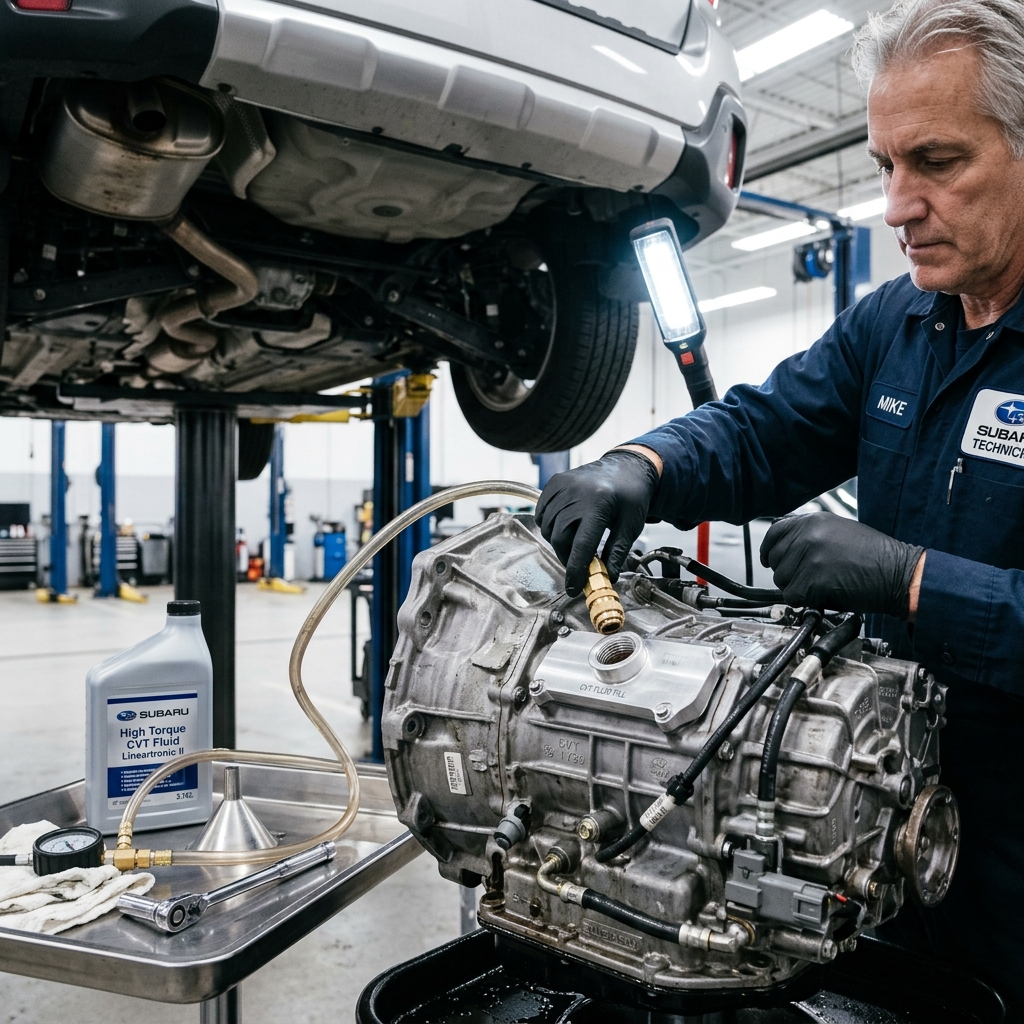
Shawn King:‘Subaru’s own severe-duty service schedule explicitly recommends fluid exchanges every 24,000 to 36,000 miles. In St. Louis County, where we experience hot 90°F+ summer stop-and-go gridlock on I-64, coupled with sub-zero winter cold snaps, virtually all local vehicles qualify as operating under severe conditions. I recommend a full drain, refill, and electronic re-adaptation procedure every 30,000 to 60,000 miles.’
Shawn King:‘It’s also essential to use exact factory-specified fluid—such as Subaru CVTF-II or High Torque CVTF (Orange/Clear depending on engine pairing). Generic multi-vehicle ATF/CVT fluids lack the specific traction coefficient additives needed for steel chain engagement, which can cause internal slippage. You can easily Schedule Service and Diagnostics online with our factory-trained master technicians.’
Q: What Causes Premature Failure in Subaru CVT Transmissions?
1. Thermal Degradation & Heat Stress
Transmission fluid loses its viscosity and traction capabilities when exposed to sustained temperatures above 220°F. Excessive towing over vehicle capacity, long mountain climbs in summer heat, or stuck radiator coolers break down chemical shear stability, accelerating metal wear on pulleys.
2. Fluid Contamination & Improper Fill Procedure
Subaru CVTs do not have a standard dipstick and must be level-checked at precise fluid temperatures (95°F–113°F) using Subaru Select Monitor diagnostic software. Quick-lube shops frequently drain CVT fluid by mistake when attempting oil changes, or overfill/underfill the unit, causing immediate cavitation or burn-out.
3. Solenoid Varnish & Valve Body Contamination
As old fluid oxidizes, micro-varnish forms inside the intricate passages of the lower valve body. This causes sensitive hydraulic control solenoids (such as the torque converter lockup solenoid) to stick or throw diagnostic trouble codes, resulting in rough operation if fluid changes are ignored.
If you are servicing your vehicle or repairing auxiliary cooling components, always insist on genuine factory components. You can directly Find Subaru Parts through our dedicated Sunset Hills Subaru parts department.
Q: What Are the Early Warning Signs That a Subaru CVT Transmission Is Failing?
Interviewer: What symptom should prompt a driver to bring their car in for inspection immediately before minor trouble becomes major damage?
Shawn King: ‘Subarus give distinct early signals when transmission health starts deteriorating. Recognizing these symptoms early can mean the difference between a simple valve body or solenoid replacement versus needing a full assembly replacement.’
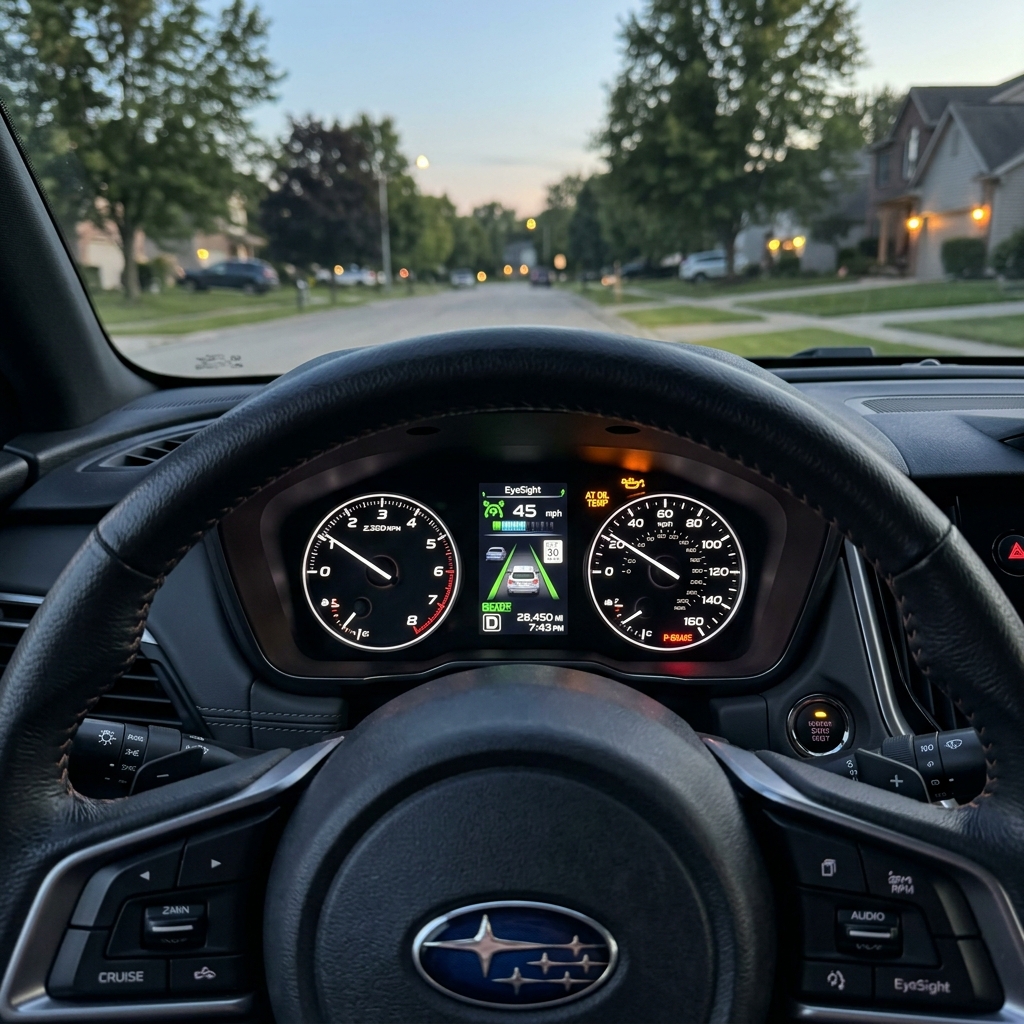
Key Warning Symptoms to Watch For:• Shuddering or Judder During Acceleration: A low-frequency vibration felt through the seat or floorboard when accelerating from a stop, often caused by torque converter lockup slip or fluid breakdown. • High-Pitched Whining Noise: A pitched whine that increases with engine RPM, signaling bearing wear or hydraulic pump strain. • Delayed Engagement: Pausing 2 to 3 seconds before Drive or Reverse engages after shifting from Park. • Flashing ‘AT OIL TEMP’ Light: Indicates transmission fluid temperature has exceeded safe operating limits (typically 248°F+). • Engine Stalling when Coming to a Stop: Occurs when a sticking lockup solenoid fails to disengage the torque converter as vehicle speed drops to zero.’
If you notice any of these signs while driving along Watson Road or I-44, stop by our shop immediately or Call us at (314) 476-9638 to speak directly with our service advising team.
Q: Does Driving in Extreme Conditions or Hilly Ladue Terrain Affect Subaru CVT Longevity?
Interviewer: How do local topography and St. Louis weather patterns impact the transmission compared to flat, mild regions?
Shawn King: ‘Topography and climate have a profound influence on internal hydraulic pressure and heat generation. Driving through hilly residential neighborhoods in Ladue, Town and Country, or Sunset Hills forces the CVT to constantly adjust pulley clamping pressure as vehicle pitch changes under variable load. Continuous elevation changes combined with stop-and-go suburban driving increase fluid thermal cycles compared to steady highway cruising.’
Shawn King: ‘Furthermore, St. Louis experiences dramatic Midwest seasonal extremes. In August, outdoor temperatures hit 95°F with extreme humidity, putting maximum heat load on the engine and transmission coolers during heavy traffic. In January, temperatures plummet below zero, causing transmission fluid to thicken overnight. Until the fluid reaches optimal operating temperature, hydraulic pressures fluctuate. Subarus equipped with X-MODE manage low-speed traction exceptionally well on snow and ice, but engaging X-MODE or hill descent control increases transmission duty cycles. This local driving environment is exactly why proactive 30,000 to 45,000 mile fluid inspections are essential in our region.’
Q: How Do Subaru CVTs Compare to Toyota e-CVTs in Terms of Reliability?
Interviewer: Consumers often hear that Toyota’s hybrid ‘e-CVT’ is practically unkillable because it has no belts or chains. How does Subaru’s mechanical Lineartronic compare, and how do hybrid Subarus bridge this gap?
Shawn King: ‘It’s important to clarify terminology because ‘e-CVT’ and mechanical CVT operate on completely different principles. Toyota’s hybrid e-CVT is a planetary power-split device driven by two electric motor-generators. It has no belts, no chains, and no hydraulic clamping pulleys. From a purely mechanical standpoint, e-CVTs have virtually zero wear components, making them exceptionally reliable in hybrid applications.’
Shawn King: ‘Subaru’s gas-powered Lineartronic is a true mechanical continuously variable transmission using a steel chain and variable hydraulic pulleys. It is designed to provide direct mechanical AWD coupling and real-time mechanical torque distribution across rugged off-road terrains—something planetary power-split devices struggle with without heavy electric motor intervention.’
Shawn King:‘In Subaru’s hybrid vehicles—such as the Crosstrek Hybrid or upcoming Forester Hybrid models—Subaru combines electric drive assist with reinforced transmission casing designs. If you are seeking absolute zero-emissions driving with no internal combustion transmission maintenance whatsoever, you can also explore our New Subaru Solterra Inventory for an all-electric SUV option.’
Q: Should You Rebuild or Replace a Subaru CVT Transmission if It Fails?
Option A: Valve Body Replacement
If diagnostic trouble codes point to a failed torque converter solenoid or hydraulic valve body sticking, you do NOT need to replace the entire transmission. Sunset Hills Subaru can replace the internal valve body assembly and harness without removing the transmission from the vehicle, saving thousands in labor costs.
Option B: Factory Remanufactured Unit
When mechanical pulleys or chains sustain severe wear, a Genuine Subaru Factory Remanufactured Transmission assembly is far superior to third-party rebuilds. Factory units are rebuilt on dedicated OEM precision assembly lines, incorporate all revised superseding parts, and come backed by a nationwide Subaru warranty.
Option C: Vehicle Equity & Trade Evaluation
If a vehicle is over 12 years old with high mileage, major transmission replacement costs should be evaluated against total vehicle equity. In many cases, trade-in value applied toward a newer model with fresh factory warranty protection is the most financially sensible decision.
Q: Does CVT Service History Affect Resale Value, and Where Can You Get a Pre-Purchase Inspection in St. Louis County?
Interviewer: How significantly does documented transmission maintenance impact used market value when an owner decides to trade or sell?
Shawn King: ‘Documented service history directly correlates with trade-in appraisal values and private resale speed. When our appraisal team inspects a trade-in, a clean CARFAX record showing regular Subaru dealer fluid exchanges indicates that the driveline has been cared for meticulously. Buyers in the pre-owned market actively seek out cars with verifiable service records, especially for popular models like the Outback, Forester, and Crosstrek.’
Shawn King: ‘For anyone shopping for a used Subaru in St. Louis County, getting a Certified Pre-Purchase Inspection (PPI) at Sunset Hills Subaru is the best insurance policy available. Our factory technicians hook up SSM4 diagnostics to check real-time CVT fluid deterioration counters, hydraulic stall pressures, and historical thermal excursion logs before you commit to buying.’
Keep Your Subaru Running Strong: Expert Transmission Service at Sunset Hills Subaru
The myth that CVTs cannot match the longevity of traditional automatic transmissions has been thoroughly debunked by Subaru’s robust steel-chain Lineartronic engineering. With routine fluid services scheduled every 30,000 to 60,000 miles, your Subaru CVT is engineered to deliver smooth, fuel-efficient performance well beyond 200,000 miles on St. Louis roads.