Blog / History Of Subaru

What Is the Meaning Behind the Six Stars in the Subaru Logo?

Subaru Logo

Which Star Cluster Inspired the Subaru Logo and What Does 'Subaru' Mean in Japanese?

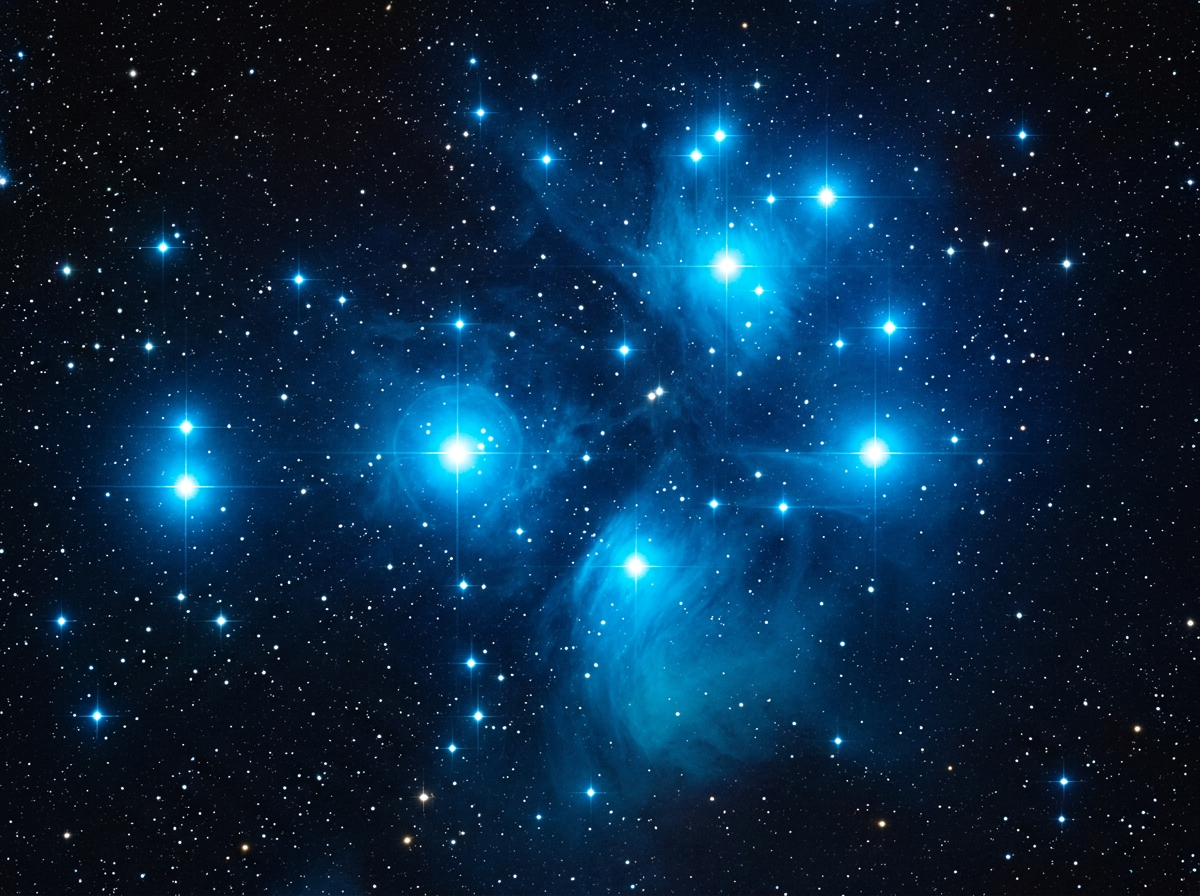
The astronomical inspiration behind Subaru's identity is the Pleiades star cluster, cataloged by astronomers as Messier 45 (M45). Located approximately 444 light-years away from Earth in the constellation Taurus, the Pleiades is one of the closest and most brilliant star clusters visible to the naked human eye from North America and Asia alike.
In ancient Japan, this prominent cluster was traditionally known as Subaruboshi(meaning 'the gathered stars') or Mutsuraboshi('six stars grouped together'). Early Classical Japanese literature, including the famous 10th-century anthology The Pillow Book (Makura no Sōshi) by Sei Shōnagon, highlights the cluster as the most captivating feature of the night sky, praising its tightly knit sparkle.
Etymologically, the classical verb sumaru(which evolved phonetically into Subaru) was recorded in early Japanese manuscripts like the Kojiki and Man'yōshū. It referred specifically to the stringing together of precious gemstones or beads into a unified necklace. Thus, when applied to automotive engineering, the name captures a profound philosophy: individual engineering components and distinct corporate entities woven together into a harmonized, high-performance whole.
Bright blue stars of the Pleiades cluster shining brightly amidst luminous blue dust and reflection nebulosity in space. (Representative image for illustration purposes only. Actual vehicle may vary based on trim and configuration.)
This cultural connection to nature and cosmic order mirrors Subaru's modern commitment to outdoor adventure, environmental stewardship, and engineering symmetry—epitomized by Symmetrical All-Wheel Drive and the iconic Subaru BOXER engine layout.

Why Does Subaru’s Logo Show Six Stars When the Pleiades Cluster Has Seven or More?

Astronomers and stargazers frequently point out a captivating celestial paradox: Western mythology traditionally refers to the Pleiades as the 'Seven Sisters'(representing Maia, Electra, Alcyone, Taygete, Asterope, Celaeno, and Merope, daughters of Atlas and Pleione). Why, then, does the Subaru badge strictly showcase six stars?
The answer combines naked-eye observational astronomy with Japanese cultural history and deliberate graphic design. Under standard, non-telescopic night sky viewing conditions across most of Earth, only six stars in the cluster shine brightly enough to be distinctly separated by human vision. The seventh star (Pleione) is a variable star that frequently dims or sits so closely beside Atlas that it appears merged to observers on the ground.
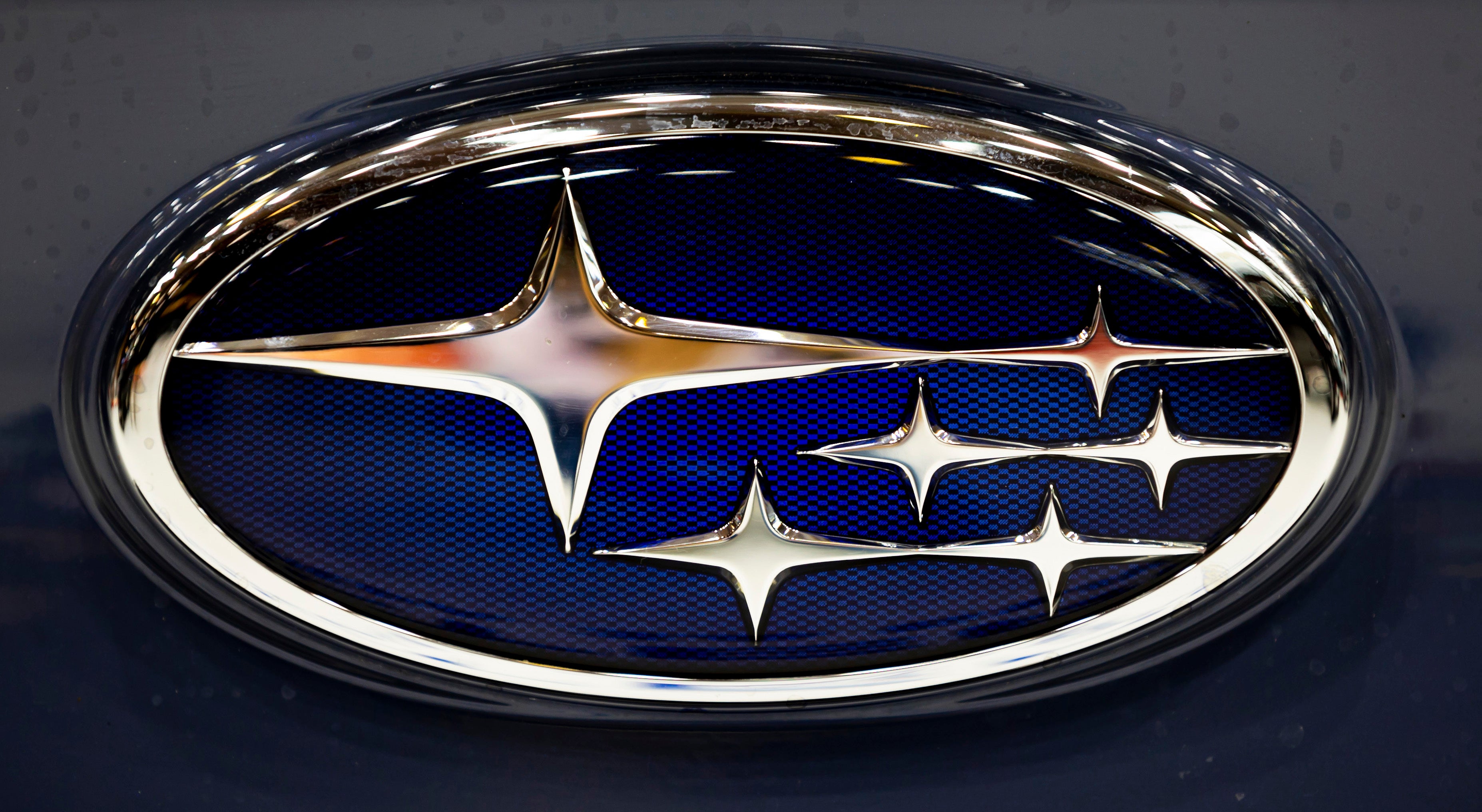
Because ancient Japanese skywatchers consistently identified six clear points of light without optical magnification, folk tradition referred to the cluster as Mutsuraboshi ('six stars'). When Kenji Kita and his design team evaluated graphic concepts in 1953, six stars provided the exact numerical match needed to represent the merger of five sub-companies into one major parent company.
Furthermore, from an artistic perspective, a six-star layout allowed for a balanced geometric composition. Placing one dominant star to the left and arranging five smaller, stylized stars on the right created an organic sense of movement, symbolizing forward momentum and unity on Japanese roadways.

What Was Fuji Heavy Industries' Original Company Name and How Was Subaru Founded?

1917–1945: Aviation Roots

Subaru's industrial origin dates back to 1917 when Chikuhei Nakajima established the Aircraft Research Laboratory. Expanding rapidly, it became the world-renowned Nakajima Aircraft Company, Japan's premier aeronautical manufacturer during World War II, famed for engine precision and aerodynamic engineering.

1945–1953: Fuji Sangyo Era

Following WWII, the company reorganized as Fuji Sangyo Co., Ltd., shifting aviation expertise toward civilian transportation. Engineers produced the Fuji Rabbit motor scooter using surplus aircraft parts, proving that compact, reliable mobility could revitalize post-war commerce.

1953: Birth of FHI & Subaru

In 1953, five spinoff companies merged with Fuji Sangyo to formally institute Fuji Heavy Industries Ltd. (FHI). CEO Kenji Kita championed automotive manufacturing, leading to the creation of the Subaru brand name and six-star emblem for passenger vehicles.

What Was the First Automobile Produced by Subaru to Wear the Star Badge?

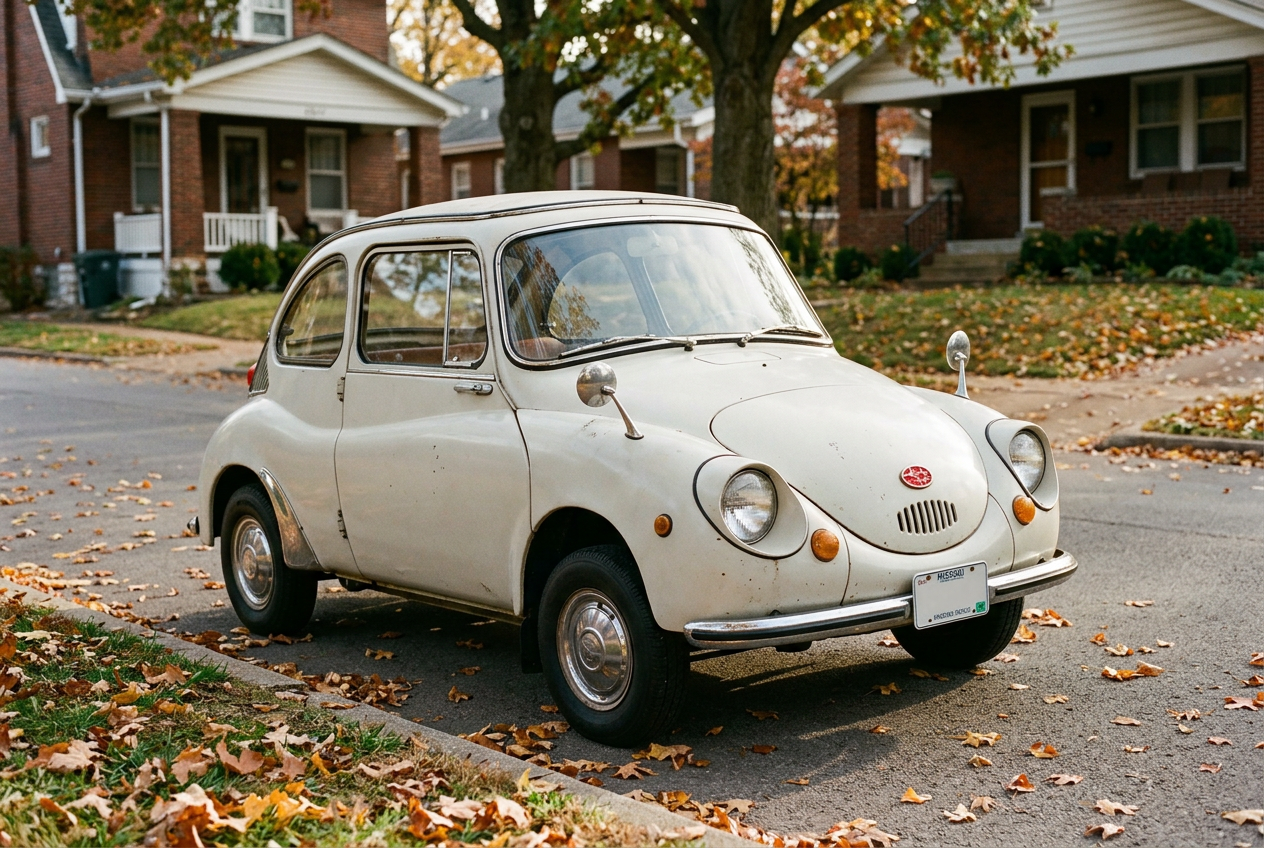
The first production vehicle to display the Subaru six-star badge was the legendary Subaru 360, affectionately nicknamed the 'Ladybug' (Kento-mushi) in Japan due to its rounded monocoque shell and compact profile. Launched on March 3, 1958, this revolutionary microcar was engineered to meet Japan's government standards for 'Kei' light vehicles.
Powered by a rear-mounted 356cc air-cooled two-cylinder two-stroke engine producing just 16 horsepower, the Subaru 360 featured a lightweight fiberglass roof panel, suicide-style rear-hinged doors, and independent rear torsion bar suspension. Despite its modest dimensions, it democratized vehicle ownership across Japan, selling over 392,000 units during its twelve-year production run.
A vintage white Subaru 360 microcar parked on a quiet residential street scattered with autumn leaves. (Representative image for illustration purposes only. Actual vehicle may vary based on trim and configuration.)
The initial badge worn by the Subaru 360 differed visually from today's modern emblem. Early 1958 models featured gold-embossed stars set against a vibrant red lacquer background, enclosed in a shield-like metallic crest. Over subsequent decades, the emblem transitioned through various metallic configurations until settling into the sleek blue-oval chrome design recognized worldwide today.

How Does Subaru's Brand Name Origin Compare to Toyota, Mazda, and Honda?

In the landscape of Japanese automotive history, brand names generally fall into two distinct naming philosophies: individual founder family surnames versus evocative linguistic and astronomical terms. Subaru stands in a rare category among major automakers.

Founder Surnames

Toyota, Honda, and Suzuki: Toyota derives from founder Kiichiro Toyoda (modified to eight stroke marks in kanji for luck). Honda honours Soichiro Honda. Suzuki bears the name of Michio Suzuki. These follow traditional patronymic corporate naming.

Philosophical Roots

Mazda: Combines founder Jujiro Matsuda's family name with Ahura Mazda, the ancient Persian Zoroastrian god of harmony, intelligence, and light, reflecting an early international brand vision.

Pure Celestial Verb

Subaru: Distinctly unique as a native Japanese astronomical term and active verb ('to unite'). Rather than honoring a single individual, it highlights group unity, structural harmony, and nature.

Automotive Brand

Name Origin Source

Literal Meaning

Primary Logo Symbol

Subaru

Native Japanese / Pleiades Cluster

'To gather together' or 'Unite'

Six Stars in Oval Frame

Toyota

Founder Family (Kiichiro Toyoda)

'Bountiful Rice Field'

Three Interlocking Ovals

Honda

Founder Family (Soichiro Honda)

'Original Rice Paddy'

Stylized Metallic 'H'

Mazda

Founder (Matsuda) & Zoroastrian Deity

'God of Light and Wisdom'

Winged 'V' in Oval

How Does the Subaru Six-Star Logo Differ from the Mercedes-Benz Three-Pointed Star and Other Badges?

Several global vehicle brands feature stars within their heraldry, but the underlying philosophy differs dramatically between Western industrial symbolism and Subaru's astronomical heritage:
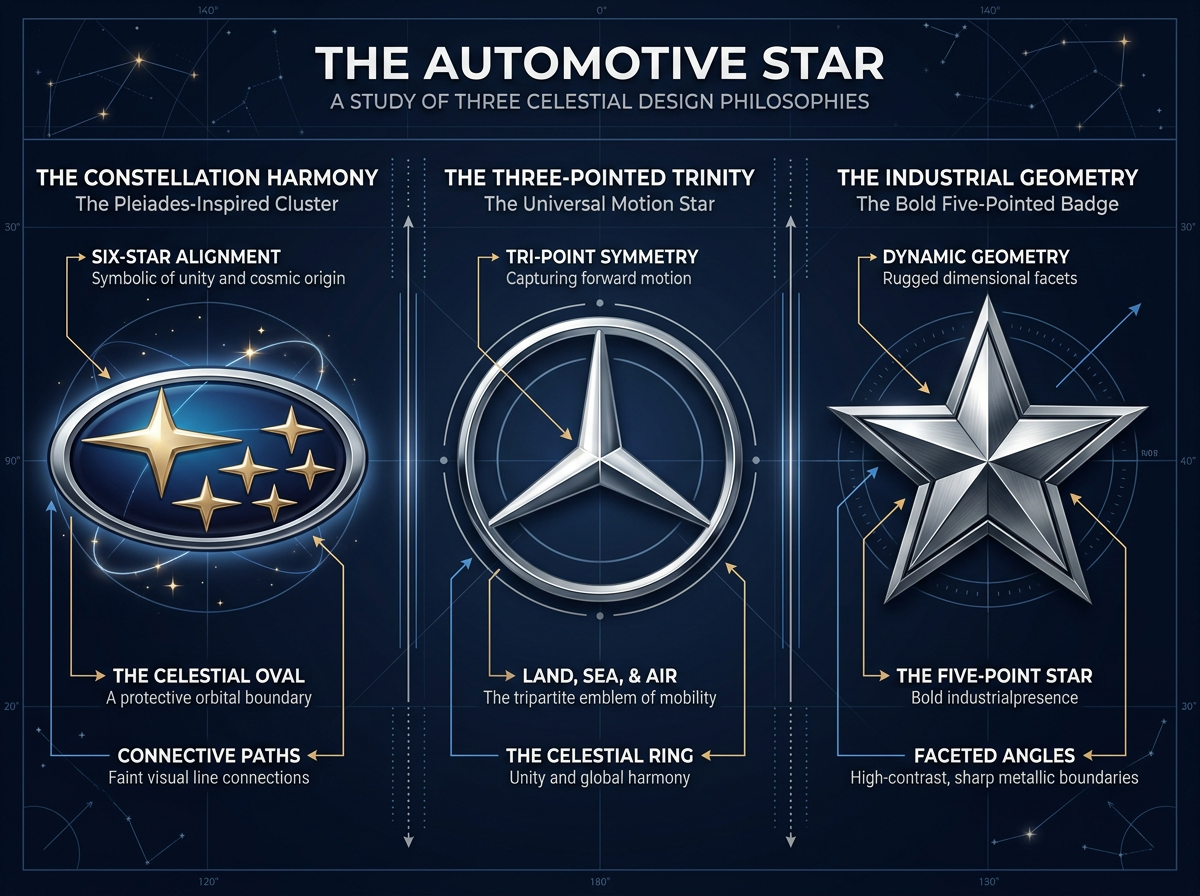
Mercedes-Benz Three-Pointed Star: Designed by Gottlieb Daimler, the three points represent technical dominance across three physical realms:land, sea, and air. It is a statement of industrial capability and global ambition.
Chrysler Pentastar: Created in 1962 by the Lippincott & Margulies design agency, the five-pointed geometric star was designed as a modern abstract corporate signature denoting dynamic forward energy and corporate expansion.
Infographic analyzing three automotive star logos: Subaru, Mercedes-Benz, and a metallic five-pointed badge. (Representative image for illustration purposes only. Actual vehicle may vary based on trim and configuration.)
Subaru Six-Star Emblem: Rather than representing physical conquest over land or mechanical abstract symmetry, Subaru utilizes an actual astronomical star cluster. It emphasizes unity among people, precision engineering aligned with nature, and light guiding drivers safely home in all weather conditions.

What Does the Name Solterra Mean on Subaru's Electric SUV and How Does It Honor Brand Tradition?

As Subaru stepped into the all-electric future with its flagship EV SUV, designers returned directly to the brand's celestial and nature-inspired roots for naming inspiration. The name Solterra is created by joining two classical Latin words: 'Sol'(the Sun) and 'Terra' (the Earth).
This blend pays homage to the sun as the ultimate source of clean energy and light, while Terra reinforces Subaru’s long-standing dedication to earthbound exploration, off-road capability, and environmental preservation. For eco-conscious drivers around Ladue, Maryland Heights, and Sunset Hills, the Solterra offers zero emissions without compromising Symmetrical All-Wheel Drive capability.
By carrying the iconic six-star emblem on an all-electric platform, the Solterra demonstrates that technological evolution and brand heritage remain deeply intertwined. Whether navigating winter snow or commuting through St. Louis, Solterra drivers experience the next generation of Subaru engineering.
Interested in making the leap to zero-emission driving? Explore our New Subaru Solterra Inventory or talk to our finance specialists about local electric vehicle incentives and EV charging solutions.

How Much Do Custom Illuminated Subaru Grille Emblem Kits Cost and How Are They Installed?

OEM Kit Pricing

Genuine OEM Subaru LED illuminated star grille emblem kits are available at current pricing that may vary by model year and trim integration. These genuine accessories feature soft white or deep blue accent illumination calibrated for legal road use.

Wiring & Integration

Installation involves removing the upper front bumper cover, mounting the waterproof housing to the grille shell, and tapping into the factory headlight/daytime running light harness using plug-and-play connections to prevent battery drain or electrical faults.
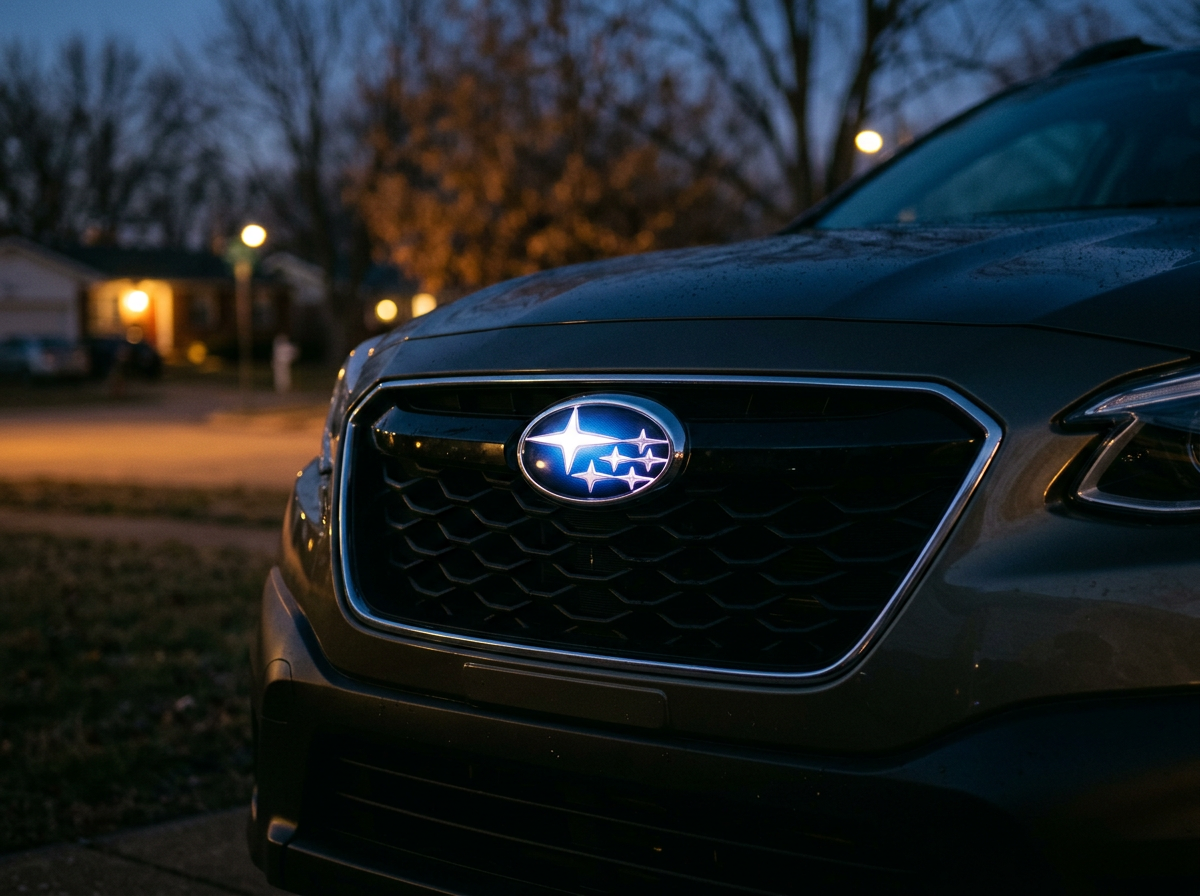
Close-up of a glowing blue Subaru logo illuminated on the front grille of a vehicle at dusk. (Representative image for illustration purposes only. Actual vehicle may vary based on trim and configuration.)
Professional installation at authorized facilities takes approximately 1 to 1.5 hours. You can Find Subaru Parts and schedule accessory installation directly through our Sunset Hills service department.

Accessory Package

Parts Cost Range

Est. Install Time

Key Features

OEM LED Front Star Badge Kit

$220 - $380

1.0 Hour

Factory harness integration, weather sealed, dusk sensor link

STI Performance Pink Badge Accent

$80 - $150

0.5 Hours

Cherry Blossom Pink perimeter trim ring, gloss finish

Matte Black / Smoked Overlay Kit

$45 - $90

0.5 Hours

UV resistant vinyl/polycarbonate shield, anti-glare finish

Where to Spot the Pleiades Cluster Around Chesterfield, Ladue, and Maryland Heights in a Subaru

For local Subaru owners seeking to view the real Pleiades star cluster in the night sky, Eastern Missouri offers several excellent low-light viewing destinations just a short drive from St. Louis County:
1. Dr. Edmund A. Babler Memorial State Park (Wildwood): Located just west of Chesterfield, Babler State Park offers dark hilltop vistas away from suburban light pollution, making autumn and winter night viewings of Taurus and M45 exceptionally crisp.
2. Faust Park Open Fields (Chesterfield): For residents in Ladue and Maryland Heights wanting a quick stargazing spot, the open meadow areas near Faust Historic Village offer wide sky access on clear autumn evenings.
3. Cuivre River State Park (Troy): A scenic 45-minute night drive north in your Outback or Forester leads to one of Missouri's darkest designated sky parks, where all six principal stars of Subaru shine with brilliant clarity.
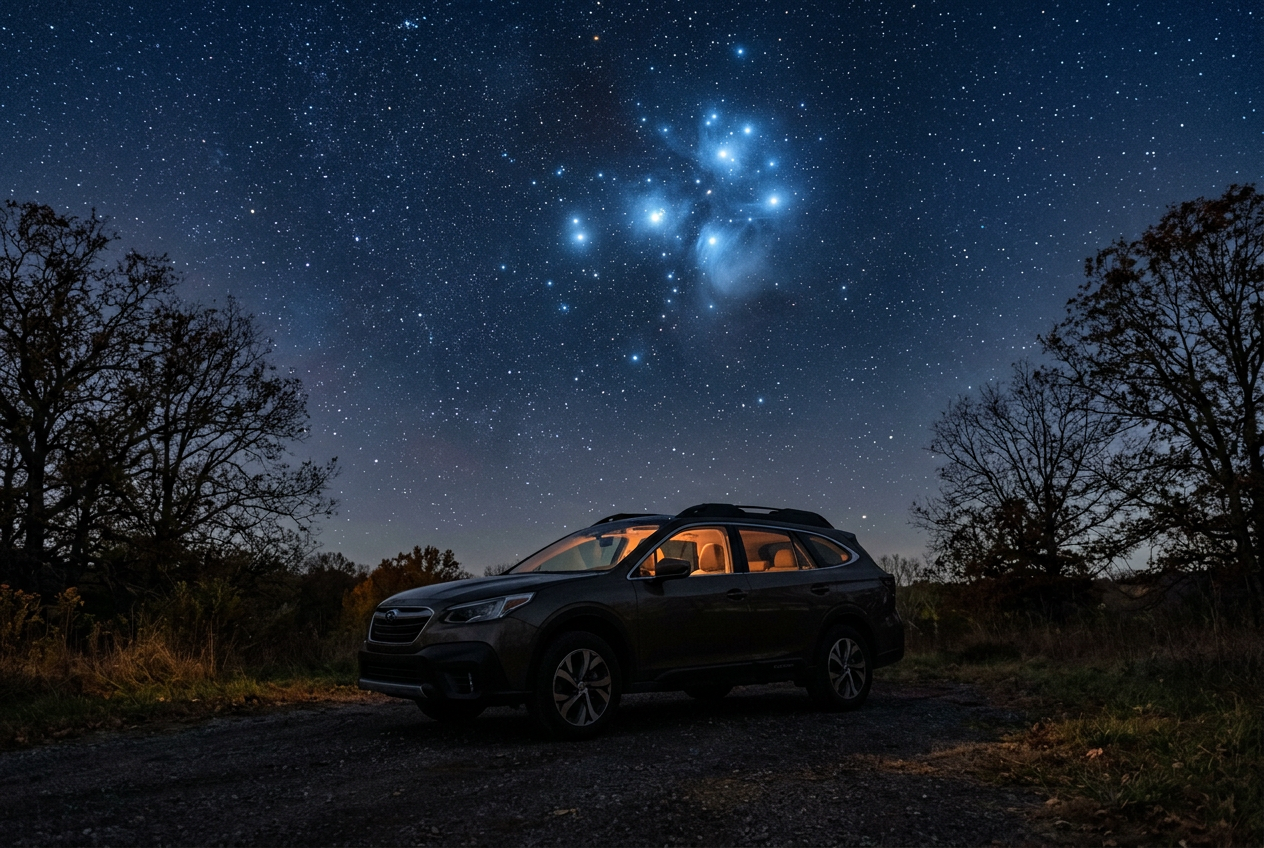
A Subaru SUV parked on a dirt path under a starry night sky featuring the bright Pleiades star cluster. (Representative image for illustration purposes only. Actual vehicle may vary based on trim and configuration.)
Equipped with standard Symmetrical All-Wheel Drive, generous ground clearance, and panoramic glass moonroofs, Subaru vehicles like the Outback, Forester, and Ascent are built specifically to take your family on celestial stargazing excursions in complete comfort.

When Did Fuji Heavy Industries Officially Change Its Name to Subaru Corporation?

For decades, automotive enthusiasts knew that Fuji Heavy Industries Ltd. (FHI) was the corporate entity behind Subaru automobiles. However, on April 1, 2017, coinciding with the 100th anniversary of the founding of Nakajima Aircraft in 1917, the parent corporation officially renamed itself Subaru Corporation.
This historic name change unified global automotive branding, aerospace divisions, and industrial manufacturing under a single recognized emblem. It signaled a clear strategic shift: prioritizing consumer automotive safety, electrification, and long-term brand equity.
Today, Subaru Corporation stands as a global leader in automotive safety, regularly earning top IIHS TOP SAFETY PICK+ accolades across its entire vehicle lineup. The unity embodied by the six stars continues to drive technological breakthroughs in EyeSight Driver Assist Technology and Global Platform architecture.
Thinking about trading in your current vehicle for a late-model Subaru engineered under this unified corporate vision? You can Get your value trade online in just a few clicks.

7 Fun Facts About the Subaru Six-Star Emblem, Rally Heritage, and Brand Lore

1. World Rally Blue Code

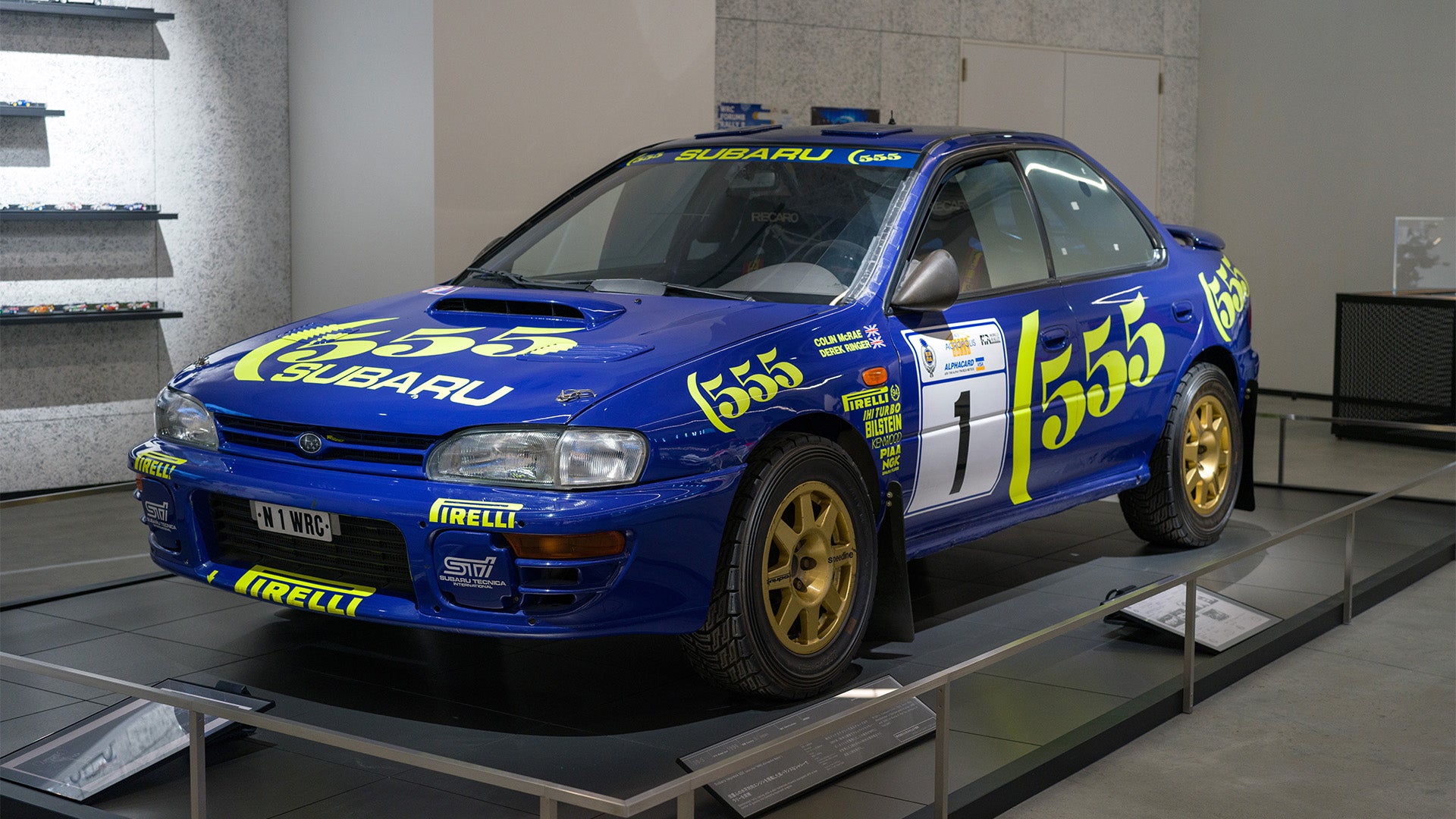
The iconic World Rally Blue (WR Blue Pearl) paint made famous by Colin McRae's WRC Impreza was specially created to match the deep night-sky blue background of the six-star emblem.

2. Cherry Blossom Pink

Subaru Tecnica International (STI) uses Cherry Blossom Pink (Sakura-iro) for performance emblems—a traditional Japanese color representing martial courage and spring renewal.

3. 1,000 Yen Currency Link

Hideyo Noguchi, the renowned microbiologist featured on Japan's 1,000 yen banknote, shares heritage ties to Fukushima prefecture where early Subaru engineering labs operated.

4. November Sky Alignment

The Pleiades star cluster reaches its highest zenith in the Midwestern night sky during mid-November—making late autumn the optimal season for local Missouri stargazing.

5. Symmetrical AWD Legacy

Subaru introduced its first All-Wheel Drive passenger car, the Leone Station Wagon 4WD, in 1972—over a decade before competitors recognized AWD safety benefits.

6. Pop Culture Cameos

From anime classics like Initial D featuring the legendary Impreza WRX STI to modern Hollywood films, the six-star badge symbolizes high-performance agility.

Experience Subaru Heritage and Innovation at Sunset Hills Subaru Near Chesterfield

images (7)
From the historical merger of five pioneering companies into Fuji Heavy Industries to the modern lineup of AWD crossovers and electric vehicles, the six stars of Subaru represent safety, reliability, and continuous innovation. At Sunset Hills Subaru, located at 10100 Watson Rd, Sunset Hills, MO 63127, we are proud to connect drivers across Chesterfield, Ladue, Maryland Heights, and Greater St. Louis with this exceptional heritage.
Whether you are shopping for a new Outback or Forester, interested in certified pre-owned vehicles, or needing expert service from factory-trained technicians, our team is committed to providing an outstanding dealership experience. Call us directly at (314) 476-9638 or get step-by-step driving routes with Get Directions to Sunset Hills Subaru.
Subaru Logo Symbolism in Sunset Hills MO | Sunset Hills Subaru

Posted in:

Related Posts

Colin Mcrae 555

The History and Heritage of Subaru’s Iconic Blue Paint and Gold Wheels

Few color combinations in automotive history evoke the immediate sensory charge of World Rally Blue paint paired with gleaming gold alloy wheels. Across motorsport, certain liveries transcend their era—think of Gulf Oil's powder blue and orange, Lotus's John Player Special black and gold, or Ferrari's Rosso Corsa. Yet, for rally enthusiasts and modern performance car aficionados alike, nothing commands attention quite like the iconic blue and gold contrast perfected by Subaru in the high-stakes crucible of the World Rally Championship (WRC) during the mid-1990s. The birth of this legend traces directly to Subaru World Rally Team’s partnership with State Express 555, a British cigarette brand owned by British American Tobacco. Debuting on the Group A Subaru Legacy RS and solidified when the nimble GC8 Impreza 555 took over the stage in 1993, the bold blue backdrop and vibrant gold graphics captured world attention. When Scottish rally legend Colin McRae secured the 1995 WRC Drivers' Championship in his factory Impreza 555 alongside co-driver Derek Ringer, history was etched in gravel, mud, and tarmac. Overnight, Subaru transformed from an obscure Japanese all-wheel-drive manufacturer into a global motorsport powerhouse. Today, that championship pedigree continues to resonate deeply with automotive historians, collectors, and everyday drivers in the St. Louis metropolitan area. The blue-and-gold aesthetic is far more than an aesthetic choice—it represents a philosophy of engineering excellence, Symmetrical All-Wheel Drive dominance, and an unyielding commitment to performance under extreme conditions. Whether you are inspecting a pristine 1990s GC8 STI or admiring a contemporary WRX or Impreza at Sunset Hills Subaru, the blue and gold hallmark stands as an enduring emblem of rally perfection. Why Did Subaru Pair World Rally Blue Paint with Gold Wheels? To understand the origin of Subaru’s visual signature, one must look back to 1993 and the commercial dynamics of international motorsport. Prodrive, the British motorsport engineering specialists led by David Richards, managed Subaru’s WRC team. When State Express 555 signed on as title sponsor, the racing livery was built around 555’s distinctive rich blue packaging and bold golden yellow insignia. The initial race color, designated internally as 555 Blue (color code 53C), was specifically formulated to pop under intense sunshine as well as overcast Scandinavian snowscapes. To complement the yellow-and-gold 555 badging on the doors and bonnet, Prodrive selected lightweight magnesium Speedline wheels painted in a striking electro-plated gold finish. Beyond sponsorship, the gold wheel choice served a vital practical purpose on the harsh WRC stages. Contrast was critical. Gold wheels offered high visual contrast against swirling dust clouds in Safari, heavy mud in Great Britain, and blinding snowbanks in Sweden. Mechanics servicing the cars in dimly lit remote service parks could instantly identify wheel hub seating and torque specifications. As WRC tobacco sponsorship restrictions tightened in the late 1990s, the three yellow '555' crescents morphed into the iconic stylized crescent graphics, but the factory World Rally Blue (WRB 02C / O2C and later K7X) paint and gold wheels remained permanent fixtures. Engine and Performance Specs of Colin McRae’s 1995 WRC Impreza 555 When Colin McRae secured his legendary 1995 WRC Drivers' World Championship, he was piloting a masterpiece of Group A rally engineering. Based on the lightweight GC8 Impreza chassis, Prodrive built a vehicle capable of enduring high-speed jumps, river crossings, and severe mechanical abuse while generating relentless traction on low-grip surfaces. Below are the definitive technical specifications of McRae's championship-winning machine: Specification 1995 Subaru Impreza 555 (Group A WRC) Technical Details & Highlights Engine Type 2.0L Turbocharged Flat-4 (EJ20) Closed-deck aluminum alloy block, custom Prodrive cylinder heads Power Output 300 hp @ 5,500 RPM (FIA Restricted) Mandatory 34mm FIA air restrictor limiting top-end horsepower Torque Output 347 lb-ft (471 Nm) @ 4,000 RPM Massive low-end torque tuned for aggressive corner exits Transmission Prodrive 6-speed Sequential Dog-engagement gearbox with electro-hydraulic paddle assist Drivetrain Symmetrical All-Wheel Drive Active computer-controlled center & mechanical front/rear differentials Curb Weight 2,711 lbs (1,230 kg) FIA Group A minimum weight limit; lightweight seam-welded chassis Suspension MacPherson Struts with Bilstein/Prodrive Long-travel adjustable dampers tailored per rally surface Brakes AP Racing 4-pot / 6-pot Calipers Water-cooled calipers with 355mm ventilated discs for tarmac The secret to McRae’s blistering speed wasn't just raw horsepower—which was heavily restricted by FIA regulations—but rather the remarkable power-to-weight ratio and the active differential technology that sent power precisely where grip was highest. McRae’s famously aggressive driving philosophy—'If in doubt, flat out'—depended entirely on the EJ20 boxer engine's immediate throttle response and low center of gravity, allowing the Impreza 555 to dance through corners sideways at triple-digit speeds. Subaru Impreza vs. Mitsubishi Lancer Evolution: The Great WRC Rivalry The Subaru Philosophy Anchored by its horizontally opposed Boxer engine and true linear Symmetrical AWD, Subaru prioritized chassis balance, a low center of gravity, and driver feedback. Guided by Colin McRae and Richard Burns, the Impreza thrived on flowing, high-speed gravel stages and unpredictable mountain passes, setting the gold standard for tactile driver engagement. The Mitsubishi Challenge Driven by Finnish star Tommi Mäkinen, the Mitsubishi Lancer Evolution featured the transverse 4G63 inline-4 engine and pioneering Active Yaw Control (AYC). The Evo was surgical, utilizing computer-managed torque vectoring to rotate the vehicle rapidly through tight hairpins, battling Subaru back-to-back across four consecutive driver titles (1996–1999). Homologation Special Era Because FIA Group A regulations required manufacturers to build at least 2,500 road-going production models annually, enthusiasts directly benefited. The rivalry forced both manufacturers to sell near-competition-ready WRX STI and Lancer Evolution models in showrooms, igniting a global enthusiast cult following. Explore New WRX Inventory The 1998 Subaru Impreza 22B STI: Original Price and Legend Status In 1998, Subaru celebrated two historic milestones simultaneously: the company's 40th anniversary and its third consecutive WRC World Manufacturers' Championship. To honor these achievements, Subaru built the holy grail of road-going Subarus—the Impreza 22B STI. Featuring Peter Stevens-designed widebody fender flares mirroring the WRC race car, a unique EJ22 2.2-liter turbocharged engine, twin-plate clutch, Bilstein suspension, and signature gold 17-inch BBS forged wheels, only 400 numbered units were built for the Japanese domestic market (plus 24 for export). When launched in March 1998, the 22B STI carried an original retail price of approximately ¥5,000,000 JPY (roughly $41,600 USD at 1998 exchange rates). All 400 JDM units famously sold out within 48 hours. Fast forward to the present, and the 22B STI has ascended into hyper-car territory among collectors. At premier auction houses like Bring a Trailer, RM Sotheby's, and Gooding & Company, pristine 22B examples routinely fetch between $250,000 and $325,000+ USD, representing a staggering valuation growth of over 600%. It stands as the ultimate manifestation of Subaru's blue and gold heritage. Authentic WRC Rally Cars vs. Replicas: Valuations and Collector Appeal The market for authentic 1990s WRC competition chassis has entered an elite collector stratosphere. An authentic, ex-works Prodrive chassis driven by Colin McRae or Richard Burns in period competition easily commands between $300,000 and $600,000+ depending on provenance and race victories. Chassis 'PRO/STI/97.001' or cars associated with McRae's 1995 season represent irreplaceable blue-chip automotive assets. Conversely, the enthusiast replica community is thriving. Driven by the availability of imported JDM 1992–2000 GC8 chassis under the 25-year import rule, hobbyists are building meticulous WRC tribute cars. A high-quality GC8 replica with authentic widebody paneling, EJ207 engine swap, speedline gold wheels, and 555 decals typically costs between $35,000 and $65,000 to construct. Standard road-going GC8 WRX and STI imports are also rapidly appreciating, serving as accessible entry points for collector passion. How the 2027 Impreza and WRX tS Honor Rally Heritage Today 2027 Subaru Impreza Hatchback The contemporary 2027 Impreza carries forward the core engineering architecture that defined McRae's championship cars: a direct-injection Subaru BOXER engine, standard Symmetrical All-Wheel Drive, and a highly rigid global platform. Available in vivid World Rally Blue Pearl, the 5-door hatchback provides daily versatility with genuine rally DNA. 2027 WRX tS & Heritage Editions Engineered by STI, the WRX tS (Tuned by STI) features electronically controlled dampers, Brembo high-performance brakes with gold calipers, STI tuned steering, and drive mode select. Special anniversary editions directly celebrate the gold wheel tradition, offering factory matte bronze and gold wheel finishes. Local Availability at Sunset Hills Drivers in St. Louis and surrounding communities can experience this heritage firsthand. Sunset Hills Subaru carries the full spectrum of new Impreza and WRX models, allowing you to choose classic World Rally Blue paired with genuine Subaru accessories. View New Impreza Inventory Factory STI Gold Wheels vs. Top Aftermarket Rally Options Achieving the perfect rally look requires choosing between official OEM Subaru STI options and proven aftermarket wheel manufacturers. Subaru offers genuine STI alloy wheel accessory packages engineered specifically for correct offset, hub bore clearance, and load ratings. Key Factory & Aftermarket Options Include: • Official Subaru STI Gold/Bronze Alloys (17", 18", and 19" fitments) • O.Z. Racing Rally Racing & Ultraleggera (Classic multispoke WRC styling) • Sparco Terra (Durable rally-inspired design built for gravel trails) • Method Race Wheels MR501 / MR502 Rally Series (Heavy-duty off-road strength) • Enkei RPF1 & Gold TS-10 (Ultra-lightweight Japanese tuning heritage) Does Adding Aftermarket Gold Wheels Void Your Subaru Factory Warranty? A common concern among Subaru owners in Missouri is whether upgrading to gold wheels will jeopardize their original factory warranty coverage. Under federal law—specifically the Magnuson-Moss Warranty Act of 1975—an auto manufacturer or dealership cannot void your vehicle's overall warranty simply because you installed aftermarket parts. To deny a warranty claim on a specific component, the manufacturer must prove that the aftermarket wheel directly caused the failure. To ensure complete peace of mind, proper fitment parameters are critical. Incorrect wheel offsets (+35mm to +55mm depending on model), improper hub-centric rings, or dramatic tire diameter changes can put undue stress on wheel bearings, suspension bushings, or interfere with Subaru EyeSight Driver Assist calibrated sensors. Sourcing genuine STI gold wheels or factory-approved setups directly through the Sunset Hills Subaru Parts Department helps support proper fitment and may help preserve warranty coverage where applicable. Budgeting Your Rally Build: Wheels, Livery Graphics, and Accessories Gold Wheels & Tires • OEM STI Gold Alloys: $1,200 – $2,200 set • Quality Aftermarket Wheels: $800 – $1,600 set • All-Weather / Performance Tires: $600 – $1,000 • TPMS Sensors & Mounting: $150 – $300 Livery & Protection • Heritage Rally Decal / Accent Kits: $150 – $450 • Rally Armor / Rek Gen Mud Flaps: $120 – $220 • Front Skid Plate / Underbody Guard: $250 – $500 • Ceramic Coating for Blue Paint: $600 – $1,200 Performance Enhancements • STI Performance Exhaust Upgrade: $800 – $1,400 • STI Flexible Tower Brace: $350 – $500 • Performance Lowering Springs / Lift Kits: $300 – $700 • Professional Installation at Dealer: Varies by job Order Genuine Subaru Parts Bringing Rally-Bred Symmetrical AWD to St. Louis Suburban Roads While Colin McRae conquered frozen Swedish forest roads and dust-choked Greek mountain passes, the engineering principles derived from WRC competition directly serve drivers navigating the greater St. Louis region today. Whether you are commuting along I-270, traversing rolling hills in Chesterfield, or tackling icy winter mornings in Ladue and Maryland Heights, Subaru’s rally-proven Symmetrical All-Wheel Drive provides unparalleled stability. Unlike converted front-wheel-drive systems that only engage rear wheels after slippage occurs, Subaru's continuous power distribution ensures immediate traction on rain-slicked pavement or sudden autumn leaf cover. Upgrading your current vehicle is straightforward at Sunset Hills Subaru—you can easily Get your value trade online, explore flexible financing options, or Schedule Service and Diagnostics for existing vehicles. Begin Your Subaru Rally Heritage Journey at Sunset Hills Subaru Whether you are a lifelong rally historian inspired by Colin McRae's championship legacy, or a modern driver seeking the security and style of World Rally Blue with gold wheels, Sunset Hills Subaru is your ultimate community partner. Visit our showroom at 10100 Watson Rd, Sunset Hills, MO 63127, or reach out directly to our team at Call (314) 476-9638. Our passionate brand specialists are ready to help you explore current inventory, order authentic STI gold wheels, or customize your dream Subaru today. Get Directions to Sunset Hills Subaru Subaru Rally Heritage in Sunset Hills MO | Sunset Hills Subaru

SIA Plant

Which Subaru Models Are Confirmed as Built at the Lafayette, Indiana Plant?

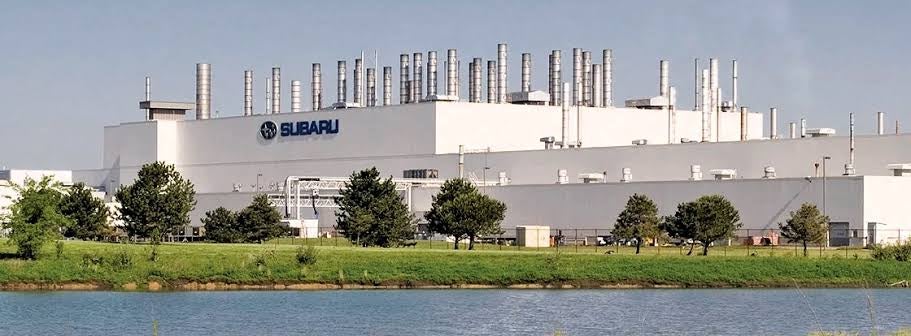
When automotive enthusiasts and prospective vehicle buyers ask which Subaru models are assembled in the United States, the answer leads directly to Tippecanoe County, Indiana. Subaru of Indiana Automotive, Inc. (SIA), located in Lafayette, Indiana, serves as the exclusive North American manufacturing facility for Subaru Corporation. Currently, the Lafayette plant produces the Subaru Outback, the Subaru Ascent, and select trim levels of the Subaru Crosstrek (specifically the 2.5-liter engine configurations including the Sport, Limited, and Wilderness trims). Historically, SIA also produced the Subaru Legacy sedan for North American drivers until production concluded following the 2025 model year. Understanding where your vehicle is manufactured provides valuable insight into quality standards, supply chain dynamics, and regional engineering adaptations. Domestic manufacturing at SIA ensures that high-demand crossovers and SUVs designed for North American lifestyles are built with localized parts, rigorous quality controls, and rapid transit times to Midwestern dealerships like Sunset Hills Subaru. Meanwhile, other popular models—such as the Subaru Forester, WRX, BRZ, Solterra, and 2.0-liter Crosstrek trims—continue to be assembled in Japan at Subaru's historic Gunma and Toyota's Motomachi assembly hubs. Subaru Model Primary Assembly Location Engine / Trim Details Target Market Subaru Outback Lafayette, Indiana (SIA) All Trims (2.5L & 2.4L Turbo / Wilderness) North America Subaru Ascent Lafayette, Indiana (SIA) All Trims (2.4L Turbo 3-Row) North America Subaru Crosstrek Lafayette, Indiana / Gunma, Japan 2.5L (Sport/Limited/Wilderness - IN); 2.0L (Base/Premium - Japan) North America / Global Subaru Forester Gunma, Japan (Yajima Plant) All Trims (2.5L BOXER) Global Subaru Legacy (Historical) Lafayette, Indiana (SIA) All Trims (1989–2025 Model Years) North America Subaru Solterra Aichi, Japan (Toyota Motomachi) All-Electric e-Subaru Global Platform Global When Was Subaru of Indiana Automotive Established and How Has It Grown? Subaru of Indiana Automotive was incorporated in May 1987 as Subaru-Isuzu Automotive Inc., a joint venture between Fuji Heavy Industries (now Subaru Corporation) and Isuzu Motors Ltd. Construction on the sprawling 820-acre facility in Lafayette, Indiana, began shortly thereafter, and the first vehicle rolled off the production line in September 1989. The initial product mix included the Subaru Legacy alongside Isuzu pickup trucks and SUVs. Over the decades, Subaru eventually acquired full ownership of the facility in 2003, renaming it Subaru of Indiana Automotive and dedicating its vast assembly infrastructure strictly to meeting the accelerating demand for Subaru vehicles in Canada, the United States, and Mexico. The growth of SIA mirrors Subaru's remarkable rise in North American popularity. From an initial investment of roughly $500 million, Subaru has continuously expanded the Lafayette campus through multi-hundred-million-dollar modernization projects. Today, the facility spans over 5 million square feet under roof and represents a total capital investment exceeding $2.2 billion. Employing more than 6,500 associate team members, SIA has evolved from a modest joint assembly experiment into a flagship manufacturing powerhouse capable of building hundreds of thousands of award-winning, Symmetrical All-Wheel Drive vehicles each year. Are All Subaru Outback Models Built in Indiana for North American Drivers? Unbroken Indiana Production Heritage Since 1999, every single Subaru Outback sold in North America has been crafted at the Lafayette facility. When the Outback originally debuted in the mid-1990s as a rugged station wagon trim of the Legacy, assembly quickly centralized in Indiana to serve the rapidly expanding North American crossover market. Trim Precision & Quality Standards Whether you select a naturally aspirated 2.5-liter Outback Premium, a turbocharged 2.4-liter Outback XT, or the trail-ready Outback Wilderness, every variant shares identical SIA stamping, welding, paint, and final assembly lines. Local assembly ensures tight adherence to rigorous North American safety standards and regional quality expectations. Drivers in St. Louis County rely on the Indiana-built Outback for proven Midwestern durability, whether navigating winter road salt on I-270 or trekking into the Ozarks. Explore New Subaru Outback Inventory at Sunset Hills Subaru. When Did Subaru Crosstrek Production Start in Indiana and Which Trims Are Made There? For the first two generations of the popular subcompact crossover, all Subaru Crosstrek models destined for U.S. showrooms were built exclusively at the Gunma plant in Japan. However, in May 2023, Subaru announced a major milestone for North American operations: domestic production of the third-generation 2024 Crosstrek officially commenced at Subaru of Indiana Automotive in Lafayette. To optimize global manufacturing efficiency, Subaru strategically split Crosstrek assembly based on powertrain options: • Indiana-Built Crosstrek Trims: Models powered by the upgraded 2.5-liter Subaru BOXER® engine—including the Crosstrek Sport, Crosstrek Limited, and the rugged Crosstrek Wilderness—are manufactured at SIA in Lafayette. • Japan-Built Crosstrek Trims: Models featuring the 2.0-liter engine—such as the Base and Premium trims—continue to be assembled at the Yajima plant in Gunma, Japan. This manufacturing shift significantly reduced delivery shipping times across the central United States for higher-trim Crosstreks. Missouri buyers can immediately verify current trim availability, engine choices, and color options directly through our local dealership inventory. Browse New Crosstrek Inventory Which Subaru Models Are Imported from Japan to the United States? The Gunma Manufacturing Complex Located in Gunma Prefecture, northwest of Tokyo, Subaru operates a consolidated cluster of production hubs including the Main Plant, Yajima Plant, and Ota North Plant. Gunma serves as the primary global engine, transmission, and vehicle assembly network for Subaru Corporation. Japanese Import Models Vehicles shipped from Gunma to North America include the best-selling Subaru Forester, the rally-bred Subaru WRX sports sedan, the lightweight rear-wheel-drive Subaru BRZ coupe, the Subaru Impreza hatchback, and 2.0L Crosstrek models. Precision Japanese Craftsmanship Every imported vehicle embodies Monozukuri—the traditional Japanese philosophy of craftsmanship and continuous quality improvement. Advanced automated assembly seamlessly pairs with hand inspections before vehicles depart Japanese ocean ports for American distribution centers. Which Plant Builds the Jointly Developed Subaru Solterra and Toyota bZ4X? The all-electric Subaru Solterra represents a major strategic collaboration between Subaru Corporation and Toyota Motor Corporation. Co-developed on a shared battery-electric platform (known as the e-Subaru Global Platform / e-TNGA), both the Subaru Solterra and its sister vehicle, the Toyota bZ4X, are assembled on the specialized EV production line at Toyota’s historic Motomachi plant in Aichi Prefecture, Japan. Toyota currently holds approximately a 20% ownership equity stake in Subaru Corporation. This financial and engineering synergy allows both Japanese automakers to pool research resources in battery electric architecture, power electronics, and autonomous safety software while preserving Subaru’s signature StarDrive dual-motor all-wheel-drive tuning. Drivers interested in electric mobility can explore New Subaru Solterra Inventory for zero-emission driving around St. Louis. Did Toyota Vehicles Used to Be Built at the Subaru Lafayette Indiana Plant? Yes. As part of a collaborative contract agreement between Fuji Heavy Industries and Toyota Motor Corporation, Subaru of Indiana Automotive built the Toyota Camry sedan at its Lafayette plant from February 2007 through May 2016. During this nearly decade-long contract, SIA dedicated an entire assembly line to building roughly 100,000 Camry sedans annually alongside core Subaru vehicles like the Legacy and Outback. In 2016, Toyota shifted Camry production to its expansive Georgetown, Kentucky, assembly plant. Ending contract assembly of the Camry allowed Subaru to reclaim valuable floor space and retool the Lafayette facility for rapid domestic expansion. This decision cleared the way for the launch of the three-row Subaru Ascent in 2018 and the domestic addition of the Crosstrek in 2023. If you currently drive an older vehicle and wish to transition into a new Indiana-built crossover, we welcome you to evaluate your options online. Get Your Trade-In Valuation What Position in the VIN Identifies the Subaru Assembly Plant Location? Locating Your Vehicle VIN You can easily find your Subaru's 17-digit Vehicle Identification Number (VIN) stamped on the metal plate visible through the lower driver's side corner of the windshield, printed on the driver's door B-pillar safety badge, or listed on state vehicle registration documents. Decoding the 11th Character The 11th position of any standardized North American VIN explicitly denotes the assembly plant code: • 'E' or 'G': Manufactured at Subaru of Indiana Automotive (SIA) in Lafayette, Indiana. • '1', '2', '8', or '9': Manufactured at the Gunma complex in Japan. In addition, the 1st position character reveals the country of origin: '4' or '7' indicates U.S. assembly (Indiana), while 'J' indicates Japanese production. How Many Vehicles Can the Subaru Lafayette Indiana Plant Produce per Year? Following comprehensive multi-phase plant expansion projects, Subaru of Indiana Automotive maintains an annual production capacity of approximately 415,000 vehicles per year. Operating flexible twin-line assembly operations, SIA can quickly rebalance production ratios between the Outback, Ascent, and Crosstrek based on real-time consumer demand and seasonal purchasing trends across the United States and Canada. SIA holds the historical distinction of becoming the first zero-landfill auto assembly plant in the United States, achieving this environmental benchmark in May 2004. Every scrap of metal, plastic, cardboard, and manufacturing byproduct generated on site is recycled, reused, or converted into energy. Efficient domestic assembly in Indiana stabilizes distribution timelines for Midwest buyers, insulating dealerships from trans-Pacific shipping bottlenecks. How Indiana-Built Subaru Vehicles Fit Active Chesterfield and St. Louis Suburban Lifestyles Subaru vehicles assembled in Indiana are engineered specifically for the varied climate and driving demands of North American drivers. For suburban families in Chesterfield, Kirkwood, and Sunset Hills, models like the three-row Ascent and versatile Outback deliver standard Symmetrical All-Wheel Drive, 8.7+ inches of ground clearance, and versatile cargo room necessary for everything from weekly youth athletic tournaments to weekend road trips along Route 66. To preserve the long-term reliability and safety of your Indiana-built or Japanese-built Subaru, trust factory-certified technicians who utilize Genuine Subaru Parts engineered precisely for your model. Schedule Service and Diagnostics How Does Subaru's Indiana Manufacturing Plant Compare to Toyota's US Footprint? Subaru: Focused Single-Site Center Subaru concentrates its entire U.S. vehicle manufacturing operations within a single, highly integrated 820-acre hub in Lafayette, Indiana. This localized concentration fosters deep engineering synergy, agile quality management, and streamlined supplier networks. Toyota: Distributed Multi-Plant Network In contrast, Toyota operates multiple massive manufacturing facilities spread across North America—including vehicle plants in Kentucky, Indiana (Princeton), Texas, Mississippi, and Missouri (engine manufacturing in Troy, MO). Strategic Control Advantages By maintaining a single centralized production hub at SIA, Subaru executives and quality control teams maintain direct, hands-on oversight over every U.S.-built vehicle, ensuring unified build consistency across the product range. What Is the Standard Destination and Delivery Fee for Subaru Vehicles? Every new Subaru sold in the United States includes a mandatory manufacturer-established Destination and Delivery charge (for current destination and delivery information). Buyers often wonder whether this fee varies depending on whether a vehicle is assembled domestically in Lafayette, Indiana, or imported overseas from Gunma, Japan. Subaru Corporation applies a uniform, equalized destination rate across all dealership locations in the contiguous United States. Destination and delivery charges may vary by model and market; contact the dealership for current information. The fee covers ocean freight, rail freight, regional carrier trucking, pre-delivery port inspection, and final transit logistics. Explore Indiana-Built and Japanese-Crafted Subaru Models at Sunset Hills Subaru Whether you are drawn to the American-assembled versatility of the Indiana-built Outback, Ascent, and Crosstrek or the Japanese craftsmanship of the Forester, WRX, and Solterra, Sunset Hills Subaru is your premier destination in the greater St. Louis region. Located at 10100 Watson Rd, Sunset Hills, MO 63127, our dealership provides a welcoming atmosphere where you can compare manufacturing origins, test-drive your favorite models, and experience Subaru's standard Symmetrical All-Wheel Drive firsthand. Our knowledgeable sales consultants can help you identify vehicle manufacturing origin tags, explain available powertrain options, review flexible auto loan options through our finance department, or guide you through current offers. Get directions to Sunset Hills Subaru or reach our team directly at Call (314) 476-9638 today to schedule your VIP appointment. Explore New Subaru Inventory Subaru Models Assembled in Lafayette, IN | Sunset Hills Subaru