Blog / Buying Guides

2026 Subaru Ascent vs Toyota Highlander: The Ultimate Family SUV Comparison for Ballwin Families

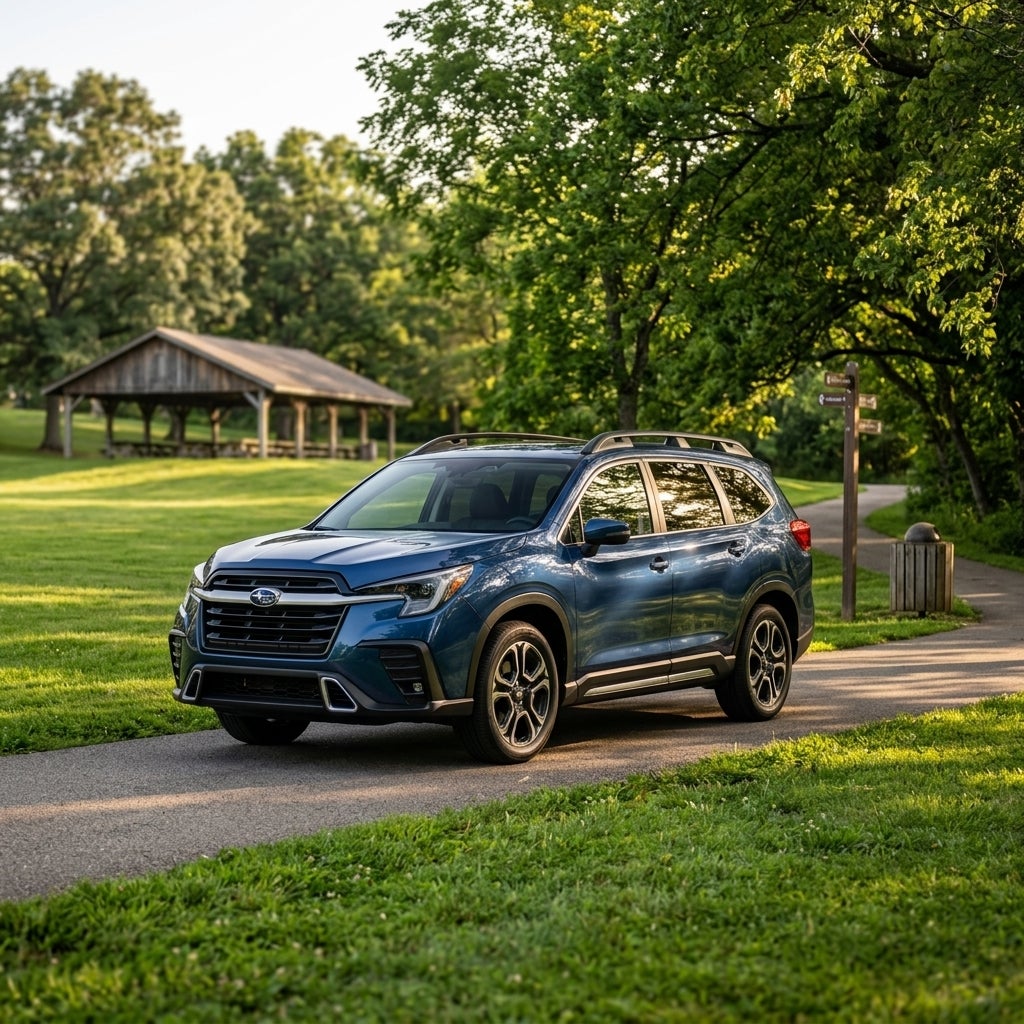
Blue Subaru Ascent parked on a paved path in a grassy park with a pavilion in the background. (Representative image for illustration purposes only. Actual vehicle may vary based on trim and configuration.)
For active families living in Ballwin, Sunset Hills, and Ladue, selecting the perfect three-row SUV is a decision that impacts daily life for years to come. Whether you are navigating the morning carpool line, heading down Manchester Road for weekend shopping, or planning a road trip to the Lake of the Ozarks, you need a vehicle that effortlessly balances safety, interior space, and capability. The 2026 Subaru Ascent and the 2026 Toyota Highlander are two of the most popular contenders in this highly competitive segment, but they approach the needs of modern families in fundamentally different ways.
While both vehicles offer three rows of seating and a reputation for long-term dependability, the 2026 Subaru Ascent is engineered with a distinct family-first philosophy. Right from the base model, the Ascent comes standard with Subaru’s legendary Symmetrical All-Wheel Drive, a spacious and airy cabin designed for maximum visibility, and a host of clever storage solutions. The Toyota Highlander, on the other hand, requires buyers to pay a significant premium to add all-wheel drive, and its third-row seating can feel remarkably cramped for growing kids and teenagers.
As we dive deep into this comprehensive comparison, we will analyze the key areas that matter most to West County families: purchase value, cabin dimensions, safety accolades, powertrain performance, and long-term ownership dynamics. By looking closely at how these vehicles handle real-world challenges, you will see why so many St. Louis-area families are choosing the Ascent as their trusted co-pilot. Discover our full selection of new models by browsing the New Subaru Inventory to find the exact configuration that fits your lifestyle.

What is the starting price of the 2026 Subaru Ascent compared to the 2026 Toyota Highlander?

When evaluating a major purchase like a three-row family vehicle, budget and overall value are top considerations. The 2026 Subaru Ascent consistently holds an edge over the Toyota Highlander by offering more standard features for a lower initial investment. Specifically, every single Ascent trim level comes equipped with Symmetrical All-Wheel Drive (AWD) as a standard feature. In contrast, the Toyota Highlander comes standard with Front-Wheel Drive (FWD), requiring buyers to pay an additional $1,600 to $2,000 depending on the trim to upgrade to AWD—a necessity for handling unpredictable Missouri weather.
This pricing discrepancy becomes even more pronounced as you move up through the trim levels. A mid-tier Ascent Premium or Onyx Edition offers premium creature comforts, advanced safety tech, and superior capabilities at a price point that is thousands of dollars less than a similarly equipped Highlander XLE or Limited. When you factor in the added cost of Toyota's optional AWD, the Ascent presents an undeniable value proposition for savvy buyers in Ballwin and Sunset Hills who want premium capability without the premium markup.
Trim Segment2026 Subaru Ascent (AWD Standard)2026 Toyota Highlander (AWD Optional)
Base / Entry TrimStarting around $39,000Starting around $41,500 (FWD)
Mid-Tier / Popular TrimsStarting around $42,500 (Premium/Onyx)Starting around $45,000 (XLE FWD)
Top-Tier / Luxury TrimsStarting around $49,000 (Touring)Starting around $51,500 (Platinum FWD)

How does interior space and seating in the 2026 Subaru Ascent compare to the 2026 Toyota Highlander for St. Louis-area families?

For growing families, an SUV's interior layout can make or break the daily commute. If passengers in the third row are constantly complaining about lack of legroom, or if a quick trip to the grocery store requires folding down seats just to fit a stroller, the vehicle isn't doing its job. Let's look at how the 2026 Subaru Ascent manages its cabin layout to provide a significantly more comfortable and spacious environment than the Toyota Highlander.

First-Row Comfort

Both SUVs offer excellent comfort for the driver and front passenger, with highly adjustable seating and intuitive controls. However, the Ascent provides a taller greenhouse design with expansive glass windows, giving the driver a commanding view of the road and reducing blind spots during heavy traffic on Manchester Road.

Second-Row Flexibility

The Ascent and Highlander both offer the choice between a second-row bench seat or captain's chairs. The Ascent's captain's chairs slide effortlessly to allow easy access to the back, while its wider rear door openings and standard grab handles make it much easier for younger kids to climb in and out safely without assistance.

Third-Row & Cargo Space

This is where the Ascent shines. With up to 31.7 inches of third-row legroom compared to the Highlander's restrictive 27.7 inches, the Ascent can actually accommodate teenagers and adults. Additionally, the Ascent features up to 76 cubic feet of total cargo volume, providing ample room for gear, groceries, and luggage.
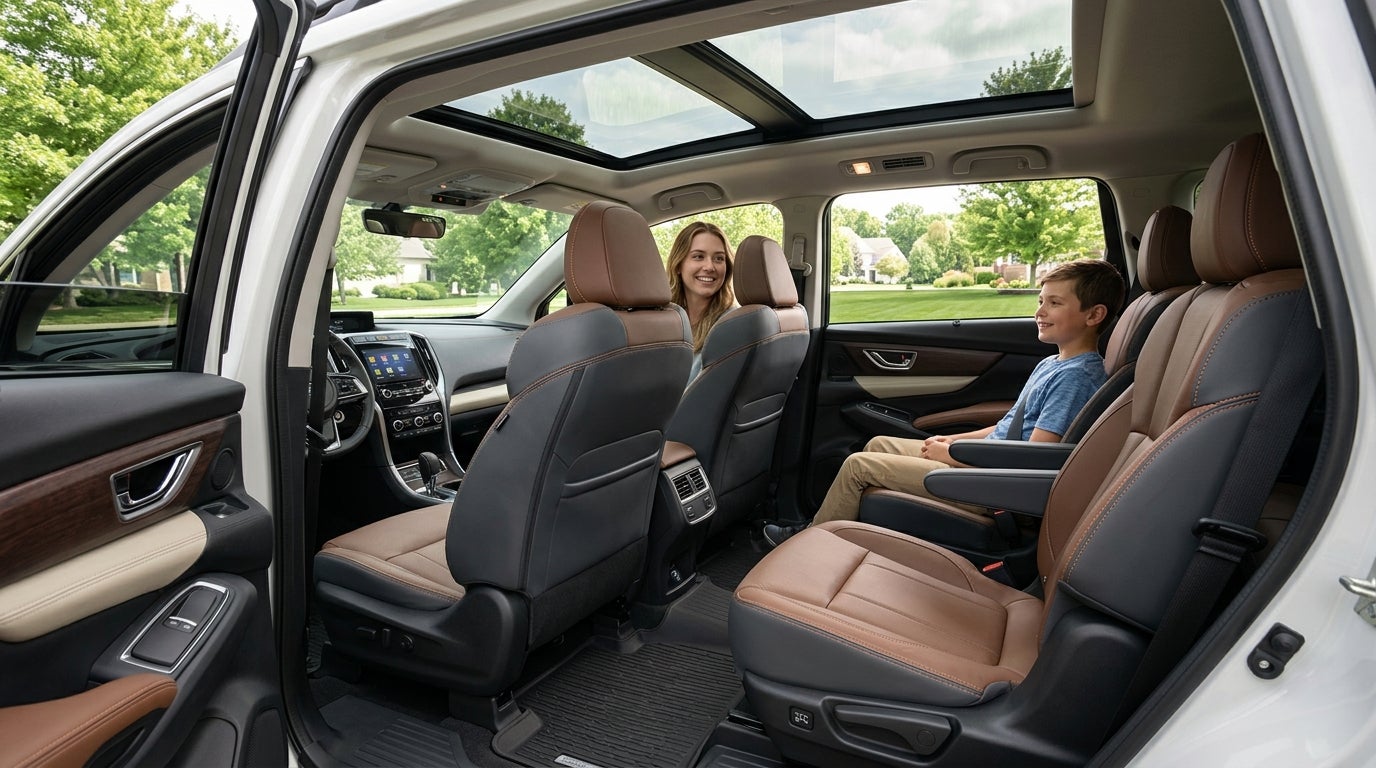
Interior of a white SUV showcasing premium leather seats, panoramic sunroof, and a smiling mother and son. (Representative image for illustration purposes only. Actual vehicle may vary based on trim and configuration.)

How many USB ports are in the third row of the 2026 Subaru Ascent and other family-friendly features?

In today’s digital age, keeping devices charged is essential for maintaining peace during family road trips. The 2026 Subaru Ascent is built with this exact reality in mind, offering up to six USB ports strategically placed throughout all three rows. This includes two dedicated USB ports in the third row (available on Premium trims and above), ensuring that even passengers in the very back can keep their tablets, phones, or gaming devices fully powered without needing to run long, messy cords from the front console.
Beyond connectivity, the Ascent's interior is packed with smart family conveniences that offer a more feature-rich layout than the Toyota Highlander. The Ascent features an incredible arrangement of up to 19 cupholders, meaning every passenger has a secure place for water bottles, juice boxes, and snacks. This is paired with standard tri-zone automatic climate control, allowing rear passengers to set their own comfortable temperatures, and a standard cabin conversation mirror that lets parents easily keep an eye on the back rows.
The Toyota Highlander offers a decent array of technology, but its third-row passengers are often left in the dark. USB charging in the Highlander's third row is non-existent on many trims, forcing passengers to share cords or rely on adapters. Its cupholder count maxes out at 14, and the tighter door openings make accessing those spots more difficult. For families who plan to make the most of their third row, the Ascent clearly offers the superior layout and feature set for a harmonized driving experience.

Why did the 2026 Subaru Ascent earn a Top Safety Pick+ while the 2026 Toyota Highlander did not?

Safety is not just an option for family haulers—it is the absolute highest priority. Subaru has long been synonymous with industry-leading vehicle safety, and the 2026 Subaru Ascent continues this legacy by earning the prestigious Top Safety Pick+ rating from the Insurance Institute for Highway Safety (IIHS). This is the highest honor a vehicle can receive, reflecting outstanding performance in rigorous crashworthiness evaluations, including the updated, more demanding moderate overlap front test and side-impact test. The 2026 Toyota Highlander, while still a safe vehicle, struggled to meet the newer, stricter criteria required to lock in the top '+' designation in recent testing cycles.
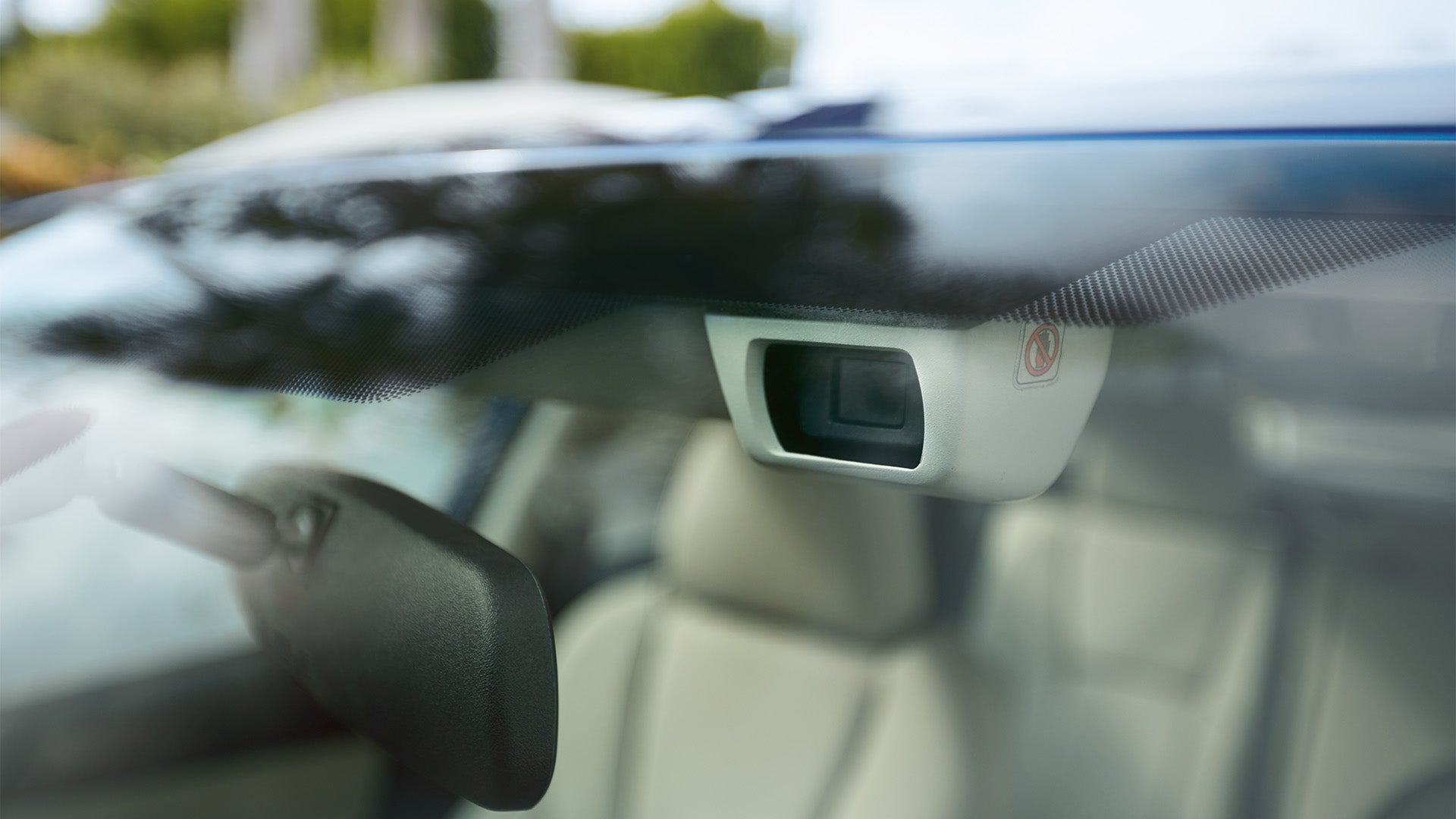
Close-up of a forward-facing safety camera mounted behind a car windshield.
At the core of the Ascent's defensive capability is the standard EyeSight Driver Assist Technology. This system acts as an extra set of eyes on busy highways like I-270 or I-64, utilizing dual color cameras to monitor traffic movement, optimize cruise control, and warn you when you are swaying outside your lane. It features Pre-Collision Braking that can apply full braking force in emergency situations, and Automatic Emergency Steering to help you avoid obstacles when a collision is imminent. Built on the high-strength Subaru Global Platform, the Ascent's ring-shaped reinforcement frame is designed to disperse crash energy away from the passenger cabin, keeping your most precious cargo secure.

Is the 2026 Subaru Ascent’s turbocharged engine powerful enough for highway merging with a family on board?

Merging onto a fast-moving highway with a fully loaded vehicle can be a stressful experience if your engine lacks responsiveness. Fortunately, the 2026 Subaru Ascent is powered by a standard 2.4-liter turbocharged BOXER engine that delivers 260 horsepower and 277 lb-ft of torque. Unlike traditional inline or V-shaped engines, the horizontally opposed BOXER engine sits low in the chassis, which lowers the vehicle’s center of gravity. This design drastically reduces body roll around tight corners and improves overall handling stability.
Because the turbocharger is engineered to deliver peak torque at a low 2,000 RPM, you get instant throttle response the moment you press the gas pedal. This low-end torque is exactly what you need when merging onto I-270 during rush hour or passing slower traffic on Route 141. The power delivery is smooth, predictable, and linear, working in perfect harmony with the Lineartronic CVT to maximize both performance and efficiency.
The Toyota Highlander comes standard with a 2.4-liter turbocharged four-cylinder engine that makes 265 horsepower and 310 lb-ft of torque, while also offering a hybrid option. While these are respectable numbers on paper, the Highlander's traditional upright engine configuration results in a higher center of gravity, leading to a more top-heavy feel during quick transitions or highway curves. Furthermore, the Highlander Hybrid, while fuel-efficient, lacks the immediate, robust acceleration of the turbocharged Ascent when the vehicle is fully packed with passengers and gear, making the Ascent the more confidence-inspiring choice for active family driving.

How does Subaru Symmetrical AWD handle Missouri winters compared to Toyota's AWD systems?

Active Symmetrical AWD

Subaru's Symmetrical All-Wheel Drive is an active, full-time system. It continuously distributes power to all four wheels, ensuring maximum traction before slippage even occurs. Its symmetrical design provides balanced weight distribution for incredibly predictable handling on wet, icy, or snow-covered roads.

Toyota's Reactive Systems

The Highlander utilizes a 'on-demand AWD system' system that operates in front-wheel drive to save fuel and only engages the rear wheels once traction is already lost. This brief delay can lead to sudden wheel spins on patches of black ice or slushy Missouri roads, reducing driver confidence when it matters most.

X-MODE Capability

Standard on the Ascent, X-MODE optimizes engine output, transmission ratios, and the AWD system to maximize traction on slippery surfaces. It also includes Hill Descent Control, which helps you safely navigate steep, icy driveways around Sunset Hills and West County without locking up the brakes.
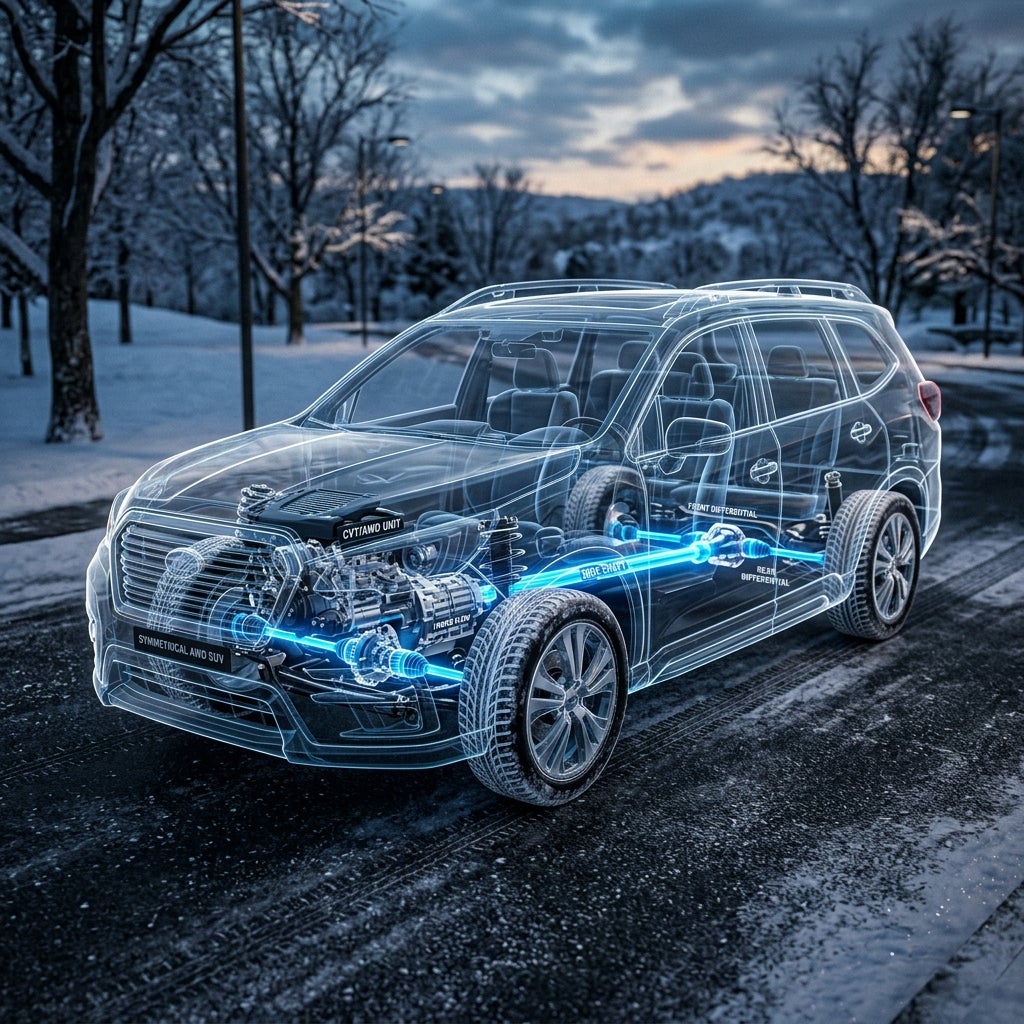
Transparent 3D cutaway of an SUV showing its symmetrical all-wheel-drive system glowing blue on a snowy road. (Representative image for illustration purposes only. Actual vehicle may vary based on trim and configuration.)

What kinds of trailers can a 2026 Subaru Ascent tow that a 2026 Toyota Highlander Hybrid cannot?

For active families who love outdoor adventures, towing capacity is a critical metric. The 2026 Subaru Ascent (Premium trims and above) boasts an impressive maximum towing capacity of up to 5,000 pounds. This robust limit allows you to confidently tow a wide variety of recreational equipment, including small speedboats, dual-axle utility trailers, pop-up campers, or a pair of personal watercraft for a weekend getaway at Castlewood State Park or the Meramec River. Every Ascent equipped for towing also features standard Trailer Stability Assist to help maintain control and prevent dangerous sway on the highway.
In comparison, the popular Toyota Highlander Hybrid is strictly limited to a maximum towing capacity of just 3,500 pounds. This lower threshold severely restricts your options, limiting the types of trailers and loads it can tow. Even the gas-powered Highlander, while rated at 5,000 pounds, requires aftermarket additions that can drive up the initial cost. If your family lifestyle involves hauling recreational gear, the Ascent offers a versatile towing option for families with active lifestyles.
Preparing for a new family SUV often involves trading in your current vehicle to help you estimate your purchase options. At Sunset Hills Subaru, we make this process incredibly transparent and straightforward. You can easily estimate the value of your current car online in just a few minutes, giving you a clear picture of your purchasing power before you even step foot on our showroom floor.

Which is better for long-term family ownership, the Subaru Ascent or the Toyota Highlander?

Investing in a three-row family vehicle is a long-term commitment. You need an SUV that not only performs exceptionally well today but also retains its value, remains affordable to maintain, and continues to look great years down the road. Let's compare how the 2026 Subaru Ascent and the Toyota Highlander stack up in terms of ownership satisfaction, trim availability in the St. Louis area, and overall durability.

Resale Value & Awards

Both Subaru and Toyota are renowned for exceptional resale value. Subaru vehicles routinely win Kelly Blue Book's Best Resale Value awards, meaning your investment in an Ascent is well-protected. Because of standard AWD and legendary durability, used Ascents remain in high demand.

Popular Trim Availability

At dealers serving Ballwin and Sunset Hills, the Premium, Limited, and Onyx Edition trims are highly sought after. The Onyx Edition stands out with its blacked-out exterior accents, 20-inch alloy wheels, and durable, water-repellent StarTex upholstery—perfect for messy spills and active dogs.

Cost of Maintenance

With simple Boxer engine layouts and highly reliable mechanical components, the Ascent is straightforward and cost-effective to service. Combined with the competitive maintenance programs and factory-certified support at Sunset Hills Subaru, long-term ownership costs remain highly predictable.

Is it better for my family to buy a 2026 Subaru Ascent now or wait for the 2027 model?

A common dilemma for car shoppers is deciding whether to buy the current model year or wait for the next iteration. For St. Louis families, purchasing the 2026 Subaru Ascent today is an incredibly smart move. The 2026 model represents a highly refined example of this generation's design, meaning all technology, mechanical systems, and interior features have been highly refined and optimized based on years of real-world feedback. Buying now allows you to enjoy a highly reliable, proven vehicle immediately, rather than waiting for unannounced changes and potential price increases in the 2027 model year.
Additionally, purchasing a 2026 model right now means you can take advantage of current financing and lease information. You can easily start the purchasing process from the comfort of your home by applying online to Get approved for financing. Our finance team works with a wide network of local and national lenders to secure the absolute best rates for your family’s budget, ensuring a stress-free transition into your new vehicle.
Leasing is another excellent option for families who prefer to drive a new vehicle every few years with lower monthly commitments. For current lease information, please contact the dealership. By choosing a lease, you can enjoy all the cutting-edge safety and technology features of the Ascent today, while keeping your monthly payments comfortable and predictable.

Where should St. Louis-area families go for reliable maintenance and warranty service on a Subaru Ascent?

To ensure your family's vehicle remains safe and reliable for years to come, choosing the right service destination is essential. Sunset Hills Subaru, located at 10100 Watson Rd, Sunset Hills, MO 63127, is the premier service center for drivers throughout Ballwin, Ladue, and the greater West County area. Our state-of-the-art service department is staffed by factory-trained, Subaru-certified technicians who know your Ascent inside and out. From routine oil changes and tire rotations to complex diagnostics and warranty repairs, we utilize specialized diagnostic equipment and follow strict factory protocols to keep your vehicle performing at its absolute best.
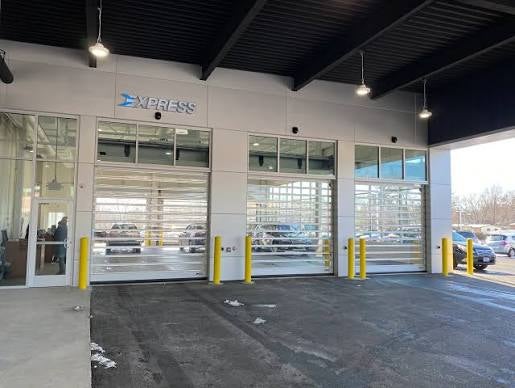
Exterior of auto service center with EXPRESS signage and cars visible inside.
We are committed to using only genuine OEM Subaru parts for every repair, ensuring perfect compatibility, optimal performance, and long-term durability. If you prefer to perform minor maintenance yourself or need specialized accessories, you can easily Find Subaru Parts through our dedicated online parts department. We understand that your time is valuable, which is why we offer a convenient online scheduling tool. It takes only a moment to Schedule Service and Diagnostics, allowing you to choose a time that fits seamlessly into your busy family calendar.

Test Drive the 2026 Subaru Ascent Today at Sunset Hills Subaru

Reading about the safety, spacious interior, and incredible capability of the 2026 Subaru Ascent is one thing, but experiencing it first-hand is another. We invite you and your family to visit us at Sunset Hills Subaru to get behind the wheel of this exceptional three-row SUV. Let your kids climb into the spacious third row, feel the smooth power of the turbocharged BOXER engine, and explore the advanced EyeSight safety features for yourself.
Our friendly, hassle-free sales team is here to answer all your questions, compare trim levels, and help you find the perfect Ascent for your lifestyle. Stop by our showroom today or Call us at (314) 476-9638 to speak with a specialist. Ready to visit? Get step-by-step navigation instructions by clicking to Get Directions to Sunset Hills Subaru. We look forward to welcoming you and helping your family embark on your next great adventure!
Posted in:

Related Posts

Silver Subaru Outback parked in a driveway in front of suburban houses with autumn foliage. (Representative image for illustration purposes only. Actual vehicle may vary based on trim and configuration.)

Evaluating Subaru Resale Value and the Real Cost of Ownership

Selecting a vehicle for daily travel requires looking past the initial transaction price to examine how that investment holds up over time. For professionals commuting from the residential neighborhoods of Ladue, a vehicle must deliver long-term financial predictability alongside everyday capability. Subaru has established a strong reputation for retaining its worth, driven by standard safety systems and engineering that handles regional weather changes with ease. When you buy a new vehicle, understanding the balance between depreciation and long-term value helps ensure your capital is well spent. more A primary driver of this strong value retention is the standard Symmetrical All-Wheel Drive system found on almost every model. This drivetrain provides consistent traction through rain, mud, and winter slush, making these vehicles highly sought after on the pre-owned market. Additionally, standard EyeSight Driver Assist Technology —which includes safety features like adaptive cruise control and pre-collision braking—helps lower the risk of accidents and helps keep insurance premiums competitive. When pre-owned buyers shop for a used vehicle, they actively seek out these built-in technologies, which keeps trade-in values high. The financial benefits of owning a Subaru extend throughout your entire ownership cycle. Our team at Sunset Hills Subaru is ready to assist you in finding a vehicle that fits your budget and lifestyle perfectly. If you are curious about what your current vehicle is worth, you can easily value your trade-in online using our secure tool. We invite you to explore our showroom at 10100 Watson Rd, Sunset Hills, MO 63127, or give our sales team a quick call to discuss our current inventory. We maintain a diverse selection of vehicles designed for every type of driver, including: The adventurous new Subaru Outback, offering ample ground clearance and premium cabin comfort. The versatile new Subaru Forester, a compact SUV featuring excellent visibility and cargo space. The highly popular new Subaru Crosstrek, perfect for efficient urban commuting and weekend getaways. The spacious three-row new Subaru Ascent, built to accommodate growing families. The sleek new Subaru Legacy, providing a refined all-wheel-drive sedan experience. The sporty new Subaru Impreza hatchback, combining practical utility with agile handling. The all-electric new Subaru Solterra, delivering modern zero-emission capability. Performance-focused models like the rally-inspired new Subaru WRX and the nimble, rear-wheel-drive new Subaru BRZ. Table of Contents Subaru Depreciation Rates Compared to Toyota and Honda Head-to-Head Value Retention: Outback vs RAV4 and Forester vs CR-V Which Subaru Models Hold Their Purchase Value the Longest? Smart Buying Strategies: Negotiating MSRP and Maximizing Your Investment Quick Answers Before You Visit Experience the Subaru Difference at Sunset Hills Subaru Subaru Depreciation Rates Compared to Toyota and Honda How does a vehicle's value change the moment it leaves the showroom? It is a well-known industry reality that a new vehicle experiences an immediate drop in value once purchased. A new Subaru typically loses approximately 9% to 11% of its original purchase price the moment you drive it off the lot. While this initial drop is standard across the automotive industry, the rate of depreciation slows down significantly in the subsequent years, allowing the brand to compete directly with historically strong rivals like Toyota and Honda. Over a five-year period, brand-new Subaru vehicles depreciate by an average of 39% after 5 years. This means they retain roughly 61% of their original value, placing them among the top tier of all automotive brands. This average depreciation rate closely mirrors the performance of Toyota and Honda, typically finishing within 1% to 3% of these competitors depending on the specific model segment and trim level. Because pre-owned buyers place a high premium on durable engineering and all-weather capability, these vehicles remain highly competitive in the secondary market. If you want to maximize your financial investment, purchasing a slightly used vehicle can be an exceptionally smart strategy. For instance, selecting a pre-owned model that is two years old allows you to bypass the steepest curve of initial depreciation while still driving a vehicle with the majority of its useful life ahead. To see our current selection of high-quality pre-owned models, you can browse our used vehicle inventory online to find a vehicle that delivers outstanding long-term value. ​ Head-to-Head Value Retention: Outback vs RAV4 and Forester vs CR-V Are you debating between a Subaru and its closest segment competitors? Buyers frequently compare the Outback directly against the Toyota RAV4, as well as the Forester against the Honda CR-V. These matchups represent some of the most competitive segments in the industry, where long-term value retention and everyday usability are top priorities for shoppers. When comparing the Outback and the Toyota RAV4, both models stand out as exceptional value holders. Over a five-year ownership period, both vehicles retain roughly 56% to 59% of their original purchase price. While the RAV4 is highly regarded for its traditional crossover packaging, the Outback offers a distinct advantage with its standard all-wheel-drive system and rugged wagon-like utility. For families who enjoy weekend recreation, the Outback Wilderness trim features an impressive towing capacity of 3,000 lbs when properly equipped, making it a highly capable partner for towing light campers or utility trailers. In the compact SUV segment, buyers often ask if the Honda CR-V has lower overall ownership costs than the Forester. While the Honda CR-V averages about $50 to $100 less in annual maintenance and repair costs over five years, the Forester counters this with a lower initial purchase price and standard all-wheel drive across its lineup. The 2026 Subaru Forester starts at an attractive base MSRP of $29,995, whereas choosing a comparable all-wheel-drive system on a competitor often requires paying for an expensive optional package. To protect your investment and keep your vehicle performing at its best, we invite you to explore our current service and parts specials for factory-authorized maintenance support. Pricing Pricing by trim Feature Limited Limited XT Premium Touring Touring XT Wilderness Base MSRP $41,715 $44,365 $34,995 $45,395 $47,995 $44,995 Destination charge $1,450 $1,450 $1,450 $1,450 $1,450 $1,450 ​ Which Subaru Models Hold Their Purchase Value the Longest? If you are looking for the absolute strongest value retention in the lineup, one specific model stands out. The compact Subaru Crosstrek historically holds its value the best of any model in the family, retaining up to 64% of its original purchase price after five years of ownership. This outstanding residual value is driven by incredibly strong demand in the pre-owned market, where younger buyers and commuters seek out its efficient performance, standard safety features, and compact footprint. The Crosstrek achieves this value retention by offering highly practical specifications. The 2026 Subaru Crosstrek features a starting MSRP of $26,995 and comes equipped with a 2.5L engine producing 180 hp and 178 lb-ft of torque, mated to a smooth Lineartronic CVT. This powertrain delivers an efficient EPA-estimated 26 city / 33 hwy MPG, helping to keep your daily fuel costs low. This combination of standard all-wheel drive, excellent fuel economy, and approachable pricing makes it a highly resilient asset on the automotive market. Whether you are interested in the highly efficient Crosstrek, a spacious Forester, or a premium Outback, our team is here to help you secure a great rate. You can browse our new Subaru inventory from the comfort of your home to see what we currently have available. When you find the perfect model, you can get approved for financing using our secure online application. Be sure to also check our current new car specials to take advantage of our latest purchase incentives. Engine & Performance Powertrain specs by trim Feature Limited Limited XT Premium Touring Touring XT Wilderness Engine 2.5L 2.4L 2.5L 2.5L 2.4L 2.4L Horsepower 180 hp 260 hp 180 hp 180 hp 260 hp 260 hp Torque 178 lb-ft 277 lb-ft 178 lb-ft 178 lb-ft 277 lb-ft 277 lb-ft Transmission Lineartronic CVT Lineartronic CVT Lineartronic CVT Lineartronic CVT High-torque Lineartronic CVT Lineartronic CVT Drivetrain All-wheel drive All-wheel drive All-wheel drive All-wheel drive All-wheel drive All-wheel drive ​ Smart Buying Strategies: Negotiating MSRP and Maximizing Your Investment When purchasing a new vehicle, employing smart buying strategies can significantly lower your overall cost of ownership from day one. Many shoppers wonder how much they can negotiate off the MSRP of a new vehicle. Depending on current factory inventory levels and regional demand, buyers can typically negotiate between 2% and 5% off the MSRP on most new models. Securing a competitive purchase price directly reduces the amount of depreciation you experience during your first few years of ownership. Beyond direct negotiation, how you manage your vehicle's mileage and condition plays a critical role in its future trade-in value. While vehicle age is a natural factor in depreciation, high mileage affects resale value much more rapidly than age alone. Exceeding the national average of 12,000 to 15,000 miles per year can accelerate a vehicle's depreciation curve, as secondary buyers actively look for lower-mileage all-wheel-drive systems that have experienced less wear and tear. Keeping your annual mileage within reasonable limits and addressing cosmetic wear promptly will pay major dividends when it comes time to trade your vehicle in. Another highly effective way to maximize your investment is to participate in official owner programs. For example, the Subaru Guaranteed Trade-In Value Program guarantees your vehicle's trade-in value for the first eight years of ownership. Additionally, the Subaru Trade Up Advantage Program monitors your vehicle's equity state, often allowing you to transition into a brand-new model sooner than you might expect with a similar or even lower monthly payment. By combining these factory-backed programs with smart mileage management, you can enjoy a highly predictable and cost-effective ownership experience. ​ Quick Answers Before You Visit Q: Which Subaru model has the lowest depreciation rate over five years? The compact Crosstrek holds its value the best in the lineup, retaining up to 64% of its original purchase price after five years of ownership. This strong performance is driven by high demand in the pre-owned market for efficient, reliable, and affordable all-wheel-drive crossovers. Q: How does Subaru's average five-year depreciation compare to Toyota and Honda? Subaru vehicles depreciate by an average of 39% after five years, which is highly competitive with both Toyota and Honda. The difference in retained value between these three brands typically sits within a narrow 1% to 3% margin depending on the specific model segment. Q: Does vehicle age or mileage have a greater impact on resale value? Accumulating miles beyond the national average of 12,000 to 15,000 miles per year impacts resale value much more rapidly than age alone. Pre-owned buyers place a high premium on well-maintained, lower-mileage all-wheel-drive systems, making mileage management crucial for preserving trade-in value. Q: What is the Guaranteed Trade-In Value Program? This exclusive program guarantees the trade-in value of your vehicle for the first eight years of ownership. It provides peace of mind by establishing a clear, predictable financial baseline for your vehicle's worth when you are ready to upgrade to a new model. Q: Do local dealers participate in the Subaru VIP Program? Yes, participating retailers honor the Subaru VIP Program, which allows qualifying members of partner organizations to purchase or lease vehicles at MSRP or other program-specific pricing where applicable. Contact our sales team directly to confirm program eligibility and details before your visit. ​ Experience the Subaru Difference at Sunset Hills Subaru When you are ready to experience a confident, safety-focused ride that protects your financial investment over the long haul, our team is here to assist you. From the versatile cargo space of our crossover lineup to the standard Symmetrical All-Wheel Drive that conquers changing weather, these vehicles are built to support your active lifestyle. We invite you to drop by our showroom to take a no-pressure test drive and find the ideal model for your daily needs. We are committed to providing a transparent, straightforward, and supportive buying experience from start to finish. Our finance specialists are ready to help you explore current financing options, evaluate your trade-in, and find a payment structure that aligns with your budget. Give our professional sales team a call at (314) 476-9638, or get easy driving directions to our showroom on Watson Road today to take the next step in your automotive journey. Keep Your Vehicle Running Strong Keep your vehicle performing at its best with our service team: Find Subaru Parts Schedule Service and Diagnostics © 2026 Sunset Hills Subaru. All rights reserved.

Three Subaru SUVs, blue, white, and red, parked side-by-side in a tree-lined suburban street. (Representative image for illustration purposes only. Actual vehicle may vary based on trim and configuration.)

Why St. Louis Families Choose Subaru: The Real Value Behind the Brand's Longevity

Why St. Louis Families Choose Subaru: The Real Value Behind the Brand's Longevity For generations, drivers throughout the greater St. Louis metropolitan area, from the bustling corridors of Creve Coeur to the quiet, tree-lined neighborhoods of Sunset Hills, have shared a common bond: a deep-seated trust in Subaru vehicles. This isn't merely a casual affinity for a brand; it is a calculated decision rooted in long-term reliability, exceptional resale value, and an safety architecture that consistently leads the automotive industry. When you choose a Subaru, you are investing in a vehicle engineered to withstand the test of time, the unpredictability of Midwestern weather, and the rigorous demands of daily family life. more At the heart of this enduring value are three pillar technologies that define the Subaru identity: the horizontally opposed BOXER engine, Symmetrical All-Wheel Drive (AWD), and the revolutionary EyeSight Driver Assist technology. Together, these systems work in perfect harmony to deliver an unparalleled driving experience characterized by stability, confidence, and protection. Whether you are navigating the daily commute on Interstate 270, taking a weekend trip down to the Ozarks, or simply running errands in Oakland and Sappington, these engineering solutions work quietly beneath the surface to keep you and your loved ones secure. Furthermore, the longevity of these vehicles is backed by impressive real-world statistics. According to industry data, an astonishing percentage of Subaru vehicles sold over the last decade are still active on the road today. This remarkable endurance translates directly into lower cost of ownership and higher resale returns when it eventually comes time to upgrade. At Sunset Hills Subaru, located at 10100 Watson Rd, Sunset Hills, MO 63127, we take pride in helping our community discover these lasting benefits. To learn more or discuss your options, you can Call us at (314) 476-9638 or stop by our showroom today. As we head through the warm summer months of July 2026, there is no better time to evaluate your family's transportation needs. A vehicle should be more than just a depreciating asset; it should be a reliable sanctuary that brings peace of mind to every journey. In this comprehensive guide, we will dive deep into the specific mechanical, safety, and economic factors that make Subaru the premier choice for discerning drivers across Missouri. From detailed technical breakdowns of the symmetrical drivetrain to practical advice on maintenance and tire care, this guide serves as your ultimate resource for understanding the true Subaru value proposition. What Are the Core Safety Benefits of Subaru's EyeSight Driver Assist Technology? Subaru's EyeSight Driver Assist Technology represents a monumental leap forward in active automotive safety, serving as a vigilant co-pilot for every mile of your journey. Unlike many competitive systems that rely on radar sensors hidden in the front bumper, EyeSight utilizes a pair of dual color cameras mounted high inside the cabin, positioned securely behind the rearview mirror. This positioning mimics the human field of view, allowing the system to scan the road ahead with incredible precision. By constantly monitoring traffic movement, lane markings, and obstacles, EyeSight can anticipate potential hazards and intervene long before the driver has time to react manually. The core suite of EyeSight features includes Pre-Collision Braking, which can apply full braking force to bring the vehicle to a complete stop in emergency situations, significantly reducing the severity of frontal impacts or avoiding them altogether. This is particularly crucial during rush hour traffic on congested St. Louis highways like I-64 or I-270, where sudden stops are a frequent hazard. Additionally, Pre-Collision Throttle Management detects obstacles ahead and restricts engine output to help minimize impact force if you accidentally accelerate toward a detected object. Complementing these crash-avoidance systems are convenience-oriented safety features like Advanced Adaptive Cruise Control with Lane Centering. This system takes the stress out of long road trips or stop-and-go commutes by automatically maintaining a safe preset distance from the vehicle ahead while helping to keep your Subaru centered within its lane. Lane Departure and Sway Warning systems also monitor your position on the road, providing clear visual and audible alerts if you begin to drift, ensuring you remain focused and safe during late-night drives or moments of highway fatigue. By acting as a second set of eyes, the EyeSight system has been shown to reduce rear-end collisions with injuries by up to 85% according to the Insurance Institute for Highway Safety (IIHS). This extraordinary statistic highlights why Subaru models consistently earn top safety picks year after year. For families living in Creve Coeur or shopping for a new vehicle at Sunset Hills Subaru, choosing an EyeSight-equipped model means choosing unparalleled peace of mind. It is a proactive defense system designed to protect what matters most. Does Subaru EyeSight Work in Heavy Rain, Snow, or Severe Midwestern Weather? Midwestern weather is notoriously unpredictable, presenting drivers in St. Louis with everything from blinding summer downpours in July to heavy winter snowstorms and thick autumn fog. Because Subaru's EyeSight driver assist technology relies on optical cameras rather than radar, it is subject to some of the same visual limitations as the human eye. If the weather conditions are so severe that you cannot clearly see the road ahead, EyeSight's cameras will likely experience a similar reduction in visibility. When the system's view is obstructed by heavy precipitation, accumulated ice on the windshield, or intense direct sunlight, it is engineered to prioritize safety by temporarily disabling itself. When this happens, the vehicle provides a clear notification on the multi-information display, illuminating an indicator light to inform the driver that EyeSight is temporarily inactive. This is a deliberate safety feature designed to prevent the system from making incorrect calculations based on obscured visual data. Crucially, as soon as the weather clears, the windshield wipers clear the glass, or the vehicle turns away from blinding sun glare, the cameras will automatically recalibrate and re-engage without requiring any driver intervention. This seamless recovery ensures that you have assistance when conditions allow, while maintaining manual control when extreme weather demands it. To maximize EyeSight's performance in challenging conditions, it is vital to keep your windshield clean and free of debris, ice, or fog. Utilizing the vehicle's defrost systems and keeping your wiper blades in top condition are simple but highly effective ways to support the system's operational readiness. At Sunset Hills Subaru, we encourage drivers to view EyeSight as a supportive safety layer rather than a replacement for attentive driving. When winter blizzards or torrential summer rains hit the St. Louis area, your primary defense is always a focused mind, supported by the mechanical excellence of Subaru's Symmetrical AWD. How Much Does It Cost to Calibrate Subaru EyeSight Cameras After a Windshield Replacement? A chipped or cracked windshield is a common frustration for drivers, but when you own an EyeSight-equipped Subaru, a simple glass replacement requires an extra, highly critical step: camera calibration. Because the EyeSight cameras rely on precise geometric alignments to calculate distances, speeds, and lane positions, even a microscopic shift in the angle of the windshield glass can distort their vision. Therefore, Subaru mandates that the system be professionally calibrated whenever the windshield is replaced, or if the cameras are ever removed or disturbed during other repairs. Skipping this step can lead to system errors, delayed braking responses, or complete system failure. The cost of an EyeSight calibration typically ranges from $300 to $600, depending on the specific model and the complexity of the alignment process. While this represents an additional expense on top of the physical glass replacement, it is an investment in your safety and the integrity of your vehicle's safety systems. Many auto insurance policies cover both the windshield replacement and the mandatory calibration under comprehensive coverage, as it is required to restore the vehicle to its factory-certified safety standards. We highly recommend checking with your insurance provider to understand your coverage options when a replacement becomes necessary. Calibration is a highly specialized process that requires OEM-specific software, precise target boards, and a perfectly level bay to execute correctly. Attempting to bypass this service or trusting it to uncertified third-party shops can compromise the accuracy of your active safety features. At Sunset Hills Subaru, our factory-trained technicians possess the exact tools and training required to perform certified EyeSight calibrations, ensuring your vehicle returns to the road in peak condition. If you recently replaced your windshield or notice any safety warnings, we invite you to Schedule Service and Diagnostics with our expert team to ensure your system is operating with flawless accuracy. Schedule EyeSight Calibration Does EyeSight Prevent Reversing Accidents and Can the System Be Permanently Turned Off? Yes, Subaru's commitment to 360-degree safety extends to reversing scenarios through an advanced system known as Reverse Automatic Braking (RAB). Utilizing sonar sensors integrated into the rear bumper, RAB constantly scans the area behind your vehicle when you are in reverse gear. If the system detects an obstacle—whether it is a concrete pillar in a tight parking garage, a stray bicycle left in a suburban driveway in Sappington, or a pedestrian walking behind the vehicle—it will emit clear, rapid auditory alerts while displaying a visual warning on the center touchscreen. If you do not apply the brakes, the system will automatically intervene and apply full braking force. This technology is a lifesaver in busy residential areas and crowded shopping centers around Sunset Hills, where visibility can be limited by adjacent parked vehicles or high blind spots. However, drivers occasionally ask if the broader EyeSight system can be permanently disabled. Some drivers worry that the safety alerts might become intrusive during specific driving scenarios, such as off-roading, driving through automated car washes, or navigating tight construction zones. While you can temporarily deactivate individual features—such as Lane Keep Assist or Pre-Collision Braking—using the overhead console buttons or the vehicle's touchscreen settings, they cannot be permanently shut off. To maintain the strict safety standards that define the brand, all EyeSight and RAB systems are engineered to automatically reset to 'on' with every new ignition cycle. This ensures that the vehicle's advanced protective shield is always active whenever you begin a new journey, protecting you from unexpected hazards. For those looking to explore these features firsthand, visiting Sunset Hills Subaru is the perfect starting point. You can check out our New Subaru Inventory online to find a model equipped with these cutting-edge driver assistance systems, or visit our dealership to experience them during a personalized demonstration. How Does Subaru's Symmetrical All-Wheel Drive Differ from Rival AWD Systems? To understand the superiority of Subaru's Symmetrical All-Wheel Drive, it is essential to look at how most competitor systems operate. Many crossover SUVs use on-demand AWD systems that can send power to the rear wheels when traction conditions change. Subaru's Symmetrical All-Wheel Drive is engineered for continuous power delivery and balanced handling. Furthermore, these systems often rely on transverse-mounted engines, which create an asymmetrical drivetrain layout with unequal-length half-shafts, leading to uneven power distribution and increased torque steer. In contrast, Subaru's Symmetrical AWD is a full-time system engineered along a central, longitudinal axis. The engine, transmission, and driveshafts are aligned in a straight line down the center of the vehicle, creating a perfectly balanced weight distribution from left to right. This symmetry ensures that power is distributed continuously and smoothly to all four wheels simultaneously. Because the system is proactive rather than reactive, it provides instant, uninterrupted traction the moment your tires touch the road. Whether you are climbing a steep hill or taking a sharp corner, this balanced layout reduces body roll and maximizes stability. This difference in engineering is felt immediately when driving on winding, rolling roads near Creve Coeur Lake or navigating wet, leaf-strewn suburban streets in the autumn. While competitor vehicles struggle to manage sudden shifts in weight and traction, a Subaru remains planted, predictable, and remarkably agile. This superior mechanical design is a primary reason why Subaru owners report a profound sense of confidence behind the wheel, regardless of the road surface or weather conditions. It is not just about getting out of a snowbank; it is about maintaining optimal handling dynamics during every single second of your drive. Drivetrain Feature Subaru Symmetrical AWD Competitor Slip-and-Grip Power Delivery Continuous (Always Active) Reactive (After Slip) Weight Balance Symmetrical / Longitudinal Asymmetrical / Transverse Handling Feel Balanced & Planted Friction-Dependent Torque Steer Virtually Eliminated Commonly Experienced Is Subaru Symmetrical AWD Always Active and Does It Lower the Vehicle's Fuel Economy? Yes, Subaru Symmetrical AWD is a full-time system, meaning it is always active and constantly routing power to all four wheels. Unlike part-time systems that disconnect the secondary axle to save fuel, a Subaru never leaves you relying on just two driven wheels. Historically, full-time all-wheel drive was associated with a significant fuel economy penalty due to the friction and weight of additional mechanical components. However, Subaru has spent decades refining its drivetrain and engine technologies to minimize this drawback, making modern Subaru models incredibly competitive with front-wheel-drive rivals in terms of fuel efficiency. A key component in this efficiency is the Lineartronic Continuously Variable Transmission (CVT). Unlike traditional automatic transmissions with fixed gear ratios, the Lineartronic CVT can infinitely adjust its gear ratios to keep the engine operating in its most efficient powerband. This seamless integration with the highly efficient BOXER engine ensures that fuel consumption is kept to a minimum. As a result, vehicles like the Subaru Forester and Outback achieve highway fuel economy ratings that rival front-wheel-drive compact SUVs, allowing you to enjoy the safety of continuous AWD without paying a heavy price at the fuel pump. Ultimately, the marginal difference in fuel economy is a minor trade-off when compared to the massive safety benefit of having uninterrupted power sent to all four wheels during unexpected road hazards. If you are ready to experience this perfect balance of efficiency and capability, we recommend checking your current vehicle's worth with our Get your value trade tool. This can be the first step toward stepping into a highly efficient, AWD-equipped Subaru that will keep you safe through every season while keeping your fuel costs low. Value Your Current Trade-In Online What Is Subaru X-MODE and How Does It Assist Your AWD System? While Subaru's Symmetrical AWD is highly capable during normal driving conditions, certain off-road or extreme weather scenarios require a higher level of traction management. This is where Subaru X-MODE comes into play. Available on most Subaru SUVs, X-MODE is a specialized software system that optimizes the vehicle's engine output, transmission ratio, AWD power split, and braking system with the touch of a button. When engaged at low speeds, X-MODE alters the throttle response to prevent sudden wheelspin, while increasing the clutch engagement force of the AWD system to deliver power to the wheels with the most grip. Another key component of X-MODE is Hill Descent Control. When descending a steep, slippery incline, this feature manages the vehicle's braking automatically, keeping your speed constant and controlled without requiring you to touch the brake pedal. This allows you to focus entirely on steering and navigating around obstacles. X-MODE is an invaluable tool for outdoor enthusiasts in Missouri, whether they are navigating muddy trails, deep gravel, or icy hills during a winter storm. It elevates the baseline capability of the AWD system, turning a standard crossover into an incredibly confident off-road explorer. Advanced versions of this technology, such as Dual-Function X-MODE, offer tailored settings for 'Snow/Dirt' and 'Deep Snow/Mud.' These settings allow a controlled amount of wheel slip in extremely soft terrain to help clear tread patterns and maintain forward momentum. For drivers who enjoy exploring the state's natural beauty or who simply want the ultimate backup plan for winter weather, understanding X-MODE is key to unlocking the full potential of your Subaru. Our product specialists at Sunset Hills Subaru are always happy to demonstrate this feature on our new models, helping you feel prepared for any adventure. Do You Have to Replace All Four Tires on a Subaru If Only One Is Damaged? One of the most frequently asked questions regarding Subaru ownership relates to tire replacement. Because of the technical precision of Subaru's continuous Symmetrical AWD system, all four tires must have virtually identical outer circumferences to ensure proper operation. Subaru's tolerance limit for tire circumference difference is extremely strict: they must be within 1/4 inch of each other. If you install a single brand-new tire alongside three partially worn tires, the variance in diameter will cause the new, larger tire to rotate at a slightly different speed than the others, creating constant strain on the drivetrain. This continuous speed differential generates excessive heat and mechanical stress within the center differential or transfer clutch. Over time, this can lead to severe drivetrain damage and costly repairs that could have been avoided. Therefore, if you experience a punctured or damaged tire that cannot be safely repaired, you will typically need to replace all four tires to keep the diameters uniform. However, there are alternative solutions available. If the remaining three tires have substantial tread depth left, some specialized tire centers can perform a process called 'tire shaving' to match the new tire's tread depth to the exact level of the others. To prevent uneven wear and extend the lifespan of your current tires, it is highly recommended to perform regular tire rotations every 6,000 miles, aligning perfectly with your scheduled oil changes. If you find yourself needing a replacement tire or want to check your current tread health, we recommend reaching out to our parts department. You can easily Find Subaru Parts and consult with our specialists to find the exact matching tire specifications for your vehicle, keeping your Symmetrical AWD system safe and operating smoothly. What Makes the Subaru BOXER Engine Design Unique and Highly Beneficial? The Subaru BOXER engine is a cornerstone of the brand's mechanical identity, setting it apart from almost every other mainstream automotive manufacturer. While most vehicles use an inline or V-shaped engine configuration where the pistons move vertically or at an angle, the BOXER engine features a horizontally opposed layout. The pistons are positioned flat on either side of the crankshaft, moving horizontally toward and away from each other in a punch-counterpunch motion. This unique horizontal movement naturally cancels out the vibrations generated by the combustion process, resulting in an incredibly smooth and refined engine operation. One of the most significant design benefits of the BOXER engine is its low profile. Because the engine is flat, it can be mounted much lower in the vehicle's chassis than a traditional upright engine. This significantly lowers the vehicle's overall center of gravity. A lower center of gravity translates directly into improved handling stability, flatter cornering, and more responsive steering. This mechanical advantage is a primary reason why even Subaru's high-riding SUVs, such as the Forester and Outback, handle with the agility and composure of a much smaller passenger car. Beyond handling performance, the flat design of the BOXER engine offers a critical safety benefit in the event of a severe frontal collision. In a standard vehicle, a frontal impact can push a tall, upright engine backward into the passenger cabin, risking serious injury to the driver and front passenger. Because the BOXER engine is mounted low and flat, it is engineered to slide beneath the cabin floor during a frontal impact, absorbing collision energy while keeping the passenger compartment intact. This safety-by-design approach is central to Subaru's engineering philosophy. Explore Subaru Financing Options Do Subaru BOXER Engines Still Have Head Gasket Problems and What Is the Recommended Oil Change Interval? When researching older Subaru models from the late 1999s and early 2000s, shoppers often encounter discussions regarding head gasket failures. It is important to address this concern with modern context: this issue has been completely resolved for over a decade. The historical problems were primarily associated with single-layer composite head gaskets used in older naturally aspirated engines. Today, Subaru utilizes Multi-Layered Steel (MLS) head gaskets across its entire lineup, combined with advanced engine cooling designs and improved metallurgy. These modern gaskets are incredibly durable and are engineered to last the entire lifespan of the engine. To ensure your modern BOXER engine maintains its exceptional reliability, adhering to the manufacturer's recommended maintenance schedule is paramount. For the vast majority of modern Subaru vehicles, the recommended oil change interval is every 6,000 miles or six months, whichever comes first. Because these engines utilize high-quality, low-viscosity synthetic motor oil (typically 0W-20), they are highly efficient but require regular lubrication to protect moving parts and minimize internal friction. Staying on top of these oil changes is the single most effective way to ensure your engine runs smoothly for hundreds of thousands of miles. Neglecting scheduled oil changes can lead to oil consumption, reduced fuel economy, and accelerated wear on internal engine components. For St. Louis area drivers, maintaining this routine is simple and hassle-free. Our service center at Sunset Hills Subaru offers quick, certified maintenance to keep your vehicle in prime condition. You can easily check our Service and Parts Information online to find current pricing on synthetic oil changes, tire rotations, and other preventative maintenance services designed to protect your investment. Does the Subaru BOXER Engine Require Premium Fuel and Are They Difficult to Service? A common misconception is that all horizontally opposed engines require high-cost premium fuel. Fortunately, this is not the case for the majority of the Subaru lineup. Popular, naturally aspirated models like the Forester, Outback (non-XT trims), Crosstrek, and Impreza are fully engineered to run efficiently on standard 87-octane regular unleaded gasoline. Premium fuel is only required or recommended for performance-oriented, turbocharged models like the WRX, BRZ, or the turbocharged XT variants of the Outback and Ascent, where higher octane is needed to prevent engine knock under high boost pressures. Another common question relates to the serviceability of the horizontal layout. Some believe that because the cylinders lay flat, basic maintenance like spark plug replacements or oil filter changes must be overly complicated. While the side-facing spark plugs do require a specific approach and proper tools due to the tight clearance near the frame rails, modern Subaru engineering has made routine maintenance remarkably straightforward. For instance, the engine oil filter is located directly on top of the engine bay within easy reach, making oil changes incredibly clean and fast. By bringing your vehicle to a certified dealership, you bypass any potential service complications entirely. Our factory-trained technicians at Sunset Hills Subaru work on BOXER engines every day and possess specialized tools designed specifically for this unique layout. We ensure that spark plug changes, fluid flushes, and engine diagnostics are performed quickly and accurately, preserving your vehicle's longevity. If you are looking for a reliable, easy-to-maintain SUV, explore our New Subaru Forester Inventory to find the perfect vehicle for your lifestyle. Experience the Subaru Difference at Sunset Hills Subaru When you combine the safety of EyeSight, the stability of Symmetrical AWD, and the smooth durability of the BOXER engine, the conclusion is clear: Subaru vehicles offer an unmatched value proposition that pays dividends for years to come. Whether you are driving a new model or keeping a trusted family vehicle running smoothly, Sunset Hills Subaru is here to support you at every stage of your ownership journey. We invite drivers from Sunset Hills, Oakland, Sappington, and Creve Coeur to visit our state-of-the-art showroom today. You can Get Directions to Sunset Hills Subaru and browse our comprehensive selection of safe, reliable, and efficient vehicles in person. Let our friendly team help you discover the perfect model for your family's needs. Browse New Subaru Inventory Browse Used Vehicle Inventory

Four compact SUVs parked in a row on a driveway in front of a brick suburban house. (Representative image for illustration purposes only. Actual vehicle may vary based on trim and configuration.)

Compare Your Most-Shopped Models Head to Head: Finding Your Perfect Suburban Match

Compare Your Most-Shopped Models Head to Head: Finding Your Perfect Suburban Match Shopping for a new vehicle in the modern automotive landscape can feel overwhelming. With dozens of highly capable crossover and midsize options flooding the market, drivers throughout the Creve Coeur, Oakland, and Sappington areas find themselves repeatedly weighing the same top-tier competitors. Making the right decision isn't just about reading a single brochure; it requires a deep, analytical, side-by-side exploration of how these vehicles perform in real-world suburban conditions. Whether you are navigating the morning school runs, packing up for a weekend getaway, or seeking long-term financial peace of mind, choosing the right model is a critical decision that impacts your daily routine for years to come. more At Sunset Hills Subaru, we believe that an informed buyer is a confident buyer. That is why we have designed this comprehensive head-to-head analysis of the most popular vehicles currently dominating suburban driveways. We will strip away the marketing jargon and focus on what truly matters to local families: real fuel economy, genuine cargo versatility, active safety suites, long-term ownership costs, and overall passenger comfort. By evaluating these key elements side-by-side, we aim to provide a clear, actionable guide that simplifies your shopping journey and helps you identify the precise model that aligns with your lifestyle, budget, and driving preferences. As you read through our analysis, keep in mind how your family utilizes space, how many miles you cover during your weekly commute, and what safety features are non-negotiable for your peace of mind. From compact daily drivers to spacious three-row haulers, we have broken down the critical data points so you can easily compare your most-shopped models head-to-head. Let's dive deep into the specific categories that define a truly great modern family vehicle. What Are the Most Popular Compact SUVs Compared Head to Head? The compact SUV segment represents the sweet spot of the American automotive market. Combining the manageable footprint of a sedan with the ride height, visibility, and cargo flexibility of a larger utility vehicle, these models are the go-to choice for suburban families, daily commuters, and weekend adventurers alike. The primary contenders dominating this fierce competition are the Toyota RAV4, the Honda CR-V, and the Subaru Forester. Each of these vehicles brings a distinct personality and set of engineering priorities to your driveway. When we compare these three segment leaders initially, we see different approaches to the same goal: providing reliable, comfortable, and versatile transportation. The Toyota RAV4 leans heavily on its rugged, truck-like exterior styling and diverse lineup of hybrid and off-road-focused trims. The Honda CR-V counters with a highly refined, sophisticated interior, car-like driving dynamics, and a strong emphasis on cabin ergonomics. Meanwhile, the Subaru Forester distinguishes itself with a standard-equipment philosophy that prioritizes all-weather capability, outward visibility, and adventure-ready utility right out of the box. To truly understand how these vehicles stack up for a local buyer, we must look beyond their initial aesthetic appeal. Daily drivability in suburban communities like Creve Coeur requires a vehicle that feels agile in crowded shopping center parking lots yet composed and quiet at highway speeds. Suburban utility means having a cabin that can transition seamlessly from carrying sports gear to hauling home improvement supplies. Value, on the other hand, is a calculation of purchase price, standard features, and long-term operating costs. As we break down the specifics, you will see that while all three models excel in general terms, they diverge significantly when it comes to standard equipment. For example, while competitor vehicles often gate their advanced all-wheel-drive systems behind expensive optional packages or higher trims, the Forester includes legendary Symmetrical All-Wheel Drive as standard equipment across its lineup. This foundational difference sets the stage for a detailed comparison of how these vehicles handle the specific demands of Missouri's changing seasons and varied terrain. Feature / Spec Subaru Forester Toyota RAV4 Honda CR-V Standard AWD Symmetrical AWD (Standard) Available (Extra Cost) Available (Extra Cost) Standard Safety Tech EyeSight® Driver Assist (Std) Toyota Safety Sense (Std) Honda Sensing® (Std) Starting Powertrain 2.5L 4-Cylinder BOXER 2.5L 4-Cylinder 1.5L Turbocharged 4-Cyl Passenger Volume Up to 111.6 cu. ft. 98.9 cu. ft. 103.5 cu. ft. Does the Toyota RAV4 or Honda CR-V Get Better Fuel Economy? For daily commuters navigating the highways between Oakland, Sappington, and downtown St. Louis, weekly fuel expenses represent a significant portion of the household budget. When analyzing the efficiency battle between the Toyota RAV4 and the Honda CR-V, we have to look closely at their respective standard powertrains. The base-model Honda CR-V utilizes a 1.5-liter turbocharged inline-4 engine paired with a Continuously Variable Transmission (CVT). This small-displacement, turbocharged setup is designed to deliver quick low-end torque while conserving fuel during steady cruising. In standard front-wheel-drive configuration, the CR-V achieves an EPA-estimated 28 mpg in the city and 34 mpg on the highway. Choosing all-wheel drive drops those numbers slightly, but it remains a highly efficient option for daily commuting. The Toyota RAV4 takes a different engineering path, equipping its standard non-hybrid models with a larger, naturally aspirated 2.5-liter Dynamic Force 4-cylinder engine mated to an 8-speed automatic transmission. This powertrain delivers 203 horsepower and earns an EPA-estimated 27 mpg city and 35 mpg highway in front-wheel-drive models. While the highway ratings are neck-and-neck, the feel of the drive is distinct. The Honda's turbocharged engine delivers power early in the rev range, making it feel highly responsive in stop-and-go traffic. The RAV4's naturally aspirated engine requires higher revs to reach its peak power, but its traditional 8-speed automatic provides stepped gear shifts that some traditionalist drivers prefer over a CVT. To put these numbers into perspective for local drivers: if you commute daily from Sappington to Clayton, covering roughly 15,000 miles per year, a difference of just 1 or 2 combined mpg can translate to hundreds of dollars in fuel savings over a multi-year ownership cycle. While both the RAV4 and CR-V offer highly efficient hybrid upgrades that push fuel economy past 40 mpg in the city, their base gasoline models remain highly competitive. However, when comparing these to a vehicle equipped with standard AWD, like the Subaru Forester, you must factor in that Subaru achieves an impressive EPA-estimated 26 mpg city and 33 mpg highway *with* its permanent all-wheel-drive system engaged, offering an exceptional balance of security and efficiency. Which Compact SUV Has the Largest Cargo Capacity? When you are packing up coolers, strollers, sports gear, or pet crates for a weekend trip to Creve Coeur Lake, raw cargo specifications transform from numbers on a screen into critical daily realities. A comparison of the physical dimensions of these top compact SUVs reveals that they are exceptionally close on paper, yet they offer very different experiences when it comes to loading and organizing your belongings. The Honda CR-V leads the segment in maximum cargo volume, boasting up to 39 cubic feet of space behind the rear seats, which expands to a massive 76.5 cubic feet when those seats are folded flat. Honda achieves this through an incredibly low load floor and a highly optimized, boxy rear design. The Toyota RAV4 follows closely, offering 38 cubic feet behind the second row and expanding to 70 cubic feet. While the RAV4's total volume is slightly smaller than the CR-V's, its cargo area features a durable, easy-to-clean reversible floor board. However, cargo utility is about more than just raw cubic feet; it is about physical accessibility. The Subaru Forester, for instance, provides up to 74 cubic feet of cargo space, but its defining advantage is the extra-wide rear gate opening. Measuring over 51 inches wide, the Forester's trunk opening is several inches wider than most competitors. This makes loading large, bulky items—such as bicycles, fully assembled strollers, or heavy cargo boxes—significantly easier because you don't have to tilt or squeeze them through a narrow aperture. Furthermore, the Forester's flat load floor and square interior shape mean that vertical, usable space is maximized. When you fold the 60/40-split flat-folding rear seats, you get a virtually seamless floor that makes sliding heavy items forward effortless. For those who lead active lifestyles in our local Missouri communities, this practical engineering is often more valuable than a minor difference in paper specifications. Explore New Subaru Forester Models with Extra-Wide Cargo Gates Which of These Compact SUVs Has the Best Standard Safety Features? Subaru EyeSight® Technology Subaru's EyeSight suite is a pioneer in driver-assist safety. Using a dual-camera setup mounted high behind the windshield, it acts like an extra set of eyes. EyeSight includes Pre-Collision Braking, Adaptive Cruise Control with Lane Centering, and Lane Keep Assist. Because the cameras are positioned inside the cabin, they are protected from exterior dirt, mud, and minor front-end bumper impacts, ensuring consistent operation when navigating busy school zones. Toyota Safety Sense (TSS) Toyota equips the RAV4 with Toyota Safety Sense, which utilizes a single-camera and radar system. It features Pre-Collision System with Pedestrian Detection, Full-Speed Range Dynamic Radar Cruise Control, and Lane Departure Alert. TSS is highly regarded for its smooth highway tracking and responsive traffic sign assist, providing excellent support for long road trips across Missouri's major highways. Honda Sensing® Suite Honda Sensing on the CR-V combines a wide-angle camera and radar to monitor the road ahead. It offers Collision Mitigation Braking, Road Departure Mitigation, and Traffic Jam Assist. Honda's system is highly praised for its subtle, non-intrusive warnings and smooth steering inputs, making it an excellent companion for congested daily commutes through St. Louis metropolitan areas. While all three systems have earned Top Safety Pick awards from the Insurance Institute for Highway Safety (IIHS), they operate with different levels of driver feedback and integration. Subaru's EyeSight stands out because of its integration with the brand's unique vehicle architecture. The Boxer engine's low placement allows for an incredibly low center of gravity, which works in tandem with EyeSight's automatic braking to maintain vehicle stability during emergency evasive maneuvers. For parents driving through active school zones in Sunset Hills and Creve Coeur, these split-second technological interventions provide invaluable peace of mind. How Do Maintenance Costs Compare Between Honda and Toyota Compact SUVs? Calculating the true cost of a vehicle means looking far beyond the initial purchase price. Scheduled maintenance, wear-and-tear parts, and overall reliability play massive roles in your long-term ownership experience. Both Toyota and Honda have built legendary reputations for durability, which translates to highly predictable maintenance schedules and strong resale values. Toyota offers a complimentary maintenance plan called ToyotaCare, which covers factory-scheduled maintenance (like oil changes and tire rotations) for the first two years or 25,000 miles. Honda offers a similar program, Honda Service Pass, covering select scheduled maintenance for 2 years or 24,000 miles on newer models. These programs provide excellent short-term cost relief for buyers. Beyond these initial periods, both brands typically demand relatively low annual maintenance budgets compared to European luxury alternatives. However, keeping your vehicle in peak condition requires a reliable local partner. At Sunset Hills Subaru, our factory-trained technicians are experts in handling the unique engineering of Boxer engines and Symmetrical AWD systems. We understand that consistent, preventive maintenance is the key to avoiding costly repairs down the road. Local drivers can easily Schedule Service and Diagnostics online to keep their vehicles running smoothly. Whether you drive a Subaru, Toyota, or Honda, adhering to factory-recommended intervals for fluid flushes, brake pad replacements, and tire alignments ensures your SUV remains safe, efficient, and reliable for hundreds of thousands of miles. Keeping an eye on local Current Service and Parts Specials is another smart way for local drivers to maintain their vehicles while keeping ownership costs highly competitive. Explore Our Local Inventory and Compare Trims in Person Reading comparisons is an excellent starting point, but nothing replaces the clarity of sitting in the driver's seat, feeling the material quality, and experiencing the visibility firsthand. Whether you want to check out the latest technology, evaluate the actual cargo space for your family's gear, or see how a brand-new model handles on the road, our dealership is ready to assist. We offer a comprehensive selection of versatile vehicles designed to elevate your daily commute. Before you visit our showroom in Sunset Hills, you can easily browse our New Subaru Inventory to find the exact color, trim, and package options you want. If you are planning to trade in your current vehicle, you can quickly Get your value trade online to establish a clear budget and streamline your buying process. Browse New Vehicle Inventory Value Your Current Trade-In How Do Midsize Three-Row SUVs Compare in Passenger Comfort and Third-Row Space? As families grow, their automotive needs naturally expand. While a compact SUV like the Honda CR-V provides highly respectable cabin space for smaller families, there comes a point where a true three-row SUV becomes a necessity. When comparing popular midsize three-row SUVs, passenger comfort in the third row is one of the most critical differentiators. Many vehicles in this class offer a third row that is tightly cramped, suitable only for small children on short trips. Others provide a genuinely hospitable space designed to accommodate teenagers or adults comfortably. The Honda Pilot and the Subaru Ascent are prime examples of three-row crossovers designed with family utility in mind. The Honda Pilot features a highly configurable interior, including an innovative removable second-row center seat that can be stored under the cargo floor when not in use. This flexibility allows you to easily switch between an 8-passenger bench layout and a 7-passenger captain's chair configuration, depending on your daily passenger hauling needs. The Subaru Ascent counters with a strong focus on standard comfort and practical family features. Boasting up to 153.5 cubic feet of total passenger volume, the Ascent ensures that occupants in all three rows have generous headroom, legroom, and shoulder space. Furthermore, the Ascent is famous for including 19 standard cup and bottle holders, ensuring that every passenger has a dedicated spot for their drinks on long road trips. When we look closely at the third row, the Ascent provides 31.7 inches of legroom paired with easy-access steps and grab handles that make climbing into the back simple for kids and adults alike. While some competitors treat the third row as an afterthought, both the Pilot and the Ascent are engineered to ensure that no passenger feels like they are riding in the 'less desirable seats.' Which of These Midsize SUVs Is Easiest to Install Child Safety Seats In? LATCH Accessibility For parents in young, active suburban communities like Oakland, installing child safety seats is a frequent and sometimes frustrating chore. The ease of installation often comes down to the accessibility of the lower LATCH anchors. In the Subaru Ascent, these anchors are clearly marked and positioned behind easily removable leather or fabric flaps, allowing you to click car seat connectors in place without wrestling with dense seat cushions. Door Opening Angles Getting a bulky rear-facing infant carrier into a vehicle requires a wide physical opening. Many three-row SUVs feature rear doors that open to roughly 70 degrees, requiring you to squeeze the seat in at an awkward angle. The Ascent features rear doors that open to a wide 75 degrees. This extra clearance makes a substantial difference, allowing parents to load child seats or secure toddlers without straining their backs. Second-Row Slide Mechanisms Accessing the third row when child seats are installed in the second row is a common challenge. Some competitors require you to completely remove a child seat to slide the second row forward. Advanced midsize SUVs solve this with sliding and tilting second-row captain's chairs that can tilt forward even with a front-facing child seat installed, maintaining quick access to the rear seats. When evaluating these real-world elements, the Subaru Ascent repeatedly earns high marks from family safety organizations for its practical LATCH ease-of-use. With up to five LATCH positions available depending on the trim, the Ascent offers maximum flexibility for growing families who need to accommodate multiple car seats or booster seats simultaneously, making it a highly compelling option for local parents. Which Three-Row SUV Has the Best Towing Capacity? For many Missouri families, a midsize SUV is more than just a daily commuter; it is a vehicle that enables weekend adventures. Whether you are towing a small camper to a state park, pulling a boat to the lake, or hauling a utility trailer with landscaping supplies, understanding towing capacities is critical for safe and confident travel. Most modern midsize three-row SUVs offer a maximum towing capacity of 5,000 pounds when properly equipped. This standard is shared by the Honda Pilot, the Toyota Highlander, and the Subaru Ascent. However, to achieve this rating, some competitors require you to purchase expensive add-on towing packages or upgrade to specific engine options. The Subaru Ascent, by contrast, offers its robust 5,000-pound towing capability as a standard feature on all Premium, Onyx Edition, Limited, and Touring trims, powered by its high-torque 2.4-liter turbocharged Boxer engine. Towing safely is about more than just engine power; it is about vehicle control. Standard features like Trailer Stability Assist (TSA) are crucial. This system constantly monitors trailer sway and can automatically apply individual brakes and reduce engine power to help bring the trailer back under control if it begins to fishtail in heavy highway winds. Additionally, having an advanced all-wheel-drive system like Subaru's Symmetrical AWD ensures that you maintain maximum traction on slippery boat ramps or gravel campsites. When you combine standard towing power with advanced traction management, you get a vehicle that handles heavy loads with confidence. If you are looking to step into a highly capable three-row vehicle, you can check out our extensive New Subaru Ascent Inventory to find the perfect towing-ready trim for your family. Browse New Subaru Ascent Models with 5,000-lb Towing Capacity Does the Hyundai Palisade or Kia Telluride Have Better Warranty Coverage? The Korean Warranty Leader The Hyundai Palisade and Kia Telluride are closely related corporate siblings that share a platform, engine, and transmission. Where they truly stand out in the three-row segment is their industry-leading warranty coverage. Both brands offer a 10-year/100,000-mile powertrain limited warranty and a 5-year/60,000-mile basic limited warranty, providing exceptional peace of mind. Roadside Assistance In addition to the extensive powertrain coverage, both manufacturers include 5 years of complimentary roadside assistance with no mileage limit. This means if you experience a flat tire, dead battery, or lock your keys out of your vehicle anywhere in the country, help is just a phone call away, which is a major comfort for families on long road trips. While these Korean midsize SUVs offer unmatched warranty lengths on paper, buyers should look closely at what is covered and how the warranty transfers. For second owners, the legendary 10-year/100,000-mile powertrain warranty typically reverts to a standard 5-year/60,000-mile coverage. By comparison, brands like Subaru offer a highly robust 5-year/60,000-mile powertrain warranty that transfers fully to subsequent owners without modification, helping maintain strong resale values in the used market. For those considering pre-owned options, you can browse our excellent selection of verified models in our Used Vehicle Inventory. How Does the Honda Pilot's All-Wheel-Drive System Compare to Its Rivals? When Missouri winter weather strikes, or when you are navigating muddy gravel roads around local state parks, a vehicle's all-wheel-drive system is your primary line of defense. However, not all AWD systems are created equal. Most modern crossovers use 'slip-and-grip' systems, which operate primarily in front-wheel drive and only send power to the rear wheels after slip is detected. While this saves small amounts of fuel, it can lead to a momentary loss of traction before the system engages. The Honda Pilot utilizes an advanced torque-vectoring AWD system called i-VTM4 (intelligent Variable Torque Management). This system is highly sophisticated, capable of sending up to 70% of the engine's torque to the rear axle, and directing 100% of that rear torque to either the left or right wheel. This active power distribution helps push the Pilot through corners and provides impressive capability in deep snow or mud. The gold standard of traction, however, remains Subaru's Symmetrical All-Wheel Drive. Unlike slip-and-grip systems, Symmetrical AWD is a permanent, continuous system that constantly delivers power to all four wheels. This layout is chemically balanced along the centerline of the vehicle, providing optimal weight distribution and exceptional stability. By actively distributing power to the wheels with the best grip, the system prevents slips before they even occur, rather than reacting after they happen. For compact models, the Honda CR-V uses Real Time AWD with Intelligent Control, which is highly efficient and capable for daily suburban use. But for true all-weather confidence and light off-road adventures, Subaru's continuous power delivery and standard X-MODE® traction management provide a level of capability that slip-and-grip rivals struggle to match. Discover our lineup of all-weather-ready vehicles by browsing our New Subaru Inventory today. How Much Does the Toyota RAV4 Cost and What Powers It? Pricing and Trims The Toyota RAV4 starts in the high-$28,000 range for the base LE front-wheel-drive trim. As you climb the trim ladder through the XLE, XLE Premium, Adventure, and Limited models, pricing can easily exceed $38,000. Adding all-wheel drive to non-adventure trims typically adds an extra $1,400 to the MSRP, which is an important budget factor to consider. Engine Performance The standard RAV4 is powered by a 2.5-liter 4-cylinder engine generating 203 horsepower and 184 lb-ft of torque. It is a highly reliable, naturally aspirated engine paired with a smooth 8-speed automatic transmission. For those seeking extra efficiency and power, Toyota offers highly popular hybrid models that deliver 219 combined horsepower. When planning your next vehicle purchase, securing competitive financing is a crucial step in keeping your monthly payments affordable. At Sunset Hills Subaru, our experienced finance team works with a wide network of local and national lenders to help you find the best rates and terms. You can get started from the comfort of your home by filling out our secure online Get approved for financing application, saving you time and hassle when you visit our showroom. Ready to Test Drive Your Top Choices Side by Side? Selecting the perfect family vehicle is a major decision, and the best way to make it is with firsthand experience. At Sunset Hills Subaru, we invite you to visit our welcoming dealership in Sunset Hills, MO, to explore our extensive lineup of new and pre-owned models. Our knowledgeable team is dedicated to helping you compare your most-shopped models head-to-head in a relaxed, no-pressure environment. We can walk you through the advanced safety technologies, demonstrate the versatile cargo configurations, and help you find the vehicle that perfectly fits your lifestyle and budget. If you have any questions or are ready to schedule a test drive, please Call us at (314) 476-9638 to speak with one of our friendly product specialists. We are conveniently located at 10100 Watson Rd, Sunset Hills, MO 63127. Plan your visit today and Get Directions to Sunset Hills Subaru. We look forward to serving you and helping you find your perfect suburban match! Get Directions to Sunset Hills Subaru Get Approved for Financing