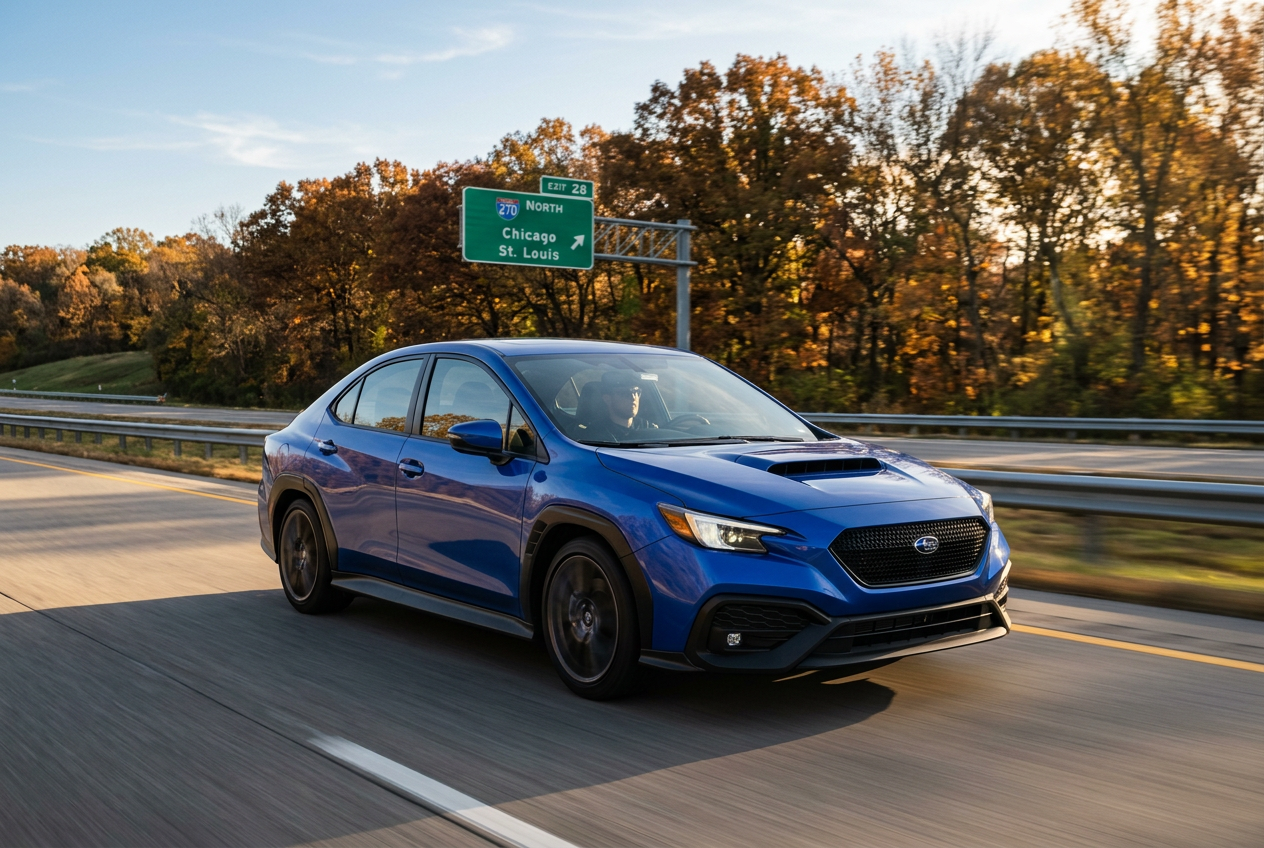
Sunset Hills Subaru · St. Louis ownership guide Subaru WRX Fuel Costs & Maintenance: What St. Louis Drivers Should Budget How much does a Subaru WRX cost to drive and maintain? Compare estimated five-year fuel expenses, learn which maintenance items deserve a place in your budget, and find the Subaru service resources that help keep a performance sedan ready for the road. The fuel examples below use published 2026-model assumptions. The URL references 2027; 2027-model specifications and ratings should be verified before applying these figures to a 2027 WRX. For a Subaru WRX owner, fuel is only part of the cost of ownership. Maintenance, tires, brakes, insurance and driving habits also matter. This guide uses a sample 15,000 miles per year (75,000 miles over five years) and an illustrative premium-fuel price of $3.85 per gallon. These are planning assumptions—not a current local fuel-price quote. The MPG examples refer to the 2026 WRX configurations discussed below; check the EPA listing for the exact model year, trim and transmission. For the standard 6-speed manual transmission WRX, which carries an EPA combined rating of 22 MPG (19 City / 26 Highway), total fuel consumption over 75,000 miles comes out to approximately 3,409 gallons. At $3.85 per gallon, standard 6-speed manual WRX owners can expect approximately $13,125 in total fuel expenses over 5 years, averaging roughly $2,625 per year. For models equipped with the quick-shifting Subaru Performance Transmission (SPT) automatic, which is rated at an EPA combined 21 MPG (19 City / 25 Highway), total consumption over 75,000 miles requires approximately 3,571 gallons. At $3.85 per gallon, automatic WRX owners will spend approximately $13,750 over 5 years, averaging $2,750 per year. The 5-year variance between manual and automatic transmissions is a modest $625, making personal driving preference and transmission convenience the primary decision factors. WRX Transmission Option EPA Combined MPG Gallons Used (75k Miles) Annual Fuel Cost (15k Mi) Estimated 5-Year Fuel Cost 6-Speed Manual Transmission 22 MPG 3,409 Gal $2,625 $13,125 Subaru Performance Transmission (SPT) 21 MPG 3,571 Gal $2,750 $13,750 Does the 2026 Subaru WRX Require Premium Unleaded Gasoline? Yes, Subaru recommended requirements specify 91 octane premium unleaded fuel (or higher) to achieve peak performance and efficiency from the 2.4-liter turbocharged Subaru BOXER engine. Turbocharged engines compress fuel and air mixtures at much higher pressures than naturally aspirated engines. Premium gasoline possesses a higher octane rating, meaning it resists premature detonation under intense heat and cylinder pressure. If lower octane regular fuel (87 octane) is used, the engine control module (ECM) detects knock via sensors and automatically retards ignition timing. While this safeguards engine components against severe knock damage, it causes a noticeable loss in peak horsepower, reduces throttle responsiveness, and worsens overall fuel efficiency—meaning you end up burning more gallons per mile. For daily commuters driving between Chesterfield, Ladue, and Sunset Hills, calculating the actual cost difference between premium and regular fuel reveals an important financial insight. Assuming regular gas averages $3.15 per gallon and premium averages $3.85 per gallon, the $0.70 price gap equates to roughly $477 per year across 15,000 miles in a manual WRX ($2,625 vs $2,148). Because running 87 octane reduces fuel economy by roughly 1 to 2 MPG, the actual savings of using regular gas shrinks down to less than $20 a month while sacrificing engine performance. To protect your investment and enjoy the full 271 horsepower of your BOXER engine, refueling with 91+ premium gas is recommended. How Does the Fuel Economy of the Manual WRX Compare to the Automatic WRX? The choice between the traditional 6-speed manual gearbox and the advanced Subaru Performance Transmission (SPT) automatic subtly impacts fuel efficiency due to weight differences and transmission dynamics. Official EPA ratings for both powertrains are structured as follows: • 6-Speed Manual: 19 MPG City / 26 MPG Highway / 22 MPG Combined • Subaru Performance Transmission: 19 MPG City / 25 MPG Highway / 21 MPG Combined In daily stop-and-go suburban driving along Manchester Road or I-270, both transmissions perform identically in urban test cycles at 19 City MPG. However, on open highway stretches like I-64 through St. Louis County, the manual gearbox holds a slight 1 MPG advantage due to direct mechanical engagement with minimal hydraulic friction drag. Over a single year of suburban highway commuting (15,000 miles), the manual WRX burns about 682 gallons versus 714 gallons in the automatic. This equals an annual cost difference of approximately $125. Over a full 5-year ownership period, that totals just $625—an incremental difference for drivers who prefer paddle-shifted automatic convenience in heavy St. Louis traffic. What Engine and Transmission Options Are Featured in the 2026 Subaru WRX? 2.4L Turbocharged BOXER At the heart of every 2026 WRX lies a 2.4-liter direct-injection turbocharged 4-cylinder Subaru BOXER engine. Producing 271 horsepower at 5,600 RPM and 258 lb-ft of torque across a wide torque band from 2,000 to 5,200 RPM, it delivers immediate throttle response. Horizontally opposed pistons sit low in the chassis to lower center of gravity and boost cornering balance. 6-Speed Manual Transmission Standard on Base, Premium, Limited, and TR trims, the 6-speed manual offers precise gear engagement with optimized ratios. Built for driving purists, it incorporates short shift throws, double-cone synchronizers on 1st and 2nd gears, and Incline Start Assist for confidence when starting on steep hills throughout Missouri terrain. Subaru Performance Transmission Standard on GT trims and available on Premium/Limited, the Subaru Performance Transmission (SPT) offers up to 30% faster upshifts and 50% faster downshifts. Featuring steering-wheel paddle shifters, 8-speed manual mode, and SI-DRIVE performance management, it delivers aggressive automatic downshift rev-matching during heavy braking. Browse New Subaru WRX Inventory How Does Subaru Symmetrical All-Wheel Drive Operate on the WRX? Unlike front-wheel-drive competitors that route power to rear wheels only after slipping occurs, Subaru Symmetrical All-Wheel Drive operates full-time. Engine power flows through a central, balanced drivetrain layout. Manual models utilize a Continuous AWD system with a viscous-coupling locking center differential (50/50 power split), while SPT automatic models employ Variable Torque Distribution (VTD) AWD with an electronically controlled hydraulic clutch. Active Torque Vectoring applies subtle braking to the inner front wheel during sharp cornering, directing torque to the outer wheel to reduce understeer. During Missouri winter ice, rain, and snow, full-time AWD provides superior traction and security. While driving four wheels creates minor mechanical drag relative to 2WD cars—slightly reducing fuel economy by about 1-2 MPG—the safety and driving dynamics are well worth the small fuel cost trade-off. What Standard Equipment Is Added When Upgrading to the WRX Premium Trim? Exterior & Wheel Upgrades Upgrading from the Base trim to the WRX Premium adds larger 18-inch dark gray alloy wheels fitted with performance summer tires, LED fog lights, body-color low-profile rear spoiler, heated side mirrors, and a windshield wiper de-icer for icy St. Louis winter mornings. Multimedia & Convenience Inside the cabin, the Premium trim adds an 11.6-inch high-resolution STARLINK multimedia display with wireless Apple CarPlay and Android Auto integration, dual rear USB charge ports, Keyless Access with Push-Button Start, and illuminated visor vanity mirrors. All-Weather Comfort Driver comfort gets a major boost with standard 3-mode heated front sport seats, dual-zone automatic climate control system, aluminum-alloy pedal covers, leather-wrapped steering wheel, and cloth seating featuring red contrast stitching. How Much Does Auto Insurance Cost per Year for a Subaru WRX? Auto insurance is an essential component when projecting total WRX ownership costs over 5 years. Nationally and across the Greater St. Louis region—including Sunset Hills, Ladue, and Maryland Heights—the average cost to insure a Subaru WRX ranges from $1,800 to $2,400 per year ($150 to $200 per month) for clean-record adult drivers. Insurance premiums depend heavily on individual driver age, driving record, zip code, annual mileage, and chosen deductible amounts. Because the WRX is classified as a performance sedan, rates are slightly higher than standard commuter cars like the Impreza, but significantly lower than two-seater sports cars. Subaru EyeSight Driver Assist Technology—now standard across both manual and automatic 2026 WRX models—helps keep insurance premiums lower. Features like Pre-Collision Braking, Adaptive Cruise Control, and Lane Keep Assist earn safety equipment discounts with major insurers, offsetting part of the performance insurance premium. Subaru WRX Maintenance Costs: What Owners Should Expect in 2026 Maintaining a turbocharged performance vehicle like the WRX requires consistent routine care to ensure peak mechanical health and preserve long-term resale value. Over 5 years or 75,000 miles, routine maintenance expenses for a Subaru WRX average between $2,200 and $3,100 total (roughly $440 to $620 annually) when serviced according to factory schedules at an authorized retailer like Sunset Hills Subaru. Many WRX maintenance schedules call for oil and filter service at 6,000-mile/6-month intervals under normal use, but the applicable Subaru maintenance schedule and severe-driving conditions control. Tire inspections, brake checks and fluid inspections are important; individual replacement intervals vary by model year and operating conditions. Service Interval Key Recommended Services Budgeting note 6,000 / 18,000 / 42,000 Miles Synthetic Oil Change, Tire Rotation, Multi-Point Inspection Request a current, itemized service quote 12,000 / 24,000 / 48,000 Miles Minor Service + Cabin & Engine Air Filters, Brake Inspection Request a current, itemized service quote 30,000 / 90,000 Miles Intermediate Service + Front/Rear Differential Fluids, Brake Fluid Flush Request a current, itemized service quote 60,000 Miles Major Service Major Inspection + Spark Plugs, All Fluid Services, Filters Request a current, itemized service quote Schedule Service and Diagnostics What Really Drives Subaru WRX Maintenance Costs? There is no single maintenance bill that fits every WRX. The most useful ownership budget separates factory-scheduled maintenance from wear items and unexpected repairs. Oil, filters & inspections Follow the maintenance schedule for your exact WRX model year. Short trips, heavy use and severe conditions can change the recommended attention your car needs. Performance tires & alignment Performance-oriented tires can be a significant wear expense. Tire type, tread depth, alignment and driving style all affect replacement timing. Brakes & drivetrain Braking habits and performance driving affect pad and rotor life. AWD and transmission maintenance should follow Subaru's vehicle-specific guidance. How to build a realistic five-year WRX budget Start with your expected annual mileage and a fuel-price assumption. Add the factory-required maintenance for that mileage, a separate allowance for tire and brake wear, and insurance quotes based on your own driver profile. Keep repair contingencies separate from scheduled maintenance so the numbers remain transparent. Example fuel math: At 15,000 miles per year, 22 combined MPG and $3.85 per gallon, estimated annual fuel spending is about $2,625. At 21 combined MPG, it is about $2,750. These are illustrations, not guaranteed operating costs. WRX service resources in Sunset Hills Explore the relevant services below, or contact our team for a WRX-specific maintenance estimate. Oil Change & Maintenance Brake Service Tire Service Service Research Hub Schedule Service Service availability, prices, tire fitment and exact maintenance requirements should be confirmed with Sunset Hills Subaru and the applicable owner's manual. Subaru WRX Maintenance Cost FAQs Is a Subaru WRX expensive to maintain? A WRX has performance-oriented components and AWD, so tire, brake and drivetrain-related expenses may differ from those of a conventional commuter sedan. Your actual costs depend on use, maintenance history, model year and local labor and parts prices. How often should a Subaru WRX get an oil change? Consult the maintenance schedule for your WRX's exact model year. A 6,000-mile or six-month interval is a common reference for the model discussed in this article, while severe-use guidance may call for additional attention. Are WRX tires more expensive? Performance tire choices and AWD tire-matching considerations can affect the cost. Compare compatible tire options, sizes and tread condition before replacing one or more tires. How much should I budget for 30,000- and 60,000-mile service? Rather than relying on a universal price, request a written estimate based on your VIN, transmission, model year and maintenance history. That identifies the work actually due and avoids paying for unnecessary services. How Much Might 30,000- and 60,000-Mile WRX Services Cost Locally? The 30,000-mile service milestone (typically occurring around year 2 or 3) is a pivotal preventative service. In addition to standard oil and filter replacements, technicians inspect and replace front and rear differential gear oil, flush and replace hydraulic brake fluid, and perform fuel system cleaning. Locally near Sunset Hills, this service averages between $350 and $550. The 60,000-mile major service milestone is the most comprehensive interval during 5 years of ownership. This major service requires replacing spark plugs (which requires specialized tools due to the horizontal BOXER engine layout), changing differential fluids, replacing transmission fluid, and renewing engine coolant. Local estimates near St. Louis range from $750 to $1,100. Replacing front and rear differential fluids is vital for protecting the Symmetrical AWD system against thermal degradation. Regular service at factory milestones prevents premature gear wear and ensures full power transfer in severe Midwest weather conditions. How Much Does Vehicle Depreciation Impact the WRX Ownership Cost? While fuel costs represent a recurring operational expense, vehicle depreciation is the single largest financial factor over 5 years. Fortunately for WRX buyers, the Subaru WRX historically boasts industry-leading residual values, routinely winning ALG Residual Value and Kelley Blue Book Best Resale Value awards in the sports car category. On average, a WRX retains approximately 52% to 58% of its original MSRP after 5 years and 75,000 miles, compared to standard compact sedans that retain only 40% to 45%. Strong Midwest demand for AWD performance vehicles keeps pre-owned WRX market values high. This exceptional resale retention directly offsets higher premium fuel expenses over 5 years. For example, retaining $3,500 to $5,000 more value at trade-in time relative to rival sports sedans effectively covers 30% to 40% of your total 5-year fuel bill. Check what your current car is worth today with our quick Get your value trade tool. How Do Factory Warranties Compare Between Subaru and Honda? Subaru Factory Warranty Every 2026 Subaru WRX comes protected by a 3-Year / 36,000-Mile New Vehicle Limited Warranty, a 5-Year / 60,000-Mile Powertrain Limited Warranty, and 5-Year / Unlimited Mileage Rust Perforation Protection. Includes 24/7 Roadside Assistance across the USA. Honda Factory Warranty Honda offers matching coverage for the Civic Si and Type R: 3-Year / 36,000-Mile Bumper-to-Bumper and 5-Year / 60,000-Mile Powertrain coverage. However, Honda does not include standard full-time AWD drivetrain protection within its basic layout. Sunset Hills Subaru Edge At Sunset Hills Subaru, factory warranty repairs are completed by factory-certified master technicians using genuine OEM Subaru parts. Explore our latest maintenance offers under Current Service and Parts Specials. Current Service and Parts Specials Real-World St. Louis Commute Analysis: Optimizing WRX MPG in Chesterfield Daily commuting through West County, along I-64/US-40 from Chesterfield through Ladue to Sunset Hills, provides a realistic test environment for WRX fuel efficiency. Owners can easily optimize real-world MPG by adopting simple driving habits: • SI-DRIVE Intelligent Mode: On SPT models, select 'I' mode in heavy traffic to smooth throttle mapping and maximize fuel economy. • Optimal Manual Shift Points: Upshift around 2,000 to 2,500 RPM when cruising flat highway stretches to avoid unnecessary turbo boost enrichment. • Tire Inflation Maintenance: Keep performance tires inflated precisely to 33 PSI front / 32 PSI rear to minimize rolling resistance. • Winter Fuel Blend Adjustment: Missouri winter oxygenated fuel blends can drop MPG by 2–3 MPG; regular tire pressure monitoring helps offset this temporary drop. By utilizing Intelligent SI-DRIVE settings during heavy commute times and reserving Sport Sharp mode for open country roads, drivers routinely exceed the EPA combined 22 MPG estimate, pushing highway figures up to 28 MPG. Test Drive the 2026 Subaru WRX at Sunset Hills Subaru When calculated over 5 years, the Subaru WRX delivers an unmatched balance of exhilarating rally-bred performance, all-weather confidence, strong resale retention, and predictable fuel expenses. Whether you choose the engaging 6-speed manual or the dynamic Subaru Performance Transmission, the WRX is designed to deliver pure driver enjoyment on every commute. Experience the 2026 Subaru WRX firsthand at Sunset Hills Subaru. Located conveniently at 10100 Watson Rd, Sunset Hills, MO 63127, our friendly team is ready to guide you through trim levels, personalized financing plans, and trade-in options. Get Directions to Sunset Hills Subaru or call us today at Call (314) 476-9638. Get Your Value Trade